7-14
• Change one or more accounting methods to increase reported earnings.
For instance: expand straight-line depreciation to all long-lived assets,
eliminate LIFO accounting.
• Change one or more accounting estimates. For instance, increase the
confronting the banker involves a trade-off between (a) using covenants to
restrict management’s action and thereby reduce credit risk and (b) inhibiting
P7-9. Accounting in regulated industries
Requirement 1:
7-15
Requirement 2:
In this particular instance, Duke Energy is reminding readers that some debt
interest costs are assigned to the balance sheet, and thus are not included in
Interest expense. Readers who overlook this reminder may mistakenly
P7-10. Understanding rate regulation and accounting choices
7-16
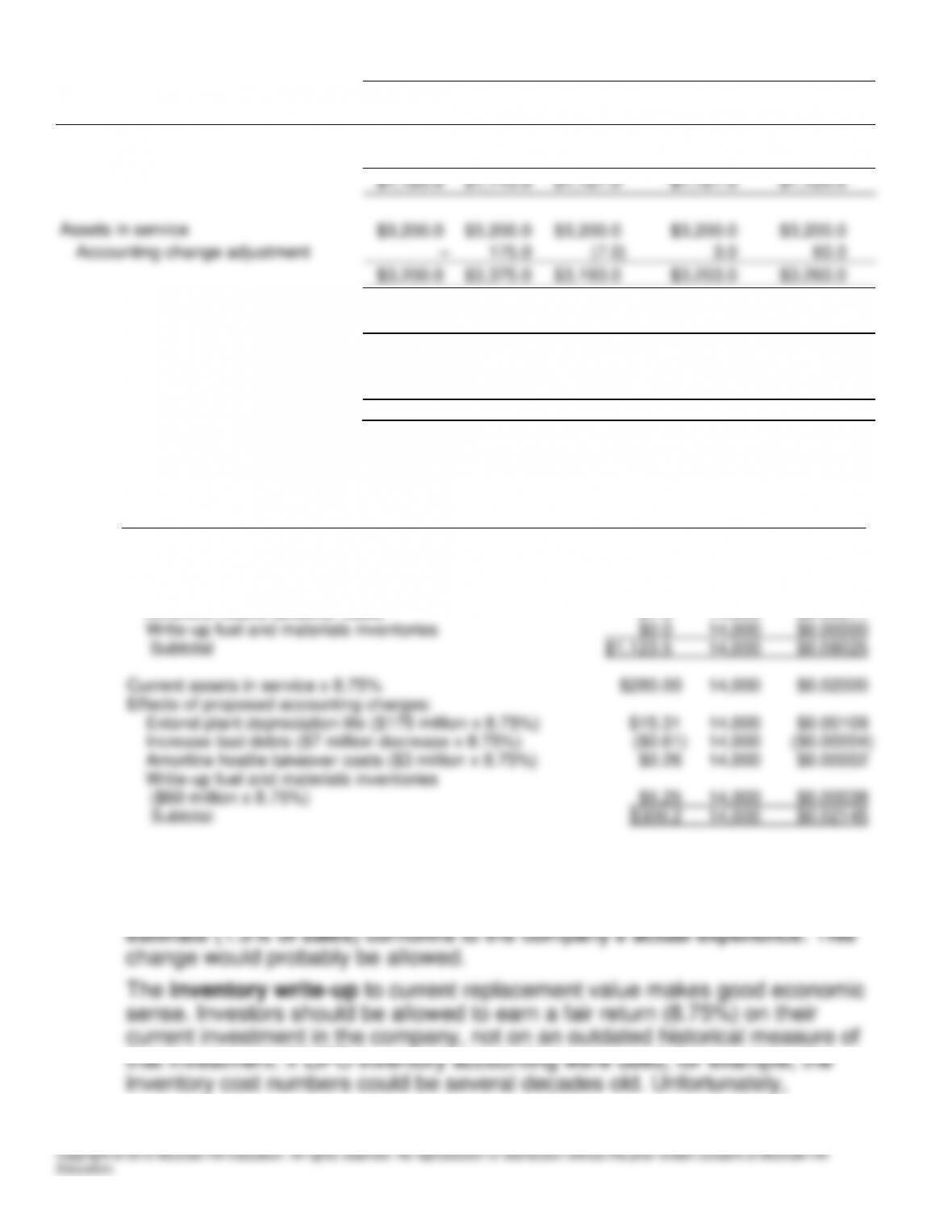
Proposed accounting changes
($ in millions)
Base
Case
Extend
Plant Life
Increase
Bad Debts
Amortize
Takeover Costs
Write-Up
Inventories
Allowed operating costs
$1,120.0
$1,120.0
$1,120.0
$1,120.0
$1,120.0
Accounting change adjustment
–
(5.0)
7.0
1.5
–
$1,120.0
$1,115.0
$1,127.0
$1,121.5
$1,120.0
Assets in service
$3,200.0
$3,200.0
$3,200.0
$3,200.0
$3,200.0
Accounting change adjustment
–
175.0
(7.0)
3.0
60.0
$3,200.0
$3,375.0
$3,193.0
$3,203.0
$3,260.0
Allowed return at 8.75%
$280.0
$295.3
$279.4
$208.3
$285.3
Revenue requirement
$ 1,400.0
$ 1,410.3
$ 1,406.4
$ 1,401.8
$ 1,405.3
Estimated demand (millions of KWH)
14,000
14,000
14,000
14,000
14,000
Rate per KWH allowed
$0.10000
$0.10074
$0.10046
$0.10013
$0.10038
Alternate solution format:
Rate per
Estimated KWH
($ in millions) Demand Allowed
Current allowed operating costs $1,120.0 14,000 $0.08000
Effects of proposed accounting changes:
Extend plant depreciation life ($5.0) 14,000 ($0.00036)
Increase bad debts $7.0 14,000 $0.00050
Amortize hostile takeover costs $1.5 14,000 $0.00011
Requirement 2:
The bad debt increase seems quite plausible as long as the revised
7-17
regulators have so far rejected this line of argument and required utilities to
maintain their balance sheet at historical cost.
The plant life extension would be allowed, but not the $175 million increase
P7–11. Determining whether citizens should have a say in CEO pay
Requirement 1:
U.S. companies are not required to obtain shareholder approval of the
compensation packages paid to top executives. Proposed pay packages are
assembled by the company’s compensation committee which is comprised of
generous executive pay levels. Management can, under certain
circumstances, refuse to place the proposal on the annual meeting agenda,
and management is not obligated to implement proposed changes in pay
practices even if the garner a majority vote of shareholders.
During the 2008 proxy season, shareholders filed resolutions seeking
Requirement 2:
One argument favoring continued use of golden parachutes is that they help
shareholders by reducing incumbent management’s tendency to fight hostile
takeover attempts. Takeovers can benefit shareholders in several ways.
First, takeover premiums are often 20% or more above the prevailing stock
7-18
takeover offers. Of course, golden parachutes also may just be one more
way of delivering overly generous compensation to top executives, and that
seems to be the view held by Mr. Minder.
Requirement 3:
(5) allow shareholders to determine whether executive pay practices are
effective.
Among the reasons for not supporting the right of shareholders to approve
CEO pay packages are: (1) labor market forces dictate top executive pay
might consider whether national votes should be held on other corporate
matters such as election of directors, approval of corporate acquisitions and
investment decisions, or approval of dividends. Given citizens the right to
7-19
Financial Reporting and Analysis (6th Ed.)
Chapter 7 Solutions
The Role of Financial Information in Contracting
Cases
Cases
C7-1. Microsoft’s “unearned revenue” account
Requirement 1:
Microsoft cannot recognize all of the revenue from software sales until it is
fully “earned.” Microsoft sets aside some software sales revenue as
“unearned” because, at the time of sale, the company still has an obligation to
Determining how much software sales revenue to set aside as unearned
each quarter is a challenge because it requires an estimate of the future cost
of providing the promised services to customers. Developing reliable cost
estimates is no easy matter, particularly in an industry where technologies
change rapidly and software released early is often error prone.
then recognize $95 of software sales revenue immediately and include this in
current earnings. The remaining $5 would be recorded as unearned revenue,
to be “earned” when the future services are performed.
A second approach would set aside enough revenue to not only cover the
estimated future costs of the promised services, but to also earn a “normal”
7-20
Requirement 3:
When the “unearned revenue” account is reduced by $100 million the dollars
go to the “revenue” account and are included in net income. That’s because
they are then considered earned revenue.
Requirement 4:
incentive to increase the amount of software sales revenue set aside as
unearned. Doing so will not jeopardize the bonus payment this year and it
creates a cushion than can be used next year if the company appears to be
falling short of its profit goal. Debt covenants can also provide incentives to
“manage” the unearned revenue account, although they are unimportant for
antitrust litigation or other forms or regulatory intervention.
Requirement 5:
Analysts and investors focus on changes in Microsoft’s unearned revenue
account for several reasons. First, the unearned revenue account is a lead
indicator of future profitability since today’s “unearned” revenues become
C7–2. Maxcor Manufacturing: Compensation and earnings quality
Requirement:
There are several reasons why Ms. Magee should feel uneasy about
7-21
above the level required to earn a 200% bonus. But in 2014, only about
34% of total R&D was charged to cost of goods sold. Operating profits that
year were barely above the bonus threshold of $4.0 million.
• Plant closing costs lowered net income for the year. The issue here is
tendency to shift earnings from one year to another. The bank would
accumulate bonuses over a three-year period, paying out one-third of the
bank balance each year.
• Charge for the capital used in the company so that bonus payments reflect
C7–3. Whole Foods Market: EVA-based Compensation
Requirement 1:1
Compared to GAAP earnings, there are two advantages to using EVA® for
7-22
Notice that performance is based on a measure of operating profits, which
means that non-operating gains and losses that might otherwise flow through
GAAP net income are excluded from EVA performance. This eliminates
non–operating “noise” in the performance measure and thus ensures that
managers stay focused on building profits from operating activities.
incentive pay—in any of several ways: increase sales at existing stores,
reduce operating costs at existing stores, or simply open more stores. This
last approach—opening more stores—requires an infusion of financial
resources (i.e., capital) and GAAP operating earnings overlooks the cost of
this added capital. Incentive pay tied to GAAP earnings (or GAAP operating
the company’s investment in that store.
Requirement 2:
The company says that “stock price performance has not been a factor in
determining annual compensation because the price of the Company’s
common stock is subject to a variety of factors outside our control.” In other
managers to create shareholder value. The use of stock options as incentive
compensation mechanisms has become quite controversial in recent years
(see Chapter 15).
Requirement 3:
At Whole Foods Market, EVA is based on GAAP operating earnings so
7-23
Requirement 4:
The annual EVA bonus for a particular Team Member is first deposited in a
“pool”, and then a portion of the pool balance is paid out annually. The
payout amount is 100% of the pool “up to certain job-specific dollar amounts
plus a portion of the excess.” If the payout amount will cause the Team
management to focus on the short term, consider the bonus pool of one
particular manager. Suppose the manger can increase EVA by $100,000 this
period by cutting back on consumer advertising. Doing so will add $20,000 to
the manager’s EVA bonus but only $5,000 of that bonus will be paid out this
year. The remaining $15,000 of the bonus stays in the pool for possible
short-run decisions that hurt future performance.
Requirement 5:
When an average of several metrics is used, it is more difficult for managers
to “game the system” by maximizing a single metric when doing so is not
optimal. For example, if a single metric of sales growth is used, managers
pursue sales growth if that is a component of the average. But if operating
margin is also a component of the average, the incentive to pursue
C7-4 Duke Energy Corp: Rate Regulation and Earnings Management
Requirement 1:
7-24
customers. One way to make it look like the company has fallen short of its
profit goal is to overstate expenses and thus understate earnings.
Requirement 2:
If the $10 million consulting fee is considered by regulators to be “above the
C7-5. Computer Associates International: Compensation and Accounting
Irregularities
Requirement 1:
Two features of the plan may have contributed to illegal backdating of sales
7-25
revenue growth. Backdated sales contracts allow management to hide
revenue declines, at least for awhile.
Requirement 3:
Auditors routinely look for an unusual clustering transactions at the end of a