7-1
Financial Reporting and Analysis (6th Ed.)
Chapter 7 Solutions
The Role of Financial Information in Contracting
Exercises
Exercises
E7–1. Understanding debt covenants
Debt covenants are restrictive provisions written into loan agreements by the
lender. Covenants are designed to reduce potential conflicts of interest
E7–2. Tying contracts to accounting numbers
Advantages:
• Low cost: Since the borrower (company) must produce financial
statements anyway, there is no added out-of-pocket cost to using these
7-2
the ability of accounting numbers to accurately portray changes in a
E7–3. Debt covenants and accounting methods
There are several reasons lenders may not want to require borrowers to use
specific accounting methods. One important consideration is just the cost
associated with keeping multiple sets of accounting records. Suppose a
E7–4. Sunshine Groceries Inc.: Sales-based bonus plan
There are two different ways to grow sales at Sunshine Groceries: (i) grow
sales at existing stores by increasing customer traffic and/or the amount each
customer spends per visit; and (ii) grow sales by opening new stores. The
7-3
cost of the item sold. Or, managers may boost sales by opening new stores
in unprofitable locations. Notice too that this sales bonus approach provides
E7–5. McDonald’s Corporation: Pay disclosure lawsuit
Country club membership is likely to be one of those pay components that
shareholders find troublesome. Why? Because the business purpose of the
E7–6. Regulatory costs
Taxes and regulations can transfer wealth from companies and their
stockholders to other groups or individuals. Consider, for example, local
property taxes paid by a company. These taxes represent a wealth transfer
7-4
E7–7. Regulatory accounting principles
When “construction in progress” costs are included in the rate base,
regulators are allowing the company and its shareholders to earn a return on
those costs before the construction project is completed. Other things equal,
this should benefit shareholders at the expense of customers (who must pay
higher rates). Here’s an example:
($ in millions)
CIP included
CIP excluded
Allowed operating costs
$1,120
$1,120
Assets in service
$3,200
$3,200
Construction in progress
500
0
Allowed assets
$3,700
$3,200
Allowed return on assets (8%)
$296
$256
Revenue requirement1
$1,416
$1,376
Estimated demand (millions of KWH)
14,000
14,000
Rate allowed per KWH
$0.1011
$0.0983
1This is the amount of revenue needed to cover all operating expenses and still earn net
income equal to the “allowed” amount.
In this case, including CIP in the rate base allows the company to set
10.11 cents per KWH instead of 9.83 cents per KWH. Once the project has
been completed, however, the CIP costs are transferred to “operating assets”
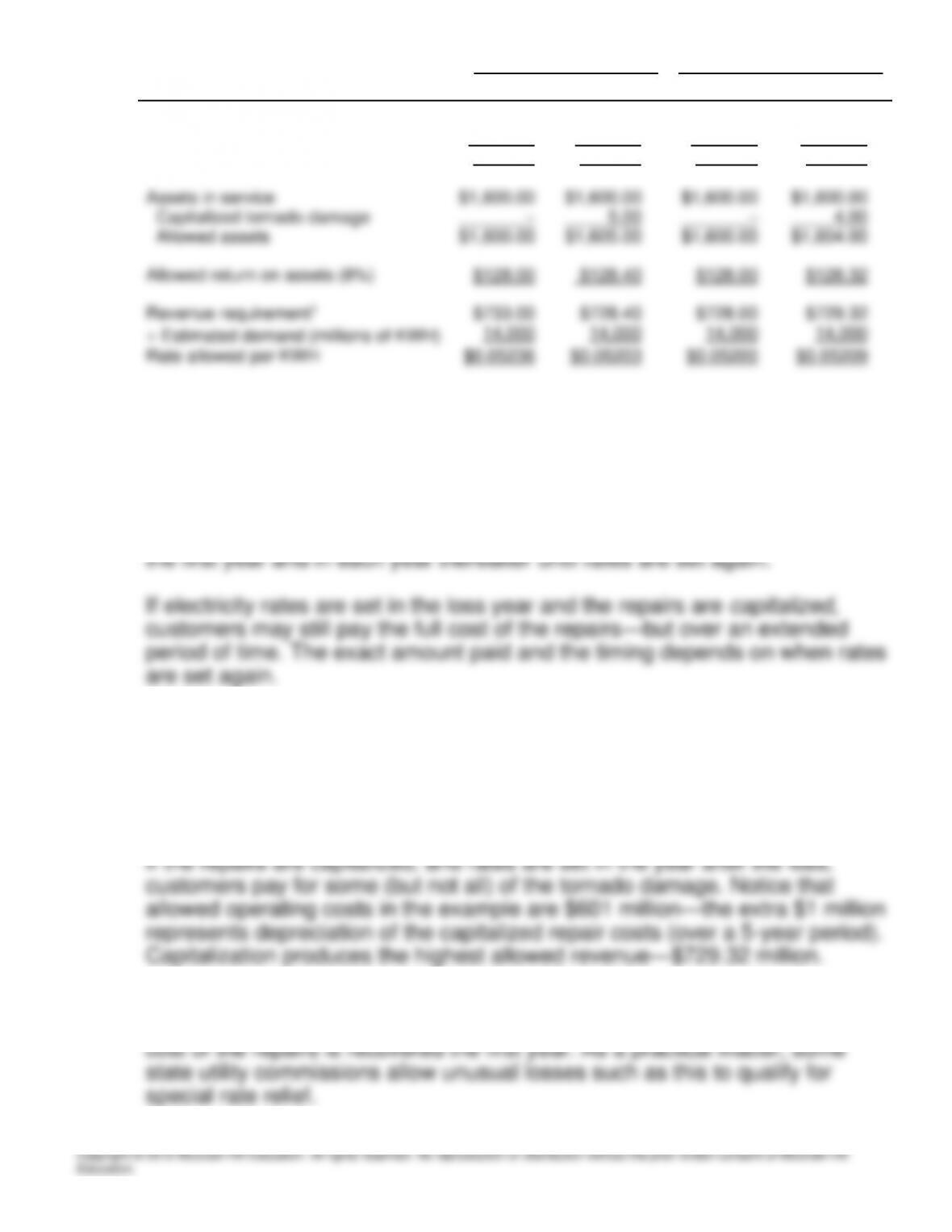
E7–8. Equipment repairs and rate regulation
7-5
Rates Set in Loss Year
Rates Set One Year Later
($ in millions)
Expense
Capitalize
Expense
Capitalize
Allowed operating costs (before loss)
$600.00
$600.00
$600.00
$601.00
Tornado damage
5.00
–
–
–
$605.00
$600.00
$600.00
$601.00
Assets in service
$1,600.00
$1,600.00
$1,600.00
$1,600.00
Capitalized tornado damage
–
5.00
–
4.00
Allowed assets
$1,600.00
$1,605.00
$1,600.00
$1,604.00
Allowed return on assets (8%)
$128.00
$128.40
$128.00
$128.32
Revenue requirement1
$733.00
$728.40
$728.00
$729.32
Estimated demand (millions of KWH)
14,000
14,000
14,000
14,000
Rate allowed per KWH
$0.05236
$0.05203
$0.05200
$0.05209
1The revenue requirement is the sum of allowed operating costs (with or without tornado
damage) and the allowed returns.
If electricity rates are set in the loss year, it is better for shareholders to have
the company treat the repairs as an expense. That’s because doing so
produces the highest allowed revenue—$733 million. But this also means that
customers pay the full cost of the tornado repairs (through higher rates) in
If rates are to be set one year after the tornado loss (but not the loss year), it
is better for customers (but worse for shareholders) if the repairs are
expensed in the loss year. That is because the repairs will then not be
recovered in higher electricity rates—shareholders, not customers, bear the
cost of the tornado.
Notice too that if rates are set both years, it is still better for shareholders (but
worse for customers) to expense the repairs immediately because the entire
7-6
E7–9. Maintaining capital adequacy
Requirement:
Banks and insurance companies are required to maintain minimum levels of
investor capital for two reasons. First, it provides a cushion to ensure that
E7–10. Identifying conflicts of interest and agency costs
An agency relationship: whenever someone hires another person (the
agent) to act on his or her behalf. Jensen and Meckling (p. 308) define an
agency relationship as “a [formal or informal] contract under which one or

7-7
See: M.C. Jensen and W.H. Meckling, “Theory of the Firm: Managerial
Behavior, Agency Costs and Ownership Structure,” Journal of Financial
7-8
Financial Reporting and Analysis (6th Ed.)
Chapter 7 Solutions
The Role of Financial Information in Contracting
Problems
Problems
P7–1. Krispy Kreme’s bonus plan
Requirement 1:
Shareholders benefit when Krispy Kreme opens new doughnut shops that
earn a rate of return on invested capital (ROIC) that exceeds the company’s
bonuses when those bonuses are based on accrual earnings (EBITDA) or
accounting revenues. These include changes in accounting methods,
changes in accounting estimates, and other accrual manipulations discussed
7-9
P7–2. Krispy Kreme’s compensation recovery plan
Requirement 1:
Annual and long-term compensation plans can contribute to agency problems
by encouraging managers to take actions that enhance their pay (and thus
personal wealth) to the detriment of shareholders. These actions may involve
Requirement 3:
The pay recovery plan is aimed at reducing managers’ incentives to inflate
P7-3. Medical malprofits
When doctors own the hospitals where they work, they may be tempted to
7-10
P7–4. Foot Locker, Inc.: Anticipating covenant violation
Requirement 1:
A minimum fixed charge coverage ratio covenant limits the company’s ability
to pay dividends or make capital expenditures by requiring that fixed
charges—current maturities on debt, dividends, and capital expenditures—
lender.
Requirement 2:
By agreeing to this restriction, Foot Locker promises to keep more cash in the
company for possible use in paying down its loans. This reduces Foot
Locker’s credit risk when viewed from the perspective of the lender, and thus
should reduce the company’s cost of obtaining borrowed capital.
because this creates slack in the covenant and permits greater cash dividend
distributions and capital expenditures. Accounting gimmicks that increase net
income (e.g., LIFO inventory liquidation, understating bad debt expense,
aggressive revenue recognition) also increase the ratio numerator and
reduce the likelihood of covenant violation.
P7–5. Frisby Technologies: Violating a covenant
Requirement 1:
7-11
the company because stockholders’ equity is increased by any profits earned.
Second, it restricts managements’ ability to pay cash dividends or buy back
stock because both of these actions reduce stockholders’ equity. Of course,
the more profitable the company and the less cash spent on dividends and
P7–6. Tying bonus to EPS performance
Requirement 1:
According to the bonus formula, Mr. Brincat would receive a bonus of
$500,000 if the company reports net after-tax earnings of $50 million and the
7-12
So, earnings last year must equal $50 / (1.30) or $38.462 million.
The increase in net after-tax earnings would then be $11.538 million
($50.000 million – $38.462 million).
Requirement 3:
Most shareholders would not feel very comfortable if managers had this type
of compensation package. Consider, for example, the incentive bonus. It is
P7–7. Earnings quality and pay
Requirement 1:
The first thing to note about the suggested adjustments is that there is no
mention of the nonoperating income items and gains. The list provided by
7-13
A similar argument can be made to exclude (b) and (c) from the bonus
calculation. Changes in the company’s economic environment may have
contributed to the need for a restructuring and the discontinued operations.
Managers should not be penalized for making good business decisions. And,
P7–8. Avoiding debt covenant violations
Requirement 1:
For most companies, the fixed charges ratio is just a variation of the interest
coverage ratio. With only two weeks until the books are closed, the company