6-25
The value estimate from requirement 1 ($19.62 per share) is substantially
below the market price of the stock ($44.00) in August 2003. There are
several reasons why the abnormal earnings value estimate might differ from
the company’s actual market price:
to properly consider the company’s growth opportunities and competitive

6-27
Financial Reporting and Analysis (6th Ed.)
Chapter 6 Solutions
The Role of Financial Information in Valuation,
Cash Flow Analysis, and Credit Risk Assessment
Cases
Cases
C6–1. Illinois Tool Works: Abnormal earnings valuation
Requirements 1 and 2:
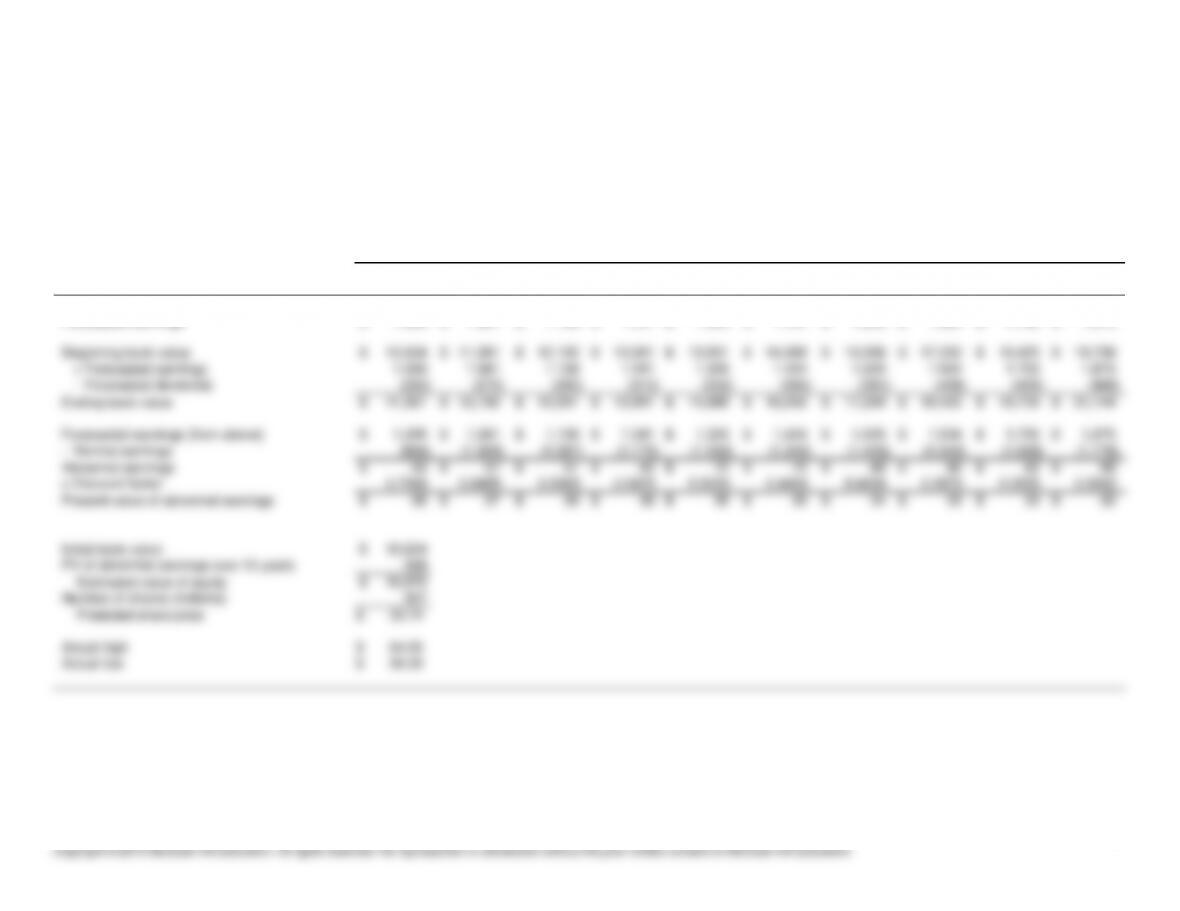
The template solution (shown on the next page) yields an estimated stock
price of $35.74 per share. This estimate is considerably below the company’s
6-28
Case 6-1 ILLINOIS TOOL WORKS
Abnormal Earnings Valuation as of early Year 4
Cost of capital 9.0%
Initial book value 12/31/ Year 3 $10,624
Dividend payout 25.0%
Forecasted ROCE on beginning equity 9.5%
Forecasted Results (rounded to nearest $)
1
Year 4
2
Year 5
3
Year 6
4
Year 7
5
Year 8
6
Year 9
7
Year 10
8
Year 11
9
Year 12
10
Year 13
Forecasted earnings
$ 1,009
$ 1,081
$ 1,158
$ 1,241
$ 1,329
$ 1,424
$ 1,525
$ 1,634
$ 1,750
$ 1,875
Beginning book value
$ 10,624
$ 11,381
$ 12,192
$ 13,061
$ 13,991
$ 14,988
$ 16,056
$ 17,200
$ 18,425
$ 19,738
+ Forecasted earnings
1,009
1,081
1,158
1,241
1,329
1,424
1,525
1,634
1,750
1,875
– Forecasted dividends
(252)
(270)
(290)
(310)
(332)
(356)
(381)
(408)
(438)
(469)
Ending book value
$ 11,381
$ 12,192
$ 13,061
$ 13,991
$ 14,988
$ 16,056
$ 17,200
$ 18,425
$ 19,738
$ 21,144
Forecasted earnings (from above)
$ 1,009
$ 1,081
$ 1,158
$ 1,241
$ 1,329
$ 1,424
$ 1,525
$ 1,634
$ 1,750
$ 1,875
– Normal earnings
(956)
(1,024)
(1,097)
(1,175)
(1,259)
(1,349)
(1,445)
(1,548)
(1,658)
(1,776)
Abnormal earnings
$ 53
$ 57
$ 61
$ 65
$ 70
$ 75
$ 80
$ 86
$ 62
$ 99
x Discount factor
0.7084
0.6499
0.5963
0.5470
0.5019
0.4604
0.4224
0.3875
0.3555
0.3262
Present value of abnormal earnings
$ 38
$ 37
$ 36
$ 36
$ 35
$ 35
$ 34
$ 33
$ 33
$ 32
Initial book value
$ 10,624
PV of abnormal earnings over 10 years
348
Estimated value of equity
$ 10,972
Number of shares (millions)
307
Predicted share price
$ 35.74
Actual high
$ 64.00
Actual low
$ 56.00
6-29
C6–2. Sunny Day Stores Inc. : Analyzing debt covenants and financial distress
Note to instructors: This is a challenging case based on a real company,
Sunshine Junior Stores, Inc. As a result, some instructors find that it is best
suited for class discussion of the issues surrounding loan renegotiations
rather than as a graded homework assignment. A useful feature of the case is
that the revised loan terms are included in the solution. This allows students
earlier lending agreements, lenders are likely to demand collateral in an
amount equal to face value of the debt.
With regard to the type of collateral, lenders prefer assets that are extremely
marketable and, thus, can be sold quickly if Sunny Day defaults. Receivables
and Inventories are usually good candidates. Less desirable, but still useful
The fact that Sunny Day defaulted on the earlier lending agreement is a clear
indication that the company’s credit risk has increased. To compensate for
the added risk, lenders often require a higher interest rate.
The actual revised lending agreement stated the following: The interest
rates on the loan agreements will be increased to 9.43% and prime plus 1.5%
the management from selling valuable assets and distributing the proceeds to
shareholders, an action that would make the lenders worse off.
The actual revised lending agreement stated the following (with dates
6-30
The proceeds from any sales of assets (20% through September 30, 2015;
30% through March 31, 2016; 40% from April 1, 2016 through June 30, 2016;
and 75% thereafter) must be applied toward additional principal reductions.
Requirement 4:
This will be a difficult question for students to answer in a precise fashion. We
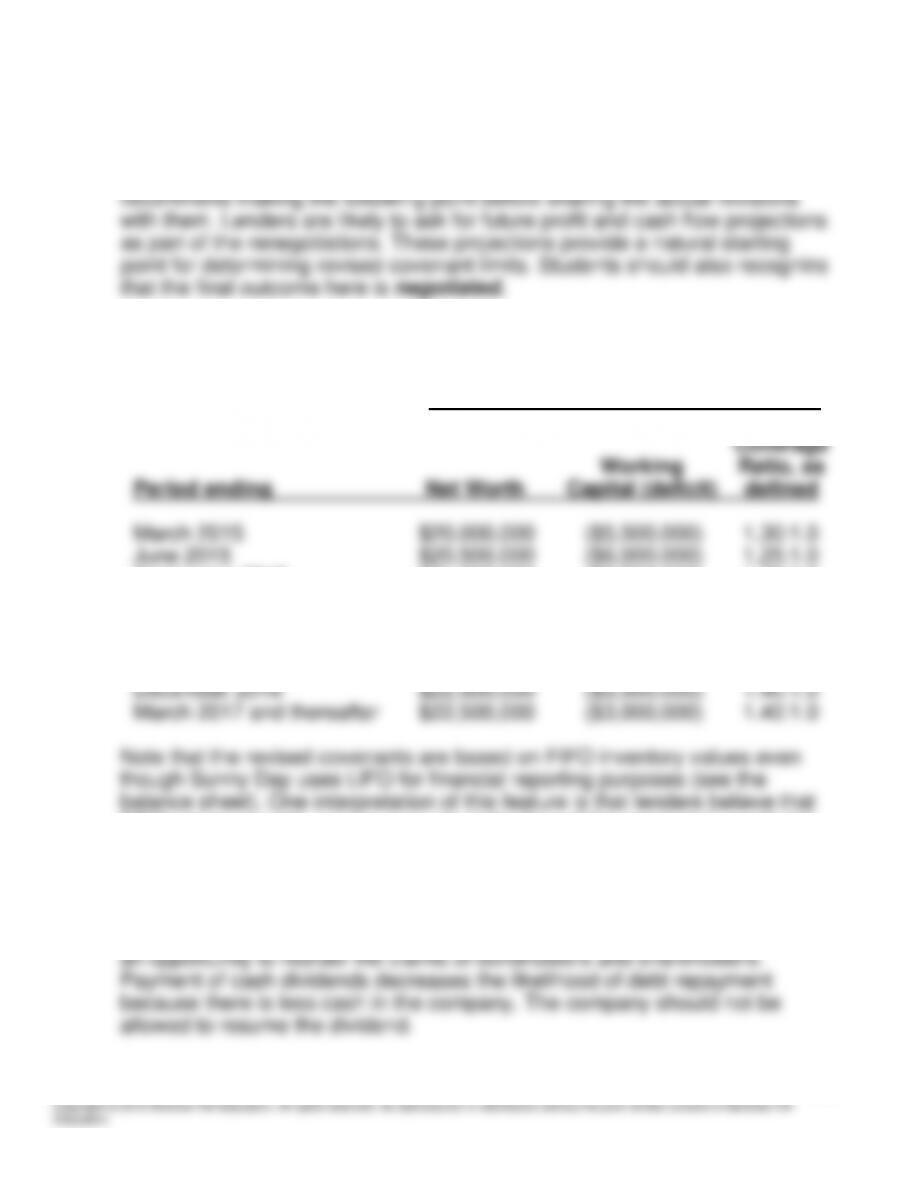
The actual revised lending agreement stated the following: The new
financial covenants, all calculated based on inventories accounted for on a
FIFO basis, are as follows:
Minimum FIFO
Fixed
September 2015 $21,000,000 ($5,500,000) 1.35:1.0
December 2015 $21,000,000 ($5,500,000) 1.40:1.0
March 2016 $21,500,000 ($5,000,000) 1.40:1.0
June 2016 $21,500,000 ($4,000,000) 1.20:1.0
September 2016 $22,500,000 ($4,000,000) 1.30:1.0
FIFO values provide a more accurate indication of the company’s credit risk
than do LIFO values.
Requirement 5:
Sunny Day defaulted on the earlier loan and is clearly experiencing some
financial difficulty. Allowing the company to pay dividends gives management
6-31
Copyright © 2015 McGraw-Hill Education. All rights reserved. No reproduction or distribution without the prior written consent of McGraw-Hill
Education.
covenants in the Company’s debt agreements prohibit the payment of
dividends.
C6–3. Microsoft Corporation: Unearned revenues and earnings management
Requirement 1:
The net profit margin is equal to net income divided by sales. For Microsoft,
the rates are:
Fourth quarter of 1996:
Year 1997:
Net profit margin = $3,454/$11,358 = 30.4%
By any standard, Microsoft’s net profit margin is very high, and it
improved from 1996 to 1997.
Requirement 2:
Requirement 4:
Income effect per share = increase in income/shares used to calculate fourth
quarter EPS
= $133.0/1,327 = 0.10 or 10 cents
Requirement 5:
6-32
Copyright © 2015 McGraw-Hill Education. All rights reserved. No reproduction or distribution without the prior written consent of McGraw-Hill
Education.
= $0.80 or 80 cents
Requirement 7:
This answer is the balance in the account of $1,418 divided by the number of
shares used to calculate 1997 annual earnings.
(subject, of course, to the available balance in the account).
In periods when the firm is doing very well, management could try to “bank”
some future earnings by increasing the amount reported in the Unearned
revenues account.
Requirement 9:
balance in periods when the firm has done poorly, or periods where the
market expects the firm to do poorly. In either case, since the analyst will get
to observe only the net change in the account balance from period-to-period,
detecting with any degree of reliability that the account is being used to
manage the firm’s earnings will be a very difficult task.