6-16
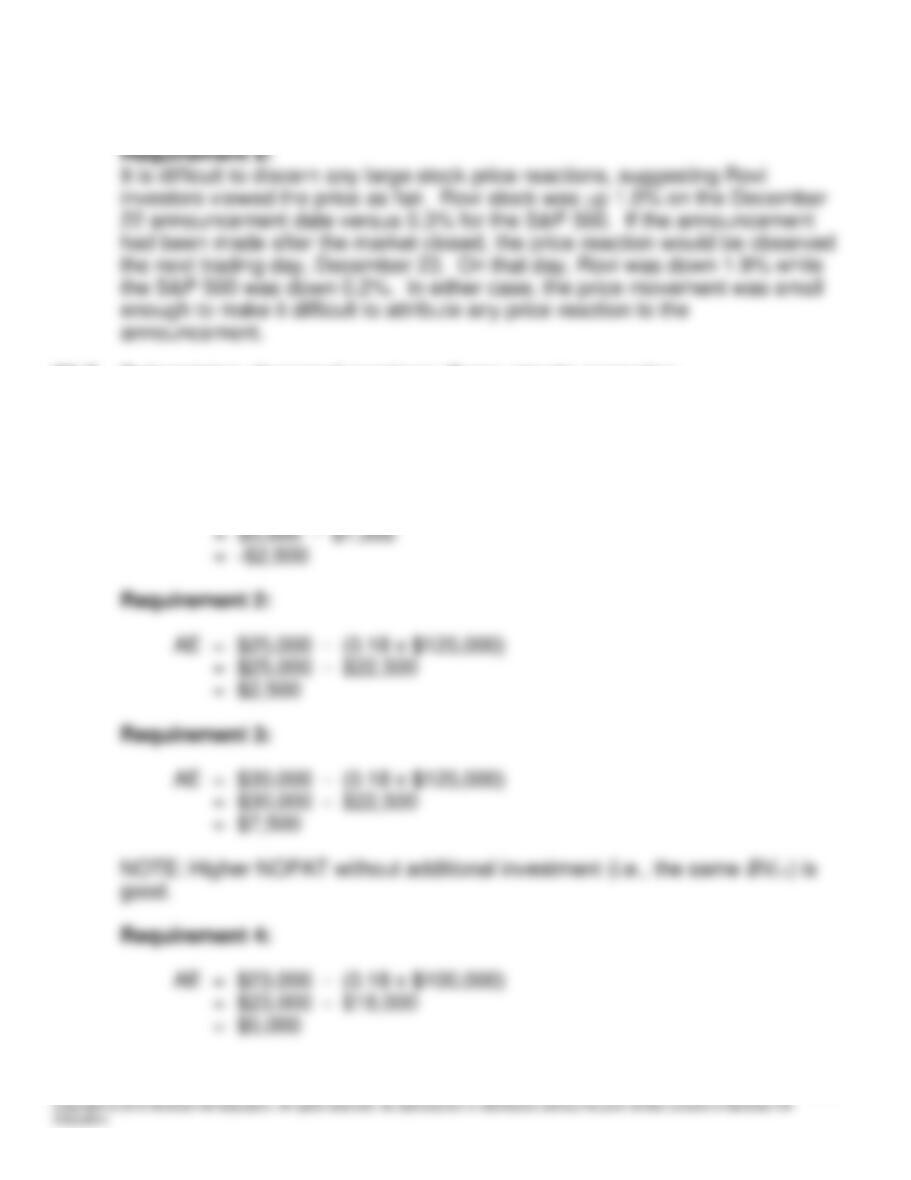
though the analyst concocted the forecasts used in the revised DCF model so
that the original $13 share value estimate was confirmed when the share
count was corrected.
P6–7. Determining abnormal earnings: Some simple examples
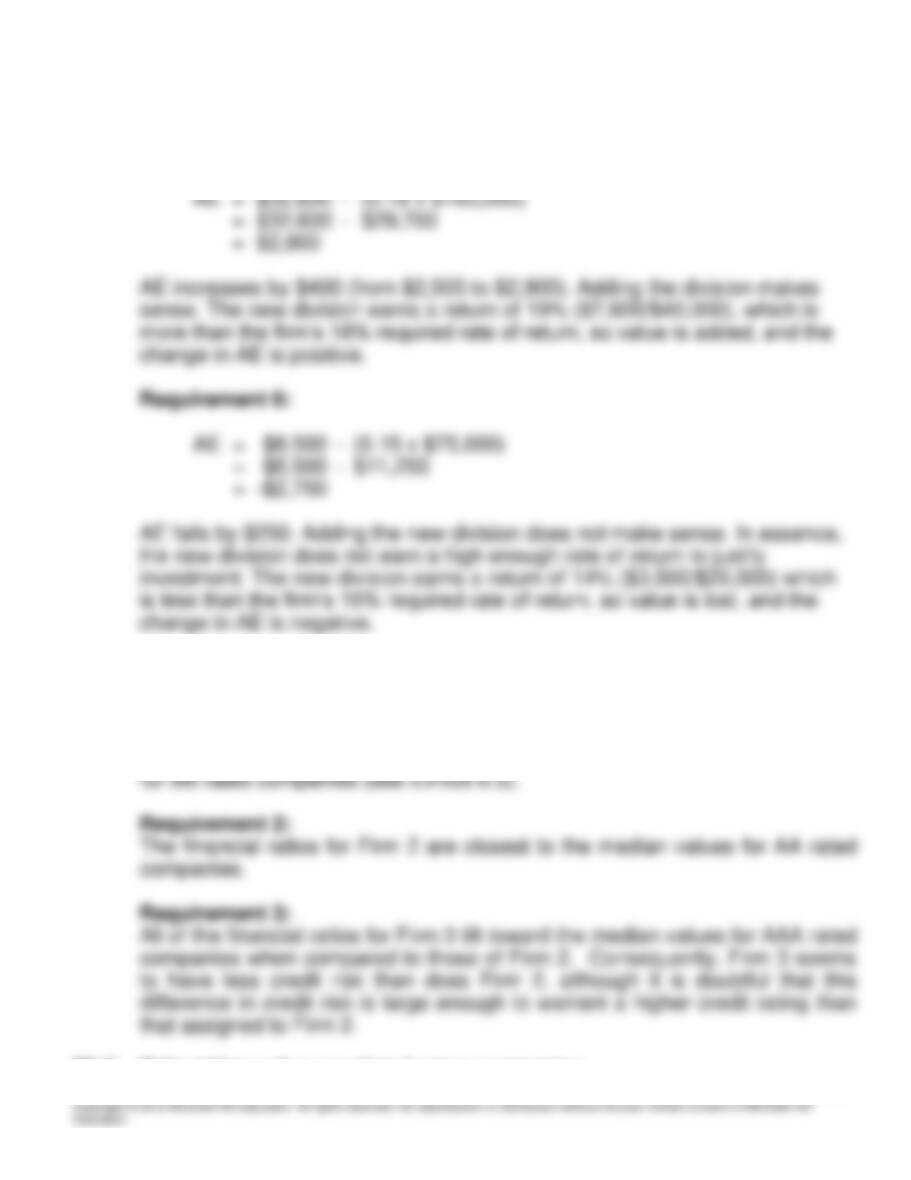
Abnormal earnings (AE) = NOPAT – (r x BVt-1).
Requirement 1:
AE = $5,000 – (0.15 x $50,000)
6-17
NOTE: Eliminating unproductive assets that do not earn as high a rate of
return as other assets increases AE. In this case, the unproductive assets
were earning a return of only 8% ($2,000/$25,000).
Requirement 5:
P6-8. Assigning credit ratings using financial ratios
Requirement 1:
Standard & Poor’s credit analysts would probably assign a credit rating of BB
to Firm 1. The financial ratios for this firm are closest to the median values
P6–9. Calculating value creation by two companies
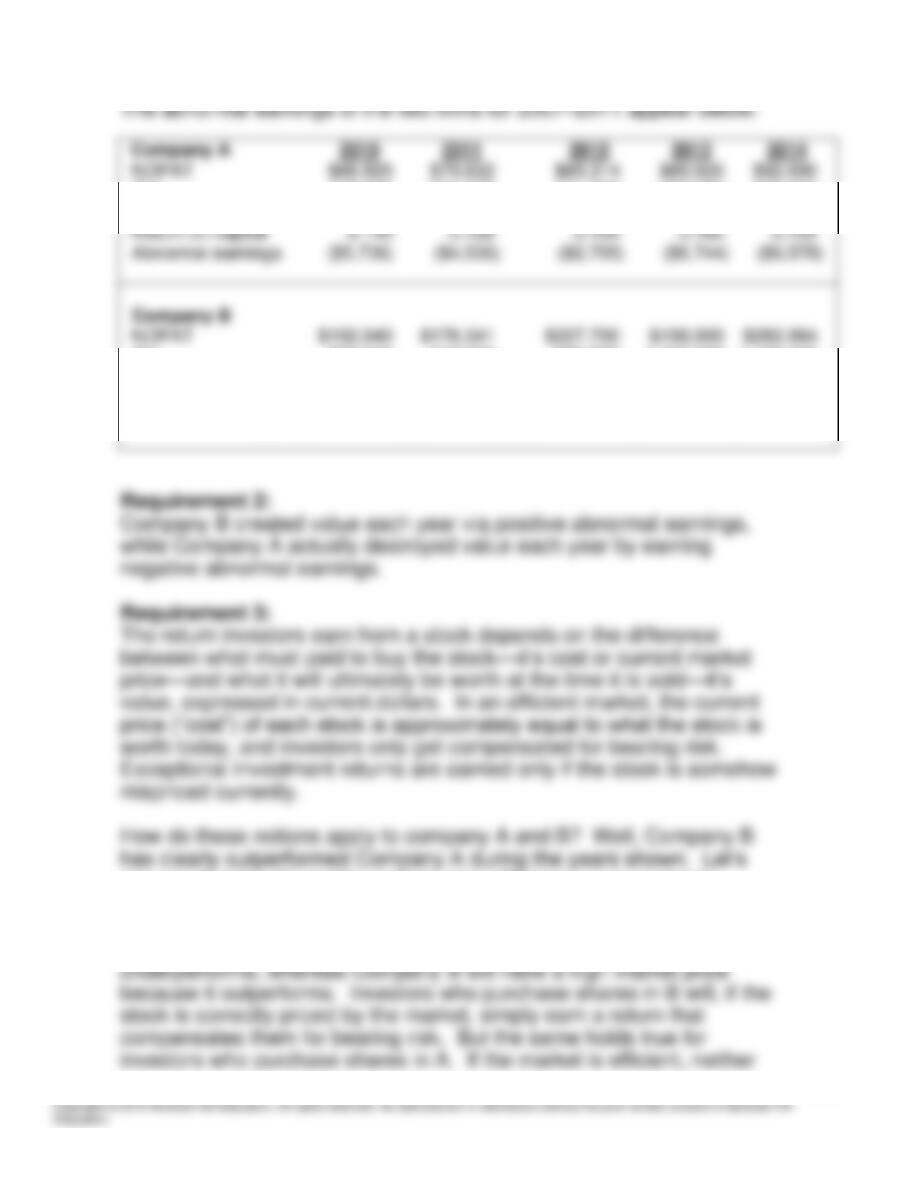
Requirement 1:
6-19
Copyright © 2015 McGraw-Hill Education. All rights reserved. No reproduction or distribution without the prior written consent of McGraw-Hill
Education.
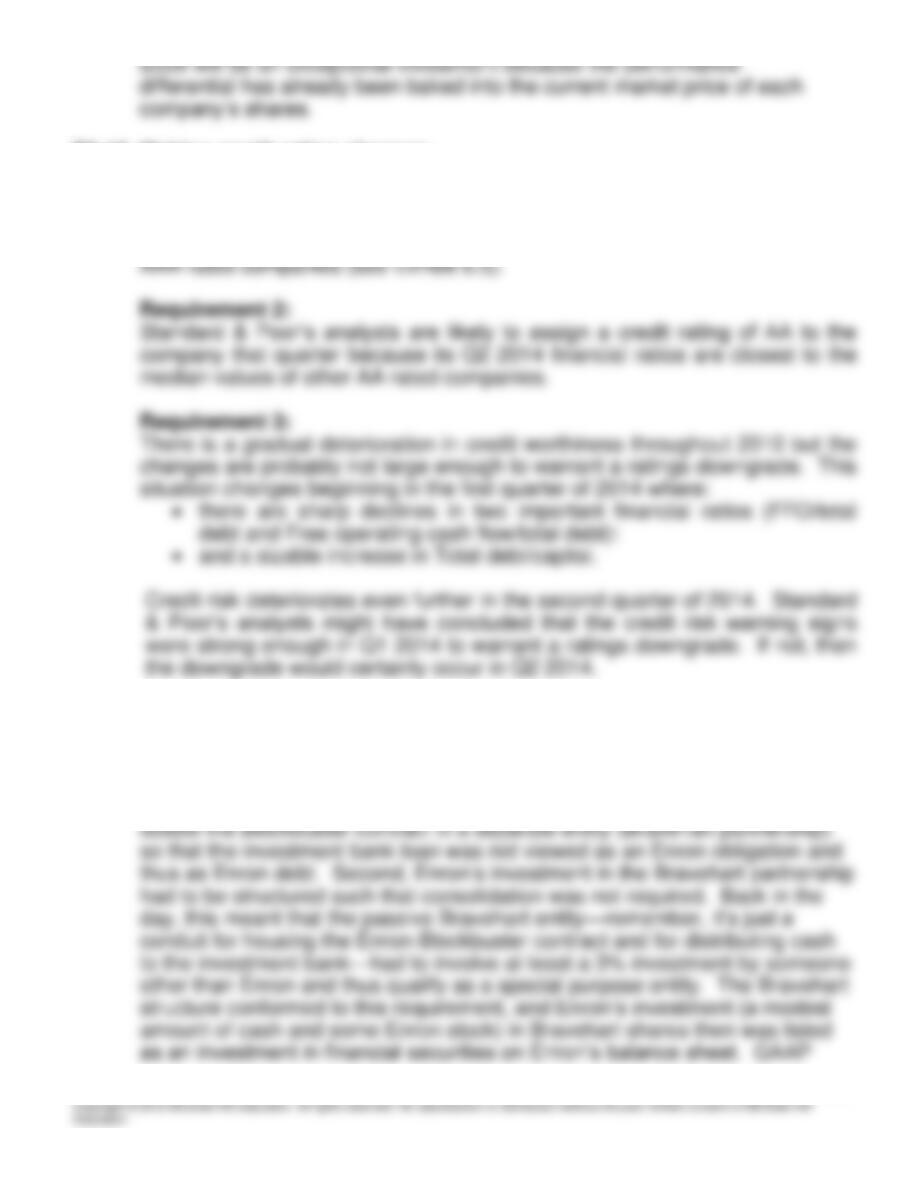
differential has already been baked into the current market price of each
company’s shares.
P6–10. Making credit rating changes
Requirement 1:
The company’s credit risk has increased since the first quarter of 2013. At
that time, the company’s financial ratios were closest to the median values for
P6–11. ENRON: Fair value accounting
Requirement 1:
There are several features of the Bravehart structure that were essential to
achieving the fair value accounting profit boost. First, Enron needed to
6-20
requires financial assets to be “marked–to–market”, meaning that fair value
accounting rules automatically applied once the Bravehart investment was
recorded in this way on Enron’s books.
The final piece required for the profit boost involved “monetizing” the Enron–
Blockbuster contract with the aid of an investment bank. The bank loan $115
$115 million loan from the bank). Once the bank loan transaction was
completed, Enron recorded a mark-to–market adjustment of $110 million to its
Investment in Bravehart shares and this adjustment flowed to profits.
Requirement 2:
There are two critical judgments required to estimate the bank guarantee’s
flows expected to arise from the Enron-Blockbuster contract. The higher
these net cash flows, the lower is Bravehart’s credit risk and the smaller is the
fair value of Enron’s loan guarantee because it is unlikely that the bank will
seek cash payments from Enron.
Requirement 3:
Requirement 4:
This would be an extraordinarily challenging audit task because the fair value
measurement occurs at Level 3, and thus relies on unobservable inputs. The
auditor could turn to independent estimates of the future net cash flows for
the Enron-Blockbuster contract, but the only third party estimates available
P6–12. Calculating sustainable earnings
6-21
Requirement 1:
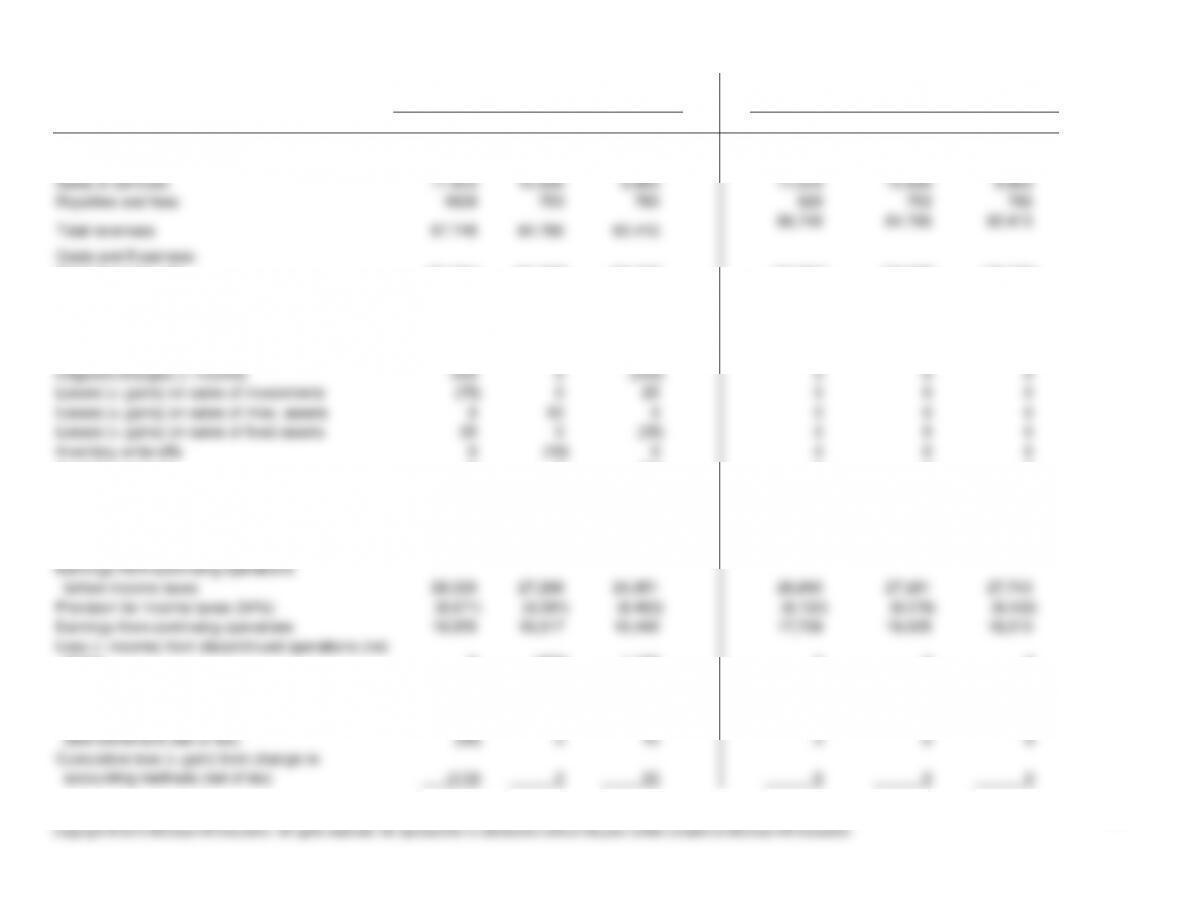
The original income statements for 2011–2014 appear on the next page
along with the calculation of sustainable earnings for each of the three years.
Except for the transitory revenue of $1 billion in 2014, which was given in the
6-22
Colonel Electric Inc.
(in millions of $)
As Reported Earnings
Sustainable Earnings Calculation
For Years Ended December 31,
2010
2009
208
2010
2009
2008
Revenues
Sales of goods
$54,196
$53,177
$52,767
$54,196
$53,177
$52,767
Sales of services
11,923
10,836
8,863
11,923
10,836
8,863
Royalties and fees
1629
753
783
629
753
783
Total revenues
67,748
64,766
62,413
66,748
64,766
62,413
Costs and Expenses:
Cost of goods sold
(24,594)
(24,308)
(22,775)
(24,594)
(24,308)
(22,775)
Cost of services sold
(8,425)
(6,785)
(6,274)
(8,425)
(6,785)
(6,274)
Restructuring charges (+ reversals)
1,000
0
(2,500)
0
0
0
Interest charges
(595)
(649)
(410)
(595)
(649)
(410)
Other costs and expenses
(6,274)
(5,743)
(5,211)
(6,274)
(5,743)
(5,211)
Litigation charges (+ income)
550
0
(250)
0
0
0
Losses (+ gains) on sales of investments
(75)
0
25
0
0
0
Losses (+ gains) on sales of misc. assets
0
55
0
0
0
0
Losses (+ gains) on sales of fixed assets
25
0
(35)
0
0
0
Inventory write-offs
0
(18)
0
0
0
0
Asset impairments
0
0
(24)
0
0
0
Special item charges
(34)
0
(8)
0
0
0
Loss from labor strike
0
(20)
0
0
0
0
Total costs and expenses
(38,422)
(37,468)
(37,462)
(39,888)
(37,485)
(34,670)
Earnings from continuing operations
before income taxes
29,326
27,298
24,951
26,860
27,281
27,743
Provision for income taxes (34%)
(9,971)
(9,281)
(8,483)
(9,132)
(9,276)
(9,433)
Earnings from continuing operations
19,355
18,017
16,468
17,728
18,005
18,310
Loss (+ income) from discontinued operations (net
of tax)
0
(250)
1,100
0
0
0
Loss (+ gain) on sale of discontinued
operations (net of tax)
750
0
0
0
0
0
Extraordinary loss (+ gain) on early
debt retirement (net of tax)
(50)
0
10
0
0
0
Cumulative loss (+ gain) from change in
accounting methods (net of tax)
___(110)
0
_____55
______0
______0
______0

6-23
Net Earnings
$19,945
$17,767
$17,633
$17,728
$18,005
$18,310
6-24
P6-13. Krispy Kreme Doughnuts: Valuing abnormal earnings
Requirement 1:
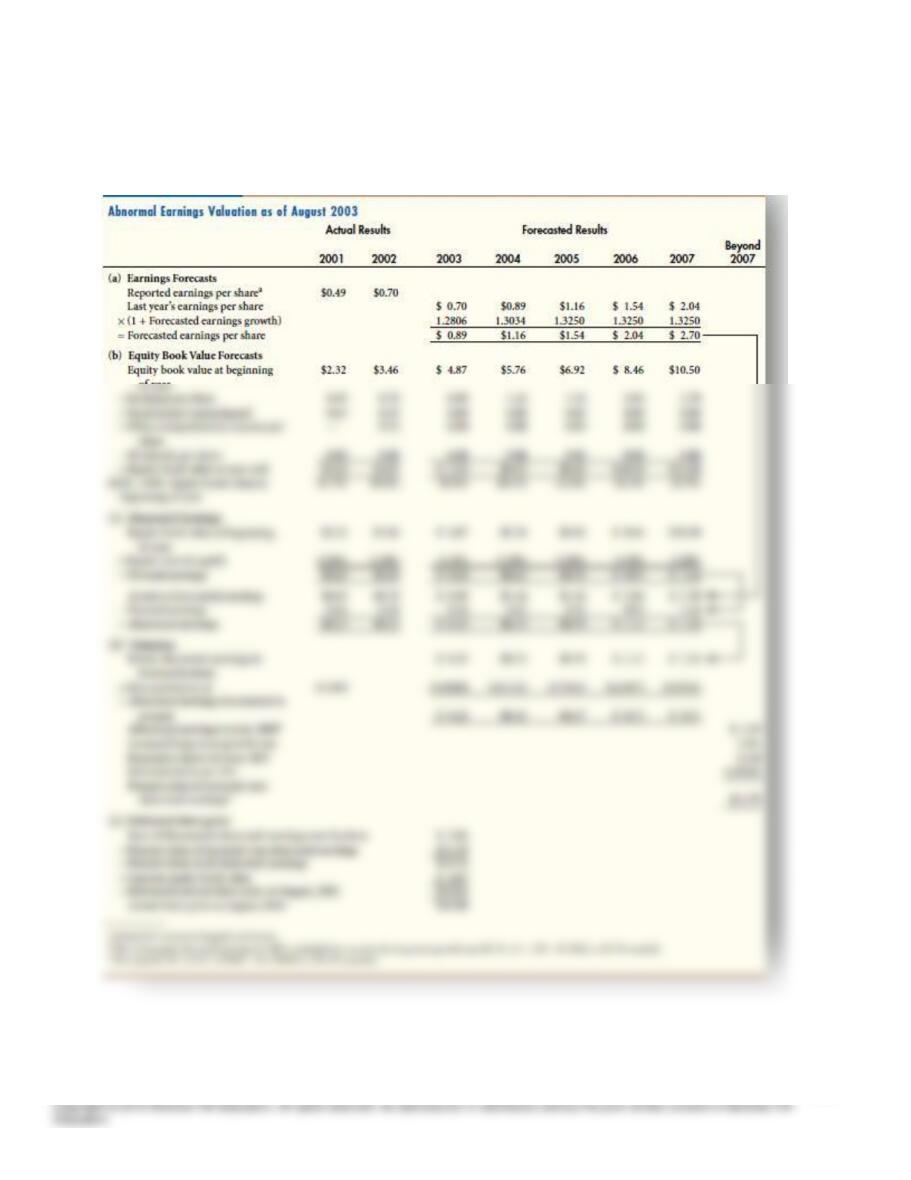
The following table implements the abnormal earnings valuation procedure
illustrated in Exhibit 6.8 of the appendix.
Requirement 2: