5-26
Flynn Cagney
Flynn –
Cagney
Revenue 195.0 1,375.0 1,570.0
Cost of goods sold (104.5) (731.2) (835.7)
Gross margin 90.5 643.8 734.3
Depreciation expense (25.5) (183.6) (209.1)
Administrative expense (12.8) (110.5) (123.3)
Operating profit before taxes 52.2 349.7 401.9
Total assets 325.0 2,300.0 2,625.0
All amounts are in millions of dollars.
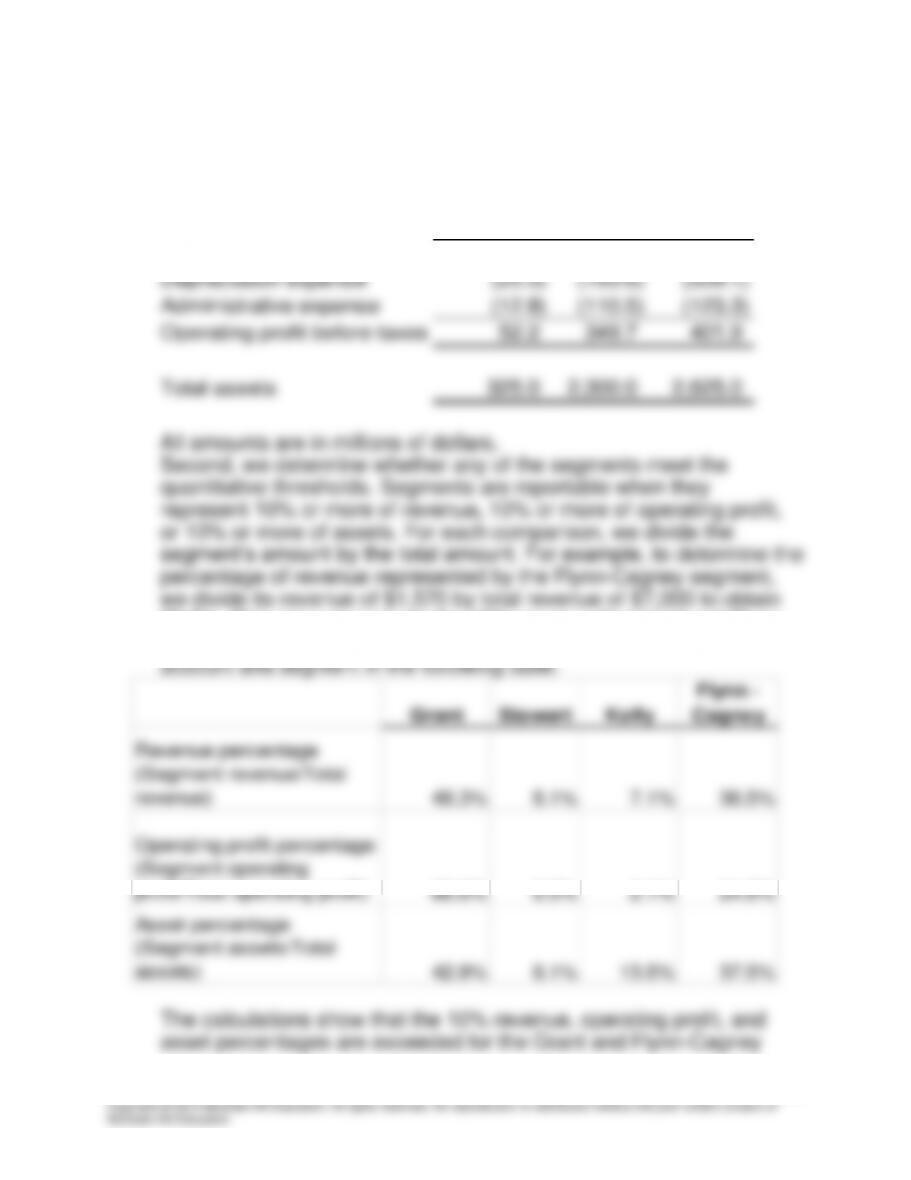
Second, we determine whether any of the segments meet the
quantitative thresholds. Segments are reportable when they
represent 10% or more of revenue, 10% or more of operating profit,
or 10% or more of assets. For each comparison, we divide the
segment’s amount by the total amount. For example, to determine the
percentage of revenue represented by the Flynn-Cagney segment,
we divide its revenue of $1,570 by total revenue of $7,000 to obtain
36.5%. This amount exceeds the 10% revenue threshold and Flynn-
Cagney is a reportable segment. The calculations are summarized by
5-27
segments. Only one of the comparisons needs to exceed the
threshold to be considered a reportable segment. This is the case for
5-28
C5-1 McDonald’s and Buffalo Wild Wings: Comparing two restaurant
chains
Supporting computations for this case are presented after the
discussion of each of the requirements.
Requirements 1 and 2:
$379.7 million in 2008 to $717.4 million in 2011. That growth
resulted from both an increase in the number of stores open ($233.2
million) and growth in sales per store ($104.0 million). In contrast,
5-29
Together, the two analyses illustrate the two different strategies
these companies employ, probably due where each is in its life
5-30
2007 2008 2009 2010 2011 2007 2008 2009 2010 2011
Requirement 1 computations:
Number of company-owned stores – beginning of year 161 197 232 259 6,906 6,502 6,262 6,399
Number of company-owned stores – end of year 197 232 259 319 6,502 6,262 6,399 6,435
Average number of company-owned stores 179.0 214.5 245.5 289.0 6,704.0 6,382.0 6,330.5 6,417.0
Sales revenue ($ in millions) 379.7 488.7 555.2 717.4 16,560.9 15,458.5 16,233.3 18,292.8
Sales revenue per company-owned store ($ in millions) 2.12 2.28 2.26 2.48 2.47 2.42 2.56 2.85
Number of franchised stores – beginning of year 332 363 420 473 24,471 25,465 26,216 26,338
Number of franchised stores – end of year 363 420 473 498 25,465 26,216 26,338 27,075
Average number of franchised stores 347.5 391.5 446.5 485.5 24,968.0 25,840.5 26,277.0 26,706.5
Franchise revenue ($ in millions) 42.7 50.2 58.1 67.1 6,961.5 7,286.2 7,841.3 8,713.2
Franchise fee revenue per franchised store ($ in millions) 0.1229 0.1282 0.1301 0.1382 0.2788 0.2820 0.2984 0.3263
Requirement 3 computations:
2008 sales revenue ($ in millions) 379.7 16,560.9
Change in sales revenue due to change in number of stores
(289.0-179.0)X2.12 233.2
(6417.0-6704.0)X2.47 -708.9
Change in sales revenue due to change in sales per store
2008 franchise fee revenue ($ in millions) 42.7 6,961.5
Change in franchise fee revenue due to change in number of stores
(485.5-347.5)X.1229 17.0
(26706.5-24968.0)X.2788 484.7
Change in franchise fee revenue due to change in franchise fees per store
Buffalo Wild Wings
McDonald’s
5-31
C5–2. Crocs and Deckers Outdoor: Comparing footwear manufacturers
Requirement 1:
(1.61 vs. 1.41).
Requirement 3:
Crocs lost money in 2009, earning an ROA of –9.5%. Deckers, on the other
hand, was profitable with an ROA of 21.5%. What was the problem that year
C5–3. Argenti Corporation: Evaluating credit risk
Requirement 1:
5-32
The company’s operating cash flows are described in the case exhibit. The
long-term debt repayment is the account balance decrease (from $423 million
to $87 million).
Property, plant, and equipment, and investments declined during 2013, which
a $1.5 billion refinancing package?
By almost any measure, Argenti’s credit risk has increased substantially
since 2009: sales have declined, losses are being recorded, operating cash
flows are negative, and the company has already violated its existing loan
5-33
This case is drawn from the experience of Montgomery Ward & Company,
which was taken private in a $3.8 billion leveraged buyout by GE Capital and
the then CEO, Bernard Brennan, in 1988. Shortly after releasing its first–
quarter results for 1997, Wards filed for Chapter 11 bankruptcy because
lenders failed to agree on a rescue plan. At the time, Wards was the nation’s
agree on a rescue plan. The move is sure to mean significant store closings
and layoffs at the nation’s ninth-largest department-store chain, which employs
60,000 people, consultants said.
The 400-store, $6.6 billion chain had been desperately negotiating with lenders
to delay a $1.4 billion payment due in August and to secure fresh cash to pay
merchandise.”
The filing comes nine years after the dowdy chain known for its polyester pants
and cheap mattresses was taken private in a $3.8 billion leveraged buyout by
GE Capital Corp. and then-Wards chief executive officer Bernard Brennan.
Bankruptcy protection is “the best way for the company to conclude a quick
5-34
shipping merchandise two weeks ago, raising the prospect that Wards would
enter the important back-to-school selling season with empty shelves.
Some of the biggest losers, besides Brennan and GE Capital, include Wards’
managers, who own 20% of the privately held company. Under bankruptcy
reorganization, shareholders’ equity is wiped out before creditors’ claims are
paid.
when some insurance companies refused to budge on the debt-restructuring
plan. Signature, which peddles everything from dental insurance to car-towing
services to Wards’ database of credit–card customers, isn’t included in the
bankruptcy filing, Wards said.
The retailer said it is close to selling Signature to HFS Inc., the Parsippany,
Goddu last week announced plans to upgrade apparel offerings to attract
slightly older female customers with household incomes of $25,000-$50,000.
But that strategy will have to be put on hold, consultants say, because
companies with strong brands such as Nike and Levi won’t sell to a company
under bankruptcy protection.
This isn’t the first crisis Wards has faced since it was founded in 1872 by
Aaron Montgomery Ward, a retail innovator who stopped selling goods out of
his buggy in favor of marketing them through mail-order catalogs. But as would
happen repeatedly in Wards’ long history, competitors quickly followed suit,
creating their own catalogs. By 1985, when Wards was an underperforming
5-35
30% stake in Wards, moved quickly to turn its stores into a collection of retail
boutiques. His Electric Avenue department for consumer electronics soon was
doing bangup business. By 1993, Wards had paid down much of its original
debt, and sales had grown to $6 billion from $4.8 billion in 1988.
idea who Montgomery Ward was,” said Whalin, the consultant. “The strategy