4-31
Liquidity and Capital Resources
Sources and Uses of Cash
Year 1. The decrease in cash from ticket sales is a result of a compression in the
booking window, forward bookings lagging behind the prior year and cruises being
purchased for lower prices compared to the prior year. As a result of the above
factors, we received an estimated $371.3 million less in customer deposits during
Year 2 as compared to Year 1. The decrease in onboard and other revenues is due
ensuring adequate cash and liquidity. We are continually committed to improving our
cost focus and have implemented new cost-containment initiatives. To ensure
adequate liquidity, we discontinued our quarterly dividend commencing in the fourth
quarter of Year 1 and have tactically managed our capital expenditures. We believe
these strategies will enhance our ability to fund our capital spending obligations and
improve our balance sheet.
Requirement 3:
In general, the changes in Royal Caribbean’s balance sheet from Year 1 to
Year 2 are mixed. Several notable changes include (amounts in thousands):
a) Cash decreased by $118,259.
d) Retained earnings increased by $162,421. This suggests that the firm was
4-32
Requirement 4:
Perhaps, the best answer to this question is to say that Royal Caribbean’s
balance sheets provide no obvious reason to invest in the firm. However, it
would be unwise to base an investment recommendation (or recommendation
firm or from industry trade publication or other independent sources.
▪ information about new destinations/on-board entertainment that Royal
4-33
P4-13. Conversion of statement of cash flows to accrual basis income
statement.
Bradley Corporation
Income Statement
For the year Ending December 31, 2014
Revenues and gains:
Sales ($375,000 + $40,000)
$415,000
Dividend Revenue ($10,000 − $2,000)
8,000
Gain on sale of investments
10,000
Total
$433,000
Expenses and losses:
Cost of goods sold ($120,000 + $12,000)
$132,000
Salaries expense ($55,000 − $6,000 + $10,000)
59,000
Depreciation expense (Note 1)
42,000
Uncollectible accounts expense
4,000
Other operating expenses
25,000
Loss—write-off of obsolete machinery
25,000
Income taxes ($25,000 + $6,000)
31,000
Total expenses
$301,000
Net income
$132,000
Note 1: Purchase of machinery
$150,000
Less: Write-off of obsolete machinery
(8,000)
Less: Depreciation expense
(x)
Equals: Increase in book value of machinery
$100,000
x = $42,000
4-34
P4-14. Preparing balance sheet and income statement
(AICPA adapted)
Requirement 1:
Vanguard Corporation
Balance Sheet
December 31, 2014
Assets
Current assets:
Cash1
$ 3,566,040
Accounts receivable (given)
$3,350,000
Allowance for doubtful accounts (3% of $3,350,000)
(100,500)
3,249,500
Inventories (obtained from cost of sales section of
the income statement)
2,750,000
Total current assets
9,565,540
Fixed assets2
4,000,000
Accumulated depreciation3
(1,774,500)
2,225,500
Total assets
$11,791,040
Liabilities and Stockholders’ Equity
Current Liabilities:
Notes Payable due within one year 4
$1,000,000
Accounts payable and accrued liabilities (given)
2,221,000
Federal income taxes payable5
130,000
Total current liabilities
3,351,000
Notes payable due after one year6
3,000,000
Stockholders’ equity:
Capital stock7
$1,050,000
Additional paid-in capital8
1,800,000
Retained earnings (per statement of retained earnings)
2,590,040
Total stockholders’ equity
5,440,040
Total liabilities and stockholders’ equity
$11,791,040
1Cash :
Cash balance at December 31, 2013
$4,386,040
Add:
2014 net sales
$15,650,000
Less: 12/31/14 accounts receivable
(3,350,000)
12,300,000
Accounts receivable at 12/31/13
3,150,000
Less: accounts charged off in 2014
(50,000)
3,100,000
19,786,040
4-35
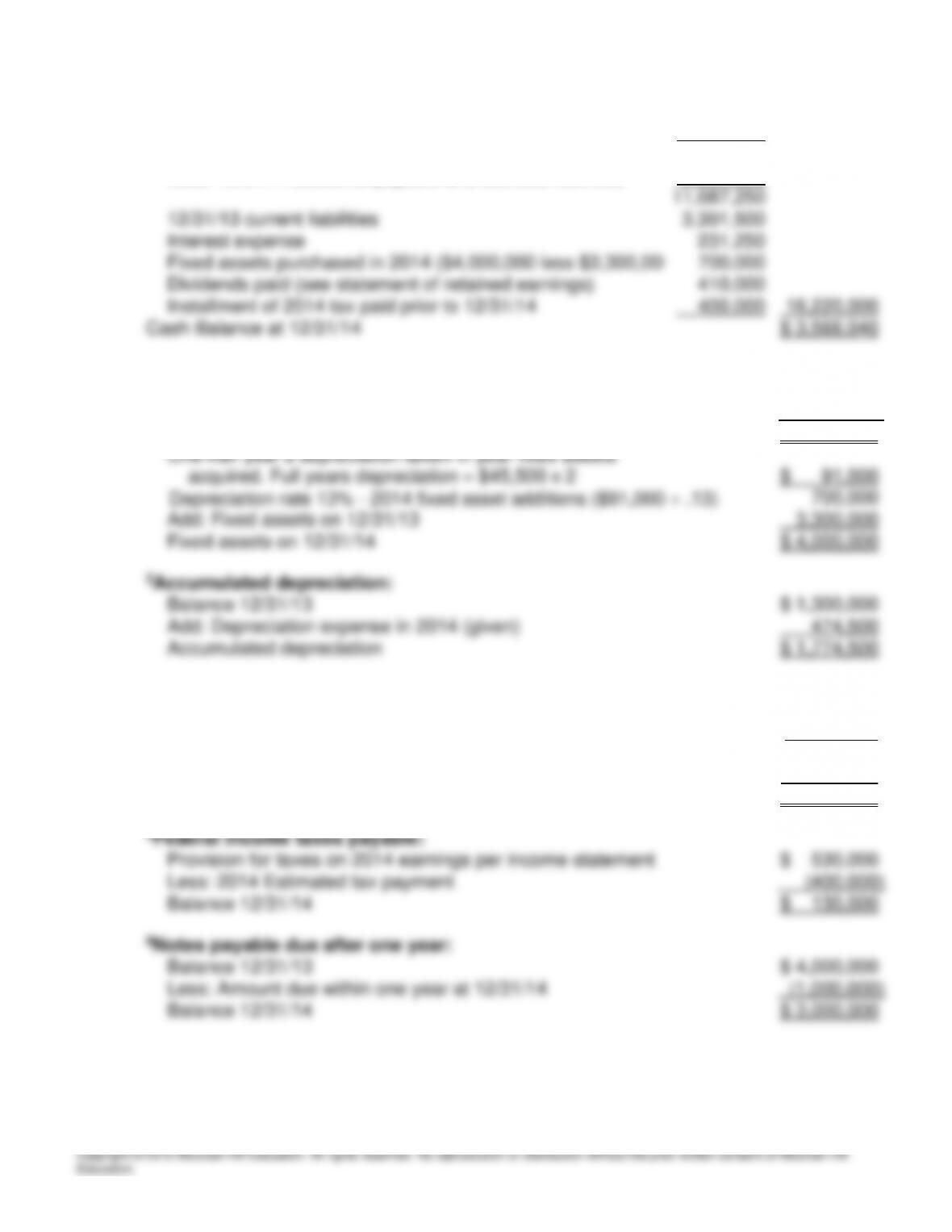
Less:
Purchases and freight-in
10,905,000
Other administrative, selling and general expenses
2,403,250
13,308,250
Less: 12/31/14 accounts payable and accrued liabilities
2,221,000
11,087,250
12/31/13 current liabilities
3,391,500
Interest expense
231,250
Fixed assets purchased in 2014 ($4,000,000 less $3,300,000
700,000
Dividends paid (see statement of retained earnings)
410,000
Installment of 2014 tax paid prior to 12/31/14
400,000
16,220,000
Cash Balance at 12/31/14
$ 3,566,040
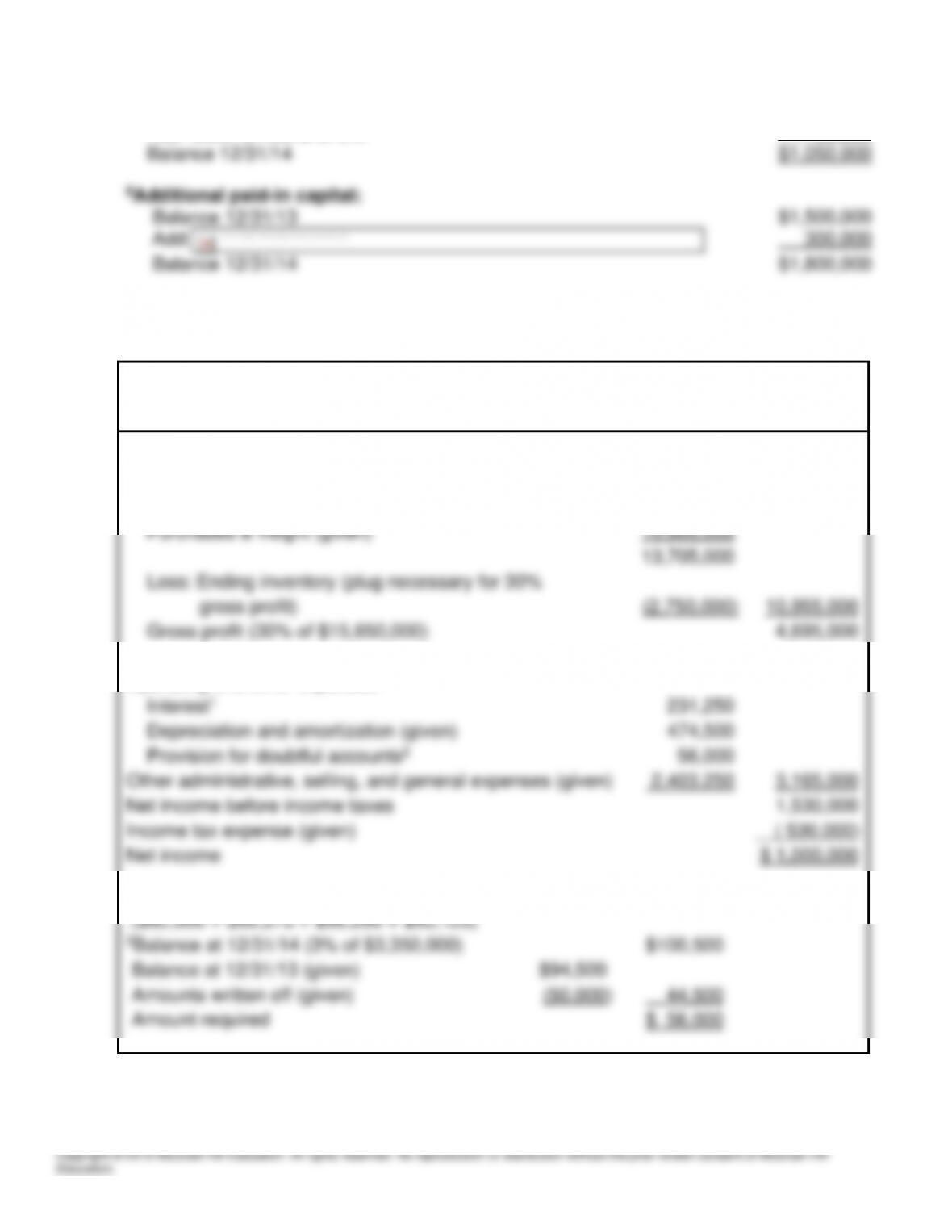
2Fixed assets:
Depreciation expense in 2014 (given)
$ 474,500
Less: Depreciation on 12/31/13 fixed assets (13% of 3,300,000)
(429,000)
Depreciation on fixed asset additions in 2014
$45,500
One-half year’s depreciation taken in year fixed assets
acquired. Full years depreciation = $45,500 x 2
$ 91,000
Depreciation rate 13% – 2014 fixed asset additions ($91,000 .13)
700,000
Add: Fixed assets on 12/31/13
3,300,000
Fixed assets on 12/31/14
$ 4,000,000
3Accumulated depreciation:
Balance 12/31/13
$ 1,300,000
Add: Depreciation expense in 2014 (given)
474,500
Accumulated depreciation
$ 1,774,500
4Notes payable due within one year:
Face value of note
$ 5,000,000
Due in twenty equal installments
÷ 20
Quarterly installment
$ 250,000
Four installments due in 2015
x 4
Notes payable due within one year
$ 1,000,000
5Federal income taxes payable:
Provision for taxes on 2014 earnings per income statement
$ 530,000
Less: 2014 Estimated tax payment
(400,000)
Balance 12/31/14
$ 130,000
6Notes payable due after one year:
Balance 12/31/13
$ 4,000,000
Less: Amount due within one year at 12/31/14
(1,000,000)
Balance 12/31/14
$ 3,000,000
7Capital stock:
Balance 12/31/13
$1,000,000
Add: Stock dividend of 5%
50,000
Balance 12/31/14
$1,050,000
8Additional paid-in capital:
Balance 12/31/13
$1,500,000
Add:
300,000
Balance 12/31/14
$1,800,000
Requirement 2:
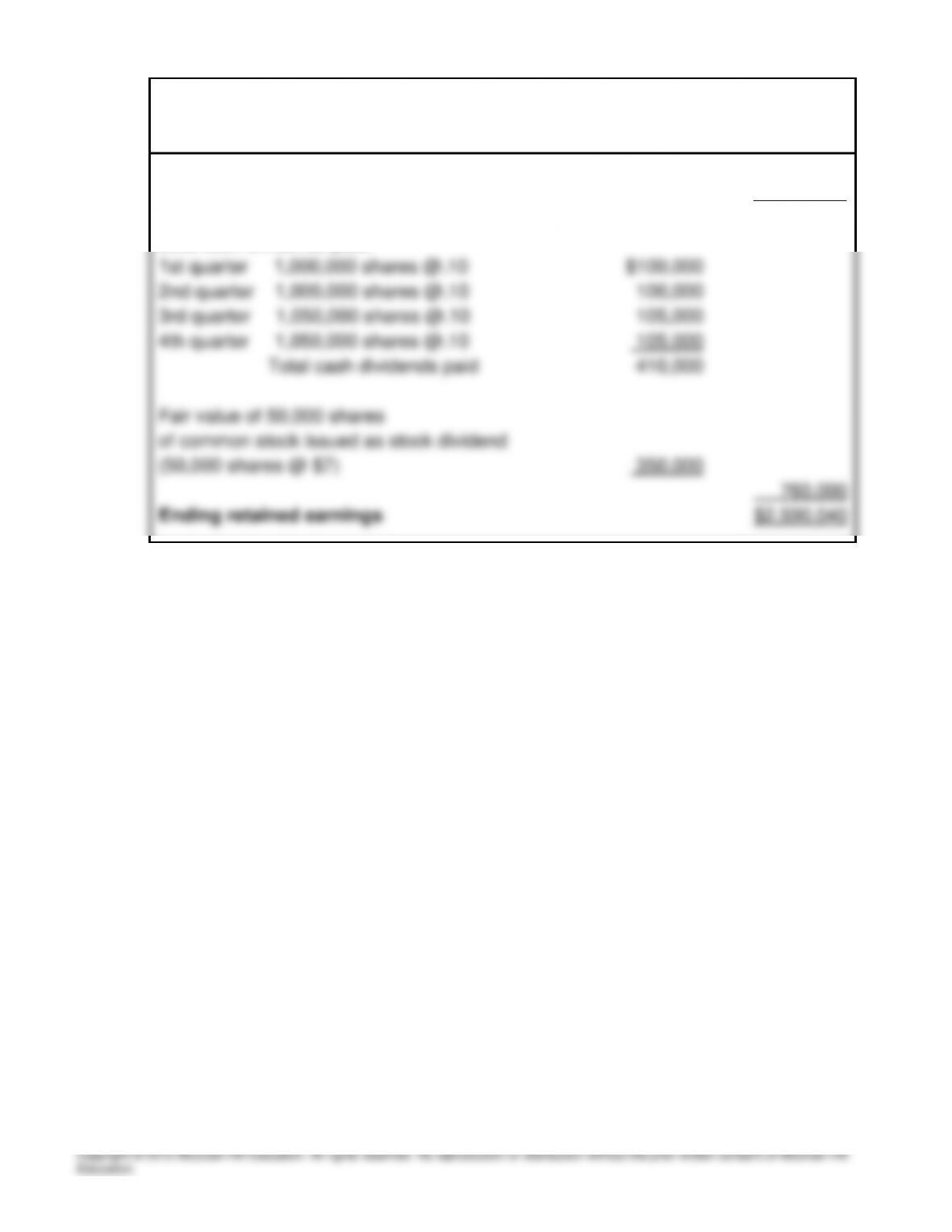
Vanguard Corporation
Income Statement
Year ended December 31, 2014
Net sales (given)
$15,650,000
Cost of sales
Beginning inventory (given)
$ 2,800,000
Purchases & freight (given)
10,905,000
13,705,000
Less: Ending inventory (plug necessary for 30%
gross profit)
(2,750,000)
10,955,000
Gross profit (30% of $15,650,000)
4,695,000
Operating and other expenses
Interest1
231,250
Depreciation and amortization (given)
474,500
Provision for doubtful accounts2
56,000
Other administrative, selling, and general expenses (given)
2,403,250
3,165,000
Net income before income taxes
1,530,000
Income tax expense (given)
( 530,000)
Net income
$ 1,000,000
15% per year on notes adjusted for four 2014 quarterly payments of $250,000.
($62,500 + $59,375 + $56,250 + $53,125)
2Balance at 12/31/14 (3% of $3,350,000) $100,500
Balance at 12/31/13 (given) $94,500
Amounts written off (given) (50,000) 44,500
Amount required $ 56,000
4-37
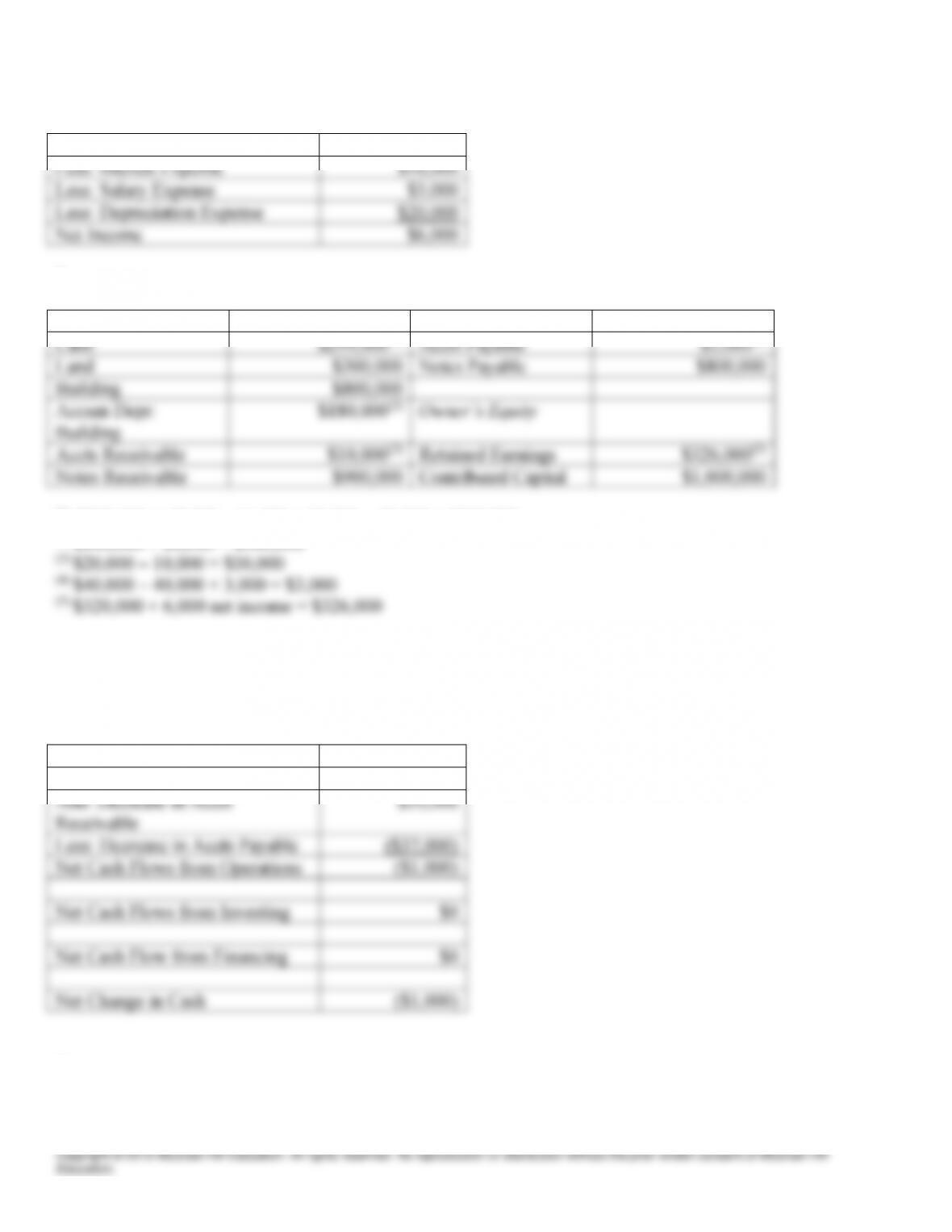
Vanguard Corporation
Statement of Retained Earnings
Year Ended December 31, 2014
Beginning retained earnings (given)
$2,350,040
Net earnings for the year (from Income Statement)
1,000,000
$3,350,040
Less cash dividends paid:
1st quarter 1,000,000 shares @.10
$100,000
2nd quarter 1,000,000 shares @.10
100,000
3rd quarter 1,050,000 shares @.10
105,000
4th quarter 1,050,000 shares @.10
105,000
Total cash dividends paid
410,000
Fair value of 50,000 shares
of common stock issued as stock dividend
(50,000 shares @ $7)
350,000
760,000
Ending retained earnings
$2,590,040
4-38
P4-15: Positioning of items within cash flow statement—IFRS vs. US GAAP—Lend Corp.
1.
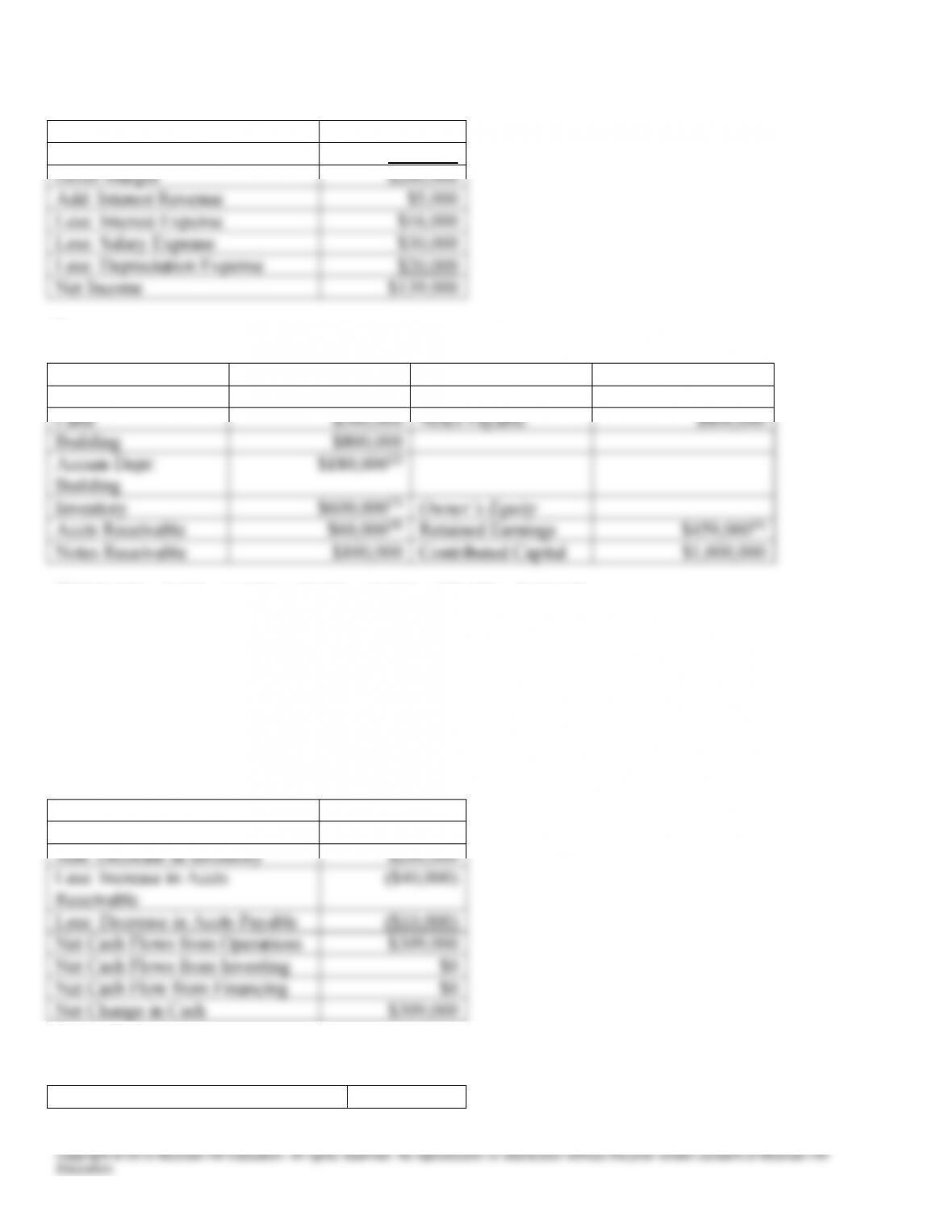
Net Income (ignoring taxes) is computed as follows:
Interest Revenue
$45,000
Less: Interest Expense
$16,000
Less: Salary Expense
$3,000
Less: Depreciation Expense
$20,000
Net Income
$6,000
2.
After the transactions, Lend Corp’s 12/31/2015 Balance Sheet looks as follows:
Assets
Liabilities
Cash
$299,000(1)
Accts Payable
$3,000(4)
Land
$300,000
Notes Payable
$800,000
Building
$800,000
Accum Depr:
Building
$180,000(2)
Owner’s Equity
Accts Receivable
$10,000(3)
Retained Earnings
$326,000(5)
Notes Receivable
$900,000
Contributed Capital
$1,000,000
(1) $300,000 + 45,000 – 16,000 + 10,000 – 40,000 = $299,000
(2) $160,000 + 20,000 = $180,000
3.
The Statement of Cash Flows under U.S. GAAP using the Indirect Method is as follows:
Net Income
$6,000
Add: Depreciation Expense
$20,000
Add: Decrease in Accts
Receivable
$10,000
Less: Decrease in Accts Payable
($37,000)
Net Cash Flows from Operations
($1,000)
Net Cash Flows from Investing
$0
Net Cash Flow from Financing
$0
Net Change in Cash
($1,000)
4.
The Statement of Cash Flows under IFRS using the Indirect Method is as follows:
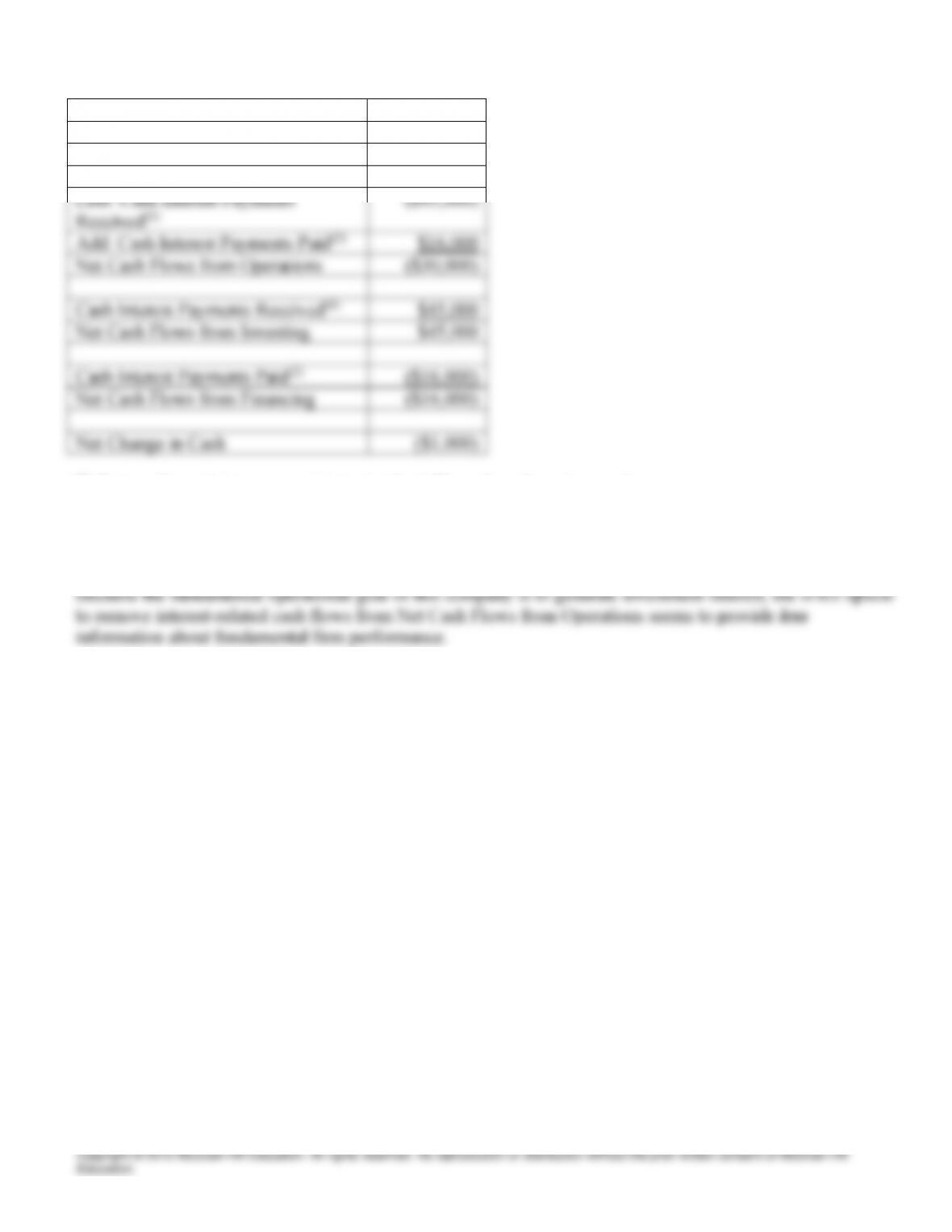
4-39
Net Income
$6,000
Add: Depreciation Expense
$20,000
Add: Decrease in Accts Receivable
$10,000
Less: Decrease in Accts Payable
($37,000)
Less: Cash Interest Payments
Received(1)
($45,000)
Add: Cash Interest Payments Paid(2)
$16,000
Net Cash Flows from Operations
($30,000)
Cash Interest Payments Received(1)
$45,000
Net Cash Flows from Investing
$45,000
Cash Interest Payments Paid(2)
($16,000)
Net Cash Flows from Financing
($16,000)
Net Change in Cash
($1,000)
(1) To transfer cash interest receipts to the Cash Flows from Investing section
(2) To transfer cash interest payments to the Cash Flows from Financing section
5.
In Requirement 3, the Net Cash Flows from Operations is -$1,000. In Requirement 4, it is -$30,000.
4-40
P 4-16: Positioning of items within cash flow statement—IFRS vs. US GAAP—Sell Corp.
1.
Net Income (ignoring taxes) is computed as follows:
Sales
$400,000
Less: Cost of Goods Sold
$200,000
Gross Margin
$200,000
Add: Interest Revenue
$5,000
Less: Interest Expense
$16,000
Less: Salary Expense
$30,000
Less: Depreciation Expense
$20,000
Net Income
$139,000
2.
After the transactions, Sell’s Corp’s 12/31/2015 Balance Sheet looks as follows:
Assets
Liabilities
Cash
$609,000(1)
Accts Payable
$30,000(5)
Land
$300,000
Notes Payable
$800,000
Building
$800,000
Accum Depr:
Building
$180,000(2)
Inventory
$600,000(3)
Owner’s Equity
Accts Receivable
$60,000(4)
Retained Earnings
$459,000(6)
Notes Receivable
$100,000
Contributed Capital
$1,000,000
(1) $300,000 + 5,000 – 16,000 + 10,000 – 40,000 + 350,000 = $609,000
(2) $160,000 + 20,000 = $180,000
(3) $800,000 – 200,000 = $600,000
(4) $20,000 – 10,000 + $50,000 = $60,000
(5) $40,000 – 40,000 + 30,000 = $30,000
(6) $320,000 + 139,000 net income = $459,000
3.
The Statement of Cash Flows under U.S. GAAP using the Indirect Method is as follows:
Net Income
$139,000
Add: Depreciation Expense
$20,000
Add: Decrease in Inventory
$200,000
Less: Increase in Accts
Receivable
($40,000)
Less: Decrease in Accts Payable
($10,000)
Net Cash Flows from Operations
$309,000
Net Cash Flows from Investing
$0
Net Cash Flow from Financing
$0
Net Change in Cash
$309,000
4.
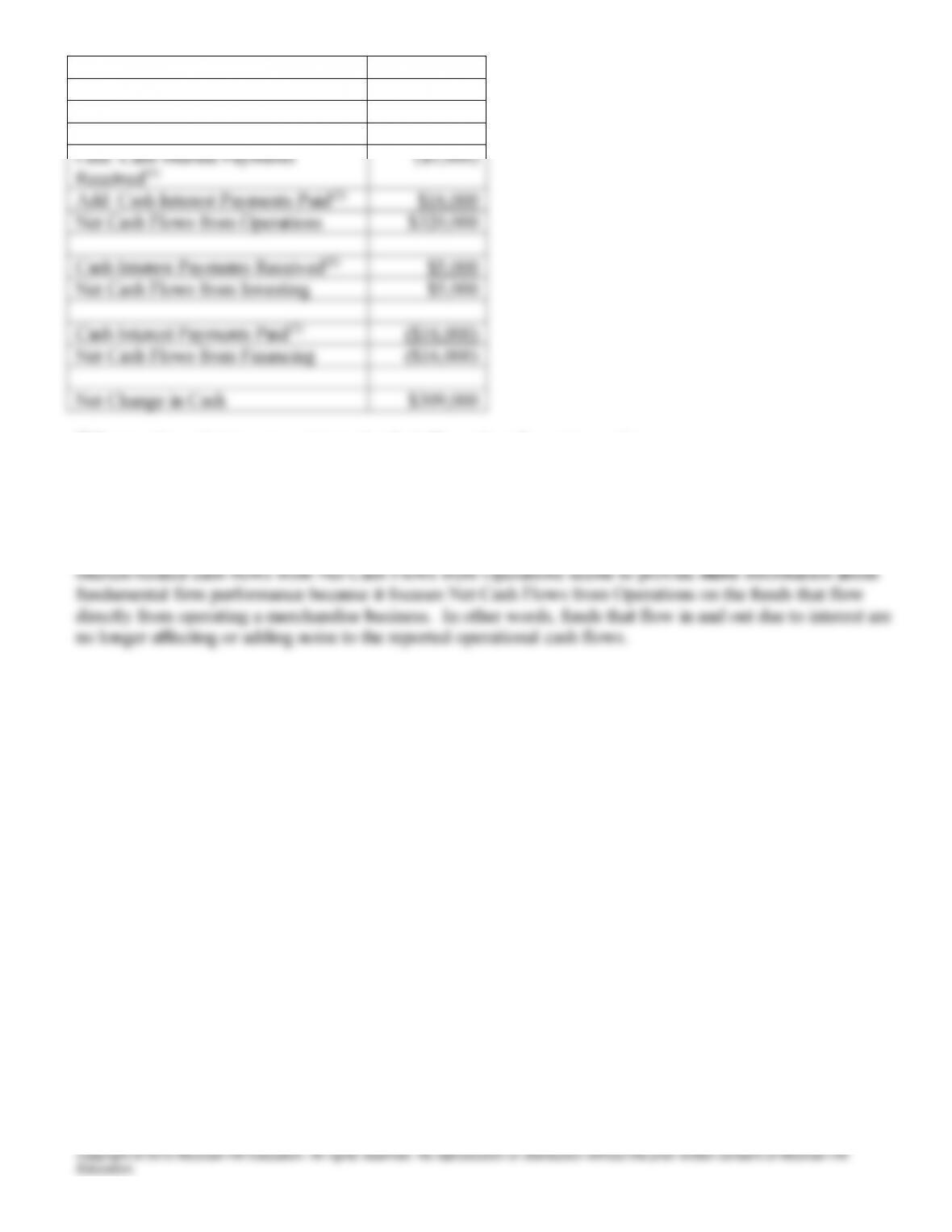
The Statement of Cash Flows under IFRS using the Indirect Method is as follows:
Net Income
$139,000
4-41
Add: Depreciation Expense
$20,000
Add: Decrease in Inventory
$200,000
Less: Increase in Accts Receivable
($40,000)
Less: Decrease in Accts Payable
($10,000)
Less: Cash Interest Payments
Received(1)
($5,000)
Add: Cash Interest Payments Paid(2)
$16,000
Net Cash Flows from Operations
$320,000
Cash Interest Payments Received(1)
$5,000
Net Cash Flows from Investing
$5,000
Cash Interest Payments Paid(2)
($16,000)
Net Cash Flows from Financing
($16,000)
Net Change in Cash
$309,000
(1) To transfer cash interest receipts to the Cash Flows from Investing section
**To transfer cash interest payments to the Cash Flows from Financing section
5.
In Requirement 3, the Net Cash Flows from Operations is $309,000. In Requirement 4, it is $320,000.
Because the fundamental operational goal of this company is to sell merchandise, the IFRS option to remove