4-16
(2) $39,000 + $50,000
4-17
P4–3. Balance sheet preparation
Short Erin Company
Balance Sheet
December 31, 2014
Assets
Current assets:
Cash
$ 53,000
(1)
Short-term investments
55,500
(1)
Accounts receivable
86,100
(2)(4)
Allowance for doubtful trade accounts
(4,600)
81,500
(3)
Inventory
175,000
Prepaid expenses
13,500
Total current assets
$ 378,500
Long-term investments:
Nontrade receivables
15,500
(4)
Property, plant and equipment:
Land
159,800
(5)
Buildings
409,900
(6)
Accumulated depreciation—buildings
(67,500)
342,400
(7)
Production equipment
477,700
Accumulated depreciation—
production equipment
(239,600)
238,100
Total property, plant and equipment
740,300
Intangible assets:
Patents
50,000
Leasehold
7,000
Total intangible assets
57,000
Other assets:
Held for sale plant assets
192,000
(5)(6)(7)
Total assets
$ 1,383,300
Liabilities and Stockholders’ equity
Current liabilities:
Accounts payable
$ 39,800
(2)
Accrued salaries
3,400
Notes payable-current
50,000
(8)
Current portion of installment note payable
5,220
(9)
Taxes payable
4,550
(10)
Total current liabilities
102,970
continued
4-18
Long-term liabilities:
Notes payable—long-term
150,000
(8)
Deferred taxes payable
61,250
(10)
Installment note payable
78,980
(9)
Bonds payable
250,000
Total long-term liabilities
540,230
Total liabilities
643,200
Stockholders’ equity:
Common stock, authorized 1,000,000 shares,
300,000 shares issued and outstanding
300,000
Retained earnings
440,100
Total stockholders’ equity
740,100
Total liabilities and stockholders’ equity
$ 1,383,300
(2) Trade receivables with credit balances should be reclassified as
accounts payable.
(3) The amount of the allowance for uncollectibles should be disclosed.
(8) The $50,000 note that matures in 2015 is a current liability; the note
maturing in 2017 ($200,000 − $50,000 = $150,000) is a long-term liability.
(9) Part of the installment note should be classified as a current liability
based on the amount of principal that will be repaid within one year. The
4-19
Payment
Interest
Principle
Date
Expense
Reduction
Loan balance
$ 84,200
6/30/06
$ 4,210
$ 2,546
81,654
12/31/06
4,083
2,674
78,980
(10) The $61,250 in deferred taxes should be separately classified among the
long-term liabilities.
P4–4. Preparing income statement and statement of cash flows
Requirement 1:
Accrual Accounting
Cash Flow Accounting
Sales revenue
$115,000
Cash collected from
customers
$115,000
– Cost of goods sold
-90,000
– Cash paid to suppliers
-85,000
Net income
$25,000
Cash flow from
operations
$30,000
Computation of cash flow from operations under the indirect method:
Requirement 2:
Since all sales are cash sales, sales revenue equals cash collected from
customers. Consequently, the adjustments made for changes in inventory
Computation of Cash Flow from Operations under the Direct Method
Sales (= cash from customers)
$115,000
Cost of goods sold
-$90,000
– Increase in inventory
-10,000
Cost of purchases
-100,000
+ Increase in accounts payable
+15,000
Cash paid to suppliers
-85,000
Cash flow from operations
$ 30,000
4-20
P4-5. Common-size financial statements
Company C has a high amount of its assets in cash and marketable
securities. It has no accounts receivable and the smallest proportion of
property, plant and equipment (PP&E). In addition, it is the only organization
with a deficit in retained earnings. The lack of inventory, accounts receivable
Companies A, B and D all have accounts receivable; however, Company A’s
balance is considerably higher than Companies B’s or D’s receivable balance.
Company A’s accounts receivable balances are more in line with a
Companies B and D both have balances consistent with organizations that
have high cash or third party credit card sales. Both companies have fairly
large PP&E balances, which appear to be consistent with the capital
requirements of major airlines or a chain of fast-food restaurants. However,
P4-6. Common-size financial statements
A quick review of the financials tells us that Companies A and B have a
4-21
appears to be highly leveraged when compared to the other three companies.
Companies B and D are both reporting significant goodwill and intangibles,
but B has significantly higher retained earnings.
Goodwill arises when one company acquires another and pays more than the
fair market value of the net assets acquired. Likewise, intangible assets will
customer relationships, so it appears likely that Pfizer will report intangible
assets on its balance sheet. As a result, we can conclude that TimeWarner
and Pfizer are either Company B or D. Looking closer at Company B, we see
that Company B has significantly higher inventory requirements than
Company D. Since Pfizer is a manufacturer and distributor of health related
AOL and TimeWarner).
As stated above, Companies A and C both have significant PP&E and that
Company C is highly leveraged when compared to Company A. Utility
companies are regulated and as such have a fairly conventional earnings
stream; as a result, utility companies tend to use long-term debt to finance
sales.
P4-7. Determining cash flows from operating and investing activities
(AICPA adapted)
Requirements 1 and 2:
Cash flow from operations and investing activities are computed below.
Karr Inc.
Partial Statement of Cash Flows
Operations
Net income $300,000
Depreciation 52,000
Decrease in inventory 20,000
Increase in accounts receivable (15,000)
Decrease in accounts payable (5,000)
Gain on sale of equipment __(5,000)
Cash flows from operations $347,000
Investing activities
Sales of equipment 18,000
Purchase of equipment _(20,000)
Cash flows from investing ($2,000)
Notice that the $30,000 increase in Notes payable is not included in cash
flows from investing activities. It is not a cash transaction if issued in
P4-8. Determining operating cash flow components
(AICPA adapted)
Requirement 1:
Cash collected during 2015 can be shown by a T-account analysis:
Accounts Receivable
Beginning balance
$ 84,000
Sales on account in 2015
1,200,000
$5,000
Accounts written off
Ending balance
$ 78,000
4-23
Requirement 2:
Cash disbursed for purchases of merchandise can be derived by using
two T-accounts, inventory and accounts payable.
Inventory
Beginning inventory
$150,000
$840,000
Cost of goods sold
Purchases (plug to balance)
830,000
Ending inventory
$140,000
Accounts Payable
$ 95,000
Beginning balance
830,000
Purchase account
Solve for: Payments
X
$ 98,000
Ending balance
below.
For expenses incurred in 2014
Variable G&A ($110,000 x 50% in 2015) $55,000
Fixed G&A: $100,000
Less Depreciation (35,000)
Bad debts (5,000)
Less Depreciation (35,000)
Bad debts (5,000)
4-24
P4-9. Understanding the relation between income statement, cash flow
statement, and changes in balance sheet accounts
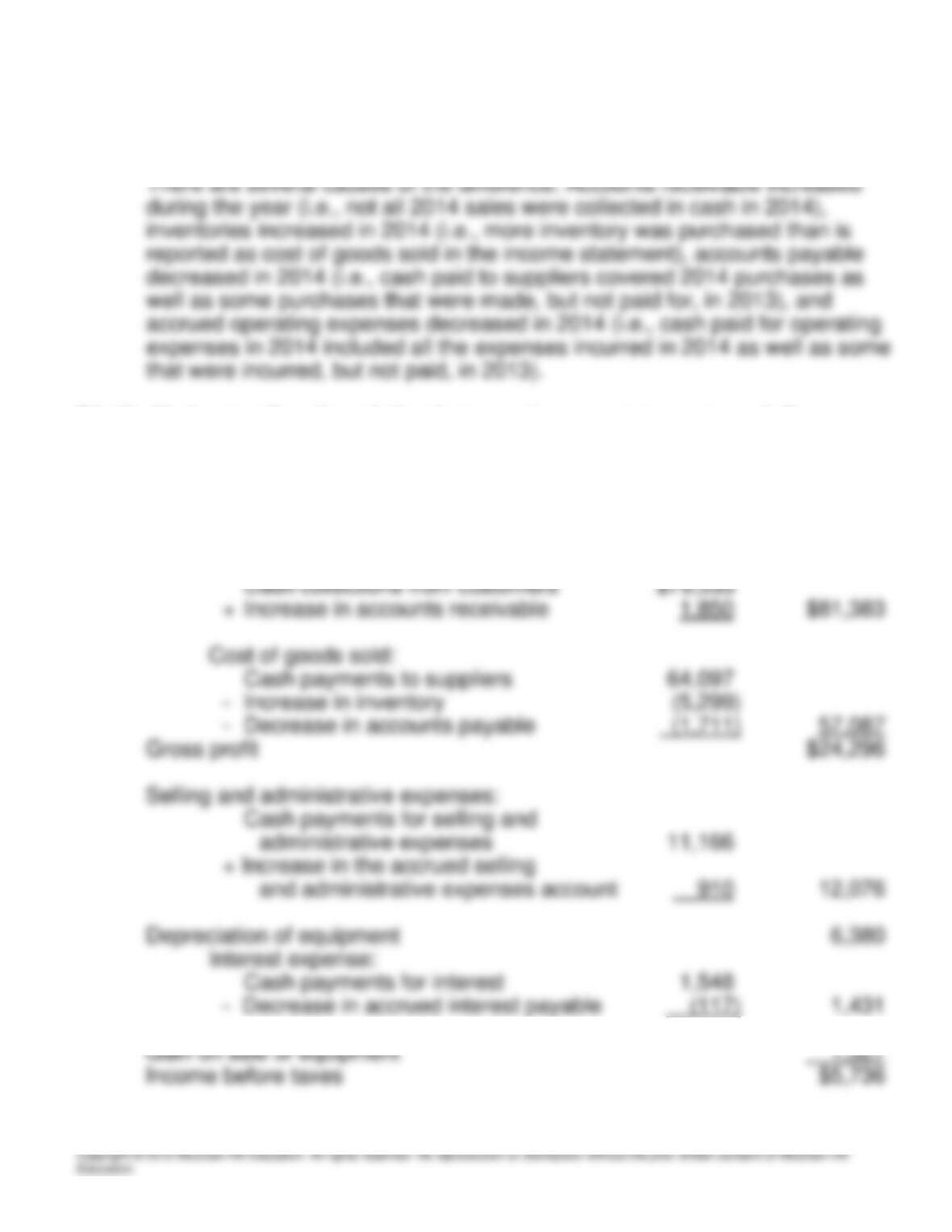
Requirement 1:
Income statement
Sales:
Cash collections from customers $16,670
Gross Profit $8,120
Operating expenses:
Cash payments for operating expenses $7,148
– Decrease in accrued operating expenses (2,788) (4,360)
Depreciation of equipment (2,256)
+ Increase in deferred taxes payable + 127 (327)
Net income $609
Requirement 2:
Cash provided by operating activities:
Net income $609
2,951
Plus/minus changes in current asset and liability accounts:
– Increase in accounts receivable (3,630)
– Increase in inventory (3,250)
4-25
Requirement 3:
Explanation for differences between accrual earnings and operating cash
flows:
Net income is $609, yet cash provided by operating activities is ($10,106).
P4–10. Understanding the relation between income statement, cash flow
statements, and changes in balance sheet accounts
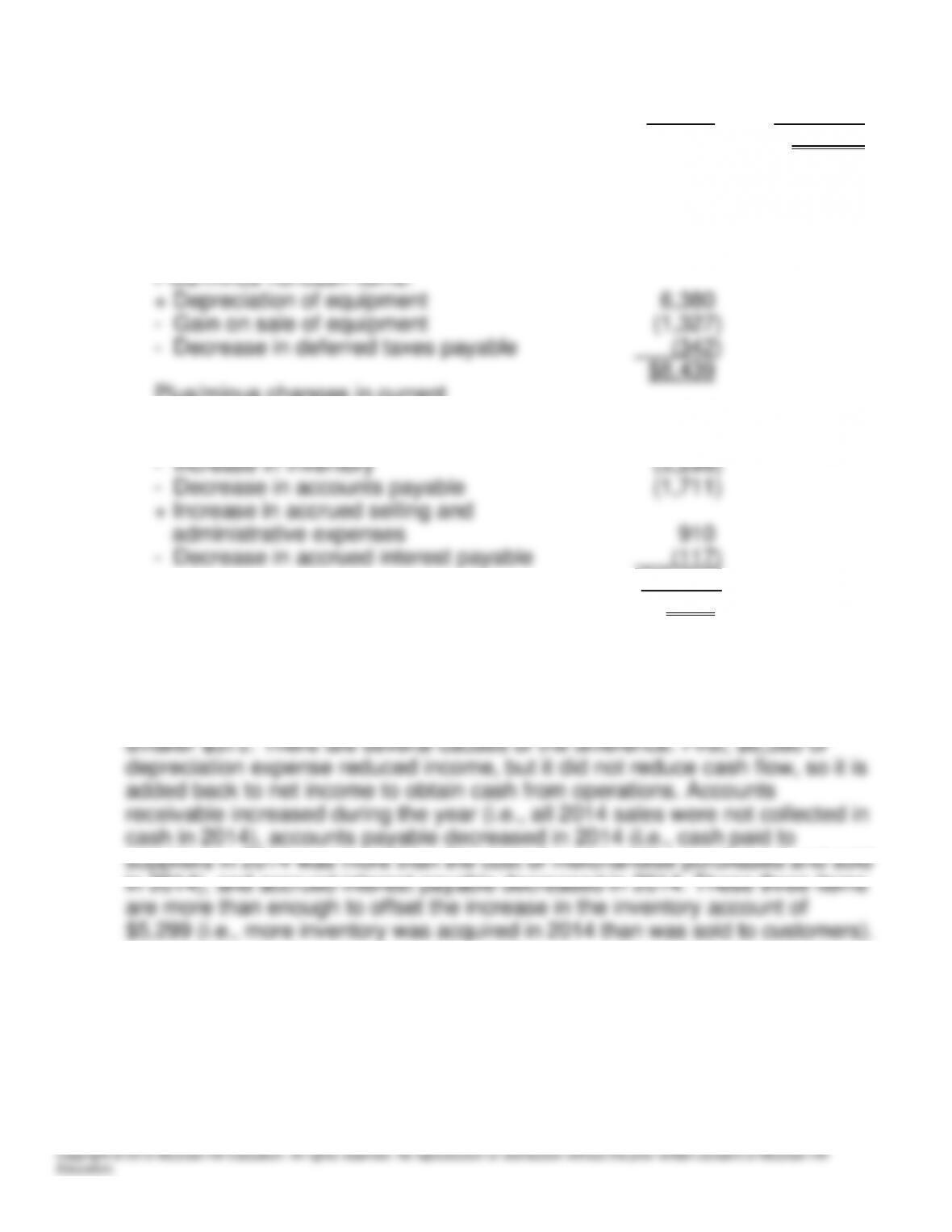
Requirement 1:
Income statement.
Sales:
4-26
Income tax expense:
Cash payments for current income taxes 2,350
– Decrease in deferred taxes payable __(342) ___2,008
Net income (given) $3,728
Requirement 2:
Cash provided by operating activities:
Net income $3,728
Plus/minus changes in current
asset and liability accounts:
– Increase in accounts receivable (1,850)
$(8,067)
Cash provided by operating activities $372
Requirement 3:
Explanation for difference between accrual and cash flow from operations:
Net income is $3,728, while cash provided by operating activities is much
4-27
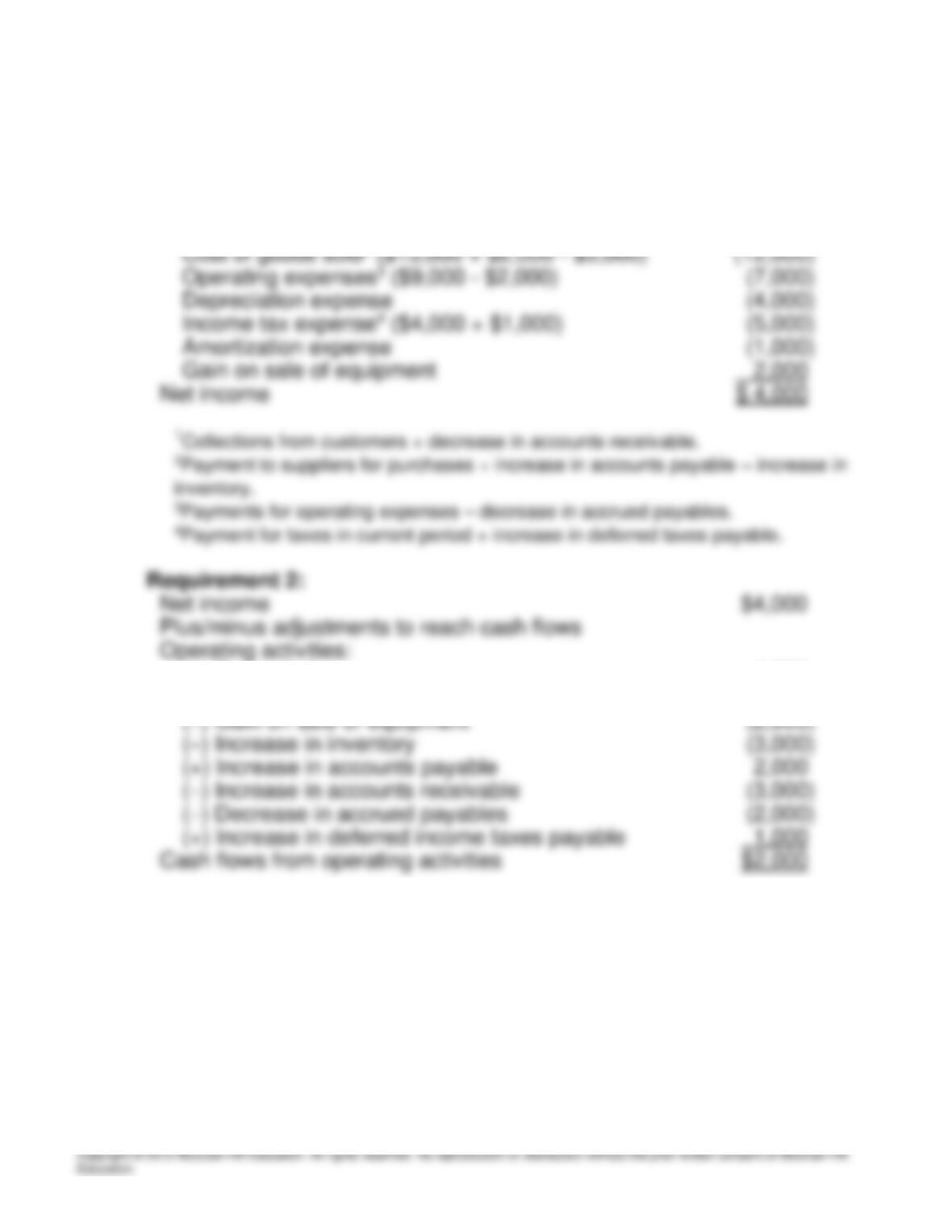
P4-11. Understanding the relation between operating cash flows and
accrual earnings
Requirement 1:
Sales1 ($28,000 + $3,000) $31,000
Less:
(+) Depreciation 4,000
(+) Amortization of goodwill 1,000
P4-12. Finding missing values on a classified balance sheet and analyzing
balance sheet changes
Requirement 1:
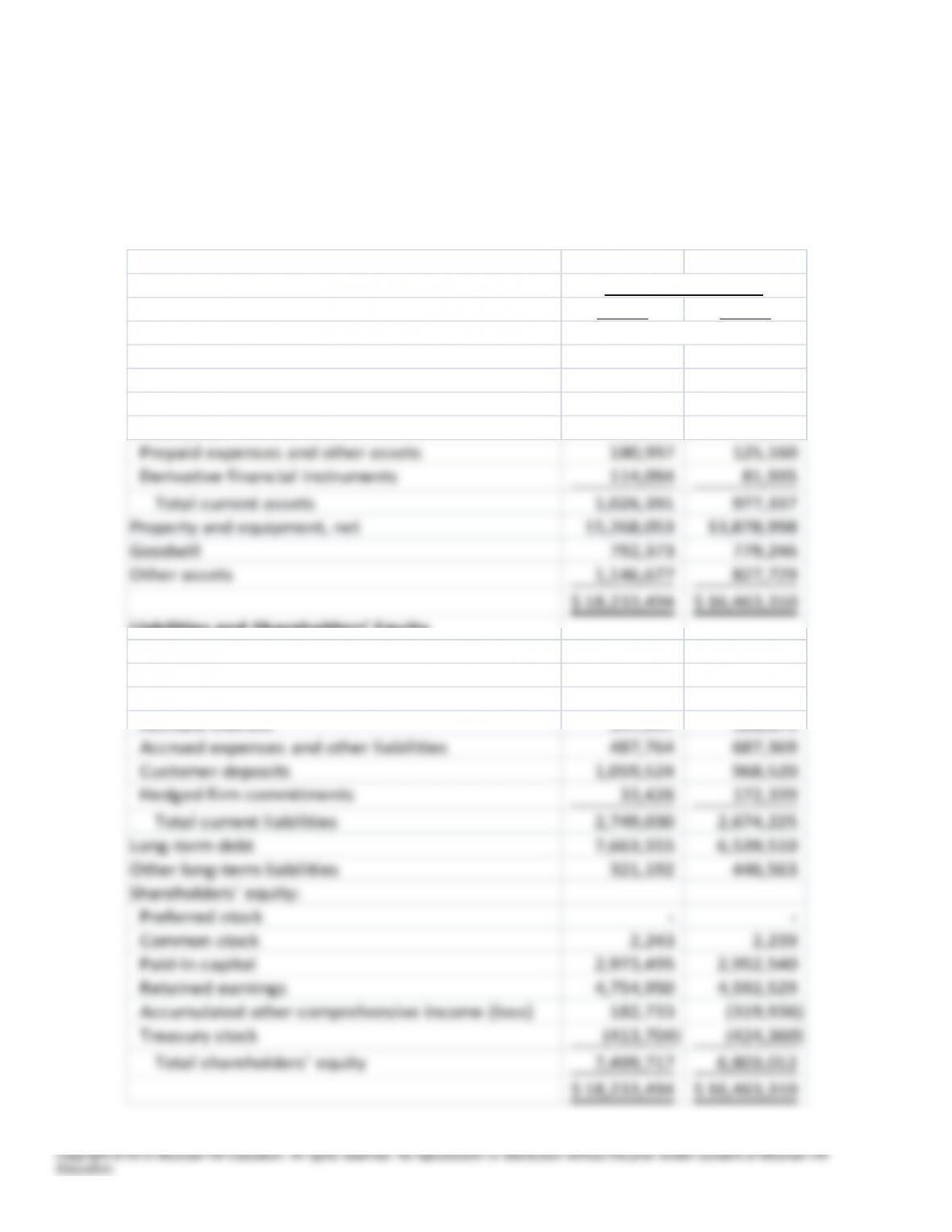
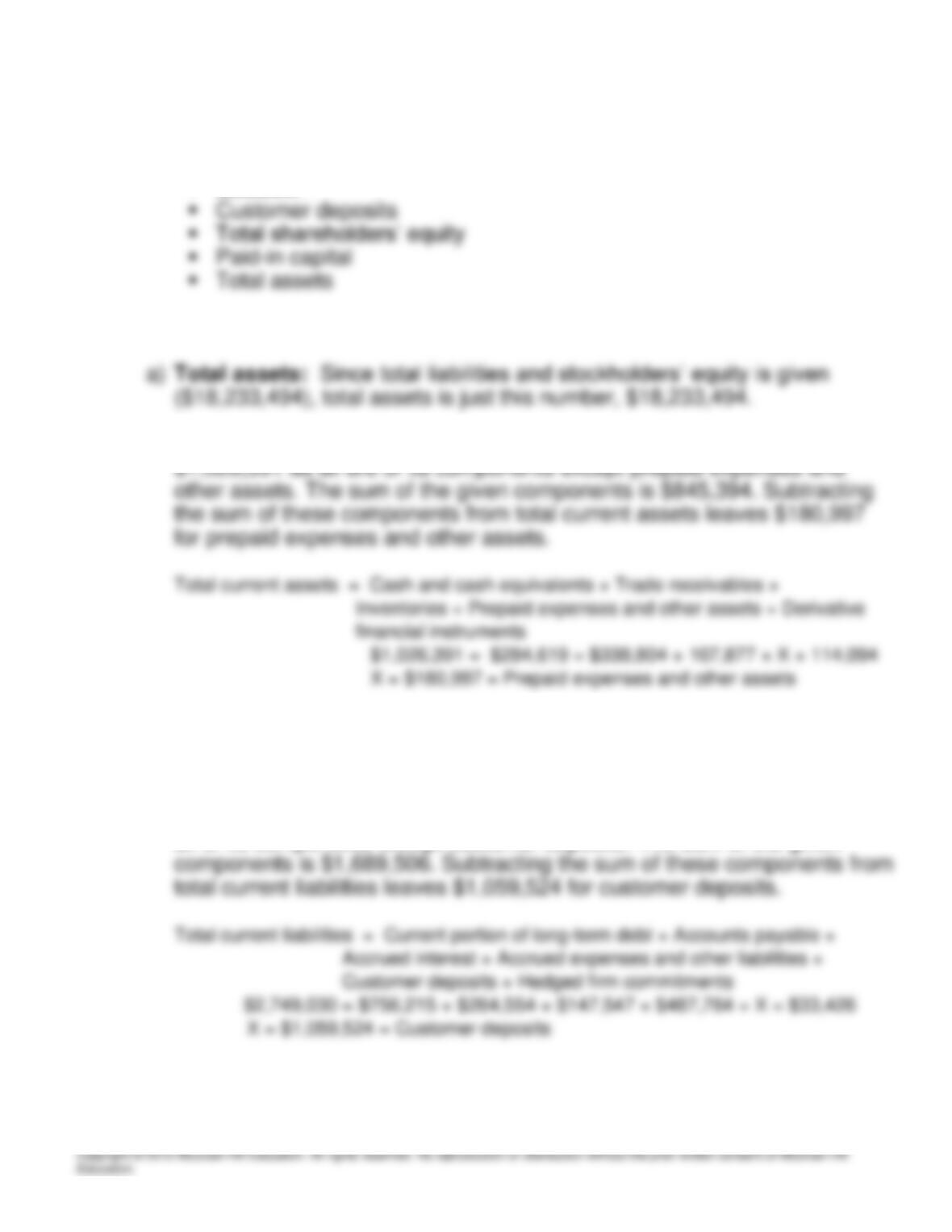
Royal Caribbean’s Year 2 balance sheet appears on the following page. The
Year 1 balance sheet is also included to facilitate responding to the remaining
parts of the question.
Consolidated Balance Sheets
Year 2 Year 1
Assets
Current assets:
Cash and cash equivalents 284,619$ 402,878$
Trade and other receivables, net 338,804 271,287
Inventories 107,877 96,077
Prepaid expenses and other assets 180,997 125,160
Derivative financial instruments 114,094 81,935
Total current assets 1,026,391 977,337
Property and equipment, net 15,268,053 13,878,998
Goodwill 792,373 779,246
Other assets 1,146,677 827,729
Accrued expenses and other liabilities 487,764 687,369
Customer deposits 1,059,524 968,520
Hedged firm commitments 33,426 172,339
Total current liabilities 2,749,030 2,674,225
Long-term debt 7,663,555 6,539,510
Other long–term liabilities 321,192 446,563
(in thousands)
As of December 31,
4-29
The unknowns in the Year 2 balance sheet are:
▪ Prepaid expenses and other assets
▪ Goodwill
They may be solved for as follows (all amounts in thousands).
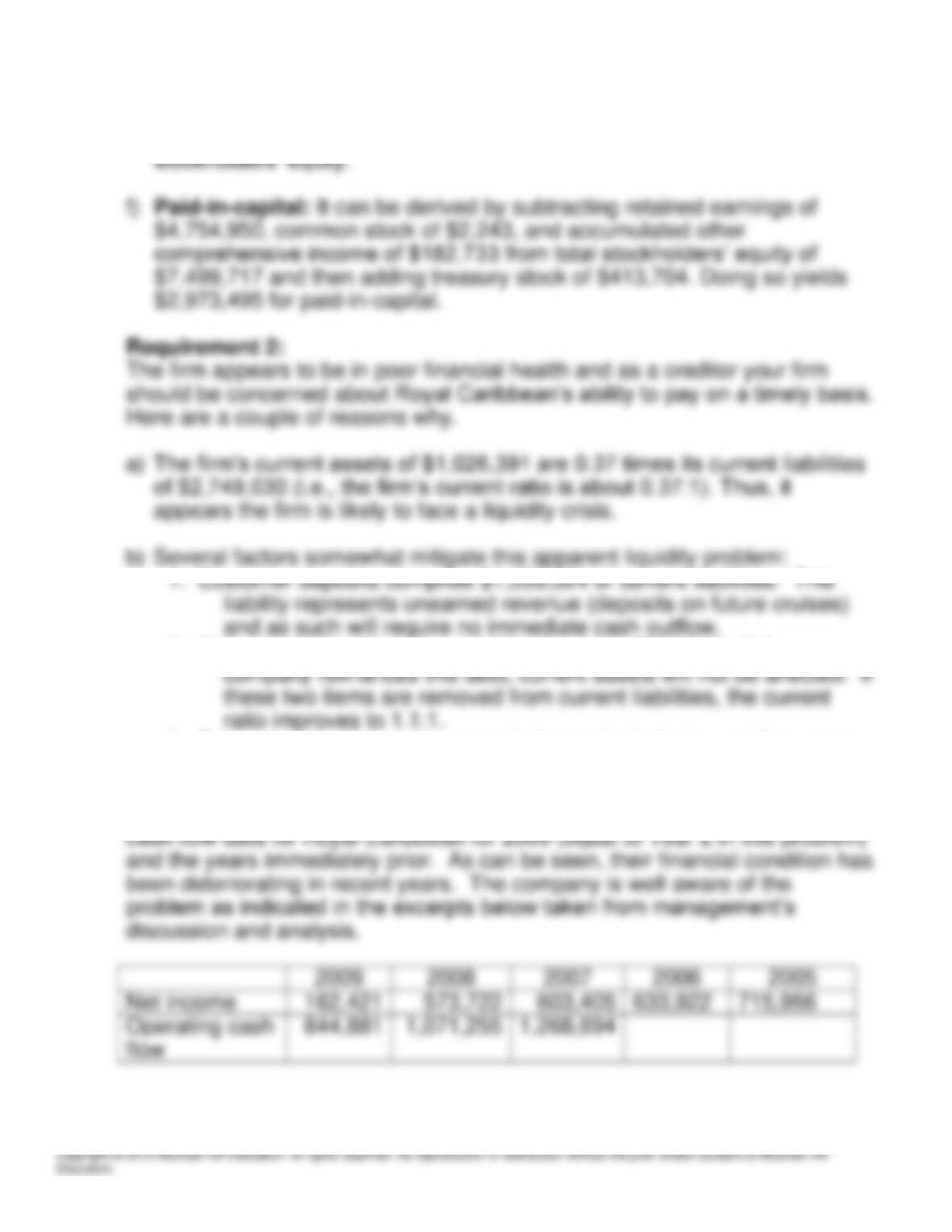
b) Prepaid expenses and other assets: Total current assets is given as
c) Goodwill: To obtain goodwill, subtract total current assets of $1,026,391,
property and equipment of $15,268,053 and other assets of $1,146,677
from total assets of $18,233,494. This yields $792,373 for goodwill.
d) Customer Deposits: Total current liabilities is given as $2,749,030 as is
all of its components except customer deposits. The sum of the given
4-30
e) Total shareholder’s equity: Total stockholders’ equity is just total
liabilities and stockholders’ equity of $18,233,494 minus total current
liabilities of $2,749,030, long-term debt of 7,663,555, and other long-term
liabilities of $321,192. Doing the subtraction yields $7,499,717 for total
2. Current portion of long-term debt amounts to $756,215. If the
3. Poor current ratios are common in the cruise industry, yet they seem
to stay afloat.
Note to instructor: The following table provides net income and operating