3-31
2016:
DR Cash
$100,000
CR Installment Accounts Receivable
$100,000
DR Deferred gross profit—adjustment to accounts
receivable
$50,000
DR Cost of installment goods sold
50,000
CR Installment sales revenue
$100,000
DR Cash
$75,000
CR Installment Accounts Receivable
$75,000
DR Deferred gross profit—adjustment to accounts
receivable
$75,000
DR Cost of installment goods sold
0
CR Installment sales revenue
$75,000
Requirement 3:
12/31/2017 U.S. GAAP:
DR Deferred gross profit—adjustment to accounts
receivable
$30,000
DR Loss on uncollectible receivables
45,000
CR Installment Accounts Receivable
$75,000
DR Deferred gross profit—adjustment to accounts
receivable
$75,000
CR Installment Accounts Receivable
$75,000
Requirement 4:
EXPOSURE DRAFT PROPOSED GUIDANCE:
To compute revenue:
Date
7/1/2014
7/1/2015
7/1/2016
7/1/2017
Cash Flow
$ 125,000
$ 135,000
$ 135,000
$ 135,000
Disc Rate
1.000
0.909
0.826
0.751
DCF
$ 125,000
$ 122,727
$ 111,570
$ 101,427
Probability
1
0.8
0.6
0.5
Exp CF
$ 125,000
$ 98,182
$ 66,942
$ 50,714
Revenue
$ 340,838
3-32
12/31/2014
DR Cash
$125,000
DR A/R
$405,000
CR Sales Revenue
$340,838
CR Allowance for Bad Debt
$189,162
DR Cost of Goods Sold
$300,000
CR Inventory
$300,000
3-33
P3-10. Alternative Bases of Revenue and Income Recognition
Requirement 1:
Three alternatives available to Quincy are the a) point of delivery method,
2014.
The cost recovery method calls for the recognition of gross profit to the extent
that cash collected in 2014 exceeds the cost of the equipment.
Requirement 2:
Point of Delivery: $200,000 (selling price) – $80,000 (cost) = $120,000
P3-11. Bundled services
Requirement 1:
Brio’s revenue recognition policies when bundled services are sold state that
“Brio recognizes product revenue when persuasive evidence of an
arrangement exists, the product has been delivered, the fee is fixed or
separately. The residual amount of revenue is allocated to the delivered
elements and recognized as revenue.”
Thus, revenue on the contract would be recognized as follows:
Total Revenue per Contract
$ 1,000,000
Less: Revenue assigned to undeliverables
based on vendor-specific objective evidence:
Technical support
120,000
Training
72,000
System implementation services
108,000
Software upgrades and enhancements
60,000
Total deferred revenue
360,000
Residual revenue assigned to delivered
elements and recognized as revenue
$ 640,000
Requirement 2:
$1,000,000
3-35
P3-12. Sales with right of return
Requirement 1:
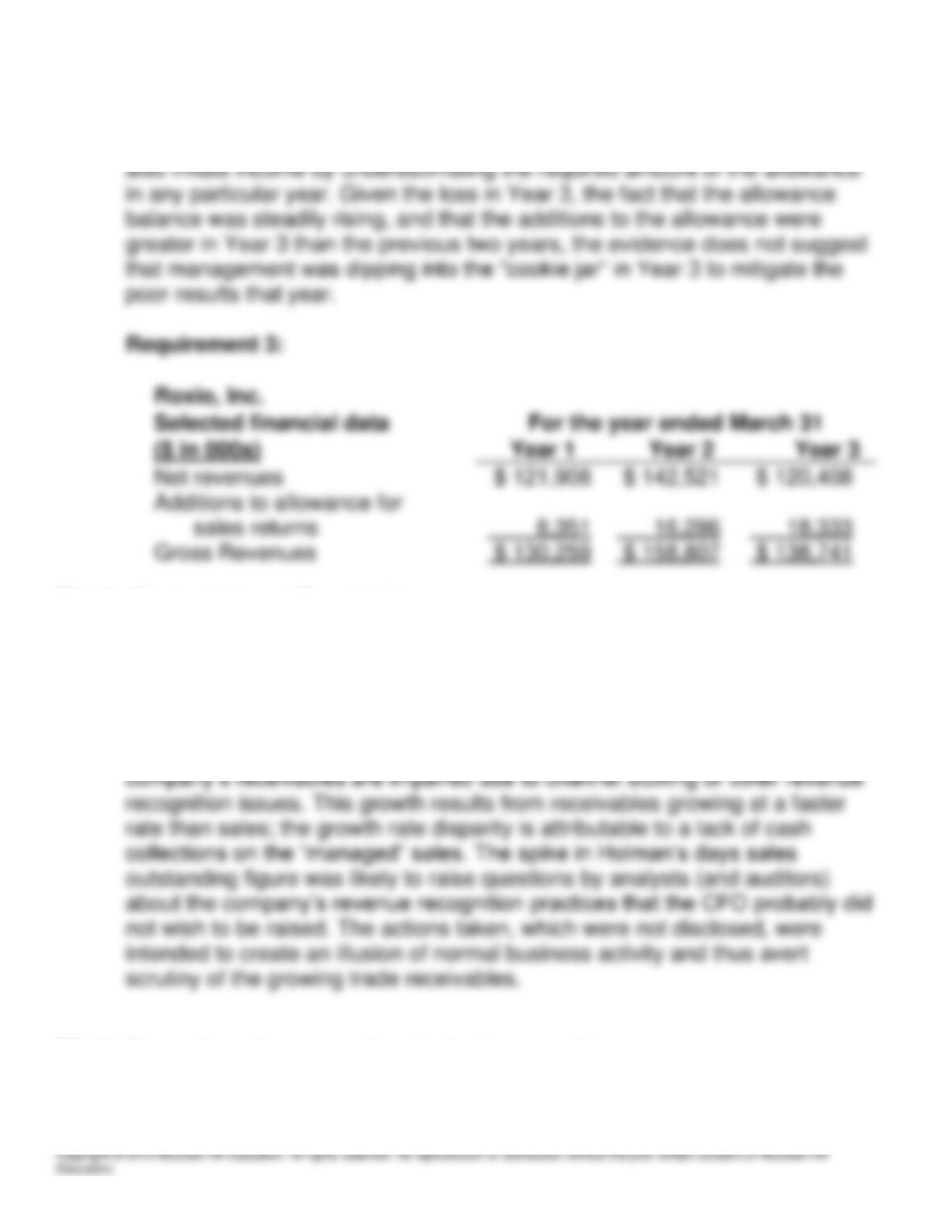
(1) To make provision for expected sales returns—Year 1
DR Sales returns
$8,351,000
CR Allowance for sales returns
and certain sales incentives
$8,351,000
(2) To record actual sales returns—Year 1
DR Allowance for sales returns and certain
sales incentives
$5,935,000
CR Accounts receivable
$5,935,000
(3) To make provision for expected sales returns—Year 2
DR Sales returns
$16,286,000
CR Allowance for sales returns and
certain sales incentives
$16,286,000
(4) To record actual sales returns—Year 2
DR Allowance for sales returns and certain
sales incentives
$15,396,000
CR Accounts receivable
$15,396,000
(5) To make provision for expected sales returns—Year 3
DR Sales returns
$18,333,000
CR Allowance for sales returns and
certain sales incentives
$18,333,000
6) To record actual sales returns—Year 3
DR Allowance for sales returns and
certain sales incentives
$16,749,000
CR Accounts receivable
$16,749,000
The rising balance in the “allowance for sales returns and certain sales
incentives” account is due to management anticipating (and deducting from
revenue) more returns each year than have actually been occurring.
Requirement 2:
As noted in Roxio’s policies regarding accounting for returns, considerable
judgment is required to estimate the amount of goods that will ultimately be
3-36
returned or price concessions that will be granted. Management indicates that
adjustments might be needed periodically based on evolving experience.
Thus, using the inherent subjectivity in this process, management can
establish “cookie jar” reserves by overestimating returns. Management can
P3-13. Manipulation of Receivables
Accounts receivable turnover = sales ÷ average accounts receivable.
Days sales outstanding = 365 ÷ Accounts receivable turnover.
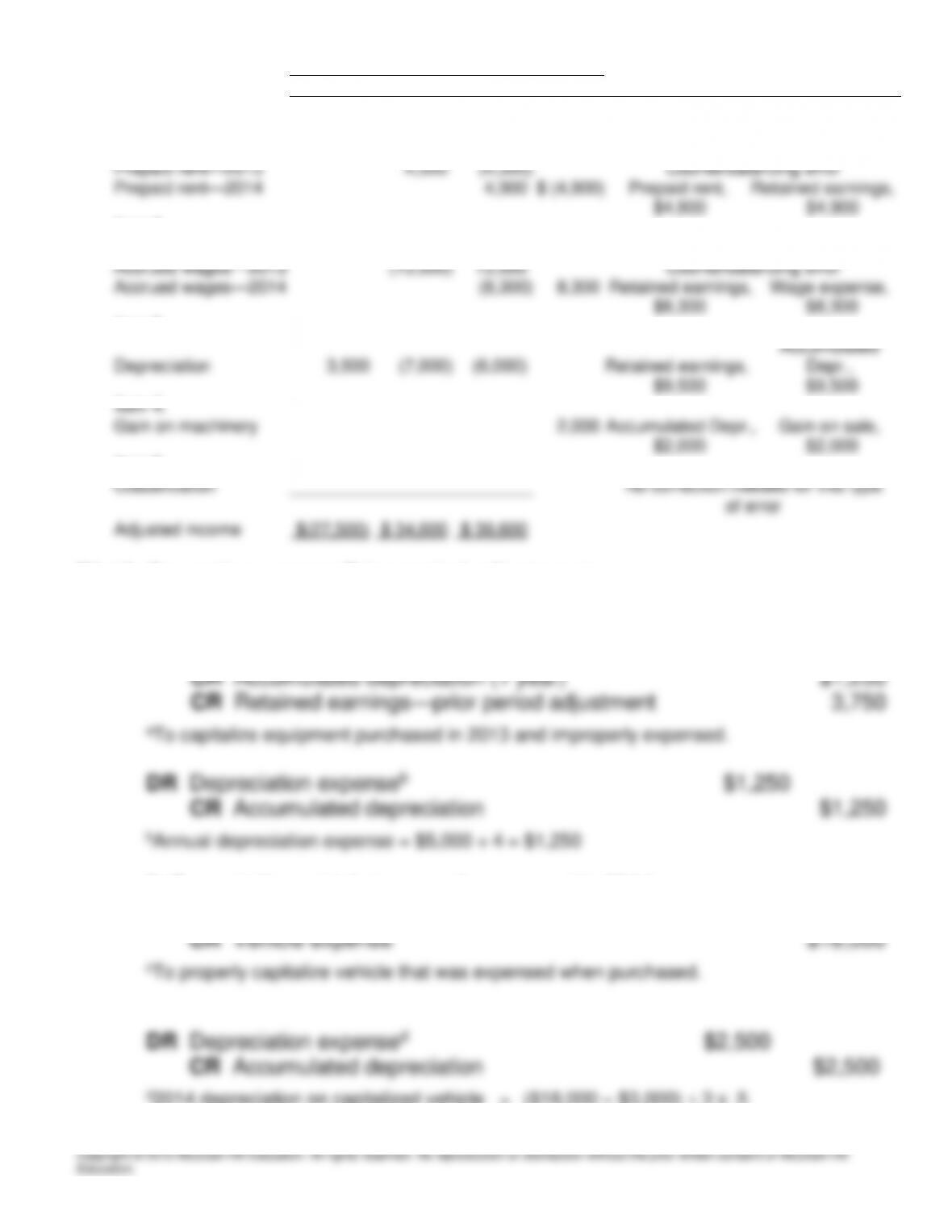
A growing days sales outstanding figure is often a telltale sign that a
P3-14. Correction of errors and worksheet preparation
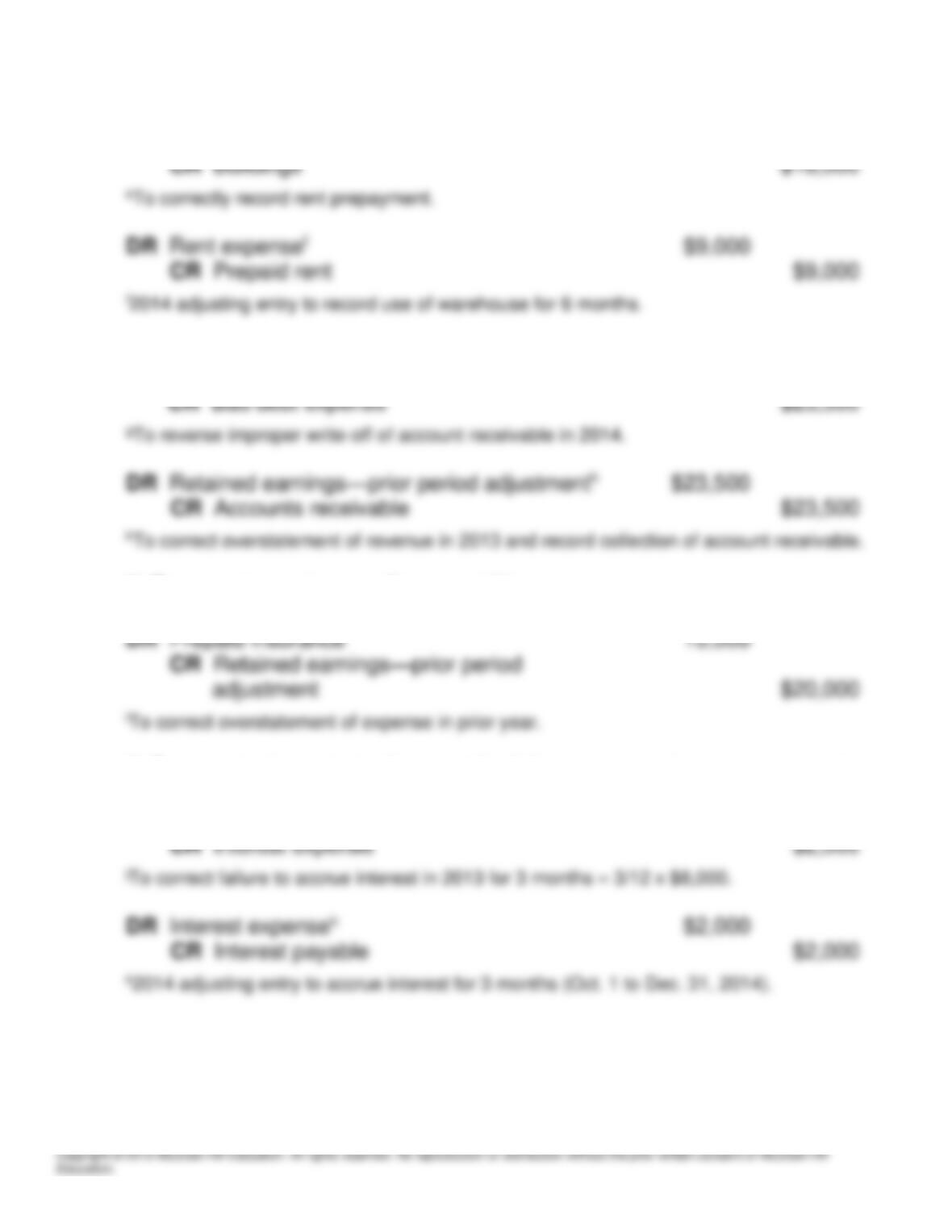
Error corrections worksheet
3-37
Effect on income
Accounts to be adjusted
Description
2012
2013
2014
2015
Dr.
Cr.
Reported income
$(24,000)
$ 43,000
$ 40,000
N/A
Item 1.
Prepaid rent—2012
5,000
(5,000)
Counterbalancing error
Prepaid rent—2013
4,500
(4,500)
Counterbalancing error
Prepaid rent—2014
4,900
$ (4,900)
Prepaid rent,
Retained earnings,
$4,900
$4,900
Item 2.
Accrued wages—2012
(12,000)
12,000
Counterbalancing error
Accrued wages—2013
(13,500)
13,500
Counterbalancing error
Accrued wages—2014
(8,300)
8,300
Retained earnings,
Wage expense,
$8,300
$8,300
Item 3.
Depreciation
3,500
(7,000)
(6,000)
Retained earnings,
Accumulated
Depr.,
$9,500
$9,500
Item 4.
Gain on machinery
2,000
Accumulated Depr.,
Gain on sale,
$2,000
$2,000
Item 5.
Classification
No correction needed for this type
of error
Adjusted income
$(27,500)
$ 34,000
$ 39,600
P3-15. Correcting errors / Prior period adjustment
1) Correcting entries in 2014 for equipment improperly expensed in 2013:
DR Office equipmenta
$5,000
CR Accumulated depreciation (1 year)
$1,250
CR Retained earnings—prior period adjustment
3,750
aTo capitalize equipment purchased in 2013 and improperly expensed.
DR Depreciation expenseb
$1,250
CR Accumulated depreciation
$1,250
bAnnual depreciation expense = $5,000 ÷ 4 = $1,250
2) To capitalize vehicle improperly expensed in 2014:
DR Vehiclec
$18,000
CR Vehicle expense
$18,000
cTo properly capitalize vehicle that was expensed when purchased.
DR Depreciation expensed
$2,500
CR Accumulated depreciation
$2,500
d2014 depreciation on capitalized vehicle = ($18,000 – $3,000) ÷ 3 x .5
3-38
= $2,500
3) To correct prepaid rent improperly charged to “Buildings” account:
DR Prepaid rente
$18,000
CR Buildings
$18,000
eTo correctly record rent prepayment.
DR Rent expensef
$9,000
CR Prepaid rent
$9,000
f2014 adjusting entry to record use of warehouse for 6 months.
4) To correct error in accounting for bad debts:
DR Accounts receivableg
$23,500
CR Bad debt expense
$23,500
gTo reverse improper write-off of account receivable in 2014.
DR Retained earnings—prior period adjustmenth
$23,500
CR Accounts receivable
$23,500
hTo correct overstatement of revenue in 2013 and record collection of account receivable.
5) To correct error in recording prepaid insurance:
DR Insurance expensei
$10,000
DR
Prepaid insurance
10,000
CR Retained earnings—prior period
adjustment
$20,000
iTo correct overstatement of expense in prior year.
6) To record prior period adjustment for failure to accrue interest expense in
2013:
DR Retained earnings—prior period adjustmentj
$2,000
CR Interest expense
$2,000
jTo correct failure to accrue interest in 2013 for 3 months = 3/12 x $8,000.
DR Interest expensek
$2,000
CR Interest payable
$2,000
k2014 adjusting entry to accrue interest for 3 months (Oct. 1 to Dec. 31, 2014).