Financial Reporting and Analysis (6th Edition)
Chapter 3 Solutions
Additional Topics in Income Determination
Exercises
E3–1. Percentage-of-completion method
Requirement 1:
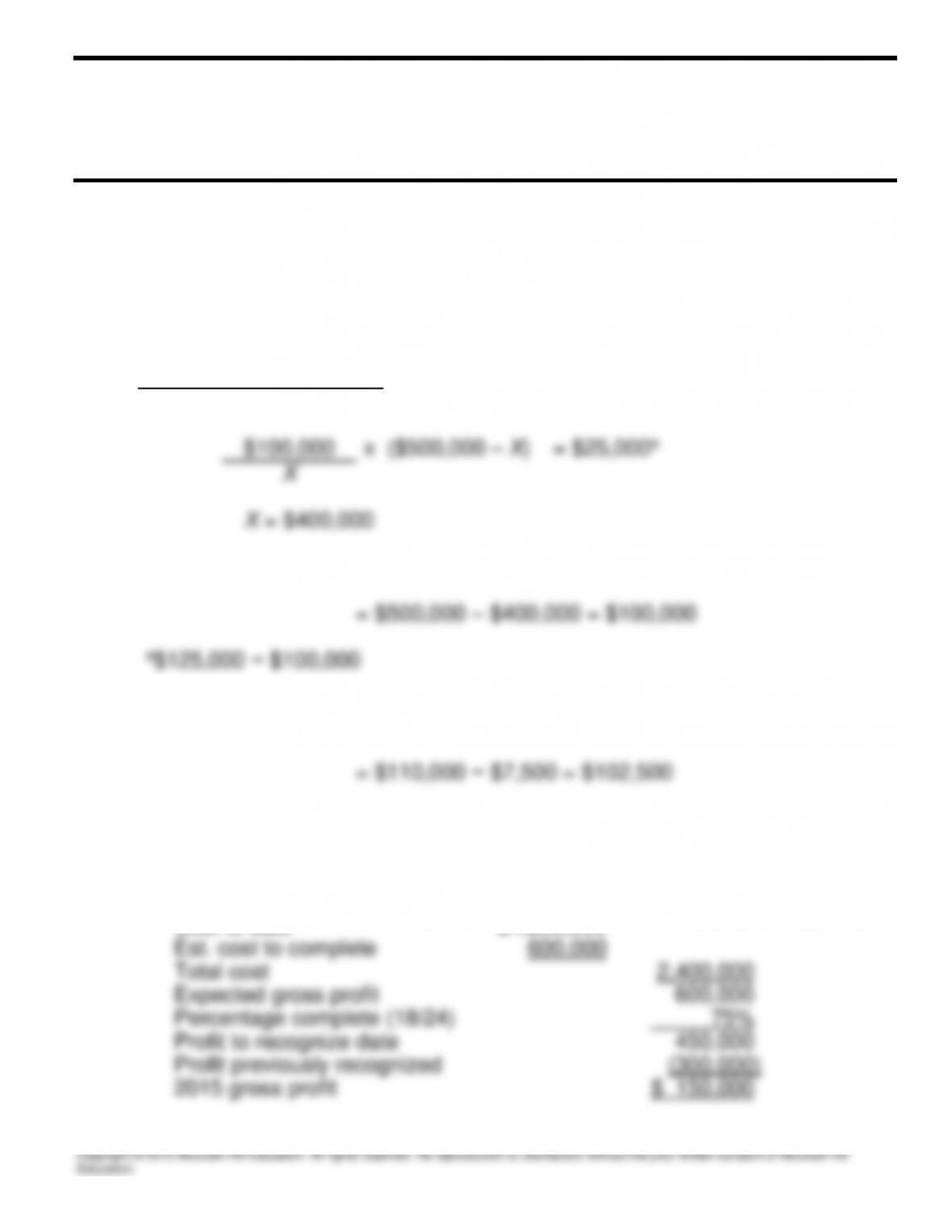
Let X = estimated cost.
Costs to date
x Estimated profit
= Profit for 2014
Estimated total costs
x ($500,000 – X)
Contract price
Cost to date $1,800,000
Est. cost to complete 600,000
Total cost
Expected gross profit
Percentage complete (18/24)
Profit to recognize date
E3–3. Determining gross profit using the installment method and cost–
recovery method
Requirement 1:
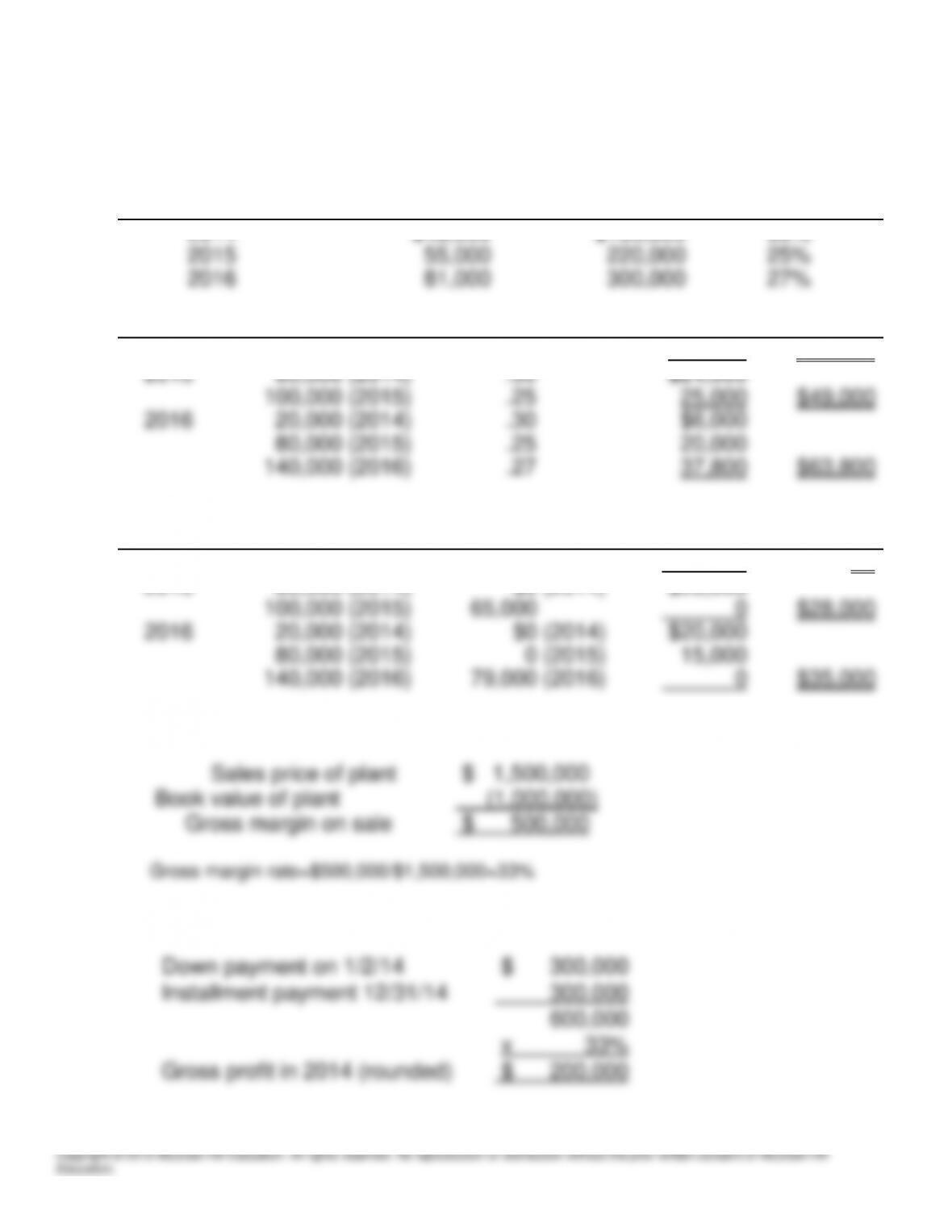
Year
Gross profit ÷
Sales =
Gross profit ratio
2014
$48,000
$160,000
30%
2015
55,000
220,000
25%
2016
81,000
300,000
27%
Year
Cash collections
x Gross profit ratio
= Income recognized
2014
$60,000 (2014)
.30
$18,000
$18,000
2015
80,000 (2014)
.30
$24,000
100,000 (2015)
.25
25,000
$49,000
2016
20,000 (2014)
.30
$6,000
80,000 (2015)
.25
20,000
140,000 (2016)
.27
37,800
$63,800
Requirement 2:
Year
Cash collections
Unrecovered cost
Income recognized
2014
$60,000 (2014)
$52,000
$0
$0
2015
80,000 (2014)
$0 (2014)
$28,000
100,000 (2015)
65,000
0
$28,000
2016
20,000 (2014)
$0 (2014)
$20,000
80,000 (2015)
0 (2015)
15,000
140,000 (2016)
79,000 (2016)
0
$35,000
E3-4. Determining realized gross profit using the installment method
$ 1,500,000
Book value of plant
(1,000,000)
Gross margin on sale
$ 500,000
3-3
E3-5. Determining installment accounts receivable
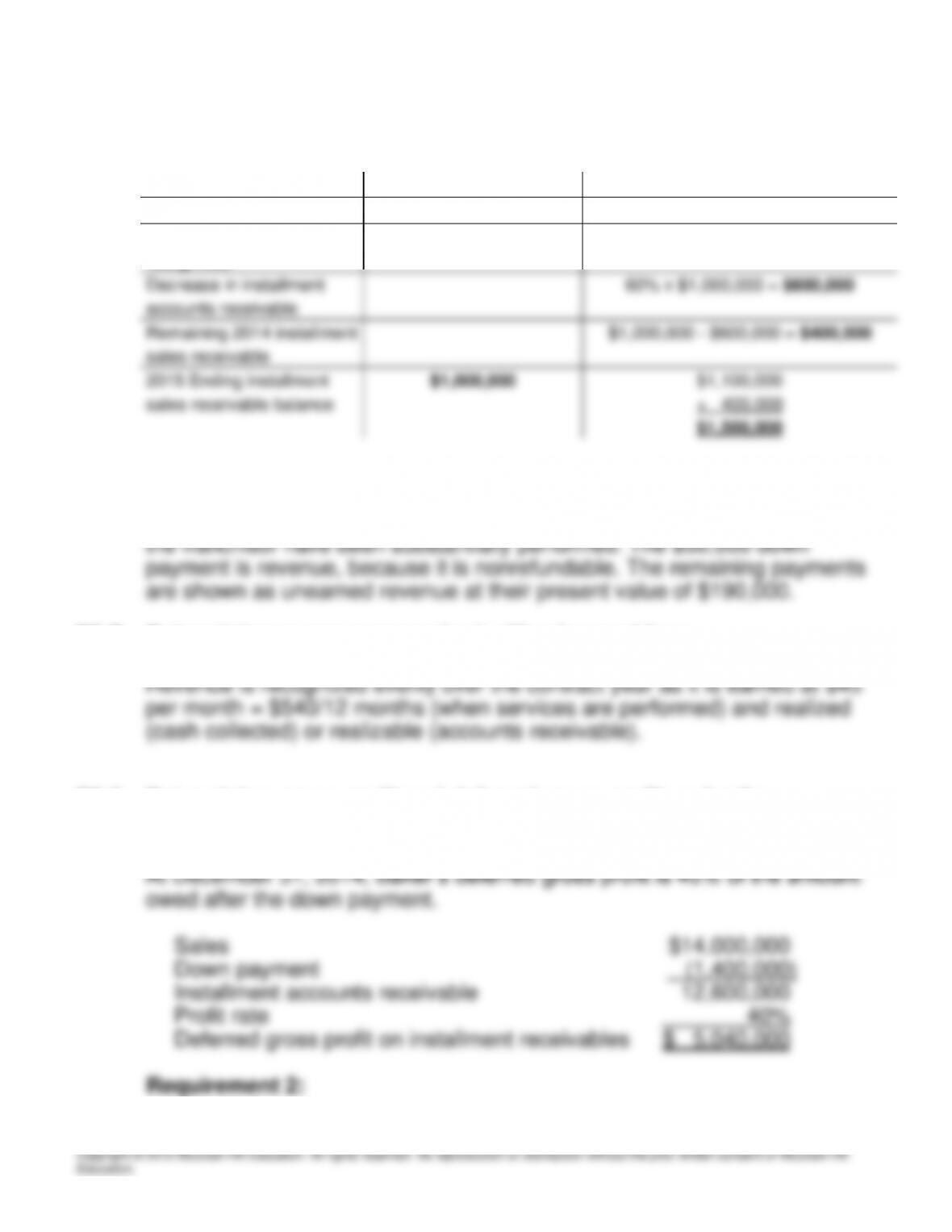
The installment sales receivable balance is computed below.
2014
2015
Installment sales
($300,000/.3) = $1,000,000
($440,000/.4) = $1,100,000
Percentage of gross profit
recognized
0%
($300,000 – $120,000)/$300,000 = 60%
Decrease in installment
accounts receivable
60% x $1,000,000 = $600,000
Remaining 2014 installment
sales receivable
$1,000,000 – $600,000 = $400,000
2015 Ending installment
sales receivable balance
$1,000,000
$1,100,000
+ 400,000
$1,500,000
E3–6. Determining deferred franchise fee revenue
Revenue from franchise sales is recognized when all material obligations of
E3-7. Determining revenue recognized with advanced fees
E3-8. Determining gross profit and deferred gross profit under the
installment Method
Requirement 1:
3-4
Copyright © 2015 McGraw-Hill Education. All rights reserved. No reproduction or distribution without the prior written consent of McGraw-Hill
Education.
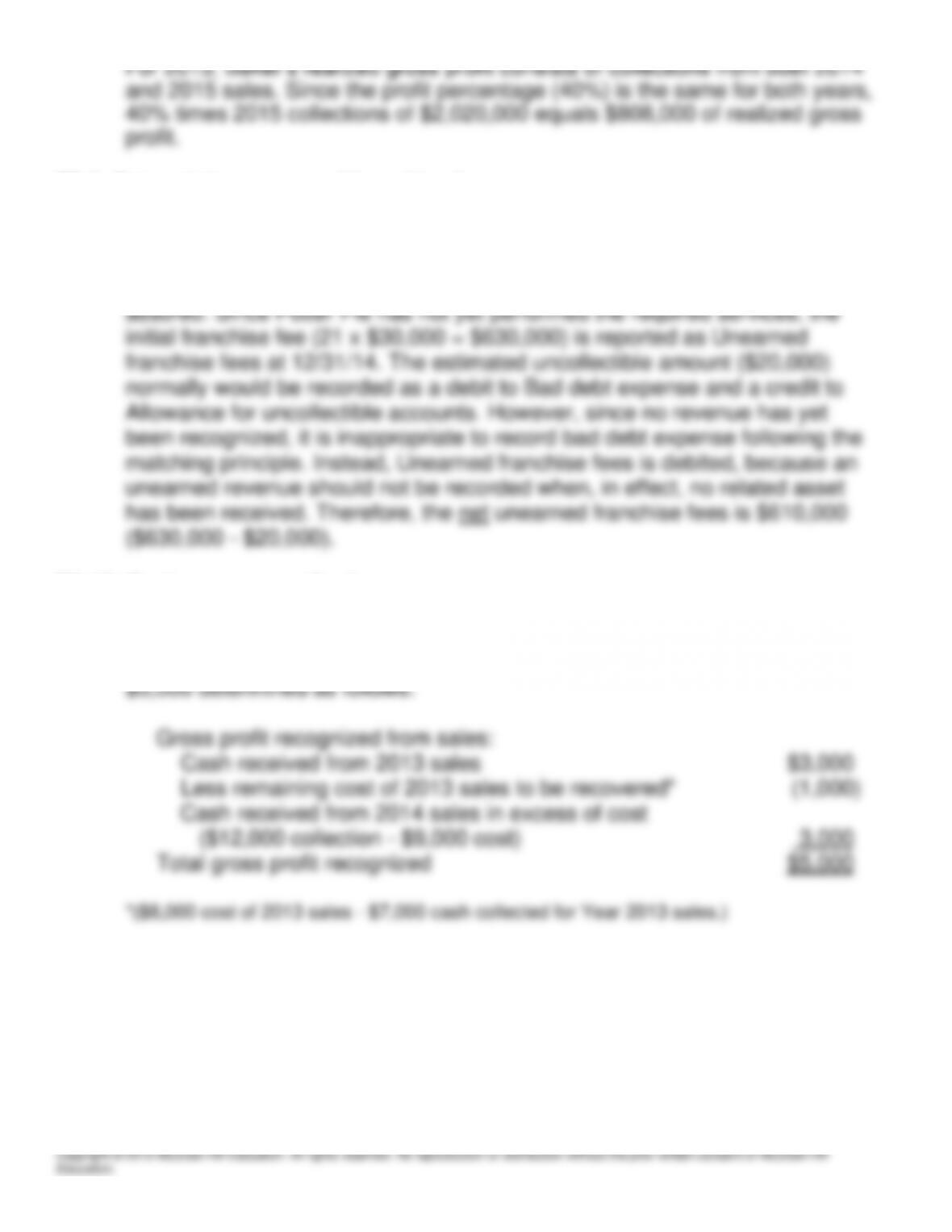
and 2015 sales. Since the profit percentage (40%) is the same for both years,
40% times 2015 collections of $2,020,000 equals $808,000 of realized gross
profit.
E3-9. Determining unearned franchise fees
(AICPA adapted)
Initial franchise fees are not recognized as revenue until the franchisor makes
substantial performance of the required services, and collection is reasonably
E3–10. Cost recovery method
(AICPA adapted)
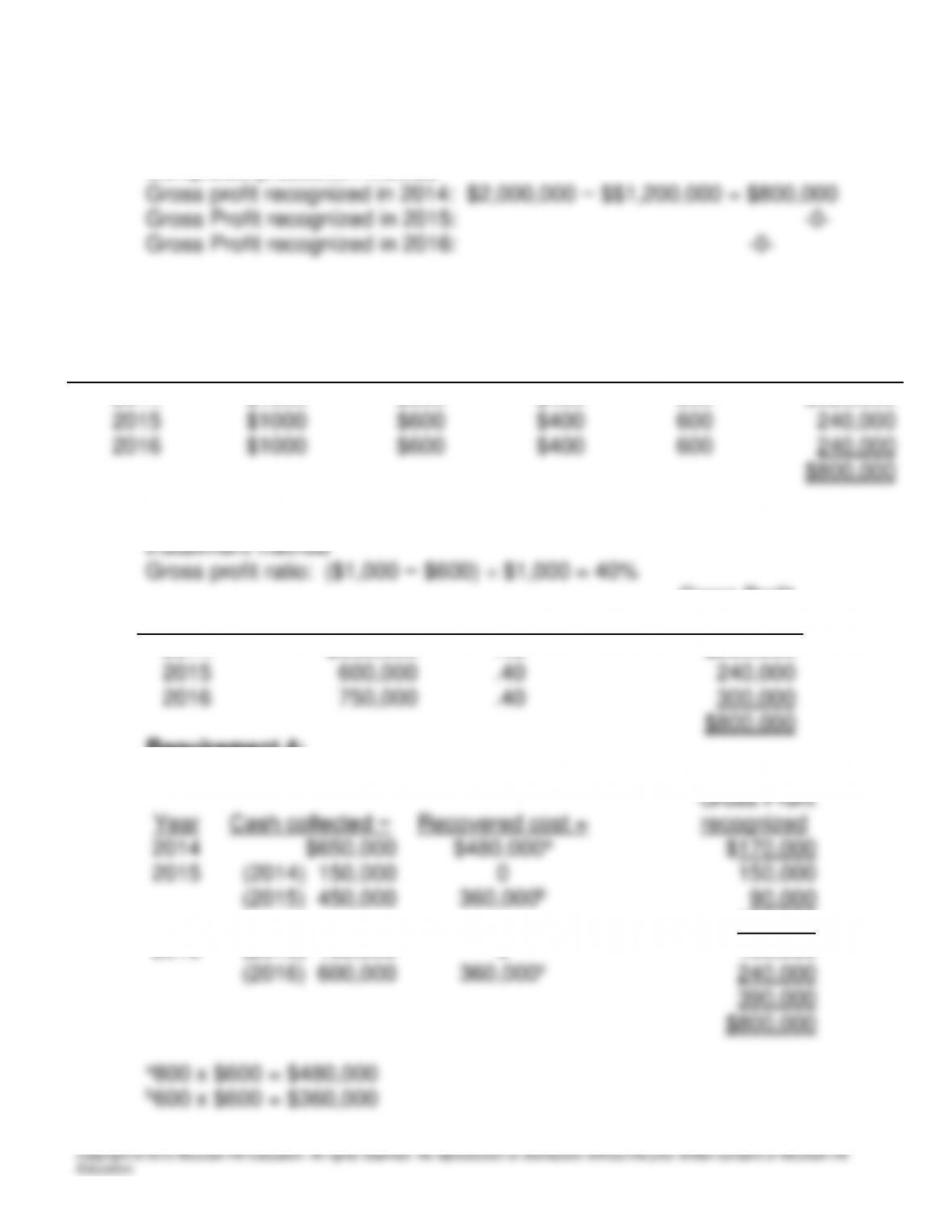
The amount of gross profit recognized in 2014 related to these sales is
3-5
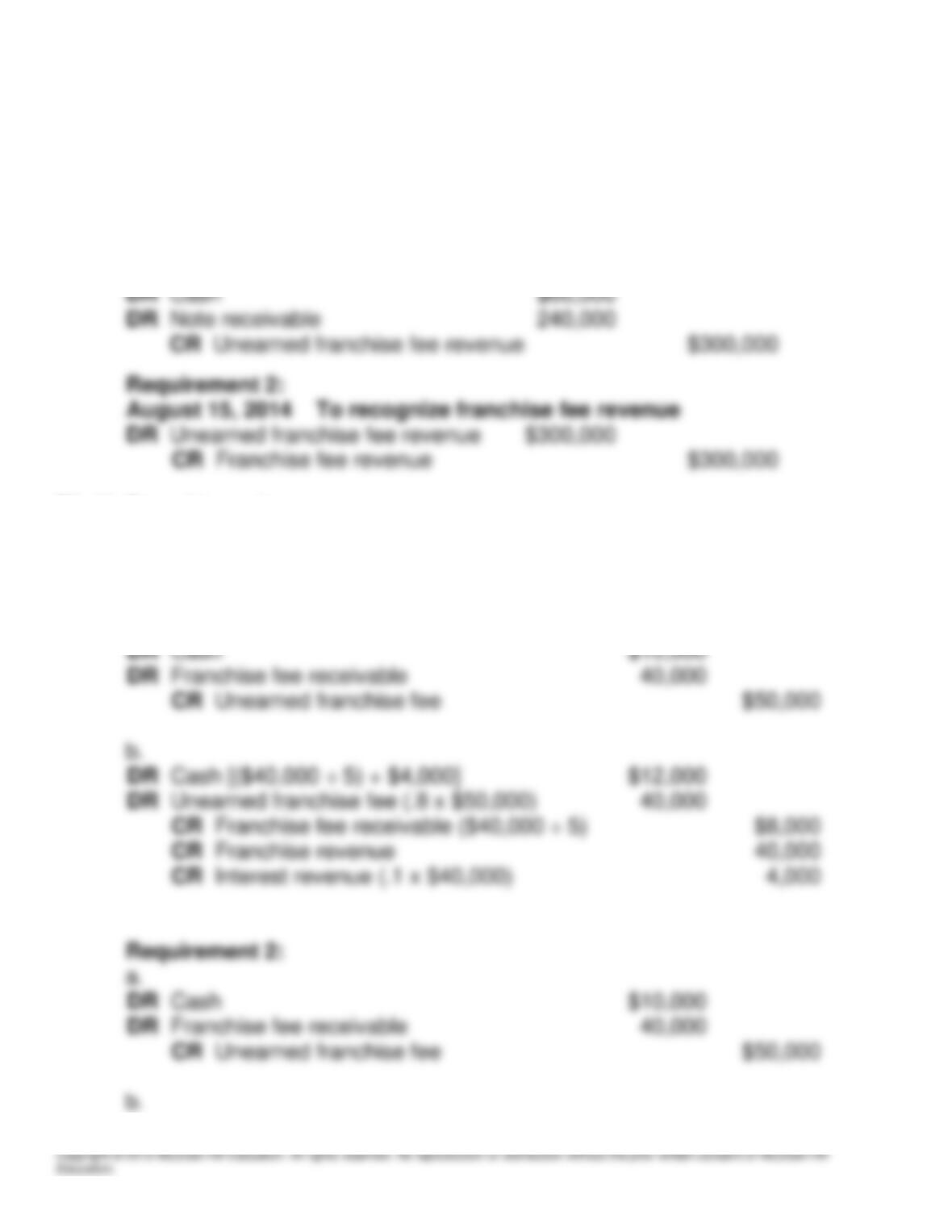
E3-11. Income determination for various methods of revenue recognition.
Requirement 1:
Completed production method
Requirement 2:
Sales method
Year
Selling
Price/Unit
− Cost/Unit =
Gross
Profit/Unit
Units Sold
Gross Profit
Recognized
2014
$1000
$600
$400
800
$320,000
2015
$1000
$600
$400
600
240,000
2016
$1000
$600
$400
600
240,000
$800,000
Requirement 3:
Year
Cash collected x
Percentage =
Gross Profit
recognized
2014
$650,000
.40
$260,000
2015
600,000
.40
240,000
2016
750,000
.40
300,000
$800,000
Requirement 4:
Cost-recovery method
Year
Cash collected −
Recovered cost =
Gross Profit
recognized
2014
$650,000
$480,000a
$170,000
2015
(2014) 150,000
0
150,000
(2015) 450,000
360,000b
90,000
240,000
2016
(2015) 150,000
0
150,000
(2016) 600,000
360,000c
240,000
390,000
$800,000
a800 x $600 = $480,000
b600 x $600 = $360,000
3-6
c600 x $600 = $360,000
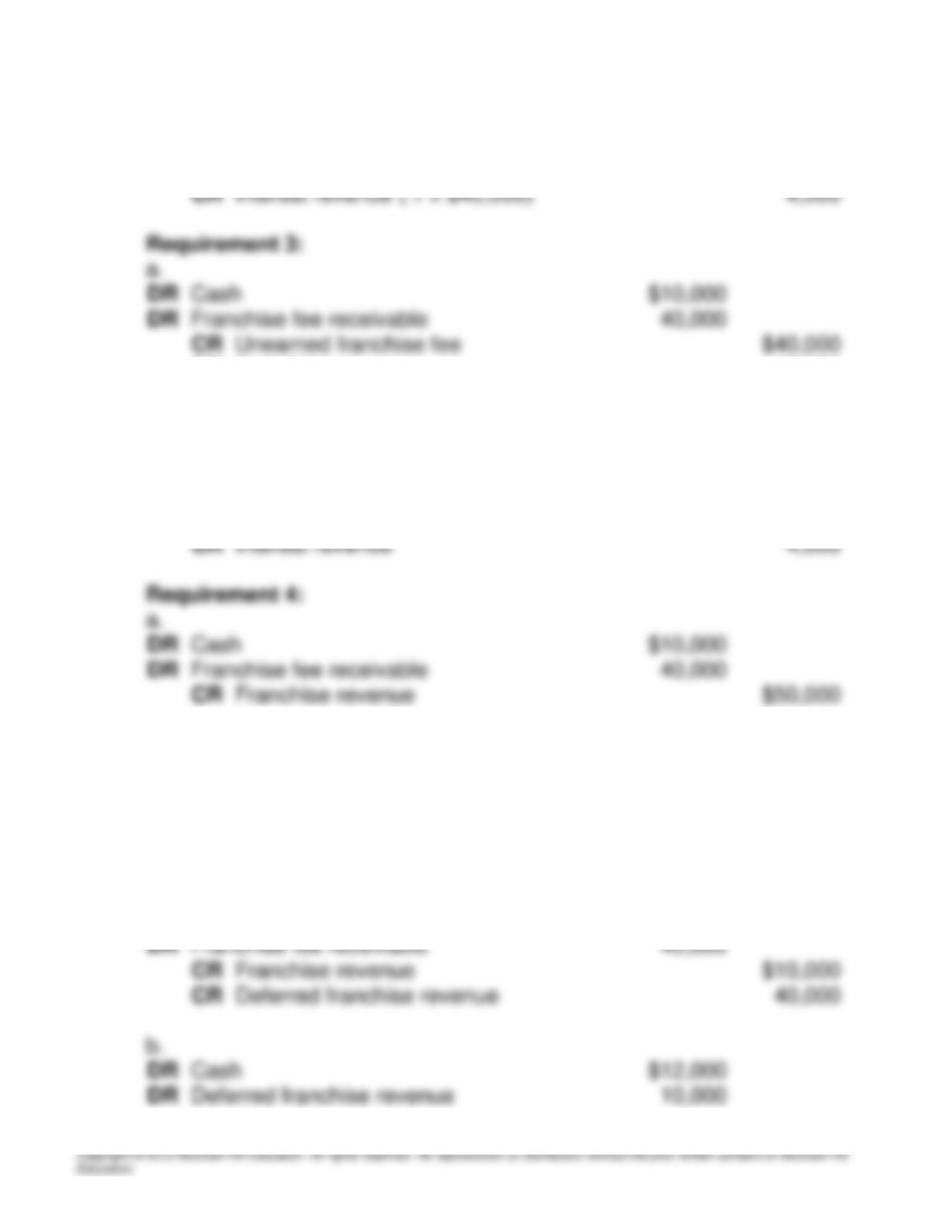
E3-12. Franchise sales; revenue recognition
Requirement 1:
April 1, 2014 To record franchise agreement and down payment
E3-13. Franchise sales.
Entry a is the initial franchise fee entry.
Entry b is the first installment and interest entry.
Requirement 1:
a.
DR Cash
$10,000
DR Franchise fee receivable
40,000
CR Unearned franchise fee
$50,000
b.
DR Cash [($40,000 ÷ 5) + $4,000]
$12,000
DR Unearned franchise fee (.8 x $50,000)
40,000
CR Franchise fee receivable ($40,000 ÷ 5)
$8,000
CR Franchise revenue
40,000
CR Interest revenue (.1 x $40,000)
4,000
Requirement 2:
a.
DR Cash
$10,000
DR Franchise fee receivable
40,000
CR Unearned franchise fee
$50,000
b.
3-7
DR Cash [($40,000 ÷ 5) + $4,000]
$12,000
DR Unearned franchise fee (.8 x $50,000)
40,000
CR Franchise fee receivable ($40,000 ÷ 5)
$8,000
CR Franchise revenue ($10,000 + $8,000)
18,000
CR Deferred franchise revenue
22,000
CR Interest revenue (.1 x $40,000)
4,000
DR Cash
$10,000
DR Franchise fee receivable
40,000
CR Unearned franchise fee
$40,000
CR Franchise revenue
10,000
b.
DR Cash [($40,000 ÷ 5) + $4,000]
$12,000
DR Unearned franchise fee
10,000
CR Franchise fee receivable
$8,000
CR Franchise revenue
10,000
CR Interest revenue
4,000
DR Cash
$10,000
DR Franchise fee receivable
40,000
CR Franchise revenue
$50,000
b.
DR Cash [($40,000 ÷ 5) + $4,000]
$12,000
CR Franchise fee receivable ($40,000 ÷ 5)
$8,000
CR Interest revenue
4,000
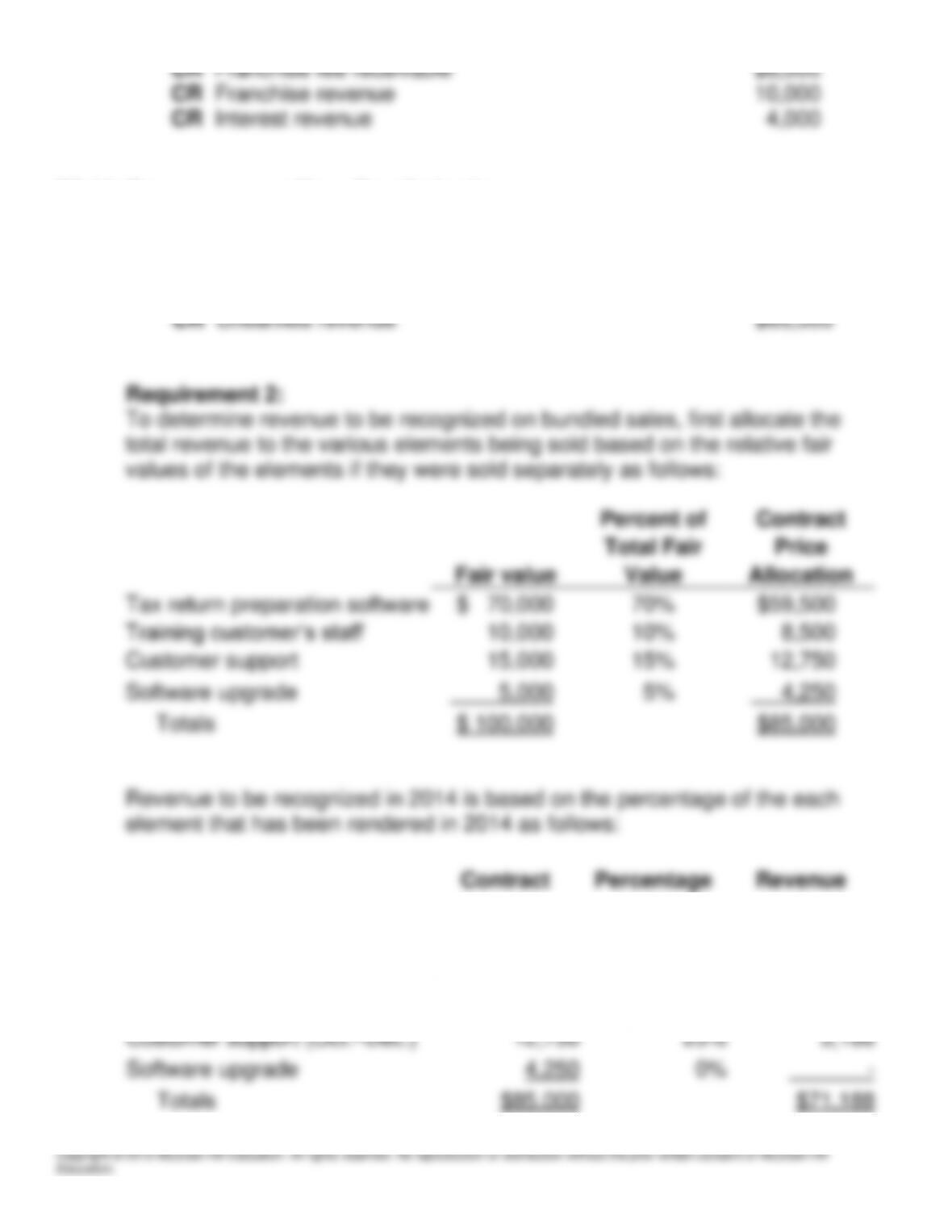
Requirement 5:
a.
DR Cash
$10,000
DR Franchise fee receivable
40,000
CR Franchise revenue
$10,000
CR Deferred franchise revenue
40,000
DR Cash
$12,000
DR Deferred franchise revenue
10,000
3-8
CR Franchise revenue
10,000
CR Interest revenue
4,000
E3-14. Revenue recognition: Bundled sales.
Requirement 1:
To record cash receipt for bundled sale
DR Cash
$85,000
CR Unearned revenue
$85,000
Requirement 2:
To determine revenue to be recognized on bundled sales, first allocate the
total revenue to the various elements being sold based on the relative fair
values of the elements if they were sold separately as follows:
Percent of
Contract
Total Fair
Price
Fair value
Value
Allocation
Tax return preparation software
$ 70,000
70%
$59,500
Training customer’s staff
10,000
10%
8,500
Customer support
15,000
15%
12,750
Software upgrade
5,000
5%
4,250
Totals
$ 100,000
$85,000
Revenue to be recognized in 2014 is based on the percentage of the each
element that has been rendered in 2014 as follows:
Contract
Percentage
Revenue
Price
Rendered
Recognized
Allocation
in 2014
in 2014
Tax return preparation software
$59,500
100%
$59,500
Training customer’s staff
8,500
100%
8,500
Customer support (Oct.–Dec.)
12,750
25%
3,188
Software upgrade
4,250
0%
–
Totals
$85,000
$71,188
CR Franchise fee receivable
$8,000
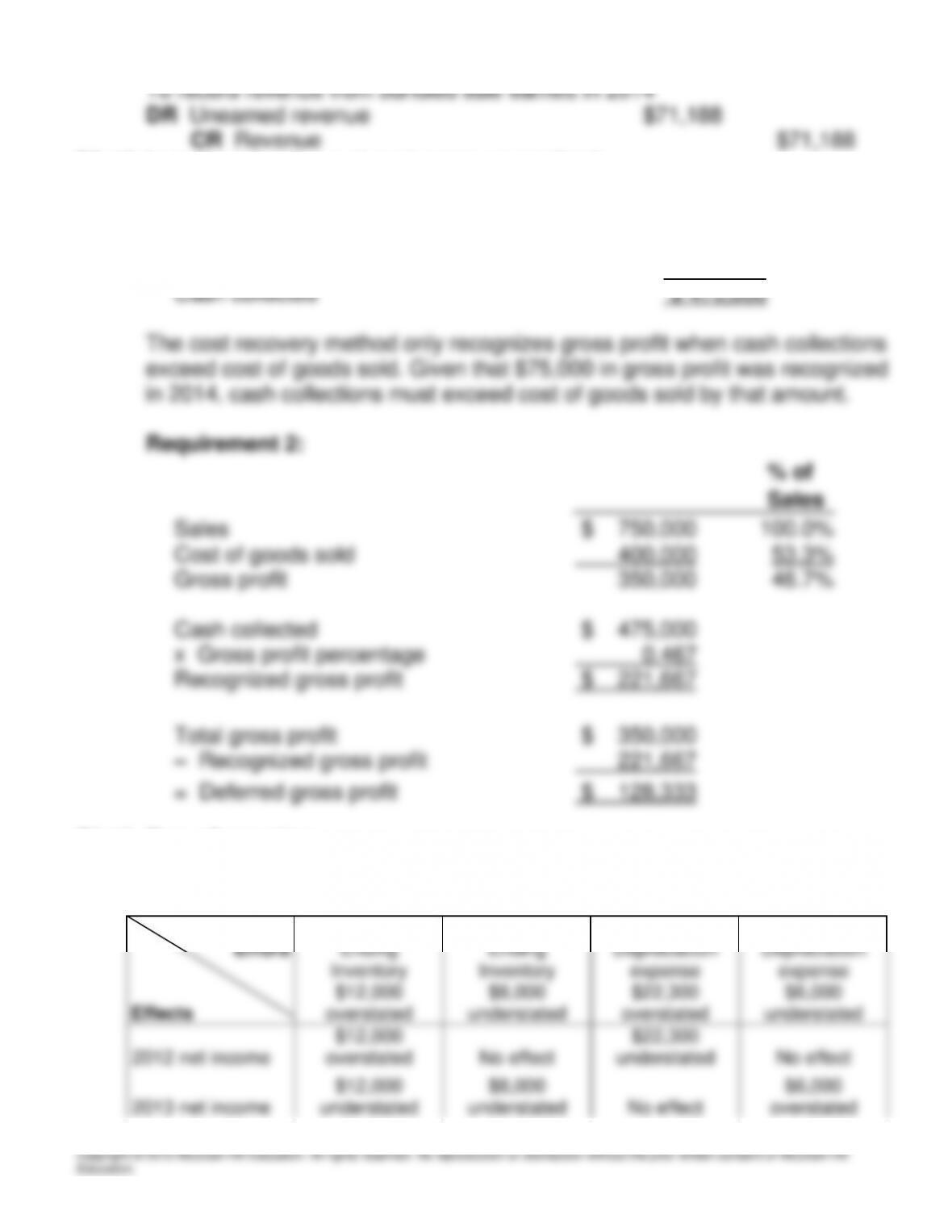
3-10
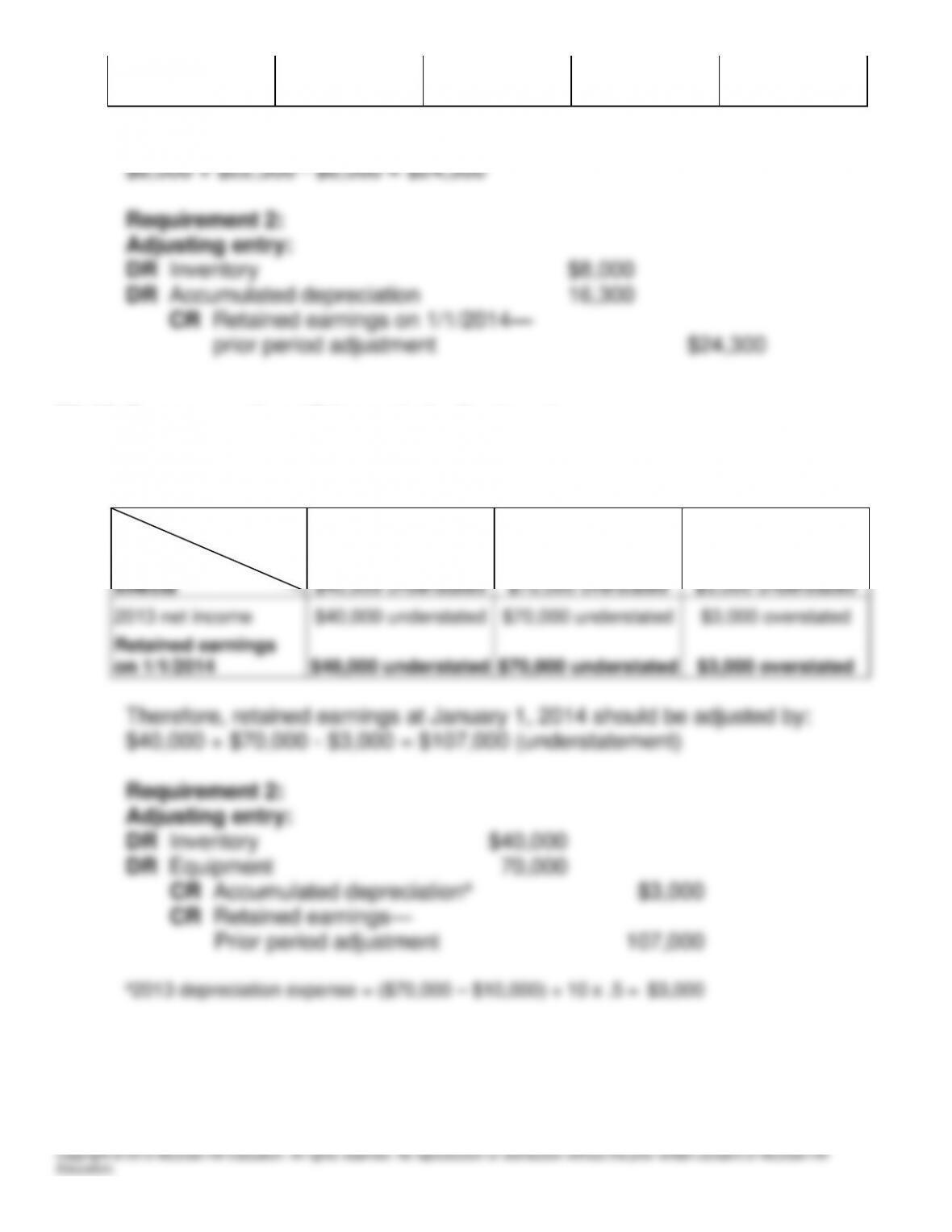
Retained earnings
on 1/1/2014
Correct
$8,000
understated
$22,300
understated
$6,000
overstated
Therefore, retained earnings at January 1, 2014 is understated by:
E3–17. Error correction / Prior period adjustment
Requirement 1:
Errors
2013
Ending Inventory
2013
Repairs expense
2013
Depreciation
expense
Effects
$40,000 understated
$70,000 overstated
$3,000 understated
2013 net income
$40,000 understated
$70,000 understated
$3,000 overstated
Retained earnings
on 1/1/2014
$40,000 understated
$70,000 understated
$3,000 overstated
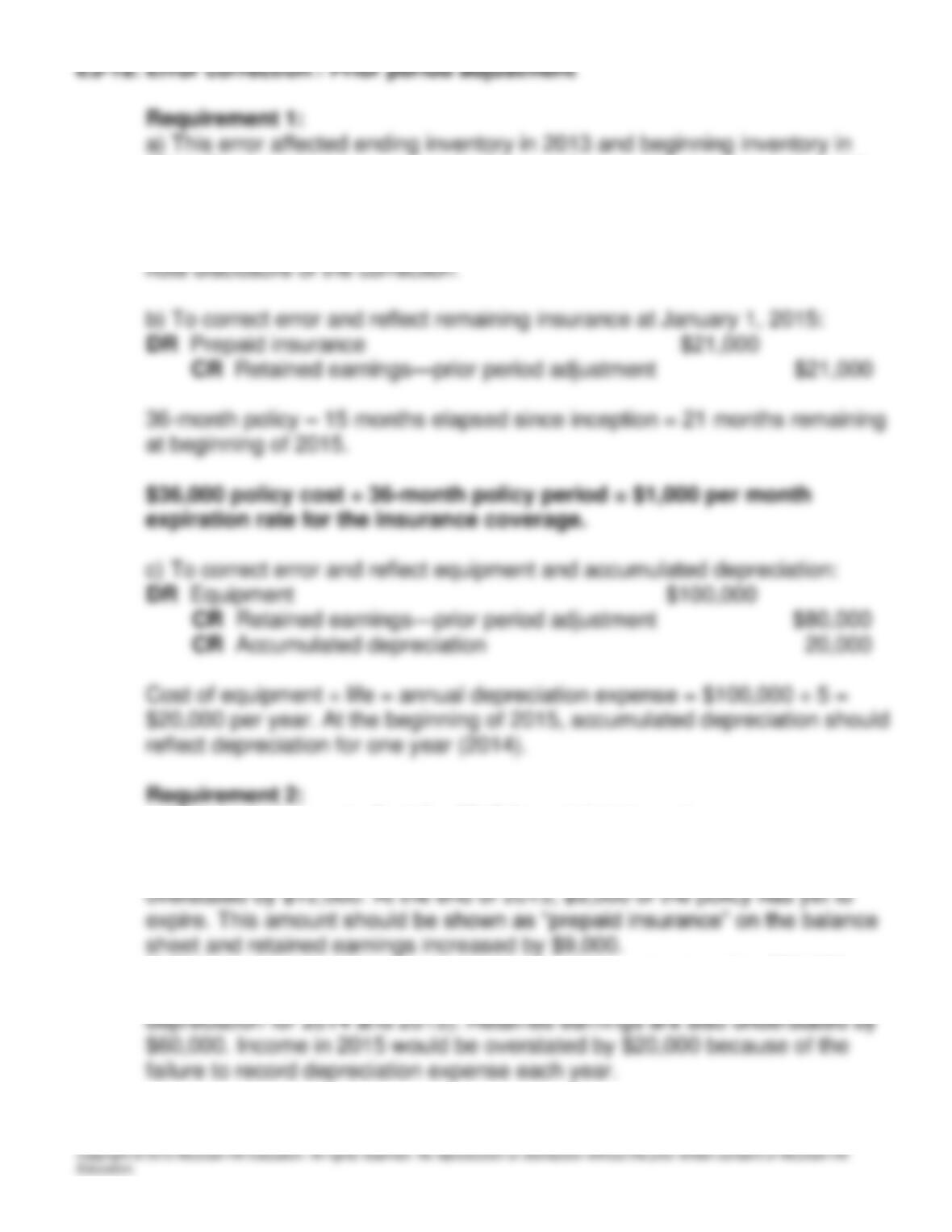
Therefore, retained earnings at January 1, 2014 should be adjusted by:
$40,000 + $70,000 – $3,000 = $107,000 (understatement)
Requirement 2:
Adjusting entry:
DR Inventory $40,000
DR Equipment 70,000
CR Accumulated depreciationa $3,000
CR Retained earnings—
Prior period adjustment 107,000
a2013 depreciation expense = ($70,000 – $10,000) ÷ 10 x .5 = $3,000
3-11
Copyright © 2015 McGraw-Hill Education. All rights reserved. No reproduction or distribution without the prior written consent of McGraw-Hill
Education.
Requirement 1:
a) This error affected ending inventory in 2013 and beginning inventory in
2014. Because inventory errors “self–correct” over a two-year period, and the
2014 financial statements have been issued, no entry is required. However, if
comparative financial statements are issued in 2015, income as presented for
2013 and 2014 should be restated to correct the error, making appropriate
a) This error does not affect the 2015 financial statements.
b) Insurance expense should be recorded at the rate of $12,000 per year as
the policy expires. If the error were not corrected, income in 2015 would be
3) Failure to correct this error leaves total assets understated by $60,000 at
the end of 2015. ($100,000 equipment cost – $40,000 accumulated
3-12
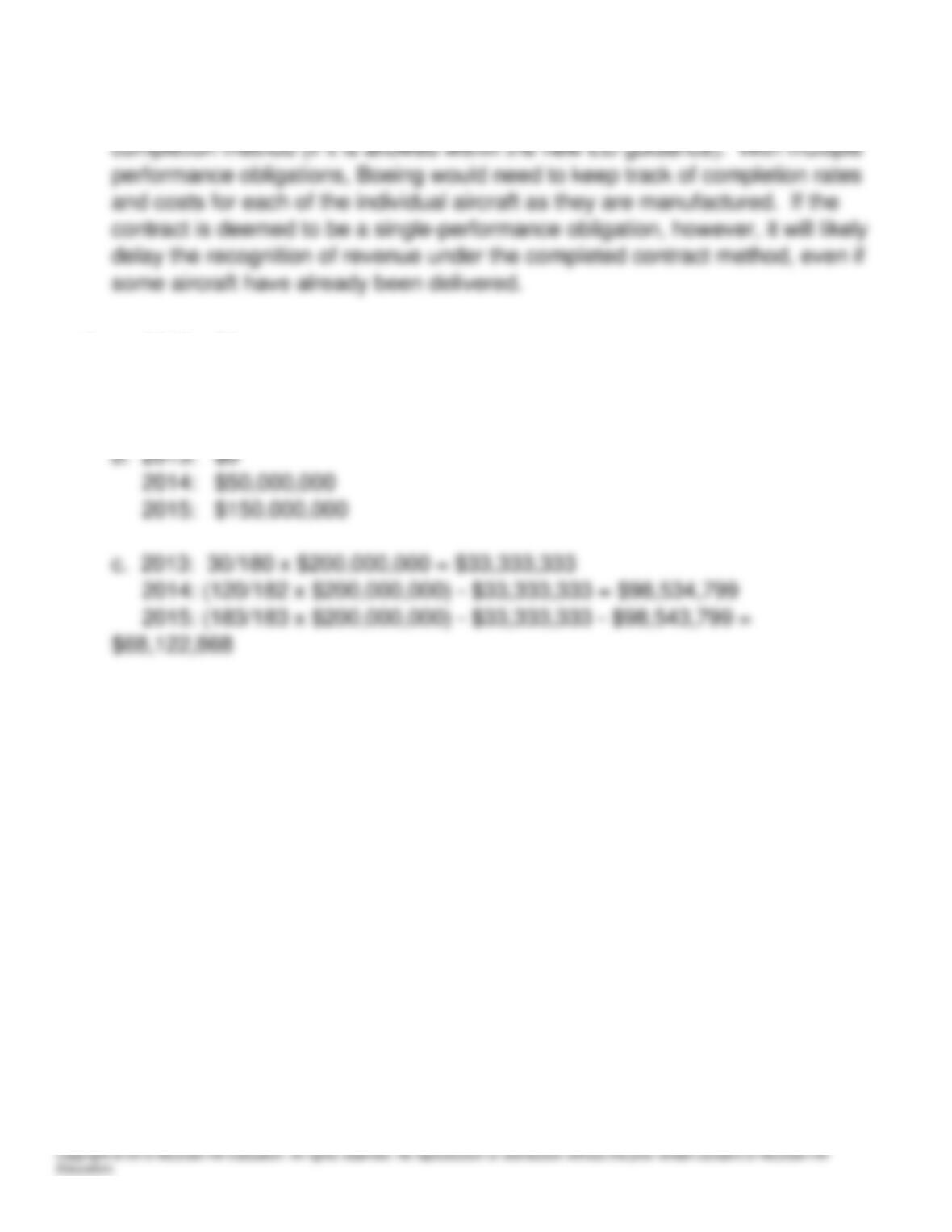
E3-19. Accounting for single versus multiple performance obligations
1. If the contract is deemed to be a single-performance obligation, it makes it
simpler for the company to recognize revenue under the percentage of
2. a. 2013: $0
2014: $0
2015: $200,000,000
3-13
Copyright © 2015 McGraw-Hill Education. All rights reserved. No reproduction or distribution without the prior written consent of McGraw-Hill
Education.
Financial Reporting and Analysis (6th Edition)
Chapter 3 Solutions
Additional Topics in Income Determination
Problems
Problems
P3–1. Revenue recognition methods
Requirement 1:
2014
2015
2016
Completion of production
Revenue (100,000 x $20)
$2,000,000
0
0
Cost of production
(1,200,000)
0
0
Selling expenses (100,000 x $1)
(100,000)
0
0
Net income
$700,000
0
0
Point of sale
Sales
$1,200,000
$800,000
0
Cost of goods sold
(720,000)
(480,000)
0
Selling expenses
(60,000)
(40,000)
0
Net income
$420,000
$280,000
0
Installment method
Gross profit ratio: $8/$20 = 40%
Revenue (Cash collections)
$1,000,000
$800,000
$200,000
Cost of sales (60% x sales)
(600,000)
(480,000)
(120,000)
Selling expenses
(60,000)
(40,000)
0
Net income
$340,000
$280,000
$80,000
Requirement 2:
a. Completion of production
To record production
DR Inventory
$1,200,000
CR Cash
$1,200,000
DR Inventory
$800,000
DR Cost of production
1,200,000
CR Revenue
$2,000,000
3-14
To record sales
DR Accounts receivable
$1,200,000
CR Inventory
$1,200,000
To record collections
DR Cash
$1,000,000
CR Accounts receivable
$1,000,000
To record selling expenses
DR Selling expenses
$100,000
CR Cash
$60,000
CR Inventory
40,000
b. Point of sale
To record production
DR Inventory
$1,200,000
CR Cash
$1,200,000
DR Accounts receivable
$1,200,000
CR Sales
$1,200,000
DR Cost of goods sold
$720,000
CR Inventory
$720,000
To record collections
DR Cash
$1,000,000
CR Accounts receivable
$1,000,000
To record selling expenses
DR Selling expenses
$60,000
CR Cash
$60,000
c. Installment method
To record production
DR Inventory
$1,200,000
CR Cash
$1,200,000
To record revenue
DR Accounts receivable
$1,200,000
CR Sales
$1,200,000
CR Inventory
CR Accounts receivable
$1,000,000
CR Cost of goods sold
CR Realized gross profit ($1,000,000 x .4)