Commercial service income
(215,000)
**Income from continuing operations, before taxes
2,355,600
Estimated selling price of commercial service
component
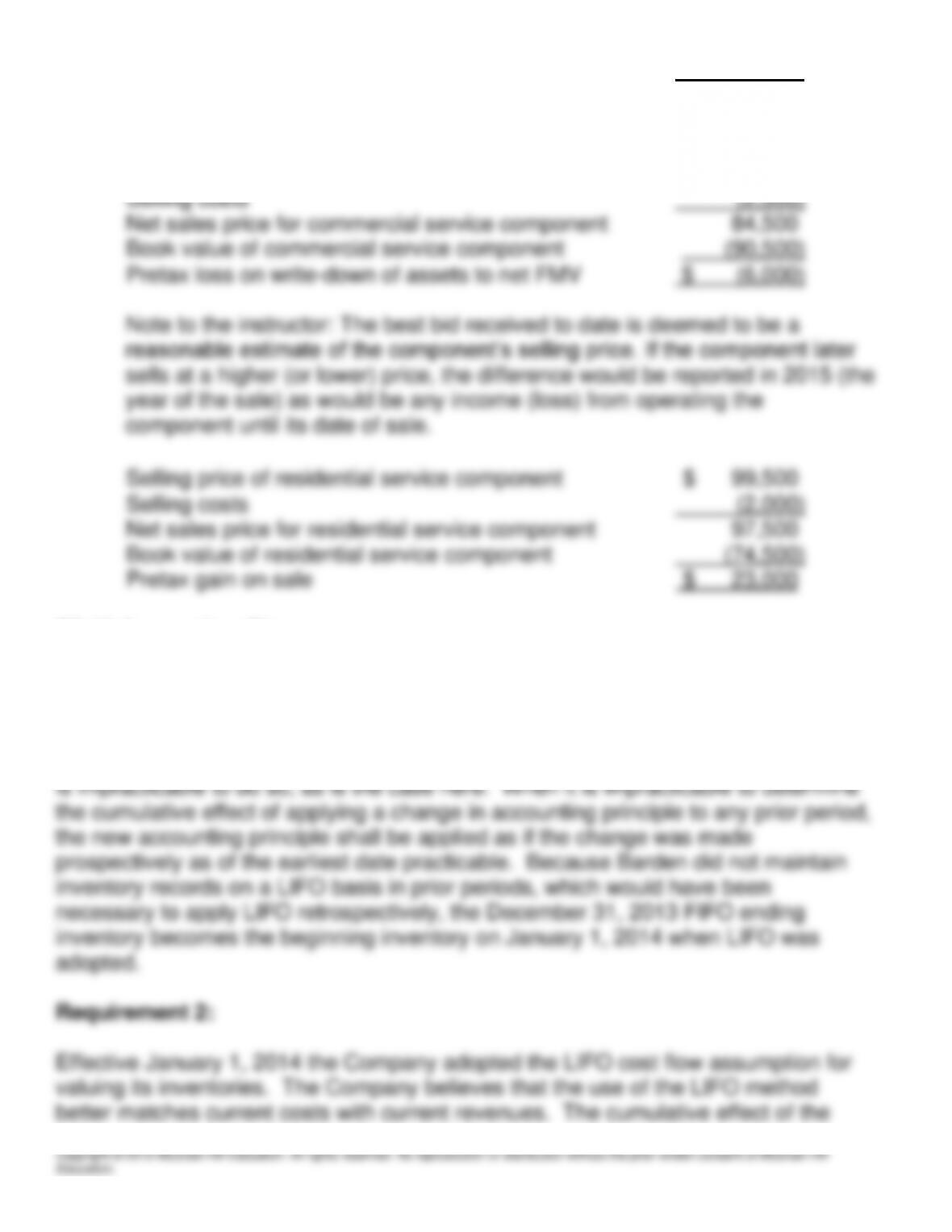
$ 87,000
Selling costs
(2,500)
Net sales price for commercial service component
84,500
Book value of commercial service component
(90,500)
Pretax loss on write-down of assets to net FMV
$ (6,000)
Selling price of residential service component
$ 99,500
Selling costs
(2,000)
Book value of residential service component
(74,500)
Pretax gain on sale
$ 23,000
2-47
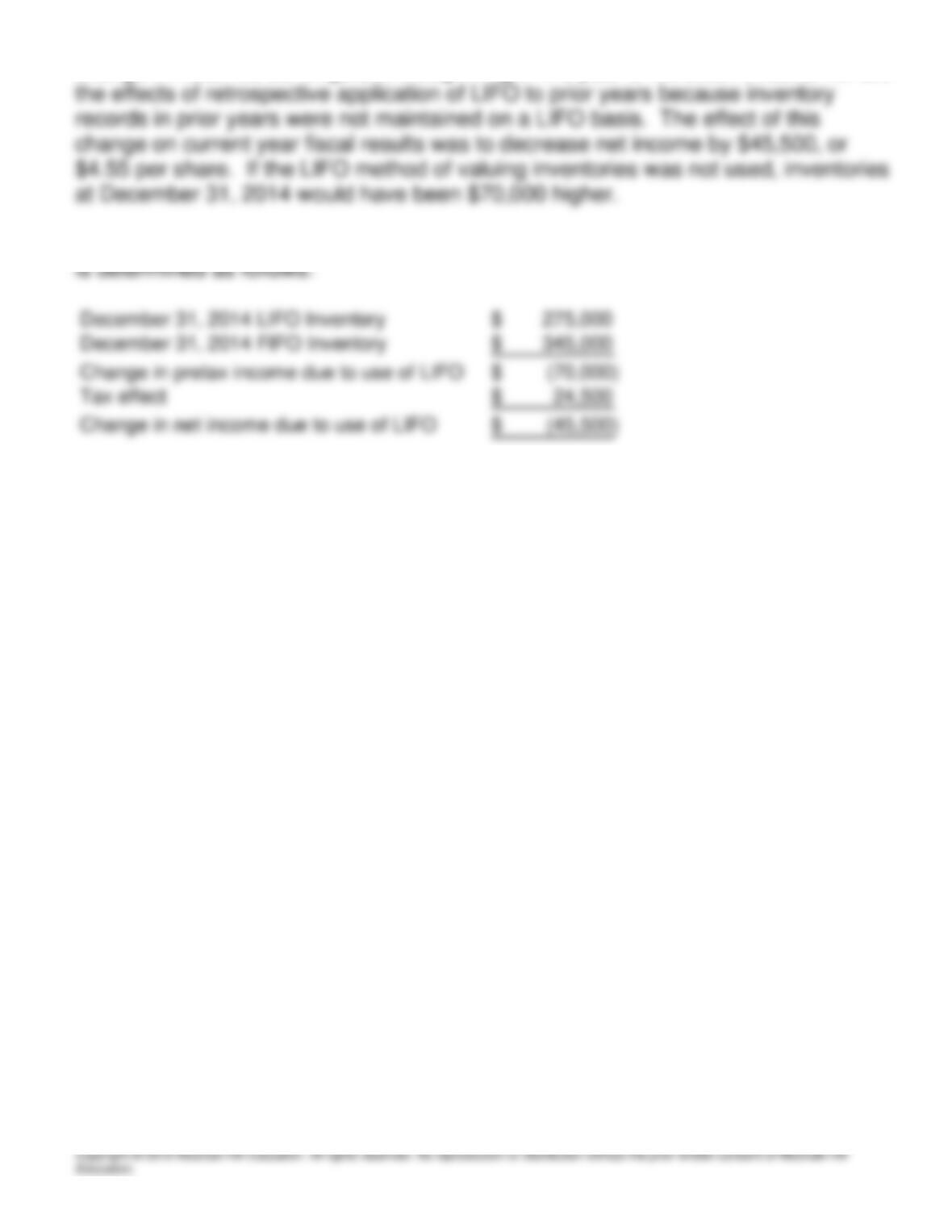
change on retained earnings at the beginning of the year is not determinable, nor are
Note to the instructor: The effect on the change in inventory method on 2014 income
2-48
P2-17. Disclosures for change in accounting principle
Requirement 1:
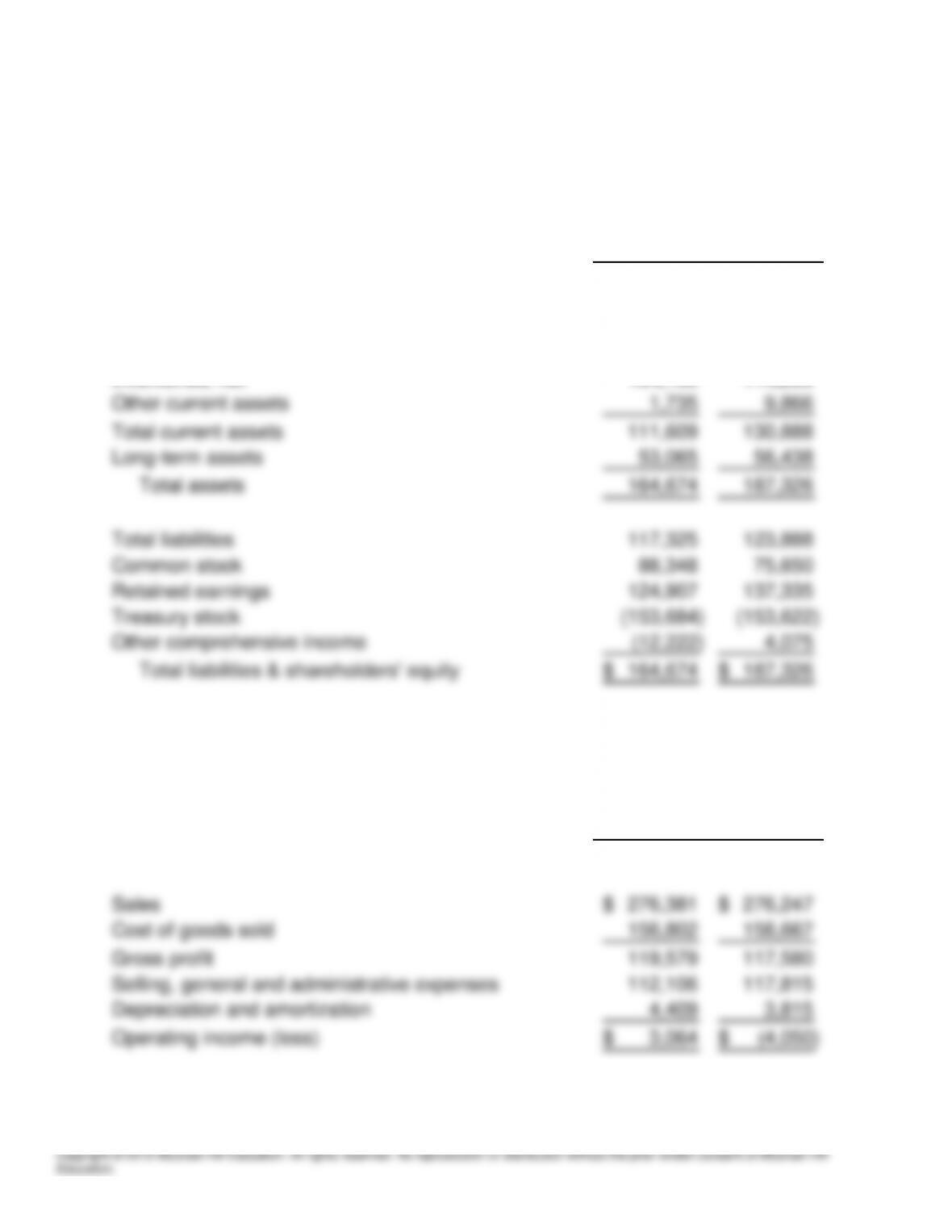
ABBA Fabrics, Inc.
Balance Sheets (Restated)
December 31, 2014 2013
(in thousands)
Current assets:
Cash and cash equivalents 2,338$ 2,280$
Receivables, less allowance for doubtful accounts 3,380 4,453
Inventories, net 104,156 114,289
Other current assets 1,735 9,866
Total current assets 111,609 130,888
Long-term assets 53,065 56,438
Total assets 164,674 187,326
Total liabilities 117,325 123,888
Common stock 88,348 75,650
(in thousands)
Sales 276,381$ 276,247$
Cost of goods sold 156,802 158,667
Gross profit 119,579 117,580
Selling, general and administrative expenses 112,106 117,815
Depreciation and amortization 4,409 3,815
Operating income (loss) 3,064$ (4,050)$
2-49
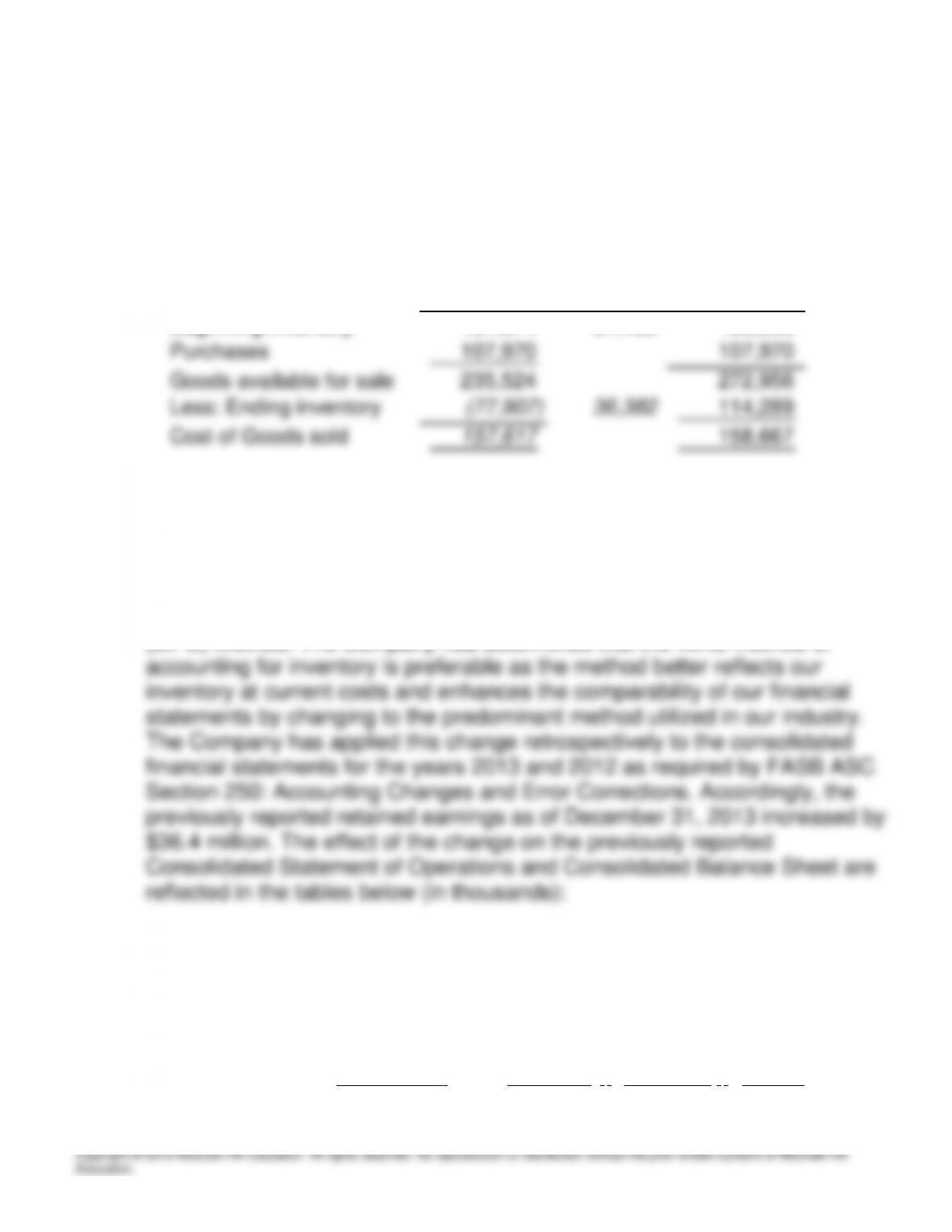
Restated cost of goods sold is determined as follows (italicized = items given in the
problem):
2013 LIFO 2013
LIFO Adjustment WAC
As reported Adjusted
Beginning inventory 127,574 37,432 165,006
Purchases 107,970 107,970
Goods available for sale 235,524 272,956
Less: Ending inventory (77,907) 36,382 114,289
Cost of Goods sold 157,617 158,667
Requirement 2:
Retrospective Application of a Change in Accounting Principle
During the fourth quarter of 2014, the Company elected to change its method
of valuing inventory to the weighted average cost (“WAC”) method, whereas
in all prior years inventory was valued using the last-in, first-out
(LIFO) method. The Company has determined that the WAC method of
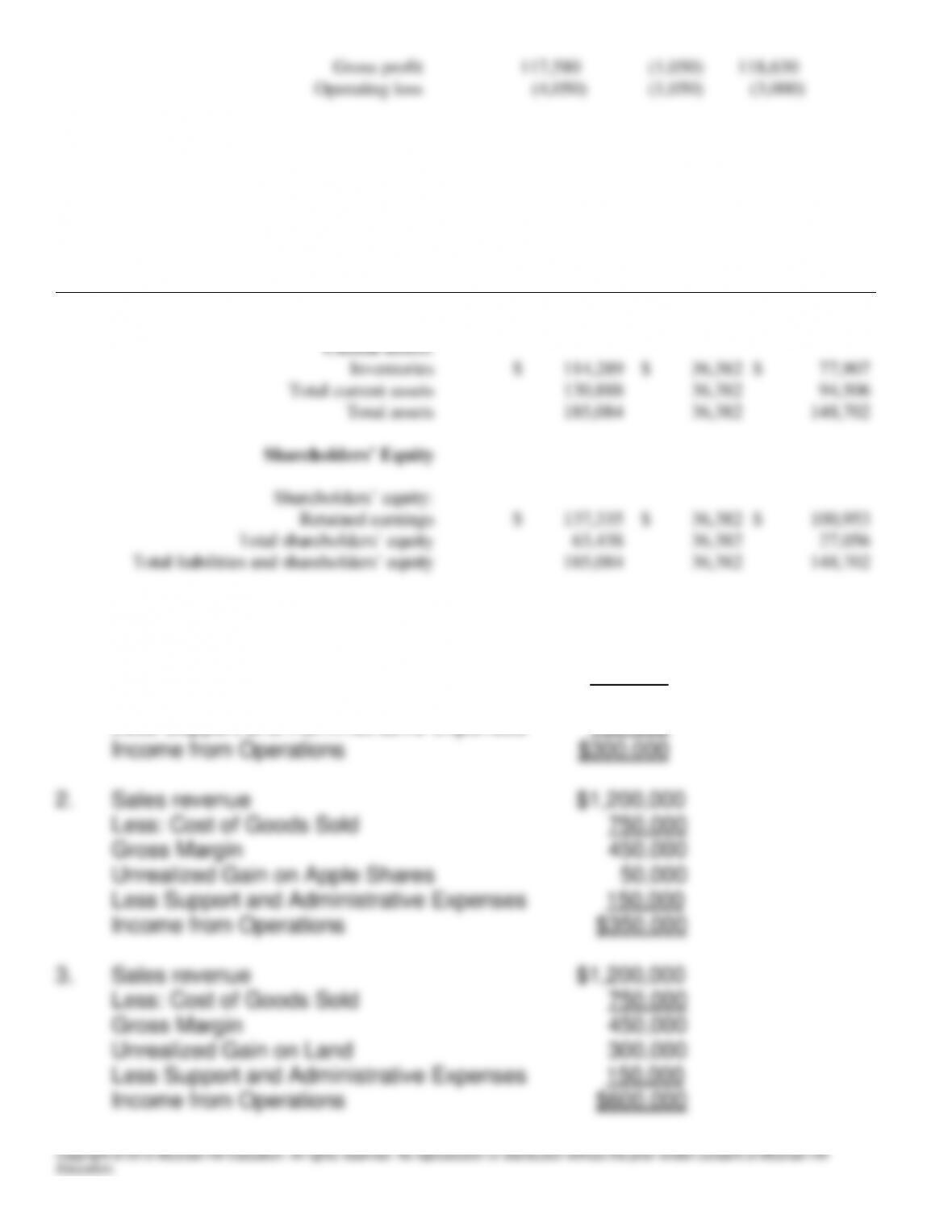
Consolidated Statements of Operations for the fiscal year ended December 31,
2013
2013
2013
As
LIFO
previously
(in thousands)
As restated
Adjustment
reported
Cost of goods sold
$
158,667
$
1,050
$
157,617
2-50
Gross profit
117,580
(1,050
)
118,630
Operating loss
(4,050
)
(1,050
)
(3,000
)
Consolidated Balance Sheet as of December 31, 2013
LIFO
As previously
(in thousands)
As restated
Adjustment
reported
Assets
Current assets:
Inventories
$
114,289
$
36,382
$
77,907
Total current assets
130,888
36,382
94,506
Total assets
185,084
36,382
148,702
Shareholders’ Equity
Shareholders’ equity:
Retained earnings
$
137,335
$
36,382
$
100,953
Total shareholders’ equity
63,438
36,382
27,056
Total liabilities and shareholders’ equity
185,084
36,382
148,702
P2-18: Isolating OCI Components
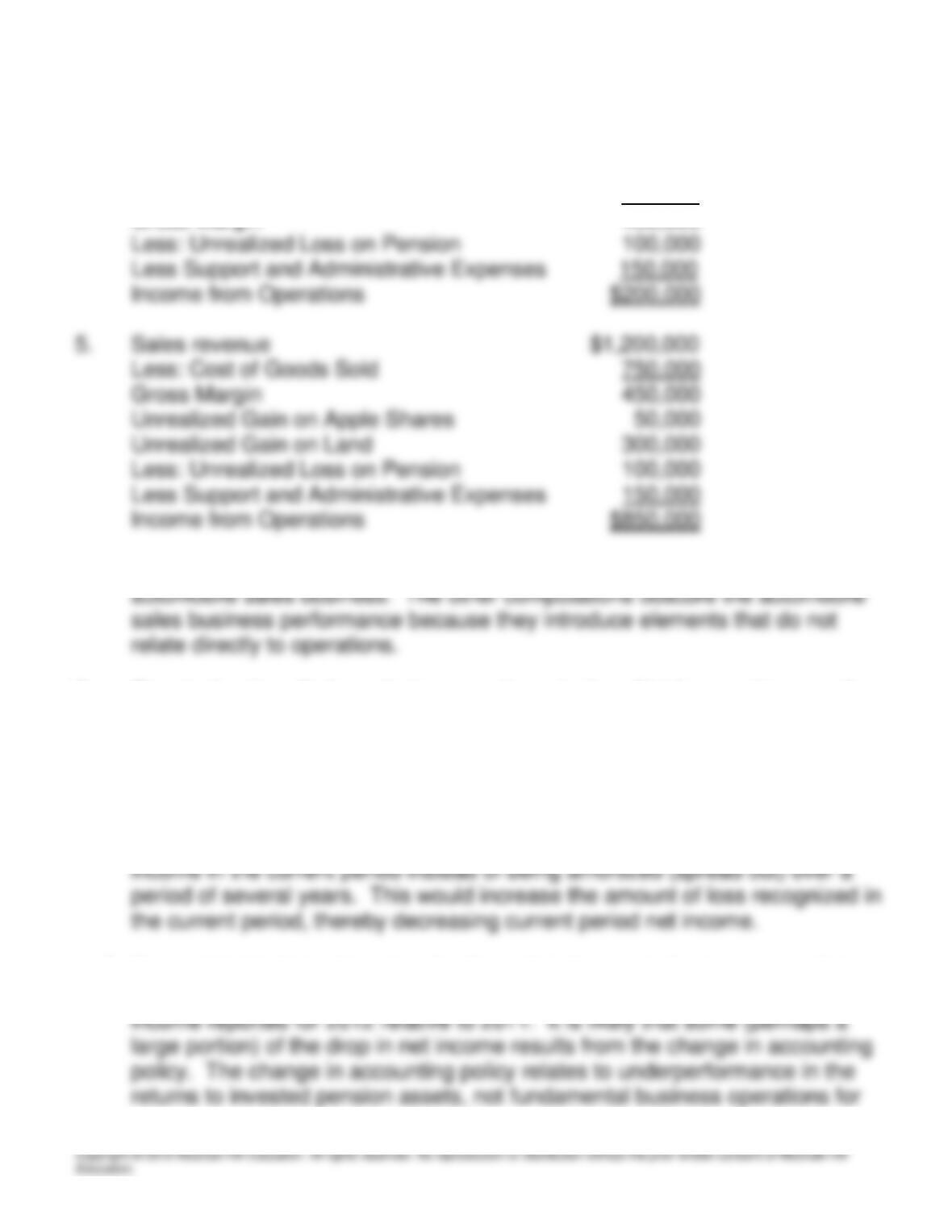
1. Sales revenue $1,200,000
Less: Cost of Goods Sold 750,000
Gross Margin 450,000
Less Support and Administrative Expenses 150,000
2-51
4. Sales revenue $1,200,000
Less: Cost of Goods Sold 750,000
Gross Margin 450,000
6. The first computation best reflects the operational performance of the
7. Standard setters likely exclude some elements from Net Income because they
might obscure the current-period fundamental performance of the company.
P2-19: UPS Change in Accounting Policy
1. If there are losses accruing into Other Comprehensive Income (OCI), the
change in accounting policy will have a portion of them recognized as part of
2. If an analyst is trying to assess fundamental changes in business operations,
this change might obscure it. Note that there was a significant drop in net

2-52
Copyright © 2015 McGraw-Hill Education. All rights reserved. No reproduction or distribution without the prior written consent of McGraw-Hill
Education.
UPS, which involves providing package delivery services. Therefore, this
accounting policy change may obscure the analyst’s ability to understand
fundamental changes in operations or the business environment.
2-53
Financial Reporting and Analysis (6th Ed.)
Chapter 2 Solutions
Accrual Accounting and Income Determination Cases
Cases
C2-1. Discontinued operations
Requirement 1:
FASB ASC Paragraph 360–10–45-9 specifies the following criteria to be met in
order to classify assets as held for sale:
that assets be transferred within one year to qualify for “held for sale”
treatment. FASB ASC Paragraph 360-10–45–11 lists several exceptions to the
“one–year” requirement for completing the sale. Waiting for pending
regulatory approval would qualify as such an exception if management
2-54
The scenario for this requirement implies that management’s plans have
changed since the original disposal plan was adopted. Clearly, the unit in
question is no longer available for immediate sale. While it is permissible to
continue to classify assets as held for sale when conditions are unexpectedly
1. Sales by Company-operated stores are recognized on a cash basis at the
2. Franchise revenue consists of (a) rents and royalties and (b) initial
franchise fees. Initial fees are recognized upon opening of a restaurant or
granting of a new franchise term, which is when McDonalds has performed
Rents and royalties are recognized in the period earned thus the critical
events would be sales by the franchisees (the basis for royalties) or the
passage of time (the basis for time-based rents or minimum royalty payments
where applicable). Realizability is presumably not an issue as McDonalds
C2-3. Retrospective Application of a Change in Accounting Principle
Requirement 1:
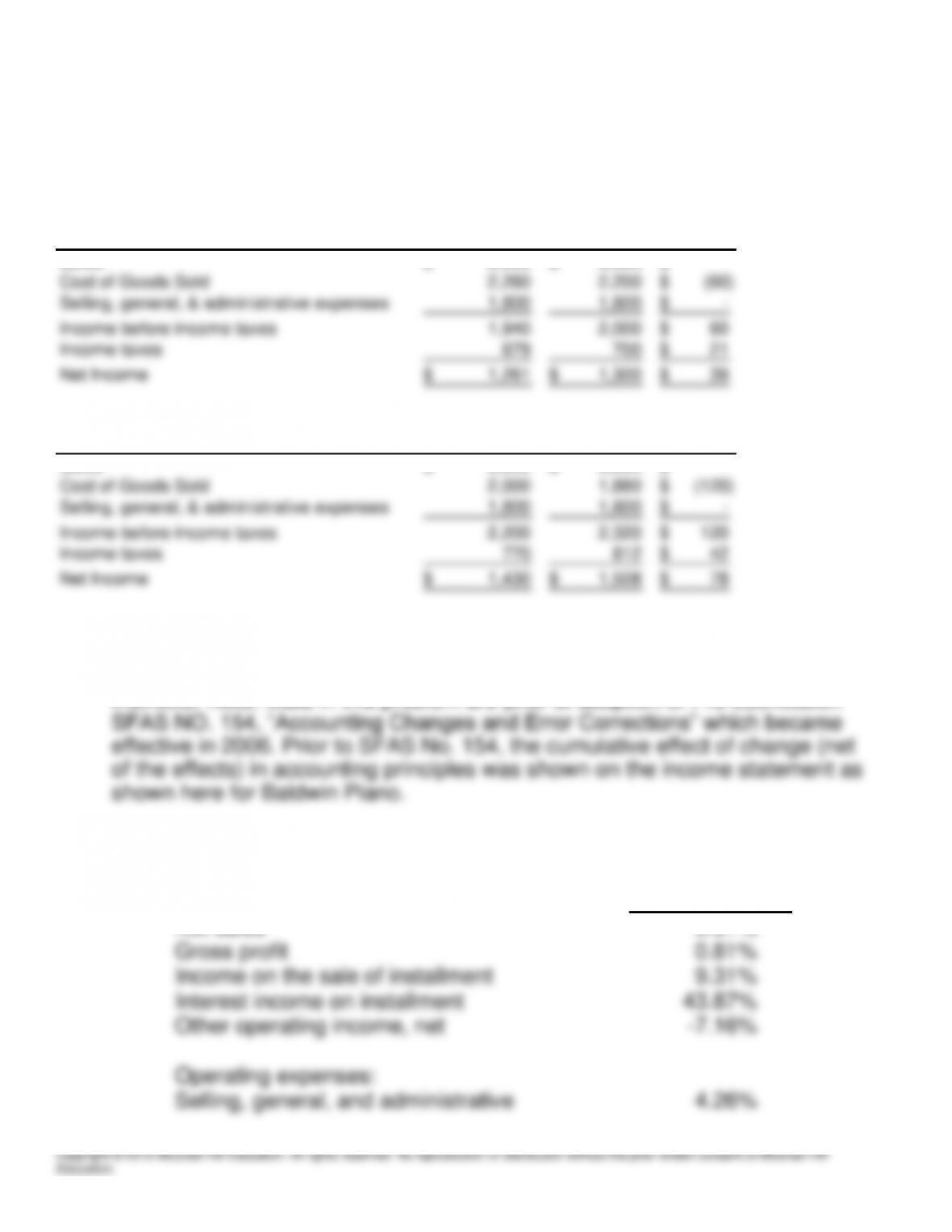
Income Statements 2013 2012
Sales 6,000$ 6,000$
Cost of Goods Sold 2,200 1,880
Selling, general, & administrative expenses 1,800 1,800
Income before income taxes 2,000 2,320
Income taxes 700 812
As adjusted
2-56
Neville Company into conformity with prevailing practices in its industry and
comparative financial statements of prior years have been adjusted to apply
the new method retrospectively. The following financial statement line items
for fiscal years 2014 and 2013 were affected by the change in accounting
principle.
Income Statements As Computed As Reported Effect of
2013 under LIFO under FIFO Change
Sales 6,000$ 6,000$ –$
Cost of Goods Sold 2,260 2,200 (60)$
Selling, general, & administrative expenses 1,800 1,800 –$
Income before income taxes 1,940 2,000 60$
Income taxes 679 700 21$
Net Income 1,261$ 1,300$ 39$
As Originally As Effect of
2012 Reported Adjusted Change
Sales 6,000$ 6,000$ –$
Cost of Goods Sold 2,000 1,880 (120)$
Selling, general, & administrative expenses 1,800 1,800 –$
Income before income taxes 2,200 2,320 120$
Income taxes 770 812 42$
Net Income 1,430$ 1,508$ 78$
C2–4. Baldwin Piano: Analyzing and interpreting of income statement
Instructor Note: Data in this problem are prior to adoption of Pre-codification
To analyze the change in Baldwin’s profitability, we compute the year–to-year
change in several of the income statement items.
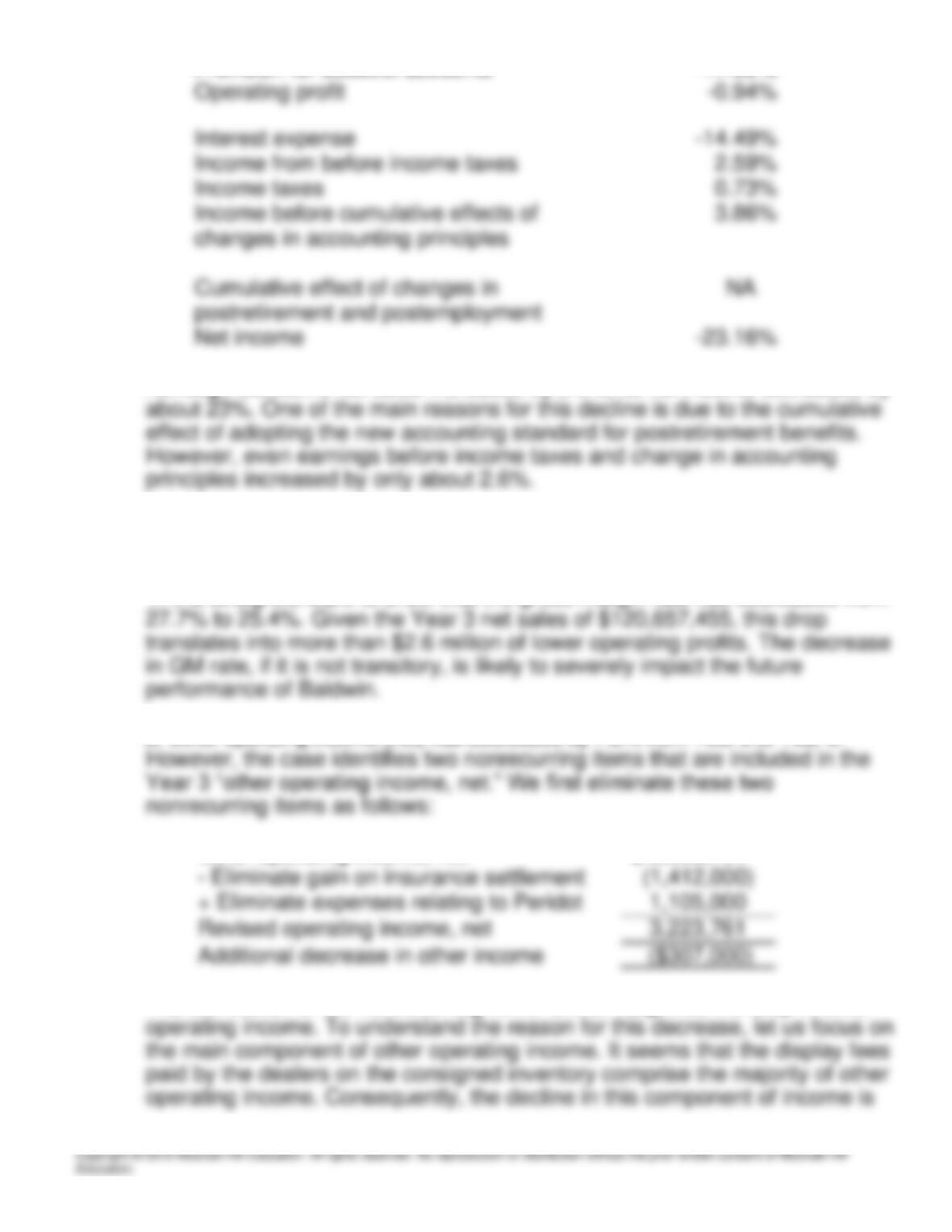
Year 2 to Year 3
Net sales
Gross profit
Interest income on installment
Other operating income, net
-7.16%
Operating expenses:
Selling, general, and administrative
4.26%
2-57
Provision for doubtful accounts
-17.09%
Operating profit
-0.94%
Interest expense
-14.49%
Income from before income taxes
2.59%
Income taxes
0.73%
Income before cumulative effects of
3.86%
changes in accounting principles
Cumulative effect of changes in
NA
postretirement and postemployment
Net income
-23.16%
Although Baldwin’s net sales increased by 9.6%, its net income decreased by
Several factors have contributed to the less than proportionate increase in
profits.
1. It is straightforward to show that the gross margin rate has decreased from
2. Other operating income (net) has decreased by 7.2% from Year 2 to Year 3.
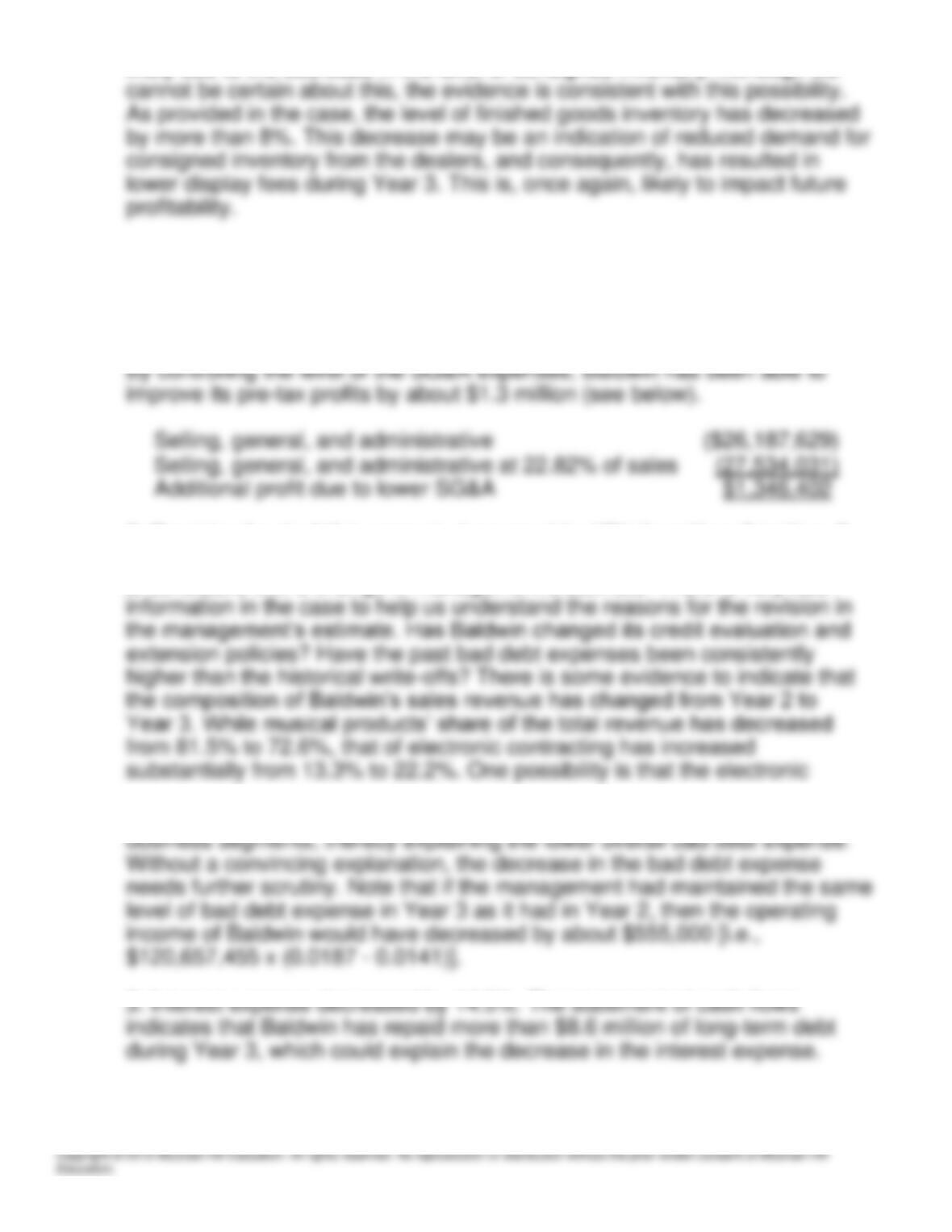
Other operating income, net
$ 3,530,761
– Eliminate gain on insurance settlement
(1,412,000)
+ Eliminate expenses relating to Peridot
1,105,000
Revised operating income, net
3,223,761
Additional decrease in other income
($307,000)
The elimination of the nonrecurring items further magnifies the drop in other
2-58
likely due to the decrease in the level of consigned inventory. Although we
However, the following positive “factors” have had a mitigating effect on the
income statement.
1. SG&A expenses increased by only 4.3%. This could be due to scale
economies. In Year 2, the SG&A expenses were 22.82% of sales revenue.
2. Provision for doubtful accounts decreased by 17% from Year 2 to Year 3;
i.e., it has decreased from 1.87% of net sales to about 1.41%. This decrease
is consistent with a change in management’s estimate. There is very little
contracting business has lower bad debt expense compared to the other
2-59
4. As discussed earlier, there are significant differences in the inter-segment
growth rates in revenues. The musical products segment now accounts for
only 72.7% revenue as opposed to 81.5% in Year 2. In addition, the operating
profitability of this segment has decreased substantially from 7.6% to 5.0%.
However, the electronic contracting segment, whose revenue has been
growing at a greater rate, has a higher operating margin. Given that the