2-1
Financial Reporting and Analysis (6th Ed.)
Chapter 2 Solutions
Accrual Accounting and Income Determination
Exercises
Exercises
E2–1. Determining accrual and cash basis revenue
(AICPA adapted)
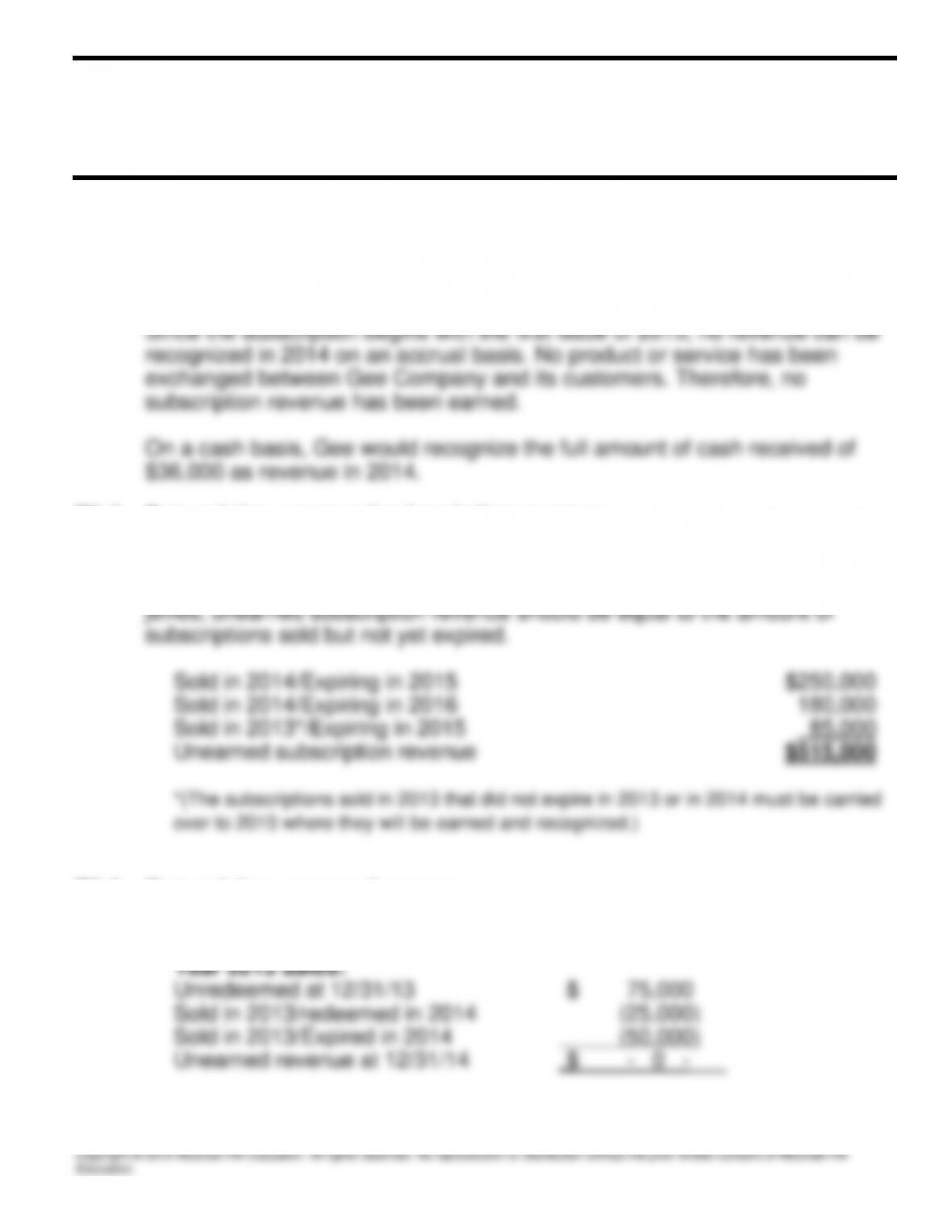
E2–2. Determining unearned subscription revenue
(AICPA adapted)
Since subscription revenue is not earned until the customer has received the
E2–3. Determining unearned revenue
(AICPA adapted)
Year 2013 Sales:
Unredeemed at 12/31/13
$ 75,000
Sold in 2013/redeemed in 2014
(25,000)
Sold in 2013/Expired in 2014
(50,000)
Unearned revenue at 12/31/14
$ – 0 –

2-2
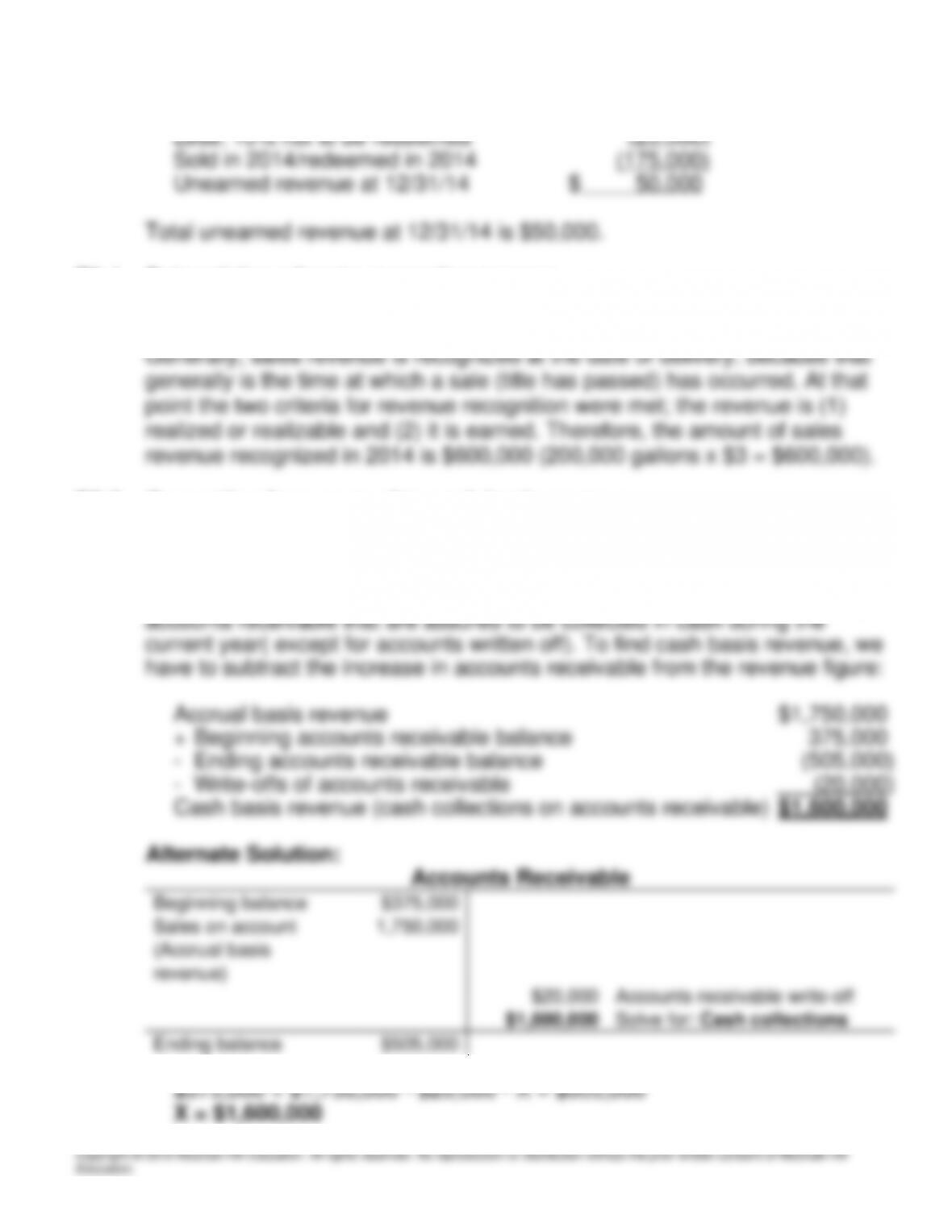
Year 2014 Sales:
Sales of gift certificates
$ 250,000
Less: 10% not to be redeemed
(25,000)
Sold in 2014/redeemed in 2014
(175,000)
Unearned revenue at 12/31/14
$ 50,000
E2–4. Determining when to recognize revenue
(AICPA adapted)
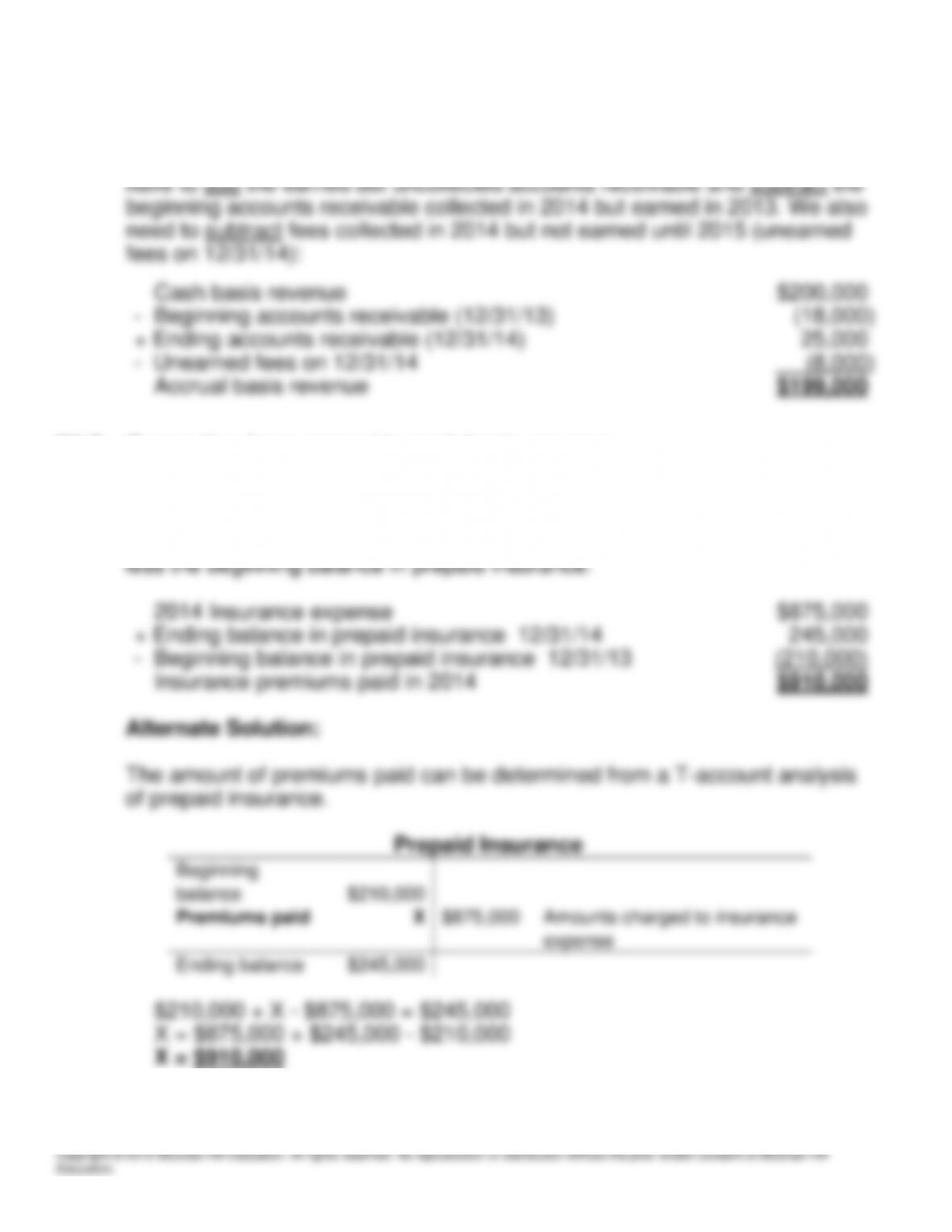
E2–5. Converting from accrual to cash basis revenue
(AICPA adapted)
Under the cash basis of income determination, the company would not regard
its ending accounts receivable as revenue but it would include beginning
2-4
E2–6. Converting from cash to accrual basis revenue
(AICPA adapted)
To change Dr. Hamilton’s revenue from cash basis to an accrual basis, we
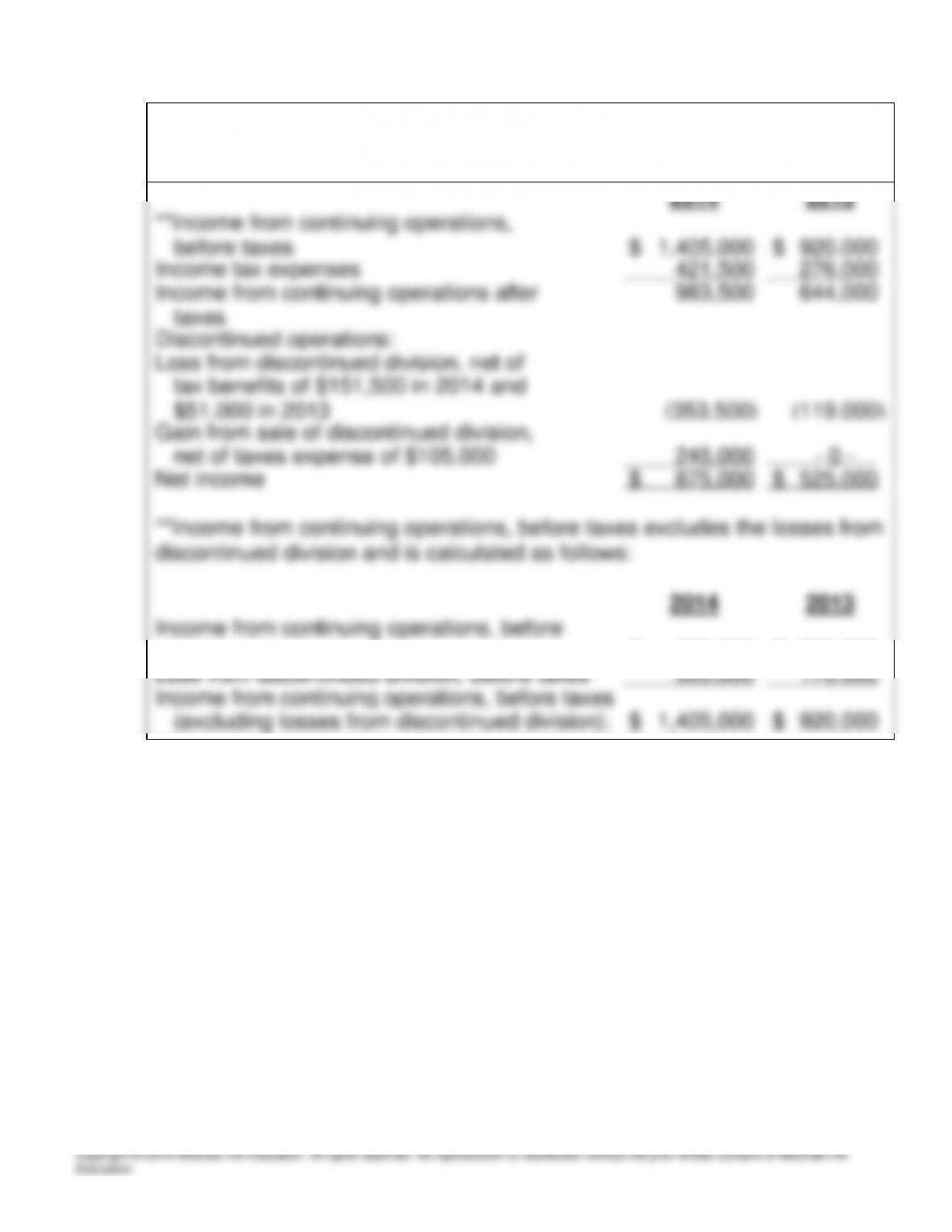
E2-7. Converting from accrual to cash basis expense
(AICPA adapted)
The total amount of insurance premiums paid in 2014 is equal to the
insurance expense for 2014 plus the ending balance in prepaid insurance and
2-5
E2-8. Determining Gain (loss) from discontinued operations
Munnster Corporation
Partial Income Statement
For the Years Ended December 31
2014
2013
**Income from continuing operations,
before taxes
$ 1,405,000
$ 920,000
Income tax expenses
421,500
276,000
Income from continuing operations after
taxes
983,500
644,000
Discontinued operations:
Loss from discontinued division, net of
tax benefits of $151,500 in 2014 and
$51,000 in 2013
(353,500)
(119,000)
Gain from sale of discontinued division,
net of taxes expense of $105,000
245,000
– 0 –
Net income
$ 875,000
$ 525,000
**Income from continuing operations, before taxes excludes the losses from
discontinued division and is calculated as follows:
2014
2013
Income from continuing operations, before
taxes
$ 900,000
$ 750,000
Loss from discontinued division, before taxes
505,000
170,000
Income from continuing operations, before taxes
(excluding losses from discontinued division):
$ 1,405,000
$ 920,000
2-6
E2-9. Determining loss on discontinued operations
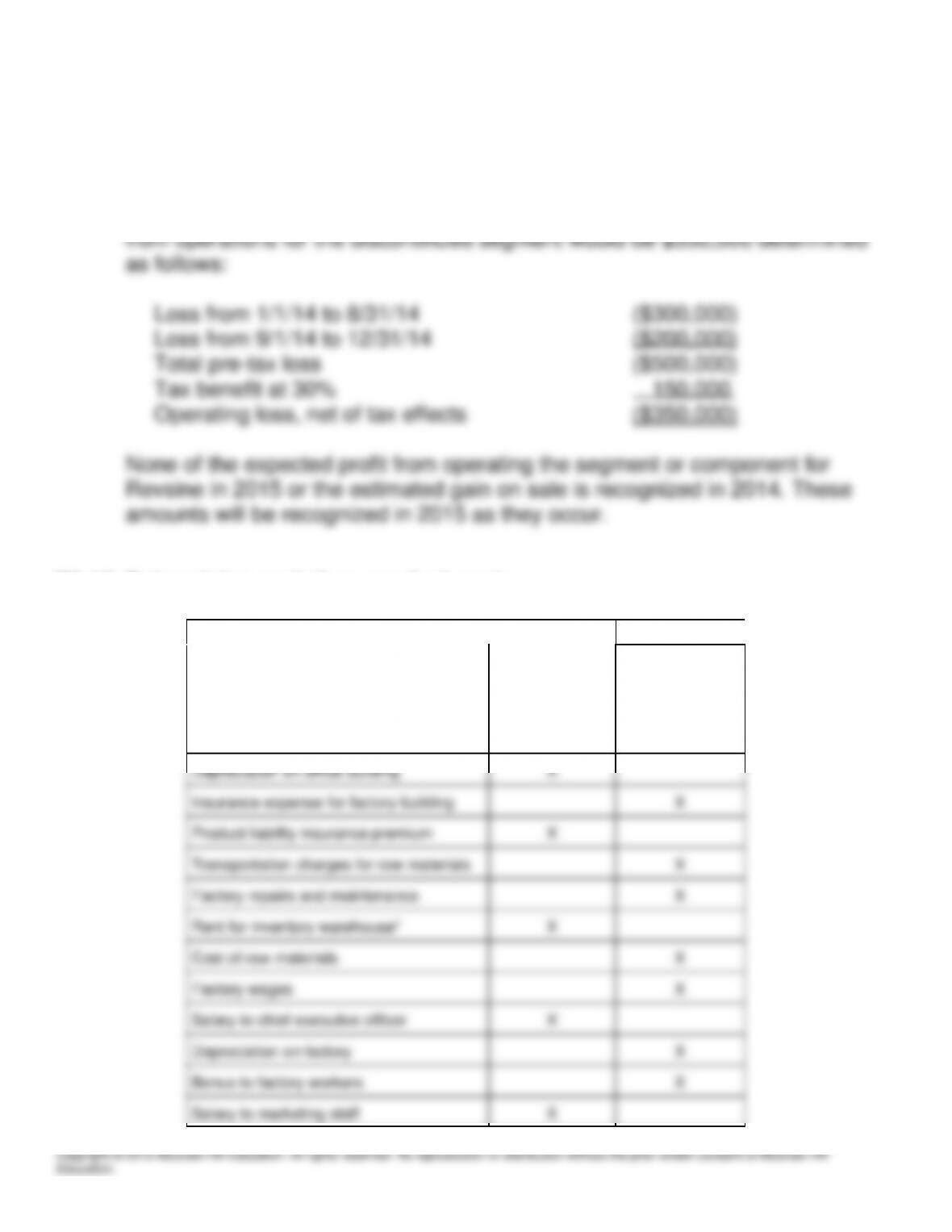
Under, results of operations on an operating segment or component of an
entity classified as held for sale are to be reported in discontinued operations
in the periods in which they occur (net of tax effects). For Revsine, the loss
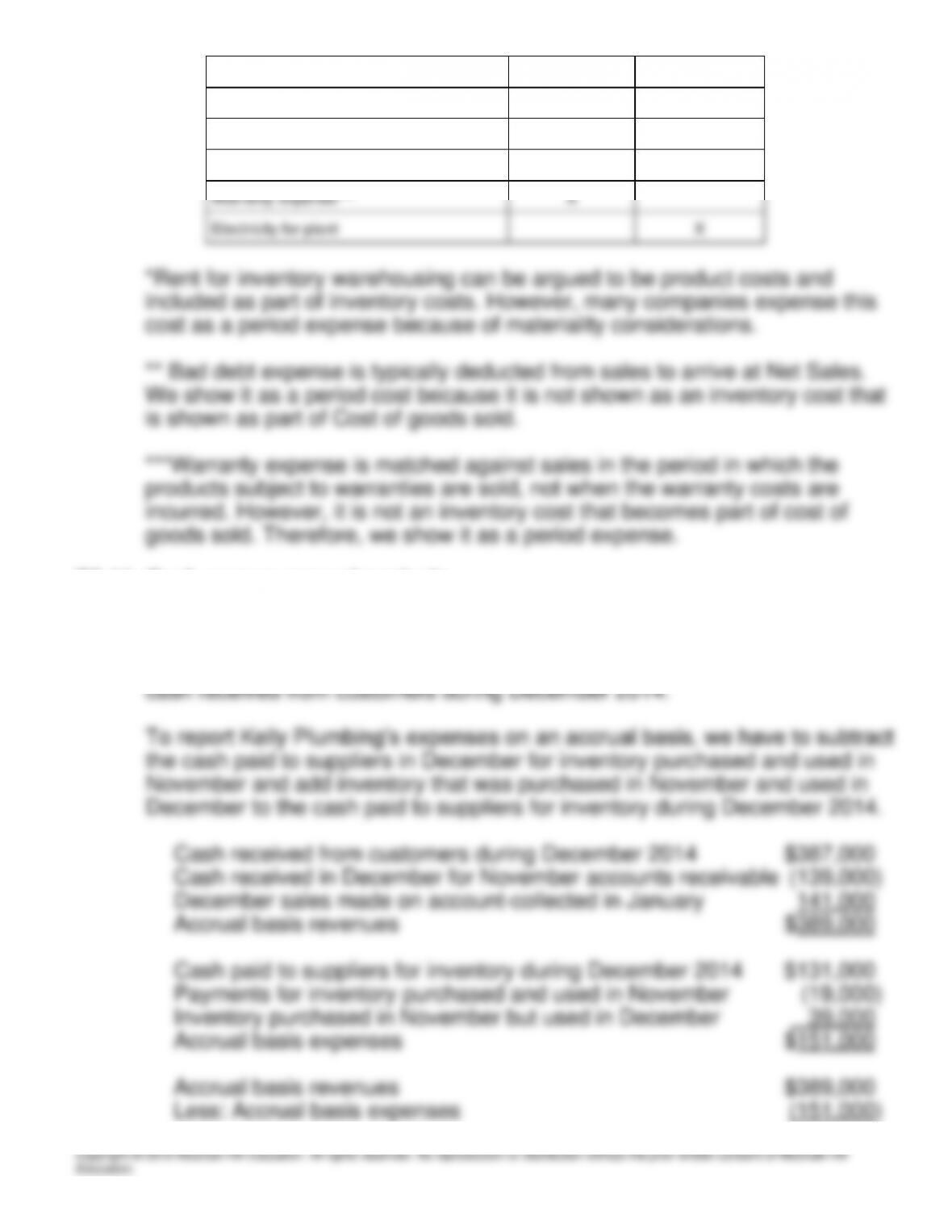
E2-10. Determining period vs. product costs
Period Cost
Product Cost
Matched
with
sales
as inventory
cost
Depreciation on office building
X
Insurance expense for factory building
X
Product liability insurance premium
X
Transportation charges for raw materials
X
Factory repairs and maintenance
X
Rent for inventory warehouse*
X
Cost of raw materials
X
Factory wages
X
Salary to chief executive officer
X
Depreciation on factory
X
Bonus to factory workers
X
Salary to marketing staff
X
2-7
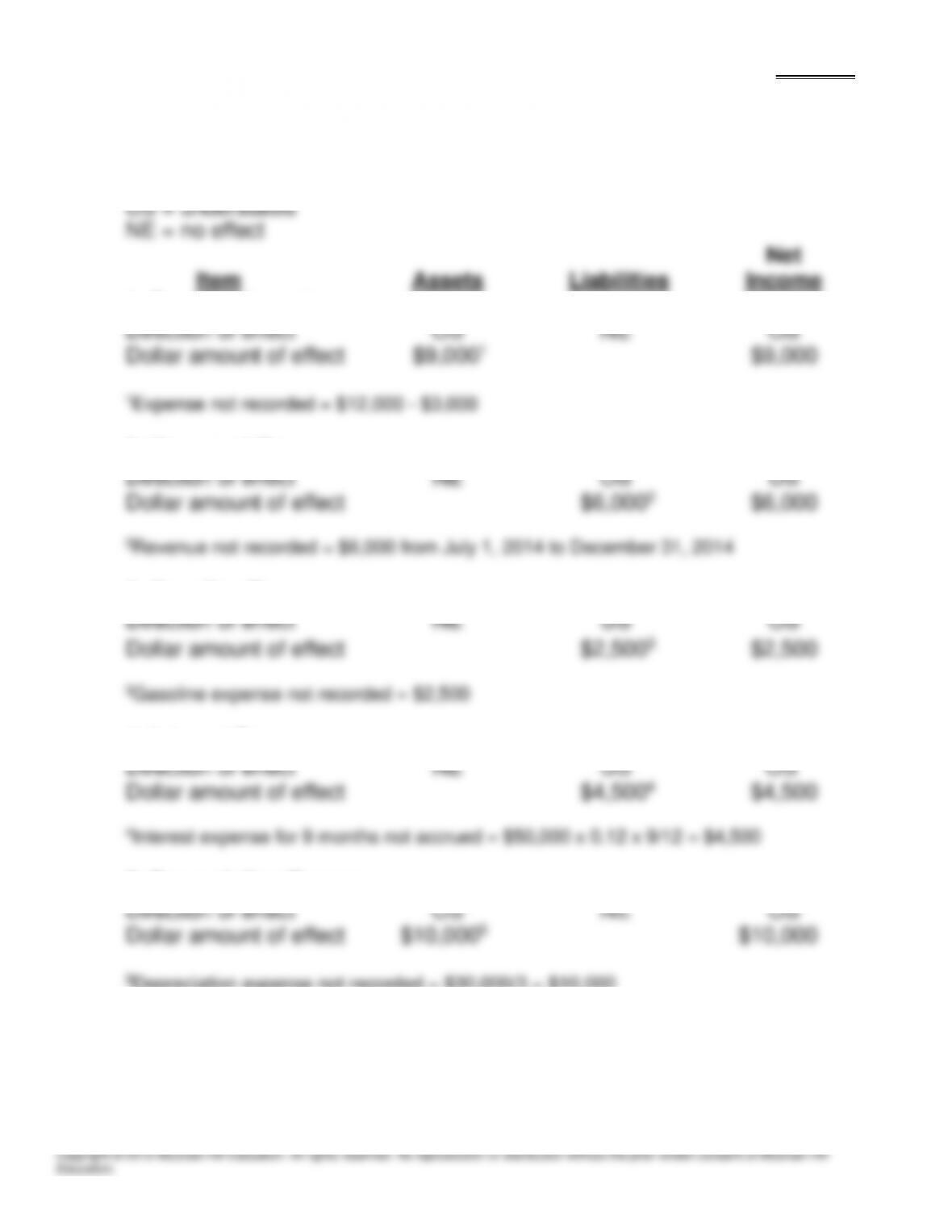
Administrative expenses
X
Bad debt expense**
X
Advertising expense
X
Research and development
X
Warranty expense***
X
Electricity for plant
X
*Rent for inventory warehousing can be argued to be product costs and
included as part of inventory costs. However, many companies expense this
cost as a period expense because of materiality considerations.
** Bad debt expense is typically deducted from sales to arrive at Net Sales.
We show it as a period cost because it is not shown as an inventory cost that
is shown as part of Cost of goods sold.
***Warranty expense is matched against sales in the period in which the
products subject to warranties are sold, not when the warranty costs are
incurred. However, it is not an inventory cost that becomes part of cost of
goods sold. Therefore, we show it as a period expense.
E2-11. Cash versus accrual analysis
To report Kelly Plumbing Supply’s revenues on an accrual basis, we need
to subtract the accounts receivable collected in December but earned in
November and add the sales on account made during December to the
2-8
Gross profit for the month of December $238,000
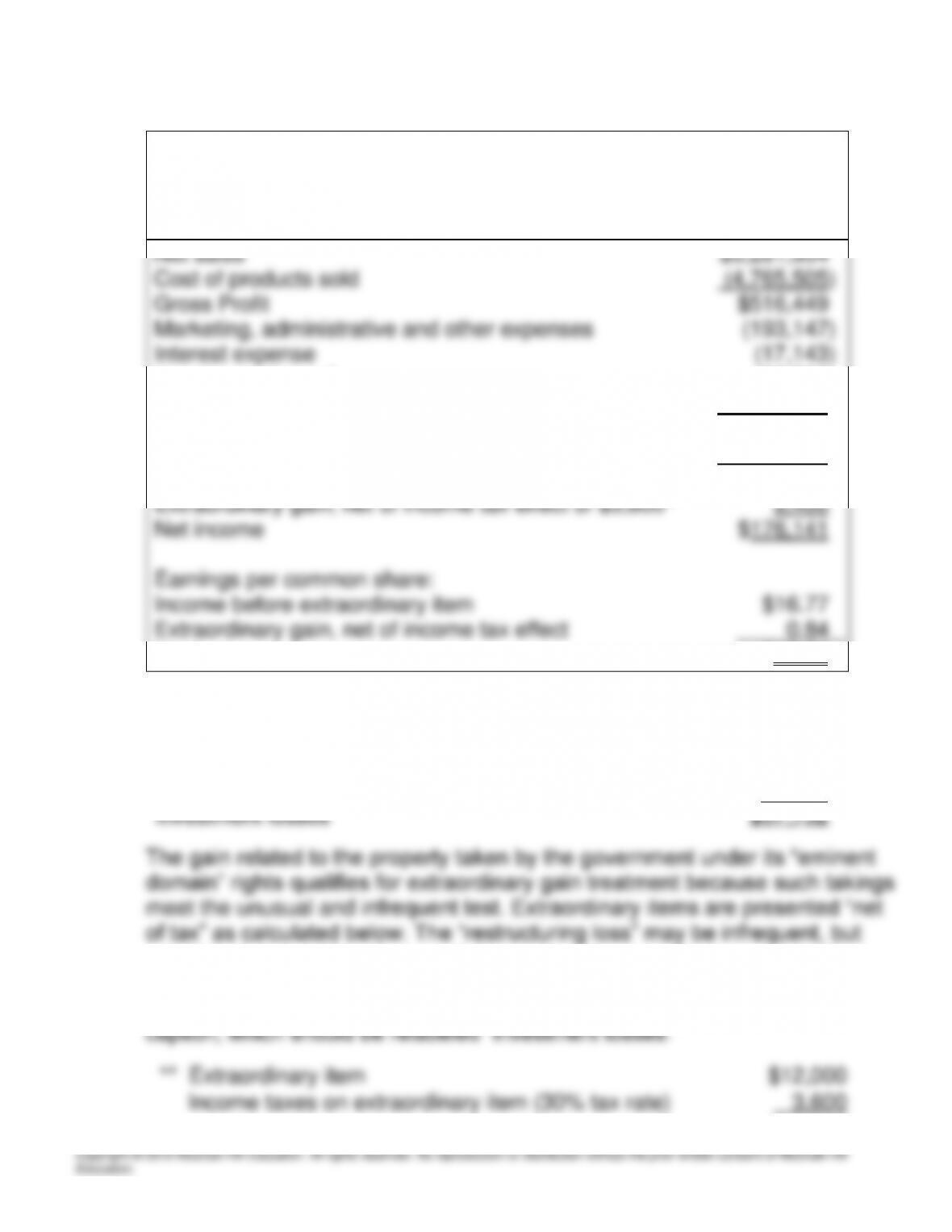
E2-12. Determining effect of omitting year-end adjusting entries
OS = overstated
1. Supplies Inventory
2. Unearned Revenue
3. Gasoline Expense
4. Interest Expense
5. Depreciation Expense
E2-13. Preparing a multiple-step income statement
Hardrock Mining Co.
Income Statement
Year Ended December 31, 2014
($ in 000)
Net sales
$5,281,954
Cost of products sold
(4,765,505)
Gross Profit
$516,449
Marketing, administrative and other expenses
(193,147)
Interest expense
(17,143)
Investment losses*
(57,752)
Restructuring charges
(8,777)
Earnings before income taxes
$239,630
Provision for income taxes
(71,889)
Income before extraordinary item
$167,741
Extraordinary gain, net of income tax effect of $3,600**
8,400
Net income
$176,141
Earnings per common share:
Income before extraordinary item
$16.77
Extraordinary gain, net of income tax effect
0.84
Net income
$17.61
The “Other, net” caption as originally reported is broken down as follows:
* “Other, net” as originally reported ($ in 000)
$54,529
Less: Restructuring charge
(8,777)
Plus: Extraordinary gain
12,000
Investment losses
$57,752
would not be considered unusual, thus it is not extraordinary and should be
separately disclosed as a component of operating income. Removing these
two items from “Other, net” leaves only the investment losses in the original
2-10
Extraordinary item net of taxes
$8,400
The foreign currency loss ($55,000) does not surpass any reasonable
E2-14. Preparing income statement with irregular items
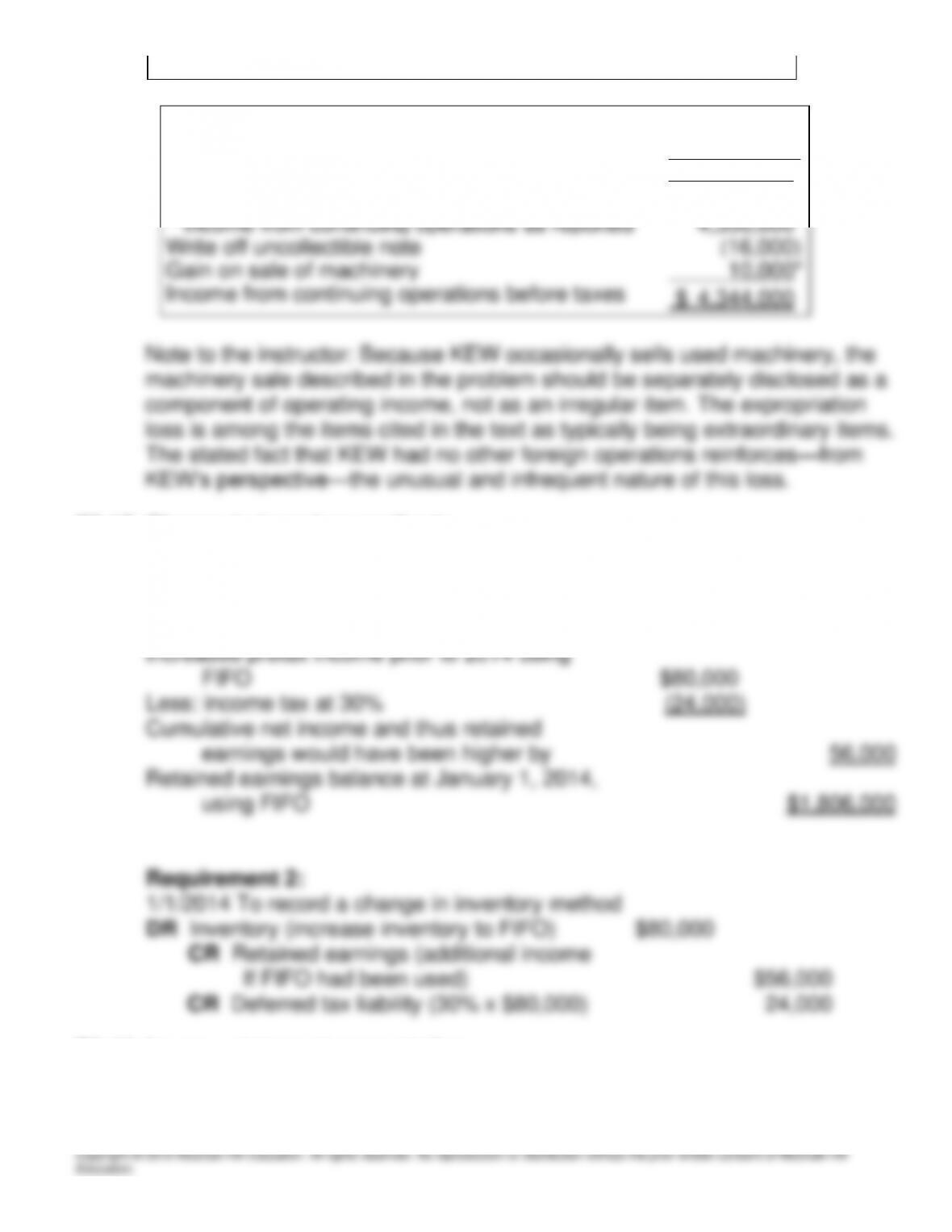
KEW Corporation
Partial Income Statement
For the Year Ended December 31, 2014
Income from continuing operations
before income taxes
$ 4,344,000**
Income tax expense
(1,520,400)
Income from continuing operations
$ 2,823,600
Discontinued operations:
Loss from operation of discontinued
division, net of tax benefit of $227,500
(422,500)
Loss from disposal of discontinued
division, net of tax benefit of $84,000
(156,000)
Income before extraordinary item
$ 2,245,100
Extraordinary loss, net of income tax
benefit of $138,250
(256,750)
Net income
$ 1,988,350
Earnings per common share:
Income from continuing operations
$ 5.65
Discontinued operations:
Loss from operation of discontinued
division
$ (0.85)
Loss from disposal of discontinued
division
$ (0.31)
Income before extraordinary item
$ 4.49
Extraordinary loss
$ (0.51)
Net income
$ 3.98
*Cost of machinery sold during 2014
$ 300,000
Less: Accumulated depreciation
(225,000)
Book value of machinery
$ 75,000
2-11
continued
Selling price of machinery
$ 85,000
Less: Book value of machinery
(75,000)
Gain on sale of machinery
$ 10,000
**Income from continuing operations as reported
4,350,000
Write off uncollectible note
(16,000)
Gain on sale of machinery
10,000*
Income from continuing operations before taxes
$ 4,344,000
E2–15. Change in inventory methods
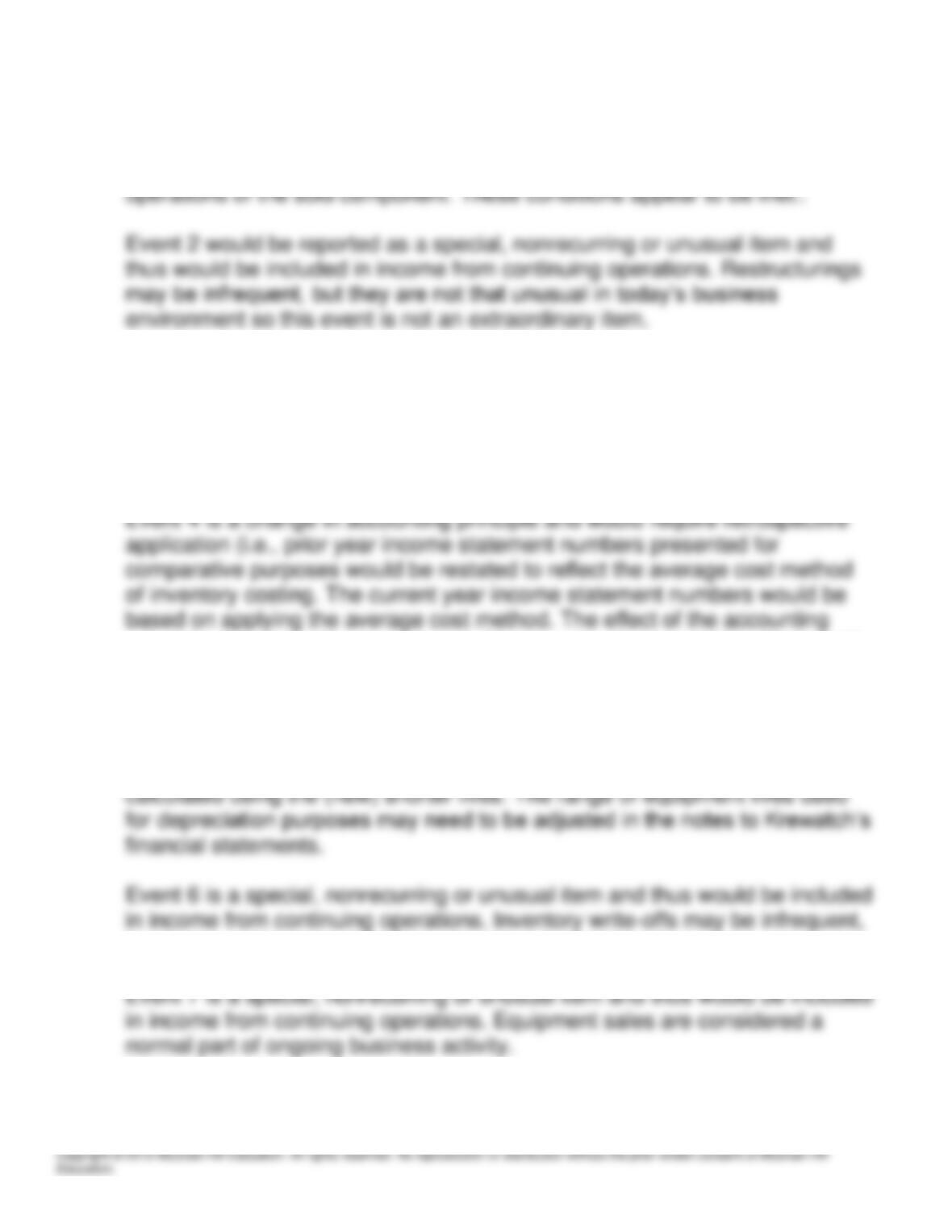
Requirement 1:
Retained earnings balance at January 1, 2014,
using LIFO
$1,750,000
Increased pretax income prior to 2014 using
FIFO
$80,000
Less: income tax at 30%
(24,000)
Cumulative net income and thus retained
earnings would have been higher by
56,000
Retained earnings balance at January 1, 2014,
using FIFO
$1,806,000
Requirement 2:
1/1/2014 To record a change in inventory method
DR Inventory (increase inventory to FIFO) $80,000
CR Retained earnings (additional income
If FIFO had been used) $56,000
CR Deferred tax liability (30% x $80,000) 24,000
E2–16. Income statement presentation
2-12
Event 1 is a discontinued operation and would appear on the income
statement below income from continuing operations. To qualify for
discontinued operation treatment, the sold component must be separable,
both operationally and financially, from the rest of the operation. Further,
Krewatch cannot have any significant continuing involvement in the
Event 3 is an extraordinary item and would appear on the income statement
below income from continuing operations. To qualify for extraordinary
treatment, an extinguishment now must meet the unusual and infrequent test.
Given that the retired bonds were the only ones issued in the company’s
history, this test appears to be met.
principle change on the current period income numbers would be disclosed in
a note to the financial statements explaining the accounting change.
Event 5 is a change in accounting estimate and thus would be included in
income from continuing operations. No special income statement disclosure
of this event is required. Depreciation expense in 2014 (and beyond) will be
but they are not unusual so this event is not an extraordinary item.
2-13
E2-17. Comprehensive income
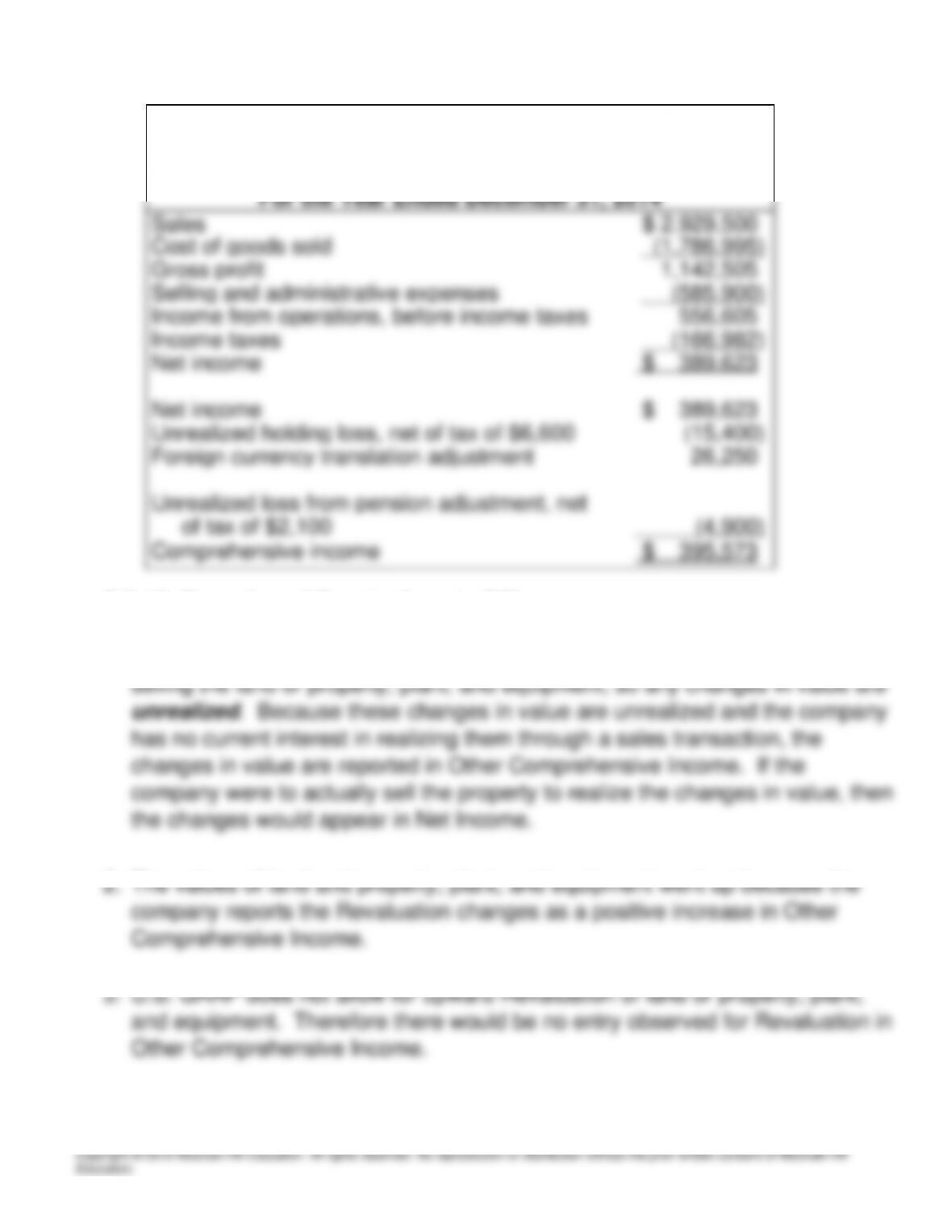
JDW Corporation
Income Statement and Statement
of Comprehensive Income
For the Year Ended December 31, 2014
Sales
$ 2,929,500
Cost of goods sold
(1,786,995)
Gross profit
1,142,505
Selling and administrative expenses
(585,900)
Income from operations, before income taxes
556,605
Income taxes
(166,982)
Net income
$ 389,623
Net income
$ 389,623
Unrealized holding loss, net of tax of $6,600
(15,400)
Foreign currency translation adjustment
26,250
Unrealized loss from pension adjustment, net
of tax of $2,100
(4,900)
Comprehensive income
$ 395,573
E 2-18. Reporting of Revaluations in OCI.
1. Revaluations occur when the company hires and then receives a valuation
report from a professional appraiser. The company has no current interest in

2-14
E2-19. Calculating EPS
1. Net income – Preferred stock dividend = $10.5 – $2 = $8.5 million
2-15
Financial Reporting and Analysis (6th Ed.)
Chapter 2 Solutions
Accrual Accounting and Income Determination
Problems
Problems
P2-1. Determining royalty revenue
(AICPA adapted)
Royalty revenue should be recognized when earned, regardless of when the
cash is collected. Royalty revenue earned from 12/1/13 to 5/31/14 is
P2–2. Preparing Journal entries and statement
Requirement 1: Journal Entries
1/1/14: To record entry for cash contributed by owners