16–31
To record 2014 fair value adjustment
DR Investment in Delta Crating $50
CR Unrealized gain on FV adjustment $50
(To record the increase in fair value from $250 to $300 ($1,000 x .3))
Equity Method FV Option
2011 investment income $26 (30 – 4) $59 (9 + 50)
2012 investment income $20 (24 – 4) $66 (6 + 60)
Newyork’s net profit margin is significantly higher in both 2011 and 2015 under
P16-5. Using acquisition versus purchase methods with goodwill
16–32
Note that Sigma’s imputed total business fair value is $80,000/80% =
$100,000.
Requirement 2 (Acquisition Method):
Imputed value of Sigma $100,000
Book value of Sigma net assets 44,000
Excess of imputed value over book value $56,000
Excess cost allocated to:
Accounts receivable ($9,000–$15,000) ($6,000)
Inventory ($43,000–$31,000) 12,000
Land ($12,000–$5,000) 7,000
Plant and equipment, net ($51,000–$35,000) 16,000
Goodwill (remaining amount) 27,000
$56,000
Requirement 3 (Acquisition Method):
Adjustment and elimination entries:
(A)DR Common Stock 2,000
to set up the noncontrolling interest in the book value of Sigma’s net assets.
(B)DR Inventory 9,600
DR Land 5,600
DR Plant and Equipment 12,800
DR Goodwill 21,600
16–33
Copyright © 2015 McGraw-Hill Education. All rights reserved. No reproduction or distribution without the prior written consent of McGraw-Hill
Education.
CR Noncontrolling interest 11,200
To adjust Sigma’s net assets to full fair value—including goodwill attributable to the
noncontrolling interest—under the acquisition method.
16–34
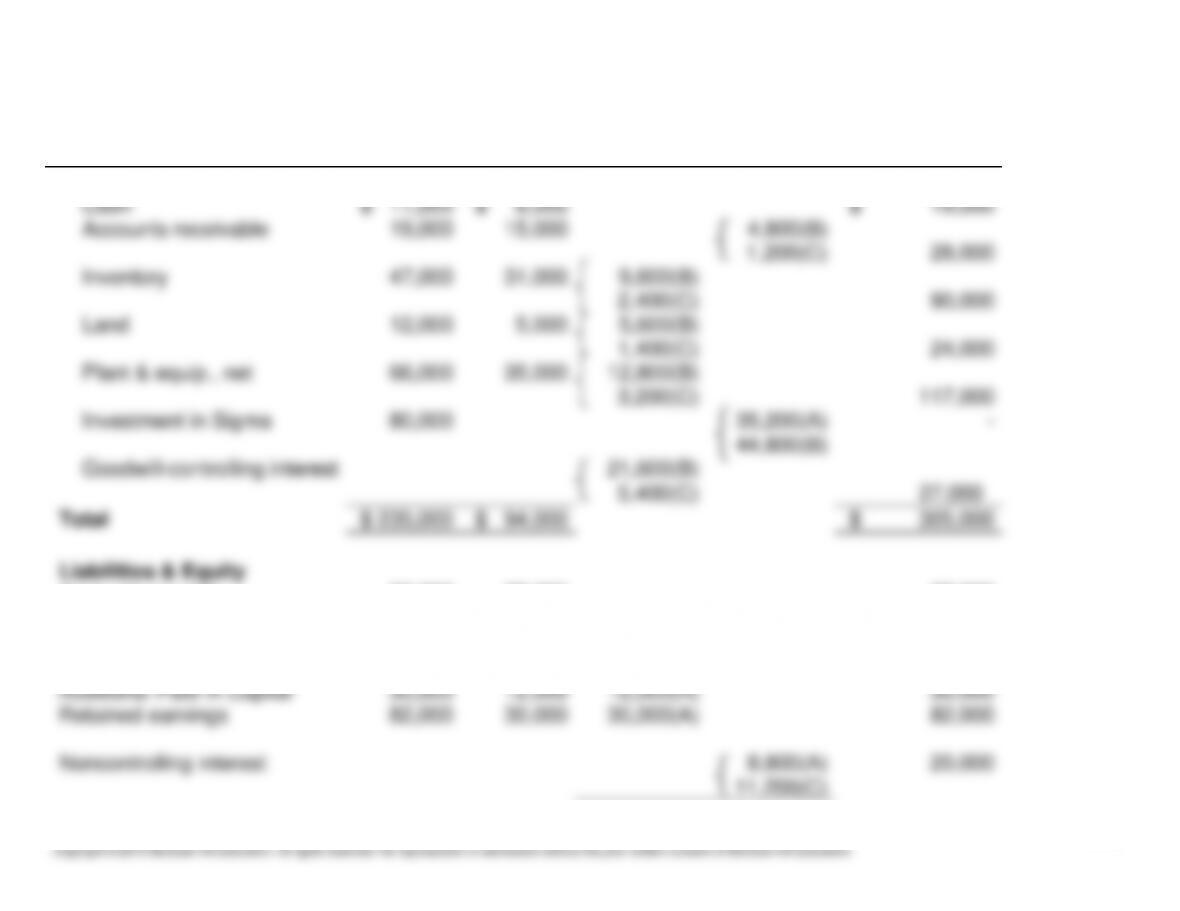
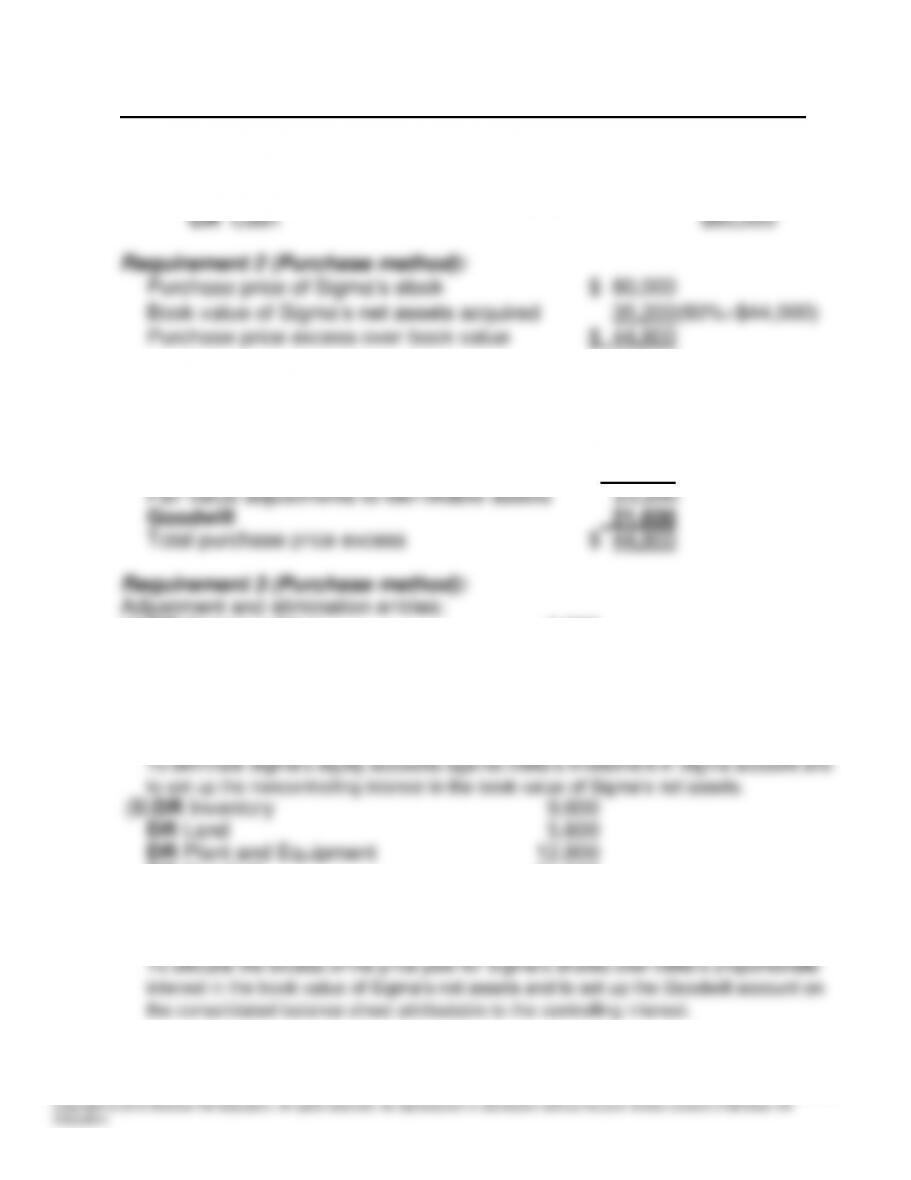
Requirement 4 (Acquisition Method): Consolidated Balance Sheet:
Delta
Sigma
Eliminations
Consolidated
Dr
Cr
Balance Sheet
Assets
Cash
$ 11,000
$ 8,000
$ 19,000
Accounts receivable
19,000
15,000
4,800(B)
1,200(C)
28,000
Inventory
47,000
31,000
9,600(B)
2,400(C)
90,000
Land
12,000
5,000
5,600(B)
1,400(C)
24,000
Plant & equip., net
66,000
35,000
12,800(B)
3,200(C)
117,000
Investment in Sigma
80,000
35,200(A)
–
44,800(B)
Goodwill-controlling interest
21,600(B)
5,400(C)
27,000
Total
$ 235,000
$ 94,000
$ 305,000
Liabilities & Equity
Accounts payable
52,000
35,000
87,000
Long-term debt
66,000
15,000
81,000
Common stock
5,000
2,000
2,000(A)
5,000
Additional Paid-in Capital
30,000
12,000
12,000(A)
30,000
Retained earnings
82,000
30,000
30,000(A)
82,000
Noncontrolling interest
8,800(A)
20,000
11,200(C)

16–35
Total
$ 235,000
$ 94,000
$106,000
$106,000
$ 305,000
16–36
Requirement 5: Repeat requirements 1-4 using the purchase method:
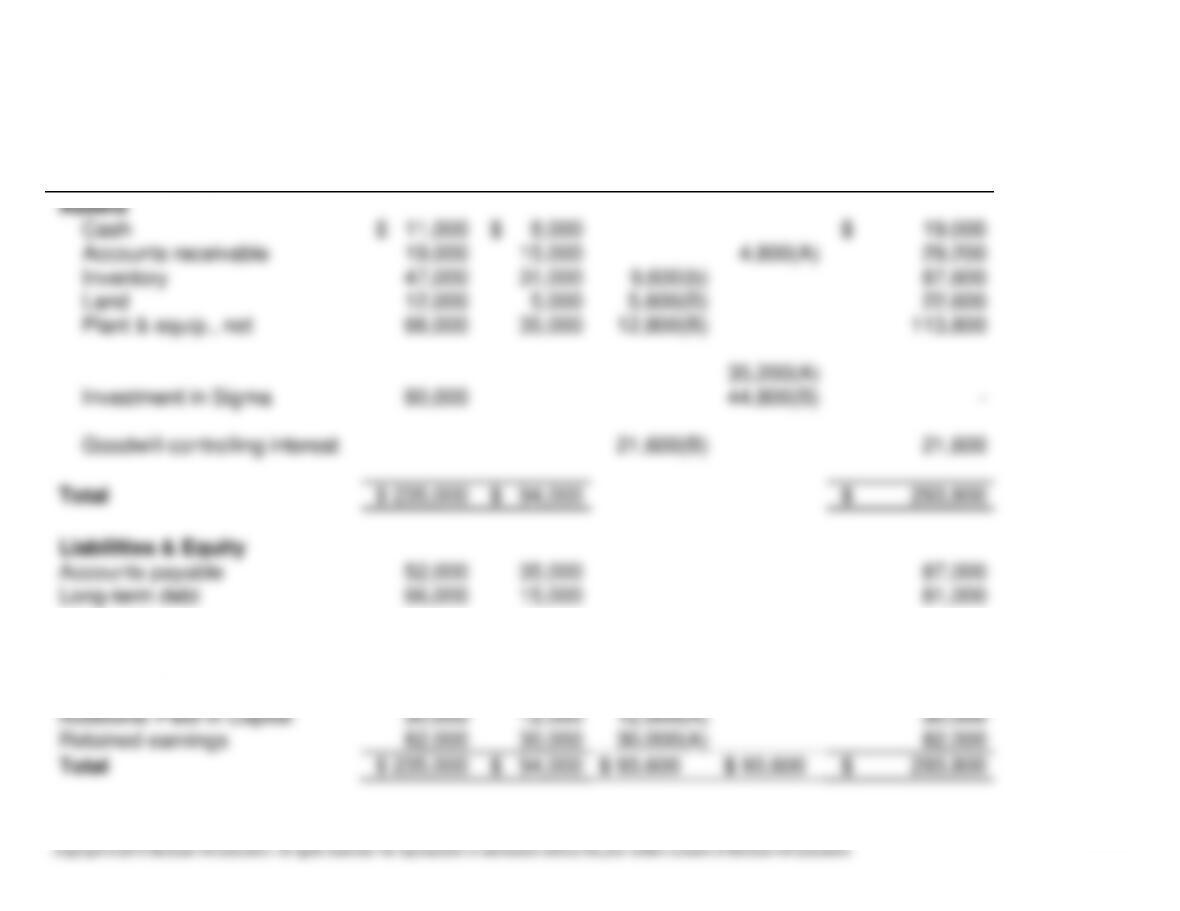
Requirement 1 (Purchase method):
Delta would make the following entry on January 1, 2014 to record the
acquisition of Sigma:
DR Investment in Sigma $80,000
The purchase price excess is allocated:
Accounts Receivable ($9,000-$15,000)80% (4,800)
Inventory ($43,000-$31,000)80% 9,600
Land ($12,000-$5,000)80% 5,600
Plant and Equipment ($51,000-$35,000)80% 12,800
(A)DR Common Stock 2,000
DR Additional Paid-in Capital 12,000
DR Retained Earnings 30,000
CR Noncontrolling interest (20%) 8,800
CR Investment in Sigma (80%) 35,200
DR Goodwill 21,600
CR Accounts Receivable 4,800
CR Investment in Sigma 44,800
16–37
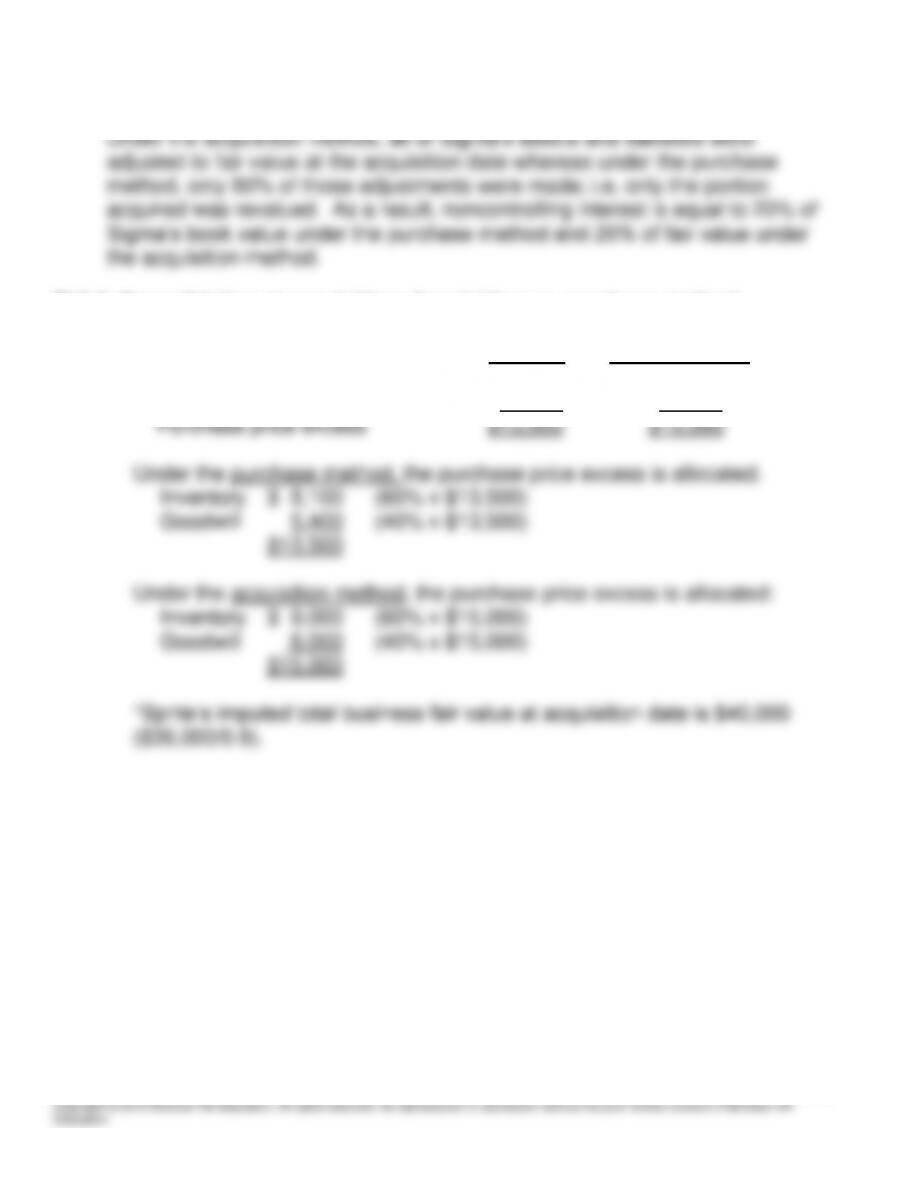
Requirement 4 (Purchase method):
Following is Delta Inc’s balance sheet immediately after the acquisition of Sigma Company:
Delta
Sigma
Eliminations
Consolidated
Dr
Cr
Balance Sheet
Assets
Cash
$ 11,000
$ 8,000
$ 19,000
Accounts receivable
19,000
15,000
4,800(A)
29,200
Inventory
47,000
31,000
9,600(b)
87,600
Land
12,000
5,000
5,600(B)
22,600
Plant & equip., net
66,000
35,000
12,800(B)
113,800
Investment in Sigma
80,000
35,200(A)
44,800(B)
–
Goodwill-controlling interest
21,600(B)
21,600
Total
$ 235,000
$ 94,000
$ 293,800
Liabilities & Equity
Accounts payable
52,000
35,000
87,000
Long-term debt
66,000
15,000
81,000
Noncontrolling interest in Sigma
8,800(A)
8,800
Common stock
5,000
2,000
2,000(A)
5,000
Additional Paid-in Capital
30,000
12,000
12,000(A)
30,000
Retained earnings
82,000
30,000
30,000(A)
82,000
Total
$ 235,000
$ 94,000
$ 93,600
$ 93,600
$ 293,800
16–38
Note the difference between the consolidated balance sheet under the
purchase method and the one we derived earlier under the acquisition method.
P16-6. Consolidation at acquisition: Acquisition vs. purchase method
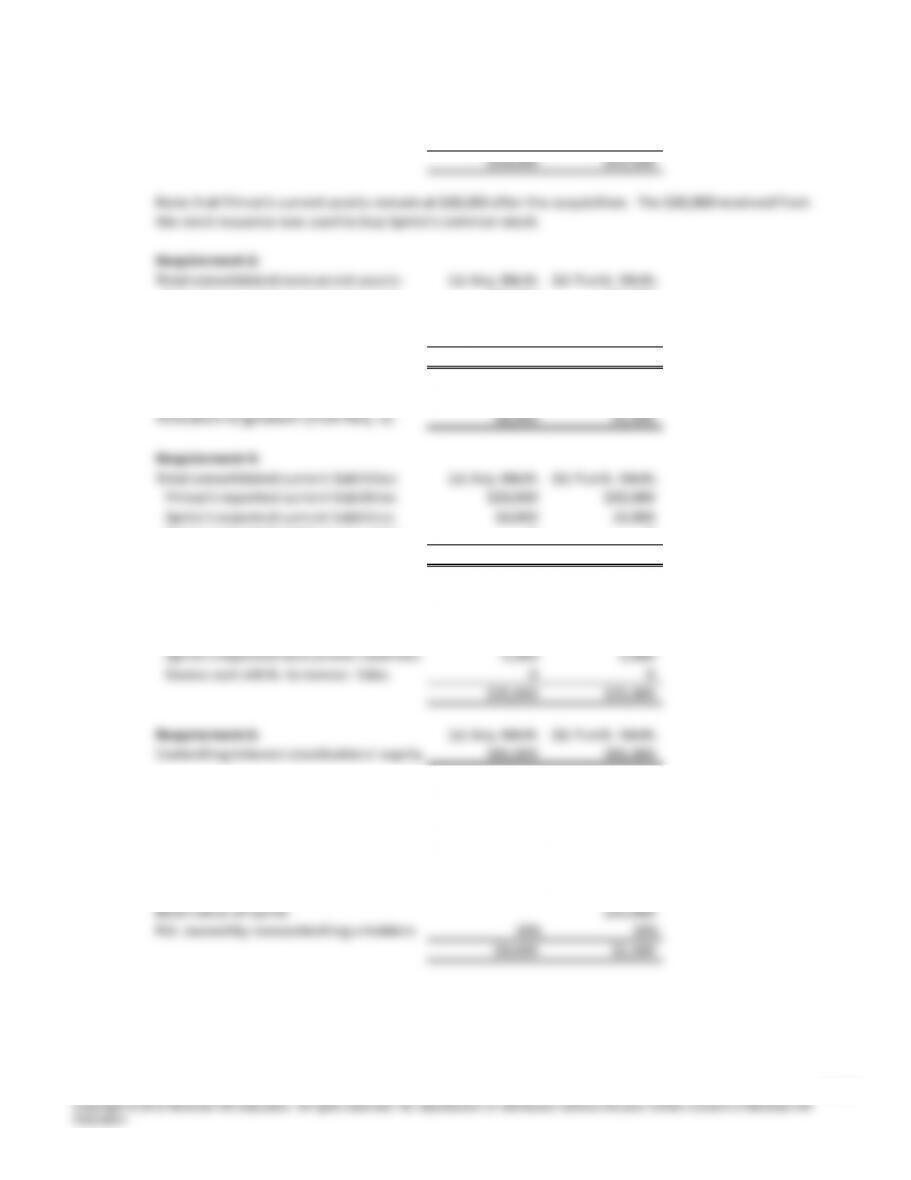
90% Imputed 100%
Purchase price of Sprite’s stock $36,000 $40,000*
Book value of Sprite’s net assets 22,500 25,000
16–39
Requirement 1:
Total consolidated current assets: (a) Acq. Meth. (b) Purch. Meth.
Prince’s reported current assets $30,000 $30,000
Sprite‘s reported current assets 15,000 15,000
Excess cost attributable to inventory 9,000 8,100
$54,000 $53,100
Note that Prince‘s current assets remain at $30,000 after the acquisition. The $30,000 received from
the stock issuance was used to buy Sprite‘s common stock.
Requirement 2:
Total consolidated noncurrent assets: (a) Acq. Meth. (b) Purch. Meth.
Prince’s reported noncurrent assets $55,000 $55,000
Sprite‘s reported noncurrent assets 25,000 25,000
Excess cost attributable to goodwill 6,000 5,400
Prince’s reported current liabilities $20,000 $20,000
Sprite‘s reported current liabilities 10,000 10,000
Excess cost attributable to cur. liabs. 0 0
$30,000 $30,000
Requirement 5:
Requirement 6: (a) Acq. Meth. (b) Purch. Meth.
Controlling interest stockholders’ equity $81,000 $81,000
Under both methods, all of Sprite‘s equity is eliminated in consolidation. Controlling shareholders’
equity in the consolidated balance sheet is equal to Prince‘s equity as a standalone company.
The $81,000 amount includes the $36,000 of stock issued to finance the acquisition.
16–40
Copyright © 2015 McGraw-Hill Education. All rights reserved. No reproduction or distribution without the prior written consent of McGraw-Hill
Education.
NOTE: Under the purchase method, noncontrolling interest of ($2,500 in
this case) was generally presented between the liability and equity sections
of the balance sheet.
P16–7. Consolidating account balances with intra-entity transactions
Requirement 1:
The amount of intra-entity sales is the amount eliminated in the
consolidation:
Palace’s reported A/R $58,000
Show’s reported A/R 36,000
94,000
Consolidated A/R (80,000)
Intra-entity A/R $14,000
16–41
P16–8. Consolidating intra-entity sales
Requirement 1:
Consolidated financial statements are intended to present the results of
operations and the financial position of a parent company and its
Inventory account. The difference between the Sales Revenue elimination
and the Inventory elimination will be eliminated from the Cost of Goods Sold
account.
16–42
P16-9. Elimination entries and consolidated balance sheet
Case 1:
Requirement 1:
DR Investment in Salad $180,000
CR Cash $180,000
Requirement 2:
Note: All balance sheet amounts are equal to the sum of the amounts given
for the two companies except: Cash is reduced by the $180,000 purchase
16–43
Case 2:
Requirement 1:
DR Investment in Salad $210,000
CR Cash $210,000
Requirement 2:
DR Common Stock & PIC, Salad $100,000
CR Investment in Salad $30,000
Requirement 3:
Assets:
Cash $390,000
A/R 70,000
Inventory 130,000
Accounts Payable $120,000
Bonds Payable 200,000
Common Stock 300,000
Retained Earnings 360,000
Total $980,000
16–44
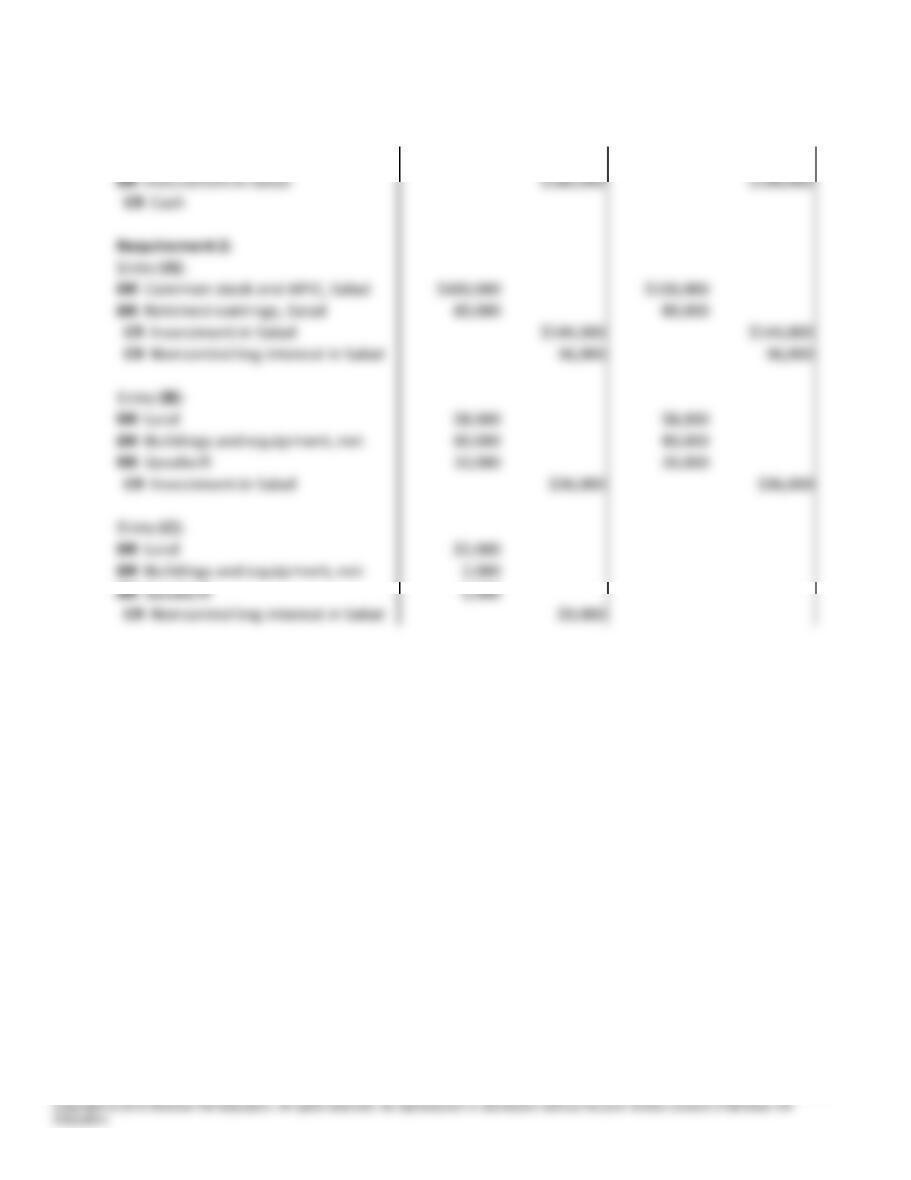
P16-10. Elimination entries and consolidated balance sheet under acquisition
versus purchase method
Requirement 1: $180,000 $180,000
DR Investment in Salad $180,000 $180,000
CR Cash
Requirement 2:
Entry (A):
DR Common stock and APIC, Salad $100,000 $100,000
DR Retained earnings, Salad 80,000 80,000
CR Investment in Salad $144,000 $144,000
CR Noncontrolling interest in Salad 36,000 36,000
Entry (B):
DR Land $8,000 $8,000
DR Buildings and equipment, net 80,000 80,000
DR Goodwill 20,000 20,000
CR Investment in Salad $36,000 $36,000
Entry (C):
DR Land $2,000
DR Buildings and equipment, net 2,000
DR Goodwill 5,000
CR Noncontrolling interest in Salad $9,000
(a) Acquisition Method
(b) Purchase Method