16-1
Financial Reporting and Analysis (6th Ed.)
Chapter 16 Solutions
E16–1. Fair value accounting for trading and available-for-sale securities
(AICPA adapted)
Requirement 1:
Only the unrealized holding gains/losses from trading securities are
Any unrealized gain or loss for the year on Tyne’s available-for-sale securities
should be recorded as part of Other comprehensive income (OCI), which is
closed out to Accumulated other comprehensive income (AOCI) and reported
as part of stockholders’ equity. AOCI is reported in the statement of
16-2
historical cost of the available-for-sale securities and their aggregate fair
value.
12/31/14: Cost $150,000 less fair value $120,000 = $30,000 credit in fair
value adjustment account (debit to OCI – unrealized loss in fair value of
available-for-sale securities).
E16–2. Fair value accounting for available-for-sale securities
(AICPA adapted)
Requirement 1:
Fair value of securities on 12/31/14 $48,200
E16–3. Fair value accounting for trading securities
Requirement 1:
Aggregate cost of trading portfolio at 12/31/14 $340,000
E16–4. Using the equity method
(AICPA adapted)
E16–5. Using the equity method and fair value option
(AICPA adapted)
Requirement 1:
Otis’s net income $90,000
Harold‘s share in Otis 0.20
Harold’s equity in Otis’s earnings 18,000
Cost of Sage‘s 40% interest in Adams $400,000
16-4
Requirement 2:
Sage’s initial investment in Adams $400,000
Equity in Adams’ earnings net of amounts amortized 42,000
E16–6. Determining business rationale and whether to consolidate a
VIE
NOTE: The instructor may direct students to Papa John’s 10-K filing to read
more about the BIBP arrangement and its effect on consolidated financial
statements.
1. It had the power to direct the significant activities of BIBP
2. It had an obligation to absorb losses or the right to receive benefits that
could be potentially significant to BIBP.
In its 2012 10–K filing, Papa John’s indicated that it was the primary
E16-7. Determining the value of goodwill
Purchase price of Shake’s stock $4,000,000 ($20 x 200,000)
E16-8. Goodwill–acquisition method
(AICPA adapted)
E16–9. Preparing consolidated financial statements
(AICPA adapted)
Beginning retained earnings (Pitt Company)
$500,000
Consolidated net income
200,000
Consolidated dividends – parent only
(50,000)
Ending retained earnings
$650,000
Note that Saxe’s amounts need not be considered explicitly because Pitt’s
consolidated results include Saxe’s.
E16-10. Determining consolidated retained earnings
Cost of shares acquired $620,000
16-6
E16–11. Consolidated balances using the acquisition method
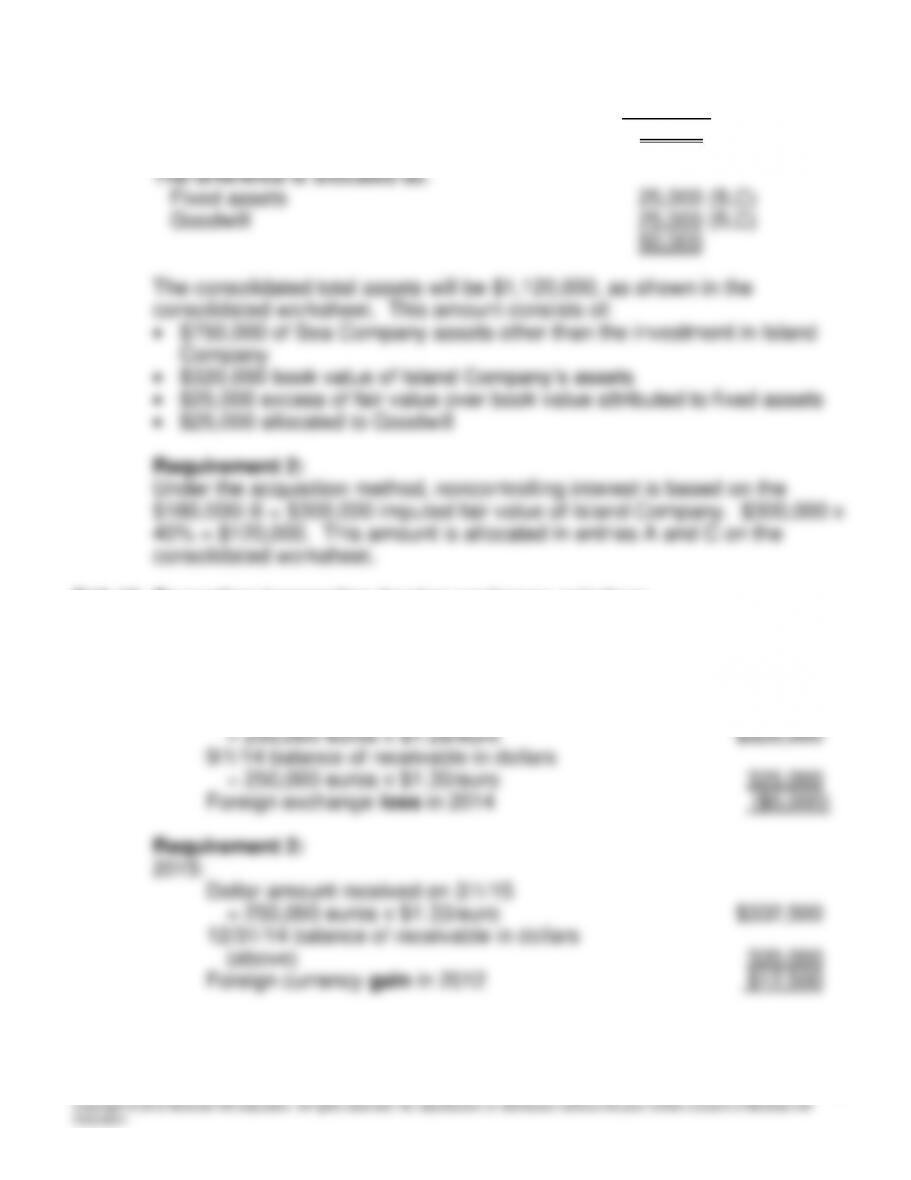
Following is Sea Company’s consolidated worksheet immediately after the acquisition of Island Company:
Sea
Island
Eliminations
Consolidated
Dr
Cr
Balance Sheet
Assets
Other assets
$ 750,000
$ 320,000
$15,000 B
$1,095,000
10,000 C
Investment in Island
180,000
150,000 A
–
30,000 B
Goodwill
15,000 B
25,000
10,000 C
Total assets
$ 930,000
$ 320,000
$ 1,120,000
Liabilities
Liabilities
$ 250,000
$ 70,000
320,000
Stockholders’ Equity
Common stock
450,000
200,000
200,000 A
450,000
Retained Earnings
230,000
50,000
50,000 A
230,000
Noncontrolling interest
100,000 A
120,000
20,000 C
Total Equity
680,000
250,000
800,000
Total Liabilities
and Equity
$ 930,000
$ 320,000
$ 300,000
$ 300,000
$ 1,120,000
16-7
Requirement 1:
Imputed full fair value of the acquisition $300,000 ($180,000/.6)
Island’s acquisition date book value (250,000)
Difference 50,000
E16–12. Recording transaction foreign exchange gain/loss
(AICPA adapted)
Requirement 1:
2014:
12/31/14 balance of receivable in dollars
16-8
E16–13. Fair value accounting for available-for-sale securities
(AICPA adapted)
Net unrealized losses on 12/31/14 ($26,000 – $4,000) $22,000
E16–14. Fair value for trading securities
Equity 2015 Unrealized
Security Cost Fair Value gain/(loss)
A $96,000 $94,000 ($2,000)
E16-15. Eliminating intra-entity profit
Requirement 1:
Pinto’s gross profit margin on sales is $400,000/$1,000,000 = 40%.
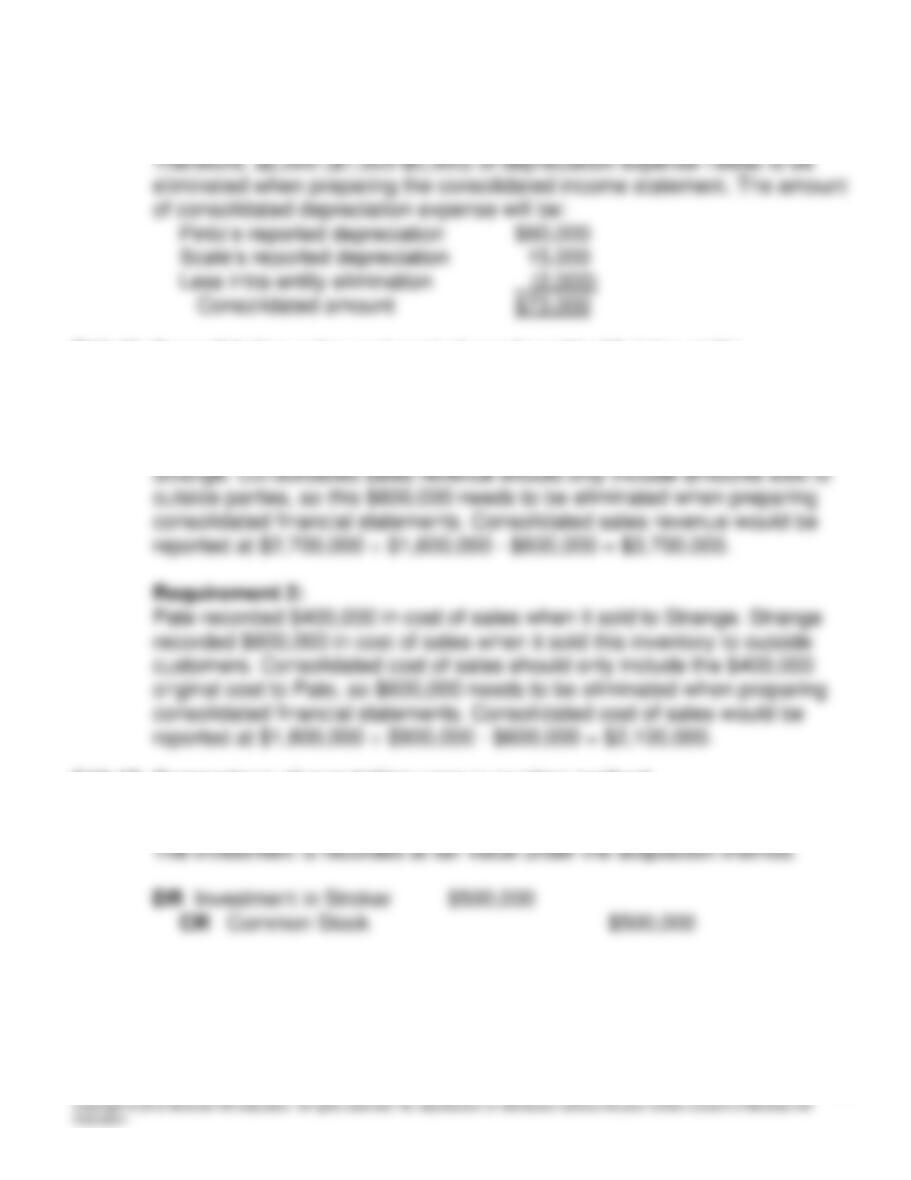
16-9
on the sale, the equipment must have been carried on Pinto’s books at
$44,000 when the sale was made. Without the intra-entity sale, Pinto would
have recorded depreciation of $44,000/8 yrs. = $5,500 in 2014.
E16-16. Consolidating sales and cost of goods sold with intra-entity
transactions
Requirement 1:
Pate recorded $600,000 in sales revenue on its books when it sold to
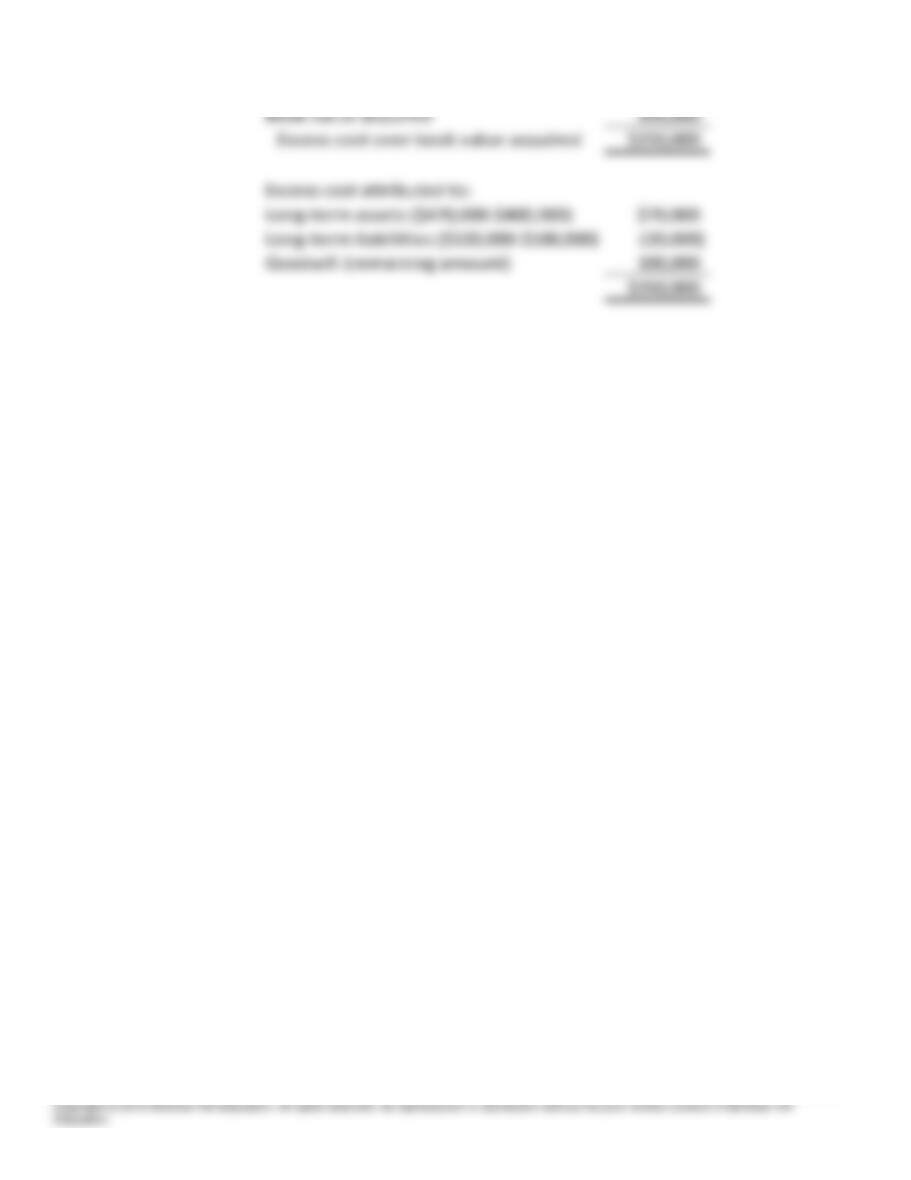
E16–17. Comparison of acquisition versus pooling method
Requirement 1 (Acquisition Method):
16–10
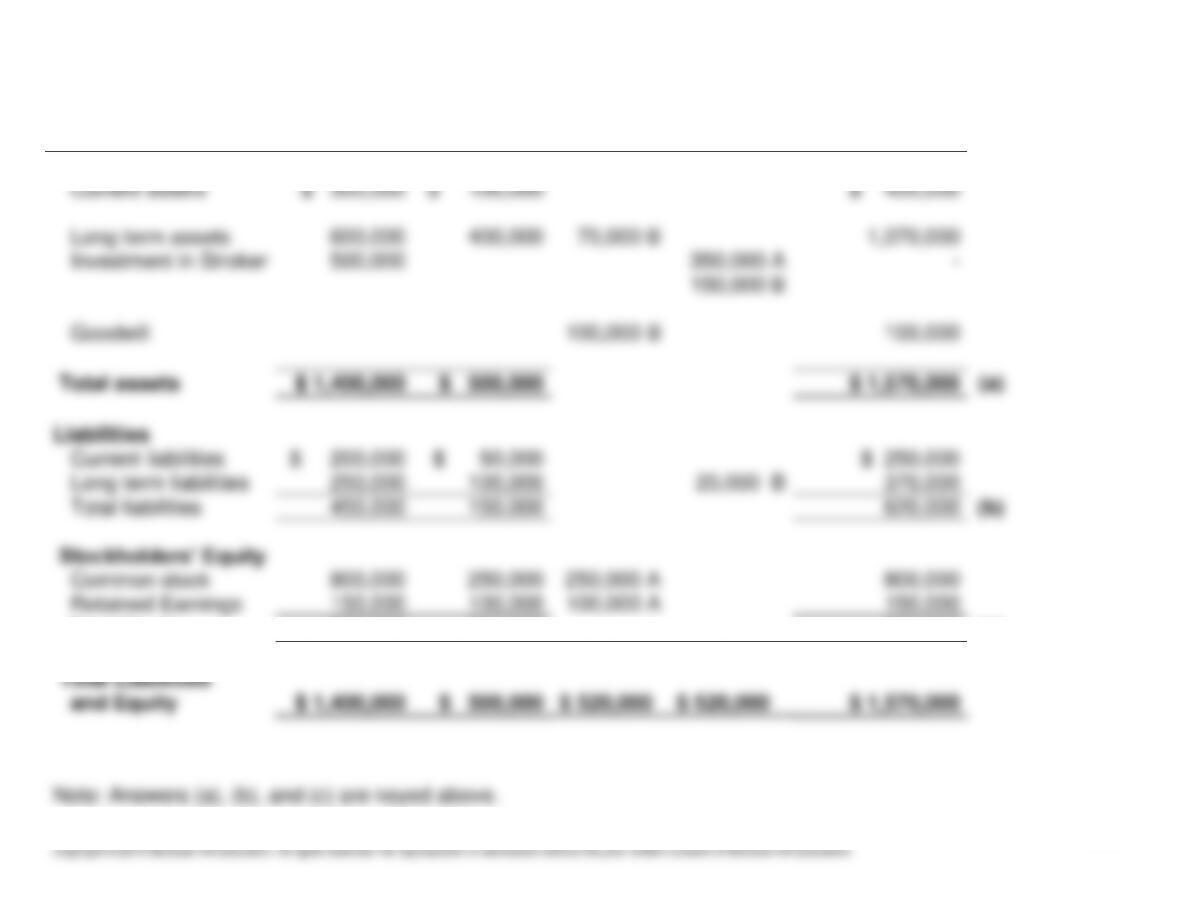
Requirement 2 (Acquisition Method):
Acquisition cost $500,000
Book value acquired 350,000
Excess cost over book value acquired $150,000
Excess cost attributed to:
Long-term assets ($470,000–$400,000) $70,000
Long-term liabilities ($120,000–$100,000) (20,000)
Goodwill (remaining amount) 100,000
$150,000
16–11
Requirement 2 (continued):
Pushway
Stroker
Eliminations
Consolidated
Dr
Cr
Balance Sheet
Assets
Current assets
$ 300,000
$ 100,000
$ 400,000
Long term assets
600,000
400,000
70,000 B
1,070,000
Investment in Stroker
500,000
350,000 A
–
150,000 B
Goodwill
100,000 B
100,000
Total assets
$ 1,400,000
$ 500,000
$ 1,570,000
(a)
Liabilities
Current liabilities
$ 200,000
$ 50,000
$ 250,000
Long term liabilities
250,000
100,000
20,000 B
370,000
Total liabilities
450,000
150,000
620,000
(b)
Stockholders’ Equity
Common stock
800,000
250,000
250,000 A
800,000
Retained Earnings
150,000
100,000
100,000 A
150,000
Total Equity
950,000
350,000
950,000
(c)
Total Liabilities
and Equity
$ 1,400,000
$ 500,000
$ 520,000
$ 520,000
$ 1,570,000

16–12
16–13
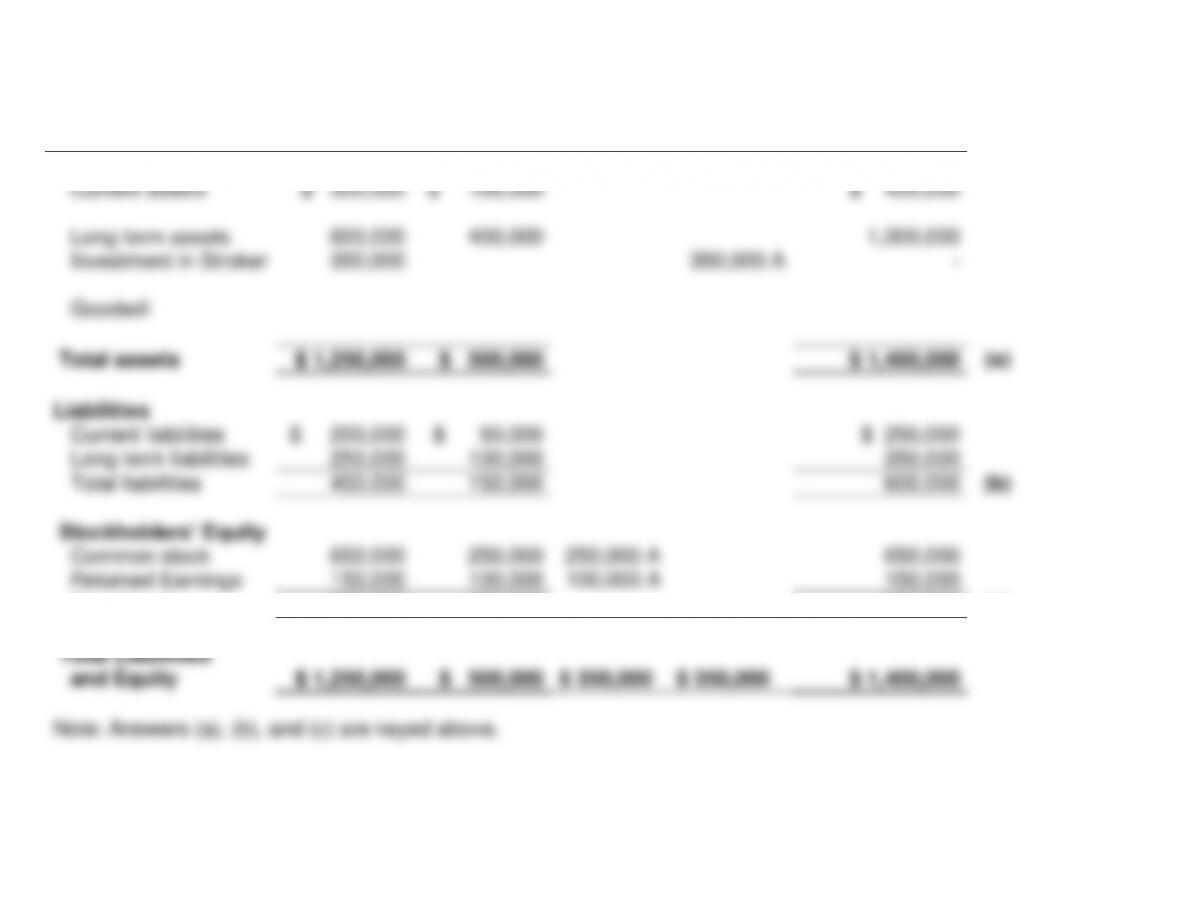
Requirement 3 (Pooling Method):
The acquisition journal entry under pooling would be at Stroker’s book value:
16–14
Copyright © 2015 McGraw-Hill Education. All rights reserved. No reproduction or distribution without the prior written consent of McGraw-Hill Education.
Requirement 3 (continued):
Pushway
Stroker
Eliminations
Consolidated
Dr
Cr
Balance Sheet
Assets
Current assets
$ 300,000
$ 100,000
$ 400,000
Long term assets
600,000
400,000
1,000,000
Investment in Stroker
350,000
350,000 A
–
Goodwill
Total assets
$ 1,250,000
$ 500,000
$ 1,400,000
(a)
Liabilities
Current liabilities
$ 200,000
$ 50,000
$ 250,000
Long term liabilities
250,000
100,000
350,000
Total liabilities
450,000
150,000
600,000
(b)
Stockholders’ Equity
Common stock
650,000
250,000
250,000 A
650,000
Retained Earnings
150,000
100,000
100,000 A
150,000
Total Equity
800,000
350,000
800,000
(c)
Total Liabilities
and Equity
$ 1,250,000
$ 500,000
$ 350,000
$ 350,000
$ 1,400,000
16–15
E16–18. Translating foreign currency
(AICPA adapted)
Because the subsidiary’s functional currency is the local currency unit
E16–19. Reporting transaction foreign exchange gain/loss
(AICPA adapted)
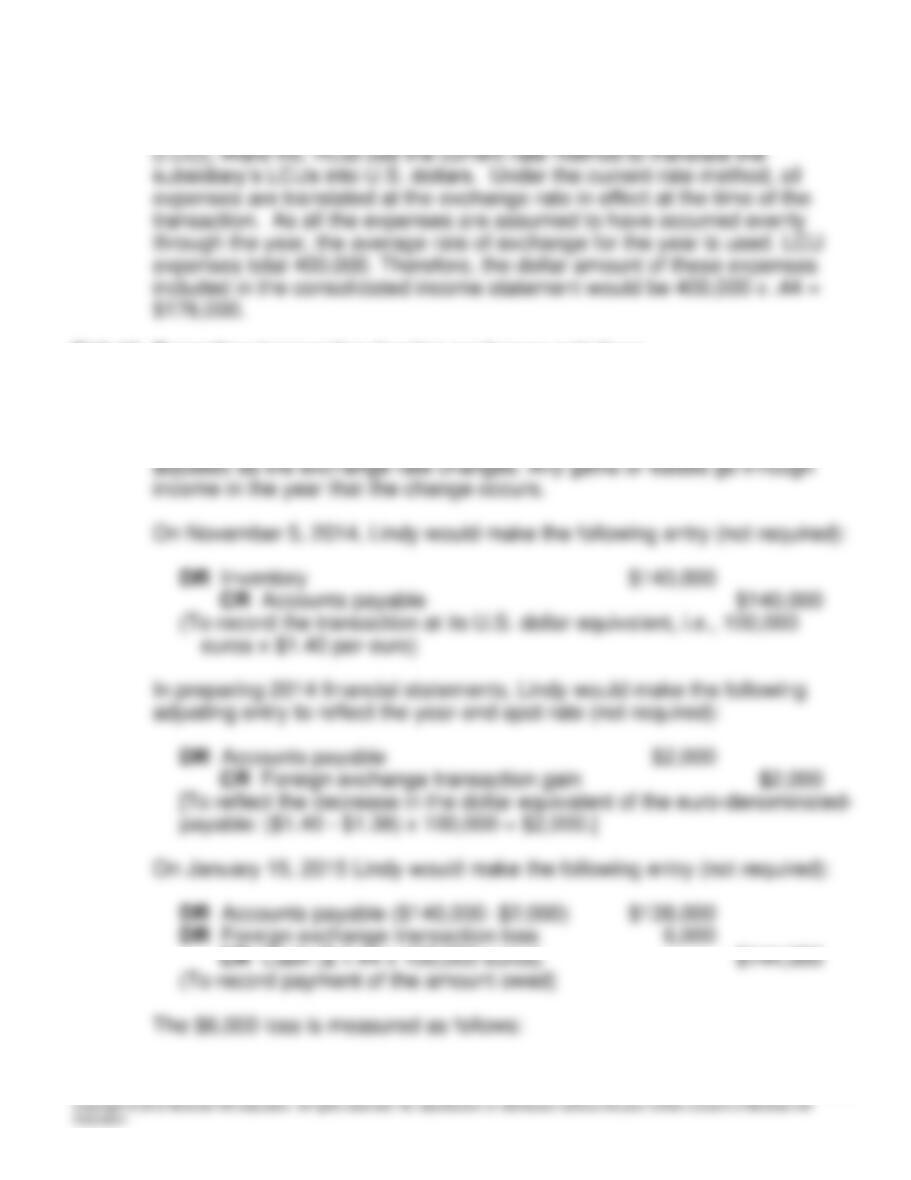
Lindy Corp. has engaged in a foreign currency transaction. The transaction
is recorded on Lindy’s books at its U.S. dollar equivalent and subsequently