15-1
Financial Reporting and Analysis (6th Ed.)
Chapter 15 Solutions
E15–1. Understanding Shareholders’ Equity
Requirement 1:
Preferred stock is a class of “capital stock” that pays dividends at a specified
rate and that has preference over common stock in the payment of dividends
and the liquidation of assets. Preferred stock does not ordinarily carry voting
company and available for retirement or resale. Treasury stock is shares
issued but not outstanding. The shares cannot be voted and they neither pay
nor accrue dividends.
Requirement 3:
Redeemable preferred stock is a less permanent form of ownership capital
its cash flow consequences.
Requirement 4:
The employer’s cost of stock-based compensation—employee stock options
and restricted stock awards—is measured as the fair value of the award as of
the grant date.
15-2
(2) options and warrants that entitle holders to obtain common shares under
E15–2. Issuing common stock
E15–3. Retiring common stock
(AICPA adapted)
Because the shares are “retired” rather than “held in treasury,” they are
removed from the books of Peter Corporation. No gain or loss is recorded
E15–4. Analyzing debt and redeemable preferred stock
Requirement 1:
The bond will be recorded as a $10 million long-term liability with annual
15-3
E15–5. Analyzing various stock transactions
(AICPA adapted)
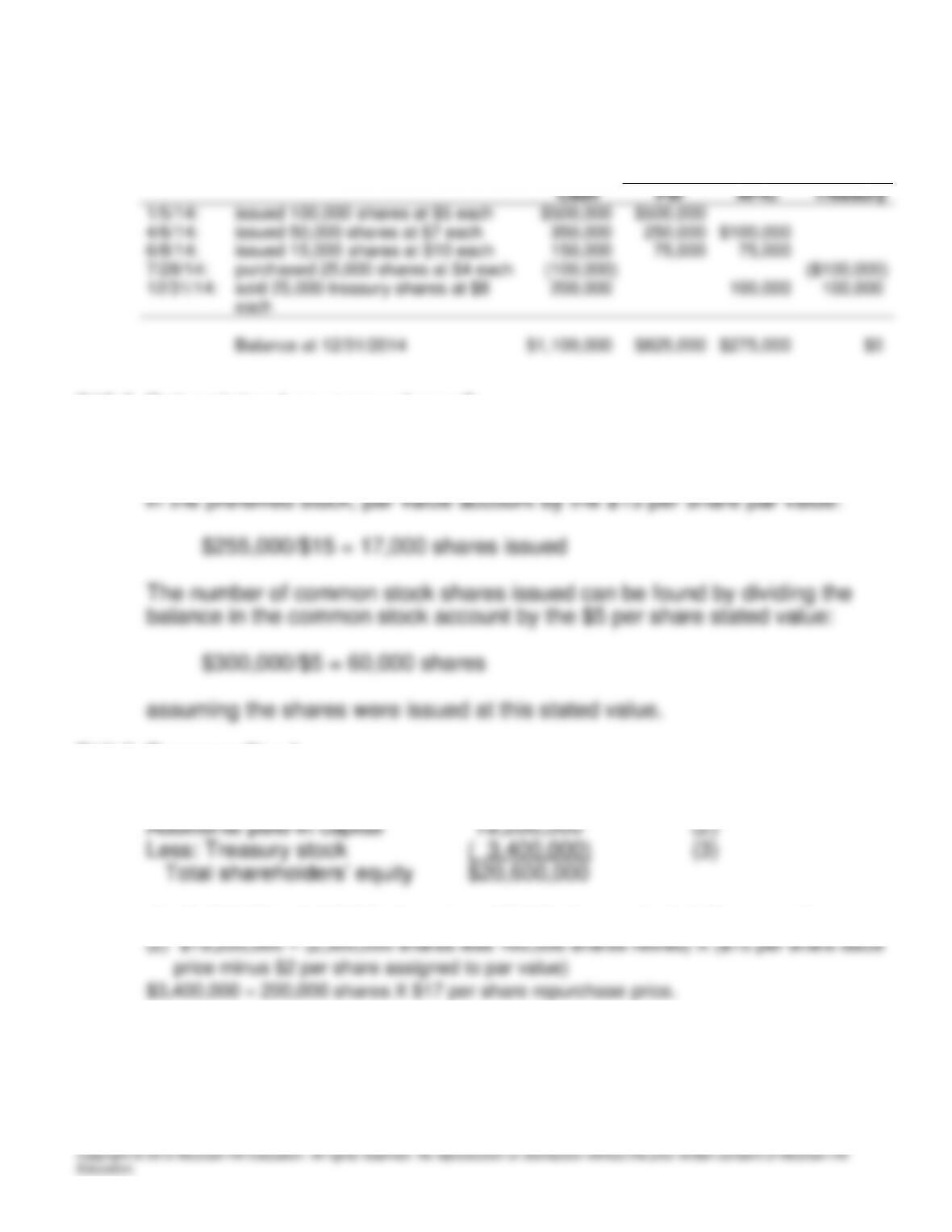
The capital transactions are described in the following schedule:
Common Stock Accounts
Cash
Par
APIC
Treasury
1/5/14:
issued 100,000 shares at $5 each
$500,000
$500,000
4/6/14:
issued 50,000 shares at $7 each
350,000
250,000
$100,000
6/8/14:
issued 15,000 shares at $10 each
150,000
75,000
75,000
7/28/14:
purchased 25,000 shares at $4 each
(100,000)
($100,000)
12/31/14:
sold 25,000 treasury shares at $8
each
200,000
100,000
100,000
Balance at 12/31/2014
$1,100,000
$825,000
$275,000
$0
E15–6. Determining how many shares?
(AICPA adapted)
The number of preferred shares issued can be found by dividing the balance
E15–7. Treasury Stock
Common stock—par $ 4,800,000 (1)
(1) $4,800,000 = (2,500,000 shares less 100,000 shares retired) X $2 par per share
15-4
E15–8. Determining stockholders’ equity after a stock repurchase
(AICPA adapted)
Common Stock Accounts
Par
APIC
Treasury
Retained
Earnings
1/1/14:
Issued 200,000 $10 par stock at $15 per share
$2,000,000
$1,000,000
Net income for 2014–2016
$750,000
Dividends for 2014–2016
(380,000)
1/5/16:
Purchased 12,000 shares at $12 for treasury
($144,000)
12/31/16:
Sold 8,000 treasury shares at $8 each
(32,000)
96,000
Balance at 12/31/16
$2,000,000
$968,000
($48,000)
$370,000
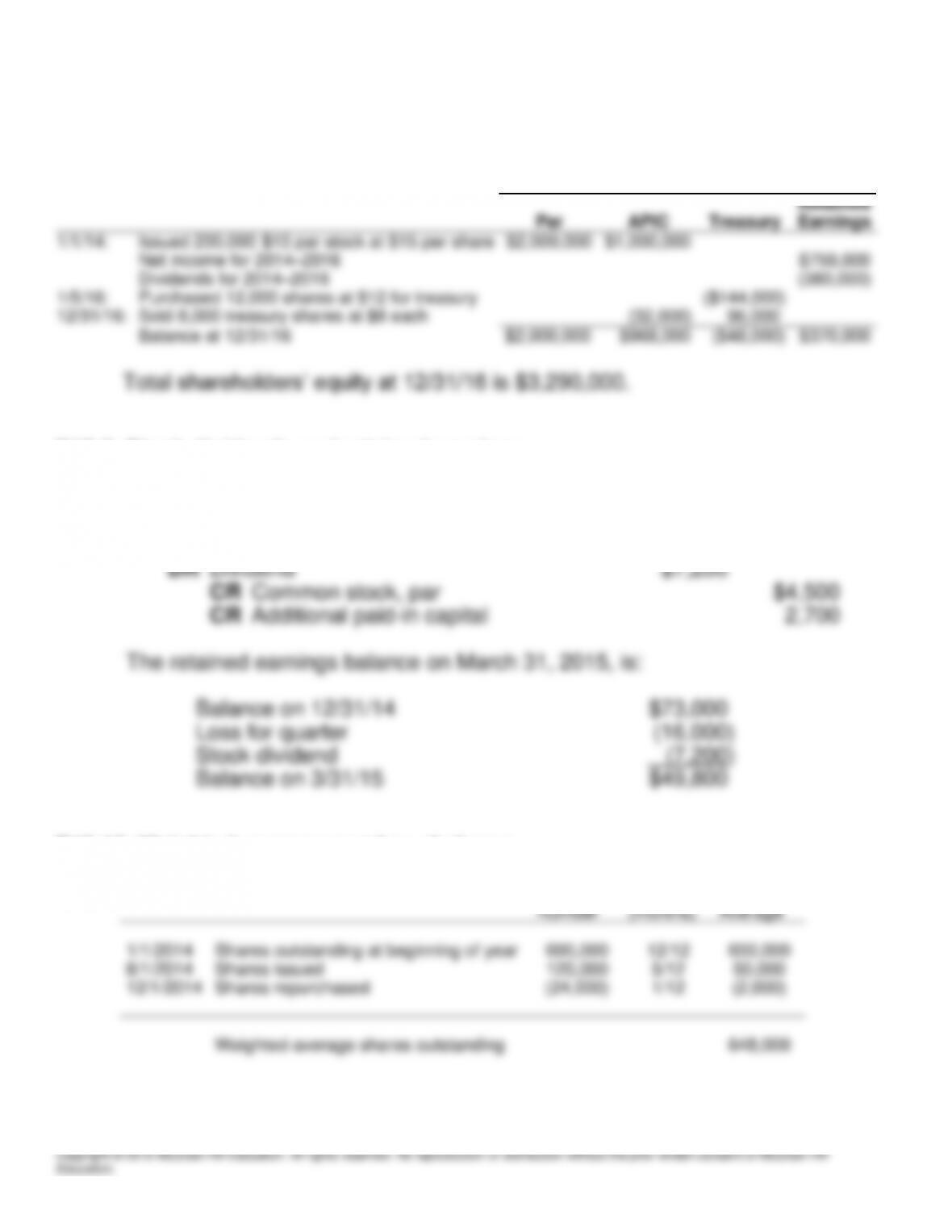
Total shareholders’ equity at 12/31/16 is $3,290,000.
E15–9. Stock dividends and retained earnings
(AICPA adapted)
The entry to record the stock dividend (900 shares x $8 = $7,200) is:
E15-10. Weighted-average number of shares
Analysis of common shares:
Weight
Weighted
Number
(months)
Average
1/1/2014
Shares outstanding at beginning of year
600,000
12/12
600,000
8/1/2014
Shares issued
120,000
5/12
50,000
12/1/2014
Shares repurchased
(24,000)
1/12
(2,000)
Weighted-average shares outstanding
648,000
15-5
E15-11. Retained earnings transactions
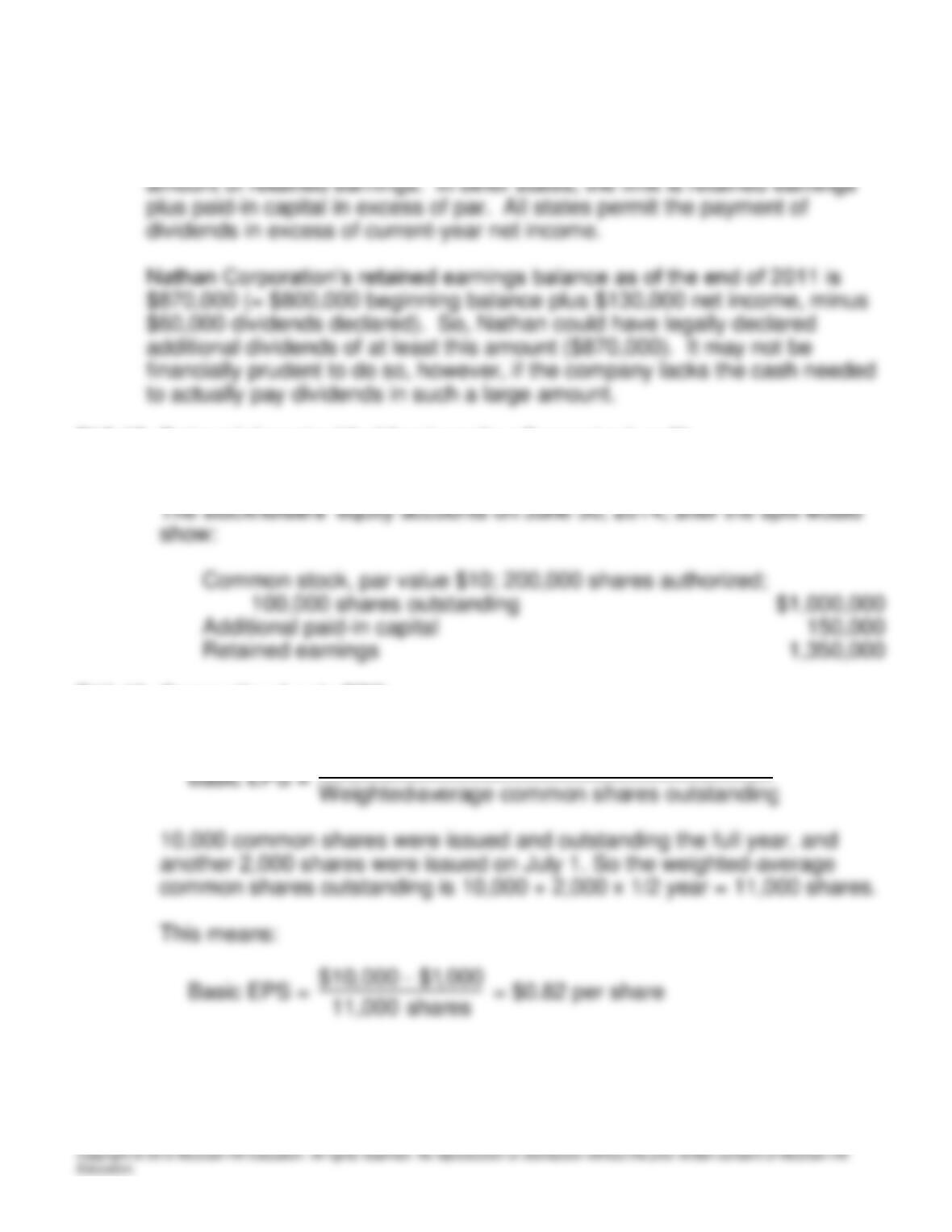
The legality of corporate dividend distributions varies from state to state. In
some jurisdictions, companies are permitted to pay dividends only up to the
E15–12. Determining stockholders’ equity after a stock split
(AICPA adapted)
E15–13. Computing basic EPS
(AICPA adapted)
(Net income– Preferred dividends)
Weighted–average common shares outstanding
10,000 common shares were issued and outstanding the full year, and
another 2,000 shares were issued on July 1. So the weighted-average
common shares outstanding is 10,000 + 2,000 x 1/2 year = 11,000 shares.
This means:
Basic EPS =
$10,000 −$1,000
11,000 shares
= $0.82 per share
15-6
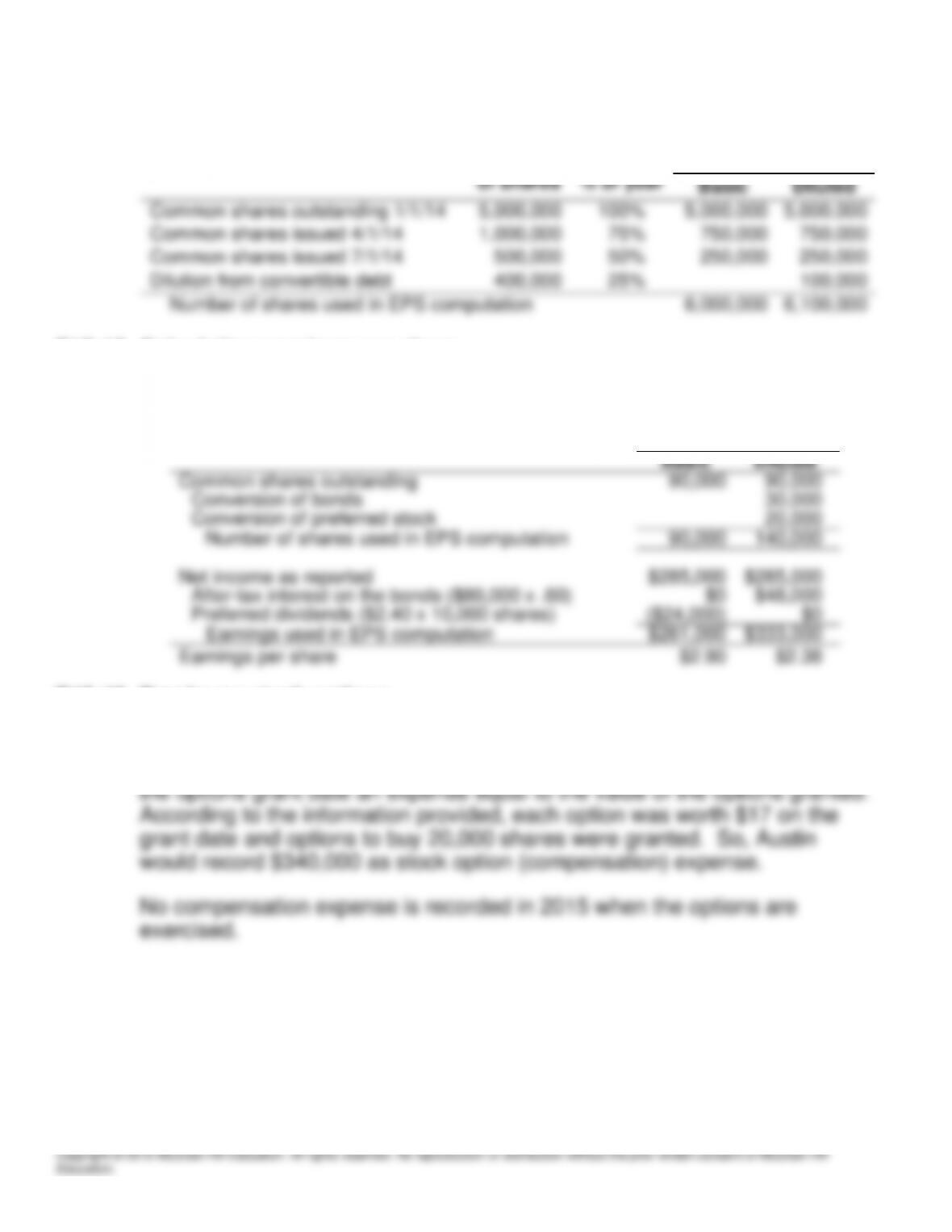
E15–14. Finding the number of shares for EPS
(AICPA adapted)
Number
of shares
Weight
% of year
EPS
Basic
Diluted
Common shares outstanding 1/1/14
5,000,000
100%
5,000,000
5,000,000
Common shares issued 4/1/14
1,000,000
75%
750,000
750,000
Common shares issued 7/1/14
500,000
50%
250,000
250,000
Dilution from convertible debt
400,000
25%
100,000
Number of shares used in EPS computation
6,000,000
6,100,000
E15–15. Calculating earnings per share
(AICPA adapted)
Requirements 1 and 2:
EPS for 2014
Basic
Diluted
Common shares outstanding
90,000
90,000
Conversion of bonds
30,000
Conversion of preferred stock
20,000
Number of shares used in EPS computation
90,000
140,000
Net income as reported
$285,000
$285,000
After-tax interest on the bonds ($80,000 x .60)
$0
$48,000
Preferred dividends ($2.40 x 10,000 shares)
($24,000)
$0
Earnings used in EPS computation
$261,000
$333,000
Earnings per share
$2.90
$2.38
E15–16. Employee stock options
(AICPA adapted)
Under the fair value method now required by GAAP, Amos would record on
15-7
P15–1. Identifying incentives for stock repurchases
Requirement 1:
The answer to this question depends on when, during the year, shares are
repurchased. The most straightforward calculation assumes shares are
There are several reasons Keystone’s management may want to maintain
the company’s record of earnings growth (Student answers will vary):
Management compensation and loan agreements may be tied to specific
15-8
P15-2. Understanding convertible debt
Requirement 1:
Investors who purchase Massey Coal’s convertible notes receive two
distinct financial claims: (1) a debt claim, represented by Massey’s promise
P15-3. Recording cash and stock dividends
Requirement 1:
Journal entries for the three dividend events are:
Preferred dividends: $10 per share x 50,000 shares.
15-9
DR Retained earnings $13,500,000
CR Common stock $600,000
CR Additional paid-in capital 12,900,000
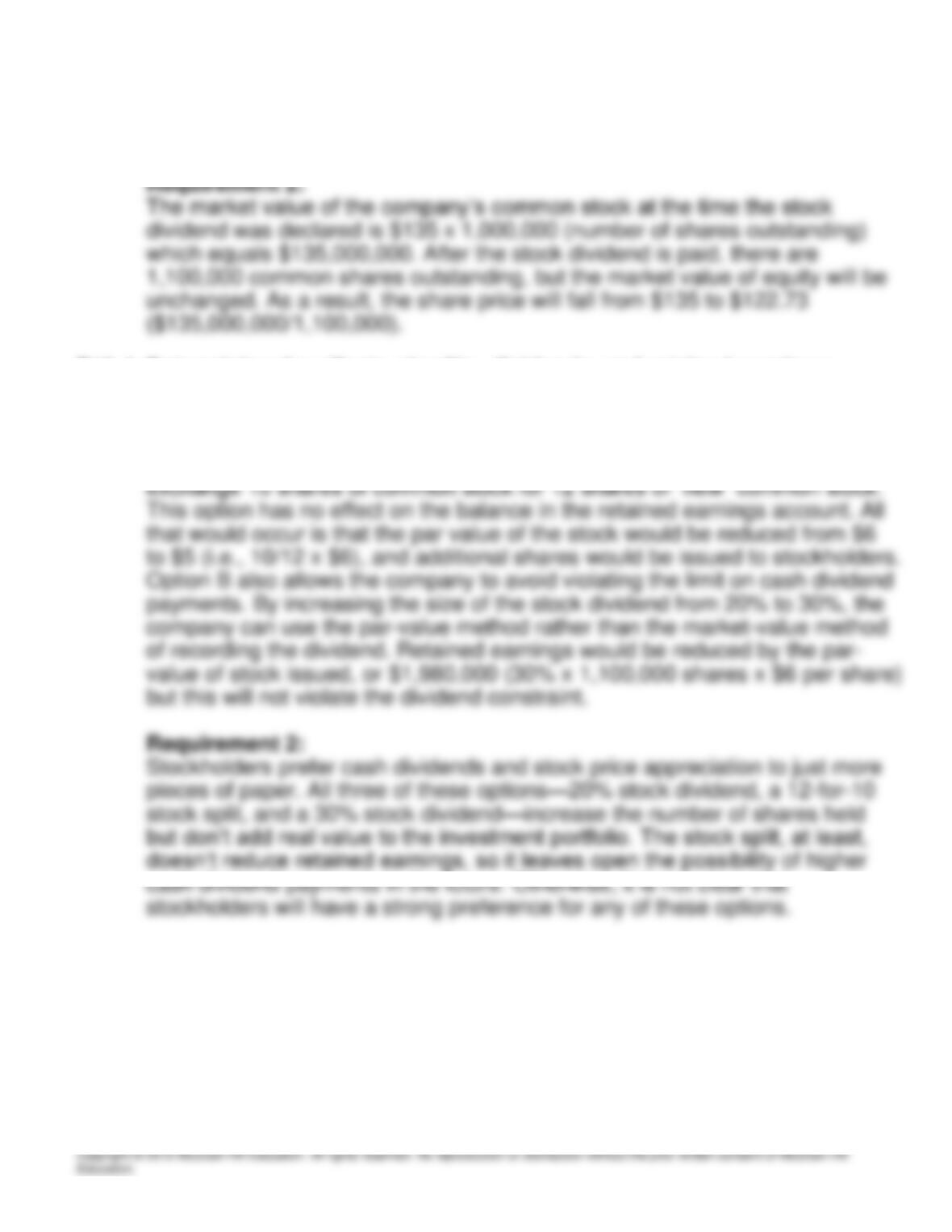
P15-4. Determining the effects of splits, dividends, and retained earnings
Requirement 1:
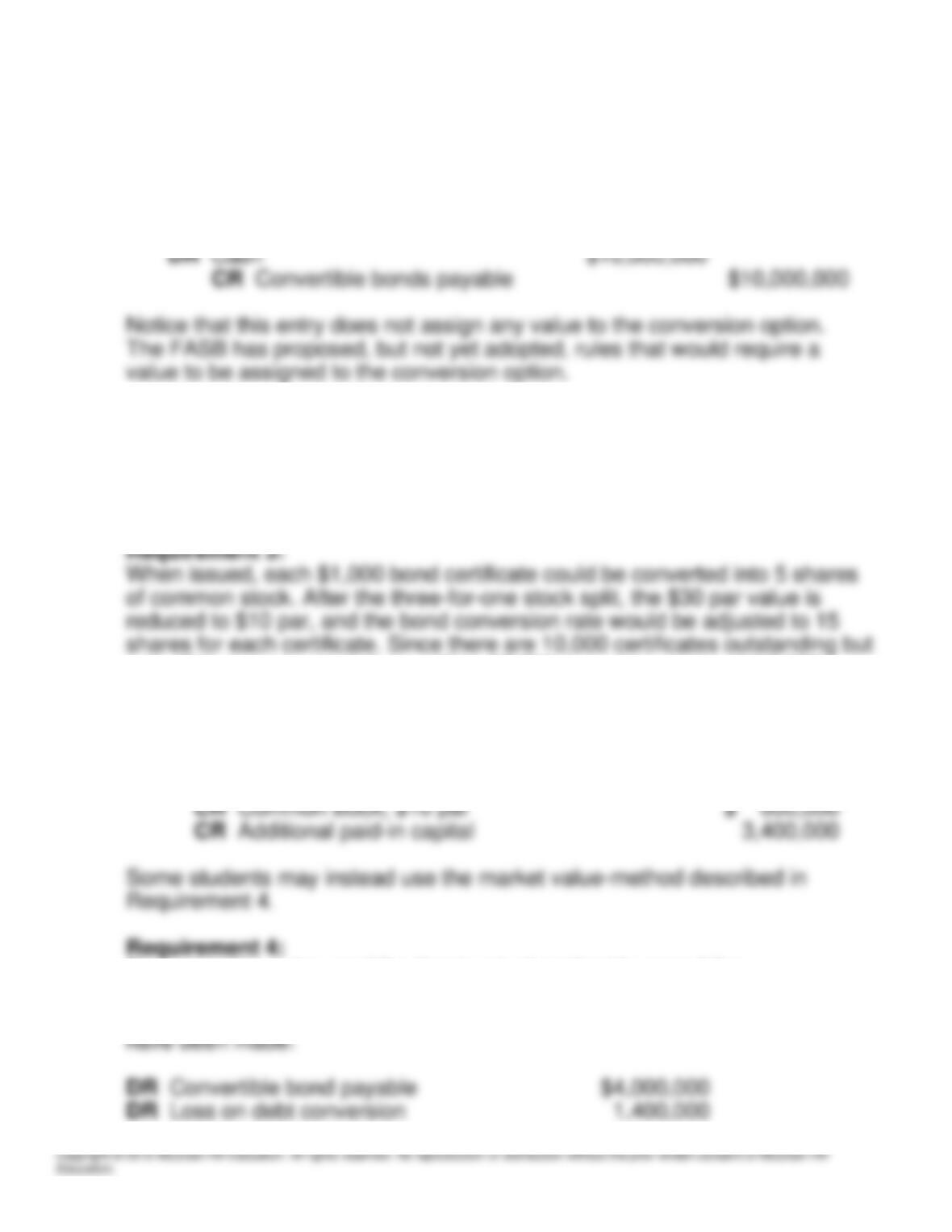
Both options allow the company to avoid violating the limit on cash dividend
payments. With regard to option A, a stock split of 12 for 10 means investors
15–10
P15-5. Analyzing convertible debt
(AICPA adapted)
Requirement 1:
Journal entry to record the original issuance of the $10 million convertible
bond at par:
Requirement 2:
Interest expense on the bond would be computed and recorded in the usual
manner using the effective-interest method described in Chapter 11. Since
the bond was issued at par, its effective interest rate is its stated interest rate
of 4%, so interest expense would be $400,000 (or $10 million x 4%).
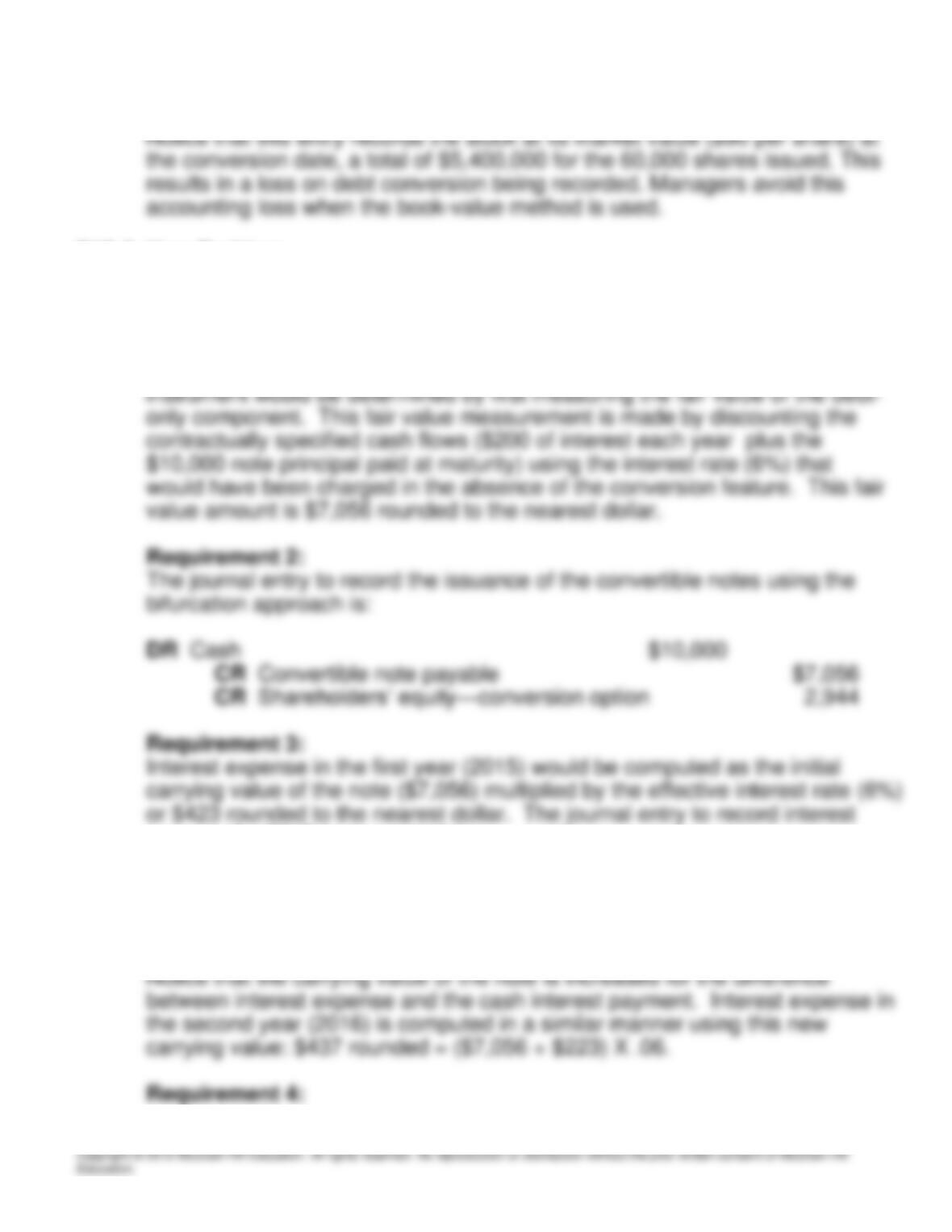
only 40% are converted, there will be 60,000 new shares issued (10,000
certificates x 15 shares x 40%). The journal entry to
record the conversion (assuming all interest has been accrued to the
conversion date) using the book value method is:
DR Convertible bond payable $4,000,000
The preceding entry used the “book value” method to record the
conversion—the issued stock was recorded at the book value of the debt
retired. Had the market-value method been used, the following entry would
15–11
CR Common stock, $10 par $ 600,000
CR Additional paid-in capital 4,800,000
P15-6. New Problem
Part [A]: Using the bifurcation approach as required by U.S. GAPP:
Requirement 1:
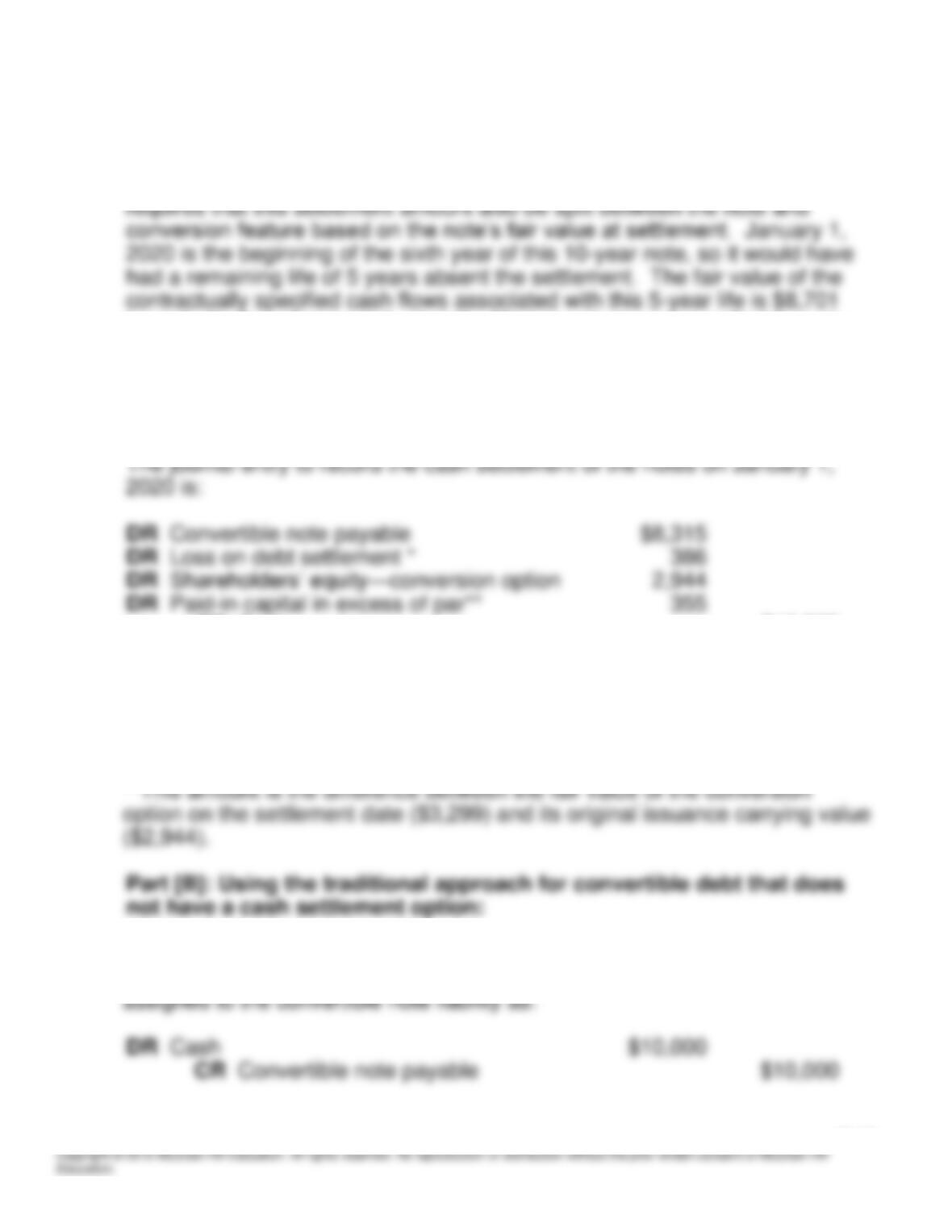
The fair value of the debt and equity components of the convertible debt
expense for 2015 (not required) is:
DR Interest Expense $423
CR Cash $200
CR Convertible note payable 223
15–12
The convertible note carrying value as of December 31, 2016—the end of
Year 2—would be $7,516 = $7,056 + $223 + $237.
Requirement 5: The cash settlement amount as of January 1, 2020 is
$12,000 and represents the cash value of 400 shares multiplied by the $30
per share fair value trading price of the stock on that date. Bifurcation
(rounded) when discounted using the 5% interest rate now applicable to the
company. The note thus has a settlement date fair value of $8,701 and the
conversion feature has a settlement date fair value of $3,299 or $12,000
minus $8,701.
Requirement 6:
CR Cash $12,000
*The loss on debt settlement is computed as the difference between the debt
fair value on the settlement date ($8,701) and its carrying value ($8,315).
You should verify that the convertible note carrying value on January 1, 2020
(the beginning of Year 6) is $8,315.
Requirement 7:
Bifurcation would be ignored and the entire proceeds at issuance would be

15–13
15–14
Requirement 8:
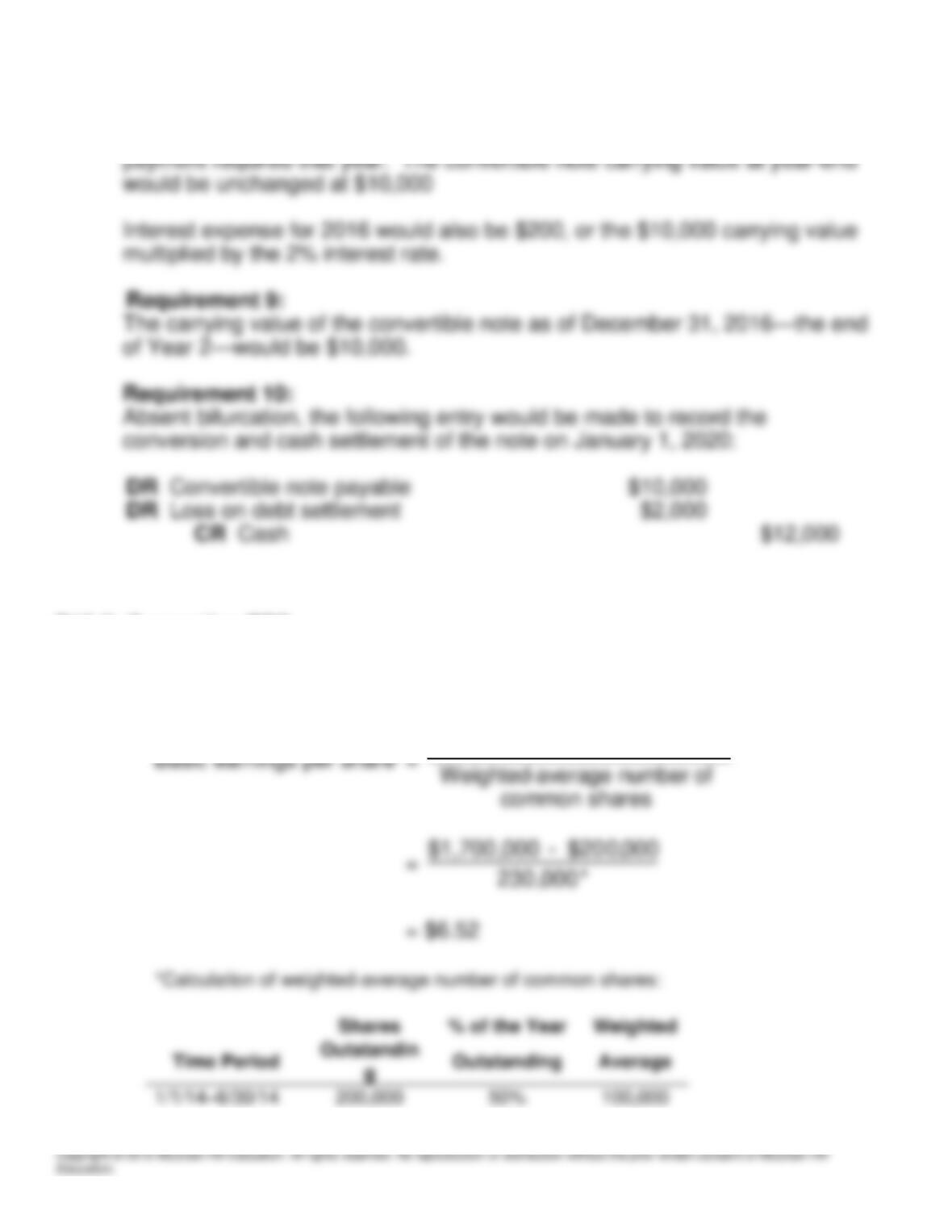
Interest expense in 2015 would be computed as the debt carrying value
($10,000) multiplied by the implied effective interest rate (2%). Interest
expense this first year would be $200, an amount equal to the cash interest
P15-7. Computing EPS
Requirement 1:
Calculation of basic earnings per share:
Net income – Preferred dividends
Weighted–average number of
common shares
=
$1,700,000 – $200,000
230,000*
= $6.52
*Calculation of weighted-average number of common shares:
Shares
% of the Year
Weighted
Time Period
Outstandin
g
Outstanding
Average
1/1/14–6/30/14
200,000
50%
100,000
15–15
7/1/14–12/31/14
260,000
50%
130,000
Total
230,000
Requirement 2:
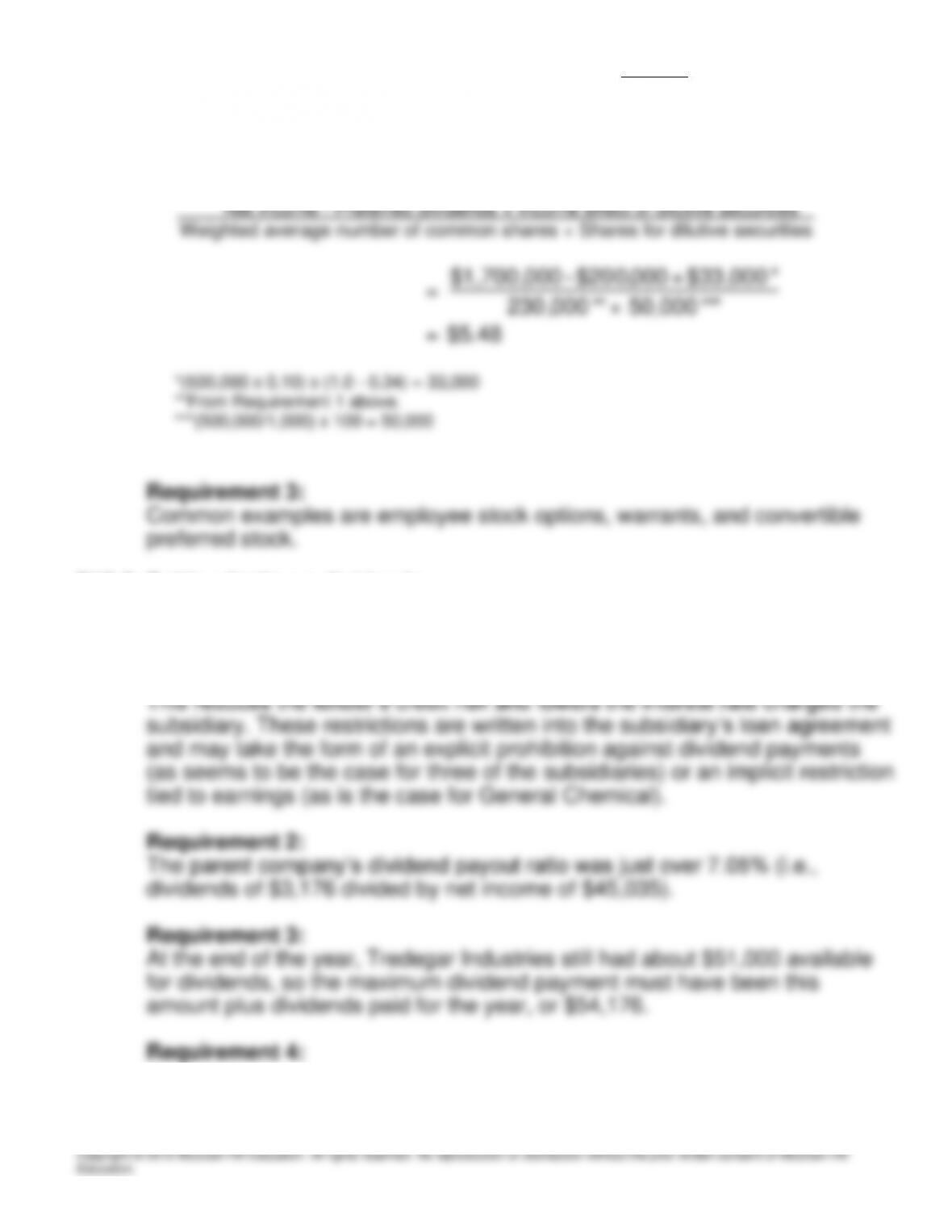
Calculation of diluted earnings per share:
P15-8. Setting limits on dividends
Requirement 1:
Lenders restrict a subsidiary’s ability to pay dividends to the parent
corporation so that the subsidiary’s cash flows are available to repay its debt.