
Financial Reporting and Analysis 6e Financial Reporting for Owner’s Equity
Black–Scholes model or some other theoretically sound approach.
e. The fair value of the options is expensed on a straight-line basis over the vesting
period (with the offset credited to a paid-in capital account).
i. This same entry is made each year even though the market value of the company’s
stock (and the value of outstanding employee stock options) will undoubtedly
change over time.
ii. GAAP guidelines specify that compensation costs—option fair value—be
measured only once, at the grant date.
f. If the options are exercised, the total amount added to the common stock and capital in
excess is the sum of the cash received by the company when the options are exercised
plus the calculated fair value of the options at the grant date.
2. In October 2002, the FASB and IASB signed the Norwalk Agreement (memorandum of
understanding) to work toward mutual convergence of accounting standards. In November
the IASB issued an exposure draft calling for mandatory expensing of the fair value of
employee stock options. The FASB was obliged to converge with IASB’s exposure draft
position.
3. Canadian accounting regulators and the IASB both issued new standards in this area
mandating the use of fair value approaches.
4. I n December 2004, the FASB released a revised version of SFAS No. 123 known as SFAS
No. 123R, that affirmed its earlier decision to only allow the fair value method for
employee stock options.
a. The same approach that was described above for the fair value method was
maintained.
b. The excess tax benefits cash flow is now reported in the financing section rather than
the operating section of the statement of cash flows.
5. In February 2005, the European Commission endorsed the new IASB stock option
accounting rules. Many U.S. firms had already voluntarily adopted the fair value method.
6. Current GAAP Requirements: The key provisions of the current guidance are:
a. Companies must record the cost of employee service received in exchange for stock
option award (limited exceptions exist).
b. Compensation cost is based on award’s grant-date fair value measured using option-
pricing models adjusted for the unique characteristics of employee stock options
(unless observable market prices are available)
c. Grant-date compensation cost is expensed on a straight-line basis over the vesting
period.
d. Incremental compensation cost from modifications to the original award terms is also
recognized during the vesting period although changes in the fair value of the
original options award itself are not recognized.
D. The options backdating scandal occurred in 2006 when it was uncovered that a number of
firms backdated their stock options to a point where the stock price was lower, thereby
conferring extra pay to executives regardless of company stock performance. This practice
also violates accounting rules and SEC disclosure regulations. To rectify the violation,
backdating firms must restate previously issued financial reports.
VIII. CONVERTIBLE DEBT
A. Convertible bonds give investors the opportunity to exchange a company’s notes and debt for
common stock in accordance with terms in the bond indenture.
1. The conversion price—the dollar value at which the debt can be converted into common
—is typically above the prevailing market price of the company’s common shares when
the debt is issued.
2. The option to convert is solely at the discretion of the investor, and will only be exercised

Financial Reporting and Analysis 6e Financial Reporting for Owner’s Equity
when and if the investor finds the exchange desirable.
3. Convertible notes and bonds are typically subordinated debentures, meaning that the
claims of “senior” creditors must be settled in full before any payment will be made to
holders of subordinated debentures in the event of insolvency or bankruptcy.
a. Senior creditors typically include all other long-term debt issues and bank loans.
b. Subordinated debentures do have priority over common and preferred stock.
B. Convertible notes and bonds are also usually callable, or redeemable by the issuer at a specified
price before maturity.
1. When convertible debt is called, investors must either convert or have the debt
redeemed for a cash price that is generally less than the value of the common stock into
which the debt can be converted.
2. Call provisions protect the company against extreme price increases by forcing investor
action.
3. Convertible bonds are often issued with the intention of a deferred equity sale, i.e., they
provide interim debt financing that will be turned into equity in the future.
C. Financial Reporting Issues:
1. GAAP specifies that convertible bonds must be recorded as debt only, with no value
assigned to the conversion privilege because of the:
a. Inseparability of the conversion feature from the debt component of the convertible
security.
b. Practical problems of determining separate values for the debt and the conversion
option in the absence of separability.
2. Given modern option pricing methods, it is unlikely that accounting standard setters
would reach the same conclusion today. Nevertheless, GAAP for most convertible
debt continues to reflect the “debt only” approach.
3. Until conversion, the accounting for convertible debt parallels that for straight debt
securities described in Chapter 10.
a. The book value method records the newly issued stock at the book value of
debt retired.
i. No accounting gain or loss is recognized at retirement because the debt book
value is just transferred to the common stock account.
ii. Managers can avoid the recognition of an accounting loss under this
method since almost all debt conversions occur when the company’s stock
price is above the conversion price.
b. The market value method records the newly issued shares at their current
market value.
i. Any difference between that market value and the conversion price is
recognized as a loss (or gain) on conversion.
ii. The conversion loss is not classified as an extraordinary item since
investors initiated the conversion.
iii. Almost all debt conversions occur when the company’s stock price is
above the conversion price, and this situation triggers recognition of an
accounting loss under the market value method.
D. Analytical insights:
1. Estimating the future cash flow implications of convertible debt is difficult.
2. Recorded interest expense may seriously understate the true cost of debt financing for
companies that issue convertible bonds or notes.
3. Footnote disclosures are useful in translating various debt and equity components into
common terms to compare financial and operational risks and returns.
D. Convertible Debt That May Be Settled in Cash:
1. GAAP has an exception for accounting for convertible debt where the borrower has the

Financial Reporting and Analysis 6e Financial Reporting for Owner’s Equity
right, upon conversion, to pay some or all of the conversion value in cash rather than in shares
of stock. GAAP, in that case, requires separate recognition of the debt and equity components.
IX. Global Vantage Point
A. Unlike U.S. GAAP, the IFRS guidelines for convertible debt require the liability and equity
components to be separated.
B. Canadian GAAP has required the use of the component approach to convertible debt accounting
for some years. While this requirement existed under GAAP for a short time, it was rescinded.
CHAPTER QUIZ
Consider the following information in answering questions 1 and 2.
The shareholders’ equity section of the balance sheet for Agee Company shows:
12/31/15 12/31/16
Preferred Stock, $200 par value, 5% dividend
20,000 shares issued and outstanding $4,000,000 $4,000,000
Common stock, $2 par value, 200,000 shares
issued and outstanding 400,000 520,000
Additional paid-in capital 19,600,000 26,800,000
Retained earnings 3,000.000 4,000.000
Total stockholders’ equity 27,000,000 35,320,000
Net income for 2016 was $1,700,000, preferred stock dividends were $200,000, and common stock
dividends were $500,000. The company issued 60,000 shares of common stock on July 1, 2016.
Agee issued $500,000 of 10% convertible subordinated debentures on September 1, 2016. Each $1,000
bond is convertible into 100 shares of common stock. Finally, the company issued options on 30,000
shares on December 31,2015 on December 31, 2016 was $130. The company’s tax rate is 35%.
1. Calculate the price at which the 60,000 shares were issued on July 1, 2016.
a. $100.00.
b. $122.00.
c. $136.60.
d. $142.86.
2. Calculate the diluted earnings per share at December 31, 2016.
a. $5.33.
b. $5.46.
c. $5.95.
d. $6.52.
3. Falcone Ltd. discloses the following in its annual report:
2015
Net income as reported ($ millions) $851
Pro forma net income ($ millions) $809
EPS as reported $3.47

Financial Reporting and Analysis 6e Financial Reporting for Owner’s Equity
Pro forma EPS $3.30
The company issued 4,131,000 options at the market value of the company’s stock on the date of
grant in 2015. Options generally vest in 20% increments over five years. The weighted average fair
value of options granted in 2015 was $21.07. What expense would the company have recorded for
the stock options granted in 2015 if the fair value method had been used?
a. $17,408,034.
b. $21,013,390.
c. $38,180,000.
d. $87,040,170.
4. As a credit analyst, how would you react to a company’s announcement of its stock
repurchase plan?
a. Credit analysts would not be concerned since stock repurchase plans have no effect on credit
risk analysis.
b. Credit analysts would support the stock repurchase program since the resulting increase
in stock price is indicative of a stronger firm.
c. Credit analysts certainly take notice of repurchase programs since they have the effect of
increasing leverage and possibly the risk of the debtor.
d. Credit analysts would not be concerned since stock repurchases using internally-generated cash
does not increase leverage.
5. Quartel’s Stockholders’ Equity section shows two issues of preferred stock carried at $100 per share
(their par value). However, both shares are callable at higher prices (1,672,594 shares of $4.50
series preferred stock are callable at $120 and 700,000 shares of $3.50 series preferred stock are
callable at $102). At December 31, 2015 the $4.50 series shares have a market value of $96.50 and
the $3.50 series shares have a market value of $98.50 per share. In calculating book value per share,
what amount for preferred stock would you subtract from shareholders’ equity?
a. Preferred stock should be restated to liquidation value when calculating book value per
common share.
b. Preferred stock should be restated to market value when calculating book value per common
share.
c. Preferred stock should be left at par value when calculating book value per common share.
d. In this case, when calculating book value per common share, restate the preferred stock to
market value since it can be liquidated for a price that is lower than the call price.
6. If you believe that stock compensation should be recognized as part of employee compensation,
what analytic adjustments should be made, in computing P/E ratios, for firms that choose the
disclose-only option?
a. Use the reported net income per share.
b. Use the pro forma net income per share if stock compensation is seen as part of recurring
income.
c. Use the pro forma net income, adjusted to reflect the full fair value of the options in the year of
the grant.
d. Stock compensation has no effect on valuation measures such as the P/E ratio.
7. What effect do stock options have on cash flows?
a. The grant of stock options is a financing cash outflow.
b. The exercise of options significantly increases operating cash flows.
c. The exercise of options has no direct cash flow effect.
d. The exercise of options provides financing cash inflows.

Financial Reporting and Analysis 6e Financial Reporting for Owner’s Equity
8. West Co. issued 1,000 shares of its $5 par common stock to Line as compensation for 1,000 hours of
legal services performed. Line usually bills $160 per hour for legal services. On the date of
issuance, the stock was trading on a public exchange for $140 per share. By what amount should the
additional paid-in capital account increase as a result of this transaction?
a. $135,000.
b. $140,000.
c. $155,000.
d. $160,000
9 Which of the following is the primary element that distinguishes accounting for corporations from
accounting for other legal forms of business organization?
a. Prevailing GAAP is based on the entity view of the company.
b. The corporation draws a sharper distinction in accounting for the sources of capital.
c. The proprietary view of a company relates primarily to other forms of business.
d. Generally accepted accounting principles apply to corporations, but have relatively little
applicability to other forms of business organization.
10. Gains and losses on the purchase and resale of treasury stock may be reflected only in:
a. Paid-in capital accounts.
b. Income, paid-in capital, and retained earnings accounts.
c. Retained earnings and paid-in capital accounts.
d. Income and retained earnings accounts.
Financial Reporting and Analysis 6e Financial Reporting for Owner’s Equity
QUIZ ANSWERS:
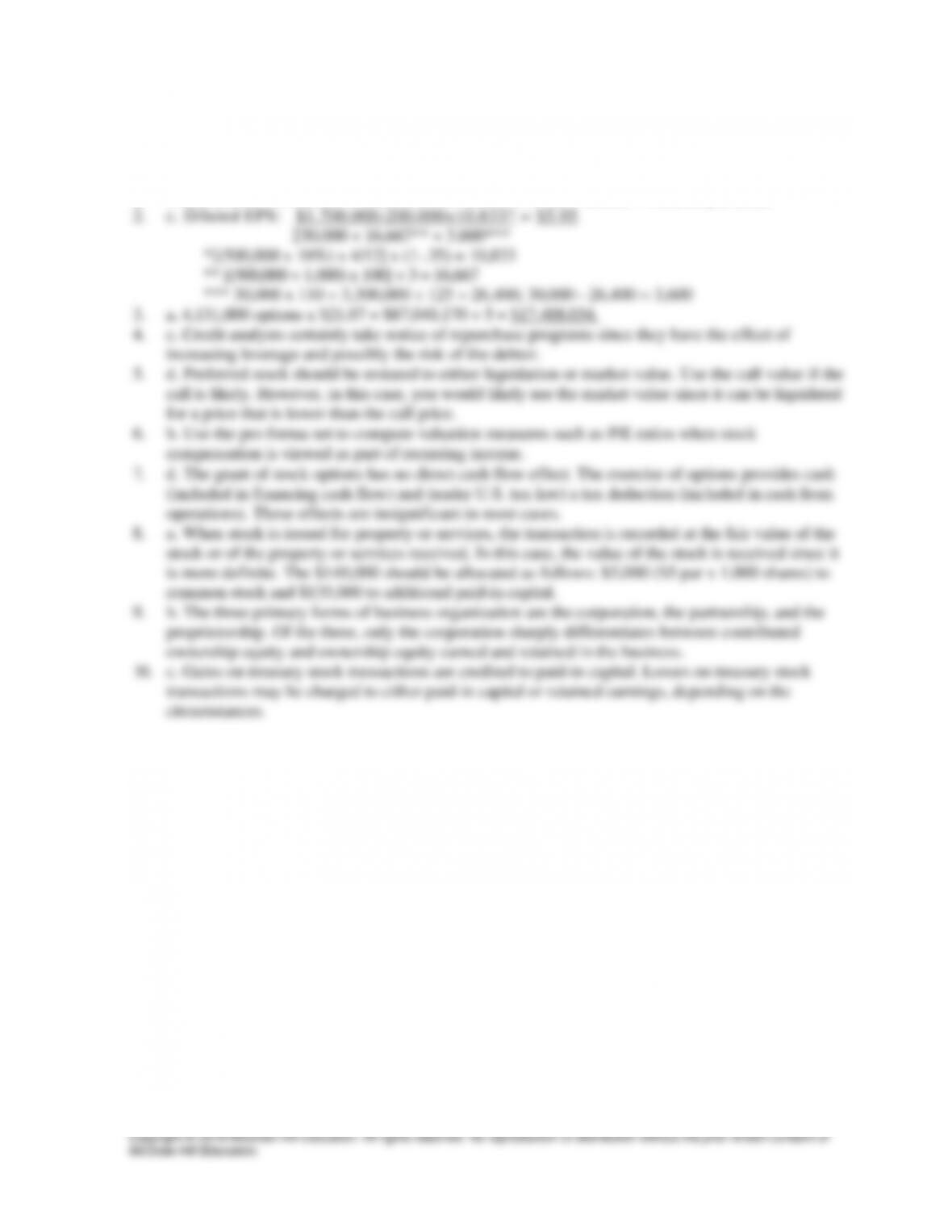
1. b. [($520,000 – $400,000) + ($26,800,000 – $19,600,000)] ÷ 60,000 = $122.00 per share.

Financial Reporting and Analysis 6e Financial Reporting for Owner’s Equity
RECOMMENDED EXHIBITS
Figure 15.1—The Dollar Value of Stock Repurchased Each Quarter 2005 – 2012 by U.S. Companies in
The Standard & Poor’s 500 Index (in $ Millions)
Figure 15.2 – Employee Stock Option Reporting Alternatives Under SFAS No. 123
SUGGESTED READINGS
1. Grullon, G., and D. Ikenberry. 2000. What do we know about stock repurchases? Journal of
Applied Corporate Finance (Spring): 31-51.
2. Johannes, L., and J. Hechinger. 2001. Buyback plan for Staples.com is raising some eyebrows.
The Wall Street Journal (March 23).
3. Lambert, W., and J. Sapsford. 2001. J.P. Morgan tells analysts to warn of a downgrade. The Wall
Street Journal (March 22).
1. McGough, R.., S. McGee, and C. Bryan-Low. 2000. Buyback binge creates big hangover. The
Wall Street Journal (December 18).
2. Plitch, P. 1998. New simpler EPS reporting method isn’t always so clear. The Wall Street Journal
(January 21).
3. Roberts, M., W. Sampson, and M. Dugan. 1990. The stockholders’equity section: Form without
substance? Accounting Horizons (December): 36-37.
4. Simon, R., and C. Bryan-Low. 2001. Some insiders can cancel unprofitable stock purchases. The
Wall Street Journal (February 15).
5. Solomon, D. 2001. Sprint’s revised stock-option plan blocks cash-ins after failed mergers. The
Wall Street Journal (March 29).
6. Weil, J. 2001. Did accountants fail to flag woes at dot-com casualties? The Wall Street Journal
(February 9)

Financial Reporting and Analysis 6e Financial Reporting for Owner’s Equity