14–46
periodic contributions. Since the periodic contributions and the rate of return
on pension plan assets are fixed in the problem, the choice of the discount
The $0.75 during 2018 represents the shortfall in the pension fund at the end
of 2018. Note that the total contributions to the pension fund equal the total
pension expense regardless of the chosen discount rate. If the rate of return
P14-9. Interpreting OPEB disclosures (LO 3, 6, 7)
Requirement 1:
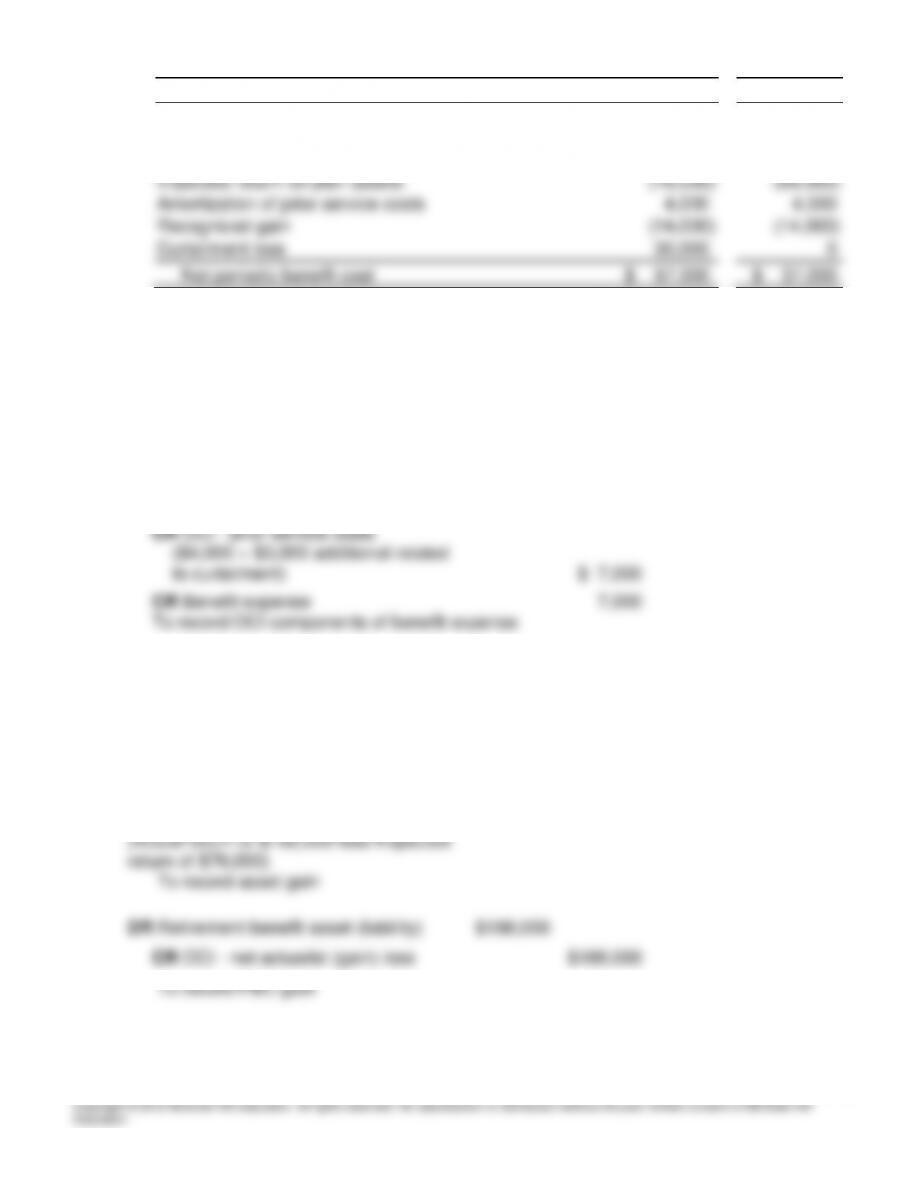
Determining missing costs and net periodic benefit cost:
2015
2014
Service cost (per change in benefit obligation schedule)
$ 41,000
$ 38,000
Interest cost (per change in benefit obligation schedule)
$ 82,000
$ 78,000
Plan assets at beginning of year
$ 865,000
$ 767,000
Assumed expected rate of return
8.8%
9.0%
Expected return on plan assets
76,120
69,030
Rounded to nearest million
$ 76,000
$ 69,000
14–47
Other Postretirement Benefit Costs
(In thousands)
2015
2014
Service cost
$ 41,000
$ 38,000
Interest cost on accumulated benefit
obligation
82,000
78,000
Expected return on plan assets
(76,000)
(69,000)
Amortization of prior service costs
4,000
4,000
Recognized gain
(14,000)
(14,000)
Curtailment loss
30,000
0
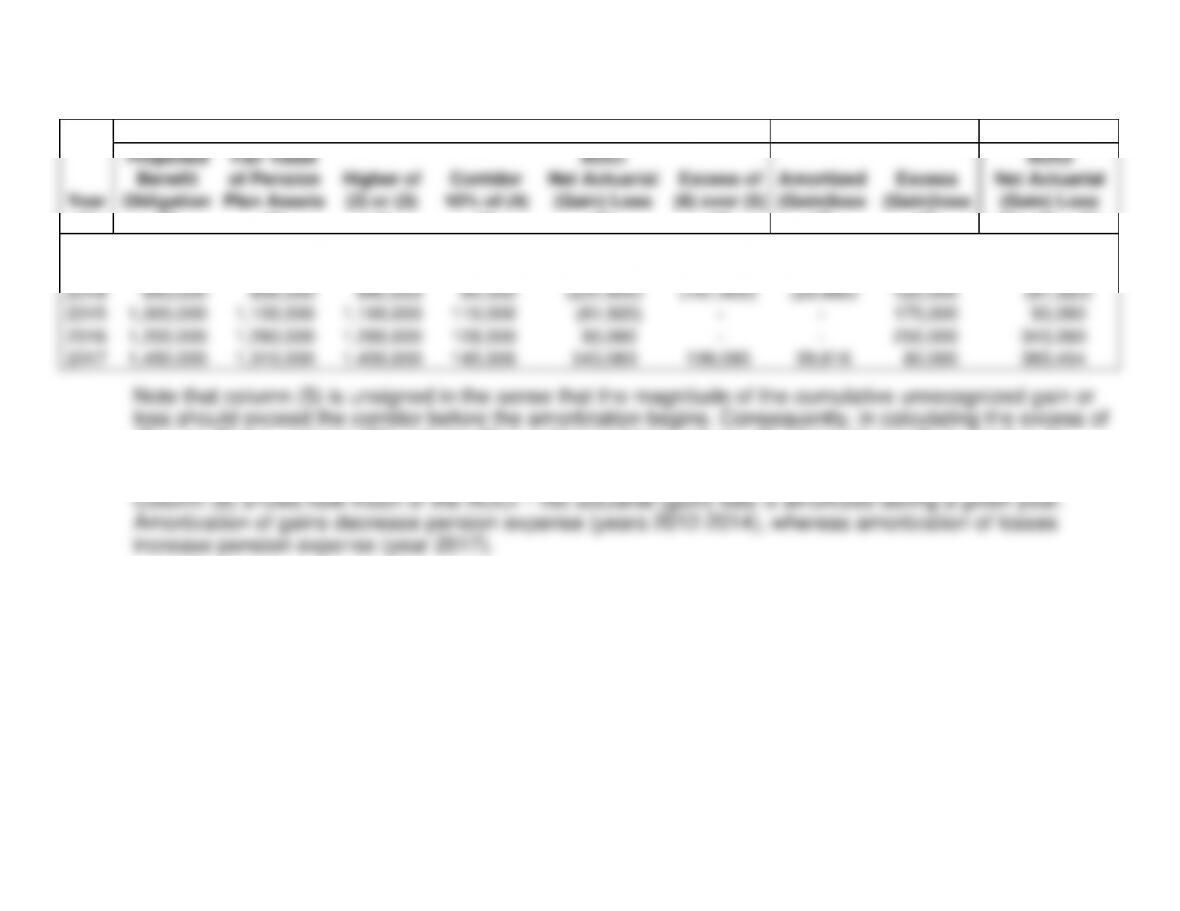
Net periodic benefit cost
$ 67,000
$ 37,000
Requirement 2: 2015 Journal entries
DR Benefit expense
$74,000
CR Retirement benefit asset (liability)
74,000
To record benefit expense less OCI amortization
DR OCI – net actuarial (gain) loss
14,000
CR OCI – prior service costs
($4,000 + $3,000 additional related
to curtailment)
$ 7,000
CR Benefit expense
7,000
To record OCI components of benefit expense
DR Retirement benefit asset (liability)
$24,000
CR Cash
$24,000
To record contribution
DR Retirement benefit asset (liability)
$29,000
CR OCI – net actuarial (gain) loss
$29,000
(Actual return of $105,000 less Expected
return of $76,000)
To record asset gain
DR Retirement benefit asset (liability)
$188,000
CR OCI – net actuarial (gain) loss
$188,000
To record PBO gain

14–48
Requirement 3: Balance sheet account
Beginning balance
$(371,000)
Expense entry
(74,000)
Contribution entry
24,000
Asset gain entry
29,000
PBO gain entry
188,000
Ending balance
$(204,000)
14–49
Copyright © 2015 McGraw-Hill Education. All rights reserved. No reproduction or distribution without the prior written consent of McGraw-Hill Education.
P14-10. Amortizating actuarial (gains) losses (LO 3, 4)
Beginning of the Year
For the Year
End of the Year
Projected
Fair Value
AOCI
AOCI
Benefit
of Pension
Higher of
Corridor
Net Actuarial
Excess of
Amortized
Excess
Net Actuarial
Year
Obligation
Plan Assets
(2) or (3)
10% of (4)
(Gain) Loss
(6) over (5)
(Gain)loss
(Gain)loss
(Gain) Loss
(1)
(2)
(3)
(4)
(5)
(6)
(7)
(8)
(9)
(6) – (8) + (9)
2012
$450,000
$410,000
$450,000
$45,000
($70,000)
($25,000)
($5,000)
($60,000)
($125,000)
2013
570,000
500,000
570,000
57,000
(125,000)
(68,000)
(13,600)
(120,000)
(231,400)
2014
840,000
800,000
840,000
84,000
(231,400)
(147,400)
(29,480)
120,000
(81,920)
2015
1,000,000
1,100,000
1,100,000
110,000
(81,920)
–
–
175,000
93,080
2016
1,200,000
1,280,000
1,280,000
128,000
93,080
–
–
250,000
343,080
2017
1,450,000
1,310,000
1,450,000
145,000
343,080
198,080
39,616
80,000
383,464
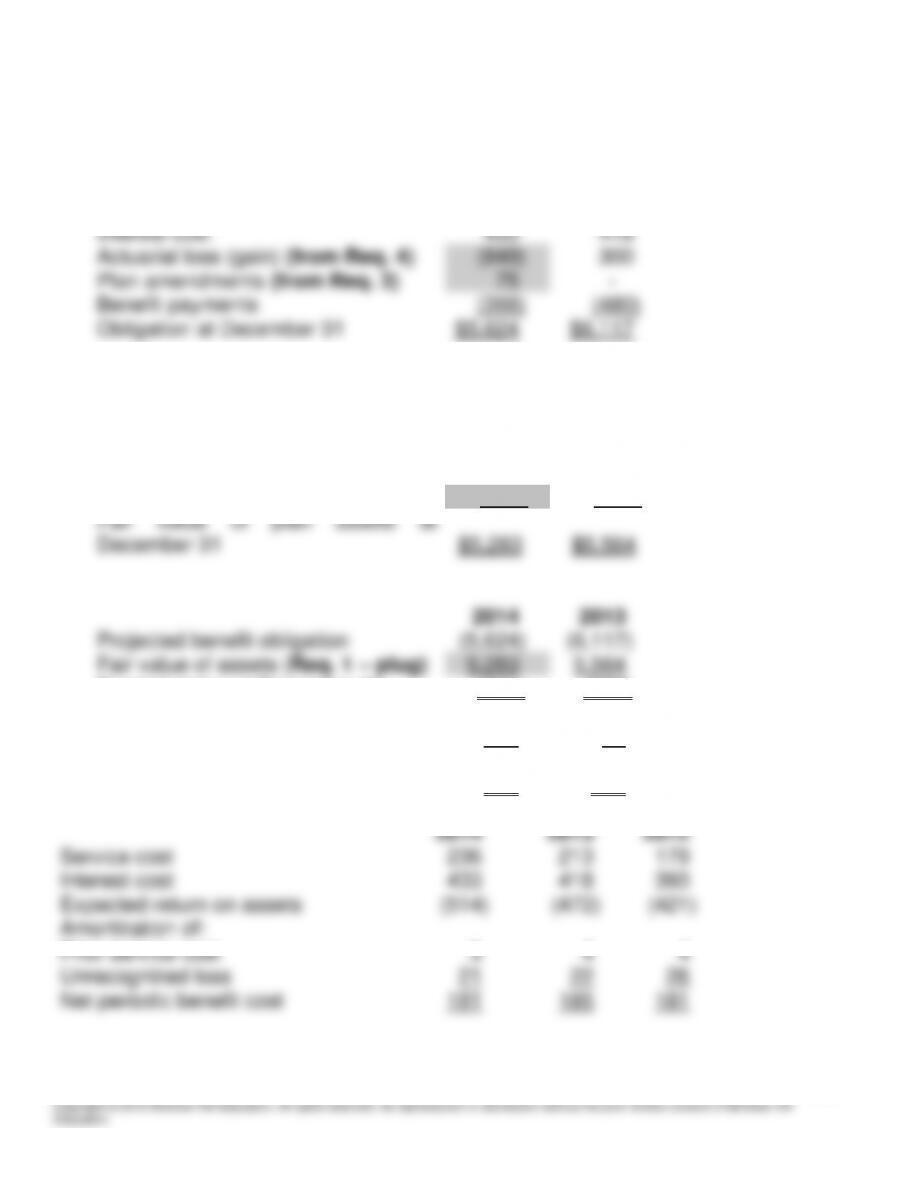
Note that column (5) is unsigned in the sense that the magnitude of the cumulative unrecognized gain or
loss should exceed the corridor before the amortization begins. Consequently, in calculating the excess of
(6) over (5) [i.e., column (7)], column (5) is subtracted from column (6) when column (6) is positive. In
contrast, column (5) is added to column (6) when column (6) is negative.
14–50
P14-11. Interpreting pension note disclosures (LO 2, 3, 4, 6)
Requirements 1 and 2 – Fair value of assets and benefit payments
($ in millions)
2014
2013
Obligation at January 1
$6,117
$5,666
Service cost
236
213
Interest cost
433
418
Actuarial loss (gain) (from Req. 4)
(849)
300
Plan amendments (from Req. 3)
75
–
Benefit payments
(388)
(480)
Obligation at December 31
$5,624
$6,117
Fair value of plan assets at January
1
$5,564
$5,127
Actual return on plan assets
7
847
Employer contributions
100
70
Benefit payments (Req. 2 – plug)
(388)
(480)
Fair value of plan assets at
December 31
$5,283
$5,564
2014
2013
Projected benefit obligation
(5,624)
(6,117)
Fair value of assets (Req. 1 – plug)
5,283
5,564
Funded status at December 31:
(341)
(553)
AOCI – Actuarial net loss
288
651
AOCI – Prior service costs
138
68
Total
426
719
2014
2013
2012
Service cost
236
213
179
Interest cost
433
418
393
Expected return on assets
(514)
(472)
(421)
Amortization of:
Prior service cost
5
4
4
Unrecognized loss
21
22
26
Net periodic benefit cost
181
185
181
14–51
Requirement 3 – Plan amendments
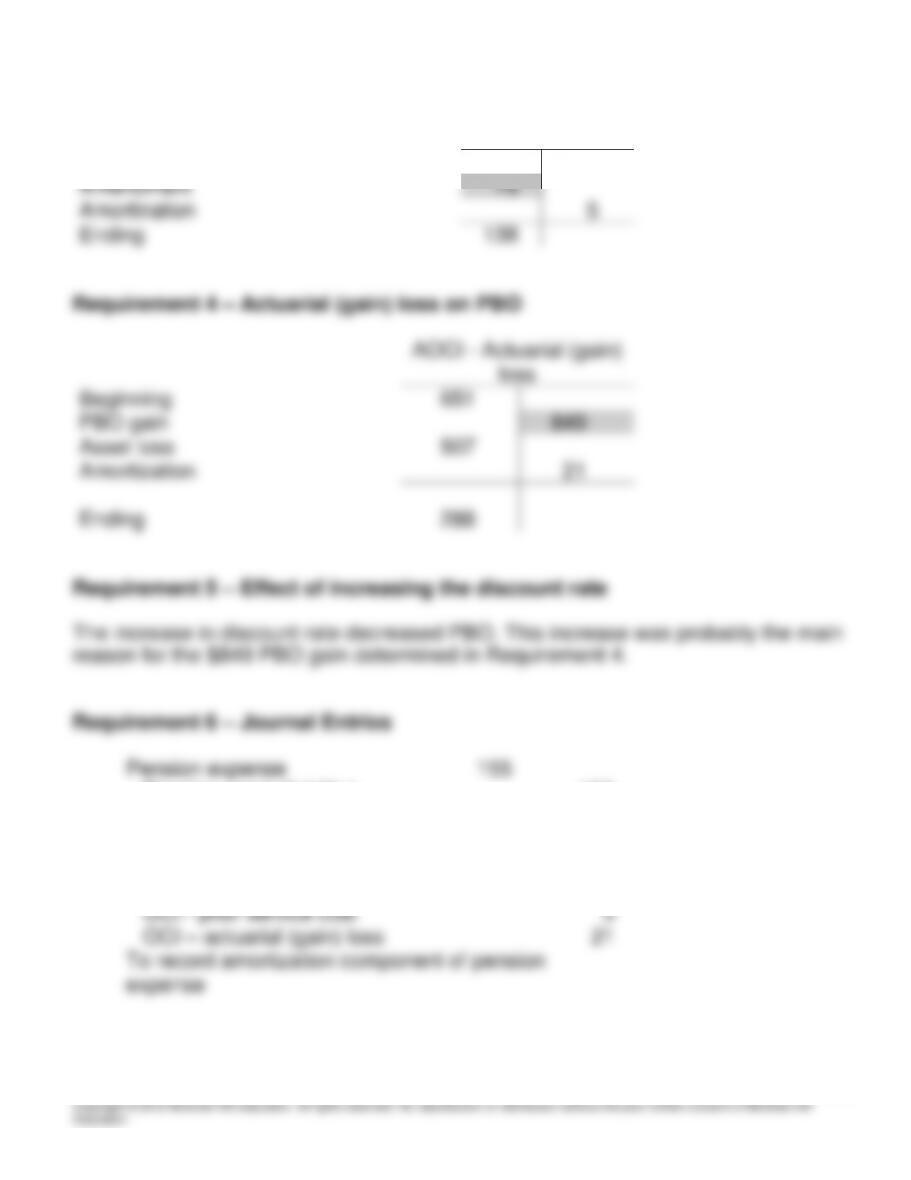
AOCI – Prior
Service Cost
Beginning
68
Amendment
75
Amortization
5
Ending
138
AOCI – Actuarial (gain)
loss
Beginning
651
PBO gain
849
Asset loss
507
Amortization
21
Ending
288
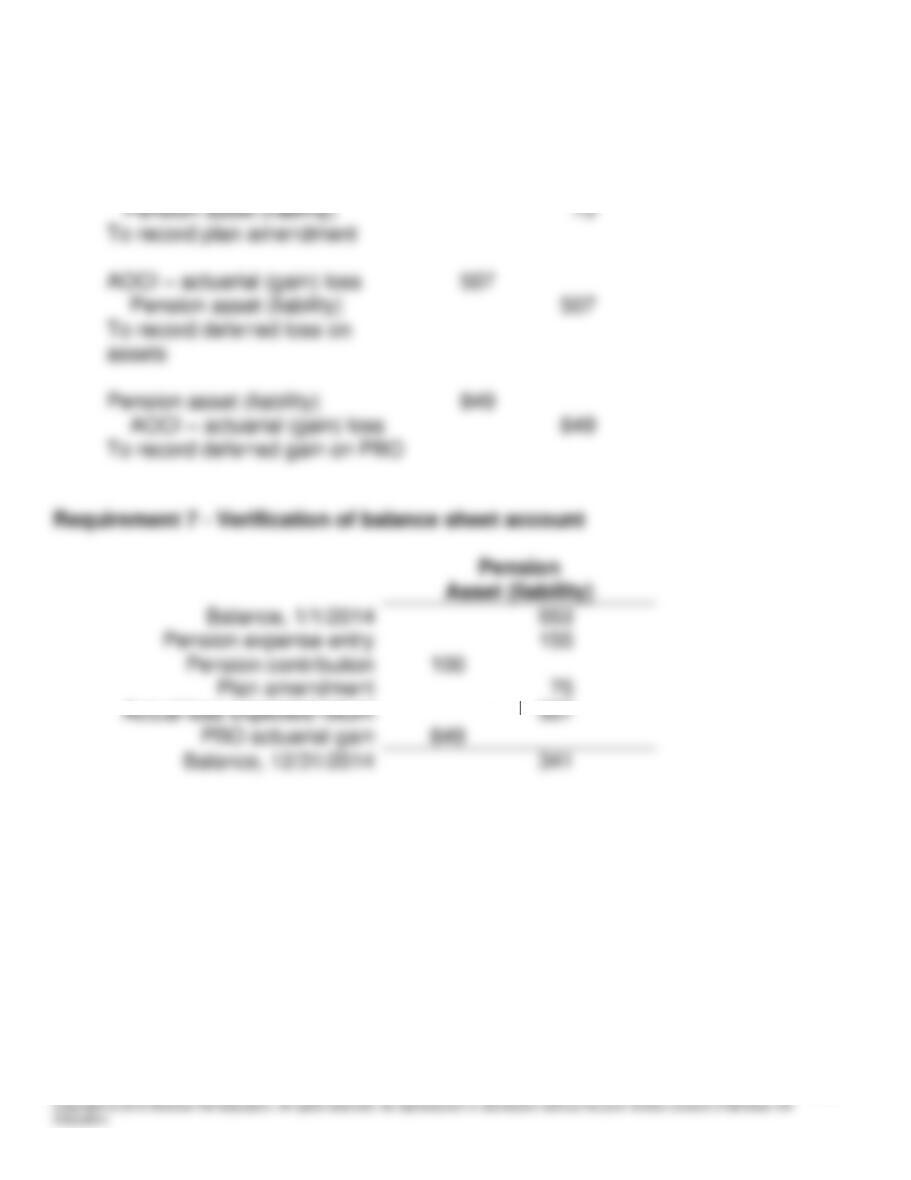
Pension expense
155
Pension asset (liability)
155
To record service cost, interest cost, and
expected return
Pension expense
26
OCI – prior service cost
5
OCI – actuarial (gain) loss
21
To record amortization component of pension
expense
14–52
Pension asset (liability)
100
Cash
100
To record contribution
AOCI – prior service cost
75
Pension asset (liability)
75
To record plan amendment
AOCI – actuarial (gain) loss
507
Pension asset (liability)
507
To record deferred loss on
assets
Pension asset (liability)
849
AOCI – actuarial (gain) loss
849
To record deferred gain on PBO
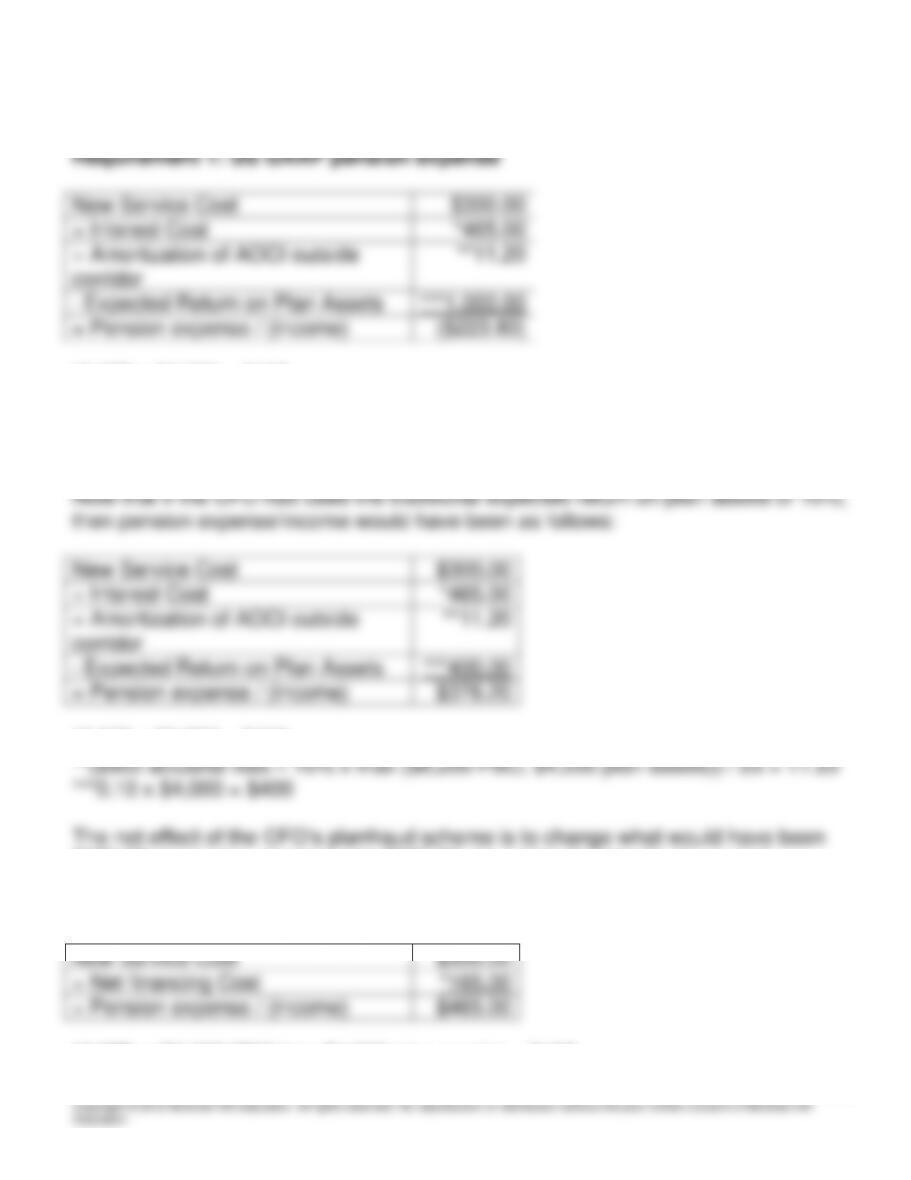
Pension
Asset (liability)
Balance, 1/1/2014
553
Pension expense entry
155
Pension contribution
100
Plan amendment
75
Actual less expected return
507
PBO actuarial gain
849
Balance, 12/31/2014
341
14–53
P14-12 Evaluating the effects of unreasonable rate of return assumptions (LO
3, 4, 6, and 9)
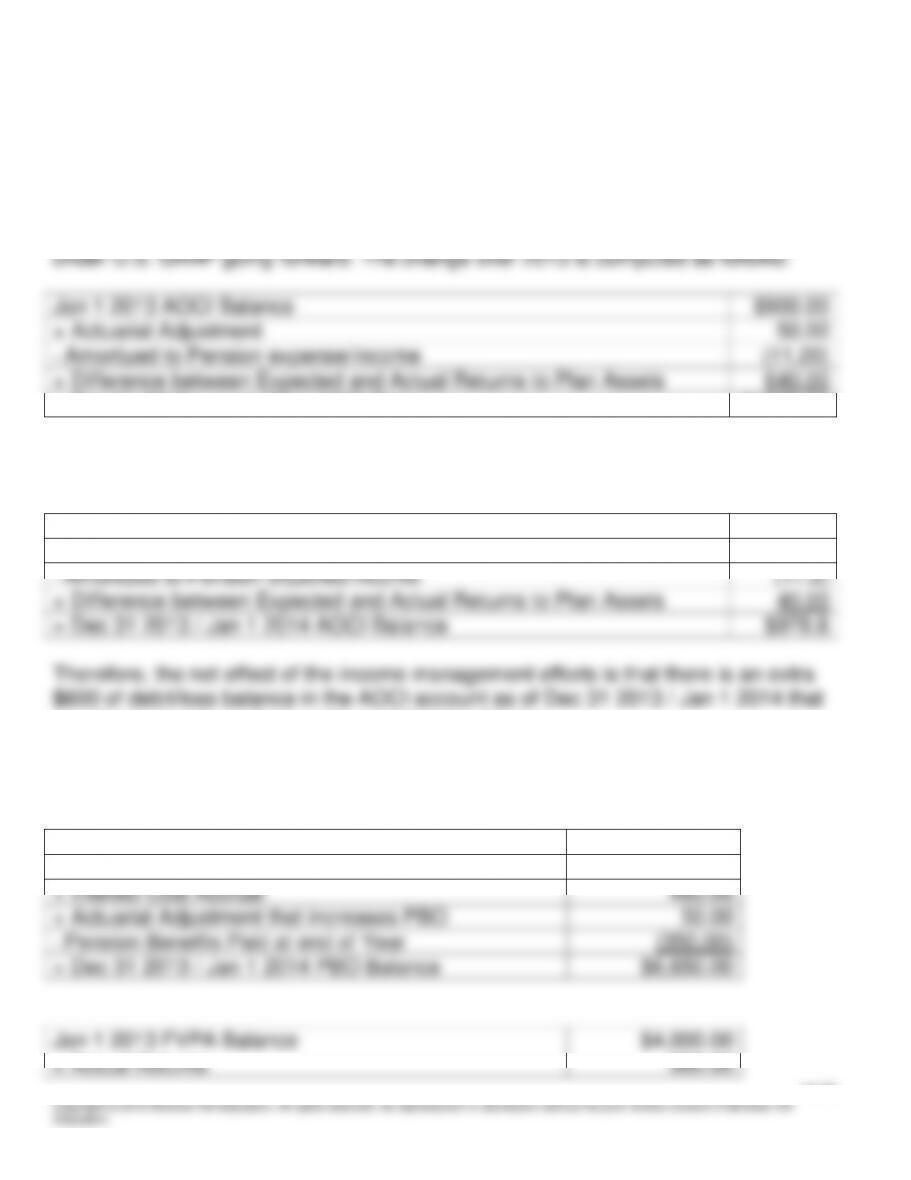
New Service Cost
+ Interest Cost
corridor
***1,000.00
= Pension expense / (income)
($223.80)
*0.075 x $6,200 = $465
**[$900 actuarial loss – .10 x max ($6,200 PBO, $4,000 plan assets)] / 25 = 11.20
***0.25 x $4,000 = $1,000
New Service Cost
$300.00
= Pension expense / (income)
$376.20
*0.075 x $6,200 = $465
$376.20 of pension expense into $223.80 of pension income for the period.
Requirement 2: IFRS pension expense
New Service Cost
$300.00
+ Net financing Cost
*165.00
= Pension expense / (income)
$465.00
*0.075 x ($6,200 PBO less $4,000 plan assets) = $165
14–54
The scheme is not effective under IFRS because IFRS requires the expected rate of
return to equal the discount rate.
Requirement 3: Effect of overstatement on U.S. GAAP amounts
To compute the incremental effect under U. S. GAAP, we first need to update some
account balances to the end of 2013. The AOCI balance is what will be amortized
Jan 1 2013 AOCI Balance
$900.00
+ Actuarial Adjustment
50.00
– Amortized to Pension expense/income
(11.20)
+ Difference between Expected and Actual Returns to Plan Assets
640.00
= Dec 31 2013 / Jan 1 2014 AOCI Balance
$1578.80
Note that if the CFO had used the traditional estimate for return on plan assets is
10%, the change would have been as follows:
Jan 1 2013 AOCI Balance
$900.00
+ Actuarial Adjustment
50.00
– Amortized to Pension expense/income
(11.2)
+ Difference between Expected and Actual Returns to Plan Assets
40.00
= Dec 31 2013 / Jan 1 2014 AOCI Balance
$978.8
Therefore, the net effect of the income management efforts is that there is an extra
$600 of debit/loss balance in the AOCI account as of Dec 31 2013 / Jan 1 2014 that
would not have been there under traditional estimates.
To compute the corridor, we need to update the balances of the PBO and of the
Fair Value of Plan Assets as follows:
Jan 1 2013 PBO Balance
$6,200.00
+ New Service Cost
300.00
+ Interest Cost Accrual
465.00
+ Actuarial Adjustment that increases PBO
50.00
– Pension Benefits Paid at end of Year
(350.00)
= Dec 31 2013 / Jan 1 2014 PBO Balance
$6,650.00
Jan 1 2013 FVPA Balance
$4,000.00
+ Actual Returns
360.00