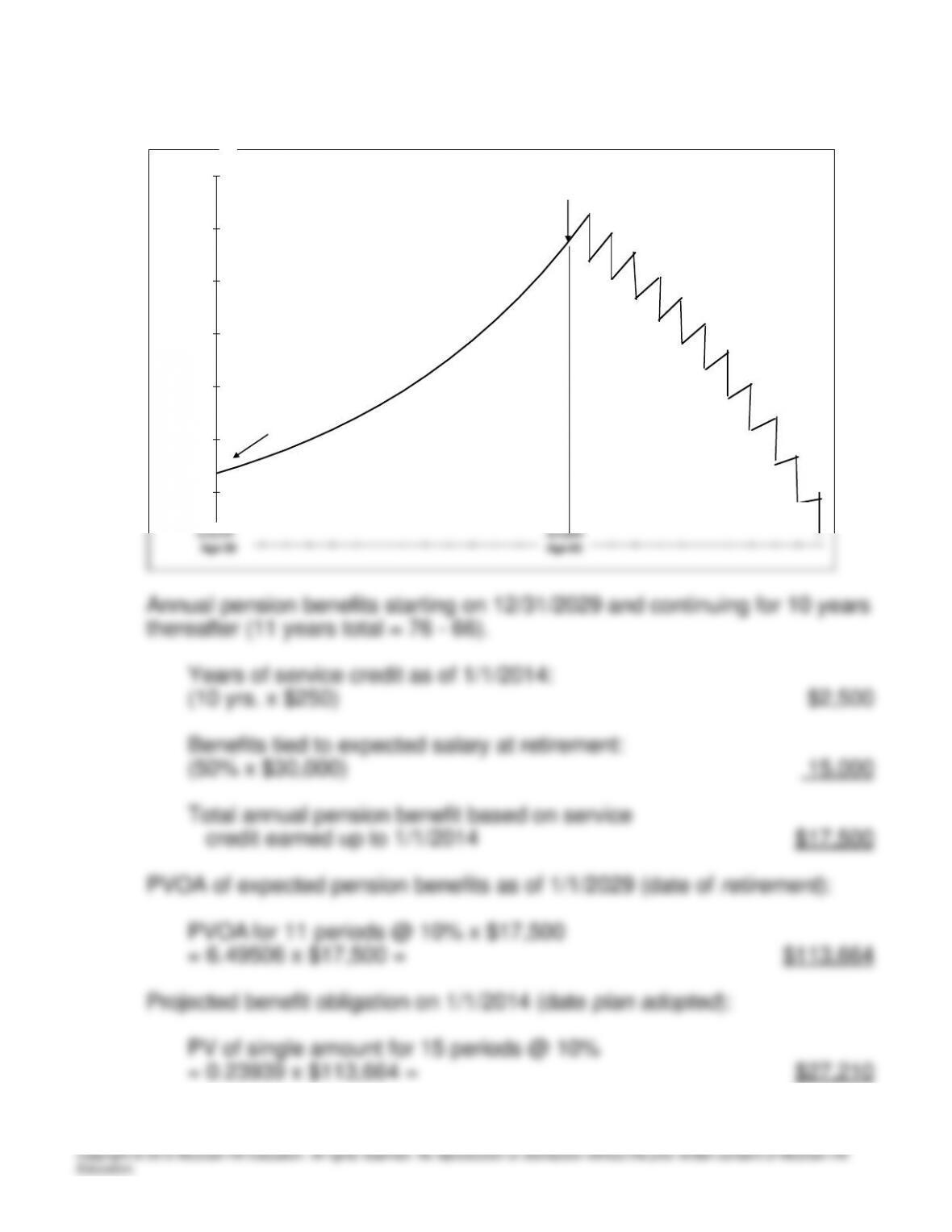
14–31
P14–5. Calculating PBO, ABO and pension expense
Requirement 1: Calculation of PBO on January 1, 2014:
0
20000
40000
60000
80000
100000
120000
140000
Projected Benefit
1/1/14
Age 50
1/1/29
Age 65
PV of Expected Pension
Benefits = $113,663
1
2
3
4
5
6
7
8
9
10
$
14–32
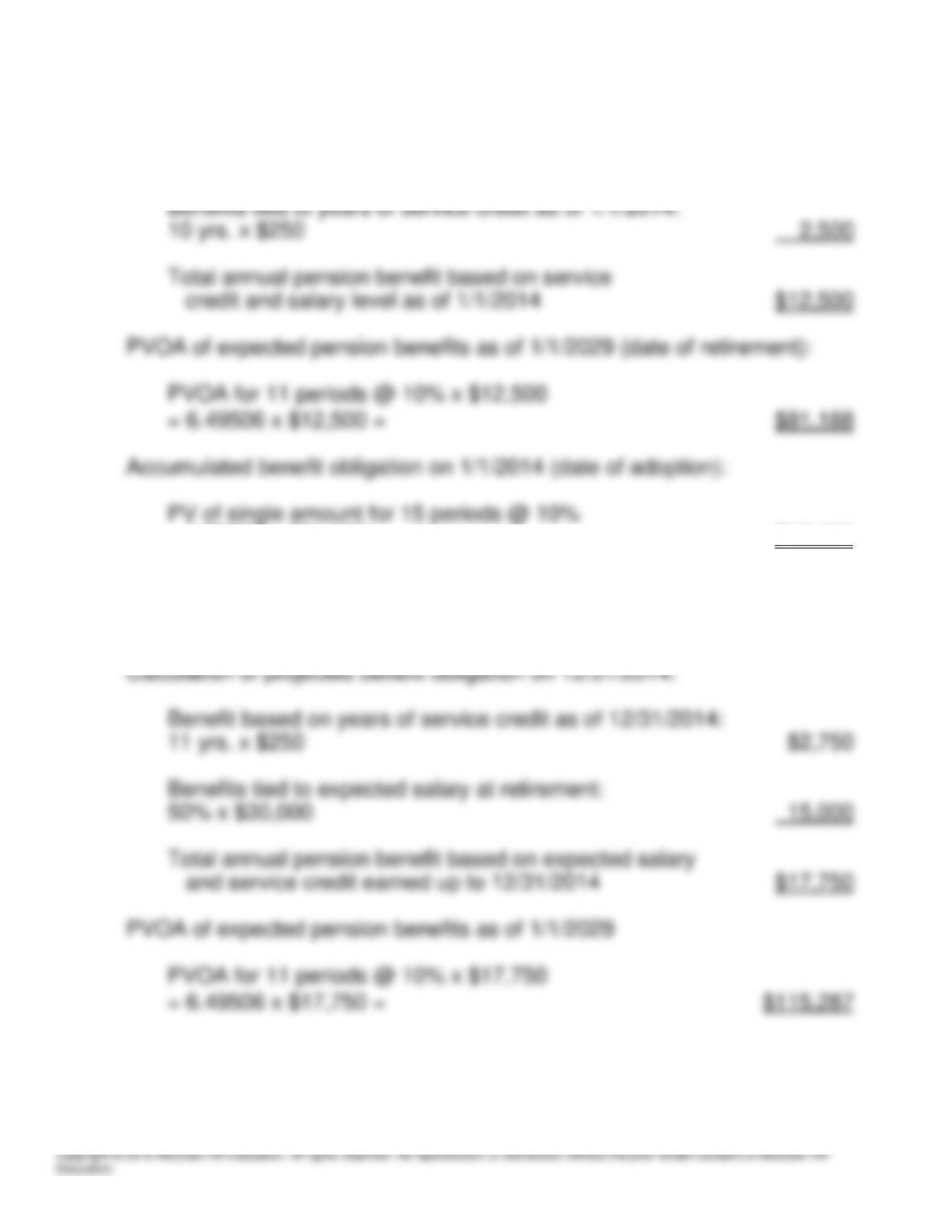
Accumulated benefit obligation on actual salary level attained as of the date
of computation (ignores future salary increase):
Benefits tied to actual salary as of 1/1/2014:
50% x $20,000 $10,000
= 0.23939 x $81,188 = $19,436
Note: Projected benefit obligation > accumulated benefit obligation
$27,210 $19,436
Requirement 2:
14–33
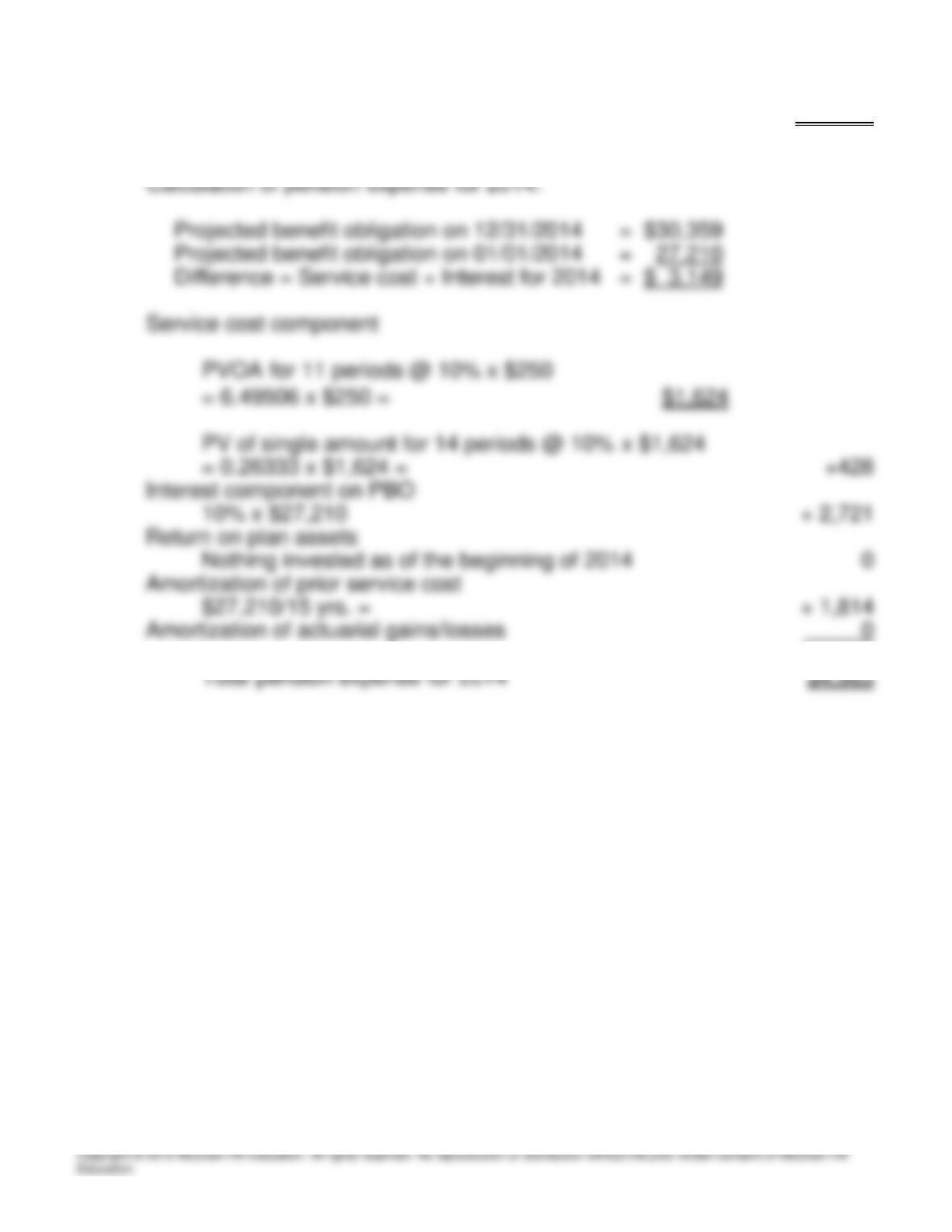
Projected benefit obligation on 12/31/2014:
PV of single amount for 14 periods @ 10%
= 0.26333 x $115,287 = $30,359
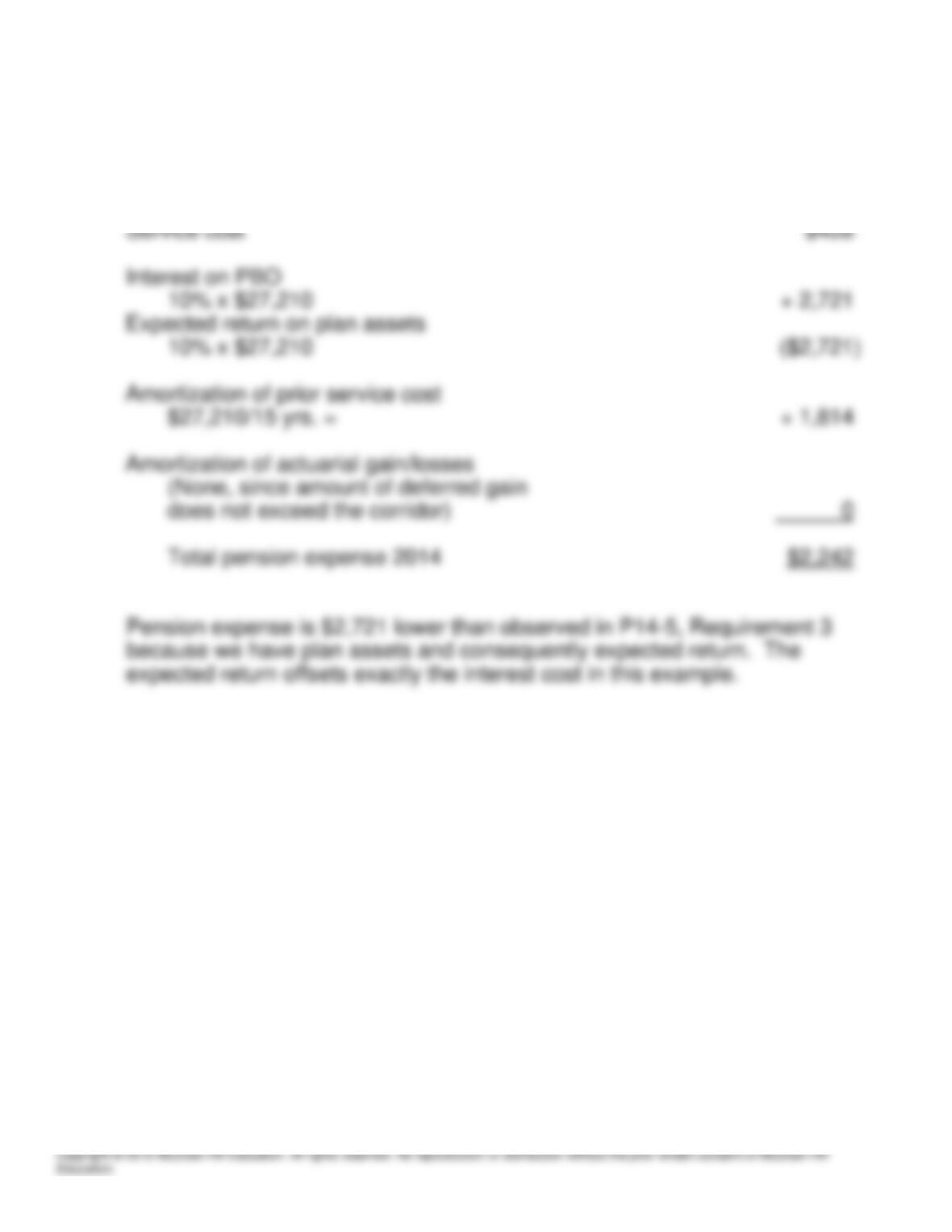
Requirement 3:
14–34
P14–6. Determining PBO, ABO and pension expense (LO 1, 2, 3)
Requirement 1:
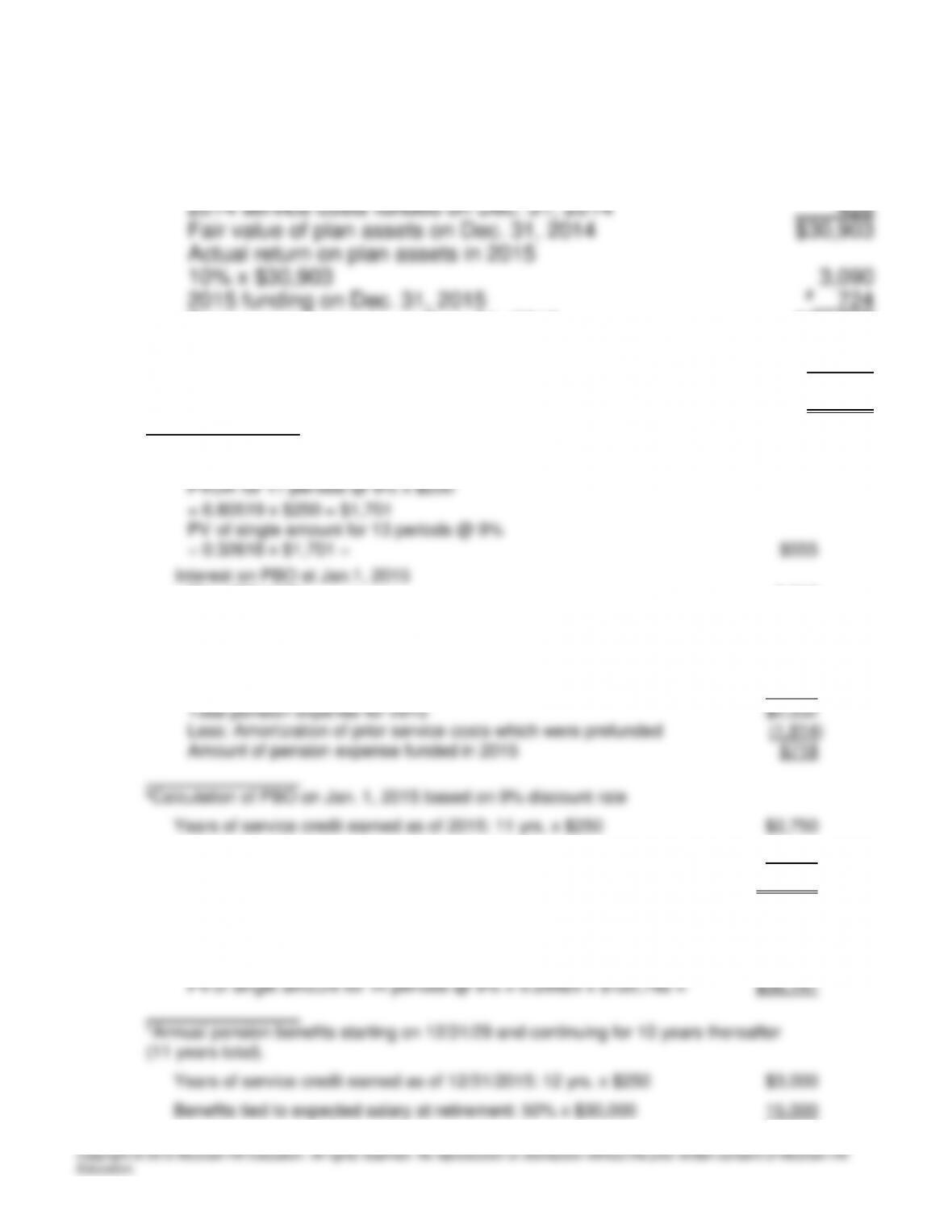
With the entire amount of PBO funded on Jan. 1, 2014, the expected return
on plan assets reduces pension expense. The calculation of pension expense
would be as follows for 2014:
14–35
Requirement 2:
Calculation of fair value of plan assets on Dec. 31, 2015:
Initial amount funded on Jan.1, 2014 $27,210
Actual return on plan assets in 2014
(12% x $27,210) 3,265
Total pension assets on Dec. 31, 2015 $34,717
Projected benefit obligation on Dec. 31, 2015* 39,955
Net underfunded position on 12/31/2015 $5,238
#Pension expense for 2015:
Service cost
9% x $36,147a 3,253
Expected return on plan assets
10% x $30,903 = ($3,090)
Amortization of prior service costs: $27,210/15 yrs. = + 1,814
Amortization of actuarial gains/losses 0
Benefits tied to expected salary at retirement: 50% x $30,000 15,000
Total annual pension benefit based on service credit earned up to 2015 $17,750
PV of expected pension benefits as of 2029:
PVOA for 11 periods @ 9% x $17,750 = 6.80519 x $17,750 = $120,792
PBO on 1/1/2015:
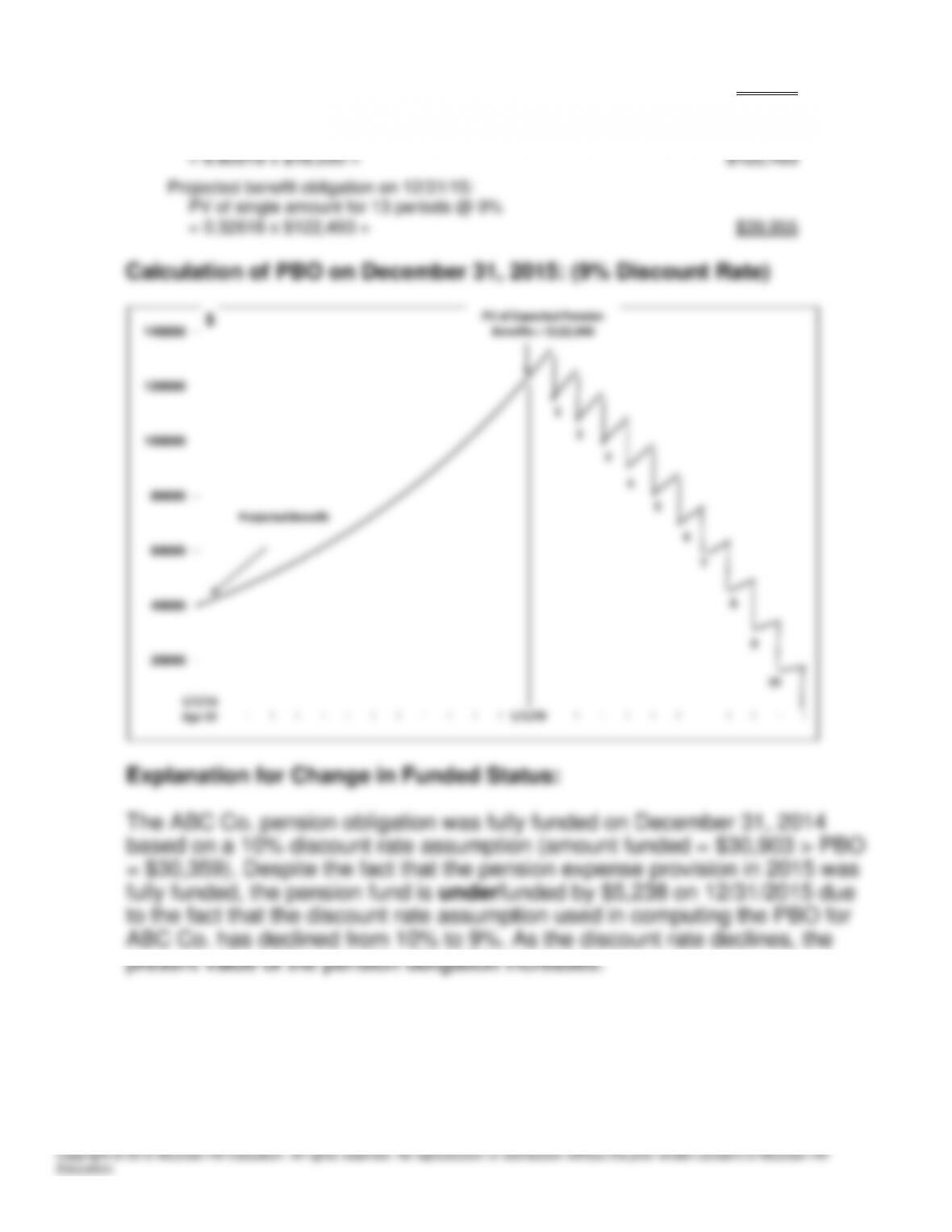
Total annual pension benefit based on service
credit earned up to 12/31/09 $18,000
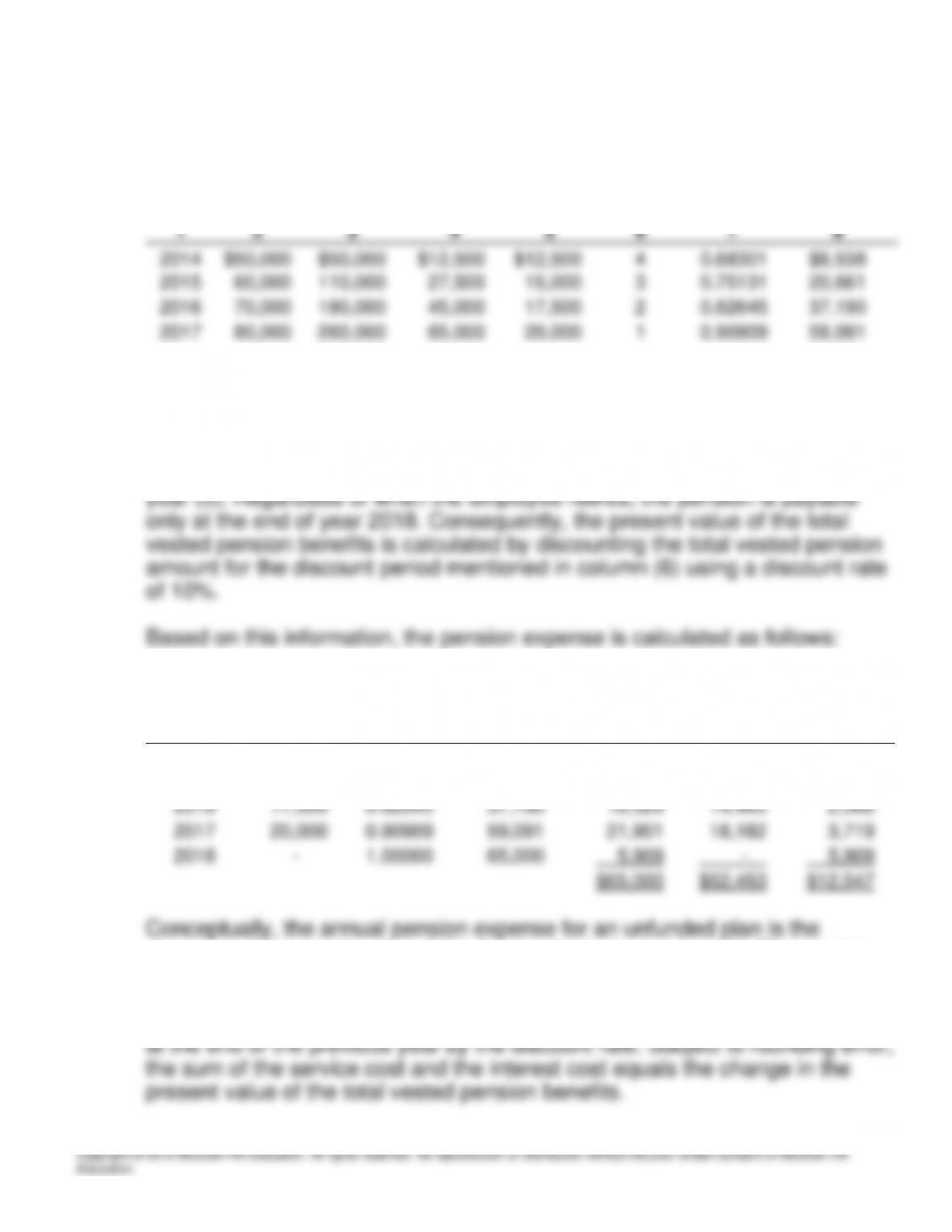
PVOA of expected pension benefits as of 1/1/29 (date of retirement):
PVOA for 11 periods @ 9% x $18,000
14–37
P14–7. Identifying effect of funding and discount rate assumption on pension
expense (LO 2, 3, 5)
Requirement 1:
Total
Vested
PV of
End of
Annual
Cumulative
Vested
During
Discount
Total Vested
Year
Salary
Salary
Pension
the Year
Period
PV Factor
Pension
1
2
3
4
5
6
7
8
2014
$50,000
$50,000
$12,500
$12,500
4
0.68301
$8,538
2015
60,000
110,000
27,500
15,000
3
0.75131
20,661
2016
70,000
180,000
45,000
17,500
2
0.82645
37,190
2017
80,000
260,000
65,000
20,000
1
0.90909
59,091
2018
–
260,000
65,000
–
0
1.00000
65,000
The above table shows the present value of the total vested pension benefits
over the period 2014–2018. At the end of each year, the total vested pension
benefits (4) is calculated by multiplying the cumulative salary (3) by 25%. The
year-to-year change in column (4) represents the pension vested during the
Vested
PV of
Change
During
Total Vested
in the
Service
Interest
Year
the Year
PV Factor
Pension
PV
Cost
Cost
2014
$12,500
0.68301
$8,538
$8,538
$8,538
–
2015
15,000
0.75131
20,661
12,123
11,270
853
2016
17,500
0.82645
37,190
16,529
14,463
2,066
2017
20,000
0.90909
59,091
21,901
18,182
3,719
2018
–
1.00000
65,000
5,909
–
5,909
$65,000
$52,453
$12,547
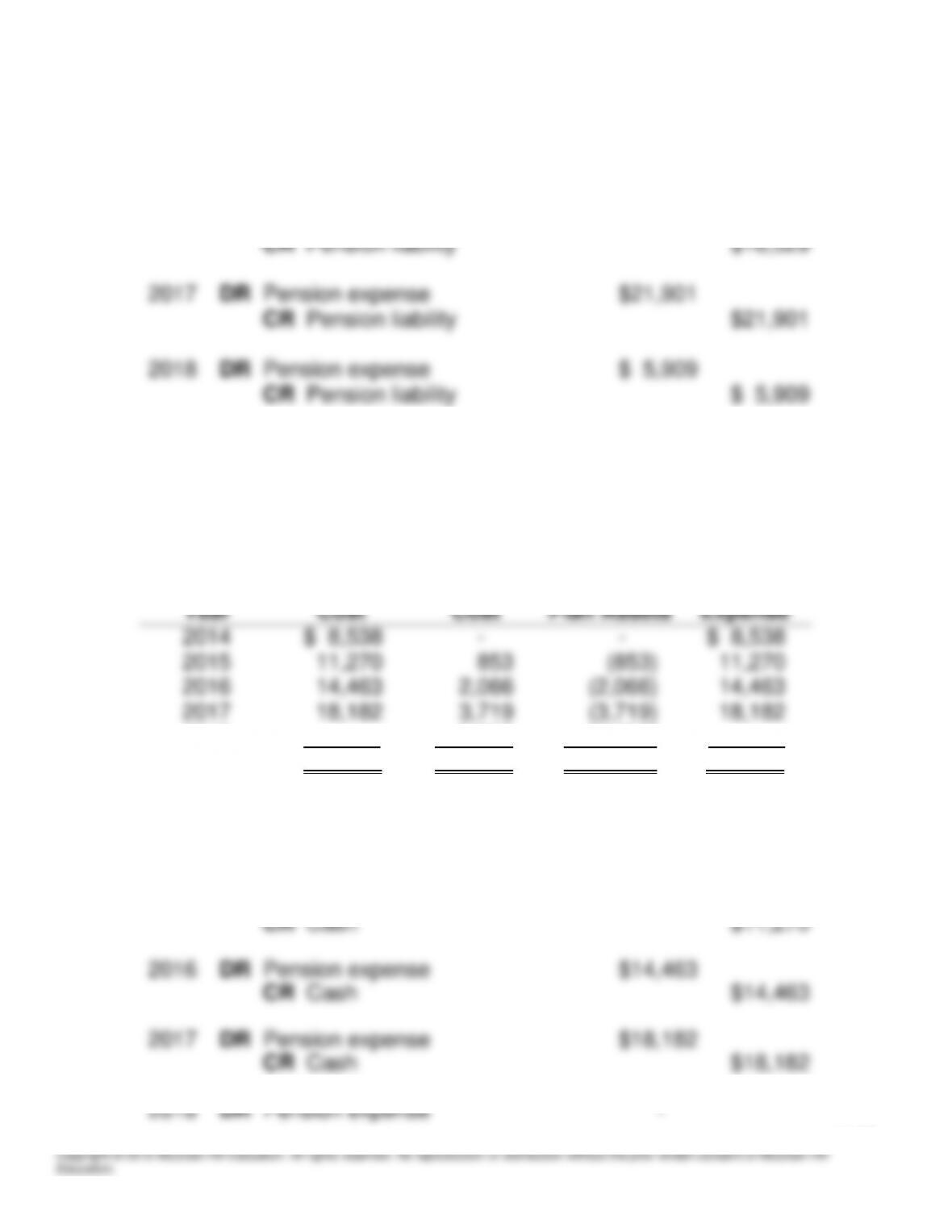
Conceptually, the annual pension expense for an unfunded plan is the
change in the present value of the total vested pension benefit. The service
cost is calculated by multiplying the amount vested during the year by the
appropriate present value factor. The interest cost for a given year is
calculated by multiplying the present value of the total vested pension benefit
14–38
2014
DR Pension expense
$ 8,538
CR Pension liability
$ 8,538
2015
DR Pension expense
$12,123
CR Pension liability
$12,123
2016
DR Pension expense
$16,529
CR Pension liability
$16,529
2017
DR Pension expense
$21,901
CR Pension liability
$21,901
2018
DR Pension expense
$ 5,909
CR Pension liability
$ 5,909
DR Pension liability
$65,000
CR Cash
$65,000
Requirement 2:
In this case, the pension expense will exactly equal the service cost:
Service
Interest
Return on
Pension
Year
Cost
Cost
Plan Assets
Expense
2014
$ 8,538
–
–
$ 8,538
2015
11,270
853
(853)
11,270
2016
14,463
2,066
(2,066)
14,463
2017
18,182
3,719
(3,719)
18,182
2018
–
5,909
(5,909)
–
Total
$52,453
$12,547
$(12,547)
$52,453
2014
DR Pension expense
$ 8,538
CR Cash
$ 8,538
2015
DR Pension expense
$11,270
CR Cash
$11,270
2016
DR Pension expense
$14,463
CR Cash
$14,463
2017
DR Pension expense
$18,182
CR Cash
$18,182
2018
DR Pension expense
–
14–39
CR Cash
–
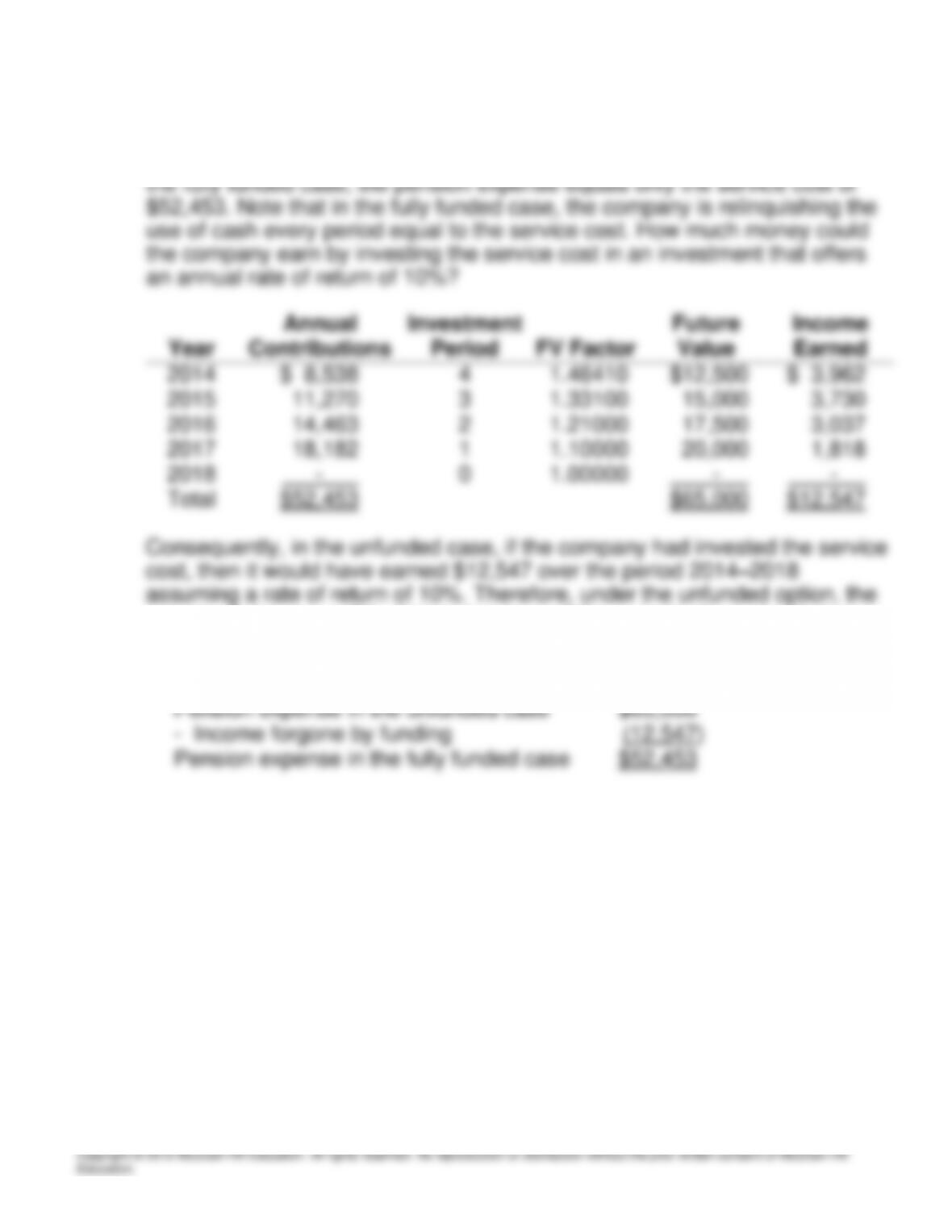
Requirement 3:
Under the unfunded scenario, the pension expense is the sum of the service
cost and interest cost, which equals $65,000 over the period 2014–2018. In
company’s income will be higher because of the opportunity cost of being
able to invest the cash saved from not funding the pension plan. This will be
compensated by the higher pension expense.
Pension expense in the unfunded case
$65,000
– Income forgone by funding
(12,547)
Pension expense in the fully funded case
$52,453
14–40
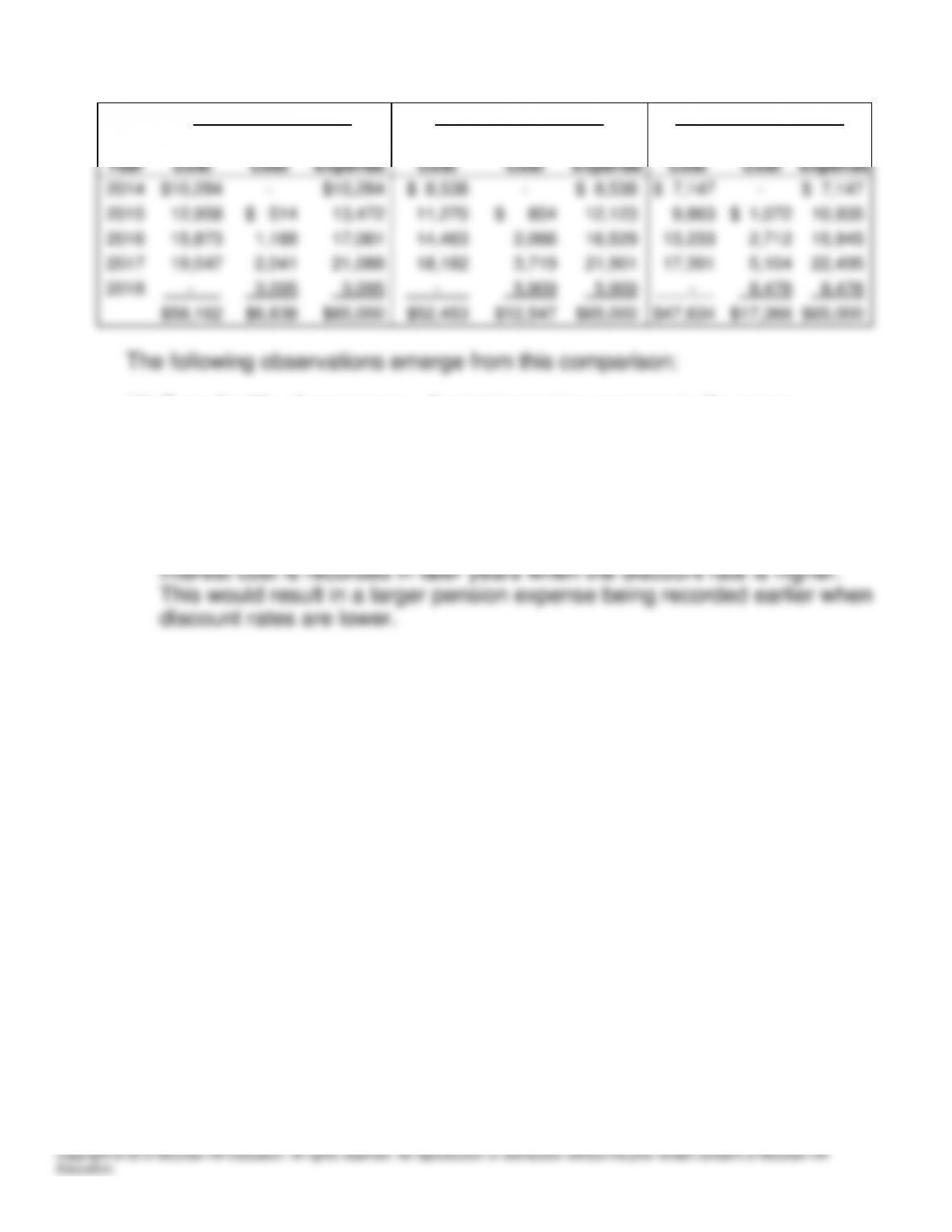
Requirement 4:
Discount Rate = 5%
Discount Rate = 10%
Discount Rate = 15%
Service
Interest
Total
Service
Interest
Total
Service
Interest
Total
Year
Cost
Cost
Expense
Cost
Cost
Expense
Cost
Cost
Expense
2014
$10,284
–
$10,284
$ 8,538
–
$ 8,538
$ 7,147
–
$ 7,147
2015
12,958
$ 514
13,472
11,270
$ 854
12,123
9,863
$ 1,072
10,935
2016
15,873
1,188
17,061
14,463
2,066
16,529
13,233
2,712
15,945
2017
19,047
2,041
21,088
18,182
3,719
21,901
17,391
5,104
22,495
2018
–
3,095
3,095
–
5,909
5,909
–
8,478
8,478
$58,162
$6,838
$65,000
$52,453
$12,547
$65,000
$47,634
$17,366
$65,000
The following observations emerge from this comparison:
(1) Over the life of a company, the total pension expense is the same
regardless of the assumed discount rate.
(2) However, the service cost is lower when the discount rate is higher,
whereas the interest cost increases with the discount rate.
(3) Since interest cost represents the time value of money, more of the
P14–8. Determining effect of discount rate assumption on pension expense
and PBO (LO 2, 3, 5)
Note to the instructor: In order to minimize the effects of rounding errors, the
solutions show all figures in dollars and cents.
First, let us focus on the case when the discount rate equals the rate of return
on plan assets – 10%:
14–42
year’s cash inflow corresponds to the pension vested during the same year
shown in the previous table.
The row titled “Year–end balance” provides the fair value of the plan assets at
the end of each of the years. Of course, at the end of year 2018, the
The funding status of the pension plan is provided below:
Requirement 2: Funded status under 10% discount rate
End of Year
2014
2015
2016
2017
Projected benefit obligation
$8,537.67
$20,661.16
$37,190.08
$59,090.91
– Fair value of plan assets
(8,475.00)
(20,322.50)
(37,354.75)
(59,090.23)
Net pension liability (asset)
$ 62.67
$ 338.66
($ 164.67)
$ 0.68
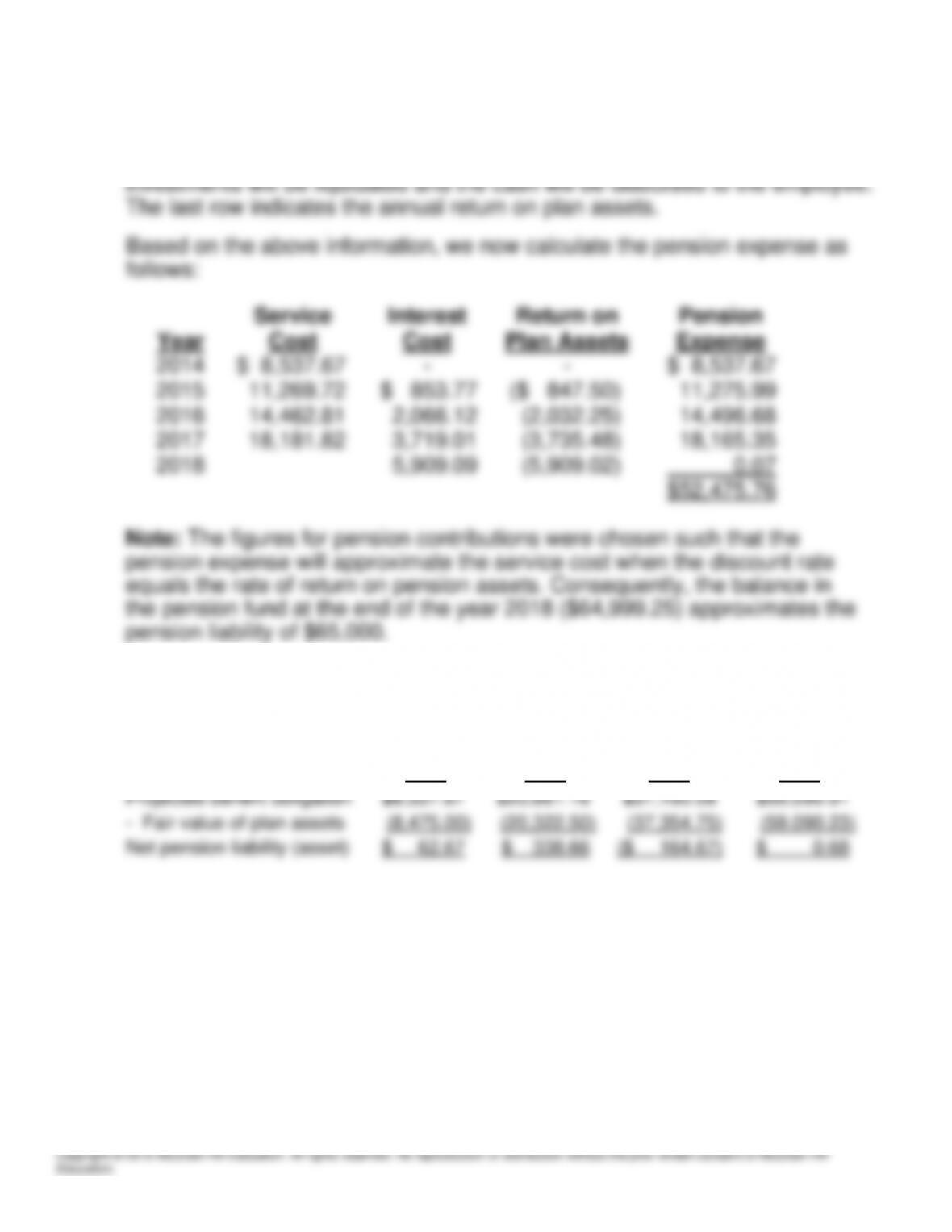
The balance in net pension liability (asset) can verified by preparing the
T-account:
Pension Liability
(Asset) at Year-End
2014
2015
2016
2017
2018
Beginning balance
–
$ 62.67
$ 338.66
($ 164.67)
$ 0.68
Pension expense
$8,537.67
11,275.99
14,496.68
18,165.35
0.07
Cash received (paid)
(8,475.00)
(11,000.00)
(15,000.00)
(18,000.00)
_(0.75)
Ending balance
$ 62.67
$ 338.66
($ 164.67)
$ 0.68
($0.00)
The tables are now reported under the other two scenarios regarding the
discount rates.
Requirement 1: Annual pension expense
Assumptions: Discount rate = 8% and rate of return on plan assets = 10%
End of
Year
1
Annual
Salary
2
Cumulative
Salary
3
Total Vested
Pension
4
Vested
During the
Year
5
Discount
Period
6
PV Factor
7
PV of
Total Vested
Pension
8
2014
$50,000
$ 50,000
$12,500
$12,500
4
0.73503
$ 9,187.87
2015
60,000
110,000
27,500
15,000
3
0.79383
21,830.39
2016
70,000
180,000
45,000
17,500
2
0.85734
38,580.25
2017
80,000
260,000
65,000
20,000
1
0.92593
60,185.19*
2018
–
260,000
65,000
–
0
1.00000
65,000.00
*Rounded
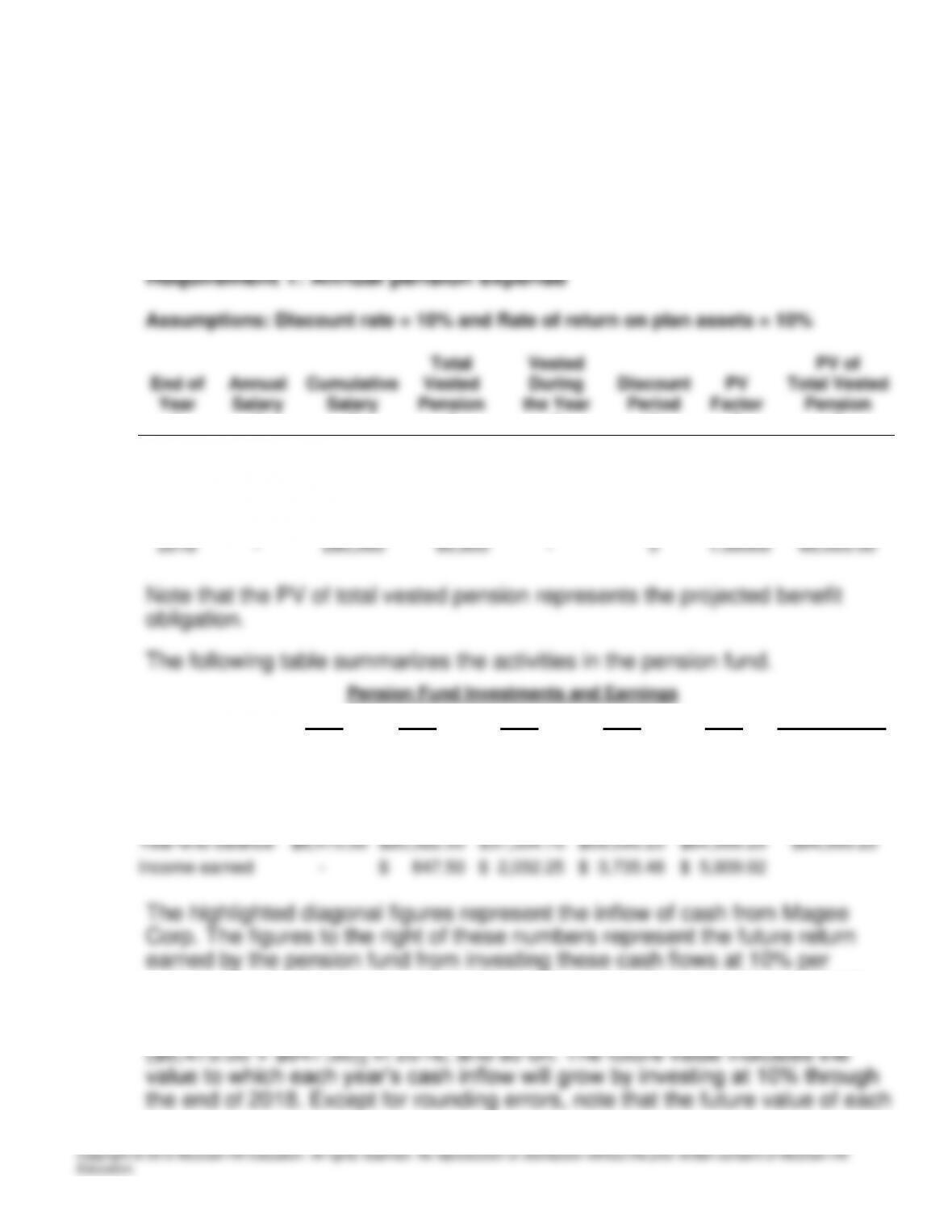
Note that the pension fund investments and earnings will be identical under
all the three scenarios. This is because the cash contributions to the pension
fund and the rate of return earned by the pension fund are assumed to be the
same regardless of the discount rate assumption. Consequently, the table
14–44
Requirement 2: Funded status under 8% discount rate
End of Year
2014
2015
2016
2017
Projected benefit obligation
$9,187.87
$21,830.39
$38,580.25
$60,185.19*
– Fair value of plan assets
(8,475.00)
(20,322.50)
(37,354.75)
(59,090.23)
Net pension liability (asset)
$ 712.87
$ 1,507.89
$ 1,225.50
$ 1,094.96
*Rounded
Pension Liability
(Asset) at Year-End
2014
2015
2016
2017
2018
Beginning balance
–
$ 712.87
$ 1,507.89
$ 1,225.50
$1,094.96
Pension expense
$9,187.87
11,795.01
14,717.61
17,869.46
(1,094.21)
Cash received (paid)
(8,475.00)
(11,000.00)
(15,000.00)
(18,000.00)
(0.75)
Ending balance
$ 712.87
$ 1,507.89
$ 1,225.50
$ 1,094.96
($ 0.00)
Requirement 1: Annual pension expense
Assumptions: Discount rate = 12% and rate of return on plan assets = 10%
End of
Year
1
Annual
Salary
2
Cumulative
Salary
3
Total
Vested
Pension
4
Vested
During the
Year
5
Discount
Period
6
PV
Factor
7
PV of
Total Vested
Pension
8
2014
$50,000
$ 50,000
$12,500
$12,500
4
0.63552
$ 7,943.98
2015
60,000
110,000
27,500
15,000
3
0.71178
19,573.96
2016
70,000
180,000
45,000
17,500
2
0.79719
35,873.72
2017
80,000
260,000
65,000
20,000
1
0.89286
58,035.71
2018
–
260,000
65,000
–
0
1.00000
65,000.00
Service
Interest
Return on Pension
Pension
Year
Cost
Cost
Plan Assets
Expense
2014
$ 7,943.98
–
–
$ 7,943.98
2015
10,676.70
$ 953.28
($ 847.50)
10,782.48
2016
13,950.89
2,348.87
(2,032.25)
14,267.51
2017
17,857.14
4,304.85
(3,735.48)
18,426.51
2018
–
6,964.29
(5,909.02)
__1,055.27
$52,475.75
14–45
Requirement 2: Funded status under 12% discount assumption
End of year
2014
2015
2016
2017
Projected benefit obligation
$7,943.98
$19,573.96
$35,873.72
$58,035.71
– Fair value of plan assets
(8,475.00)
(20,322.50)
(37,354.75)
(59,090.23)
Net pension liability (asset)
($ 531.02)
($ 748.54)
($ 1,481.03)
($ 1,054.52)
Pension Liability
(Asset) at Year-End
2014
2015
2016
2017
2018
Beginning balance
–
($ 531.02)
($748.54)
($1,481.03)
($1,054.52)
Pension expense
$7,943.98
10,782.48
14,267.51
18,426.51
1,055.27
Cash received (paid)
(8,475.00)
(11,000.00)
(15,000.00)
(18,000.00)
(0.75)
Ending balance
($ 531.02)
($ 748.54)
($1,481.03)
($1,054.52)
($ 0.00)
Requirement 3:
The most (least) conservative approach for the purposes of income
determination is when the discount rate is less (more) than the rate of return
on the plan assets. Let us compare the pension under the three scenarios:
Pension Expense under Various
Discount Rate Assumptions
Year
8%
10%
12%
2014
$ 9,187.87
$ 8,537.67
$ 7,943.98
2015
11,795.01
11,275.99
10,782.48
2016
14,717.61
14,496.68
14,267.51
2017
17,869.46
18,165.35
18,426.51
2018
(1,094.21)
0.07
1,055.27
$52,475.74
$52,475.76
$52,475.75
In the first three years, the pension expense is the highest (lowest) when the
employee. (To illustrate this point, we have assumed that the contributions to
the pension fund are unaffected by the discount rate assumption used for
financial reporting purposes.) For instance, if the pension was completely
unfunded, then the total pension expense will equal $65,000, the cash to be
paid to the employee on retirement. If the pension is funded, then the total