14-1
Copyright © 2015 McGraw-Hill Education. All rights reserved. No reproduction or distribution without the prior written consent of McGraw-Hill Education.
Financial Reporting and Analysis (6th Ed.)
Chapter 14 Solutions
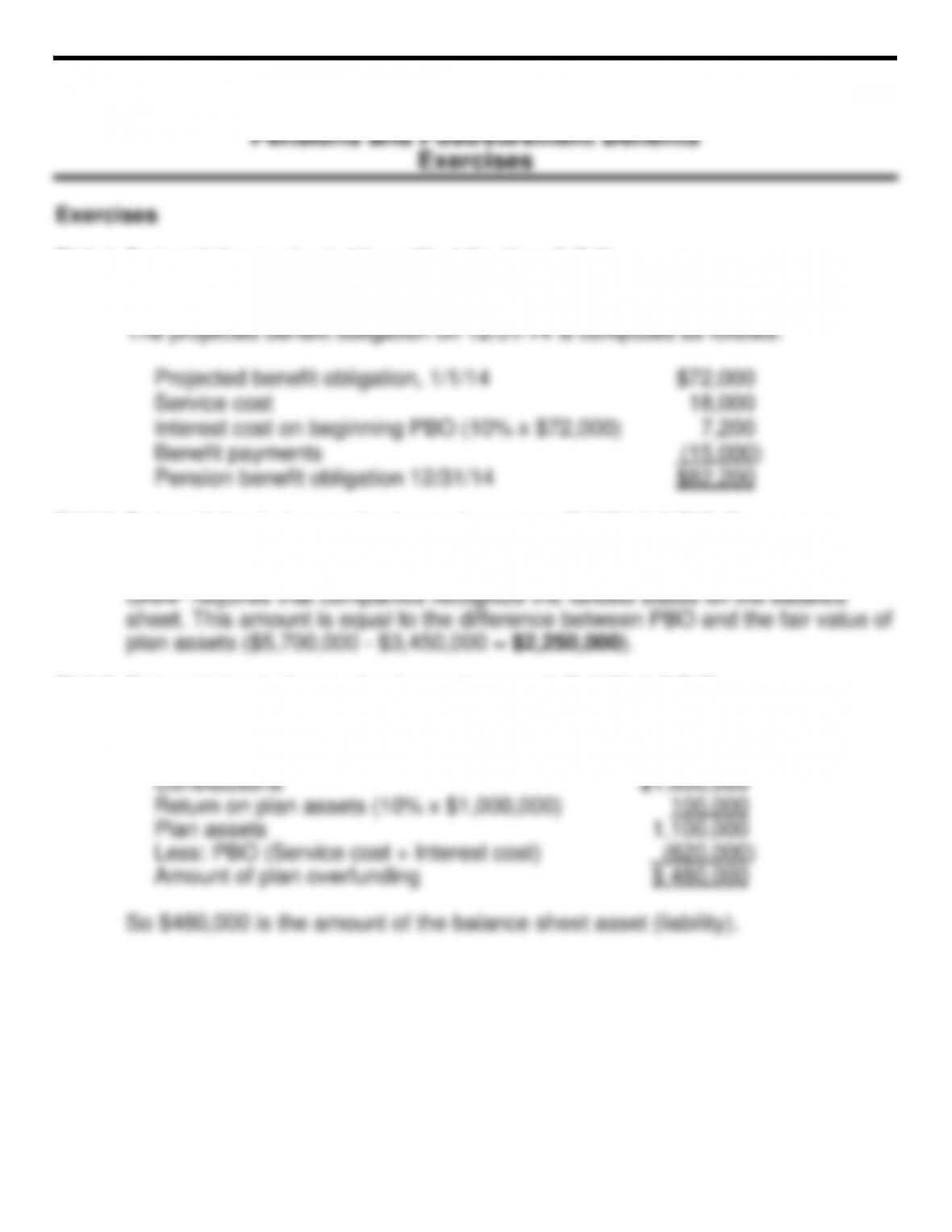
E14–1. Determining projected benefit obligation (LO 3)
(AICPA adapted)
E14–2. Determining balance sheet pension asset (liability) (LO 2, 3)
(AICPA adapted)
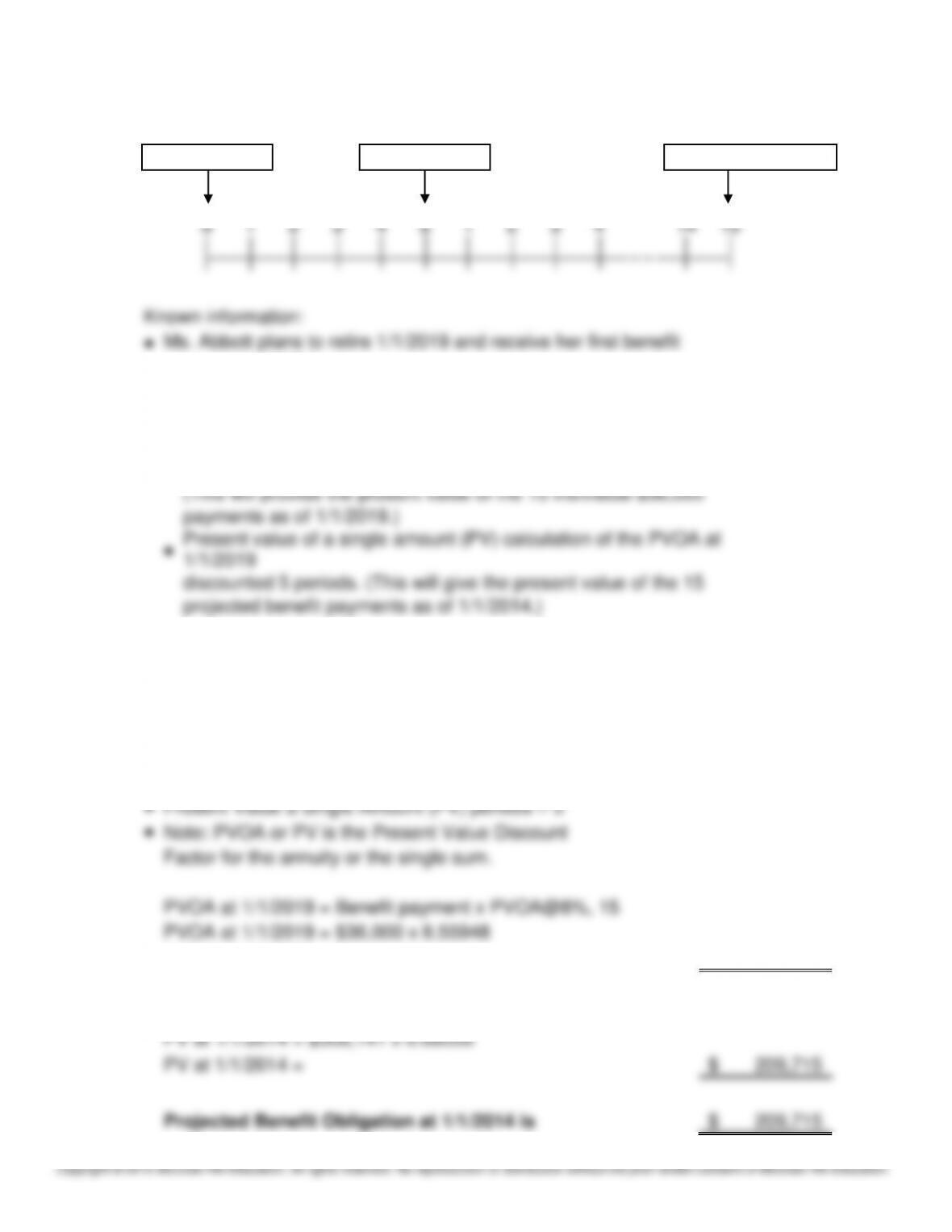
E14–3. Determining balance sheet pension asset (liability) (LO 3)
(AICPA adapted)
Funded status of the plan 12/31/14:
14-2
E14–4. Determining PBO and ABO (LO 1, 2)
Birthday # 60
Birthday # 65
Birthday # 80
1/1/2014
1/1/2019
1/1/2034
0
1
2
3
4
5
1
2
3
4
14
15
Known information:
•
Ms. Abbott plans to retire 1/1/2019 and receive her first benefit
payment 1/1/2020.
•
Ms. Abbott’s expected benefit payment is $36,000 ($60,000 x 60%).
•
Ms. Abbott is expected to receive 15 benefit payments of $36,000.
•
Calculations required:
•
Present value of an ordinary annuity (PVOA) of $36,000 for 15 years.
(This will provide the present value of the 15 individual $36,000
payments as of 1/1/2019.)
•
Present value of a single amount (PV) calculation of the PVOA at
1/1/2019
discounted 5 periods. (This will give the present value of the 15
projected benefit payments as of 1/1/2014.)
Requirement 1:
Compute the projected benefit obligation at 1/1/2014:
•
Discount rate = 8%
•
Benefit payment = $36,000 ($60,000 x 60%)
•
Present Value of the Annuity (PVOA) periods = 15
•
Present Value a Single Amount (PV) periods = 5
•
Note: PVOA or PV is the Present Value Discount
Factor for the annuity or the single sum.
PVOA at 1/1/2019 = Benefit payment x PVOA@8%, 15
PVOA at 1/1/2019 = $36,000 x 8.55948
PVOA at 1/1/2019 =
$ 308,141
PV at 1/1/2014 = PVOA at 1/1/2019 x PV@8%, 5
PV at 1/1/2014 = $308,141 x 0.68058
PV at 1/1/2014 =
$ 209,715
Projected Benefit Obligation at 1/1/2014 is
$ 209,715
14-3
Requirement 2:
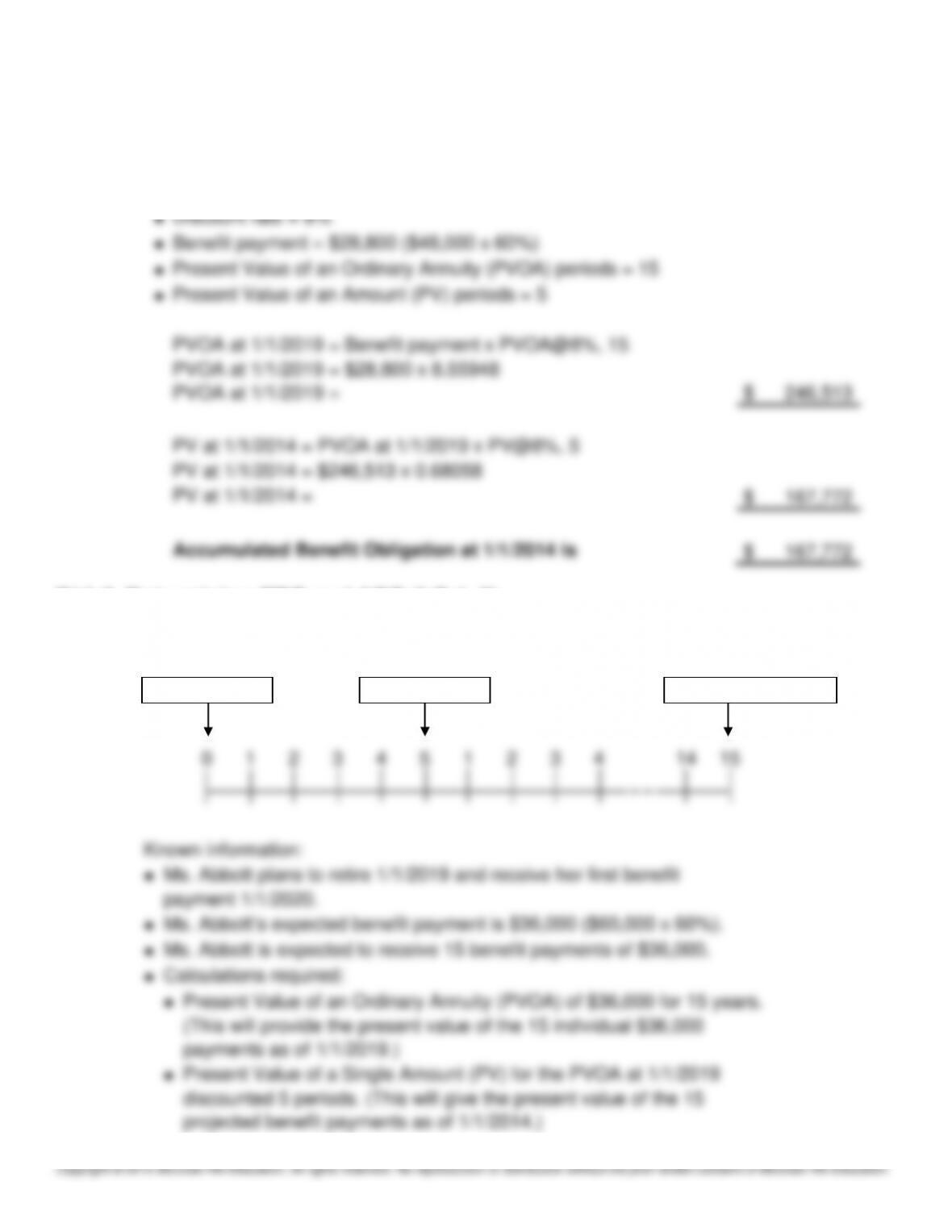
Compute the accumulated benefit obligation at 1/1/2014:
Same calculation as Requirement 1, except benefit payment ignores
future salary increases, and is based on current salary level.
•
Discount rate = 8%
•
Benefit payment = $28,800 ($48,000 x 60%)
•
Present Value of an Ordinary Annuity (PVOA) periods = 15
•
Present Value of an Amount (PV) periods = 5
PVOA at 1/1/2019 = Benefit payment x PVOA@8%, 15
PVOA at 1/1/2019 = $28,800 x 8.55948
PVOA at 1/1/2019 =
$ 246,513
PV at 1/1/2014 = PVOA at 1/1/2019 x PV@8%, 5
PV at 1/1/2014 = $246,513 x 0.68058
PV at 1/1/2014 =
$ 167,772
Accumulated Benefit Obligation at 1/1/2014 is
$ 167,772
E14–5. Determining PBO and ABO (LO 1, 2)
Birthday # 60
Birthday # 65
Birthday # 80
1/1/2014
1/1/2019
1/1/2034
0
1
2
3
4
5
1
2
3
4
14
15
Known information:
•
Ms. Abbott plans to retire 1/1/2019 and receive her first benefit
payment 1/1/2020.
•
Ms. Abbott’s expected benefit payment is $36,000 ($60,000 x 60%).
•
Ms. Abbott is expected to receive 15 benefit payments of $36,000.
•
Calculations required:
•
Present Value of an Ordinary Annuity (PVOA) of $36,000 for 15 years.
(This will provide the present value of the 15 individual $36,000
payments as of 1/1/2019.)
•
Present Value of a Single Amount (PV) for the PVOA at 1/1/2019
discounted 5 periods. (This will give the present value of the 15
projected benefit payments as of 1/1/2014.)
Requirement 1:
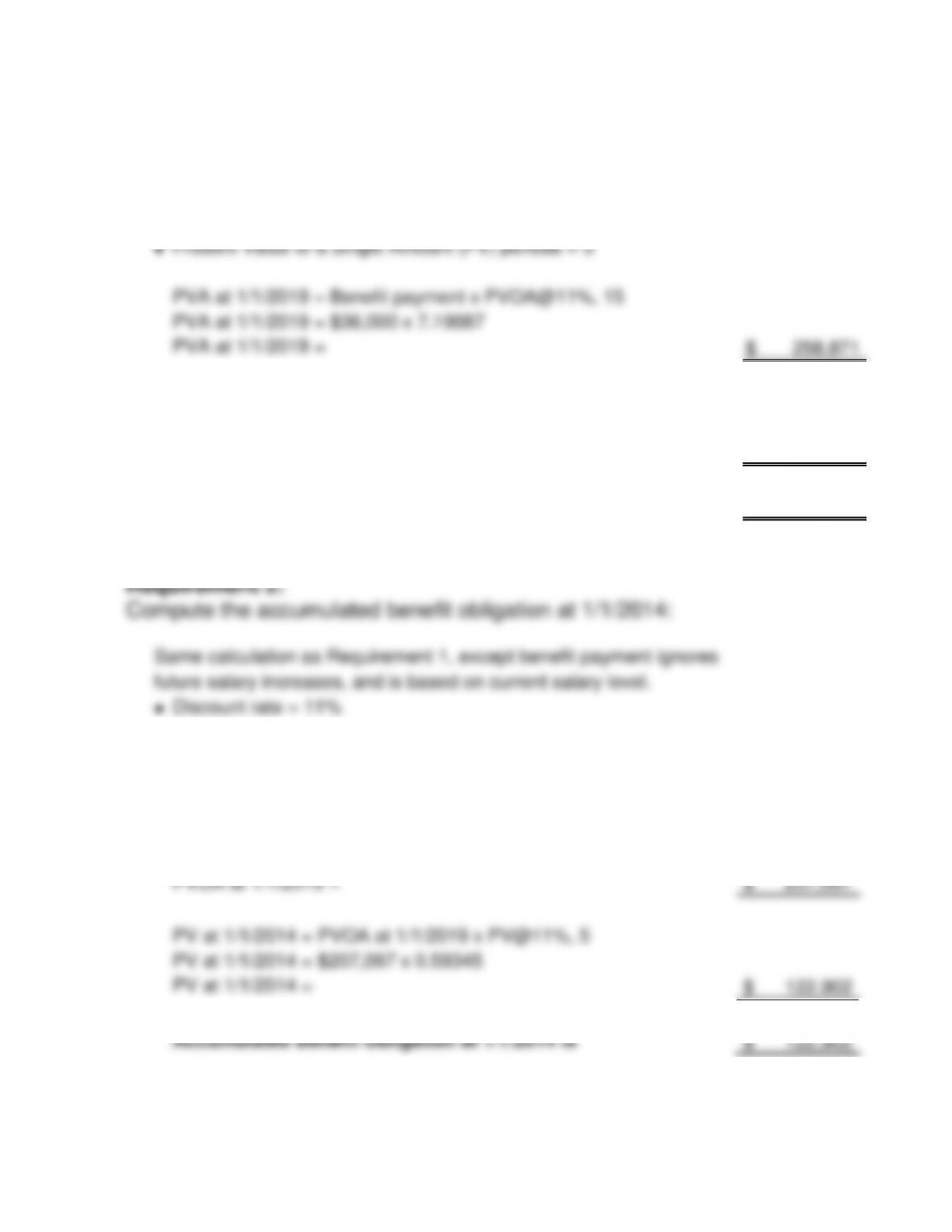
Compute the projected benefit obligation at 1/1/2014:
•
Discount rate = 11%
•
Benefit payment = $36,000 ($60,000 x 60%)
•
Present Value of an Ordinary Annuity (PVOA) periods = 15
•
Present Value of a Single Amount (PV) periods = 5
PVA at 1/1/2019 = Benefit payment x PVOA@11%, 15
PVA at 1/1/2019 = $36,000 x 7.19087
PVA at 1/1/2019 =
$ 258,871
PV at 1/1/2014 = PVOA at 1/1/2019 x PV@11%, 5
PV at 1/1/2014 = $258,871 x 0.59345
PV at 1/1/2014 =
$ 153,627
Projected Benefit Obligation at 1/1/2014 is
$ 153,627
future salary increases, and is based on current salary level.
•
Discount rate = 11%
•
Benefit payment = $28,800 ($48,000 x 60%)
•
Present Value of an Ordinary Annuity (PVOA) periods = 15
•
Present Value of a Single Amount (PV) periods = 5
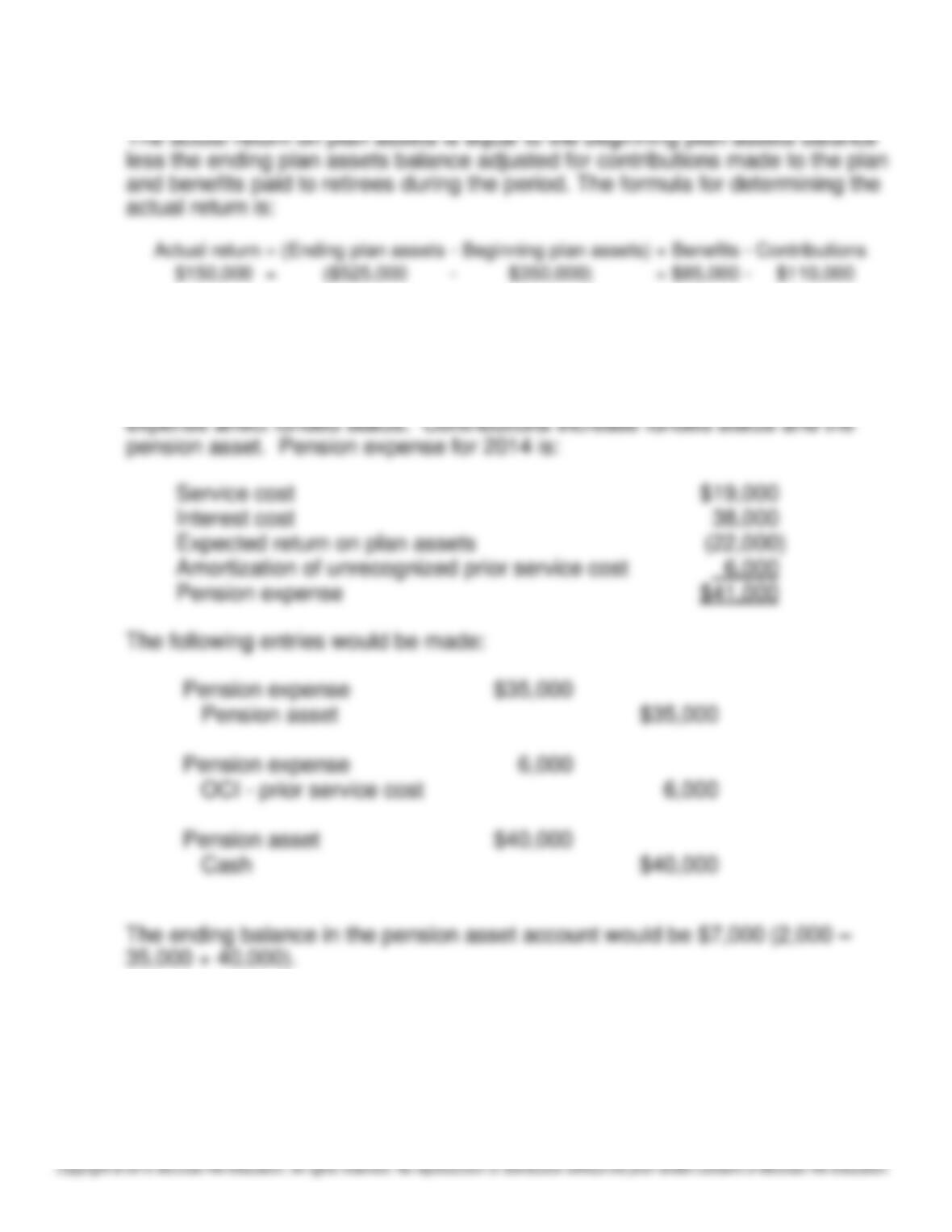
PV at 1/1/2014 = $207,097 x 0.59345
PV at 1/1/2014 =
14-5
E14–6. Determining actual return on plan assets (LO 2, 3)
(AICPA adapted)
E14–7. Determining balance sheet pension asset (liability) (LO 3, 4)
(AICPA adapted)
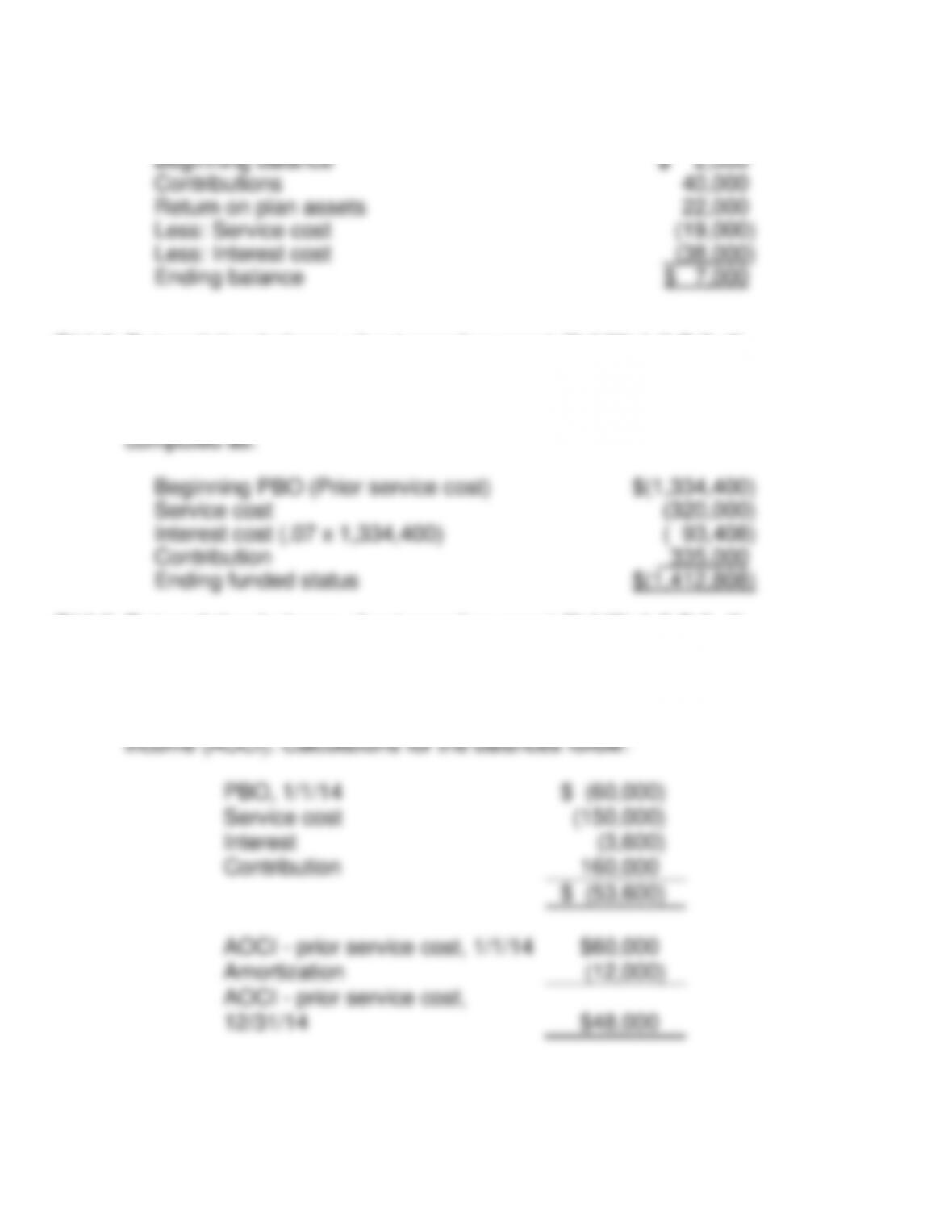
The balance sheet pension asset (liability) as of 12/31/14 is the funded status.
Except for the prior service cost amortization, the components of pension
14-6
Copyright © 2015 McGraw-Hill Education. All rights reserved. No reproduction or distribution without the prior written consent of McGraw-Hill Education.
An alternative approach would be to recognize that the balance sheet asset
equals the funded status. You could then compute funded status with
information in the problem as follows:
E14–8. Determining balance sheet pension asset (liability) (LO 3, 4)
(AICPA adapted)
The amount on the balance sheet is the funded status. The ending amount is
E14–9. Determining balance sheet pension asset (liability) (LO 3, 4)
(AICPA adapted)
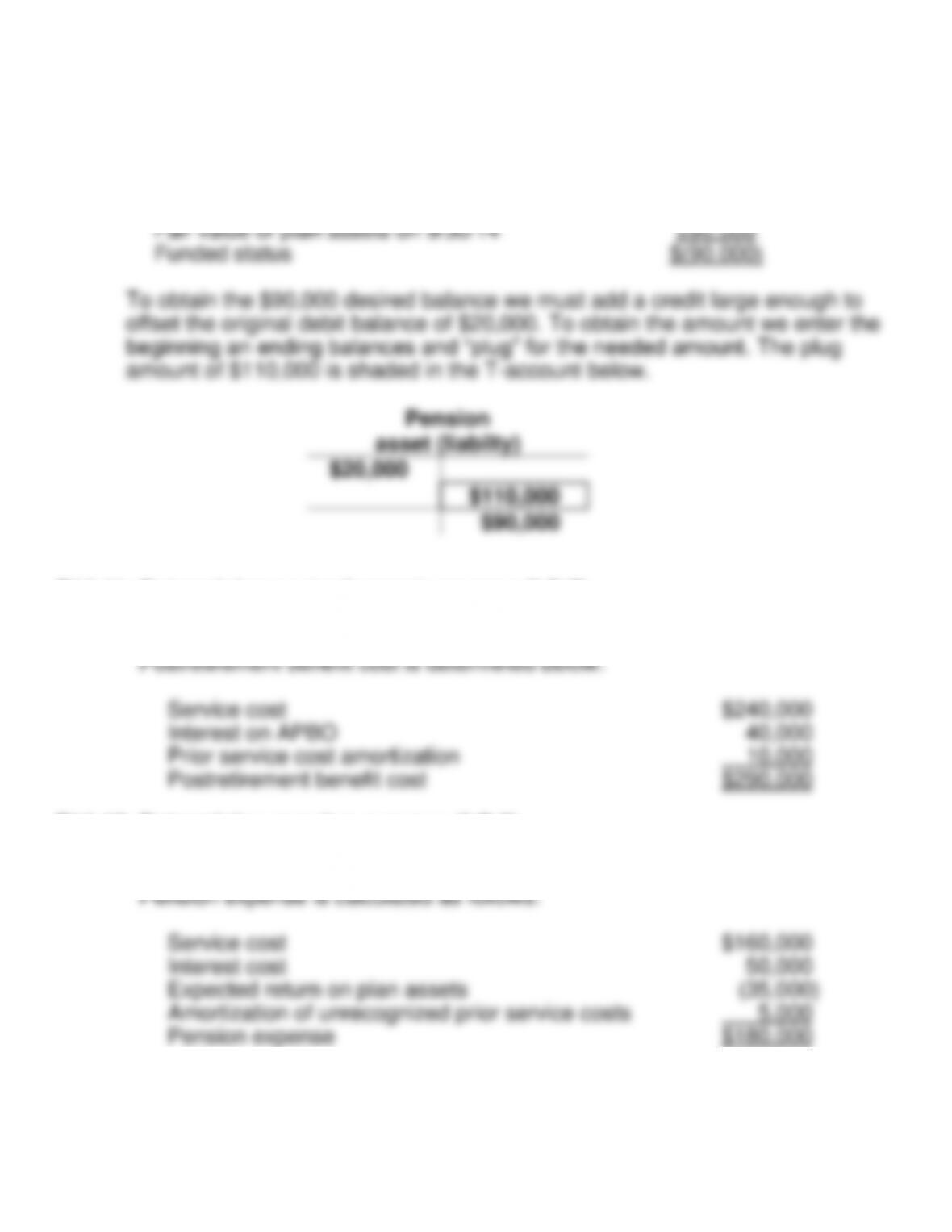
The amount of the pension asset (liability) is the funded status. Unamortized
prior service cost is recognized as a debit in Accumulated other comprehensive
14-7
Copyright © 2015 McGraw-Hill Education. All rights reserved. No reproduction or distribution without the prior written consent of McGraw-Hill Education.
E14-10. Adjusting balance sheet pension asset (liability) (LO 3)
(AICPA adapted)
The balance sheet asset liability is the difference between plan assets and
PBO:
PBO on 9/30/14 $(380,000)
E14–11. Determining postretirement expense (LO 7)
(AICPA adapted)
E14–12. Determining pension expense (LO 3)
(AICPA adapted)
14-8
E14–13. Determining pension expense, fair value of plan assets, and deferred
return on plan assets (LO 3, 4)
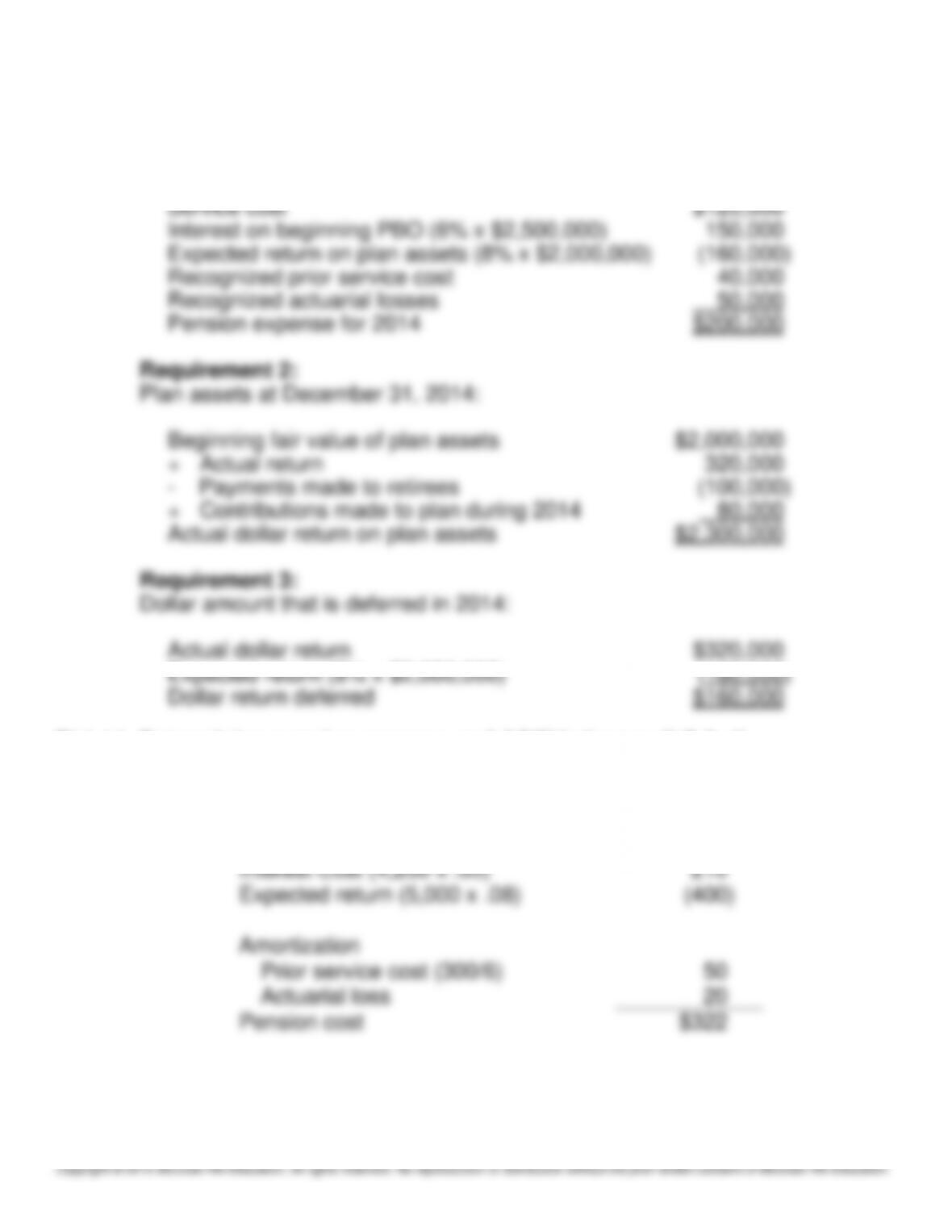
Requirement 1:
Determination of pension expense for Bostonian in 2014:
E14–14. Determining pension expense and AOCI balances (LO 3, 4)
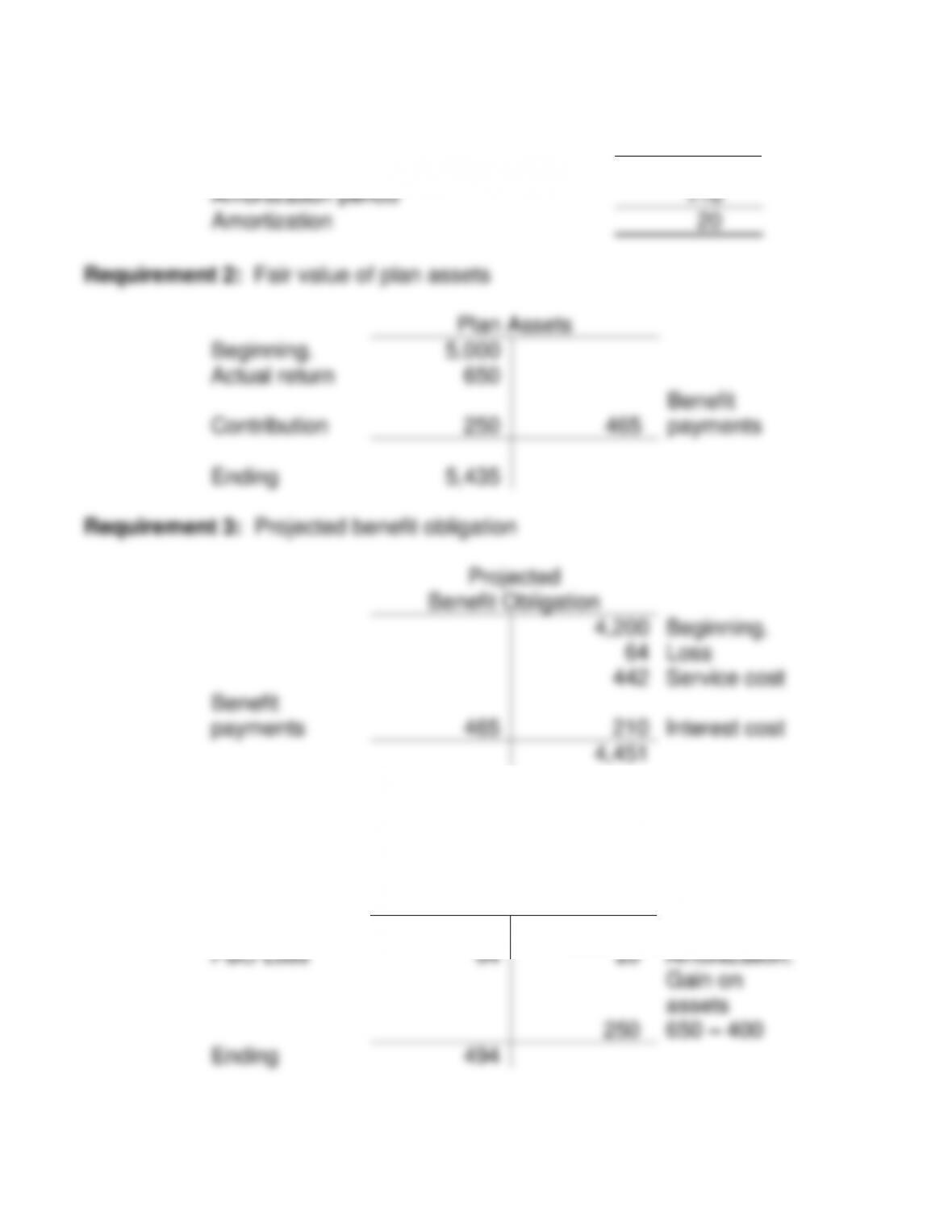
Requirement 1: Pension expense
Service Cost
$442
Interest Cost (4,200 x .05)
210
Expected return (5,000 x .08)
(400)
Amortization
Prior service cost (300/6)
50
Actuarial loss
20
Pension cost
$322
14-9
Actuarial loss calculation:
Unrecognized Actuarial Loss at 1/1/2014
700
Corridor
500
Amount outside corridor
200
Amortization period
÷10
Amortization
20
Plan Assets
Beginning.
5,000
Actual return
650
Contribution
250
465
Benefit
payments
Ending
5,435
Projected
Benefit Obligation
4,200
Beginning.
64
Loss
442
Service cost
Benefit
payments
465
210
Interest cost
4,451
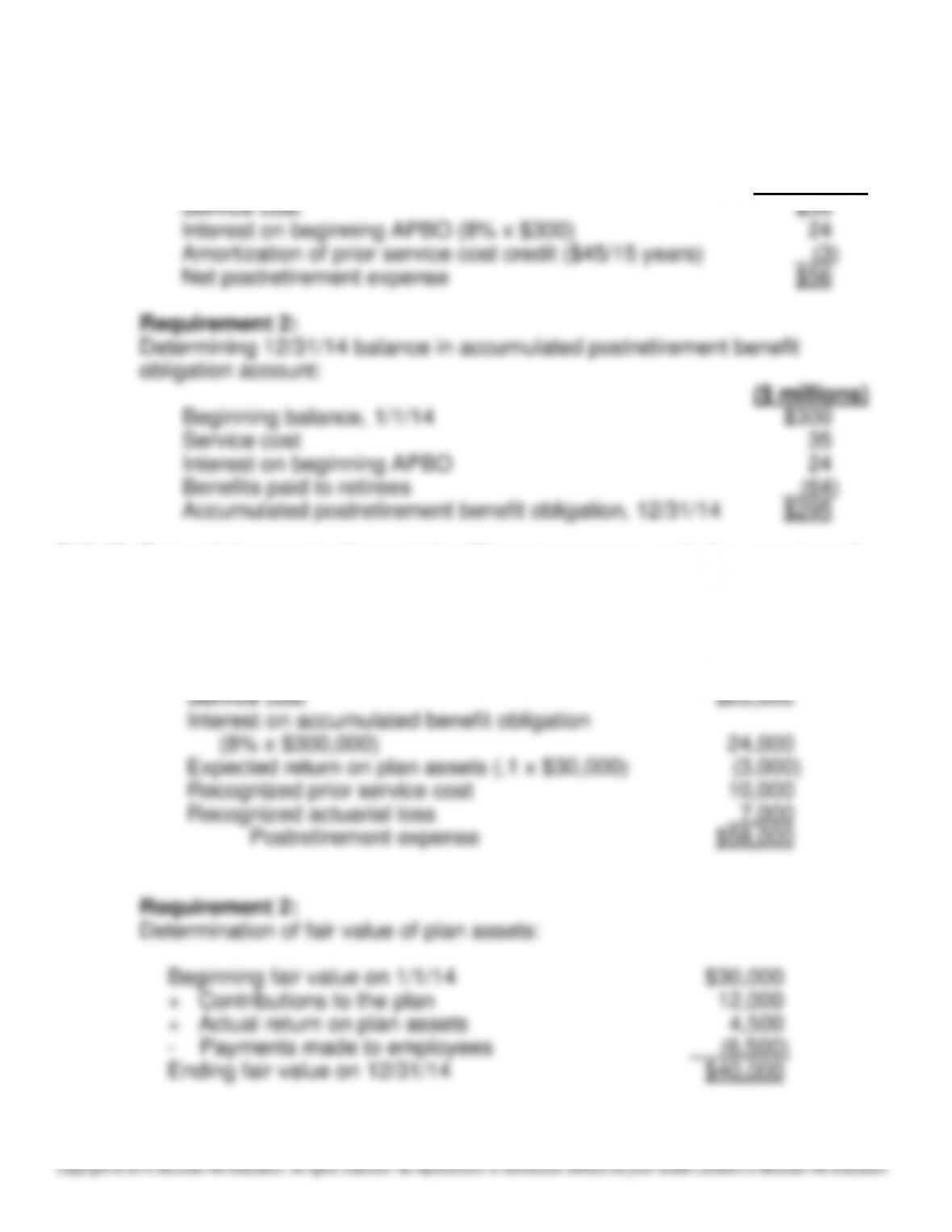
Requirement 4: AOCI – Net actuarial (gain) loss
AOCI – Net Actuarial
Loss (Gain)
Beginning
700
PBO Loss
64
20
Amortization.
250
Gain on
assets
650 – 400
Ending
494
14–10
E14–15. Determining postretirement (healthcare) benefits expense and obligation
(LO 7)
Requirement 1:
Determining postretirement expense:
($ millions)
E14–16. Determining postretirement healthcare expenses and plan assets and
liabilities balances (LO 7)
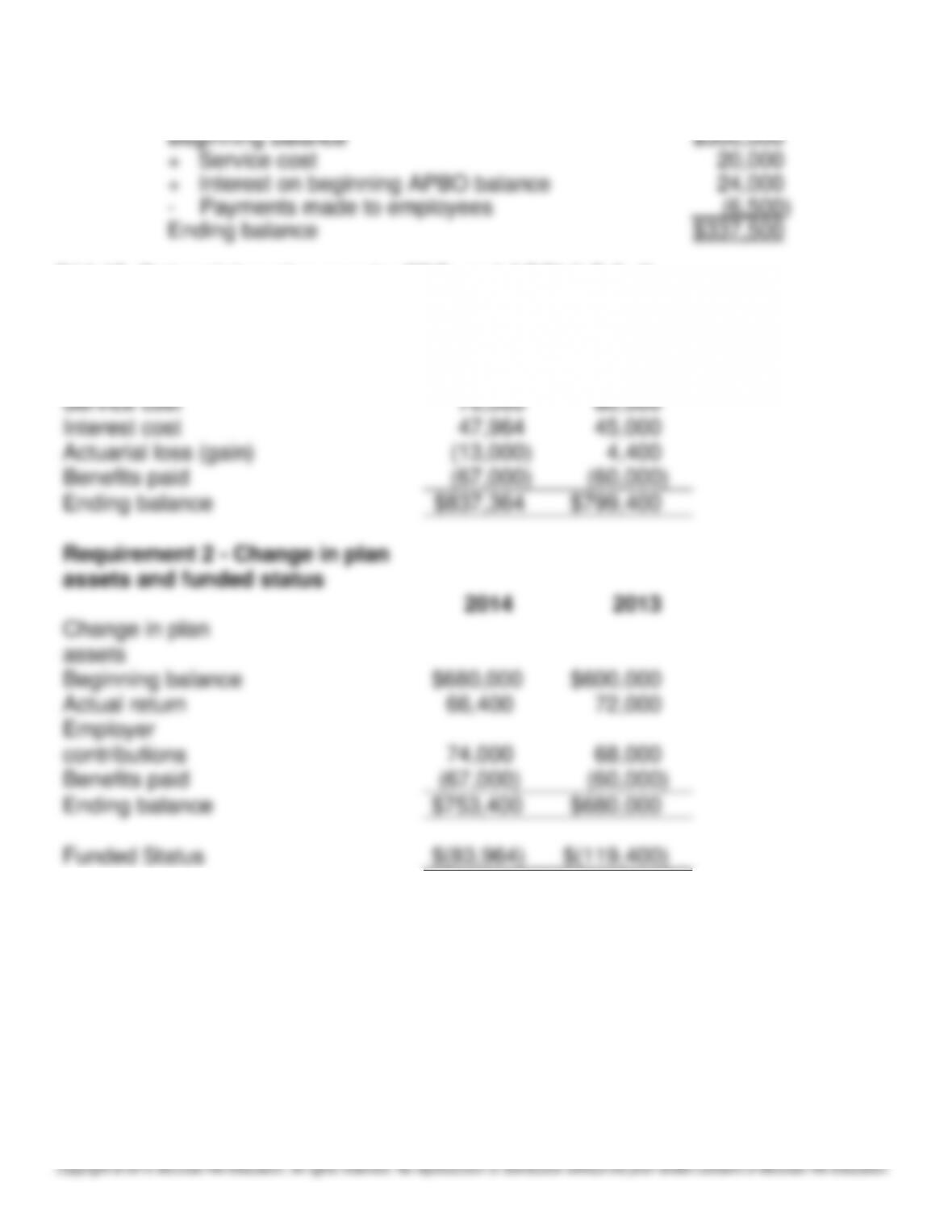
Requirement 1:
Determination of postretirement health care expense for 2014:
14–11
Requirement 3:
Balance of accumulated postretirement benefit obligation (APBO) at 12/31/14:
E14–17. Determining plan assets, PBO, and AOCI (LO 3, 4)
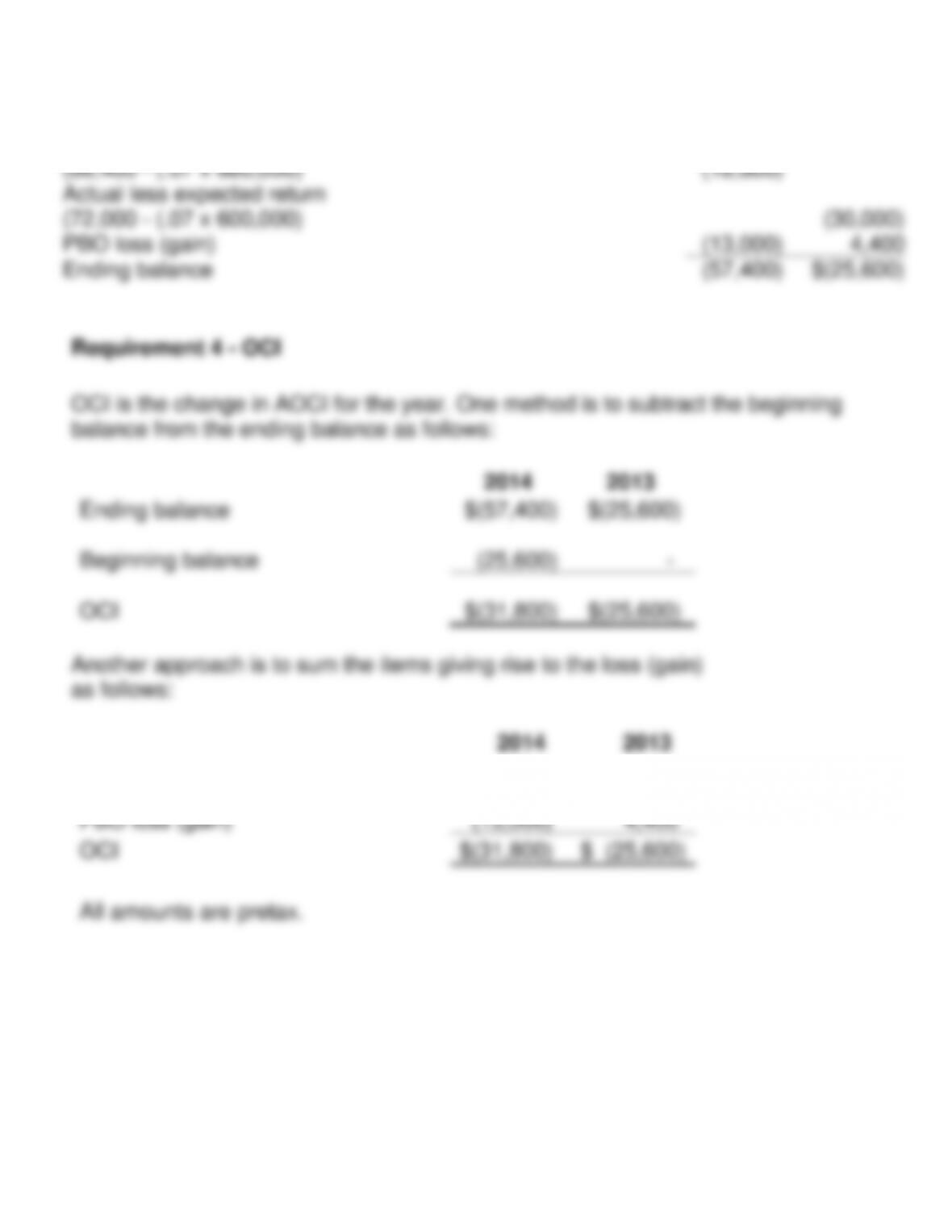
2014
2013
Requirement 1 – Change in PBO
Beginning balance
$799,400
$750,000
Service cost
70,000
60,000
Interest cost
47,964
45,000
Actuarial loss (gain)
(13,000)
4,400
Benefits paid
(67,000)
(60,000)
Ending balance
$837,364
$799,400
Requirement 2 – Change in plan
assets and funded status
2014
2013
Change in plan
assets
Beginning balance
$680,000
$600,000
Actual return
66,400
72,000
Employer
contributions
74,000
68,000
Benefits paid
(67,000)
(60,000)
Ending balance
$753,400
$680,000
Funded Status
$(83,964)
$(119,400)
14–12
Requirement 3 – AOCI Actuarial losses (gains)
2014
2013
Beginning balance
$(25,600)
$ 0
Actual less expected return
(66,400 – (.07 x 680,000)
(18,800)
Actual less expected return
(72,000 – (.07 x 600,000)
(30,000)
PBO loss (gain)
(13,000)
4,400
Ending balance
(57,400)
$(25,600)
Requirement 4 – OCI
OCI is the change in AOCI for the year. One method is to subtract the beginning
balance from the ending balance as follows:
2014
2013
Ending balance
$(57,400)
$(25,600)
Beginning balance
(25,600)
–
OCI
$(31,800)
$(25,600)
2014
2013
Actual less expected return
$(18,800)
$ (30,000)
PBO loss (gain)
(13,000)
4,400
OCI
$(31,800)
$ (25,600)
All amounts are pretax.
14–13
E14–18. Determining amount of recognized net gain or loss using the corridor
approach (LO 3, 4)
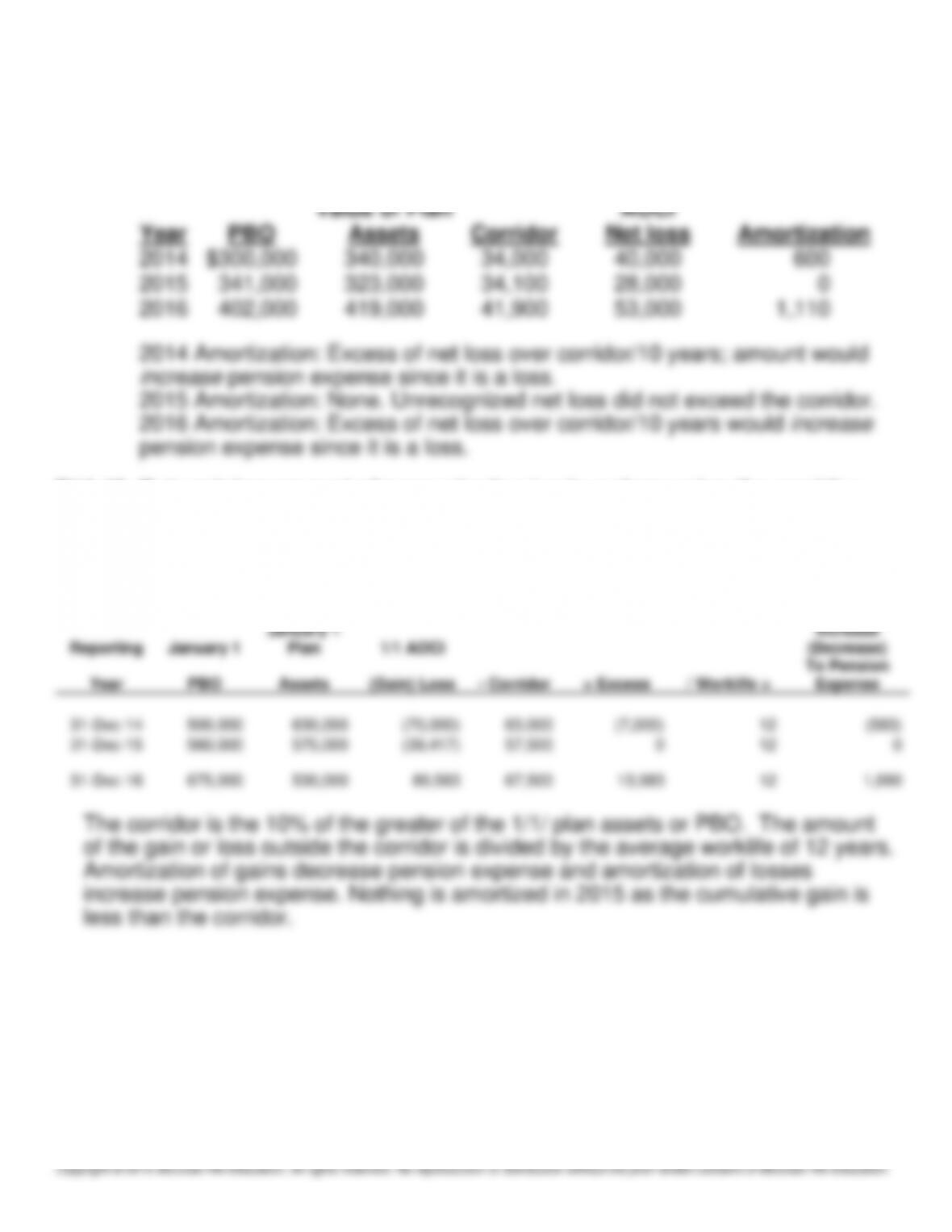
Amortization Net Actuarial (Gains) Losses—Corridor Approach:
Year
PBO
Fair Market
Value of Plan
Assets
Corridor
AOCI
Net loss
Amortization
2014
$300,000
340,000
34,000
40,000
600
2015
341,000
323,000
34,100
28,000
0
2016
402,000
419,000
41,900
53,000
1,110
2014 Amortization: Excess of net loss over corridor/10 years; amount would
increase pension expense since it is a loss.
2015 Amortization: None. Unrecognized net loss did not exceed the corridor.
2016 Amortization: Excess of net loss over corridor/10 years would increase
pension expense since it is a loss.
E14–19. Determining amount of recognized net gain or loss using the corridor
approach (LO 3, 4)
Requirement 1: Effect on pension expense
Reporting
January 1
January 1
Plan
1/1 AOCI
Increase
(Decrease)
Year
PBO
Assets
(Gain) Loss
– Corridor
= Excess
/ Worklife =
To Pension
Expense
31-Dec-14
500,000
630,000
(70,000)
63,000
(7,000)
12
(583)
31-Dec-15
560,000
575,000
(39,417)
57,500
0
12
0
31-Dec-16
675,000
530,000
80,583
67,500
13,083
12
1,090
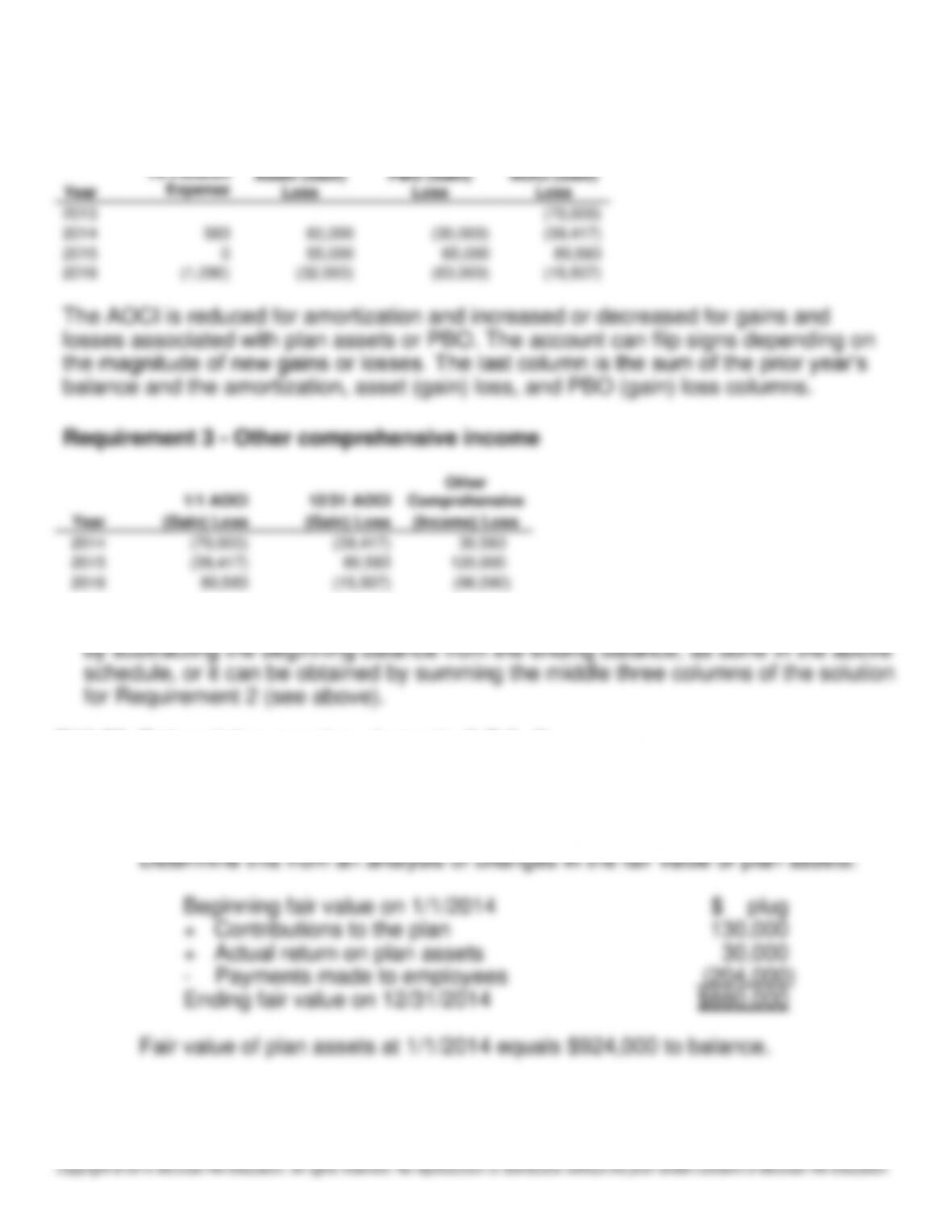
The corridor is the 10% of the greater of the 1/1/ plan assets or PBO. The amount
of the gain or loss outside the corridor is divided by the average worklife of 12 years.
Amortization of gains decrease pension expense and amortization of losses
increase pension expense. Nothing is amortized in 2015 as the cumulative gain is
less than the corridor.
14–14
Requirement 2 – AOCI balance
Amortization
Current Year
Current Year
12/31
Year
To Pension
Expense
Asset (Gain)
Loss
PBO (Gain)
Loss
AOCI (Gain)
Loss
2013
(70,000)
2014
583
60,000
(30,000)
(39,417)
2015
0
55,000
65,000
80,583
2016
(1,090)
(32,000)
(63,000)
(15,507)
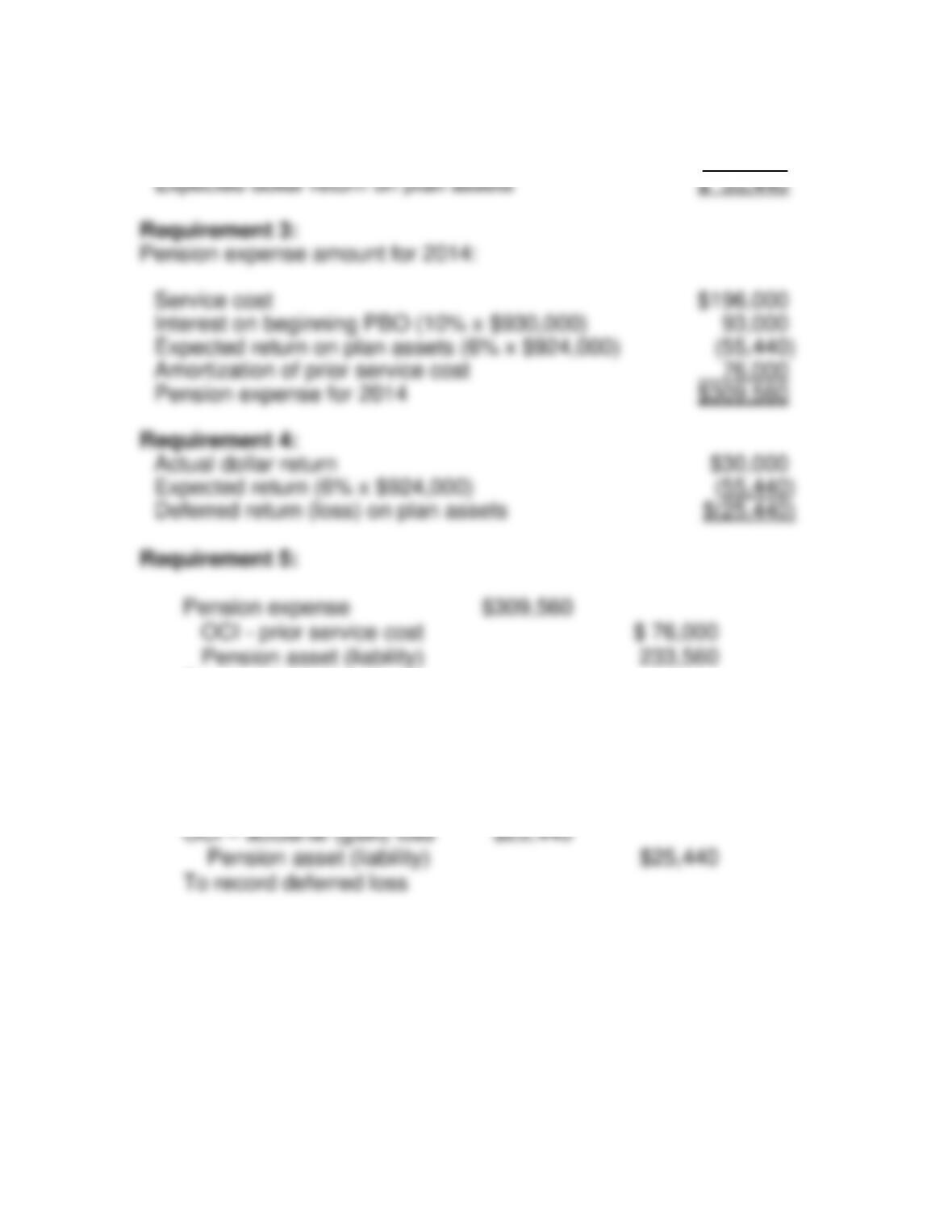
The AOCI is reduced for amortization and increased or decreased for gains and
losses associated with plan assets or PBO. The account can flip signs depending on
the magnitude of new gains or losses. The last column is the sum of the prior year’s
balance and the amortization, asset (gain) loss, and PBO (gain) loss columns.
Requirement 3 – Other comprehensive income
1/1 AOCI
12/31 AOCI
Other
Comprehensive
Year
(Gain) Loss
(Gain) Loss
(Income) Loss
2014
(70,000)
(39,417)
30,583
2015
(39,417)
80,583
120,000
2016
80,583
(15,507)
(96,090)
Other comprehensive income is the change in AOCI for the year. It can be obtained
E14–20. Determining pension elements (LO 3, 4)
Requirement 1:
Determination of fair value of plan assets for George at January 1, 2014:
14–15
Copyright © 2015 McGraw-Hill Education. All rights reserved. No reproduction or distribution without the prior written consent of McGraw-Hill Education.
Requirement 2:
Expected dollar return on plan assets for 2014:
Beginning fair value of plan assets $924,000
Times expected rate of return 6%
Pension expense
$309,560
OCI – prior service cost
$ 76,000
Pension asset (liability)
233,560
To record pension expense
Pension asset (liability)
$130,000
Cash
$130,000
To record contribution
OCI – actuarial (gain) loss
$25,440
Pension asset (liability)
$25,440
To record deferred loss