
Financial Reporting and Analysis 6e Pensions and Postretirement Benefits
CHAPTER 14
PENSIONS AND POSTRETIREMENT BENEFITS
CHAPTER OVERVIEW
Pension plan contracts allow employees to exchange current service for payments to be received
during retirement. Defined contribution pension plans specify amounts to be invested for the employee
during the employee’s career, and the employee’s pension will be based on the value of those
investments at retirement. In the United States, most new pension plans are defined contribution pans.
Consequently, defined contribution pension plans now hold 30% more assets than do defined benefit
plans. Still, U.S. defined benefit pension plans hold approximately $2 trillion in assets.
The accounting for defined contribution plans is straightforward. Defined benefit pension plans
specify amounts to be received during retirement, thereby complicating the underlying economics of the
exchange and the accounting. Under ASC Topic 715, pension expense for defined benefit pension
plans consists of service cost, interest cost, expected return on pan assets, and two other “smoothing”
components. The two smoothing mechanisms avoid year-to–year volatility in pension expense but
make pension accounting exceedingly complex because many pension-related items are presented in
AOCI.
Under pre-Codification SFAS No. 87, the balance sheet asset (liability) on the balance sheet differed
from the pan’s actual funded status. Current GAAP requires that the balance sheet asset (liability) equal
the plan’s funded status. Employer funding of defined benefit pension plans is influenced by tax law,
labor law, union membership, and the employer’s financial needs.
The reporting rules for other postretirement benefits (OPEB) closely parallel the pension accounting
rules. GAAP requires information about expected future cash flows, future amortization amounts, and
major classes of investments so that investors can make cash flow projections, assess risk, and evaluate
rate of return assumptions.
Academic research suggests that stock prices reflect pension and OPEB disclosures but their impact
may not be fully valued. Statement readers should watch for potential warning signals or indicators of
earnings management. Such indicators may include (1) a significant disagreement between any of the
various pension and OPEB rates selected by a firm; (2) a very large difference between the chosen
expected rate of return on plan assets and the discount rate used; (3) an increase in the year–to-year
expected rate of return on plan assets that seems unrelated to changes in market conditions, etc; (4) a
decrease in the assumed rate of increase in future compensation levels (or, for OPEB, future health cost
trends) that cannot be explained by changing industry or labor market conditions; (5) rate of return
assumptions that are inconsistent with prior investment experience or mix of equity and debt
investments.
IAS 19 (revised 2011) offers guidance that is markedly different from U.S. GAAP. Among other
things, it requires that the discount rate be used to measure both the expected return on assets and the
interest cost on PBO to obtain a net financing component. Additionally, actuarial losses (gains)
recognized in OCI are not subsequently amortized into pension expense. It also requires new past
service cost to be recognized immediately as a component of pension expense.
CHAPTER OUTLINE
I. RIGHTS AND OBLIGATIONS IN PENSION CONTRACTS
A. A pension plan is an agreement by an organization (sponsor) to provide payments—called a
pension—to employees when they retire either in a series of payments (annuity) or as a one-
time “lump sum” distribution.

Financial Reporting and Analysis 6e Pensions and Postretirement Benefits
1. Defined contribution plans specify the amount of cash that the employer puts into the
plan for the benefit of the employee.
a. No explicit promise is made about the size of the periodic payments the employee
will receive on retirement.
b. The amount that will ultimately be paid out to the employee is determined by the
accumulated value at retirement of the amounts contributed to the plan over the
period of employment.
c. Therefore, the employee bears the risk of the ultimate pension payments being large
enough to sustain a comfortable retirement income.
d. Money purchase plan, profit sharing, and 401(k) are common types of plans.
2. A defined benefit plan specifies the formula for determining the amount that will be paid
out to the employee after retirement rather than the amount that will be put into the plan.
a. The annual pension benefit typically depends on years of service with the firm and
salary.
b. The employee bears the risk that a firm will go bankrupt and default on unfunded
pension liabilities.
c. A plan is fully funded if its assets equal its liabilities.
II. ACCOUNTING ISSUES RELATED TO DEFINED BENEFIT PENSION PLANS
A. In a defined contribution plan, pension expense in any period is equal to the amount of
cash contributed to the plan by the employer.
1. Upon retirement, individual employees receive their share of the accumulated
balance from the investments.
B. In a defined benefit plan, the main complication is how much should be charged to
pension expense in each year during which employees covered under the plan work.
1. This complication arises because only the benefits formula is specified, not the
benefits amount.
2. To determine what the periodic pension expense should be over the span of the
employees’ working careers, the following factors must be estimated;
a. What proportion of the workforce will remain with the company long enough to
qualify for benefits—called vesting—under the plan?
b. At what rate will salaries rise over the period until eventual retirement?
c. What is the anticipated life span of covered employees after retirement?
d. What is the appropriate discount rate that should be used to reflect the present
value of the future benefits earned by employees in the current period?
e. What do firms do when actual experience is different from expectations?
3 In December 1985, the FASB issued specific measurement and disclosure
requirements for defined benefit pension plans which were later amended in 1998
2003, and 2006. Current GAAP is found in FASB ASC Topic 715,
Compensation – Retirement Benefits. Pension expense measurement for financial
reporting includes several smoothing features to avoid volatility in pension
expense.
a. These features acknowledge that short-term gains and losses on pension assets
and obligations may not result in cash inflows or outflows and are therefore omitted
from pension expense but have been included in footnotes between 1986 to 2006.
b. Since 2006, the temporary gains and losses have been recognized in
accumulated other comprehensive income (AOCI) with a corresponding offset to
a balance sheet pension asset or liability account.
c. Due to the existing complexity in the financial reporting, the FASB still views
the current GAAP as an interim measure and continues to study pension measurement
and presentation issues.

Financial Reporting and Analysis 6e Pensions and Postretirement Benefits
III. FINANCIAL REPORTING FOR DEFINED BENEFIT PENSION PLANS
A. Pension expense (in a defined benefit plan) is comprised of five separate components (a +
indicates increase in expense and a – indicates decrease in expense).
1. Service cost (+).
2. Interest cost (+).
3. Expected return on the market related value of pension plan assets (–).
4. Recognized gains or losses (+ or –).
5. Recognized prior service cost (+ or –).
B. A Simple Example: A World of Complete Certainty
1. Component 1 (service cost):
a. Service cost is the increase in the discounted present value of the pension benefits
ultimately payable that is attributable to an additional year’s employment.
i. In a typical defined benefit pension plan, the pension pay-out increases for each
additional year of service.
ii. This increase in the expected pay-out results in an increase in the discounted
present value of the liability.
iii. This increase is service cost.
b. In the example in the text, service cost is $24,526 in 2014 and $26,243 in 2015.
c. The gross assets and projected benefit obligation (PBO) of the pension plan do not
appear on the balance sheet but rather the company recognizes the funded status (the
net difference of the fair value of plan assets and the PBO) through its pension
expense and plan contribution (funding) journal entries.
2. Component 2 (interest cost):
a. The interest cost component of pension expense (and the increase in the liability)
arises due to the passage of time for unpaid PBO.
i. In contrast, the service cost element arises because the pension liability grows
as workers accumulate additional years of service.
ii. Because the payment of the pension liability draws closer as each year passes,
its present value increases.
iii. Interest cost is computed by taking the pension liability at the beginning of the
period and multiplying it by the discount rate.
b. In the example in the text, the interest cost for 2015 ($1,717) equals the pension
liability at the beginning of 2015 ($24,526) multiplied by the interest rate factor (7%).
c. There was no interest cost in 2014 since the liability did not arise until December 31,
2014 after the employee’s completion of a year of service.
3. Component 3 (expected return on plan assets):
a. The expected return on plan assets increases plan assets and decreases pension
expense.
b. In a world of certainty, the expected return and actual return on plan assets are equal.
The rules allow for a “smoothing” of this difference over several years.
c. Pension cost equals service cost when there is complete certainty because interest
cost is exactly offset by the return on plan assets. In other words, the return on plan
assets offsets increases to PBO created by the service cost and interest cost
components. Depending on the age distribution of the workforce, interest cost instead
of service cost could be the dominant part of pension expense.
C. The Real World: Uncertainty Introduces Gains and Losses
1. Uncertainty requires estimates of future discount rates, the expected return on plan assets,
and numerous other future events like employee turnover and longevity beyond retirement.
a. GAAP requires that the same rate be used to compute both the service cost and the
interest cost components of pension expense.

Financial Reporting and Analysis 6e Pensions and Postretirement Benefits
i. The higher the discount rate initially chosen for computing service cost, the
lower the reported service cost component of pension expense. Conversely,
the higher the expected rate of return used, the higher the deducted expected
return component of the pension expense.
ii. This reduction in service cost is partially offset by an increase in the interest cost
component of pension expense, which is due to the higher interest rate.
b. GAAP provides explicit criteria for estimating discount rates. This criteria
reduces (but does not eliminate it) managers’ ability to manipulate its pension
expense and its projected benefit obligation.
i. GAAP states that “assumed discount rates shall reflect the rates at which the
pension benefits could effectively be settled” (FASB ASC 715-30–35–43).
ii. To obtain this discount rate, firms can look to prevailing rates of return on high–
quality debt instruments with maturities that match expected payouts to retirees.
iii. Recent decline in rates coupled with low asset returns have led to significant
underfunding in both private and government pension plans.
2. Uncertainty also means that realizations will likely differ from expectations.
a. These deviations between actual and expected events would inject volatility in
periodic pension expense if recognized immediately.
b. Components 4 and 5 are designed to smooth these variances over future periods.
E. Components 4 and 5 are smoothing devices:
1. Component 4 (Recognized Gains or Losses):
a. In an uncertain environment, the actual return on pension plan assets can differ from
the expected return in any year.
b. Volatility in year-to-year pension expense can be avoided because firms can reduce
pension expense by the expected return on plan assets rather than by the actual
return.
c. This result is accomplished using a two-stage process:
i. First, firms select a target long-term rate of return that they expect to earn on
plan assets (rate of return assumption).
ii. Second, any difference between this expected return and the actual return that is
earned in a given year is recognized in other comprehensive income instead of
pension expense.
d. The difference between the expected and actual return in each year is recognized in
other comprehensive income instead of pension expense and called the unrecognized
gain or loss.
e. Since managers select the rate for computing the expected return on plan assets, it is
possible to lower pension expense in the short-run by using an expected asset return
rate that is higher than the discount rate.
f. If the gains and losses do not offset one another over time, the cumulative deferred
amounts continue to grow.
i. This cumulative gain or loss amount is amortized over current and future years
and recognized as a component of pension expense if it exceeds a certain maturity
threshold called a “corridor.”
ii. This threshold is defined as 10% of the larger of the following two numbers
measured at the beginning of the period:
1. The present value of pension obligations (PBO) based on assumed
future compensation levels (called the projected benefit obligations), or
2. The market–related value (MRV) of pension plan assets.
iii. If the 10% threshold is exceeded, the excess cumulative gain or loss is
amortized straight-line over the estimated remaining service period of active
employees.
1. The amortization of excess cumulative gains reduces pension expense.

Financial Reporting and Analysis 6e Pensions and Postretirement Benefits
2. The amortization of excess cumulative losses increases pension expense.
2. Component 5 (Recognized Prior Service Cost):
a. The dollar amount of the increase in the projected benefit obligation due to plan
enhancements is called prior service cost.
i. When a firm retroactively enhances (reduces) the benefits provided by its
pension plan, past pension expense and funding were too low (high).
ii. The pension benefit obligation under the enhanced (reduced) plan immediately
increases (decreases).
b. When this amendment is made, the effect is initially deferred in OCI and amortized
from AOCI to pension expense component 5 (prior service cost) over future years.
b. Prior service costs are then amortized into pension expense on a straight-line basis over
the expected service lives of employees who are expected to receive benefits under
the plan.
c. Similar to net actuarial losses, new prior service costs increase balance sheet liabilities
and decrease OCI and AOCI.
d. Journal Entries for Changes in Funded Status – Follow example in text
F. Determinants of Pension Funding – The U.S. Congress enacted the Employees Retirement
Income Security Act (ERISA) in order to protect workers covered by company sponsored
pension plans.
1. ERISA introduced minimum funding requirements and limited investments in employer
stock to 10% of plan assets, and created the Pension Benefit Guaranty Corporation
(PBGC) to assume pension obligations in case of company bankruptcy.
2. U.S. income tax law has influence on pension plan funding since contributions are tax
deductible and plan earnings are nontaxable to the plan sponsor.
3 A pension plan sponsor is obliged to fund the annual service cost computed under the plan.
4. There is a tax incentive to overfund pension plans since plan contributions are tax
deductible and plan earnings are nontaxable to the plan sponsor.
a. Tax law limits the deducibility of contributions to overfunded plans.
b. Consequently firms with overfunded plans limit subsequent funding to that amount
which is deductible for tax purposes.
5. Firms sometimes reduce or even forgo funding of the current period’s pension expense
(subject to minimum funding guidelines) to meet competing investment or financing cash
needs.
6. Research suggests that tax incentives, finance incentives, labor incentives, and
contracting/political cost incentives affect a firm’s pension funding strategy.
a. Firms with high marginal tax rates tend to have higher funding ratios.
b. Firms with less stringent capital constraints and larger union membership tend to have
higher funding ratios.
c. Firms with more “precarious” debt/equity ratios (that is, firms close to violating debt
covenant restrictions) tend to fund a lower proportion of their pension obligations.
IV. CASE STUDY OF PENSION RECOGNITION AND DISCLOSURE – GENERAL
ELECTRIC – [The use of the case in the text would be a great idea since it is a comprehensive one.
Figures 14.6, 14.7, and 14.8 are extremely useful in summarizing the transactions affecting those
accounts] Be sure to cover the subtle elements in the following subtopics:
1. Accumulated Other Comprehensive Income Disclosure and Deferred Income Taxes
2. Additional Issues in Computing Expected Return
3. Extraction of Additional Analytic Insights from Note Disclosures
Important Section Highlights:
A. A company’s pension disclosures provide information about the current economic status of
its pension plans. This provides insights regarding expected future pension-related cash
flows and their potential effect on firm cash flows.

Financial Reporting and Analysis 6e Pensions and Postretirement Benefits
B. The funded status and the PBO can be used to assess defined benefit pension risk for the
firm.
C. Underfunded pension plans represent a potential drain on future cash flows and should be
viewed as unsecured debt.
V. POSTRETIREMENT BENEFITS OTHER THAN PENSIONS
A. The computations for postretirement benefits expense and measures of the liability generally
parallel the format for pension expense and liability.
1. When OPEB plans are funded, postretirement benefit expense is reduced by the expected
return on plan assets.
a. To accomplish this, asset gains and losses are excluded from current expense but
recognized as a component of OCI.
b. These gains and losses are accumulated and amortized as component 4 of pension
expense if they exceed a 10% corridor.
2. A counterpart to pension component 5—amortization of prior service costs—exists as
well in instances in which firms enhance or reduce the level of postretirement benefits.
B. One difference between the accounting for pensions and the accounting for postretirement
benefits is that postretirement benefits are rarely tied to salary at retirement.
1. Consequently, there is no projected benefit obligation calculation.
2. The liability attributable to service date is called the accumulated post-retirement benefit
obligation (APBO).
a. The typical plan promises employees full coverage after a certain period of
employment.
b. The actuarially determined service cost of the plan is accrued over the same
attribution period.
C. Analytical Insights: Assessing OPEB Liability – Like for pensions, the OPEB liability
is riskier than many traditional forms of debt. Two ratios used in assessing the magnitude of
risk are:
1. Short-term OPEB risk ratio (quick version): APBO – Plan Assets/Market Value of CS
or for an extended version the numerator is: 5 yrs of Expected Benefit payment – Plan
Assets
2. Long-term OPEB risk ratio: APBO/Market Value of Common Stock
D. Most of the companies with the highest OPEB risk ratios declared bankruptcy.
E. Statement readers must be mindful that the future cash outflows associated with these
plans could be much higher than the current cash outflows.
F. Evaluation of Pension and Postretirement Benefit Financial Reporting
G. Recognition calculations for pensions and OPEB are extremely complex, and net income does
not reflect immediately actual asset returns or PBO effects as they arise.
H. Current GAAP requires the funded status of pension and postretirement plans be disclosed as
an asset or liability on the firm’s balance sheet.
I Some analysts argue that only service cost should be charged to operating income.
1. They believe interest cost (Component 2) is a financing cost.
2. The expected return (Component 3) — which lowers pension expense—should be
shown in other income.
VI. GLOBAL VANTAGE POINT: Comparison of IFRS and GAAP Retirement Benefit
Accounting
IFRS for pensions are specified by IAS 19 – “Employee Benefits.” Many of the requirements are
similar to the provisions in FASB ASC Subtopic 715-30: Compensation – Retirement Benefits –
Defined Benefit Plans – Pension.
A. However, important differences remain:
1. Prior service cost related to vested employees is recognized immediately as part of

Financial Reporting and Analysis 6e Pensions and Postretirement Benefits
pension expense, while prior service cost related to nonvested employees is amortized
over the average remaining vesting period. GAAP, on the other hand, requires firms to
recognize new prior service costs as part of OCI ad recycles them to pension expense
over the shorter of the average remaining work life or the period covered under a collect
bargaining agreement.
2. IAS 19 requires that the discount rate be used to compute the expected return on plan
assets. Actuarial gains and losses on the PBO and the actual return (less the expected
return on plan assets) are recognized in OCI without subsequent amortization to
pension expense. That means the periodic pension expense computed under IFRS
consists only of current service cost, past service cost, and net interest on the net defined
benefit liability or asset (funded status).
3. Placement on the statement of comprehensive income: Service cost is part of operating
activities while the finance component is part of the finance costs within profit and loss,
and actuarial gains and losses (remeasurement component) is part of OCI.
4. Balance sheet pension asset cannot exceed the asset ceiling which is the sum of (1) the
net plan assets available from refunds or reduced plan contributions, (2) the
unrecognized prior service costs, and (3) the unrecognized net actuarial losses.
5. Because FASB has not yet changed U.S. GAAP for pensions, pension expense is likely
more volatile under U.S. GAAP since it requires firms to amortize actuarial gains and
losses.
6. U.S. GAAP pension is likely to be lower because it allows the expected rate of return to
exceed the discount rate.

Financial Reporting and Analysis 6e Pensions and Postretirement Benefits
CHAPTER QUIZ
1. The projected benefit obligation is best described as the:
a. Present value of benefits accrued to date based on future salary levels.
b. Present value of benefits accrued to date based on current salary levels.
c. Increase in retroactive benefits at the date of the amendment of the plan.
d. Amount of the adjustment necessary to reflect the difference between actual and estimated
actuarial returns.
2. Which of the following describes a fundamental aspect of pension accounting?
a. Changes in pension assets and obligations are recognized immediately.
b. The amount of pension benefits is not precisely determinable.
c. Net periodic pension expense may be reported within maximum and minimum limits.
d. When underfunding occurs, immediate recognition in the balance sheet and income statement
is required.
3. Effective January 1, 2015, Visor Co. established a defined benefit pension plan with no retroactive
benefits. The first of the required equal annual contributions was paid on December 31, 2015. A
10% discount rate was used to calculate service cost, and a 10% rate of return was assumed for plan
assets. All information on covered employees for 2015 and 2016 is the same. How should the
service cost for 2016 compare with 2015, and should the 2015 balance sheet report an accrued or a
prepaid pension cost?
Service Cost Pension Cost Reported
For 2016 on the 2015
Compared to 2008 Balance Sheet
a. Equal to Accrued
b. Equal to Prepaid
c. Greater than Accrued
d. Greater than Prepaid
4. The following information pertains to Seda Co.’s pension plan:
Actuarial estimate of projected benefit obligation at 1/1/15 $72,000
Assumed discount rate 10%
Service cost for 2015 $18,000
Pension benefits paid during 2015 $ 15,000
If no change in actuarial estimates occurred during 2015, Seda’s projected benefit obligation at
December 31, 2015 is:
a. $64,200.
b. $75,000.
c. $79,200.
d. $82,200.
5. The following information pertains to Gali Co.’s defined benefit pension plan for 2015:
Fair value of plan assets, beginning of year $3 50,000
Fair value of plan assets, end of year $525,000
Employer contributions $ 110,000
Benefits paid $85,000
In computing pension expense, what amount should Gali use as an actual return on plan assets?
a. $65,000.
b. $150,000.
c. $175,000.

Financial Reporting and Analysis 6e Pensions and Postretirement Benefits
d. $260,000.
6. The following information pertains to the 2015 activity of the defined benefit pension plan of Twain
publishers, Inc.
Service cost $120,000
Return on plan assets $30,000
Interest cost on pension benefit obligation $40,000
Amortization of actuarial loss $ 10,000
Amortization of prior service cost $5,000
Twain’s 2015 pension cost is:
a. $105,000.
b. $125,000.
c. $135,000.
d. $145,000.
7. The following information pertains to Kane Co.’s defined benefit pension plan:
Prepaid pension cost, beginning of year $ 2,000
Service cost $19,000
Interest cost $38,000
Actual return on plan assets $22,000
Amortization of unrecognized prior service cost $52,000
Employer contributions $40,000
The fair value of plan assets exceeds the accumulated benefit obligation. In its end-of–year financial
statements, what amount should Kane report as unfunded accrued pension cost?
a. $45,000.
b. $49,000.
c. $67,000.
d. $87,000.
8. The gain or loss components of net periodic postretirement benefit cost (FASB ASC 715) and net
periodic pension expense are calculated similarly. Moreover, under either pronouncement, an
employer may use a systematic method of amortizing unrecognized net gain or loss other than the
corridor approach. The alternative is allowable if it results in amortization at least equal to the
minimum determined using that approach. Under FASB ASC 715, however, if an enterprise
consistently recognizes gains and losses immediately,
a. Any net loss in excess of a net gain previously recognized first offsets any unrecognized prior
service cost.
b. Any net gain in excess of a net loss previously recognized first offsets any unrecognized
transition asset.
c. Any net loss in excess of a net gain previously recognized first offsets any unrecognized
transition obligation.
d. Any net gain in excess of a net loss previously recognized first offsets any unrecognized
transition obligation.
9 An employer maintains a postretirement health care plan for employees. Under the plan’s terms, an
excess of benefit payments over the sum of the employer’s cost and the employees’ contributions
for a year will be recovered from increased employees’ contributions in the subsequent year.
However, for the current year only, the employer has decided not to adjust contributions. The
employer should:

Financial Reporting and Analysis 6e Pensions and Postretirement Benefits
a. Delay recognition of the loss by using the corridor approach.
b. Apply any systematic and rational delayed recognition approach to accounting for the loss.
c. Immediately recognize the loss in income.
d. Adjust the transition asset.
10. A company provides postretirement health care benefits to employees who have completed at least
10 years of service and are aged 55 years or older when retiring. Employees retiring from this
employer have a median age of 62, and no one has worked beyond age 65. An employee is hired at
the age of 48. The attribution period for accruing the employer’s health care benefit obligation to
the employee is during the period when the employee is aged:
a. 48 to 65.
b. 48 to 58.
c. 55 to 65.
d. 55 to 62.
Financial Reporting and Analysis 6e Pensions and Postretirement Benefits
QUIZ ANSWERS:
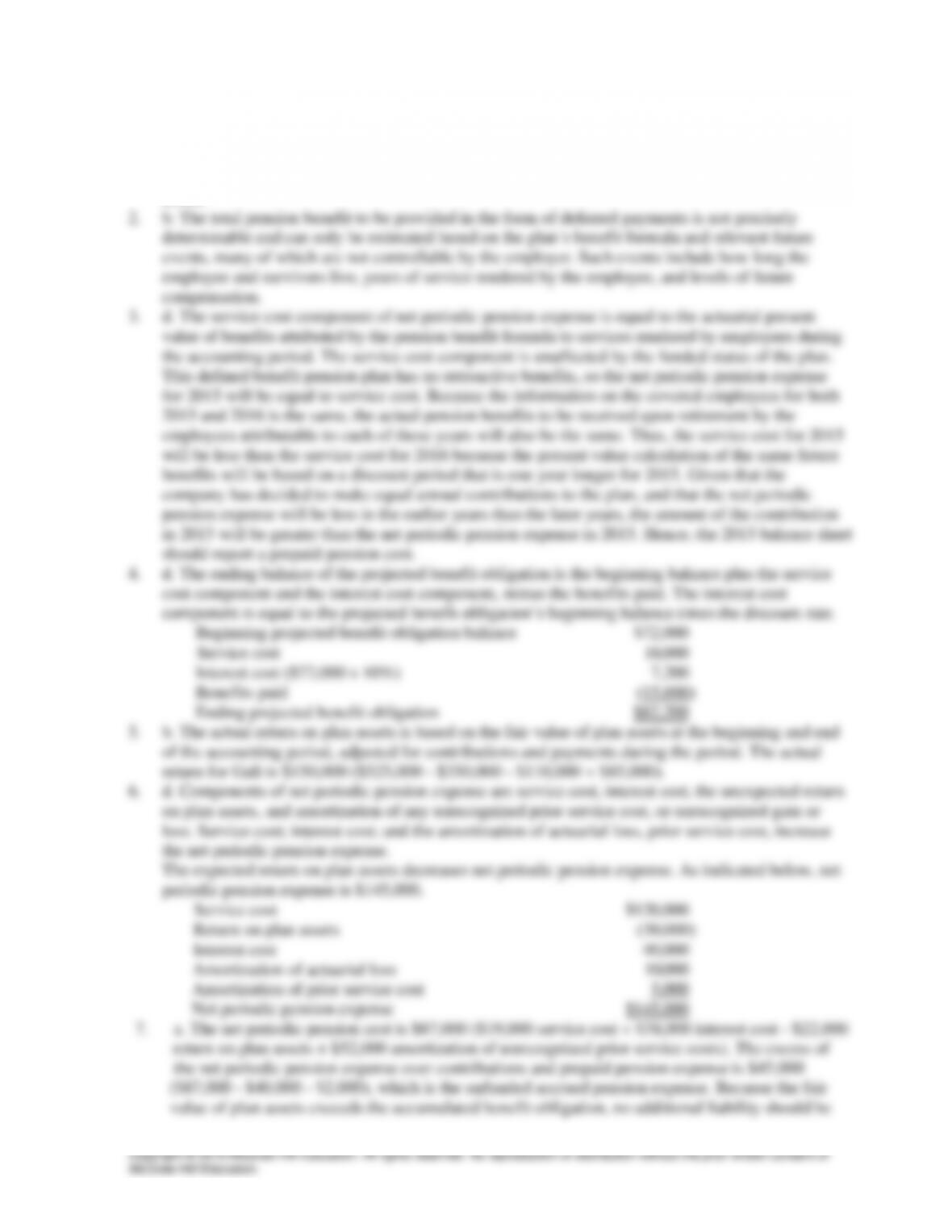
1. a. The projected benefit obligation is equal to the actuarial present value of all of the benefits
attributed by the pension benefit formula to employee service rendered prior to the date of
measurement. The projected benefit obligation is measured using assumptions as to future salary
levels.
Financial Reporting and Analysis 6e Pensions and Postretirement Benefits
Copyright © 2015 McGraw-Hill Education. All rights reserved. No reproduction or distribution without the prior written consent of
McGraw-Hill Education.
recognized.
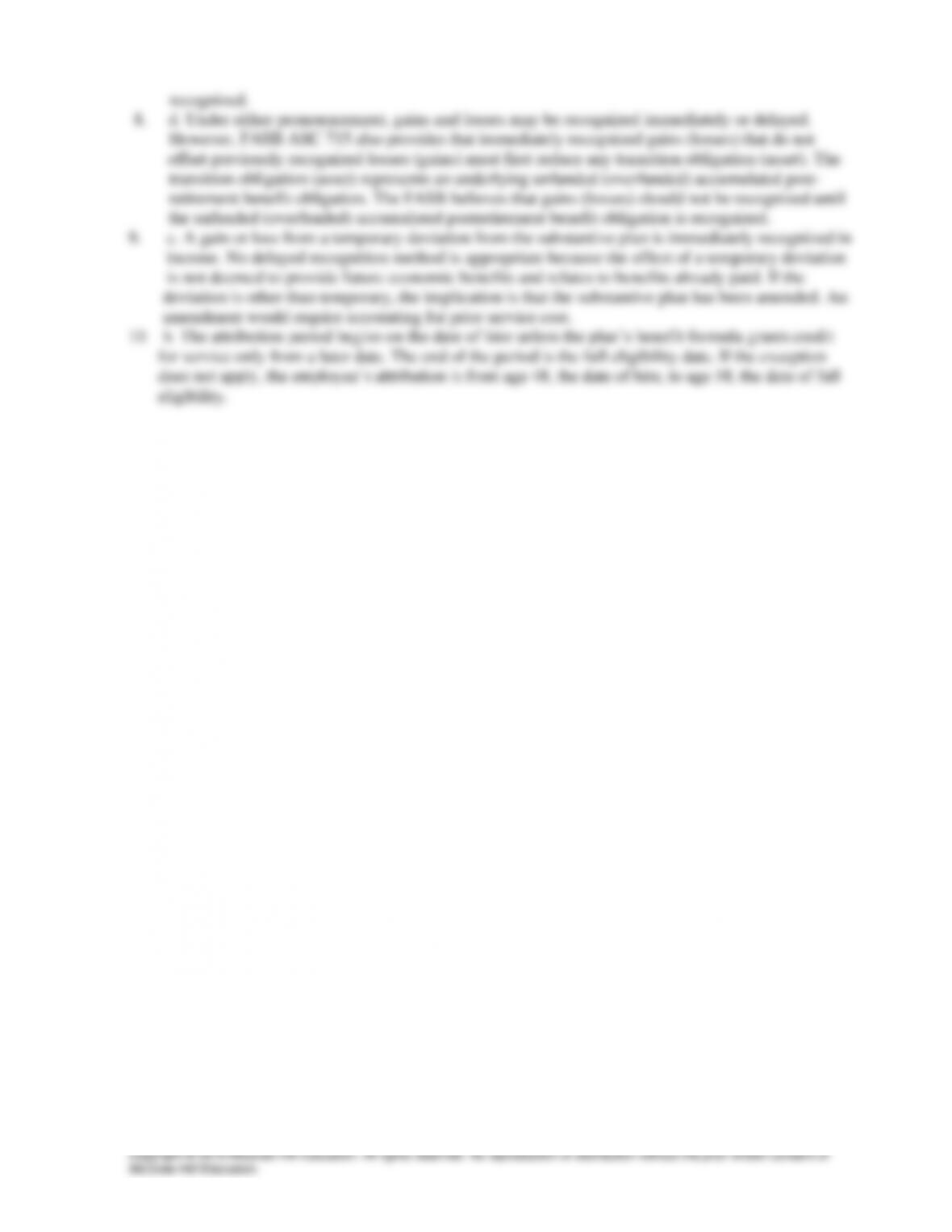
8. d. Under either pronouncement, gains and losses may be recognized immediately or delayed.
However, FASB ASC 715 also provides that immediately recognized gains (losses) that do not
offset previously recognized losses (gains) must first reduce any transition obligation (asset). The
transition obligation (asset) represents an underlying unfunded (overfunded) accumulated post-
retirement benefit obligation. The FASB believes that gains (losses) should not be recognized until
the unfunded (overfunded) accumulated postretirement benefit obligation is recognized.
9. c. A gain or loss from a temporary deviation from the substantive plan is immediately recognized in
income. No delayed recognition method is appropriate because the effect of a temporary deviation
is not deemed to provide future economic benefits and relates to benefits already paid. If the
deviation is other than temporary, the implication is that the substantive plan has been amended. An
amendment would require accounting for prior service cost.
10. b. The attribution period begins on the date of hire unless the plan’s benefit formula grants credit
for service only from a later date. The end of the period is the full eligibility date. If the exception
does not apply, the employee’s attribution is from age 48, the date of hire, to age 58, the date of full
eligibility.
RECOMMENDED EXHIBITS
Figure 14.1- Pension Plan Entities and Relationships
Figure 14.2—Assets By Plan Type
Figure 14.3—Pension Discount Rate and Expected Long-Term Rate of Return on Plan
Figure 14.5—Computing Component 4 – Recognized Gains or Losses.
Figure 14.6—Causes of Increases and Decreases in Plan Assets
Figure 14.7—Causes of Increases and Decreases in PBO
Figure 14.8 – Analysis of Balance Sheet Liability and OCI Accounts
Exhibit 14.1 – Present Value Calculations for Robie Corporation Pension Plan
SUGGESTED READINGS
1. Amir, E., and J. Livnat. 1997. Adoption choices of SFAS No. 106: Implications for financial
analysis. Journal of Financial Statement Analysis (Winter).
2. Anonymous. 1998. Materiality out in postretirement statement. Journal of Accountancy
(February): 15.
3. Boma, J., and M. Rosenbaum. 1998. Keep executives happy. Journal of Accountancy (February):
47–50.
4. McGough, R., and E. Schulz. 1999. How pension surpluses lift profits. The Wall Street Journal
(September 20).
5. Schultz, E. 2000. Companies quietly use mergers, spinoffs to cut worker benefits. The Wall Street
Journal (December 27).
6. Solomon, D. 2001. Three pension funds sue AT&T over plan to change some voting rules. The
Wall Street Journal (March 20).

Financial Reporting and Analysis 6e Pensions and Postretirement Benefits