13–42
is in “steady–state,” whereby its fixed asset acquisitions are just sufficient to
replace its assets going out of service, it has no net change in deferred tax
liabilities related to fixed assets.
Intangible assets other than nondeductible goodwill: This deferred tax liability
arose because amortization is recognized faster for tax purposes than for financial
carryforwards incurred in 2012 exceeded carryforwards used. Although Pepsico
is profitable overall, it can still have carryforwards if they pertain to jurisdictions
where Pepsico is not profitable. For example, the company could have a foreign
subsidiary that is incurring losses. Those losses may not be used to offset U.S.
taxable income and therefore create carryforwards that may be used when the
option vesting period for financial reporting. However, no tax deduction is
permitted until the options are exercised, which must be after the vesting period is
over. (See Chapter 15.)
Retiree medical benefits, Other employee-related benefits: In both of these
cases, there is a deferred tax asset because expense is recognized earlier than a
Pension benefits: Pension benefits, like other benefits, are accrued over an
employee’s working year for financial statement purposes. However, pension
plans generally create an income tax deduction when contributions are made to
the plan. The firm does not have to wait until the benefit payment is made to take
13–43
comprehensive income (through pension expense and other comprehensive
income) than the amount of the tax deduction that has been taken. The amount
of the deferred tax asset increased, indicating net originating temporary
differences. (See Chapter 14.)
C13-2. Google Inc.: Analyzing tax notes
Requirement 1:
($ in millions)
DR Income tax expense $2,598
13–44
Requirement 4:
Let X = taxable income as per tax return ($ in millions)
Income Tax Payable = Statutory Tax Rate * X
$2,871 = .35X
X = $8,209.9
2012, so depreciation and amortization for tax purposes exceeded the
amount for financial reporting.
Let Z = difference between tax return and book income ($ in millions)
Increase in DTL = Statutory Tax Rate x Z
$761 – $479 = .35Z
income tax rate on foreign income is, on average, lower than the 35% U.S. rate.
Although the U.S. taxes worldwide income of U.S. companies (after allowing a
credit for foreign taxes paid), it does not impose the tax until the earnings are
repatriated. Firms that have deemed their foreign earnings to be permanently
reinvested overseas do not accrue income tax expense for the additional taxes
C13-3. Motorola vs. Intel: Adjusting for depreciation differences
Requirement 1:
Begin by looking at the edited financial statement disclosures from the Year 2
10K of Motorola, which shows the balances in the sub-components of
the deferred tax account. The highlighted depreciation item reflects the
$213 million cumulative deferred tax liability arising from book versus tax
depreciation expense at December 31, Year 2. The liability rose by
Therefore,
$45.7 = (Tax depreciation – Book depreciation)
Since the edited financial statement disclosures show Motorola’s book
depreciation was $2,308 million, tax depreciation must have been $2,308
million + $45.7 million = $2,353.7 million.
or:
$98 = (Tax Depreciation – Book Depreciation) x .35
or:
$280 = (Tax Depreciation – Book Depreciation)
Intel’s book depreciation was $1,888 million (from disclosures), so tax
depreciation must have been $1,888 million + $280 million = $2,168 million.
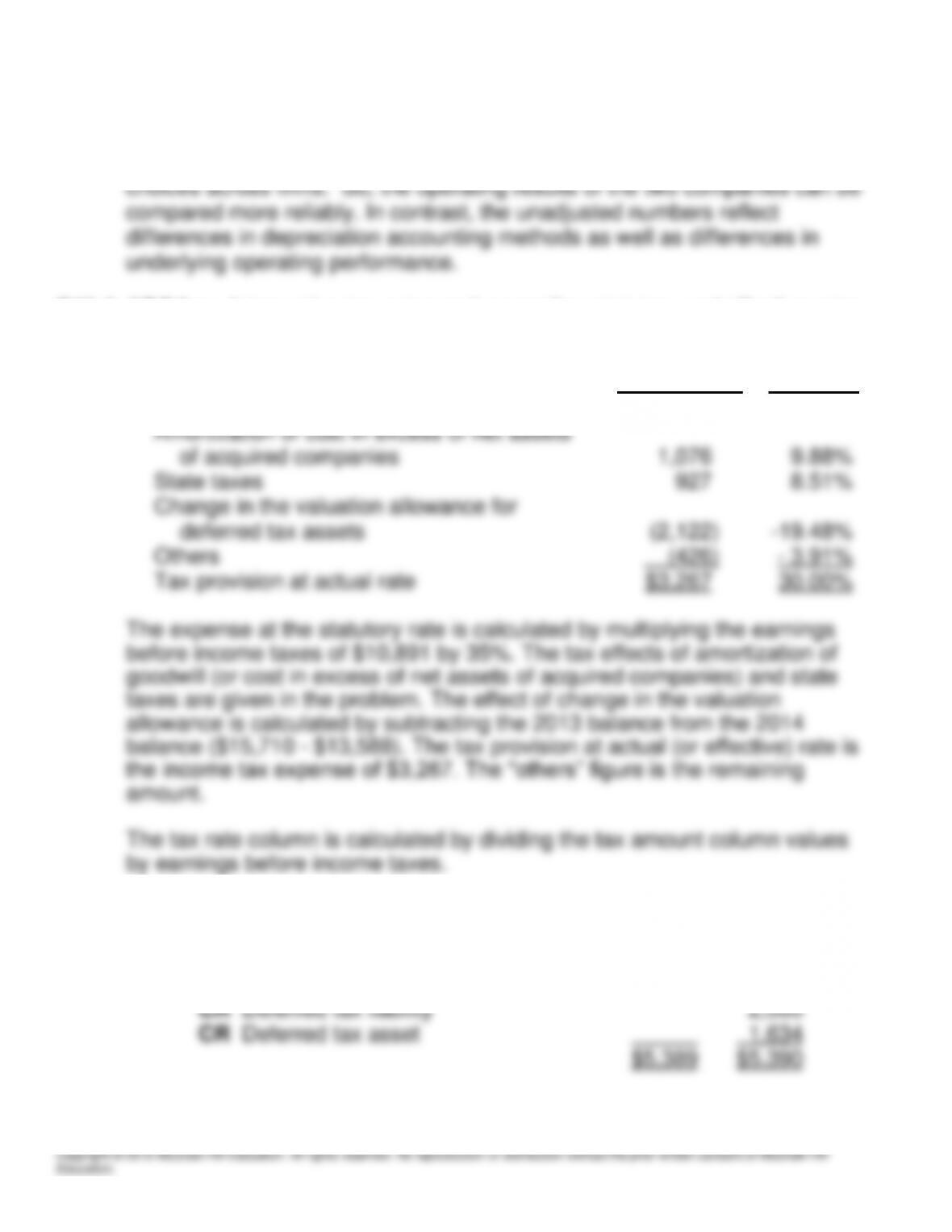
Requirement 2:
13–46
Requirement 3:
The adjusted figures are not affected by variations in depreciation reporting
C13-4. ABC Inc.: Interpreting tax notes and reconciling statutory and effective rates
Requirement 1:
Tax Amount
Tax Rate
Tax expense at statutory rate of 35%
$3,812
35.00%
Amortization of cost in excess of net assets
of acquired companies
1,076
9.88%
State taxes
927
8.51%
Change in the valuation allowance for
deferred tax assets
(2,122)
-19.48%
Others
(426)
– 3.91%
Tax provision at actual rate
$3,267
30.00%
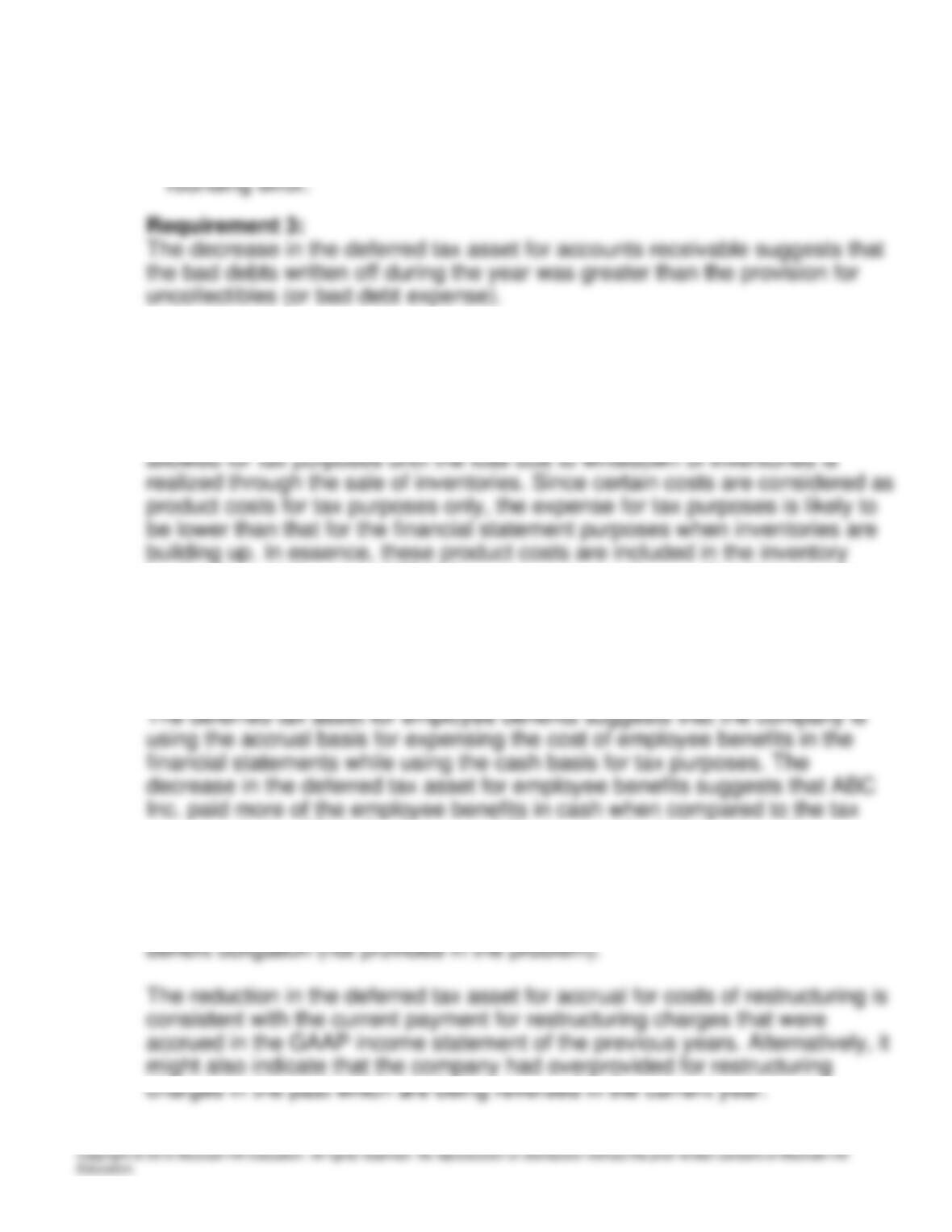
Requirement 2:
DR Income tax expense
$3,267
DR Valuation allowance
2,122
CR Income tax payable
$1,756
CR Deferred tax liability
2,000
CR Deferred tax asset
1,634
$5,389
$5,390
13–47
The credit to the income tax liability represents the current portion of the
income tax expense. The decrease in the deferred tax asset ($47,652 –
$49,286) and the increase in the deferred tax liability ($12,957 – $10,957)
are obtained from comparing the 2014 and 2013 balance sheet values. The
one dollar difference between the total debit and total credit appears to be
The deferred tax asset for inventories is due to additional costs inventoried
for tax purposes and financial statement allowances. It appears that certain
costs that are considered as product costs for tax purposes are considered
as period costs for financial reporting purposes. In addition, it seems that
certain writedown of inventories (financial statement allowances) are not
book values at the end of 2011 for tax purposes, whereas they have been
expensed in the financial statements as part of operating expenses. Thus, the
increase in the deferred tax asset for inventories is consistent with the
inventory buildup indicated by the change in the balance sheet value from
2013 to 2014.
expense during 2014. Another possibility to consider is that, since the
company has gone through significant restructuring, the reduction in the
deferred tax asset might be indicative of the reduction in the liability for
employee benefits from contract renegotiations. In fact, the income statement
of the company reported a $6,000 credit from reduction in the employee
13–48
The deferred tax asset for accrual for disposal of discontinued operations was
created to record the expected tax benefit from the loss on discontinued
operations reported in the GAAP financial statements of the previous years.
The reduction in this deferred tax asset suggests that a portion of the loss
C13-5. Understanding tax note disclosures
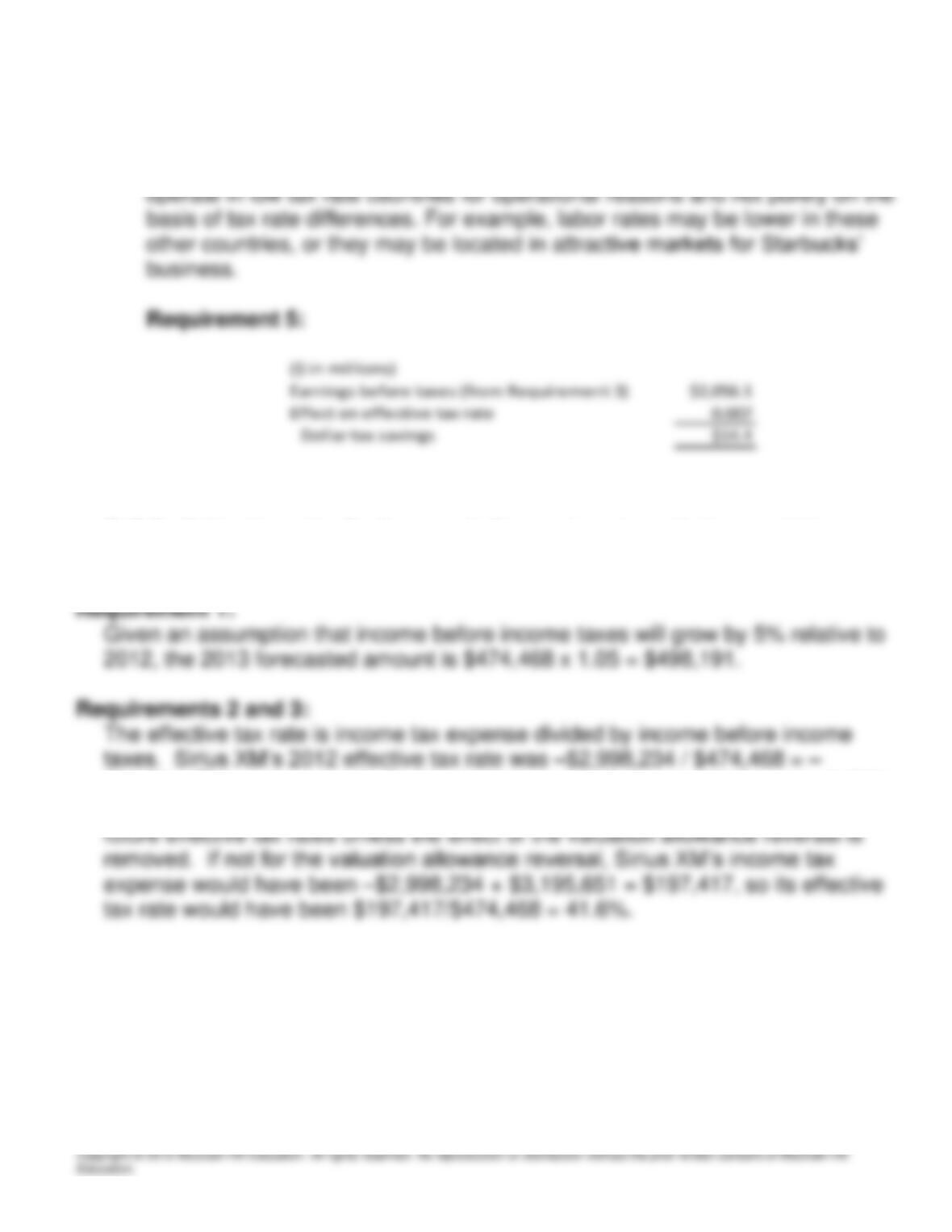
Requirement 1:
($ in millions)
DR Income tax expense $674.4
$674.4 = .328 X
$2,056.1 = X
13–49
Requirement 4:
The tax jurisdictions in which the firm chooses to operate—indicated by the
3.3 percentage point reduction in the effective tax rate attributed to foreign tax
rates—account for much of the difference between Starbucks’ effective tax
rate and the U.S. statutory tax rate. Note that Starbucks may choose to
C13-6. Using tax note disclosures to forecast next year’s tax provision
Note: All dollar amounts in this discussion are in thousands.
631.9%. This very unusual effective tax rate results because of the reversal of the
valuation allowance. As a result, this effective tax rate is not useful for forecasting
Requirements 4 and 5:
($ in thousands)
Forecasted income before income taxes $498,191
Forecasted income tax expense:
Income before income taxes x 41.6% 207,247
Less: Reversal of remaining valuation allowance 9,800 197,447
Forecasted net income $300,744
Forecasted 2013
C13-7 Interpreting FIN48 disclosures
Requirement 1:
$17.1 million minus $15.3 million, or $1.8 million.
C13-8: Tax note under IFRS
Requirement 1:
13–51
Lufthansa was not able to capitalize €498 million of deferred tax assets because
management did not deem it likely that those assets would be realized. This
amount is analogous to what Lufthansa would have reported for a valuation