13–16
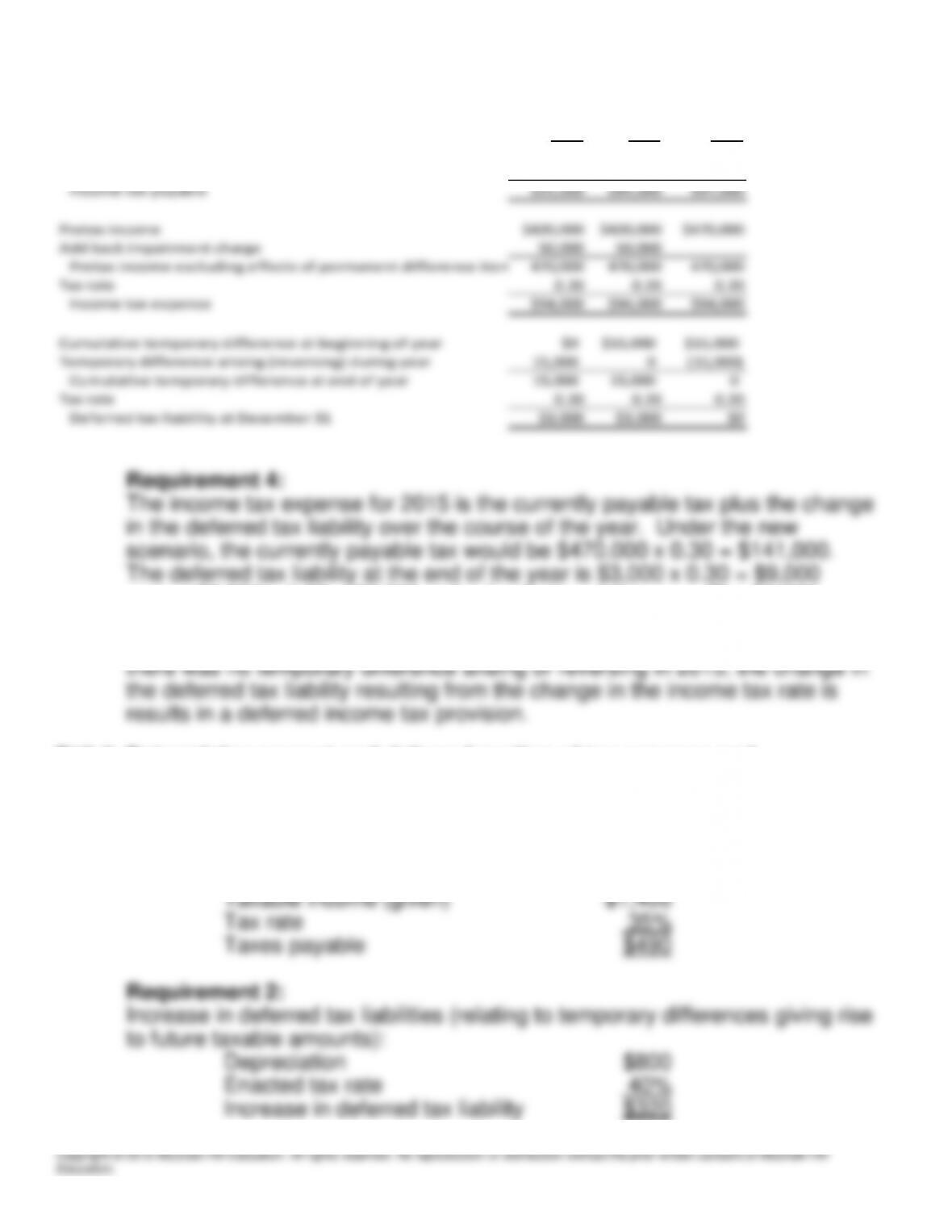
Requirement 3:
2014 2015 2016
Taxable income $455,000 $470,000 $485,000
Tax rate 0.20 0.20 0.20
Income tax payable $91,000 $94,000 $97,000
Pretax income $420,000 $420,000 $470,000
Add back impairment charge 50,000 50,000
Pretax income excluding effects of permanent difference items
470,000 470,000 470,000
Tax rate 0.20 0.20 0.20
Income tax expense $94,000 $94,000 $94,000
Cumulative temporary difference at beginning of year $0 $15,000 $15,000
Temporary difference arising (reversing) during year 15,000 0 (15,000)
Cumulative temporary difference at end of year 15,000 15,000 0
Tax rate 0.20 0.20 0.20
Deferred tax liability at December 31 $3,000 $3,000 $0
Requirement 4:
The income tax expense for 2015 is the currently payable tax plus the change
in the deferred tax liability over the course of the year. Under the new
scenario, the currently payable tax would be $470,000 x 0.30 = $141,000.
The deferred tax liability at the end of the year is $3,000 x 0.30 = $9,000
versus $3,000 x 0.20 = $6,000 at the beginning of the year. The $3,000
increase in the deferred tax liability is added to the currently payable tax of
$141,000, for an income tax expense of $144,000. Note that even though
P13-5. Determining current and deferred portion of tax expense and
reconciling statutory and effective tax rates
All dollar amounts are in thousands.
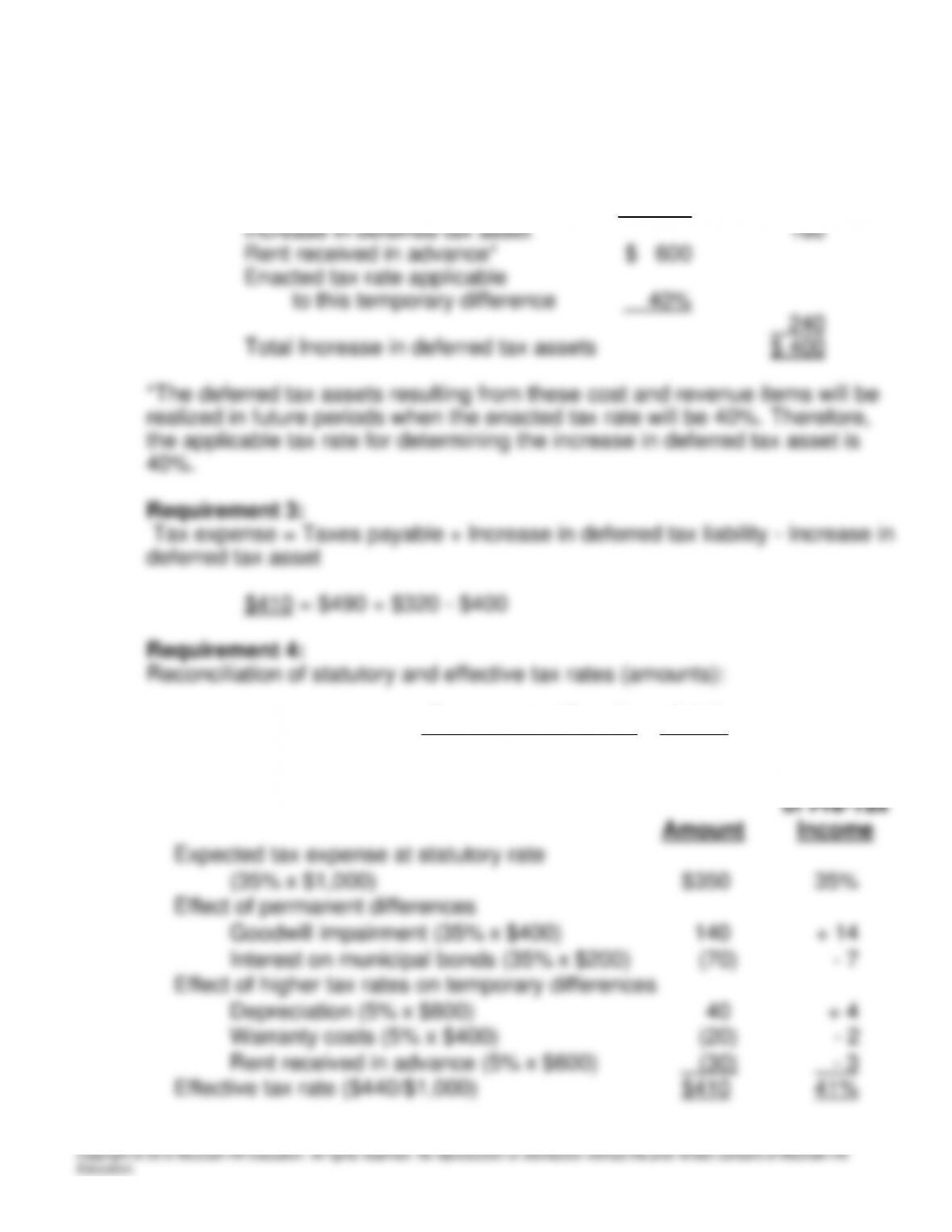
Requirement 1:
13–17
Increase in deferred tax assets (relating to temporary differences giving rise
to future deductible amounts):
Warranty costs* $ 400
Enacted tax rate 40%
41%
$1,000
$410
(given) income tax–Pre
3) (Req. expense Tax
rate tax (book) Effective ===
Percentage

13–18
13–19
P13-6. Entries for loss carrybacks and carryforwards
Requirement 1:
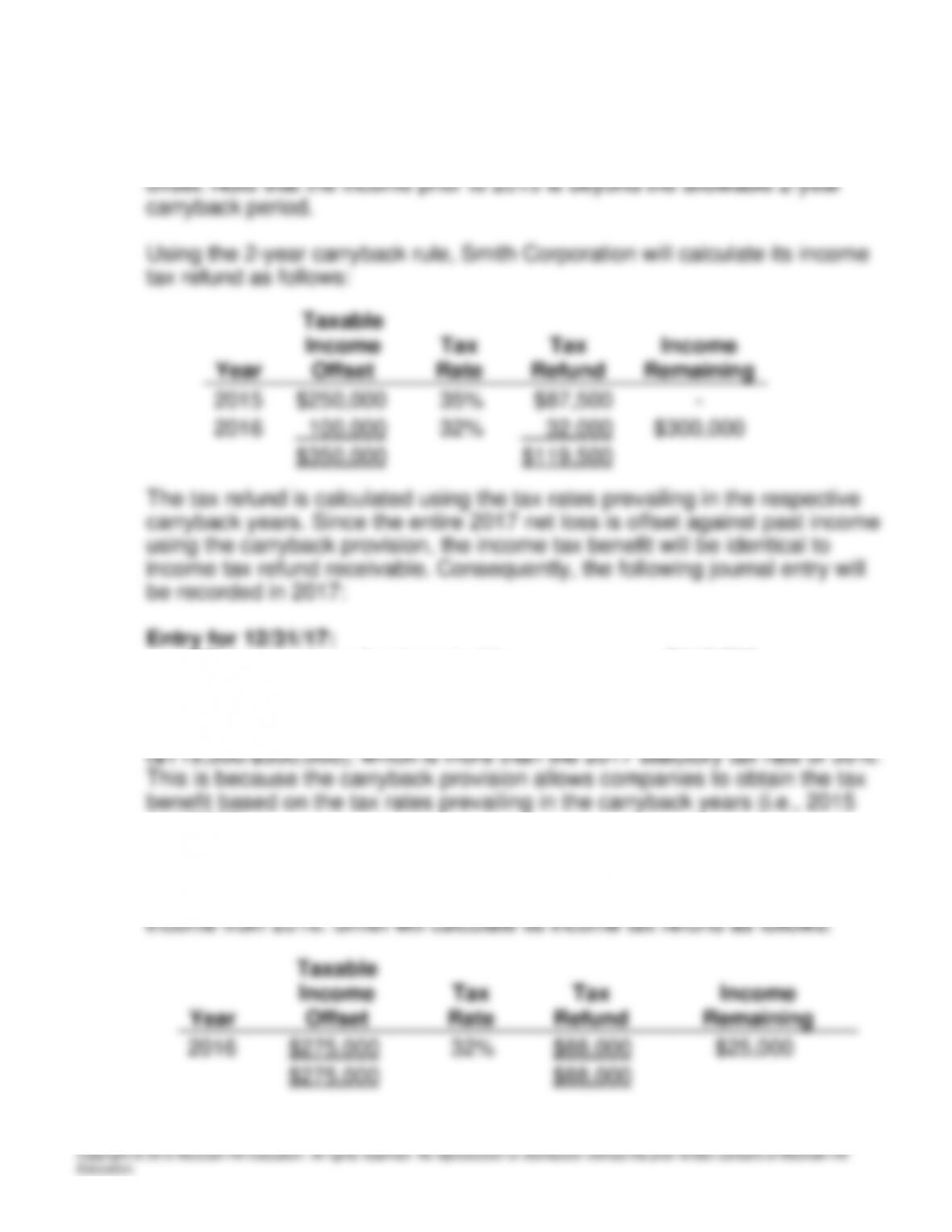
Smith Corporation will offset the 2017 loss against the 2015 income and a
portion of the income of year 2016 until the entire loss of $350,000 is fully
DR Income tax refund receivable $119,500
CR Income tax expense or benefit $119,500
Note that the effective tax “benefit” rate during 2017 is 34.14%
and 2016).
Because the remaining income from 2016 ($300,000) exceeds the 2018 loss,
Smith Corporation will offset the entire 2018 loss against the remaining
13–20
The tax refund is calculated using the tax rate prevailing in the carryback
year. Since the entire 2018 net loss is offset against past income using the
carryback provision, the income tax benefit will be identical to income tax
refund receivable. Consequently, the following journal entry will be recorded
in 2018:
Entry for 12/31/18:
tax rates prevailing in the carryback years (i.e., 2016).
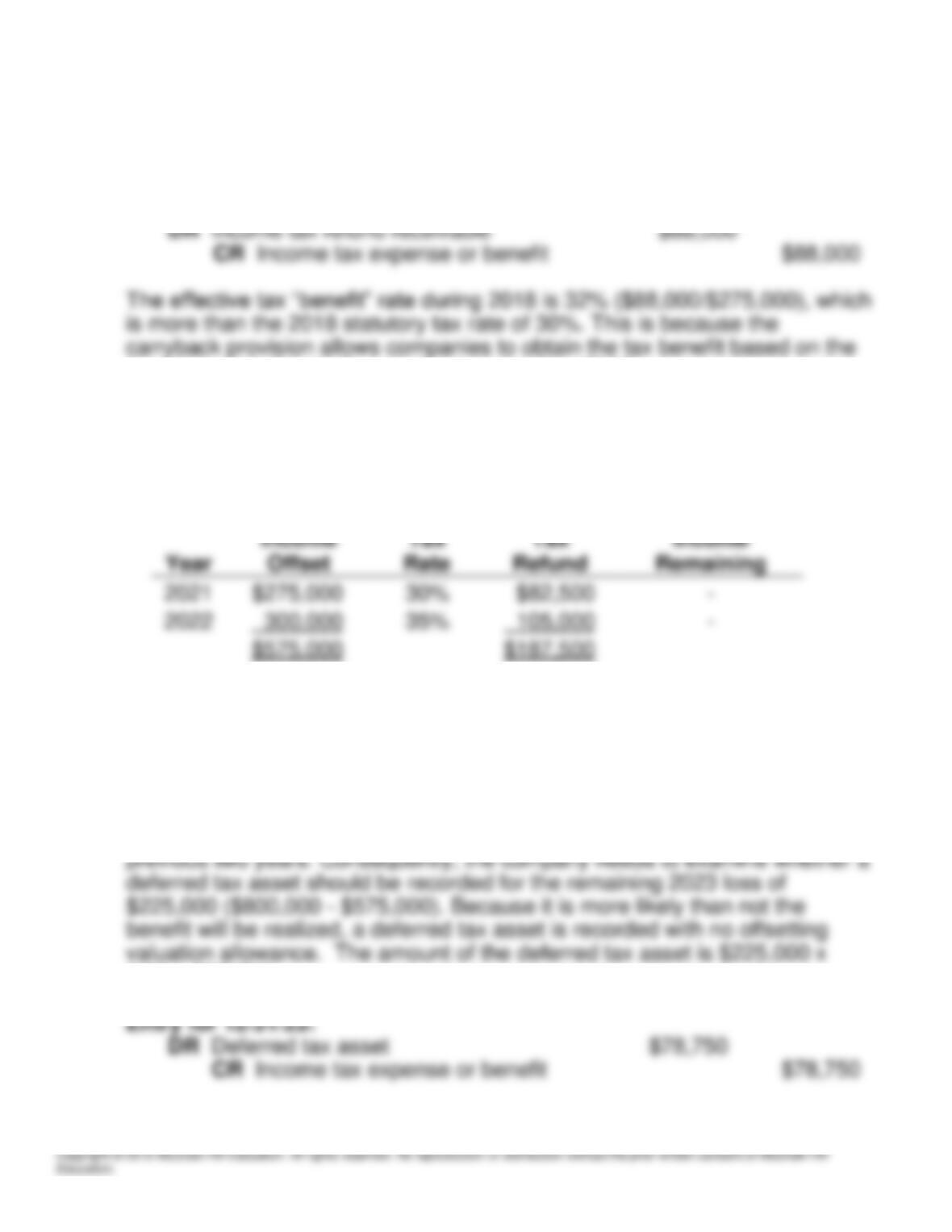
Smith Corporation will offset the 2023 net loss of $800,000 against the past
two years’ income. Smith will be eligible for an income-tax refund, calculated
as follows:
Taxable
Year
Income
Offset
Tax
Rate
Tax
Refund
Income
Remaining
2021
$275,000
30%
$82,500
–
2022
300,000
35%
105,000
–
$575,000
$187,500
The following journal entry will be made to record the 2023 refund due:
Entry for 12/31/23:
DR Income tax refund receivable $187,500
CR Income tax expense or benefit $187,500
Note, however, Smith Corporation had earned only $575,000 during the
0.35 = $78,750.
13–21
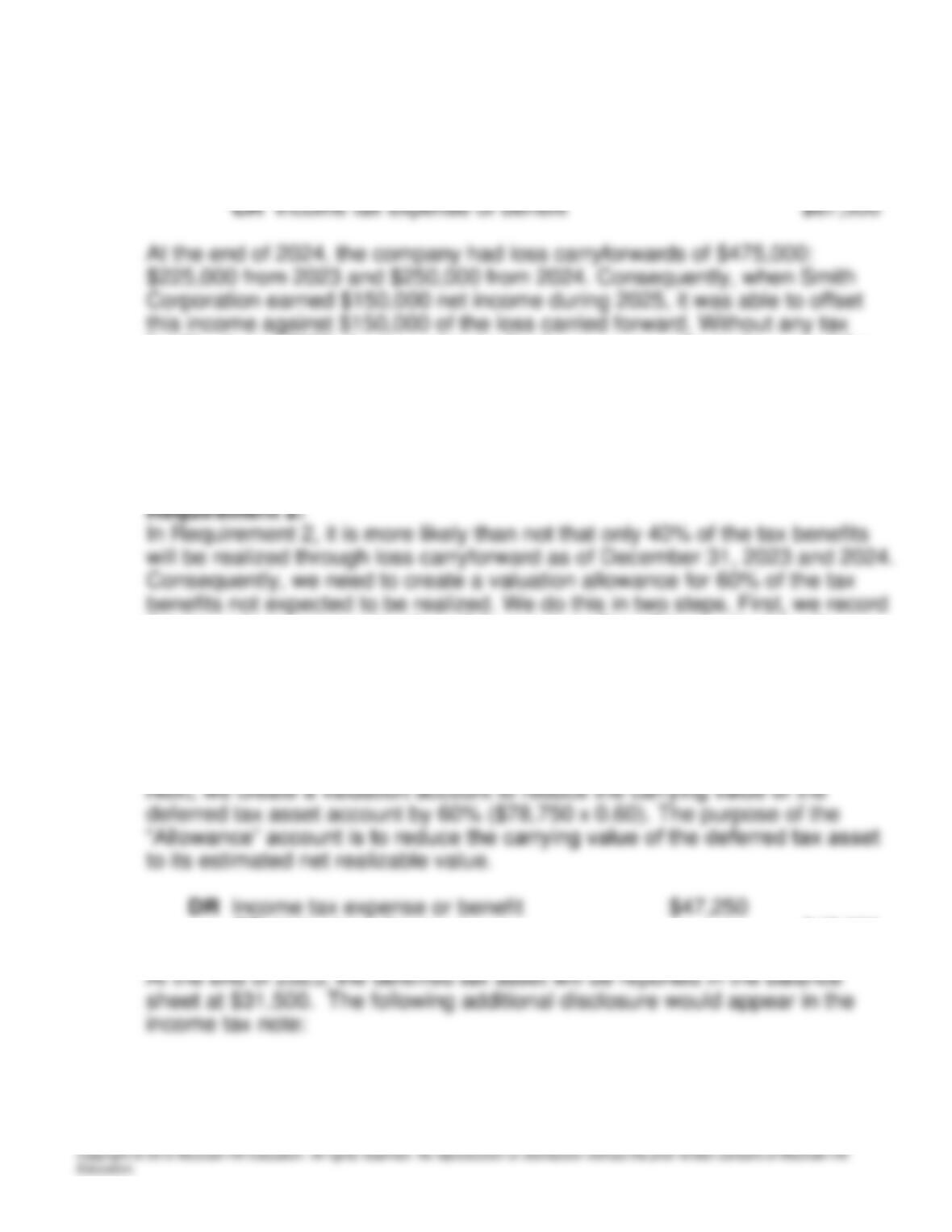
By 2024, Smith Corporation has completely exhausted the benefits from the
loss carryback provision. However, once again a deferred tax asset is created
($250,000 x 0.35).
Entry for 12/31/24:
DR Deferred tax asset $87,500
liability during 2025, the journal entry for the expense reflects the use of the
carryforward ($150,000 x 0.35):
Entry for 12/31/25:
DR Income tax expense $52,500
CR Deferred tax asset $52,500
the journal entry assuming that all the tax benefits will be realized (as in
Requirement 1).
Entry for 12/31/23:
DR Deferred tax asset $78,750
CR Income tax expense or benefit $78,750
CR Valuation allowance $47,250
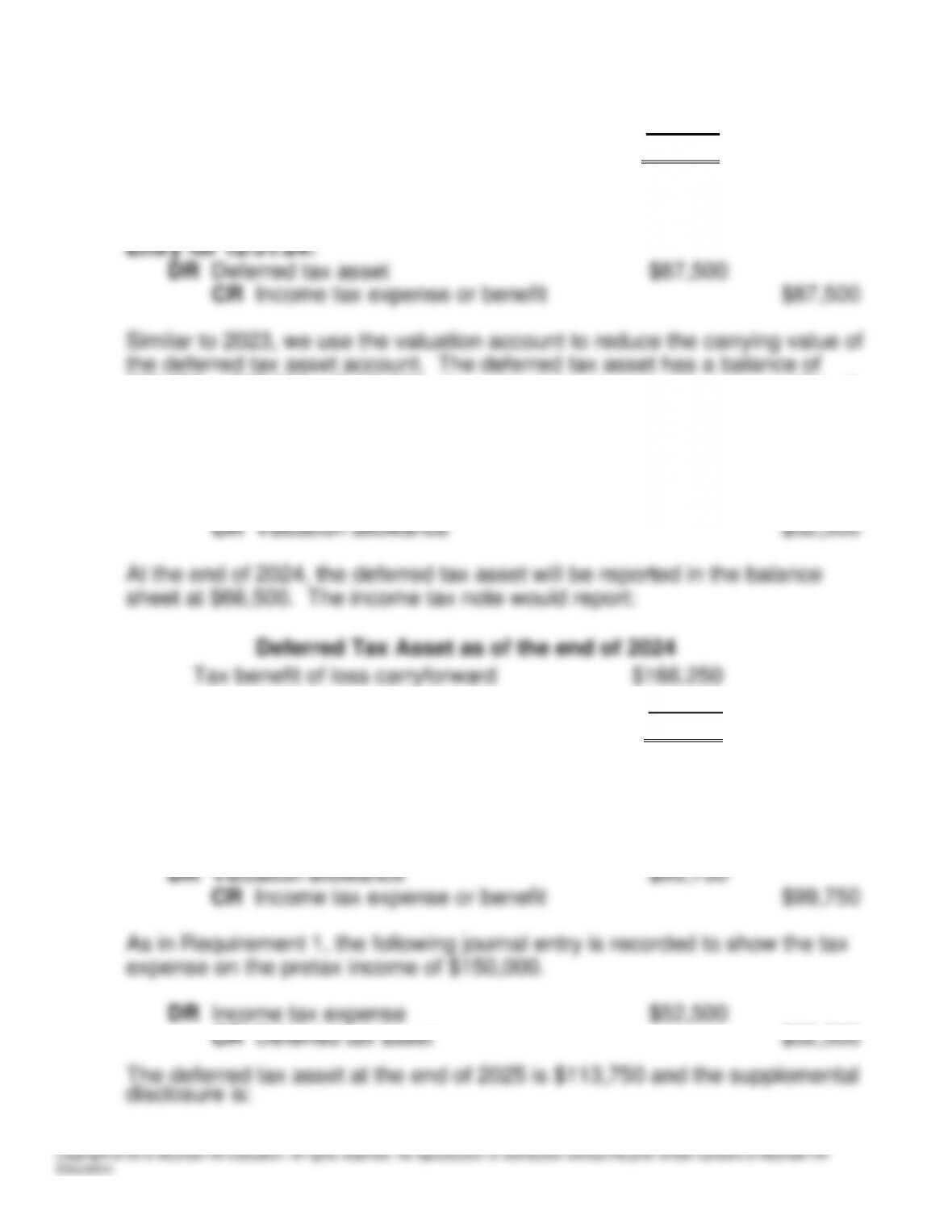
Deferred Tax Asset as of the end of 2023
Tax benefit of loss carryforward
$78,750
Less: Valuation allowance
(47,250)
Net deferred tax asset
$31,500
The journal entries for 2024 follow the same two steps:
$78,750 + $87,500 = $166,250. Its estimated net realizable value is 40% of
that amount, so a valuation allowance of $155,250 x 60% = $99,750 is
required. A valuation allowance of $47,250 already exists, so an additional
$99,750 – $47,250 = $52,500 is required.
DR Income tax expense or benefit $52,500
Tax benefit of loss carryforward
Less: Valuation allowance
Net deferred tax asset
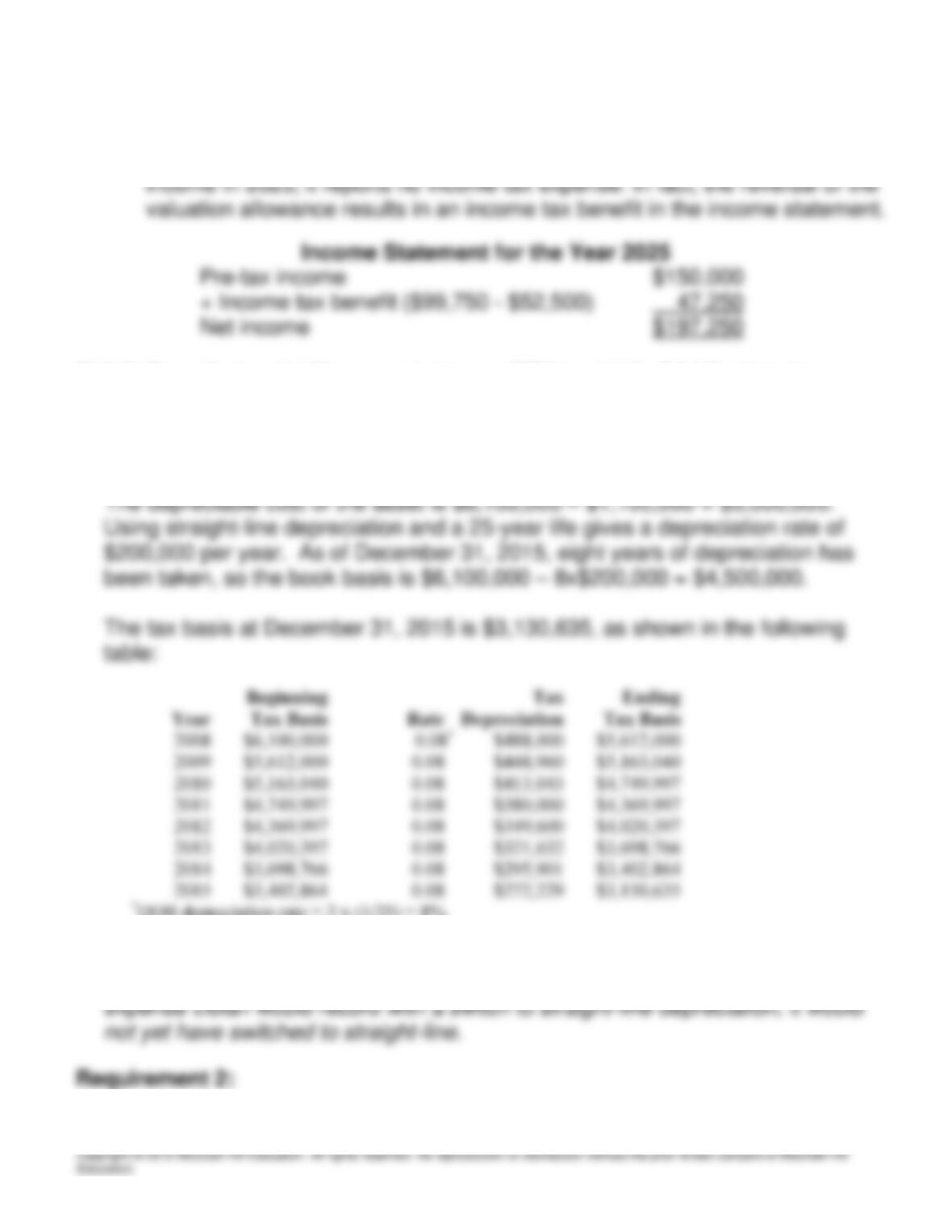
Deferred Tax Asset as of the end of 2025
Tax benefit of loss carryforward
$113,750
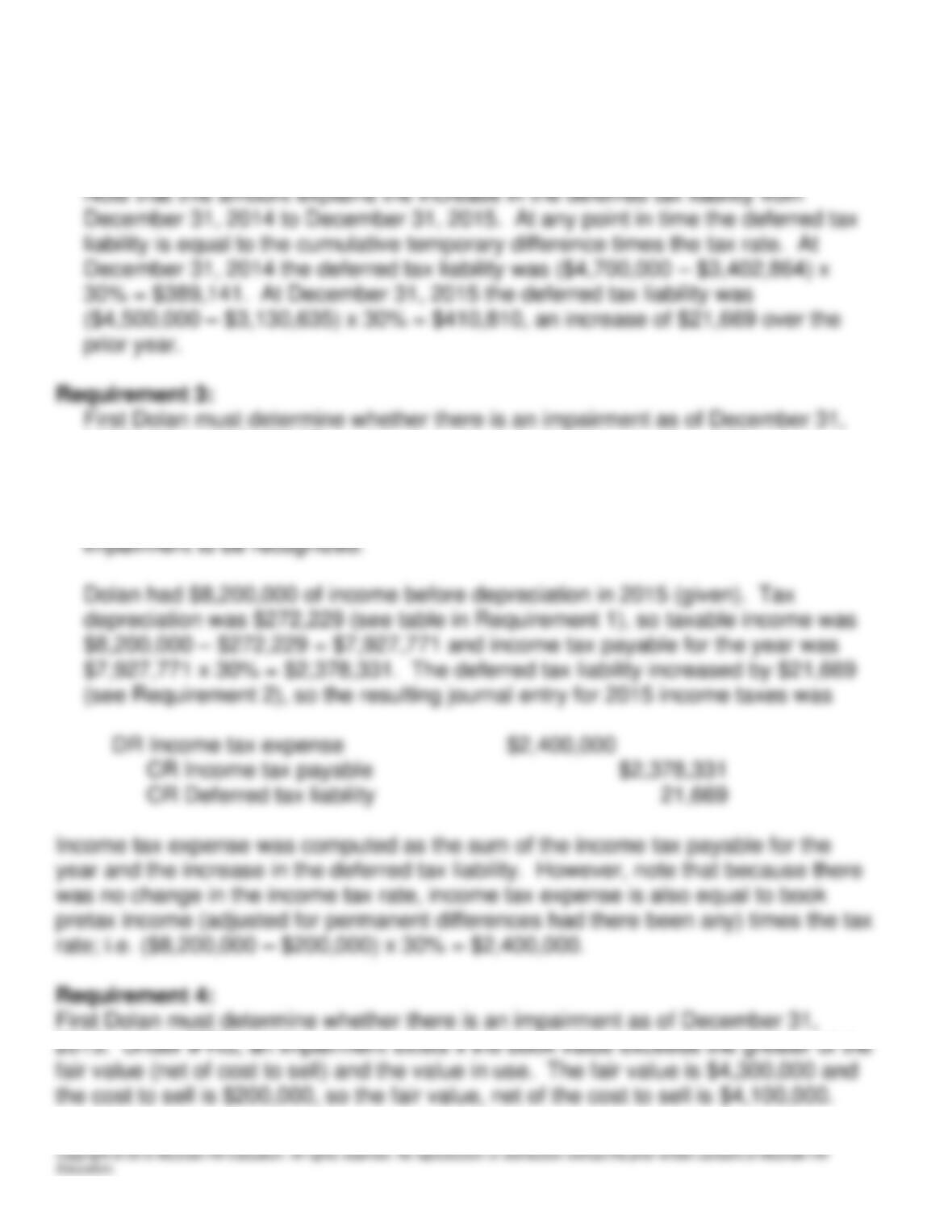
One interesting result is that, although the company reports a positive pre-tax
+ Income tax benefit ($99,750 – $52,500)
13–24
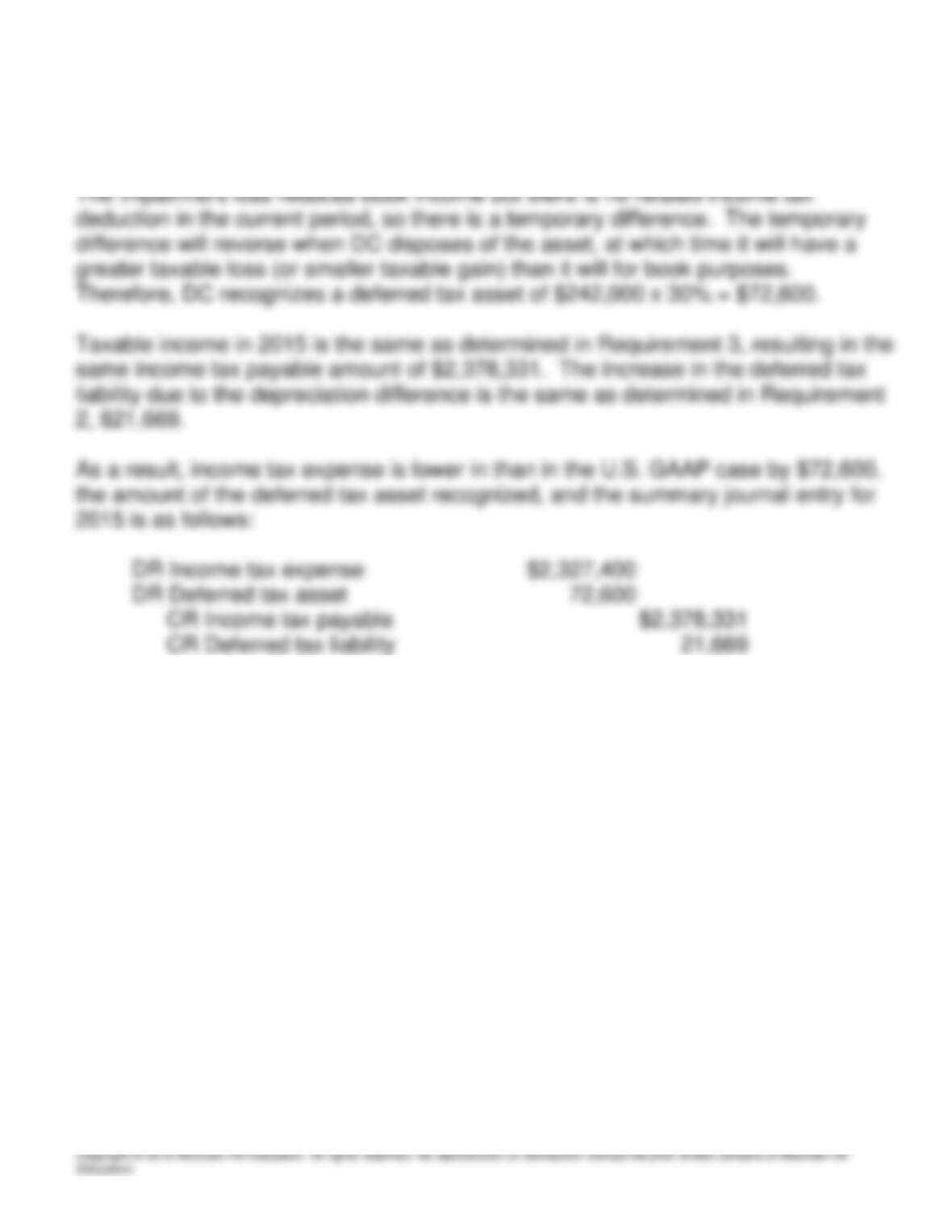
In 2015 Dolan had tax depreciation of $272,229 (see table in Requirement 1)
versus $200,000 of book depreciation. Because the tax rate did not chante during
the year, the increase in the deferred tax liability is equal to the tax rate (30%)
times the depreciation difference of $72,229, or $21,669.
2015. Under U.S. GAAP, an impairment exists if the book value of the asset
exceeds the asset’s undiscounted future cash flow. The undiscounted cash flows
are $4,598,000 versus a book value of $4,500,000. So, even though the book
value exceeds the present value of the cash flow stream ($4,258,000) there is no
13–25
The value in use is given as $4,258,000. The greater of these amounts is
$4,258,000, which is less than the book value of $4,500,000, so there is an
impairment and the asset must be written down by $4,500,000 – $4,258,000 =
$242,000.
13–26
P13-8. Tax rate reconciliation schedules for IFRS vs. U.S. GAAP
Note: If the weighted average tax rate or effective rate is rounded before doing the
calculations, the student’s solution will differ because of rounding errors.
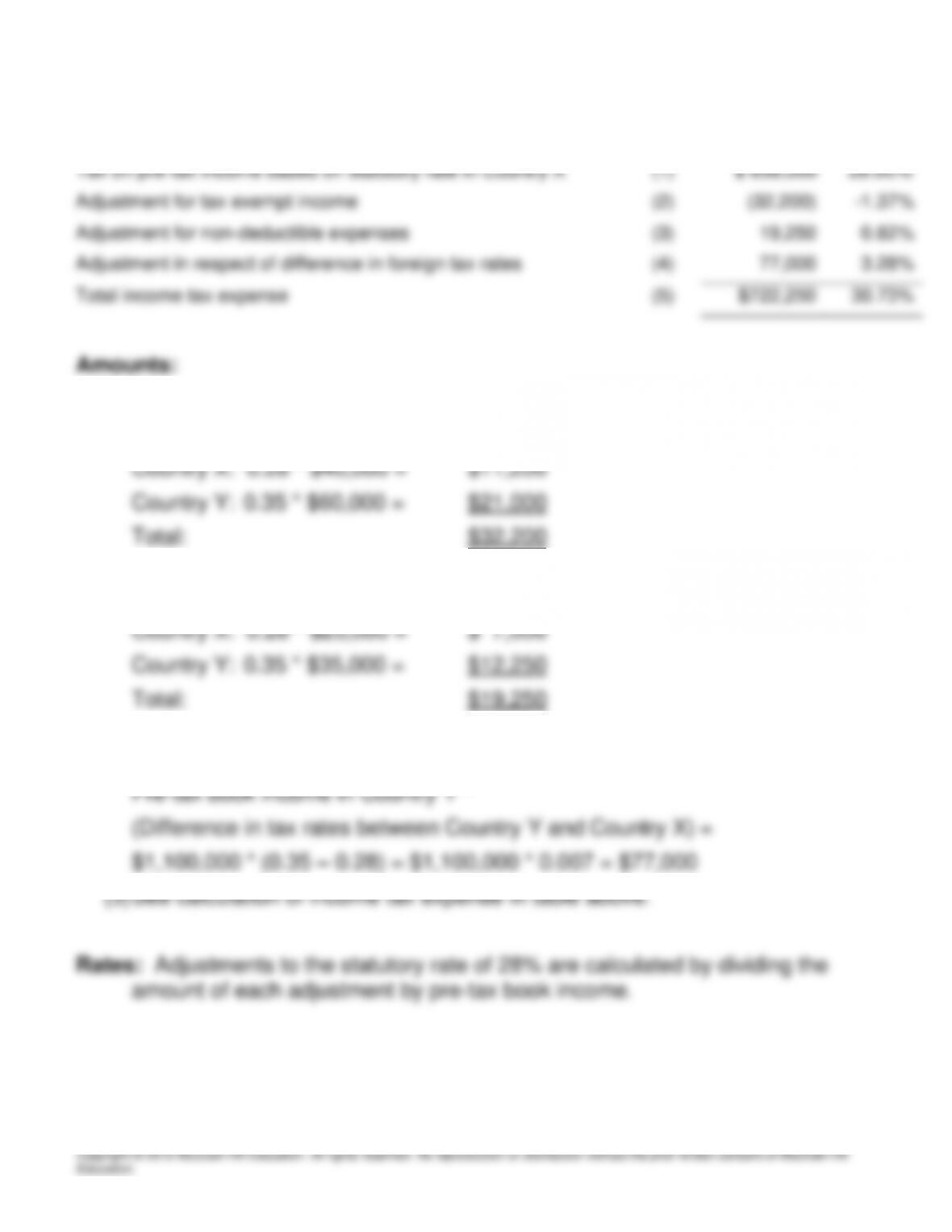
Calculations relevant to both reconciliations:
Country X
Country Y
Total
Pre-tax Book Income
(1)
$1,250,000
$1,100,000
$2,350,000
Adjustments:
Tax-exempt income
(1)
(40,000)
(60,000)
(100,000)
Non-deductible expenses
(1)
25,000
35,000
60,000
Taxable income
(2)
$1,235,000
$1,075,000
$2,310,000
Country-specific statutory tax rates
(1)
28.00%
35.00%
Tax on pre-tax book income at country-
specific statutory rate
(3)
$350,000
$385,000
$735,000
Weighted Average Statutory Rate
(4)
31.28%
Tax Expense
(Tax payable * country-specific
statutory rate)
(5)
$345,800
$376,250
$722,050
Effective Tax Rate
(Tax Expense pre-tax book income)
(6)
30.73%
(1) Given in problem.
(2) Sum of pre-tax book income and adjustments.
(4) Weighted Average Statutory Rate = Sum of country-specific taxes based on
pre-tax book income (3) Total pre-tax book income
13–27
Requirement 1:
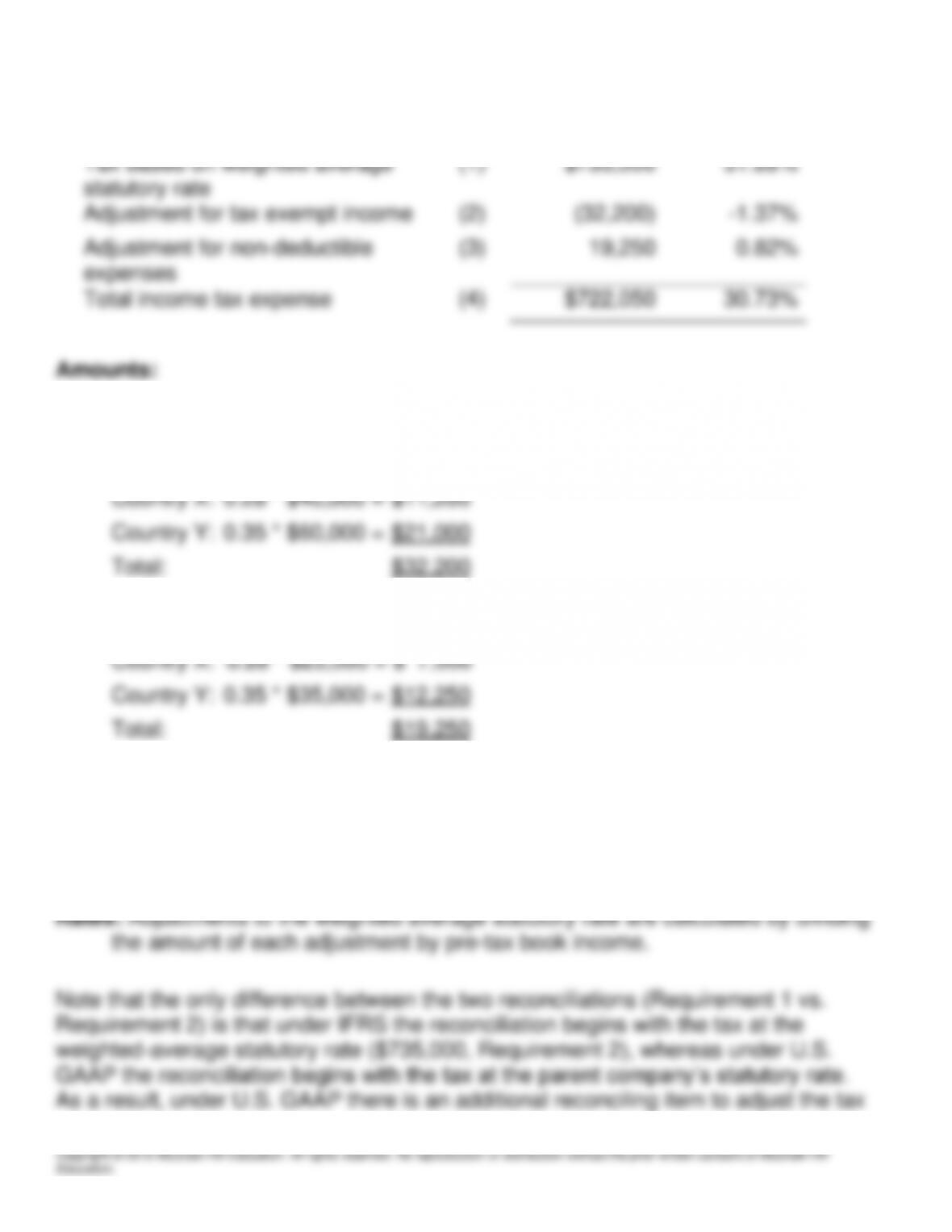
US GAAP:
Reconciliation
Notes
Amounts
Rate
Tax on pre-tax income based on statutory rate in Country X
(1)
$ 658,000
28.00%
Adjustment for tax exempt income
(2)
(32,200)
-1.37%
Adjustment for non-deductible expenses
(3)
19,250
0.82%
Adjustment in respect of difference in foreign tax rates
(4)
77,000
3.28%
Total income tax expense
(5)
$722,250
30.73%
Amounts:
(1) 0.28 * pre-tax income = .28 * $2,350,000 = $658,000
(2) Tax effect depends on relevant tax rate in country where income is tax-exempt:
(3) Tax effect depends on relevant tax rate in country where expenses are not
deductible:
(4) Difference between sum of amounts (1), (2) and (3) and total income tax
expense. It can be calculated directly as follows:
13–28
Requirement 2:
IFRS:
Reconciliation
Notes
Amounts
Rates
Tax based on weighted average
statutory rate
(1)
$735,000
31.28%
Adjustment for tax exempt income
(2)
(32,200)
-1.37%
Adjustment for non-deductible
expenses
(3)
19,250
0.82%
Total income tax expense
(4)
$722,050
30.73%
Amounts:
(1) See table above for calculation of total tax on pre-tax book income and
weighted-average statutory tax rate.
(2) Tax effect depends on relevant tax rate in country where income is tax-exempt:
(3) Tax effect depends on relevant tax rate in country where expenses are not
deductible:
(4) See calculation of income tax expense in table above.
(5) Note: No adjustment for differences in tax rates in different countries is
required. Differences in tax rates are already included in the weighted average
statutory rate.
13–29
at the parent’s statutory rate to the tax at the weighted-average statutory rate (i.e.,
$658,000 + $77,000 = $735,000).
P13-9. Differences in revenue recognition and tax reporting under IFRS vs.
U.S. GAAP
Note: The choice between the completed contract method and the percentage of
completion method is not considered a “free choice among alternatives” under US
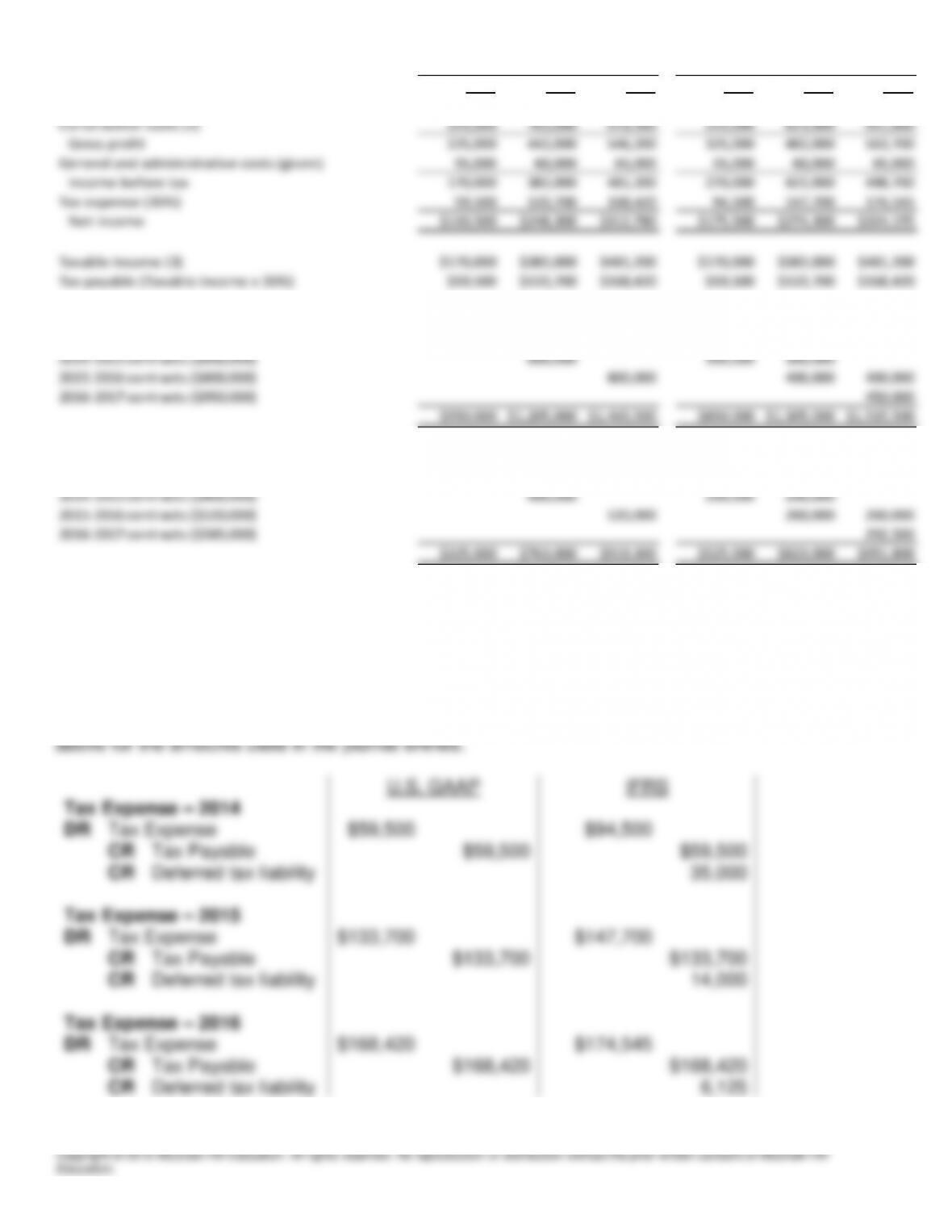
2014 2015 2016 2014 2015 2016
Revenue (1) $550,000 $1,205,000 $1,465,500 $850,000 $1,305,000 $1,515,500
Construction costs (2) 325,000 763,000 919,300 525,000 823,000 951,800
Gross profit 225,000 442,000 546,200 325,000 482,000 563,700
General and administrative costs (given) 55,000 60,000 65,000 55,000 60,000 65,000
Income before tax 170,000 382,000 481,200 270,000 422,000 498,700
Tax expense (35%) 59,500 133,700 168,420 94,500 147,700 174,545
Net income $110,500 $248,300 $312,780 $175,500 $274,300 $324,155
Taxable income (3) $170,000 $382,000 $481,200 $170,000 $382,000 $481,200
Tax payable (Taxable income x 35%) $59,500 $133,700 $168,420 $59,500 $133,700 $168,420
(1) Calculation of contract revenues in each year:
Contracts started and completed in same year (given) $550,000 $605,000 $665,500 $550,000 $605,000 $665,500
2014-2015 contracts ($600,000) 600,000 300,000 300,000
2015-2016 contracts ($800,000) 800,000 400,000 400,000
2016-2017 contracts ($950,000) 450,000
$550,000 $1,205,000 $1,465,500 $850,000 $1,305,000 $1,515,500
(2) Calculation of construction costs in each year:
Contracts started and completed in same year (given) $325,000 $363,000 $399,300 $325,000 $363,000 $399,300
2014-2015 contracts ($400,000) 400,000 200,000 200,000
2015-2016 contracts ($520,000) 520,000 260,000 260,000
2016-2017 contracts ($585,000) 292,500
$325,000 $763,000 $919,300 $525,000 $823,000 $951,800
U.S. GAAP
IFRS
(3) Lance uses the completed contract method for tax reporting, so taxable income is equal to U.S.
GAAP pretax income, which is also computed under the completed contract method.
Note: All contracts spanning two years are 50% complete at year-end.
The deferred tax liability is best illustrated with the journal entries for each year. (See the table