13-1
Financial Reporting and Analysis (6th Ed.)
Chapter 13 Solutions
E13–1. Determining current taxes payable
(AICPA adapted)
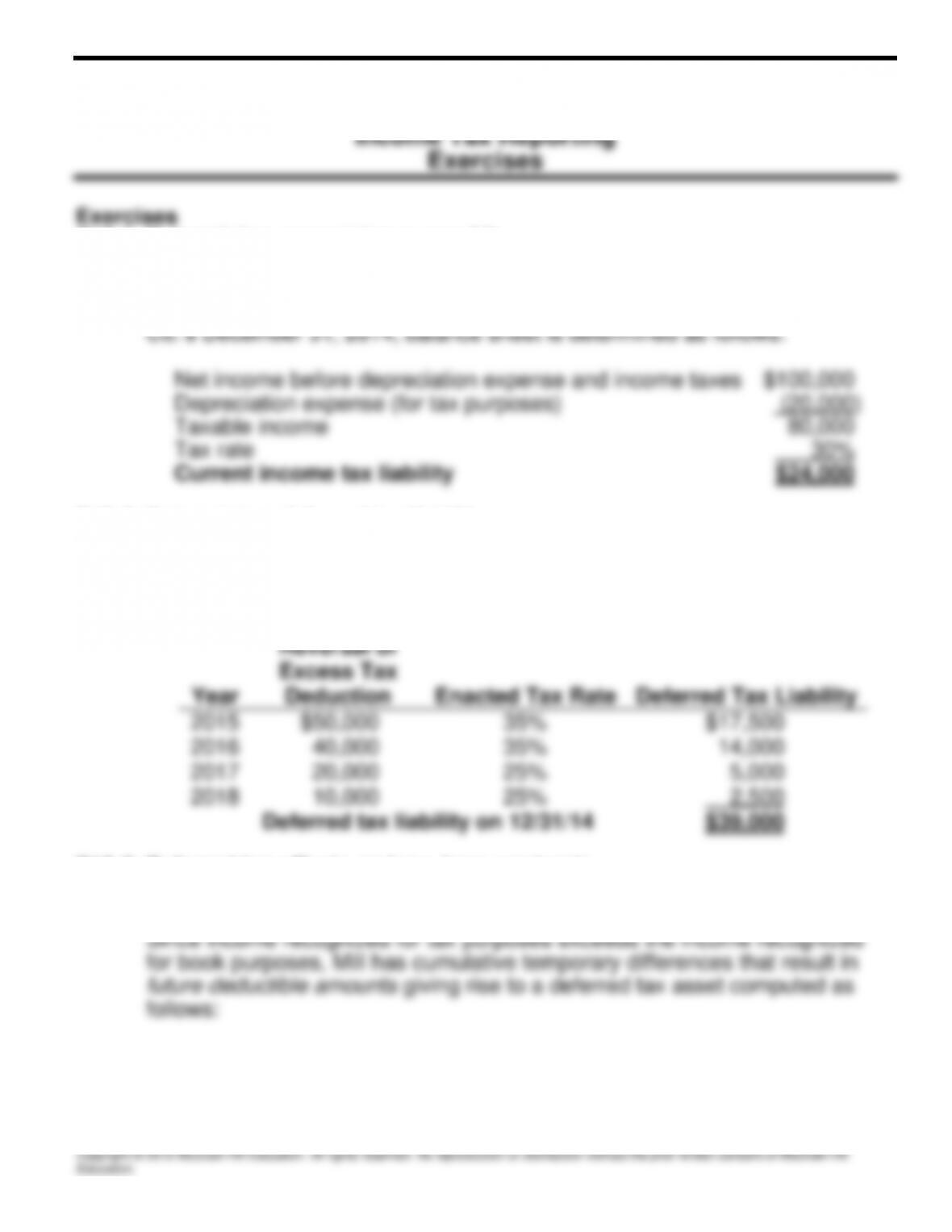
The amount of current income tax liability that would be reported on Allen
E13-2. Determining deferred tax liability
(AICPA adapted)
Tow’s deferred tax liability for December 31, 2014, is computed as follows:
Year
Reversal of
Excess Tax
Deduction
Enacted Tax Rate
Deferred Tax Liability
2015
$50,000
35%
$17,500
2016
40,000
35%
14,000
2017
20,000
25%
5,000
2018
10,000
25%
2,500
Deferred tax liability on 12/31/14
$39,000
E13-3. Deferred tax effects on long-term contracts
(AICPA adapted)
13-2
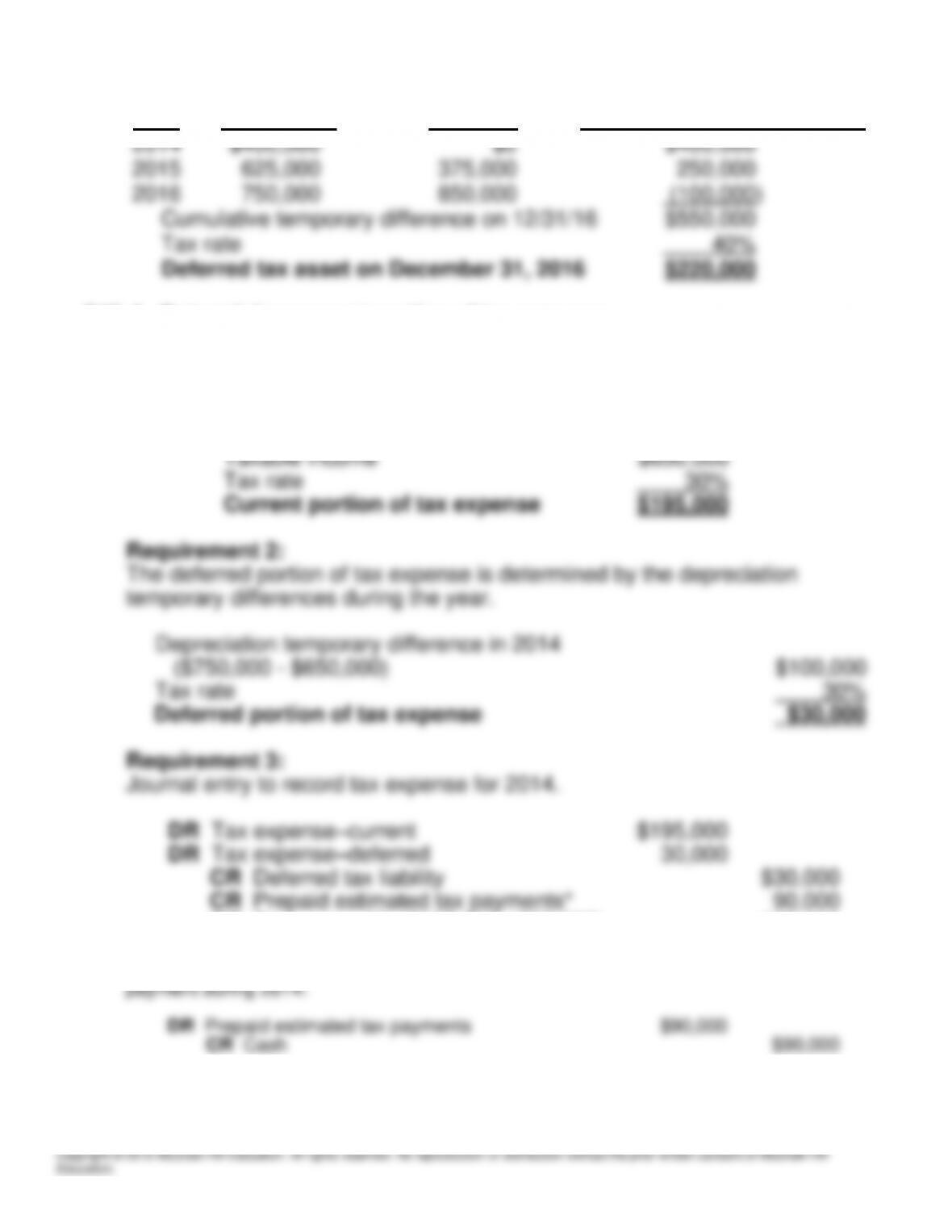
Year
(Tax purposes)
Percentage-of–
completion
(Book purposes)
Completed
Contract
Temporary Difference
Increase (Decrease) in
Future Deductible Amounts
2014
$400,000
$0
$400,000
2015
625,000
375,000
250,000
2016
750,000
850,000
(100,000)
Cumulative temporary difference on 12/31/16 $550,000
Tax rate
40%
Deferred tax asset on December 31, 2016
$220,000
E13-4. Determining current portion of tax expense
(AICPA adapted)
Requirement 1:
The current portion of tax expense is the tax payable to the IRS for 2014.
CR Taxes payable ($195,000 – $90,000) 105,000
*This credit assumes the following entry was made when Tyre made its estimated tax
13-3
E13-5. Determining current taxes payable
(AICPA adapted)
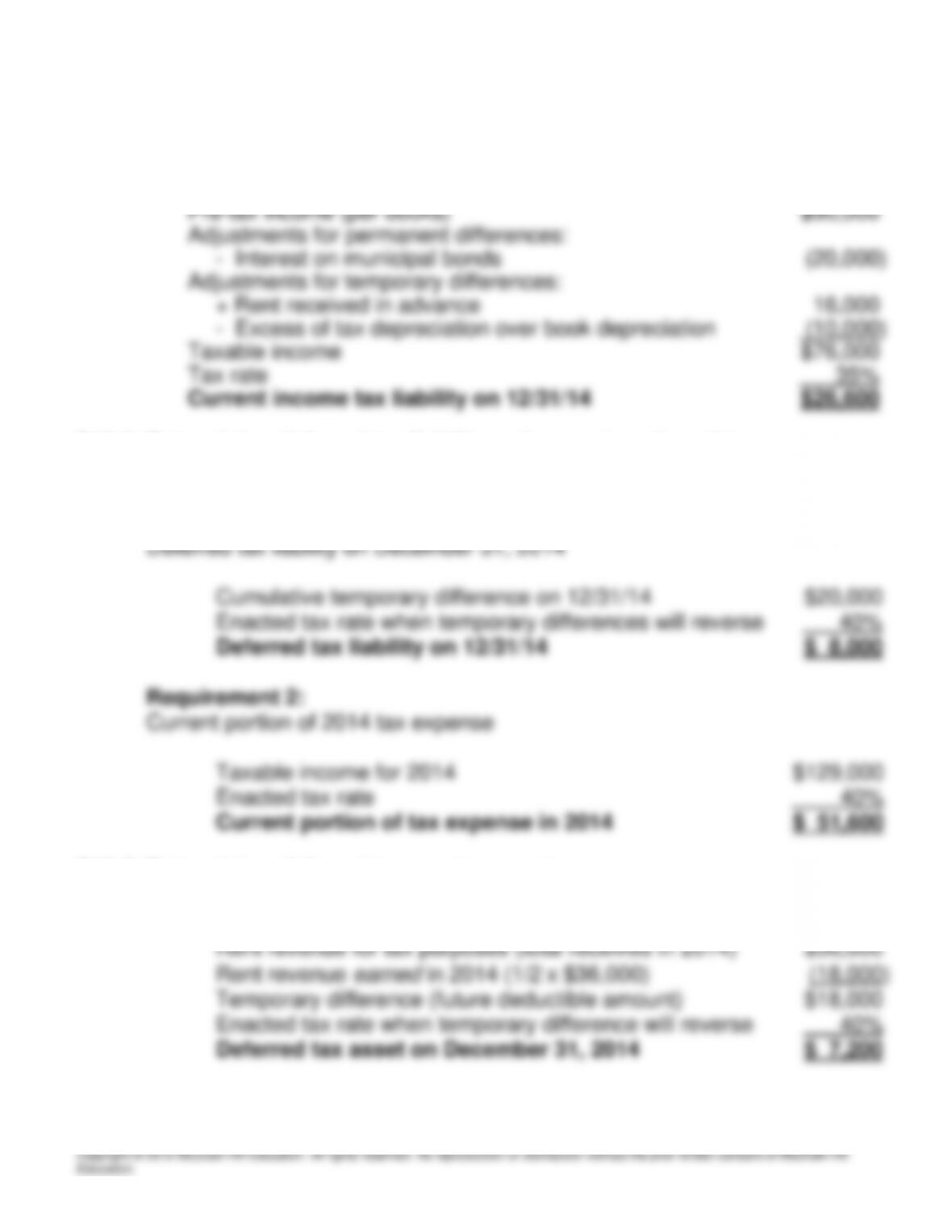
The calculation of the current income tax liability of Dunn Co. for the
December 31, 2014, balance sheet is as follows:
E13-6. Determining deferred tax liability and current portion of tax expense
(AICPA adapted)
Requirement 1:
E13-7. Determining deferred tax asset amounts
(AICPA adapted)
13-4
E13-8. Determining deferred tax asset amounts
(AICPA adapted)
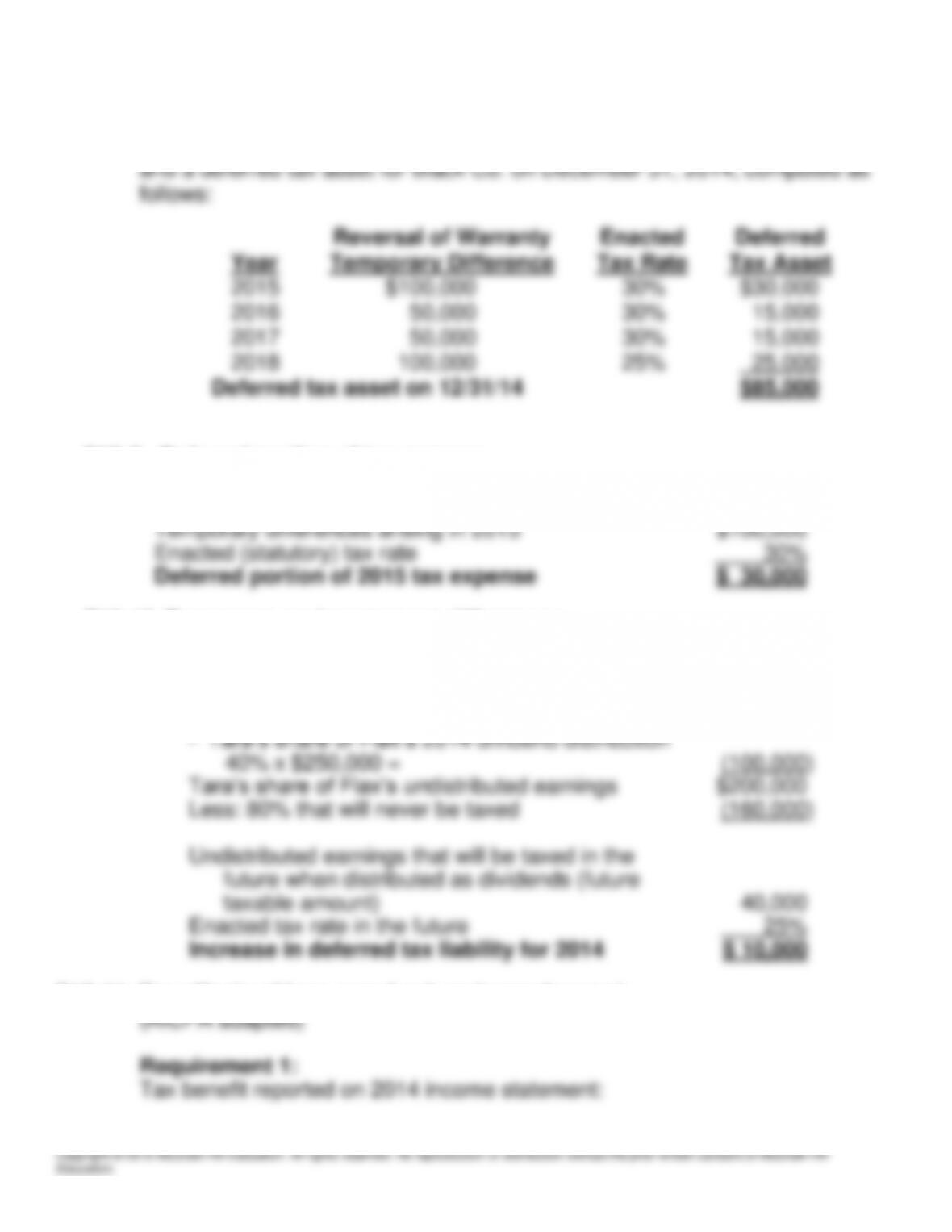
The warranty temporary differences give rise to future deductible amounts
E13-9. Deferred portion of tax expense
(AICPA adapted)
E13-10. Temporary and permanent differences
(AICPA adapted)
Tara’s equity in Flax’s 2014 earnings
40% x $750,000 = $300,000
E13-11. Tax effects of loss carryback and carryforward
13-5
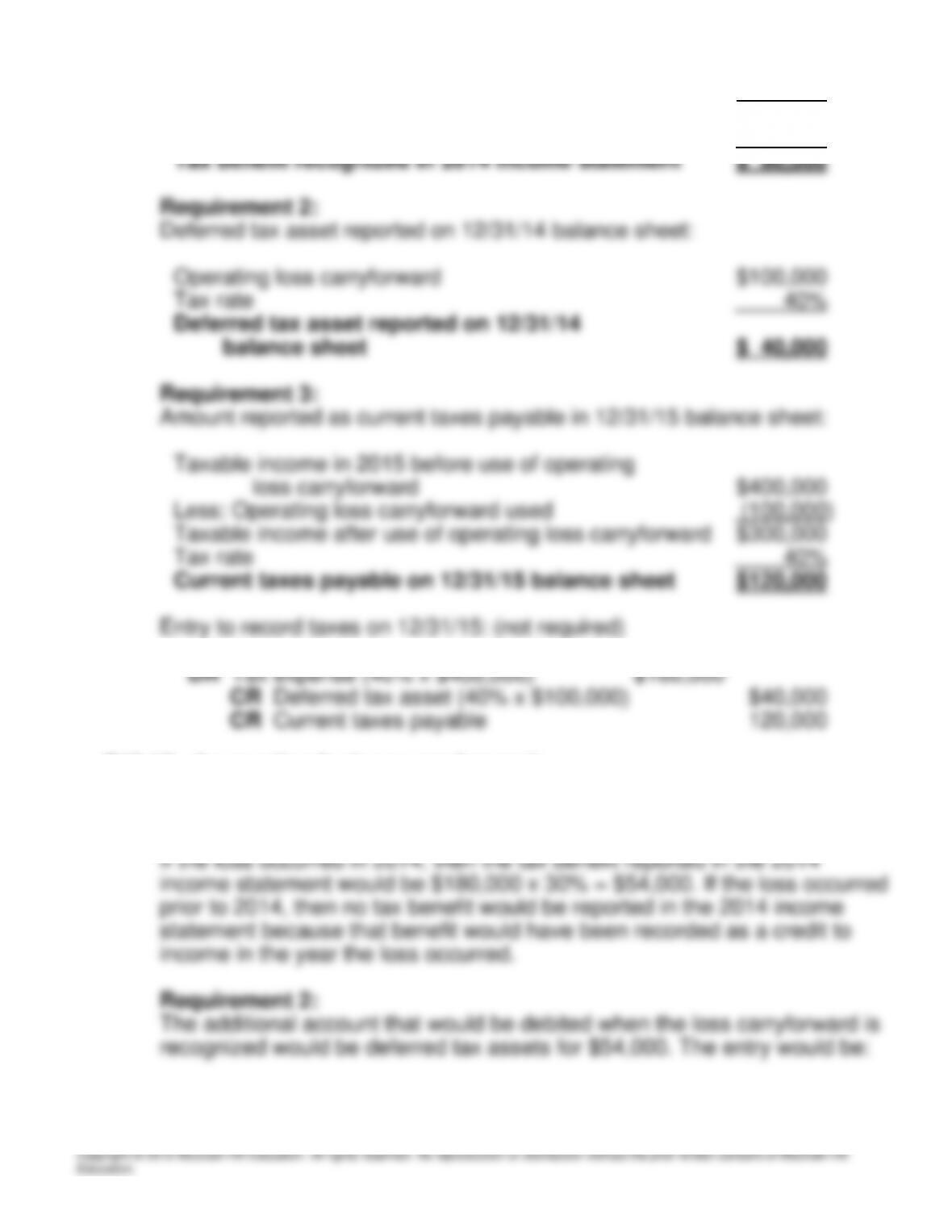
Loss carried back to 2013 $100,000
Loss carried forward 100,000
Total $200,000
Tax rate 40%
E13-12. Accounting for loss carryforwards
(AICPA adapted)
Requirement 1:
13-6
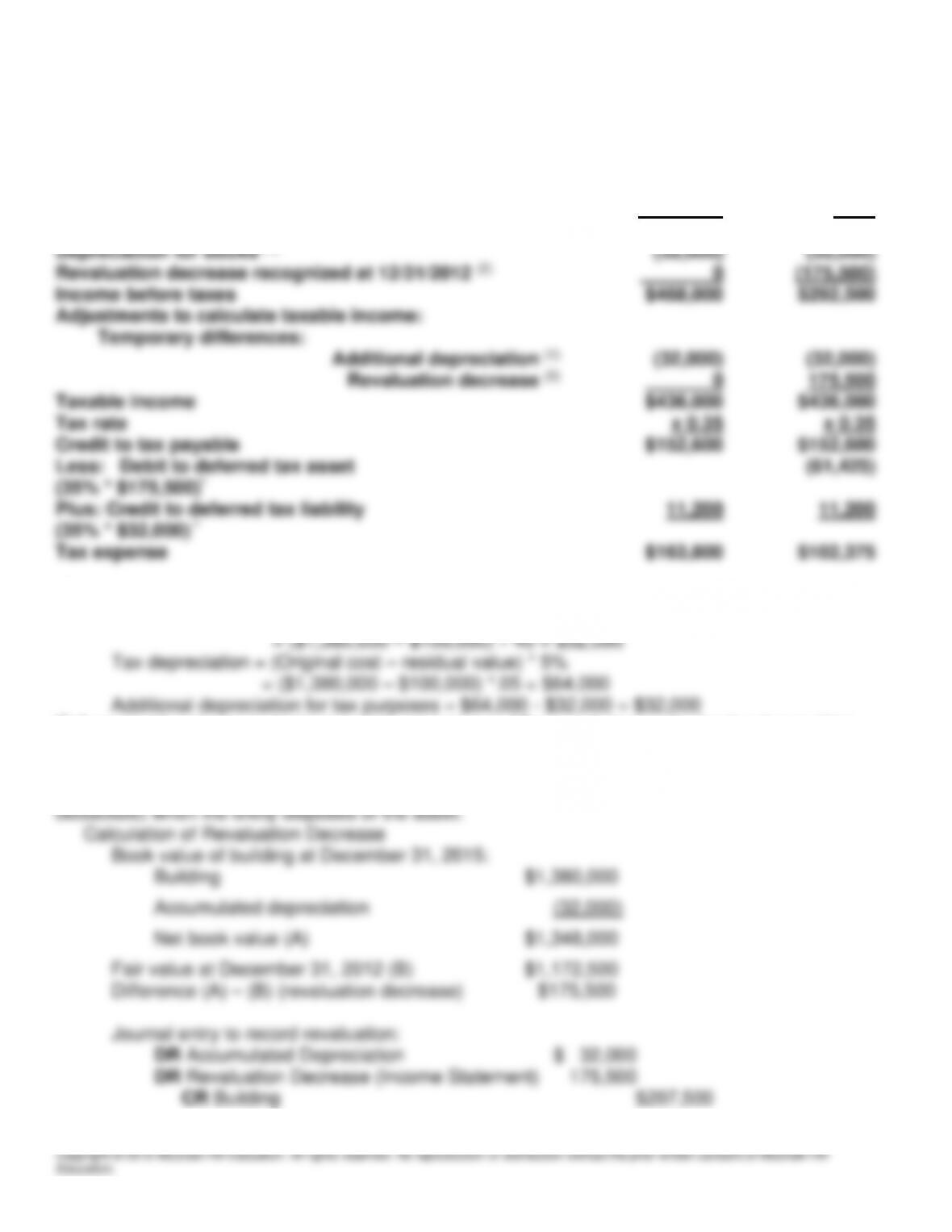
DR Deferred tax asset $54,000
CR Income tax expense (carryforward benefit) $54,000
E13-13. IFRS vs. US GAAP Tax Entries
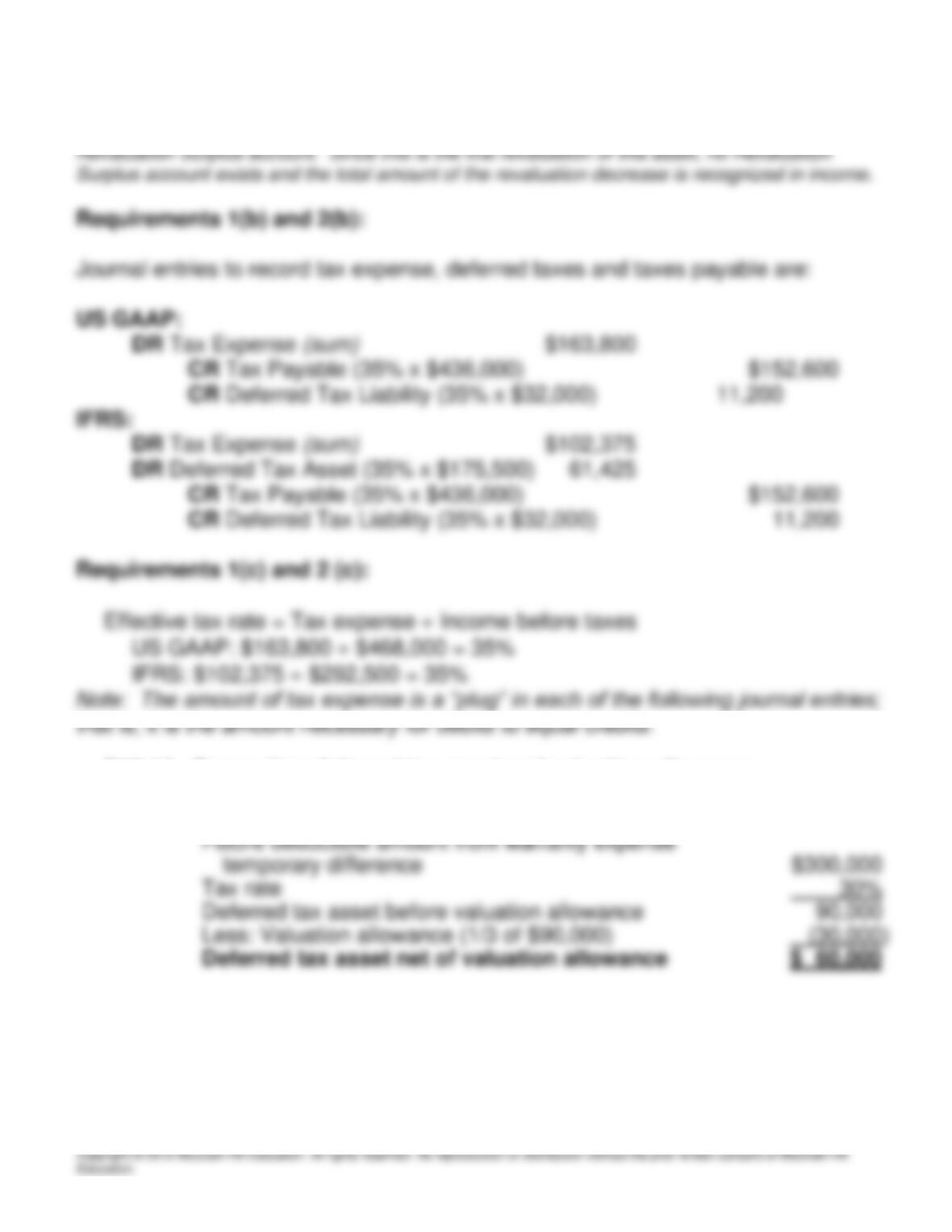
Requirements 1(a) and 2(a):
US GAAP
IFRS
Income before temporary differences
$ 500,000
$ 500,000
Depreciation for books (1)
(32,000)
(32,000)
Revaluation decrease recognized at 12/31/2012 (2)
0
(175,500)
Income before taxes
$468,000
$292,500
Adjustments to calculate taxable income:
Temporary differences:
Additional depreciation (1)
(32,000)
(32,000)
Revaluation decrease (2)
0
175,500
Taxable income
$436,000
$436,000
Tax rate
x 0.35
x 0.35
Credit to tax payable
$152,600
$152,600
Less: Debit to deferred tax asset
(35% * $175,500)*
(61,425)
Plus: Credit to deferred tax liability
(35% * $32,000) *
11,200
11,200
Tax expense
$163,800
$102,375
(1) Calculation of Depreciation:
Book depreciation = (Original cost – residual value) useful life
(2) A revaluation decrease (or increase) is a temporary difference between the book value and tax
base of the asset. Unlike temporary differences due to use of different depreciation methods for
tax and financial reporting, a temporary difference between the book value and tax base of an
asset due to revaluation, whether an increase or decrease, will only reverse (that is, be taxable or
13-7
Note: This is one of the allowed methods for recording this transaction. The alternative would
reduce the building and accumulated depreciation accounts proportionately, so that the net book
value would equal fair value at the date of the revaluation. Revaluation decreases are recorded to
the income statements (profit or loss) to the extent they cannot be used to reduce an existing
E13-14. Computing deferred tax asset and valuation allowance
(AICPA adapted)
13-8
E13-15. Determining deferred tax liability for equity method earnings
(AICPA adapted)
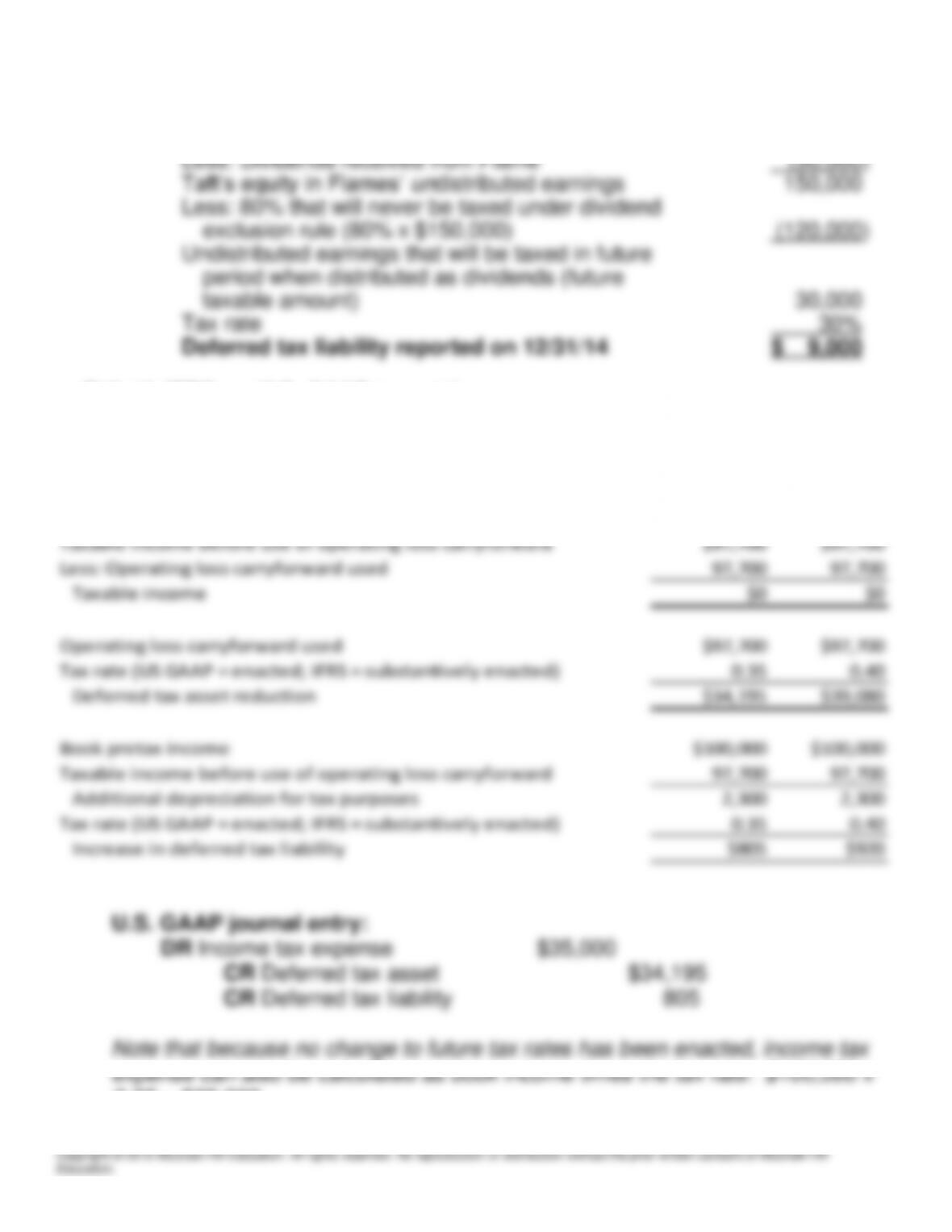
Taft’s equity in Flame’s earnings $180,000
E13–16. IFRS vs. U.S. GAAP tax entries
U.S. GAAP requires the use of enacted tax rates to value deferred tax assets and
liabilities. In contrast, IFRS uses substantively enacted tax rates.
US GAAP IFRS
Taxable income before use of operating loss carryforward $97,700 $97,700
Less: Operating loss carryforward used 97,700 97,700
Taxable income $0 $0
Operating loss carryforward used $97,700 $97,700
Tax rate (US GAAP = enacted; IFRS = substantively enacted) 0.35 0.40
Deferred tax asset reduction $34,195 $39,080
Book pretax income $100,000 $100,000
Taxable income before use of operating loss carryforward 97,700 97,700
Additional depreciation for tax purposes 2,300 2,300
Tax rate (US GAAP = enacted; IFRS = substantively enacted) 0.35 0.40
Increase in deferred tax liability $805 $920
0.35 = $35,000.
13-9
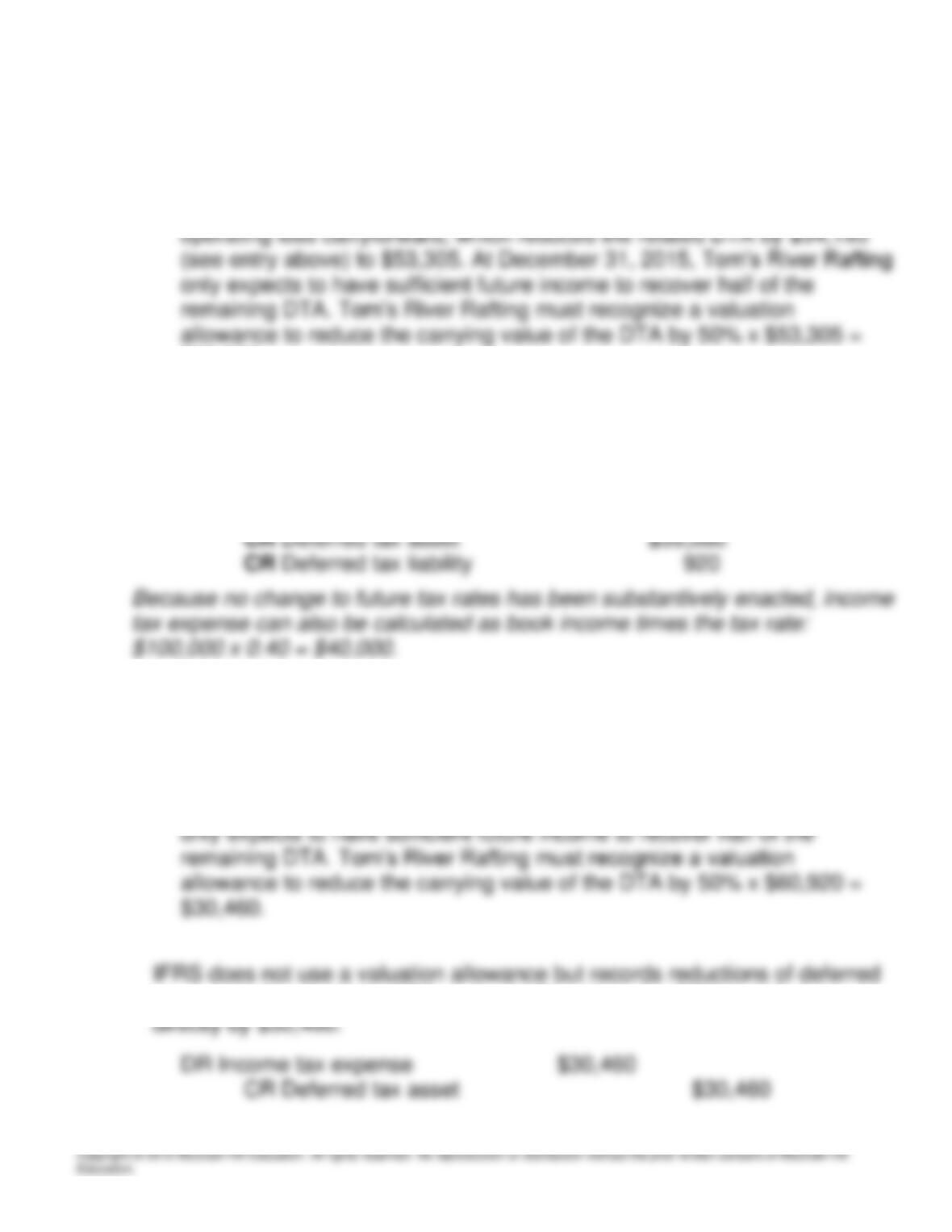
US GAAP requires the use of a valuation allowance when it is more likely
than not that deferred tax assets will not be realized.
The existing Deferred Tax Asset (DTA) account had a balance on January
1, 2015, of 35% x $250,000 = $87,500 related to the Net Operating Loss
Carryforward. In 2015, Tom’s River Rafting used $97,700 of the
$26,653.
DR Income tax expense $26,653
CR Valuation allowance – DTA $26,653
IFRS journal entry:
DR Income tax expense $40,000
The existing Deferred Tax Asset (DTA) account had a balance on January
1, 2015, of 40% x $250,000 = $100,000 related to the Net Operating Loss
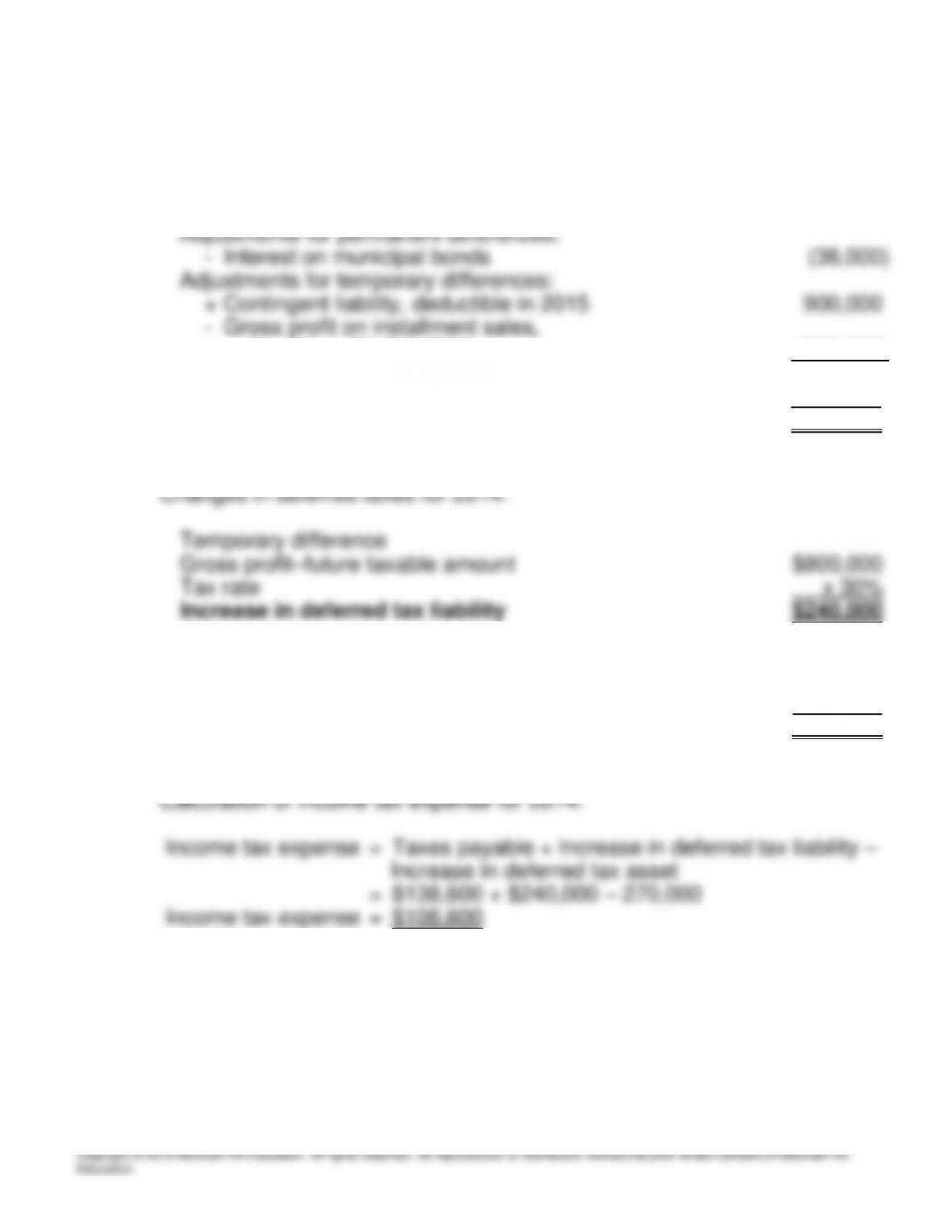
Carryforward. In 2015, Tom’s River Rafting used $97,700 of the
operating loss carryforward, which reduced the related DTA by $39,080
(see entry above) to $60,920. At December 31, 2015, Tom’s River Rafting
tax assets directly in the DTA account. Therefore, the DTA is reduced

13–10
13–11
E13–17. Computing tax payable, deferred taxes, and tax expense
Requirement 1:
The calculation of the current income tax liability of Millie Co. at December
31, 2014 is as follows:
Pretax income (per books) $400,000
taxable in 2015 & 2016 (800,000)
Taxable income 462,000
Tax rate 30%
Current income tax liability on 12/31/14 $138,600
Requirement 2:
Temporary difference
Contingent liability–future deductible amount $900,000
Tax rate x 30%
Increase in deferred tax asset $270,000
Requirement 3:
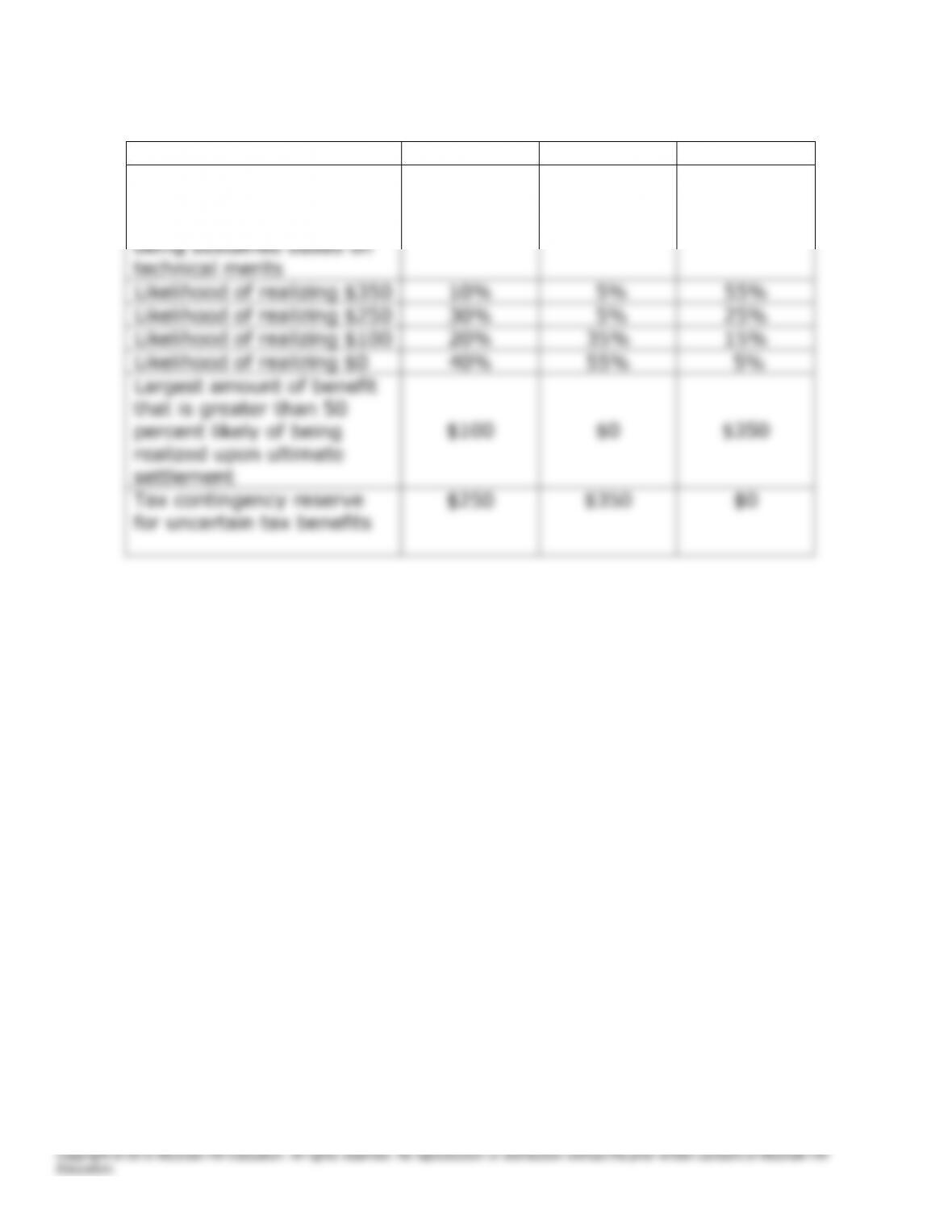
13–12
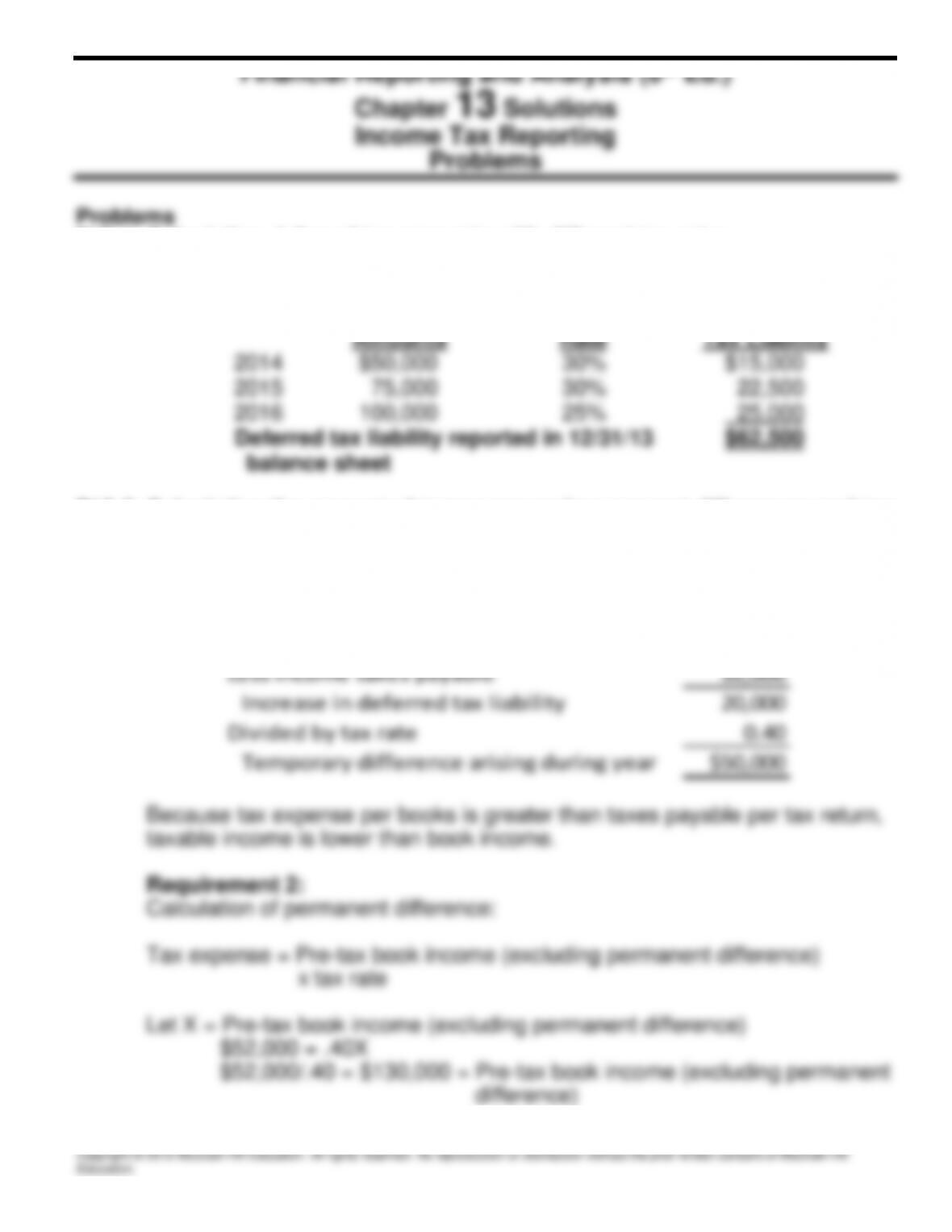
E13–18. Determining tax benefit for uncertain tax position
Case 1
Case 2
Case 3
Management’s assessment
of the likelihood of the
uncertain tax position
being sustained based on
technical merits
65%
40%
80%
Likelihood of realizing $350
10%
5%
55%
Likelihood of realizing $250
30%
5%
25%
Likelihood of realizing $100
20%
35%
15%
Likelihood of realizing $0
40%
55%
5%
Largest amount of benefit
that is greater than 50
percent likely of being
realized upon ultimate
settlement
$100
$0
$350
Tax contingency reserve
for uncertain tax benefits
$250
$350
$0
Financial Reporting and Analysis (6th Ed.)
Chapter 13 Solutions
Income Tax Reporting
Problems
Problems
P13–1. Calculating deferred tax amounts with different tax rates
(AICPA adapted)
Future Taxable
Amounts
Enacted Tax
Rate
Deferred
Tax Liability
2014
$50,000
30%
$15,000
2015
75,000
30%
22,500
2016
100,000
25%
25,000
Deferred tax liability reported in 12/31/13
balance sheet
$62,500
P13–2. Calculating the amount of temporary and permanent differences and tax
entry
Requirement 1:
Calculation of temporary difference:
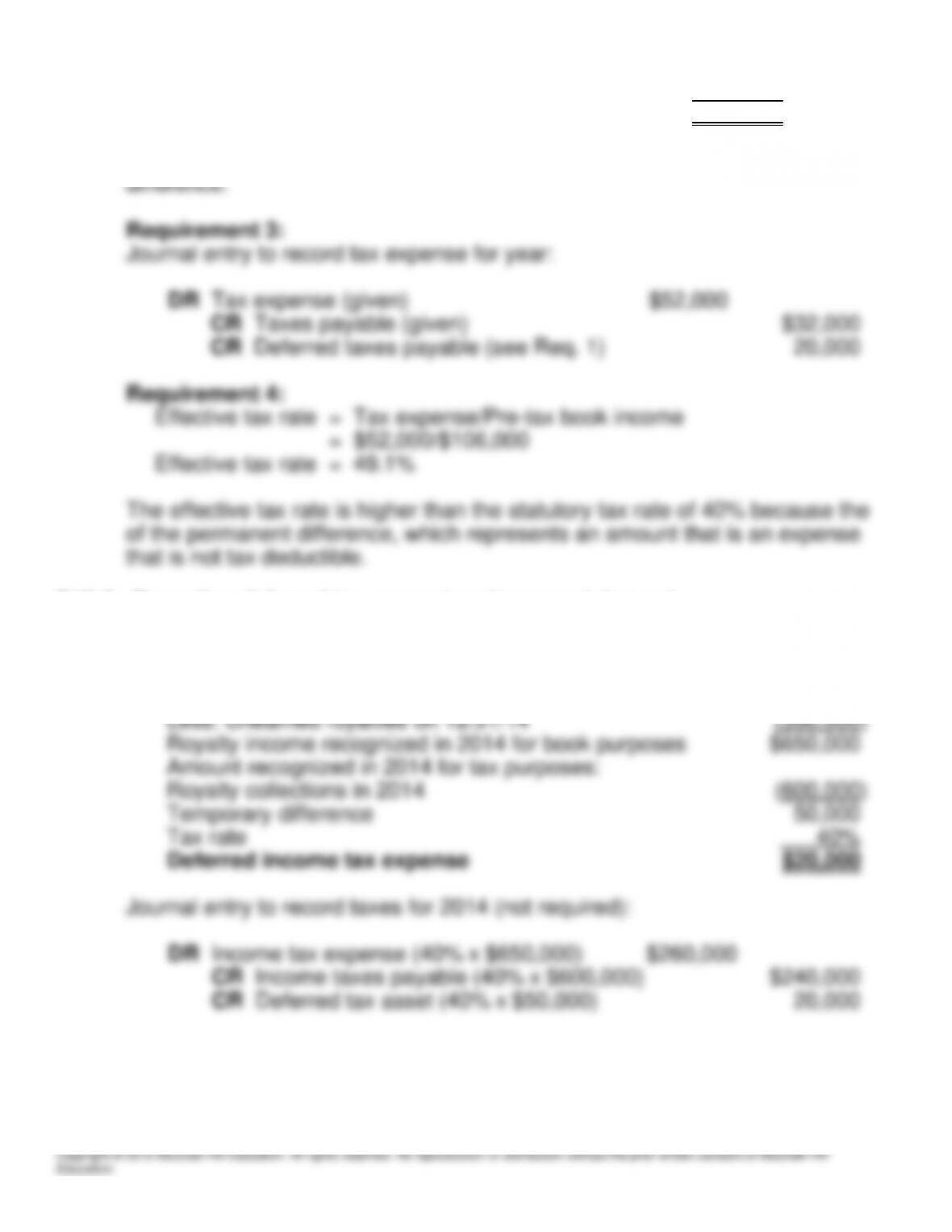
Income tax expense $52,000
13–14
Book income (excluding permanent difference) $130,000
Book income before taxes (given) (106,000)
Permanent difference $ 24,000
Book income will be lower than taxable income because of this permanent
P13–3. Reporting deferred tax amount on income statement
(AICPA adapted)
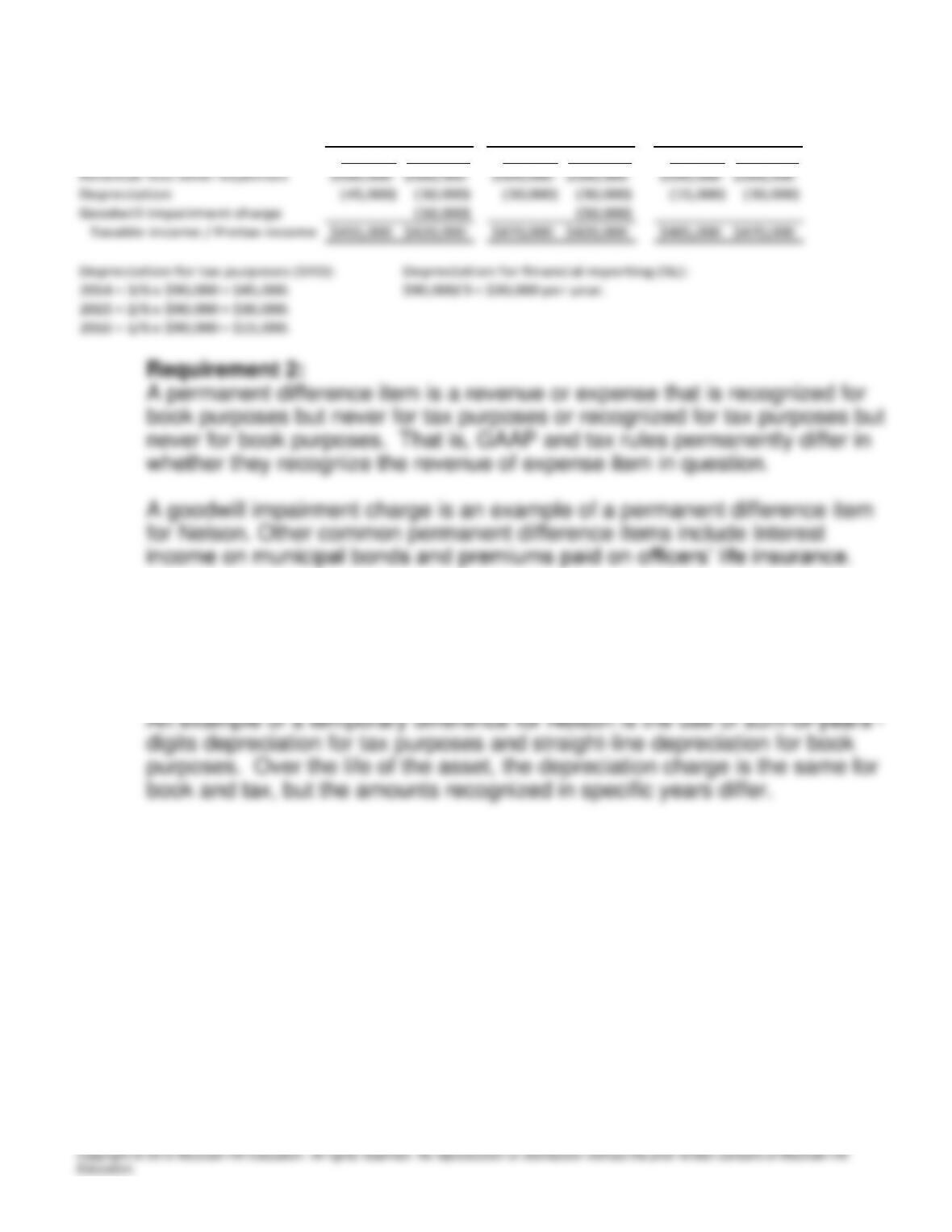
Unearned royalties at 12/31/13 $400,000
Additional royalties received in 2014 600,000
P13–4. Tax expense and deferred tax calculations
Requirement 1:
Taxable Financial Taxable Financial Taxable Financial
Revenue less other expenses $500,000 $500,000 $500,000 $500,000 $500,000 $500,000
Depreciation (45,000) (30,000) (30,000) (30,000) (15,000) (30,000)
Goodwill impairment charge (50,000) (50,000)
Taxable income / Pretax income $455,000 $420,000 $470,000 $420,000 $485,000 $470,000
Depreciation for tax purposes (SYD): Depreciation for financial reporting (SL):
2014 = 3/6 x $90,000 = $45,000. $90,000/3 = $30,000 per year.
2015 = 2/6 x $90,000 = $30,000.
2016 = 1/6 x $90,000 = $15,000.
2014
2015
2016
Temporary differences are revenue or expense items that are recognized in a
different period for book purposes than for tax purposes. GAAP and tax rules
agree that temporary differences are included in income determination, but
differ as to the timing of the recognition.