
Financial Reporting and Analysis 6e Income Tax Reporting
CHAPTER 13
INCOME TAX REPORTING
CHAPTER OVERVIEW
The rules for computing income for financial reporting purposes—book income—differ from the
rules for computing income for tax purposes. The differences between book income and taxable income
are caused both by permanent and temporary (timing) differences in the revenue and expense items
reported on a company’s book versus its tax return. Temporary differences give rise to either a
deferred tax asset or a deferred tax liability. Deferred tax accounting generally requires firms to report
tax costs (or benefits) on the income statement in the period in which the related revenue and expense
items are recognized for book purposes irrespective of when these amounts were reported on the tax
return.
The income tax footnote provides useful information for understanding how much of the current
period’s tax provision (expense) is actually payable to the federal, state, and foreign governments, and
how much is deferred. Tax footnotes allow users to understand why firms’ effective tax rates may
differ from the statutory rate. GAAP disclosures are useful in assessing a firm’s uncertain tax positions
and whether the firm is aggressive or conservative in recognizing the benefits associated with these
positions. Finally, tax footnotes provide information that can be exploited to improve interfirm
comparability and evaluate firms’ earnings quality.
There are a number of differences between IFRS and U.S. GAAP rules for accounting for income
taxes that you should be aware of as you analyze financial statements across countries. IFRS and US
GAAP income tax rules largely overlap but differ in several subtle but important ways. A recent IASB
exposure draft proposes to narrow the differences.
CHAPTER OUTLINE
I. UNDERSTANDING INCOME TAX REPORTING – Temporary and Permanent Differences
Between Book Income and Taxable Income
A. In the U.S., as in many industrialized countries, the rules for computing GAAP income for
financial reporting purposes (book income) do not correspond to rules for computing income for
taxation purposes (taxable income).
1. This divergence is allowable and makes sense because of the different objectives
underlying book income and taxable income.
a. Book income is intended to reflect increases in a firm’s “well-offness” – to
include all changes in net assets except from/with owners.
b. Book income includes all earned inflows of net assets, even inflows not
immediately convertible into cash, and it reflects expenses as they accrue, not
just when they are paid.
c. In contrast, taxable income is governed by the “constructive receipt/ability to pay”
doctrine, meaning that taxation usually (but not always) follows the inflow of cash
or cash equivalents.
2. This divergence complicates the way that income taxes are reflected in financial reports.
B. The differences that result from determining income reported in external financial statements
and determining taxable income for tax purposes fall into two broad categories:
1. A temporary or timing difference results when a revenue (gain) or expense (loss) enters
into the determination of book income in one period but affects taxable income in a

Financial Reporting and Analysis 6e Income Tax Reporting
different earlier or later period.
a. Timing differences are considered “temporary” because a revenue (or expense) item
that causes book income to be greater than (less than) taxable income when it is
initially recorded (called an originating temporary difference) will eventually
reverse.
b. These reversals cause book income to be less than (greater than) taxable income in
future periods and are called reversing temporary differences.
c. Temporary differences that will cause taxable income to be higher than book income
in future periods give rise to a deferred tax liability.
d. Conversely, temporary differences that will cause taxable income to be lower than
book income in future periods when those differences reverse give rise to a deferred
tax asset.
b. See Exhibit 13.1 in the text for examples of temporary (timing) differences.
c. Timing differences result in a journal entry on the books of the corporation for the
difference between the tax liability for the year and book income times the
applicable tax rate for the corporation.
C. Problems Caused by Temporary Differences
1. Interperiod tax allocation refers to the allocation of income tax expense across periods
when there are differences between book and tax income.
2. Depreciation expense is the most prevalent temporary book/tax timing difference.
a. For tax purposes, profit-maximizing firms try to minimize the discounted present
value of their future tax payments by using accelerated depreciation for tax purposes.
b. Many of these same firms use straight–line depreciation for financial reporting
purposes, causing a temporary difference between book income and taxable
income.
c. Treating actual cash taxes paid as income tax expense would not reflect the true
economics of the situation.
i. This approach would mismatch tax expense with pre-tax book income, resulting
in an increasing effective (book) tax rate even when the pre-tax book income
and the statutory tax rate are stable over time.
ii. The effective (book) tax rate is the tax expense divided by pre-tax income that is
reported on the GAAP income statement.
iii. Continuing with the depreciation expense temporary difference, this approach
also ignores the future tax liability that results.
d. Therefore, tax expense must be adjusted for temporary differences between book and
tax items in order to reflect the true economics of the situation.
D. Deferred Income Tax Accounting: Interperiod Tax Allocation:
To avoid these drawbacks, income tax accounting does not simply equate tax expense
with current taxes paid (or payable).
1. Instead, the journal entry for income taxes expense reflects all tax payments related
to current period pre-tax income regardless of when the payments will occur. It calls
for recognizing deferred tax liability, reflecting future tax payments.
a. The debit to income tax expense, when tax rates are constant and there are no
permanent book/tax differences, equals the tax rate times pre–tax book income.
b. The credit to income tax payable is the tax rate times the taxable income per the tax
return.
c. The debit/credit to the deferred income taxes line is the tax rate times the net of all
temporary differences.
d. The text illustrates that the debit to income tax expense is a plug number, which
represents the combination of current taxes payable and any change in the deferred

Financial Reporting and Analysis 6e Income Tax Reporting
tax balance.
2. As summarized in Figure 13.5 in the text, income tax expense equals taxes payable plus
increases in the deferred tax liability minus decreases in the deferred tax liability.
a. Increases in the deferred tax asset decrease the income tax expense.
b. Decreases in the deferred tax asset increase the income tax expense.
3. When tax rates do not change from year to year, the entry described above
simultaneously overcomes both of the drawbacks that would exist if we simply
measured tax expense as cash taxes paid.
a. The liability for future taxes is explicitly recognized.
b. The reported tax expense is exactly the same percentage of the pre-tax book income
(provided there are no permanent book/tax differences).
c. This matching disappears in any year that Congress changes the U.S. tax rates, since
the current GAAP focuses on the liability for future taxes, which changes as tax
rates change.
Teaching Tip: At any point in time, the balance in the deferred tax liability (asset) equals the
cumulative dollar amount of temporary difference(s) between book and tax income times the tax
rate.
E. When Congress changes tax rates, the tax effects of the reversals change as well.
1. In any year that current or future tax rates are changed, the income tax expense number
absorbs the full effect of the change, and the relationship between that year’s tax expense
and book income is destroyed.
2. Assume a deferred tax liability position that is attributable to depreciation.
a. As tax rates increase, the liability for future taxes will be larger than the amount
currently reported.
b. As tax rates decrease, the liability for future taxes will be less than the amount
currently reported.
c. Therefore, the future liability represents the cumulative excess of tax over book
depreciation multiplied by the new tax rate that will be in effect.
d. Under the liability approach of the current U.S. GAAP (FASB Topic 740 for
Income Taxes), the full change in the amount of future liability for income taxes is
recognized as an increase or decrease in income tax expense in the year that the tax
rate change becomes known.
e. This accounting injects a transitory adjustment to earnings in the year that Congress
passes new tax rates. This effect on bottom-line earnings can vary depending on:
i. Whether tax rates are increasing or decreasing.
ii. Whether the firm has net deferred tax assets or net deferred tax
liabilities.
iii. The magnitude of the deferred tax balance.
F. Deferred Tax Assets result when taxable income initially exceeds pre-tax income.
1. Temporary differences that result in deferred tax assets (liabilities) are called future
deductible (taxable) amounts since future tax return income will be lower (higher) than
future book income when these amounts reverse (all other factors being equal).
a. Increases in deferred tax assets are subtracted from income tax payable to arrive at
income tax expense.
b. Decreases in deferred tax assets are added to income tax payable to arrive at income
tax expense.
2. Deferred Tax Asset Valuation Allowances: It is always possible that a firm that has
recognized deferred income tax assets may not receive tax payment reductions in future

Financial Reporting and Analysis 6e Income Tax Reporting
years.
a. For this reason, the FASB requires firms with deferred tax assets to assess the
likelihood that these assets may not be fully realized in future periods.
b. If management believes that the probability of future taxable income is greater than
50%, deferred income tax assets can be recognized (without adjustment) in their
entirety.
c. However, if this assessment indicates that it is more likely than not that some
portion of the benefit will not be realized in its entirety:
i. Then a deferred tax asset valuation allowance is required to “reduce
deferred tax asset to the amount that is more likely than not to be
realized.” (FASB ASC Paragraph 740-10-30-5e)
ii. The creation of this allowance requires a debit to income tax expense.
iii. Future adjustments to this allowance are also adjustments to the income
tax expense account.
d. There is some evidence that managers use the valuation allowance to manage
earnings.
e. Valuation Allowances at Profitable Companies: It may seem counterintuitive
to see a valuation allowance at a profitable company. If a firm has deferred tax
assets in a particular jurisdiction, it will have to generate taxable income in that
jurisdiction to realize the value of the deferred tax assets.
f. Subjectivity of Valuation Allowances: Potential for abuse of valuation
allowances exist since there are no readily observable criteria for the decision to
establish a deferred tax asset valuation allowance.
g. There is compelling evidence that managers take advantage of the discretion
associated with setting the deferred tax asset valuation allowance to manage
earnings in both a positive and a negative direction.
G. Firms reporting operating losses may offset those losses against either past or future tax
payments.
1. A firm may carry back the operating loss and offset it against taxable income in the
previous two years offsetting the earliest year first.
2. If the loss exceeds the total taxable income for the two-year period, then the remaining
loss can be carried forward and offset against future taxable income in the ensuing 20
years.
3. A firm can elect to only carry the loss forward against taxable profits in the next 20
years.
a. In this case the firm would for go an immediate refund if there was taxable income
in the previous two years.
b. Most firms elect the carryback option in order to maximize the present value of the
benefit.
c. Firms may elect the carry forward option if they believe that future rates will be
much higher than past rates.
4. Any income tax refund receivable is immediately credited to income tax expense.
5. The loss in excess of the combined prior two-years’ profits will result in future tax
benefits.
a. The firm recognizes a deferred tax asset for an amount equal to the carry forward
times the tax rate.
b. Income tax expense is credited.
c. The firm must determine whether any portion of the asset needs to be offset with a
valuation allowance.
H. Classification of Deferred Tax Assets and Deferred Tax Liabilities

Financial Reporting and Analysis 6e Income Tax Reporting
A. The disclosures contained in a typical income tax footnote provide information
that enable financial statement users to extract useful insights about a firm’s past
performance future prospects, and tax planning strategies.
1. GAAP requires firms to classify deferred tax assets or deferred tax liabilities as
current or noncurrent based on the related asset’s classification.
2. The disclosure typically shows the tax expense provision for three years.
a. This includes the portion currently payable to the IRS and the portion that is
deferred taxes.
b. Within each category, separate amounts for U.S. federal, foreign, and state and
local taxes are typically disclosed.
3. For tax-paying components of an entity, all current deferred tax assets and liabilities
can be netted and presented as a single amount.
4. Noncurrent deferred tax assets and liabilities can be netted and presented as a single
amount.
5. Firms are not allowed to net deferred tax liabilities and assets attributable to
different tax-paying components or to different tax jurisdictions.
I. Deferred Income Tax Accounting When Tax Rates Change
A. GAAP uses the liability approach whereby deferred tax assets and liabilities are
always valued at the enacted tax rate expected to be in effect when the related temporary
differences reverse.
1. In any year that current or future tax rates change, the income tax expense
number absorbs the full effect of the change, and the usual relationship
between that year’s income tax expense and book income is destroyed.
2. Under the liability approach of Topic 740: Income Taxes, the full charge in the
amount of future liability for income taxes is recognized as an increase or
decrease in income tax expense in the year the tax rate change is enacted.
3. Analysts must be alert to recognize how tax rate changes can inject one–time
(transitory) shocks to earnings in the year a taxing authority adopts new tax
rates.
J. Permanent Differences: A permanent difference between taxable income and book
income is caused by income items that:
a. Enter into the determination of accounting income but never affect taxable income
and vice versa.
b. Because permanent differences between book income and taxable income do not
reverse and are not offset by corresponding differences in subsequent periods, they
`do not give rise to deferred tax assets or liabilities.
c. Exhibit 13.2 in the text provides examples of permanent differences.
II. UNDERSTANDING INCOME TAX NOTE DISCLOSURES
A. The disclosures contained in a typical income tax footnote provide information that enable
financial statement users to extract useful insights about a firm’s past performance future prospects,
and tax planning strategies.
1. GAAP requires firms to disclose separately the current and deferred portion of the current
period’s income tax provision.
2. Reconciliation of Statutory and Effective Tax Rates: The required reconciliation
disclosure typically explains why the debit to income tax expense differs from the U.S.
statutory corporate tax rate multiplied by pre-tax book income.
a. Divergence between the statutory rate and the effective rate is attributable to
tax credits and permanent differences.

Financial Reporting and Analysis 6e Income Tax Reporting
b. This divergence between statutory tax rate and the effective tax rate is useful to
analysts because it provides information on the firm’s tax policy decisions related
to:
i. Permanent difference items that are not taxed or are not tax deductible but
are included in book income.
ii. State and local taxes.
iii. Changes in the valuation allowance.
iv. Differential tax rates in foreign jurisdictions in which the firm operates.
v. Various tax credits offered by the federal government.
4. Details on the Sources of Deferred Tax Assets and Liabilities: This disclosure typically
contains major components of the net deferred asset and net deferred liability accounts.
a. The change in the net deferred liability (asset) position may or may not be the credit
(debit) to the deferred taxes line in the income tax journal entry.
b. There may be a change in the deferred tax asset valuation account that affects this
analysis.
c. Tax effects arising from discontinued operations, extraordinary items, direct charges
or credits to stockholders’ equity for prior period adjustments or other comprehensive
income items are not included in the journal entry that relates to income from
continuing operation.
d. Deferred tax assets and liabilities changes not seen in the deferred tax provision is
acquisitions.
e. GAAP require that the amounts and expiration dates of net operating loss and tax
credit carryforwards for which tax benefits have not been recognized be disclosed in
the income tax note.
5. Why Don’t Company’s Deferred Tax Assets and Liabilities Seem to
Reverse? Even though individual deferred tax assets and liabilities reverse, they
are replaced by new deferred tax assets and liabilities that arise.
6. Deferred Taxes and Cash Flow: The company’s tax strategy, not whether a
deferred tax liability is created, affects cash flow. Using tax accounting methods
that accelerate deductions or delay income recognition increases cash flow at least
in the early years.
III. MEASURING AND REPORTING OF UNCERTAIN TAX POSITIONS
A. The basis for this section is FASB Accounting Standards Codification under Topic
740 (FASB Interpretation No. 48 (FIN 48) in the pre-Codification period) which defines a
tax position as a position in a previously filed tax return or a position expected to be
taken in a future tax return that is reflected in measuring current taxes payable or deferred
income tax assets and liabilities for interim or annual periods.
1. GAAP procedures require a two-step process to determine how much benefit to
recognize from an uncertain tax position and how much a firm should recognize
in its tax contingency reserve as a liability for unrecognized tax benefits.
2. Step 1 involves a recognition threshold where a firm must determine whether the
uncertain tax position meets the test of “more likely than not” that it will be able to
sustain the tax return position based solely on technical merits.
a. The term “more likely than not” means a likelihood of more than 50%.
3. If the recognition threshold is met, then the firm moves to step 2.
4. Step 2 measures the tax benefit as the largest amount of benefit that is
cumulatively greater than 50% likely of being realized.
5. The difference between the tax benefit as shown on the tax return and the tax

Financial Reporting and Analysis 6e Income Tax Reporting
benefit determined under the two-step approach is recorded as an increase in the
tax contingency reserve (or liability for unrecognized tax benefits).
6. Increases or decreases into the tax contingency reserve resulting from permanent
differences affect a firm’s current tax provision.
7. An uncertain tax position relating to a temporary difference also gives rise to
book-tax basis differences that create a deferred tax asset or deferred tax liability.
8. GAAP forbids the use of a valuation allowance in place of a contingency reserve.
B. Recording Uncertain Tax Position Related to Timing of Deductibility: Changes or
resolution of uncertain tax positions in subsequent years or if the
uncertain tax position is settled with the taxing authority, appropriate adjustments
are made to the tax contingency reserve with offsetting adjustments to tax expense
or cash.
IV. EXTRACTING ANALYTICAL INSIGHTS FROM NOTE DISCLOSURES
A. Information about deferred tax assets and liabilities can help assess earnings quality and
enhance interfirm comparisons. Firms will generally select policies that minimize the
present value of their tax payments, even though their financial reporting choices might
differ substantially.
B. Using Deferred Tax Notes to Assess Earnings Quality
1. Companies must disclose details about individual temporary differences that give rise to
the deferred tax asset and deferred tax liability balances on the balance sheet.
2. Since materiality guidelines are subjective, careful scrutiny of the income tax note
provides analysts a way to detect subtle changes in accounting estimates that affect
bottom-line earnings but are not separately disclosed.
3. A detailed examination of deferred income tax balances provides auditors evidence for
evaluating management candor.
C. Using Tax Notes to Improve Interfirm Comparability
1. The deferred tax portion of the income tax note can be used to undo differences in
financial reporting choices across firms and thus to improve interfirm comparisons.
V. GLOBAL VANTAGE POINT
A. Even though IFRS and U.S. GAAP rules for accounting for income taxes largely overlap,
there are important but subtle areas of difference to note:
1. Approach for recognizing deferred tax assets
2. Reconciliation of statutory and effective tax rates
3. Reporting of deferred taxes on the balance sheet
4. Disclosure of income tax amounts recognized directly in equity
5. Uncertain tax positions.
B. Approach for Recognizing Deferred Tax Assets
1. Set forth in IAS 12, “Income Taxes,” IFRS rules, like U.S. GAAP, take an assets-liability
approach to accounting for income taxes intended to recognize, in the balance sheet, the
future tax consequences of events that are recognized on the financial statements and tax
return in different periods (temporary difference) – both record an deferred tax asset
(liability).
2. For U.S. GAAP, the applicable tax rate is the enacted tax rate passed by Congress. IFRS
allows firms to use either the enacted tax rate or substantively enacted tax rates.
3. No valuation account is used for deferred tax assets under IFRS. Firms use a one-step
approach that provides for recognition of deferred tax assets only to the extent it is deemed

Financial Reporting and Analysis 6e Income Tax Reporting
probable that they will be realized.
4. Attempts to manage earnings through adjustments to deferred tax assets are more difficult to
detect under current IFRS reporting.
C. Reconciliation of Statutory and Effective Tax Rates
1. Both IFRS and US GAAP require a numerical reconciliation that explains the differences
between statutory and effective tax rates. US GAAP requires the domestic federal statutory rate
be used as a starting point. While IFRS allows firms to use this rate also, it offers the alternative
of using a statutory rate that aggregates domestic rates in various jurisdictions in which a firm
operates to be used.
D. Reporting Deferred Taxes in the Balance Sheet
1. US GAAP requires firms to classify deferred tax assets and liabilities as current or non-
current depending on the classification of the event, giving rise to the temporary difference.
2. IFRS does not give consideration to the classification of the underlying asset or liability but
rather deferred tax assets and liabilities are reported as non-current in a classified balance sheet.
3. US GAAP requires netting of deferred tax assets and liabilities (both current and non–
current) on the face of the balance sheet if they relate to the same tax-paying component and
same tax authority of an entity. IFRS allows netting (offsetting) if, and only if,
i. entity has a legally enforceable right to set off current tax assets against current tax liabilities
ii. deferred tax assets and liabilities relate to income taxes levied by the same taxing authority
on either the same taxable entity or different taxable entities which intend to settle taxes on a net
basis or realize assets and settle liabilities simultaneously
4. Practically, these stringent requirements result in deferred tax assets and liabilities being
reported separately by firms following IFRS rules.
E. Disclosure of Income Tax Amounts Recognized Directly in Equity (Other Comprehensive
Income)
1. IFRS requires a disclosure of aggregate amount of current and deferred tax expense or
income flowing directly through Other Comprehensive Income. US GAAP does not currently require
such disclosure.
F. Uncertain Tax Positions
1. While FASB provides extensive guidance on measurement and recognition of continent
liabilities related firms’ uncertain tax positions, the IFRS has no such specific guidance but
rather calls for tax assets and liabilities to be measured at the amount expected to be paid.
G. IASB Exposure Draft on Income Taxes: In March 2009, the IASB issued an exposure draft that
would eliminate many of the current differences existing between IFRS and US GAAP among which
are the following four:
1. As in US GAAP firms would recognize a valuation account against deferred tax assets.
2. Firms would recognize tax expense (or benefits) arising at the time of the transactions and
other events in the same component of comprehensive income or equity in which it recognizes
the related event or transaction.
3. Firms would be required to disaggregate deferred tax assets and liabilities into current and
non- current amounts based on the classification of the related asset or liability.
4. As to the uncertainty of whether the tax authority would accept the amounts reported to it,
the draft proposes the deferred tax assets and liabilities be measured at the probability-weighted average
of all possible outcomes.
5. IASB is planning a fundamental review of accounting for income taxes.

Financial Reporting and Analysis 6e Income Tax Reporting

Financial Reporting and Analysis 6e Income Tax Reporting
CHAPTER QUIZ
1. A firm purchases a machine costing $6,000 with a three-year estimated service life and no
salvage value. For financial reporting purposes, the firm uses straight-line depreciation with a
three-year life. For income tax reporting, the machine is depreciated with a two-year life. The
machine is used to manufacture a product that will generate annual revenue of $5,000 for three years.
Warranty expenses are estimated at 10% of revenues each year; all repairs are provided in Year 3.
The tax rate is 40% in all three years. Calculate the deferred tax asset and liability balances at the end
of Year 2.
Asset Liability
a. $200 $400
b. $400 $800
c. $800 $800
d. $1,000 $800
2. Assume the same facts as in #1 above, except that the income tax rate is 40% in Year 1 and 35% in
Years 2 and 3. Calculate the Year 1 income tax expense assuming the Year 2 tax-rate change is enacted
in Year 1.
a. $750.
b. $800.
c. $975.
d. $1,000.
3. What circumstances lead to the recognition of a deferred tax asset?
a. A deferred tax asset results when a transaction originates a difference that causes financial
income to be less than taxable income.
b. A deferred tax asset results when a transaction originates a difference that causes taxable
income to be less than financial income.
c. A deferred tax asset results when a transaction reverses a difference, causing financial income to
be less than taxable income.
d. A deferred tax asset results when a transaction reverses a difference, causing taxable income to
be less than financial income.
4. How are tax loss carryforwards and credits classified on the balance sheet?
a. Tax loss carryforwards and credits are classified on the balance sheet as current assets.
b. Tax loss carryforwards and credits are classified on the balance sheet as long-term assets.
c. Tax loss carryforwards and credits are classified on the balance sheet in the same manner as the
asset or liability that gives rise to the difference.
d. Tax loss carryforwards and credits are classified on the balance sheet based on their expected
reversal date.
5. Which of the following best characterizes how impairments and restructuring costs affect the
accounting for income taxes?
a. For impairments, the financial reporting write-downs generate tax deductions when the loss is
recognized.
b. Restructuring costs usually become tax deductible when they are paid rather than when they are
accrued.
c. Impairments and restructuring costs do not affect the volatility of deferred tax assets.
d. Neither cost results in deferred tax assets.

Financial Reporting and Analysis 6e Income Tax Reporting
6. An increase in the age of long-term assets increases ROA. How does this increase in age
generally affect deferred taxes?
a. Deferred tax liabilities associated with the depreciation of long–term assets start to reverse as
long-term assets age.
b. Deferred tax liabilities associated with the depreciation of long-term assets continue to
originate as long-term assets reach the final years of their useful lives.
c. Deferred tax assets associated with the depreciation of long-term assets originate as long-term
assets age.
d. Deferred tax liabilities associated with the depreciation of long-term assets are maintained as
long-term assets age.
7. Deferred tax assets related to postretirement benefits other than pensions are $582 million in 2015
and $625 million in 2016. Calculate the incremental difference between benefits accrued
and amounts deducted for taxes in 2016. Assume a 35% tax rate.
a. $66 million.
b. $123 million.
c. $1,663 million.
d. $1,786 million.
8. The balance in the deferred tax asset valuation allowance was $23 million in 2015 and $16
million in 2016. What effect did the change in this allowance have on the 2016 income statement?
a. Decreases in the allowance suggest that the firm does not expect to realize future sources
of taxable income.
b. The decline in the valuation allowance is recognized as nonoperating income on the
income statement.
c. The decline in the valuation allowance is recognized as an increase in income from
continuing operations because of lower income tax expense.
d. The decline in the valuation allowance does not affect the income statement since it is offset
by a lower deferred tax asset amount.
9. What effect does a decline in the deferred tax asset valuation allowance have on cash flows?
a. Cash flows decline in the year that the decline in the valuation allowance was recorded.
b. Cash flows increase in the year that the decline in the valuation allowance was recorded.
c. The increase in the asset balance has no effect on cash from operations in the future since
deferred tax assets are “noncash” items.
d. The increase in the asset balance will lead to higher cash from operations in the future since
tax payments will decline when the additional assets are realized.
10. Which of the following best characterizes why changes in accounting principles rarely have an
impact on cash flows?
a. A change in assumed inventory cost flow methods does not alter the amount of cash required
to acquire the inventory, so the accounting method is inconsequential to cash flows.
b. A change to the LIFO method from the FIFO method is the only accounting change that
impacts cash flows.
c. Cash flows are not affected by financial reporting changes unless the firm also changes
methods on its tax return.
d. Deferred taxes offset the change in the taxes payable, so income tax expense remains
unchanged.
Financial Reporting and Analysis 6e Income Tax Reporting
QUIZ ANSWERS:
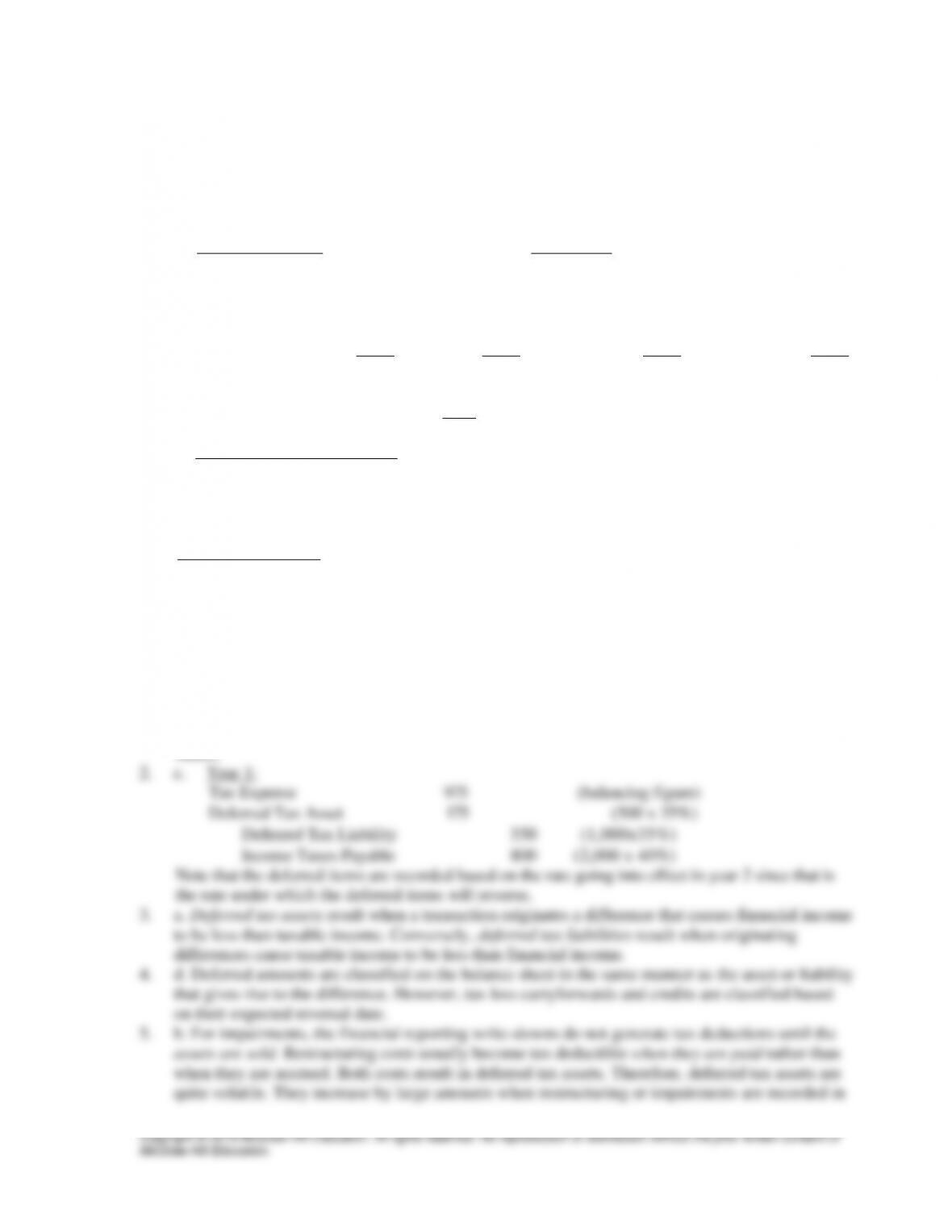
1. b. Income Statement: Tax Return:
Pretax Tax Pretax Tax
Yr. Rev. Exp. Income Exp. NI Rev. Exp. Income Payable NI
1 5,000 2,500 2,500 1,000 1,500 5,000 3,000 2,000 800 1,200
2 5,000 2,500 2,500 1,000 1,500 5,000 3,000 2,000 800 1,200
3 5,000 2,500 2,500 1,000 1,500 5,000 1,500 3,500 1,400 2,100
7,500 4,500 7,500 4,500
Depreciation expense: 6,000 ÷ 3 = 2,000 6,000 ÷ 2 = 3,000 in years 1 and 2
Warranty Expense: 5,000 x 10% = 500 1,500 in year 3
Total expenses, years 1-3 2,500
Years 1 and 2 journal entries:
Tax Expense 1,000
Deferred Tax Asset 200 (500 x 40%)
Deferred Tax Liability 400 (1,000 x 40%)
Income Taxes Payable 800
Year 3 journal entry:
Tax Expense 1,000
Deferred Tax Liability 800 (2,000 x 40%)
Deferred Tax Asset 400 (1,000 x 40%)
Income Taxes Payable 800
At the end of year 1 there is a current deferred tax asset of $200 and a long-term deferred tax
liability of $400. At the end of year 2 there is a current deferred tax asset of $400 and a long-term
deferred tax liability of $800. These amounts are originating differences in both of these years. In
year 3, they completely reverse, so there is no deferred tax balance at the end of year 3. (In other
words, the cumulative financial reporting income and tax income return income before tax is the
same).
Financial Reporting and Analysis 6e Income Tax Reporting
Copyright © 2015 McGraw-Hill Education. All rights reserved. No reproduction or distribution without the prior written consent of
McGraw-Hill Education.
the financial statements, but they decrease by large amounts in subsequent periods as the assets are
sold or the amounts are paid.
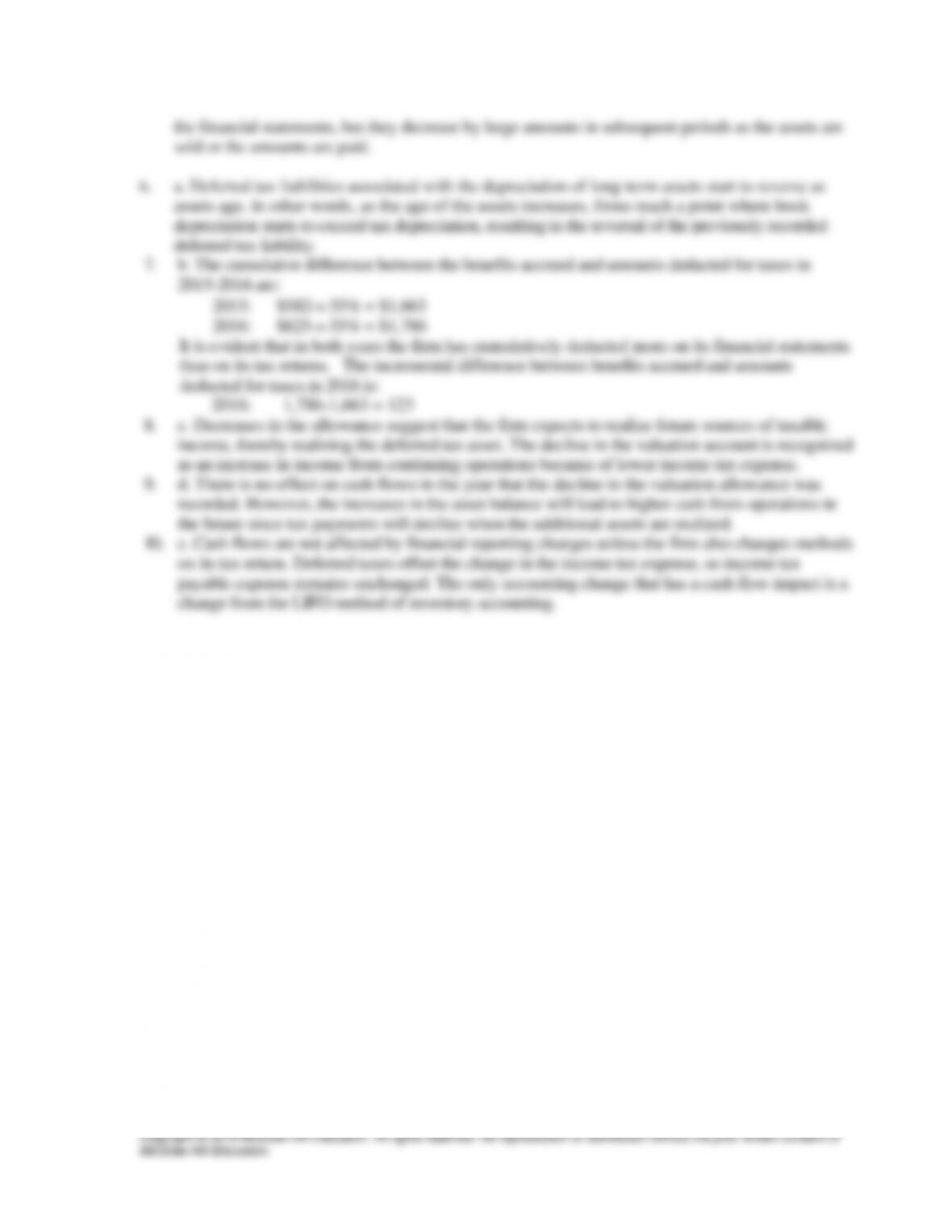
6. a. Deferred tax liabilities associated with the depreciation of long-term assets start to reverse as
assets age. In other words, as the age of the assets increases, firms reach a point where book
depreciation starts to exceed tax depreciation, resulting in the reversal of the previously recorded
deferred tax liability.
7. b. The cumulative difference between the benefits accrued and amounts deducted for taxes in
2015-2016 are:
2015: $582-s-35% = $1,663
2016: $625-s-35% = $1,786
It is evident that in both years the firm has cumulatively deducted more on its financial statements
than on its tax returns. The incremental difference between benefits accrued and amounts
deducted for taxes in 2016 is:
2016: 1,786–1,663 = 123
8. c. Decreases in the allowance suggest that the firm expects to realize future sources of taxable
income, thereby realizing the deferred tax asset. The decline in the valuation account is recognized
as an increase in income from continuing operations because of lower income tax expense.
9. d. There is no effect on cash flows in the year that the decline in the valuation allowance was
recorded. However, the increases in the asset balance will lead to higher cash from operations in
the future since tax payments will decline when the additional assets are realized.
10. c. Cash flows are not affected by financial reporting changes unless the firm also changes methods
on its tax return. Deferred taxes offset the change in the income tax expense, so income tax
payable expense remains unchanged. The only accounting change that has a cash flow impact is a
change from the LIFO method of inventory accounting.
RECOMMENDED EXHIBITS
Exhibit 13.1—Examples of Temporary Differences Between Book Income and Taxable Income.
Exhibit 13.2—Examples of Permanent Differences Between Book Income and Taxable Income.
Exhibit 13.6—Computation of Income Tax Expense with Interperiod Tax Allocation.
Figure 13.5— Relations Among Income Tax expense, Taxes Payable, and Changes in Deferred
Tax Assets and Liabilities.
Figure 13.7—Overview of Interperiod Tax Allocation.
SUGGESTED READINGS
1. Anonymous. 1997. IASC proposals pose a threat. Accountancy (March).
2. Clark, P. 1996. Farewell, deferral method. Accountancy (November).
3. Hitt, G. 1998. Lawmakers strike a deal on bill to overhaul IRS. The Wall Street Journal (June 24).
4. MacDonald, E. 1998. IRS bill gives accountants new confidentiality privileges. The Wall Street
Journal (June 26).
5. Rego, S., and M. Frank. 2006. Do managers use the valuation allowance account to manage
earnings around certain earnings targets? Journal of the American Taxation Association, Vol. 28,
pages 43–65.
6. Schrand, C., and F. Wong. 2003. Earnings management using the valuation allowance for
deferred tax assets under SFAS No. 109. Contemporary Accounting Research, Fall, pages 579-
611.

Financial Reporting and Analysis 6e Income Tax Reporting