12–69
more flexibility to the borrower. For instance, the company’s income before
interest and taxes can go down by as much as $12,000 (from $120,000 to
$108,000) without violating the covenant for the times interest earned ratio.
Consequently, the company may be inclined to take on riskier projects that
increase the variance in earnings. Of course, higher earnings variability
In order to reduce such managerial opportunism, most lenders provide their
own definitions for financial ratios. For instance, Guaraldi Bank includes rent
expenses from operating leases as part of the fixed charges in calculating the
coverage ratio. Consequently, a borrower will not be able to increase the
coverage ratio by merely restructuring some of the capital leases as operating
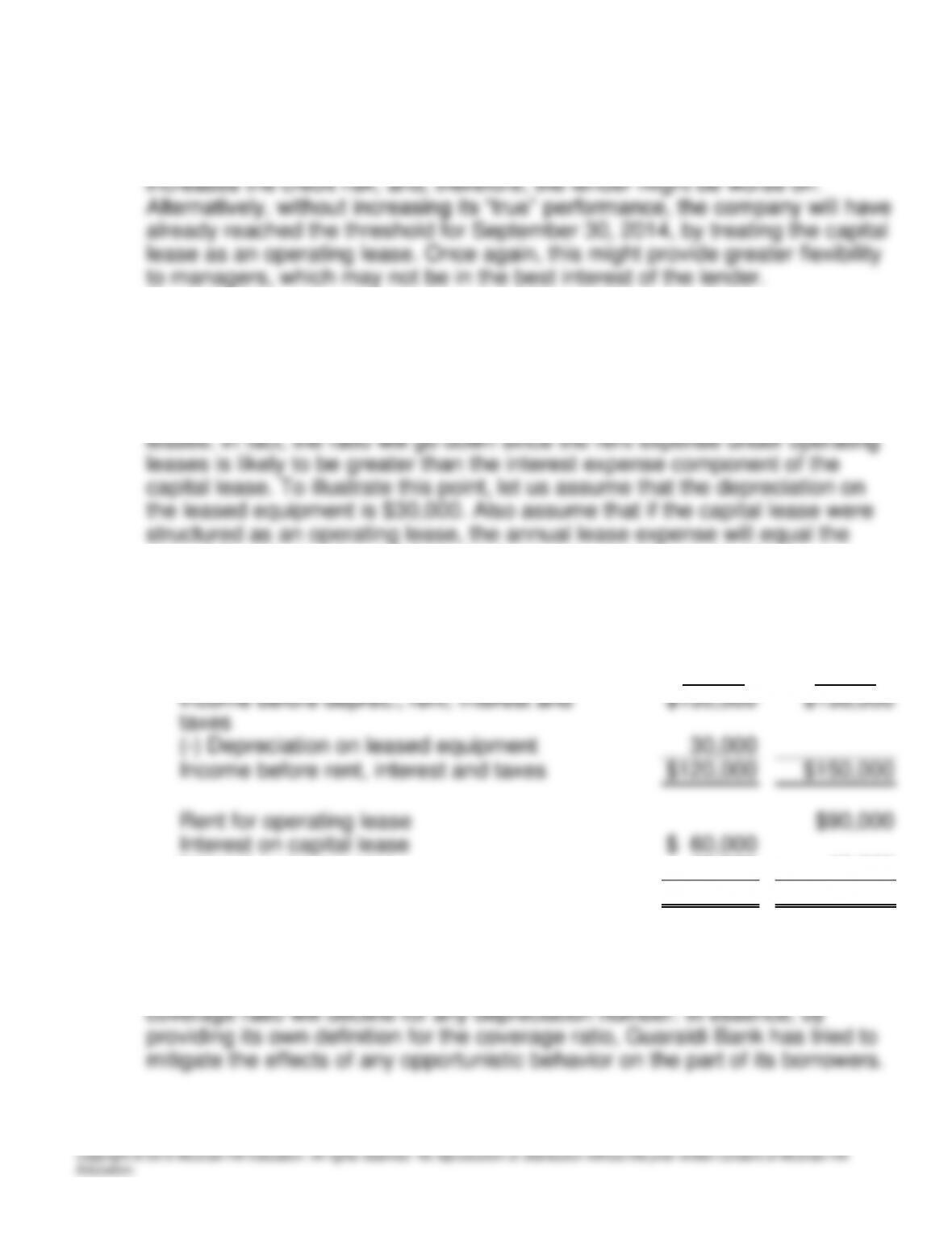
sum of the depreciation and interest expense under the capital lease
($30,000 + $60,000). Based on these assumptions, the fixed charges
coverage ratio is calculated under the two accounting methods:
Capital
Operating
Lease
Lease
Income before deprec., rent, interest and
taxes
$150,000
$150,000
(-) Depreciation on leased equipment
30,000
Income before rent, interest and taxes
$120,000
$150,000
Rent for operating lease
$90,000
Interest on capital lease
$ 60,000
Interest on borrowings
40,000
40,000
Fixed charges
$100,000
$130,000
Fixed charges coverage ratio
1.20
1.15
While $30,000 is assumed for the illustrative purposes, the fixed charges
Requirement 2:
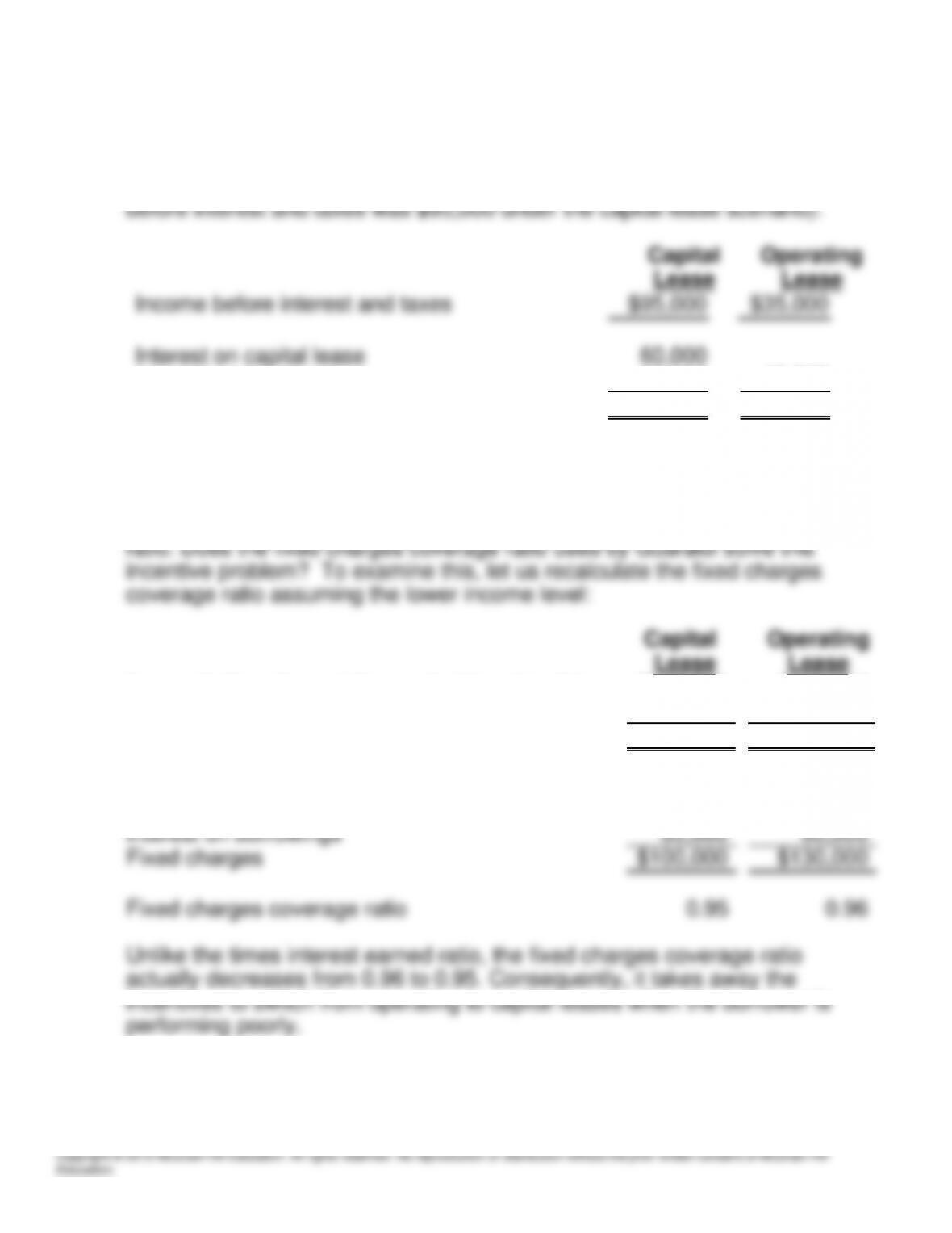
Note that if the times interest earned ratio is more than 1.00, reclassification
of the lease into an operating lease will increase the ratio from 1.20 to 1.50.
In contrast, if the ratio is less than 1.00, this reclassification will decrease the
ratio. This is illustrated through the following example (assume that income
12–71
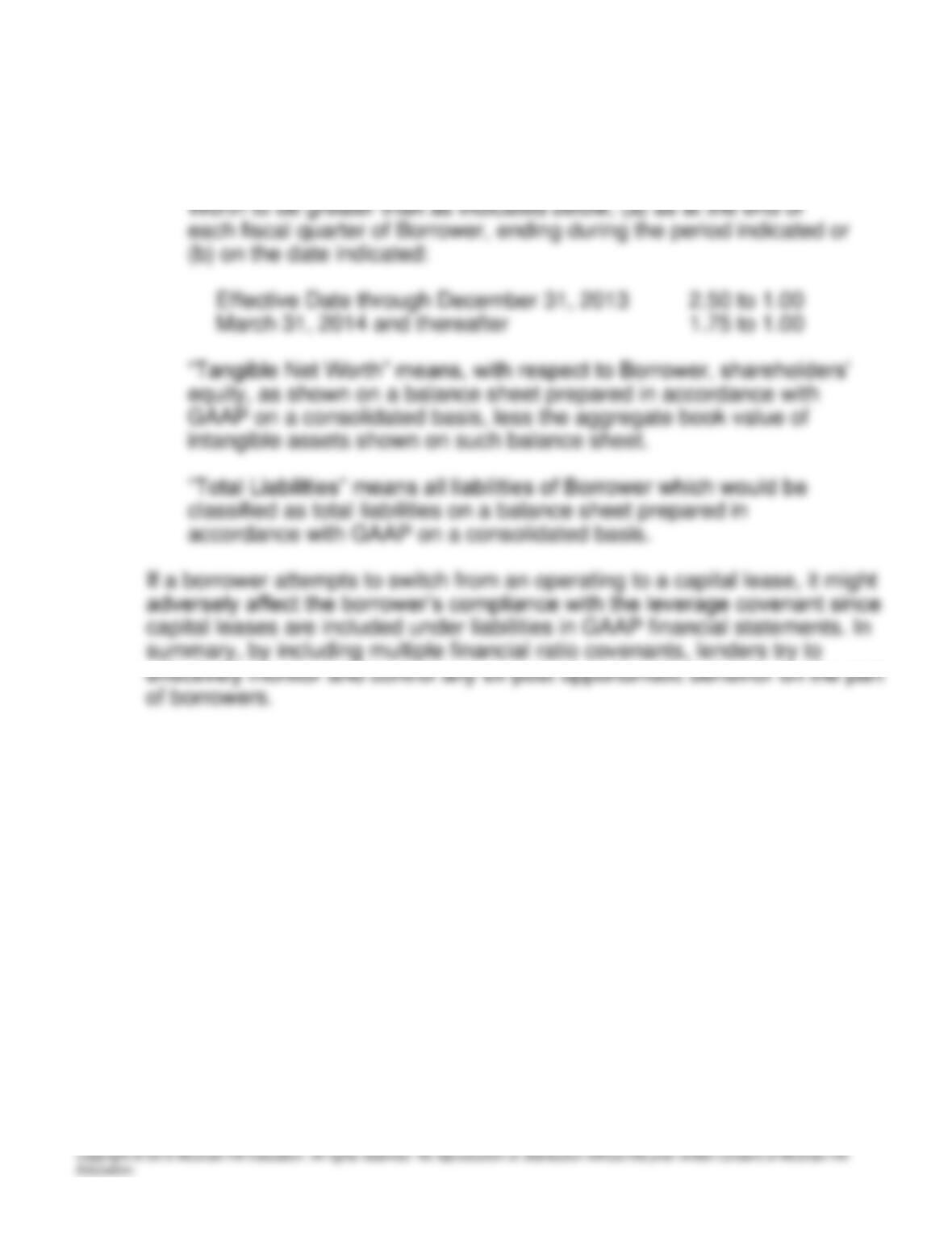
Note: In addition to the fixed charges coverage ratio, bankers also typically
include a leverage ratio. For instance, Guaraldi had the following leverage
covenant in the lending agreement:
Borrower shall not permit the ratio of Total Liabilities to Tangible Net
C12-4.Walgreens: Lessee reporting and constructively capitalizing operating
leases (LO 2, 5, 11)
12–73
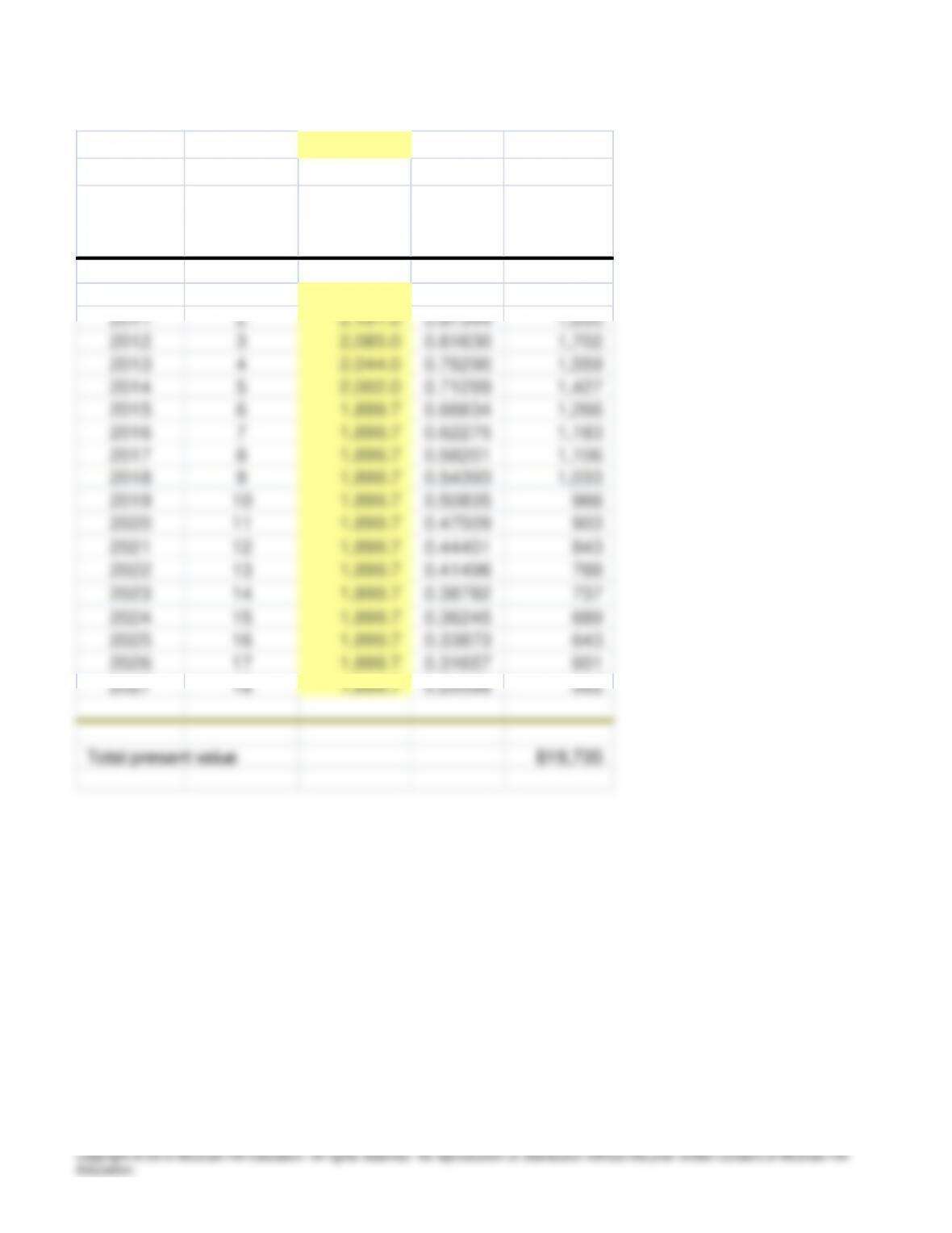
PV factors for individual years
Rate 7.0%
Year
# of Years
discounted
Operating
Lease
Payment
PV factor
@7.0%
PV of
Operating
Lease
2010 1 $2,024.0 0.93458 $1,892
2011 2 2,101.0 0.87344 1,835
2012 3 2,085.0 0.81630 1,702
2013 4 2,044.0 0.76290 1,559
2014 5 2,002.0 0.71299 1,427
2015 6 1,899.7 0.66634 1,266
2016 7 1,899.7 0.62275 1,183
2017 8 1,899.7 0.58201 1,106
2018 9 1,899.7 0.54393 1,033
2019 10 1,899.7 0.50835 966
2020 11 1,899.7 0.47509 903
2021 12 1,899.7 0.44401 843
2022 13 1,899.7 0.41496 788
2023 14 1,899.7 0.38782 737
2024 15 1,899.7 0.36245 689
2025 16 1,899.7 0.33873 643
2026 17 1,899.7 0.31657 601
2027 18 1,899.7 0.29586 562
12–74
PV and PVOA factors
Discount
Rate 7.0%
Year
# of Years
discounted
Operating
Lease
Payment
PV factor
@7.0%
PV of
Operating
Lease
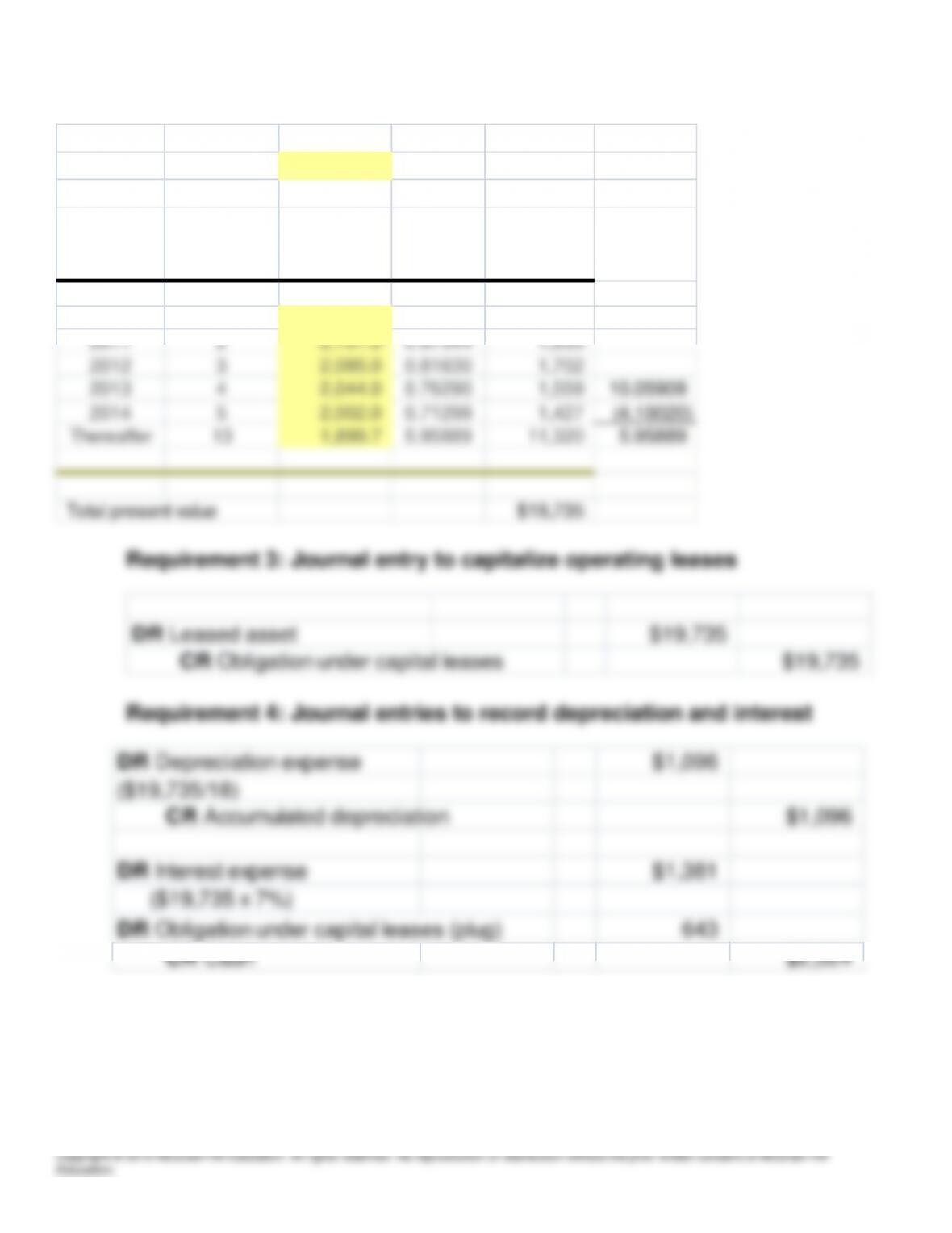
2010 1 2,024.0$ 0.93458 $1,892
2011 2 2,101.0 0.87344 1,835
2012 3 2,085.0 0.81630 1,702
2013 4 2,044.0 0.76290 1,559 10.05909
2014 5 2,002.0 0.71299 1,427 (4.10020)
Thereafter 13 1,899.7 5.95889 11,320 5.95889
Total present value $19,735
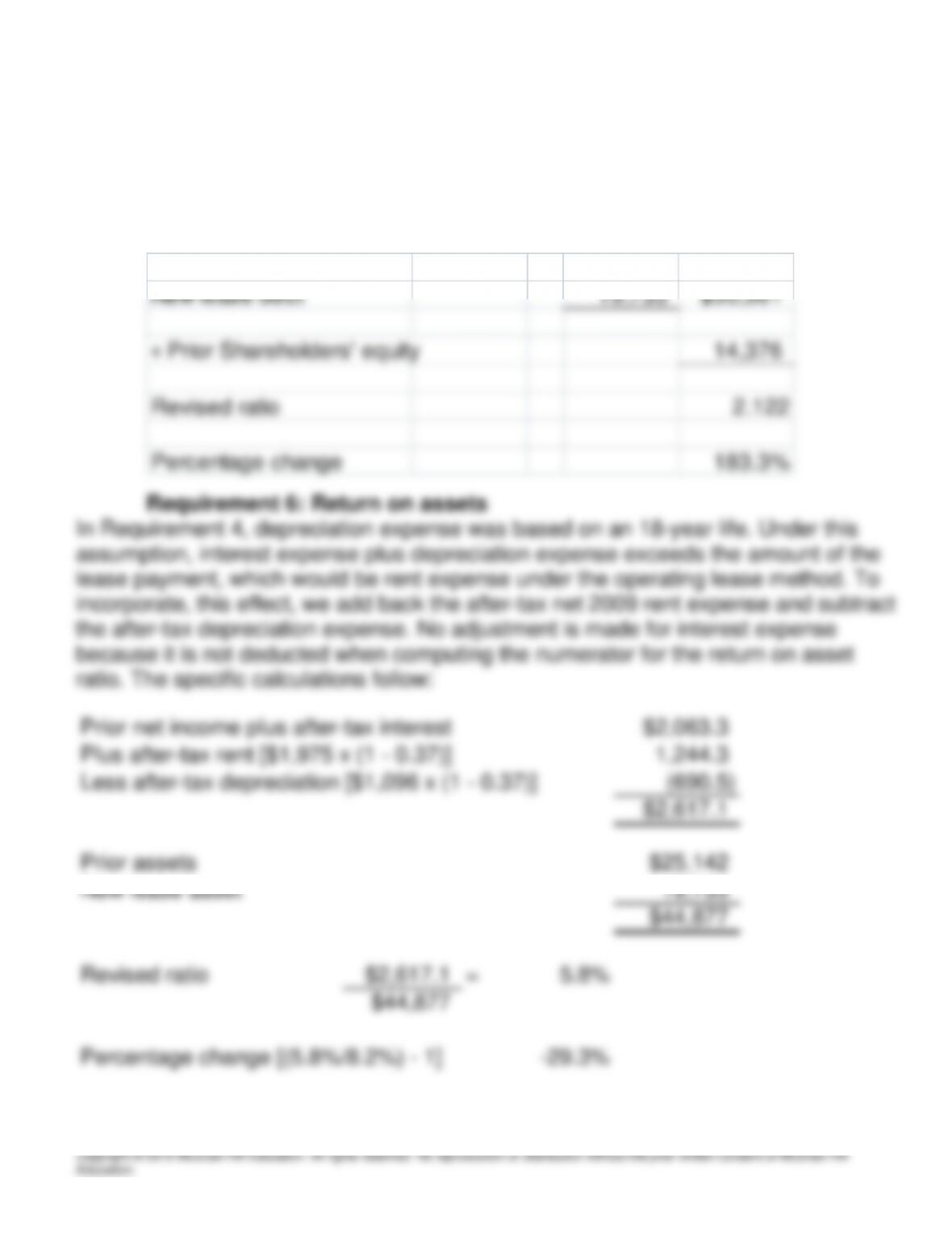
Requirement 3: Journal entry to capitalize operating leases
DR Leased asset $19,735
CR Obligation under capital leases $19,735
Requirement 4: Journal entries to record depreciation and interest
DR Depreciation expense $1,096
($19,735/18)
CR Accumulated depreciation $1,096
DR Interest expense $1,381
($19,735 x 7%)
DR Obligation under capital leases (plug) 643
CR Cash $2,024
12–75
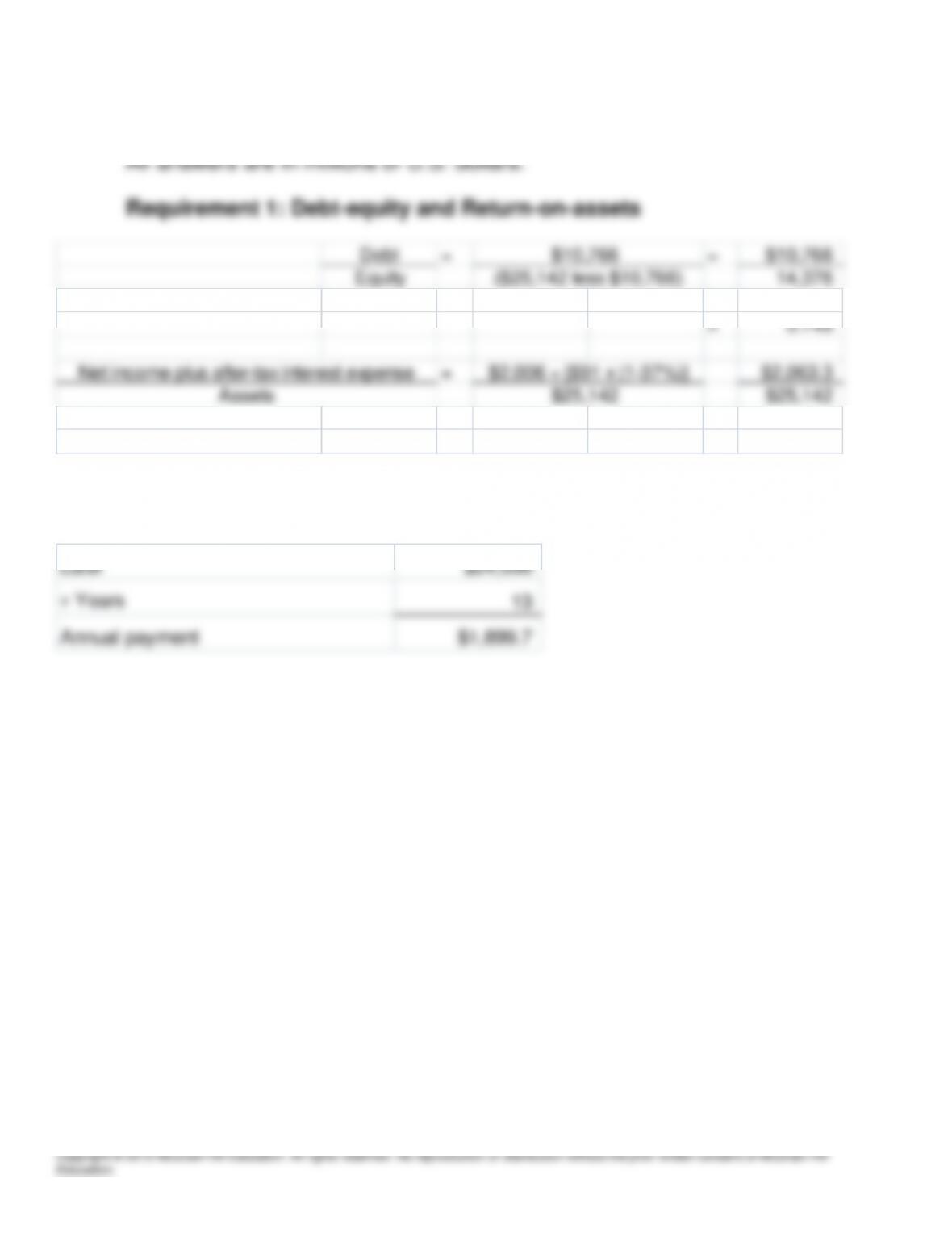
Requirement 5: Debt to equity ratio
Note from Requirement 3 that there is no effect on Shareholders’ equity.
Therefore, we compute a new amount of debt and compute the new ratio as
follows.
Prior Debt $10,766
New lease debt 19,735 $30,501
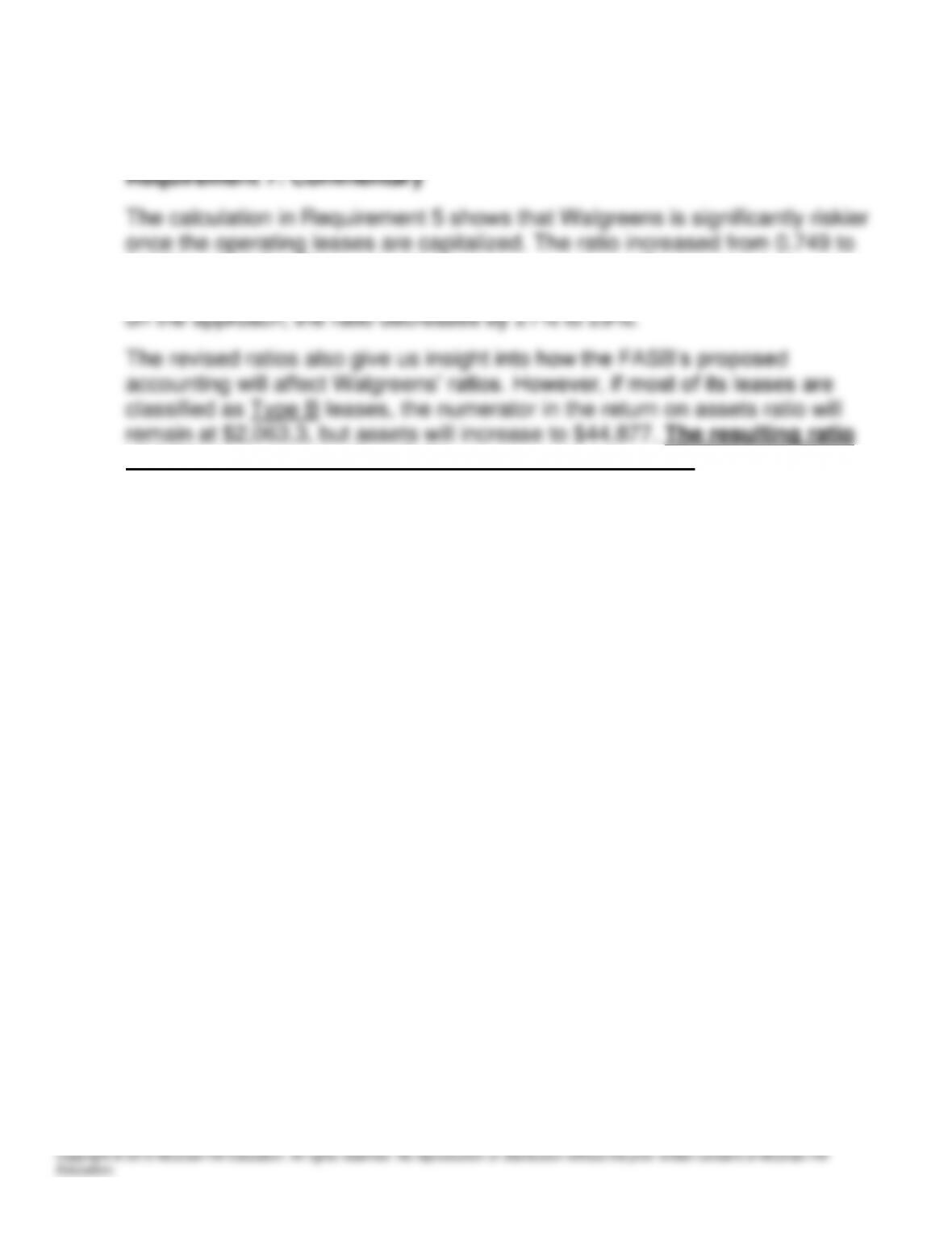
÷ Prior Shareholders’ equity 14,376
Revised ratio 2.122
Percentage change 183.3%
Requirement 6: Return on assets
In Requirement 4, depreciation expense was based on an 18-year life. Under this
assumption, interest expense plus depreciation expense exceeds the amount of the
lease payment, which would be rent expense under the operating lease method. To
incorporate, this effect, we add back the after-tax net 2009 rent expense and subtract
the after-tax depreciation expense. No adjustment is made for interest expense
because it is not deducted when computing the numerator for the return on asset
ratio. The specific calculations follow:
Prior net income plus after-tax interest $2,063.3
Plus after-tax rent [$1,975 x (1 – 0.37)] 1,244.3
Less after-tax depreciation [$1,096 x (1 – 0.37)] (690.5)
$2,617.1
Prior assets $25,142
New lease asset 19,735
$44,877
Revised ratio $2,617.1 = 5.8%
$44,877
12–76
The return on asset ratio is significantly lower than the one computed in
Requirement 1.
2.122, or 183.3%. The revised return–on-asset ratios (Requirement 6)
suggest that Walgreen’s is less profitable than originally thought. Depending
of 4.6% is even lower than 5.8% we computed in part 6.