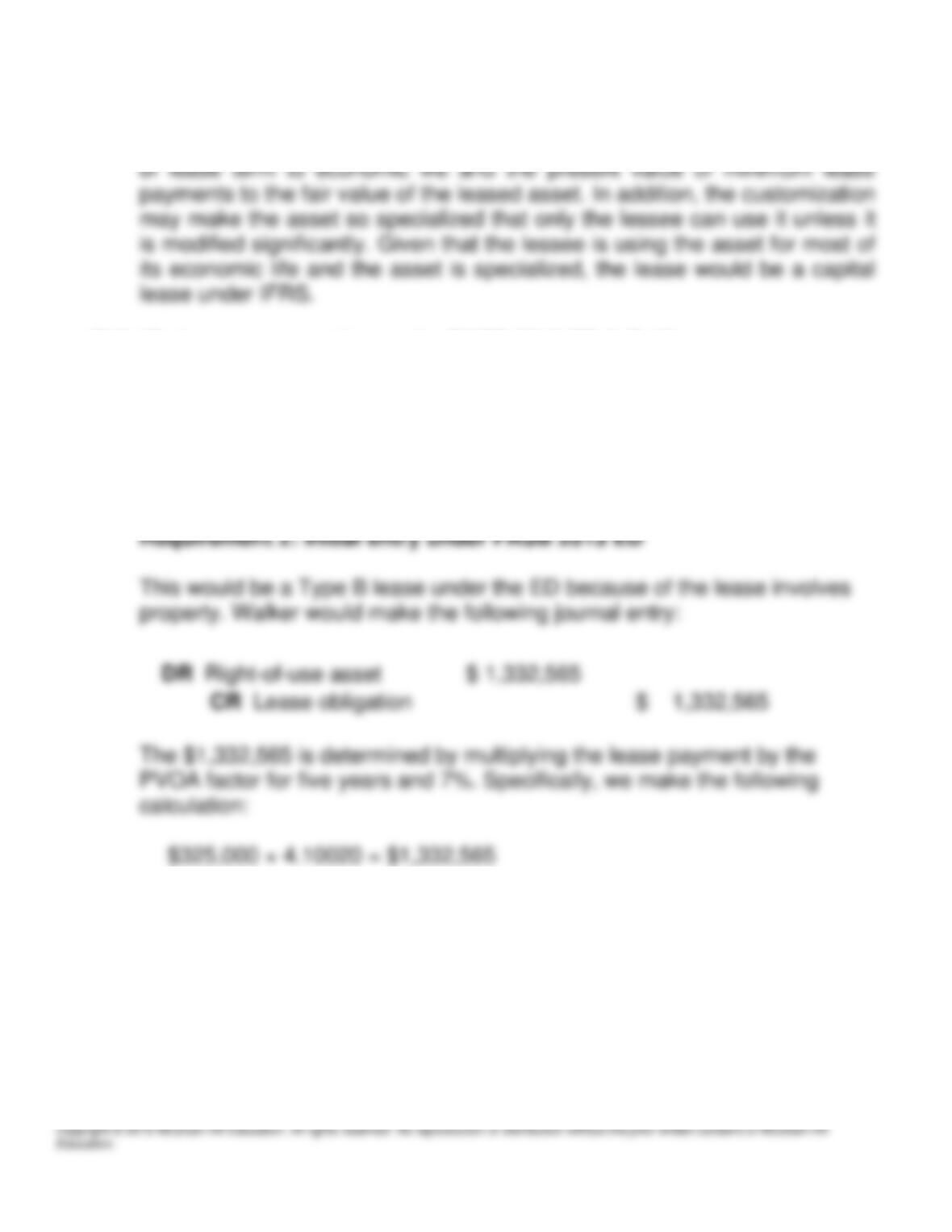
Requirement 2: Classification under U.S. GAAP
There are no bright lines under IFRS, but one would still consider the ratio
E12-17. Lessee accounting under FASB 2013 ED (LO 10)
Requirement 1: Initial entry under U.S. GAAP as of 2014
This would be an operating lease because none of the four lease criteria are
met. Therefore, no entry is required.
12–17
Requirement 3: Financial Statement effects under FASB 2013 ED
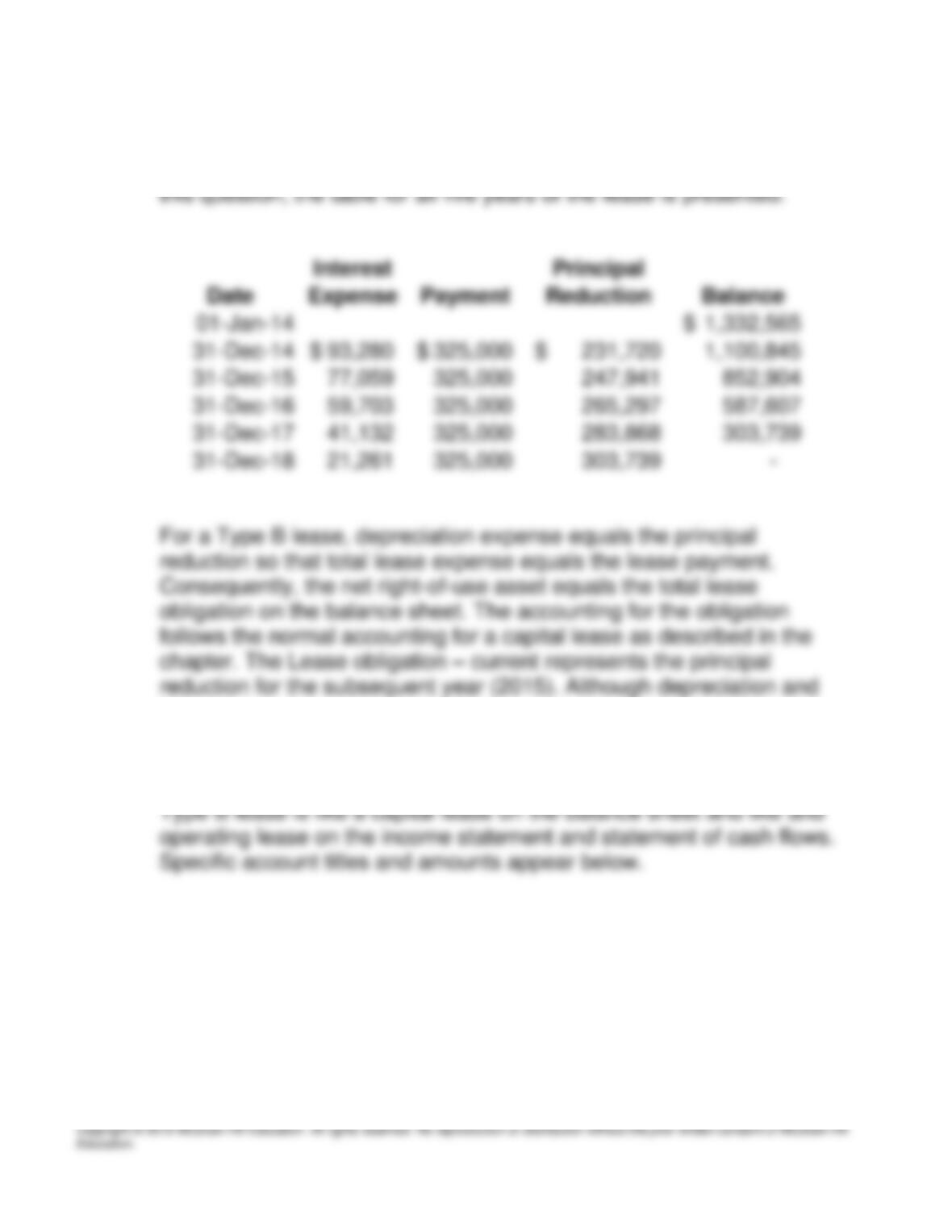
Most of the information needed comes from the amortization table
presented below. Although only the first three rows are needed to answer
interest expense comprise total lease expense, the depreciation and
interest expense are not handled separately in the income statement
and the statement of cash flows. Instead, a single line item for lease
expense or lease payments appear in both statements. Essentially, a
12–18
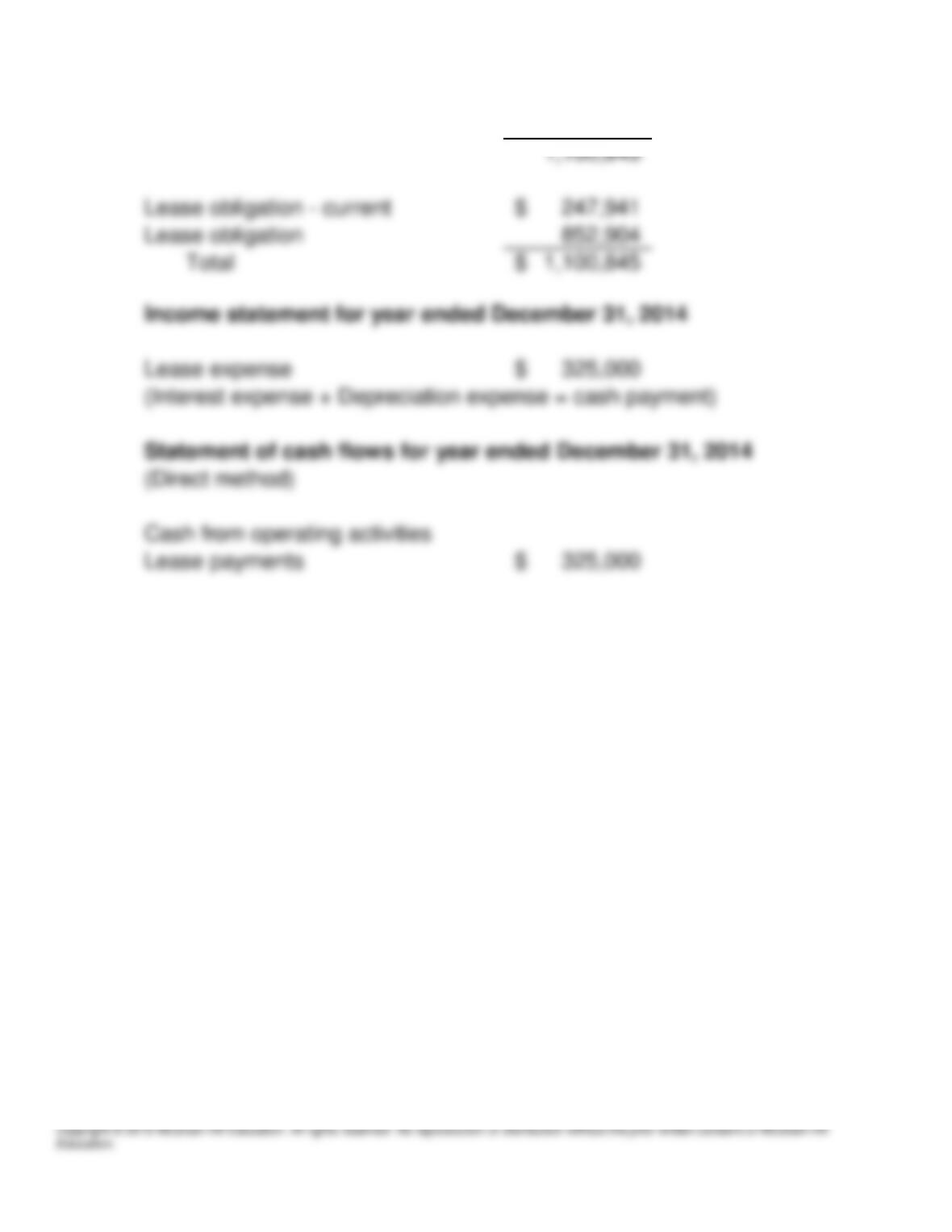
Balance sheet at December 31, 2014
Right-of-use asset 1,332,565$
Less: Accumulated depreciation (231,720)
1,100,845
Lease obligation – current 247,941$
Lease obligation 852,904
Total 1,100,845$
Income statement for year ended December 31, 2014
Lease expense 325,000$
(Interest expense + Depreciation expense = cash payment)
Statement of cash flows for year ended December 31, 2014
(Direct method)
Cash from operating activities
Lease payments 325,000$
12–19
Copyright © 2015 McGraw-Hill Education. All rights reserved. No reproduction or distribution without the prior written consent of McGraw-Hill
Education.
Financial Reporting and Analysis (5th Ed.)
Chapter 12 Solutions
Financial Reporting for Leases
Problems
Problems
P12–1. Making computations and journal entries for lessee (LO 3, 4, 5)
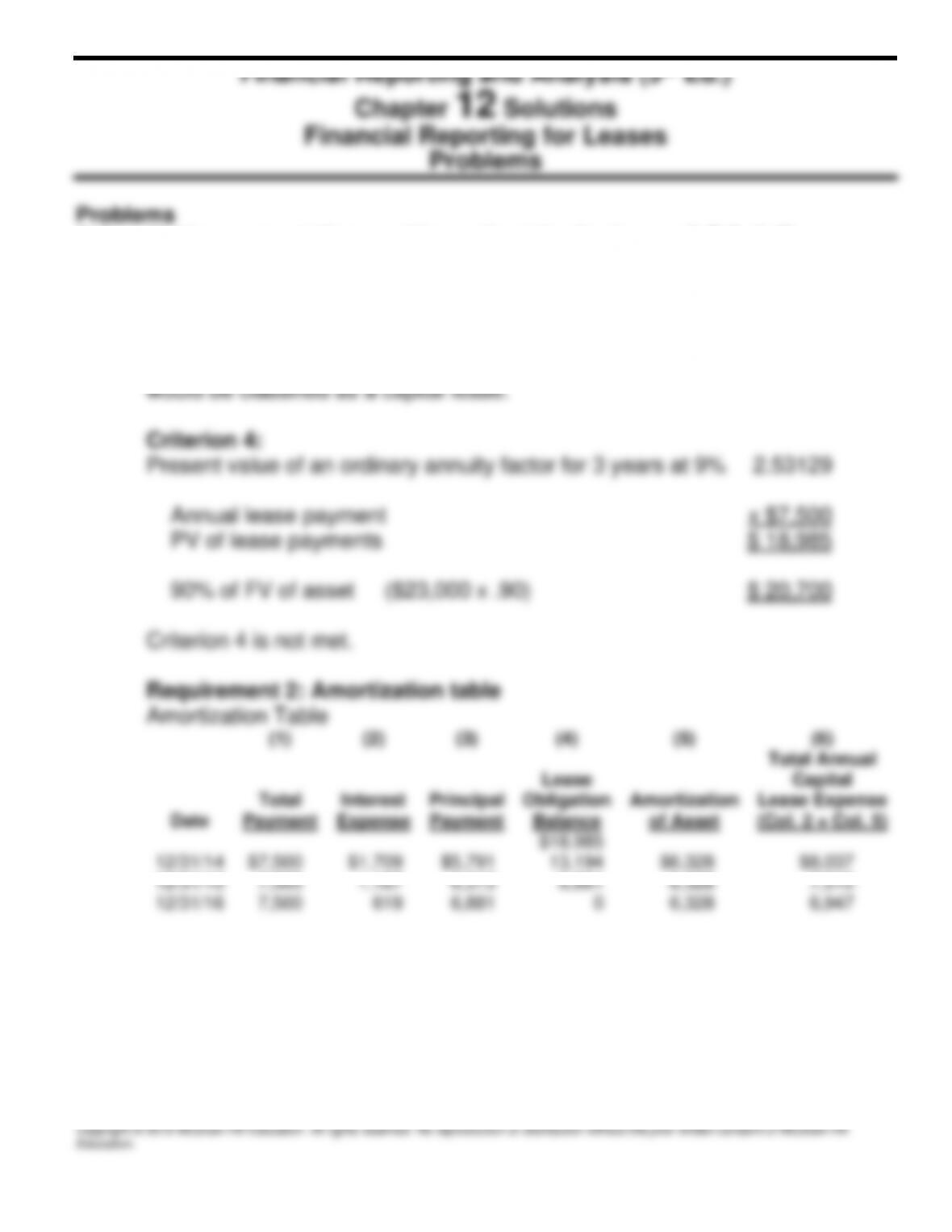
Requirement 1: Lease classification
Criterion 2:
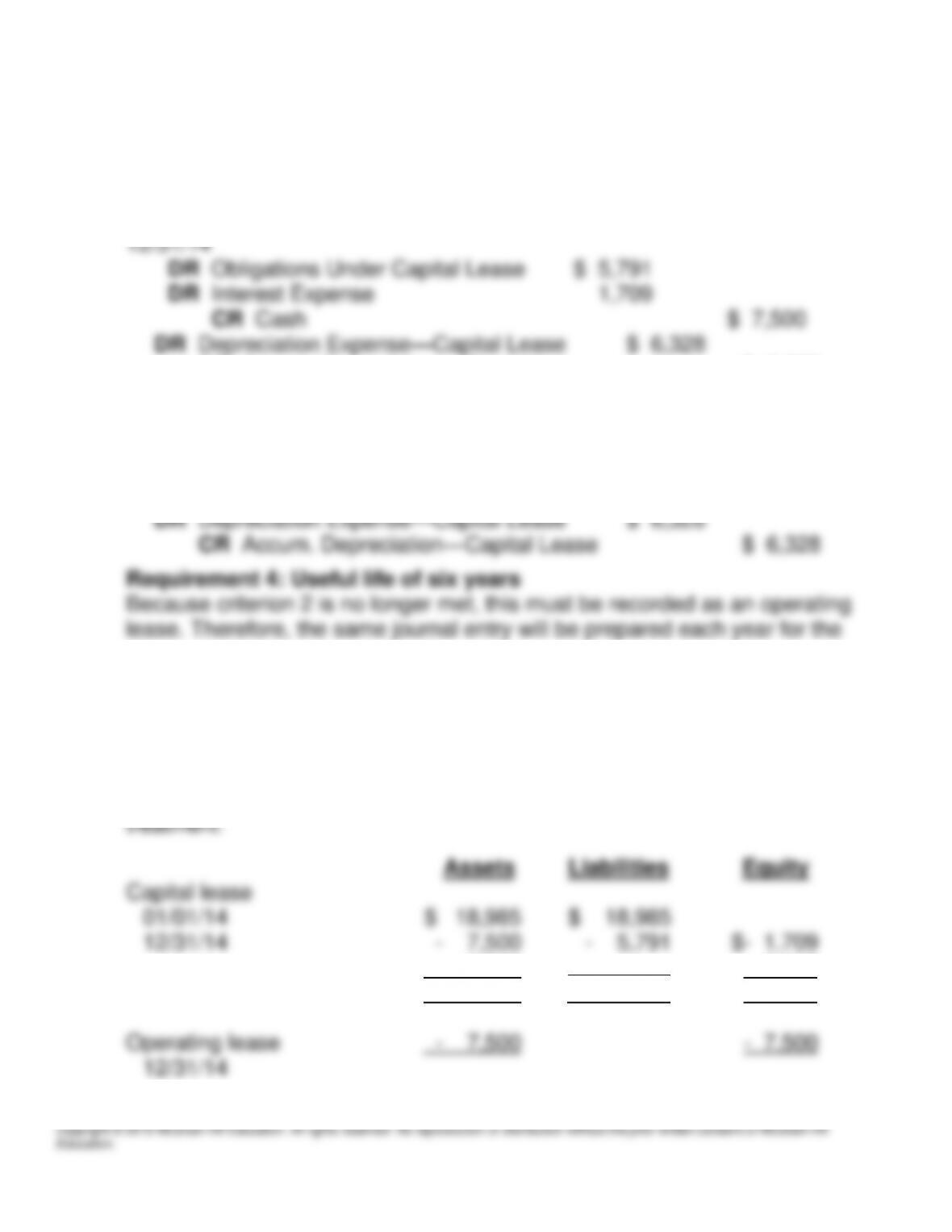
Lease term of 3 years divided by economic life of 4 years equals 75% so it
12–20
Requirement 3: Journal entries for first two years
01/01/14
DR Leased Asset—Capital Lease $18,985
CR Obligations Under Capital Lease $18,985
CR Accum. Depreciation—Capital Lease $ 6,328
12/31/15
DR Obligations Under Capital Lease $ 6,313
DR Interest Expense 1,187
CR Cash $ 7,500
three-year lease term:
DR Rent Expense $ 7,500
CR Cash $ 7,500
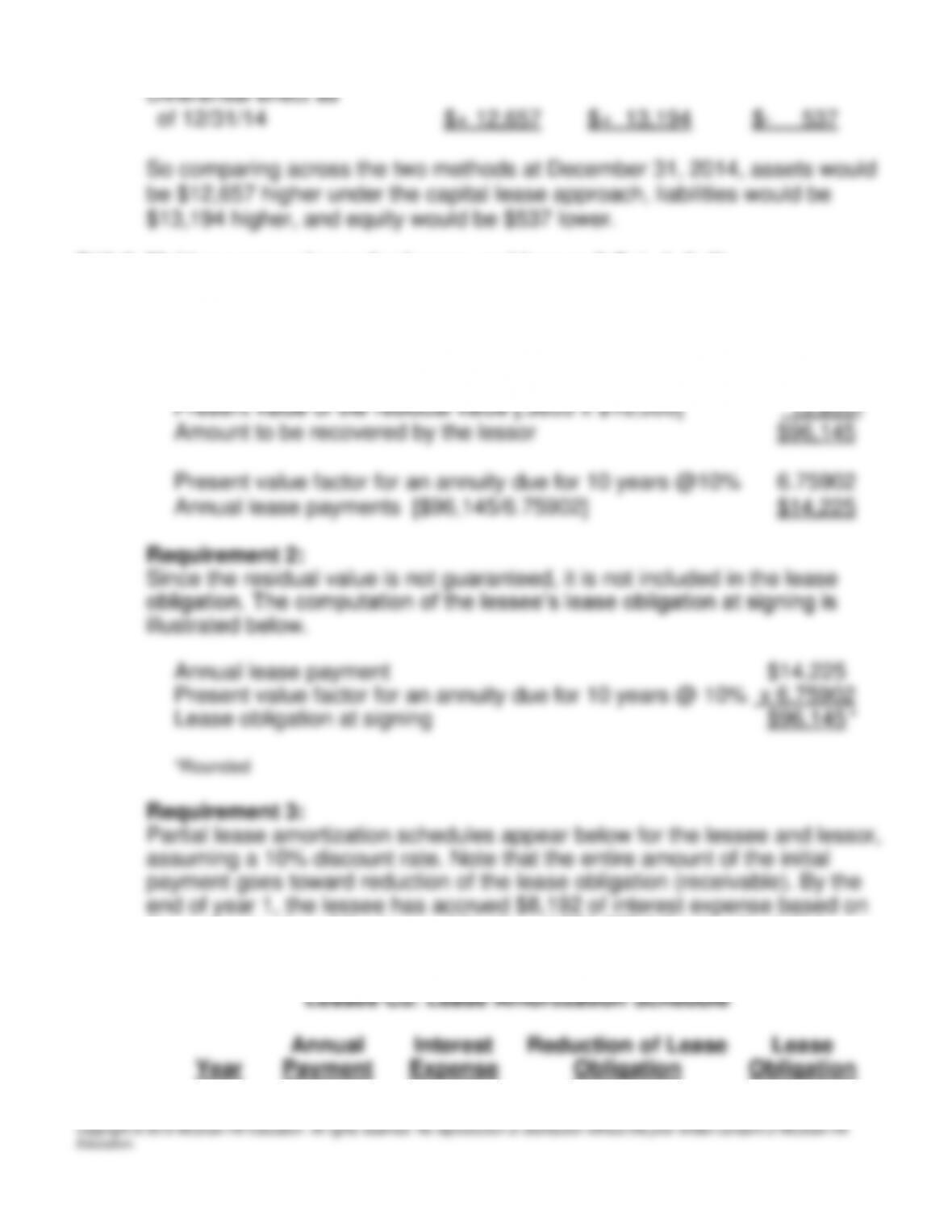
Requirement 5: Financial statement effects
Effects on assets, liabilities, and equity of capital versus operating lease
Assets
Liabilities
Equity
Capital lease
01/01/14
$ 18,985
$ 18,985
12/31/14
– 7,500
– 5,791
$- 1,709
– 6,328
– 6,328
Net effect at 12/31/14
$+ 5,157
$+ 13,194
– 8,037
Operating lease
– 7,500
– 7,500
12/31/14
Differential effect as
of 12/31/14
$+ 12,657
$+ 13,194
$- 537
So comparing across the two methods at December 31, 2014, assets would
be $12,657 higher under the capital lease approach, liabilities would be
$13,194 higher, and equity would be $537 lower.
P12–2. Making comparisons for lessee and lessor (LO 1, 4, 5, 8)
Requirement 1:
The computation of the annual lease payments is shown below:
Fair value of the machine
$100,000
Present value of the residual value [.3855 x $10,000]
(3,855)
Amount to be recovered by the lessor
$96,145
Present value factor for an annuity due for 10 years @10%
6.75902
Annual lease payments [$96,145/6.75902]
$14,225
Requirement 2:
Since the residual value is not guaranteed, it is not included in the lease
obligation. The computation of the lessee’s lease obligation at signing is
illustrated below.
Annual lease payment $14,225
Present value factor for an annuity due for 10 years @ 10% x 6.75902
Lease obligation at signing $96,145 *
*Rounded
Requirement 3:
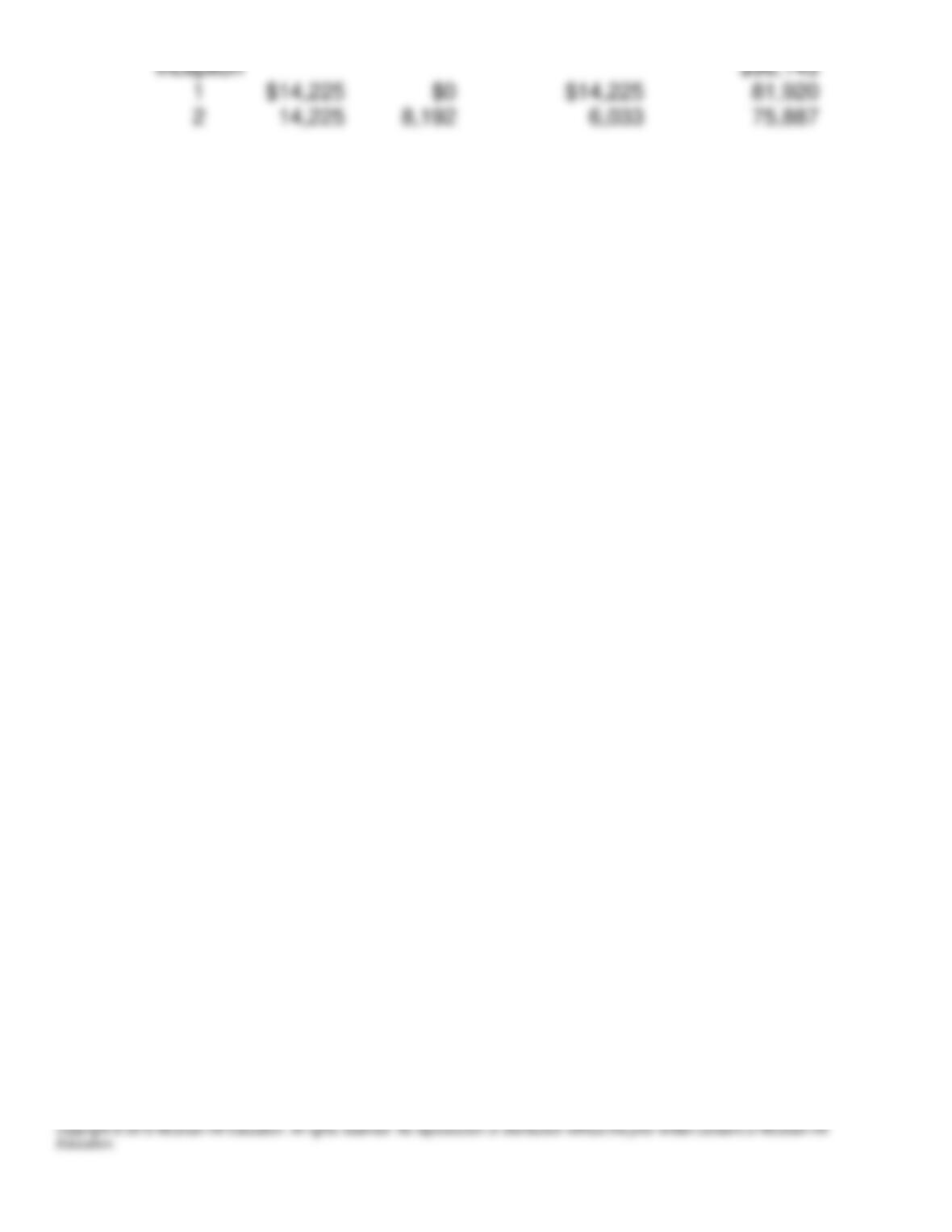
Partial lease amortization schedules appear below for the lessee and lessor,
assuming a 10% discount rate. Note that the entire amount of the initial
payment goes toward reduction of the lease obligation (receivable). By the
end of year 1, the lessee has accrued $8,192 of interest expense based on
the present value of the lease obligation of $81,920 following the initial
payment.
12–22
Copyright © 2015 McGraw-Hill Education. All rights reserved. No reproduction or distribution without the prior written consent of McGraw-Hill
Education.
Inception
$96,145
1
$14,225
$0
$14,225
81,920
2
14,225
8,192
6,033
75,887
12–23
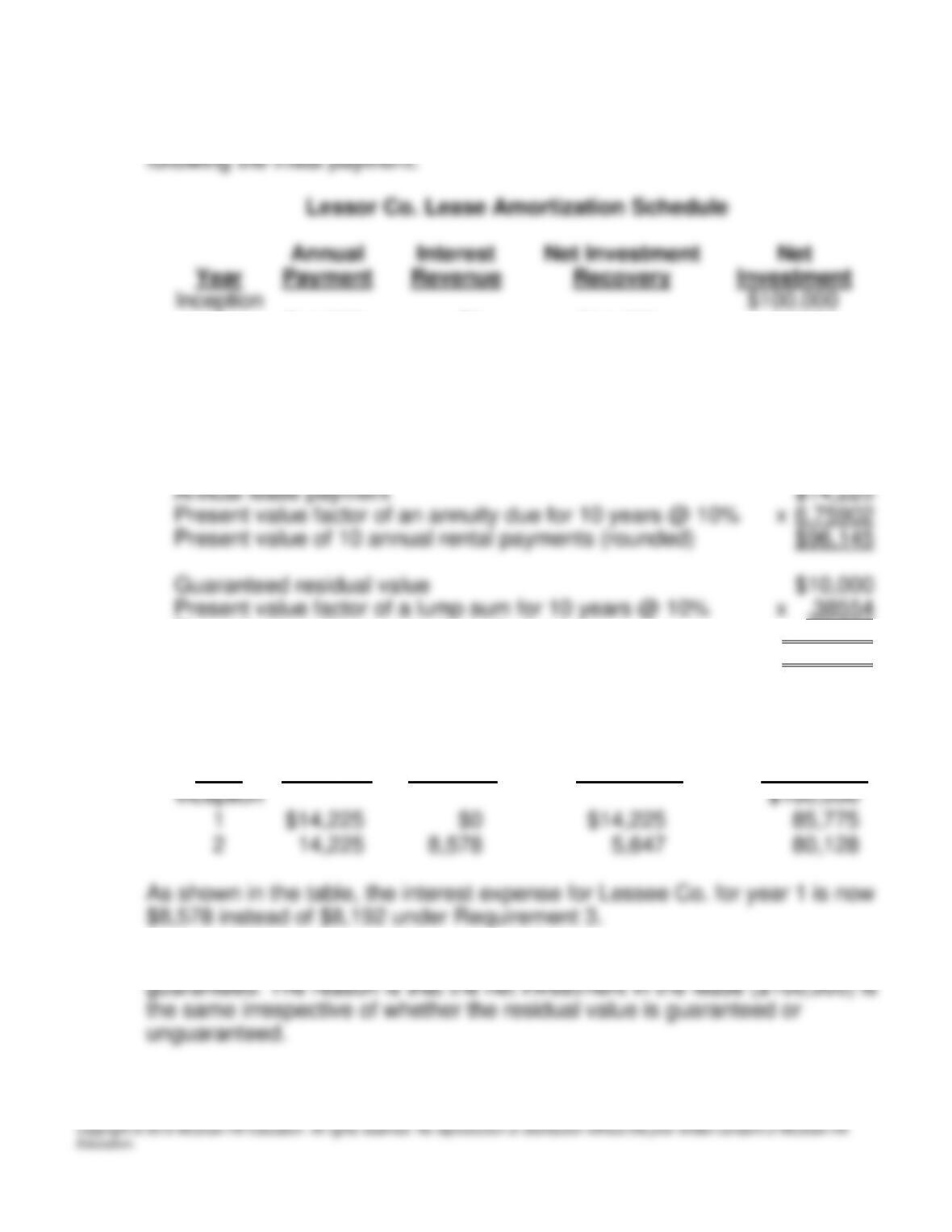
The lessor will recover $100,000 because the machine will have residual
value at the end of the lease, even though it may be unguaranteed. Thus, by
the end of the first year the lessor has earned $8,578 in interest revenue from
the lease based on the present value of the net investment of $85,775
Year
Annual
Payment
Interest
Revenue
Net Investment
Recovery
Net
Investment
Inception
$100,000
1
$14,225
$0
$14,225
85,775
2
14,225
8,578
5,647
80,128
Requirement 4:
a) If the residual value were guaranteed, it would change the lease obligation
as follows:
Present value of guaranteed residual value $3,855
Lease obligation at signing ($96,145 + $3,855) $100,000
b) A revised amortization table for Lessee Co. follows:
Year
Annual
Payment
Interest
Expense
Reduction of Lease
Obligation
Lease
Obligation
Inception
$100,000
1
$14,225
$0
$14,225
85,775
2
14,225
8,578
5,647
80,128
The computation for Lessor Co. would not change if the residual value were
P12–3. Accounting for lessees’ capital leases (LO 3, 4, 5)
Requirement 1: Rationale for classification
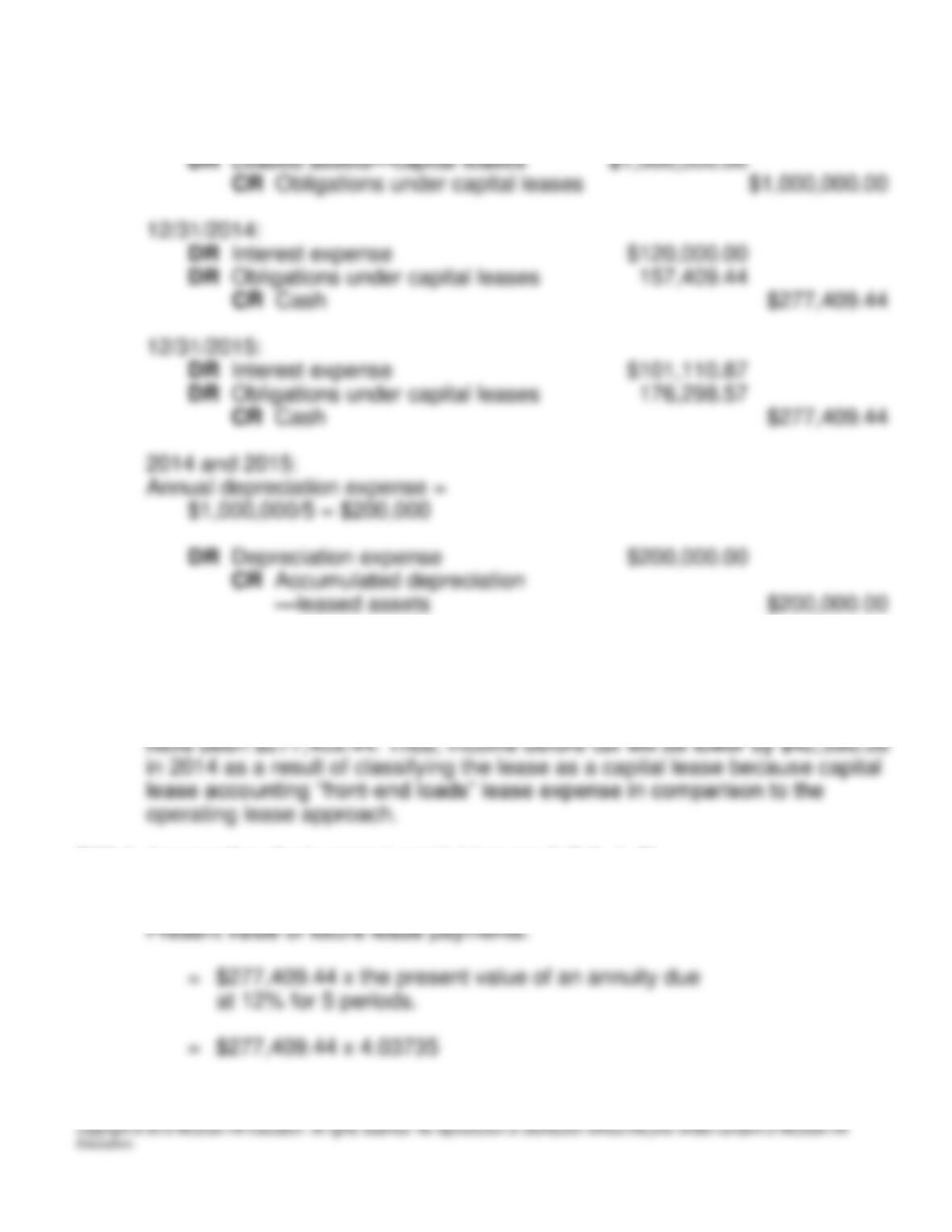
Given that the leased asset has an expected useful life of 6 years, Seven
Wonders must account for the lease as a capital lease since the lease term of
12–25
Requirement 3:
The journal entries are:
1/1/2014:
Requirement 4:
Under the capital lease method, the total expense recognized in 2014 is the
interest expense of $120,000 plus the depreciation of $200,000 for a total of
$320,000. Under the operating lease method, the amount of expense would
P12–4. Accounting for lessees’ capital leases (LO 3, 4, 5)
Requirement 1:

12–26
= $1,119,999
12–27
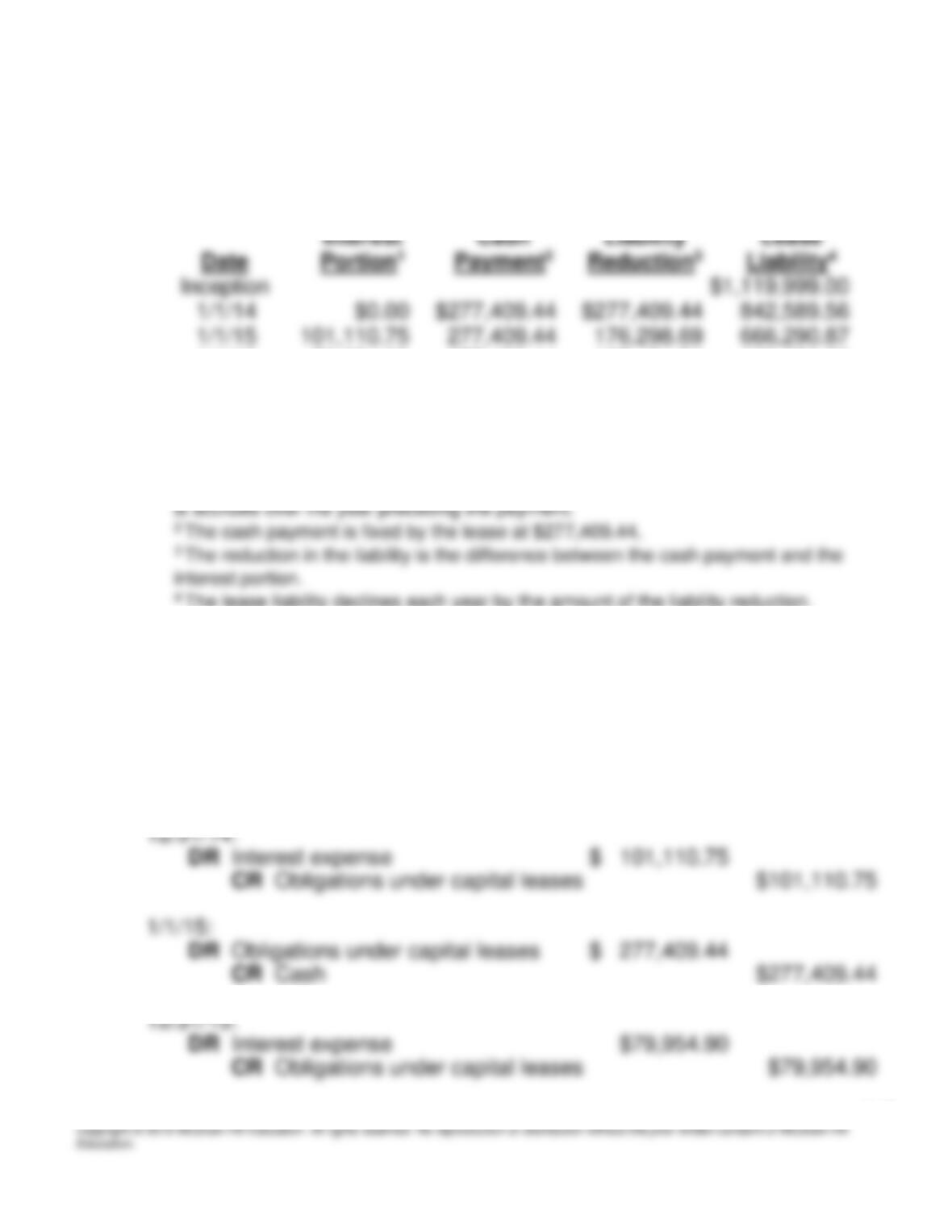
Appearing below is the amortization schedule for the lease liability:
Amortization of Capital Lease Liability
Seven Wonders Incorporated
First payment due at the inception of the lease
Interest
Cash
Liability
Lease
Date
Portion1
Payment2
Reduction3
Liability4
Inception
$1,119,999.00
1/1/14
$0.00
$277,409.44
$277,409.44
842,589.56
1/1/15
101,110.75
277,409.44
176,298.69
666,290.87
1/1/16
79,954.90
277,409.44
197,454.54
468,836.33
1/1/17
56,260.36
277,409.44
221,149.08
247,687.25
1/1/18
29,722.19*
277,409.44
247,687.25
0.00
*Rounded by $0.28
1 The interest portion is 12% of the carrying amount at the beginning of the period and
Requirement 2:
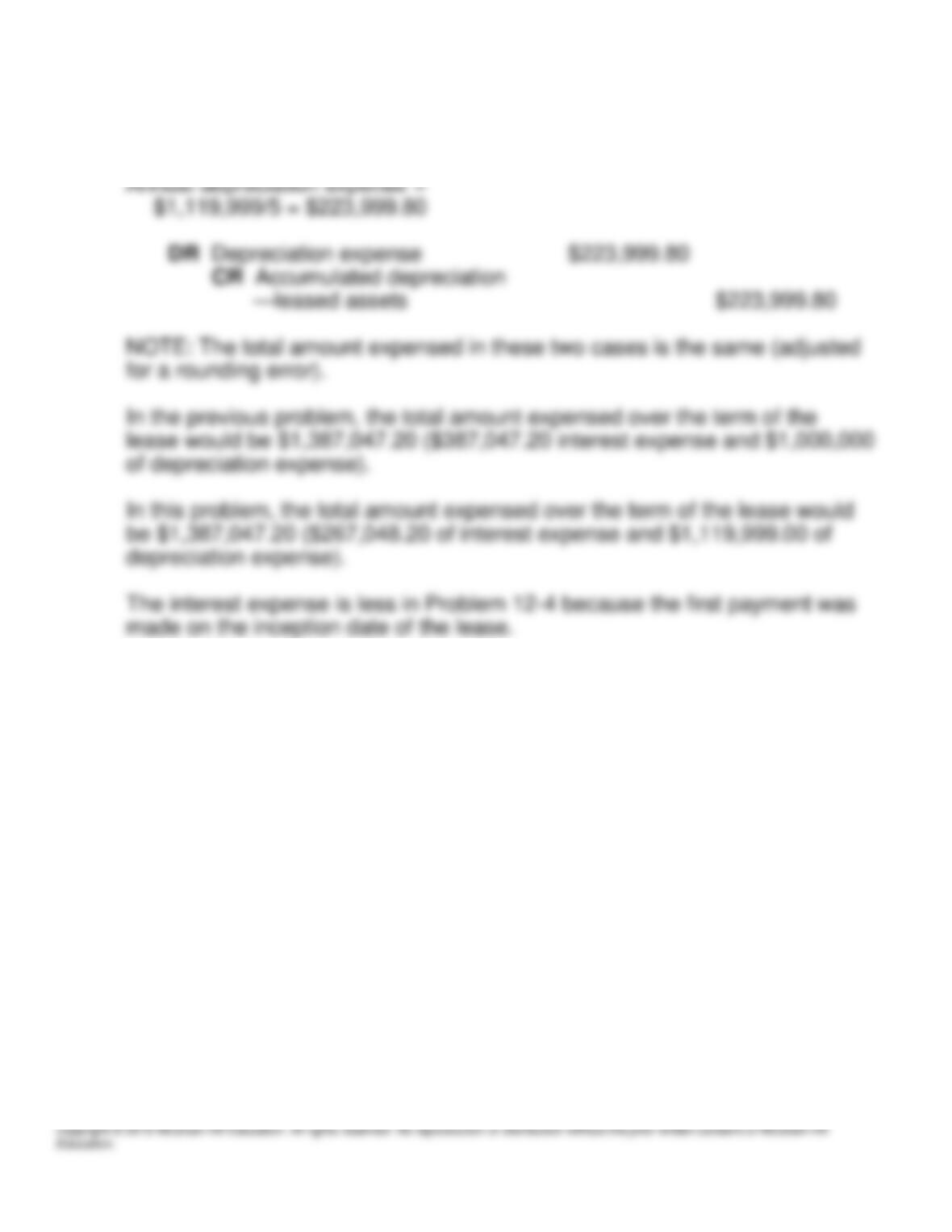
The journal entries are:
1/1/14:
DR Leased assets—capital leases $1,119,999.00
CR Obligations under capital leases $842,589.56
CR Cash 277,409.44
12–28
1/1/16:
DR Obligations under capital leases $277,409.44
CR Cash $277,409.44
2014–2018:
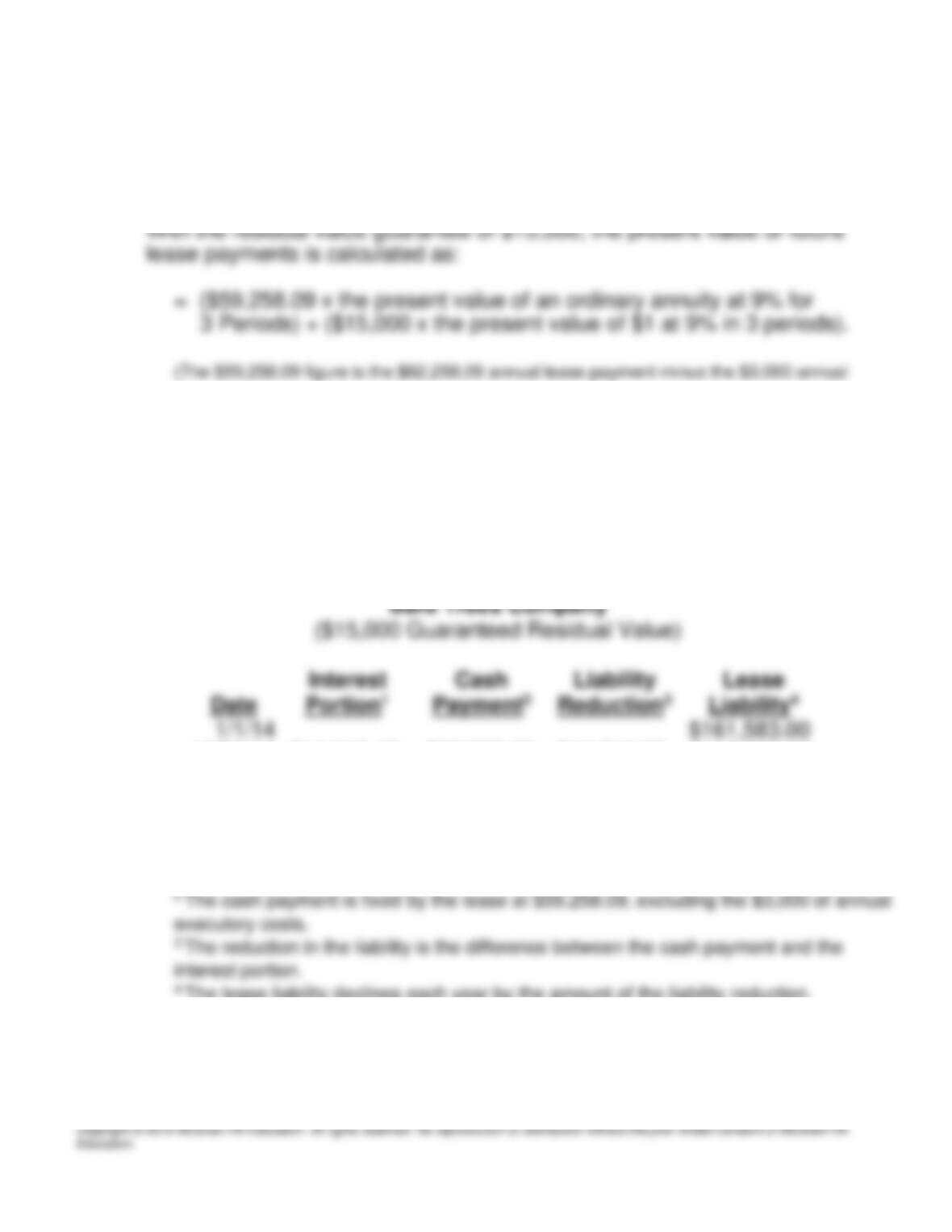
12–29
P12–5. Accounting for lessees’ capital leases including executory costs and
residual value guarantee (LO 3, 4, 5)
Requirement 1:
This is a capital lease to Bare Trees Company because the lease term of
3 years is equal to 75% of the asset’s useful life of 4 years.
executory costs).
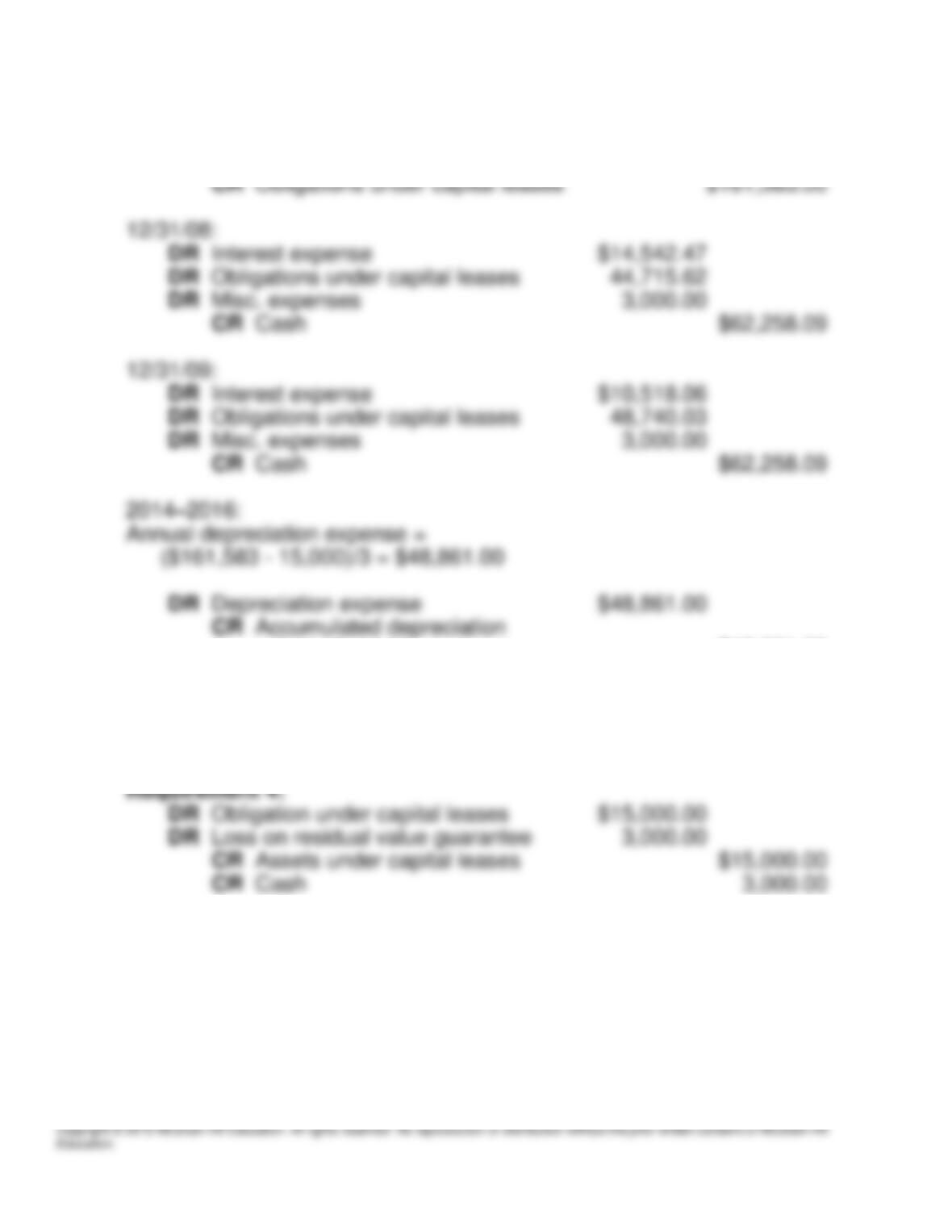
= ($59,258.09 x 2.53130) + ($15,000 x 0.77218)
= $161,583
Appearing below is the amortization schedule for the lease liability:
Amortization of Capital Lease Liability
Bare Trees Company
($15,000 Guaranteed Residual Value)
Interest
Cash
Liability
Lease
Date
Portion1
Payment2
Reduction3
Liability4
1/1/14
$161,583.00
12/31/14
$14,542.47
$59,258.09
$44,715.62
$116,867.38
12/31/15
$10,518.06
$59,258.09
$48,740.03
$68,127.35
12/31/16
$6,130.74*
$59,258.09
$53,127.35
$15,000.00
*Rounded by $0.73.
1 The interest portion is 9% of the carrying amount at the beginning of the period.
12–30
Requirement 2:
The journal entries are:
1/1/08:
DR Leased assets—capital leases $161,583.00
—leased assets $48,861.00
Requirement 3:
DR Obligation under capital leases $15,000.00
CR Assets under capital leases $15,000.00