12-1
Financial Reporting and Analysis (6th Ed.)
Chapter 12 Solutions
E12–1. Accounting for lessee with purchase option (LO 3, 4, 5)
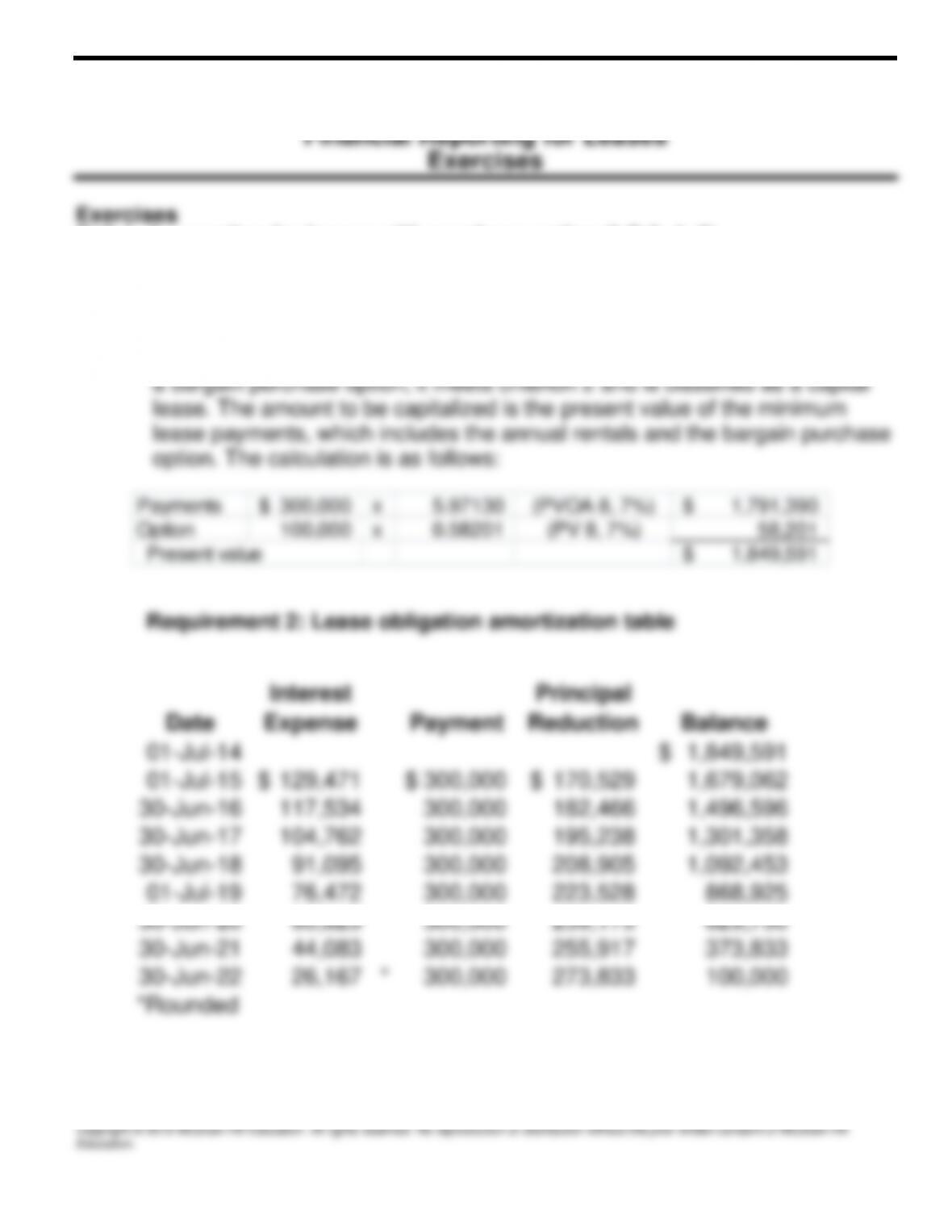
Requirement 1: Amount capitalized by Leland at 07/01/2014
The $100,000 represents a bargain purchase as the amount is significantly
below the expected residual value of $600,000. Given that the lease contains
12-2
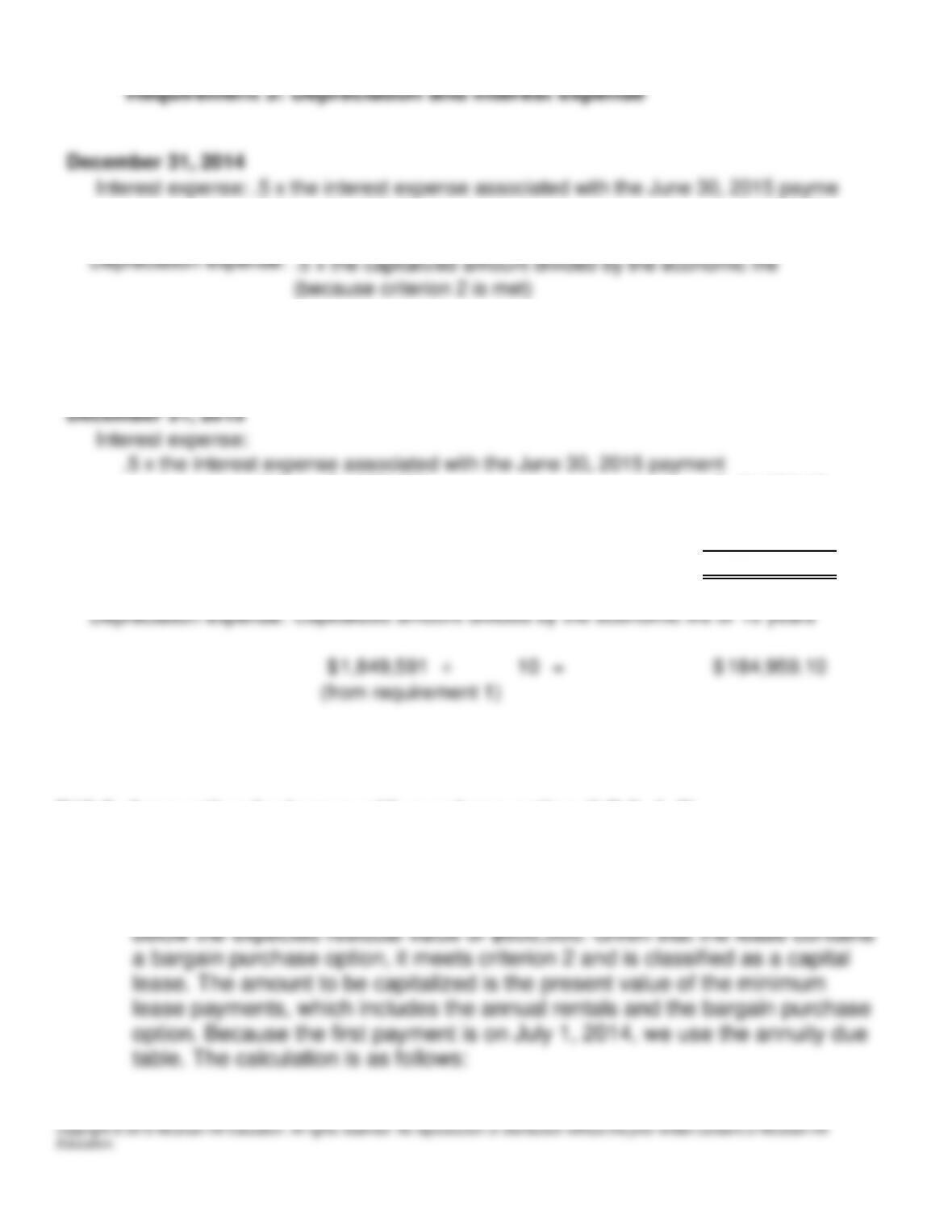
(from requirement 1)
E12–2. Accounting for lessee with purchase option (LO 3, 4, 5)
Requirement 1: Amount capitalized by Leland at 07/01/2014
The $100,000 represents a bargain purchase as the amount is significantly
12-3
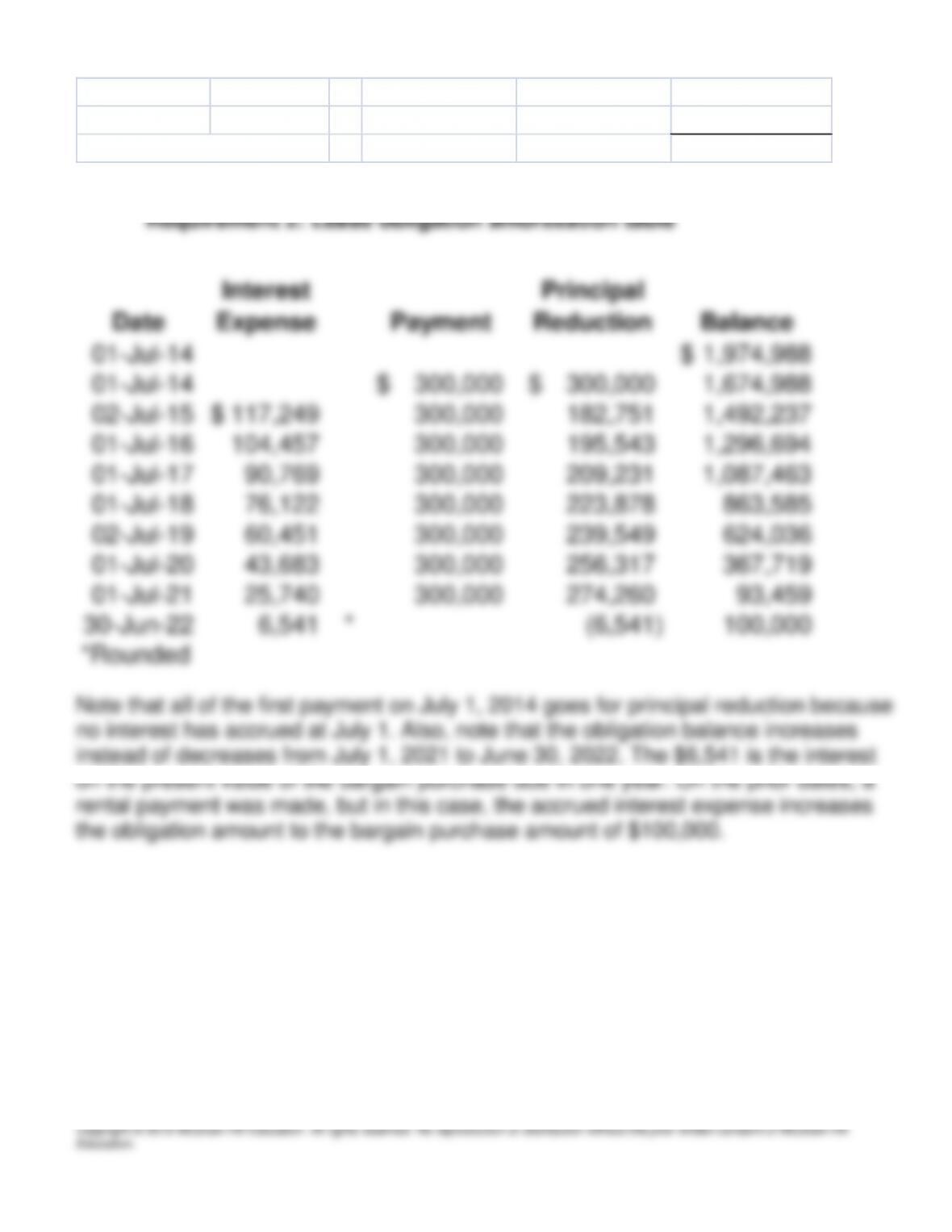
Payments 300,000$ x 6.389290
(PVAD 8, 7%)
1,916,787$
Option 100,000 x 0.582010 (PV 8, 7%) 58,201
Present value 1,974,988$
12-5
Copyright © 2015 McGraw-Hill Education. All rights reserved. No reproduction or distribution without the prior written consent of McGraw-Hill
Education.
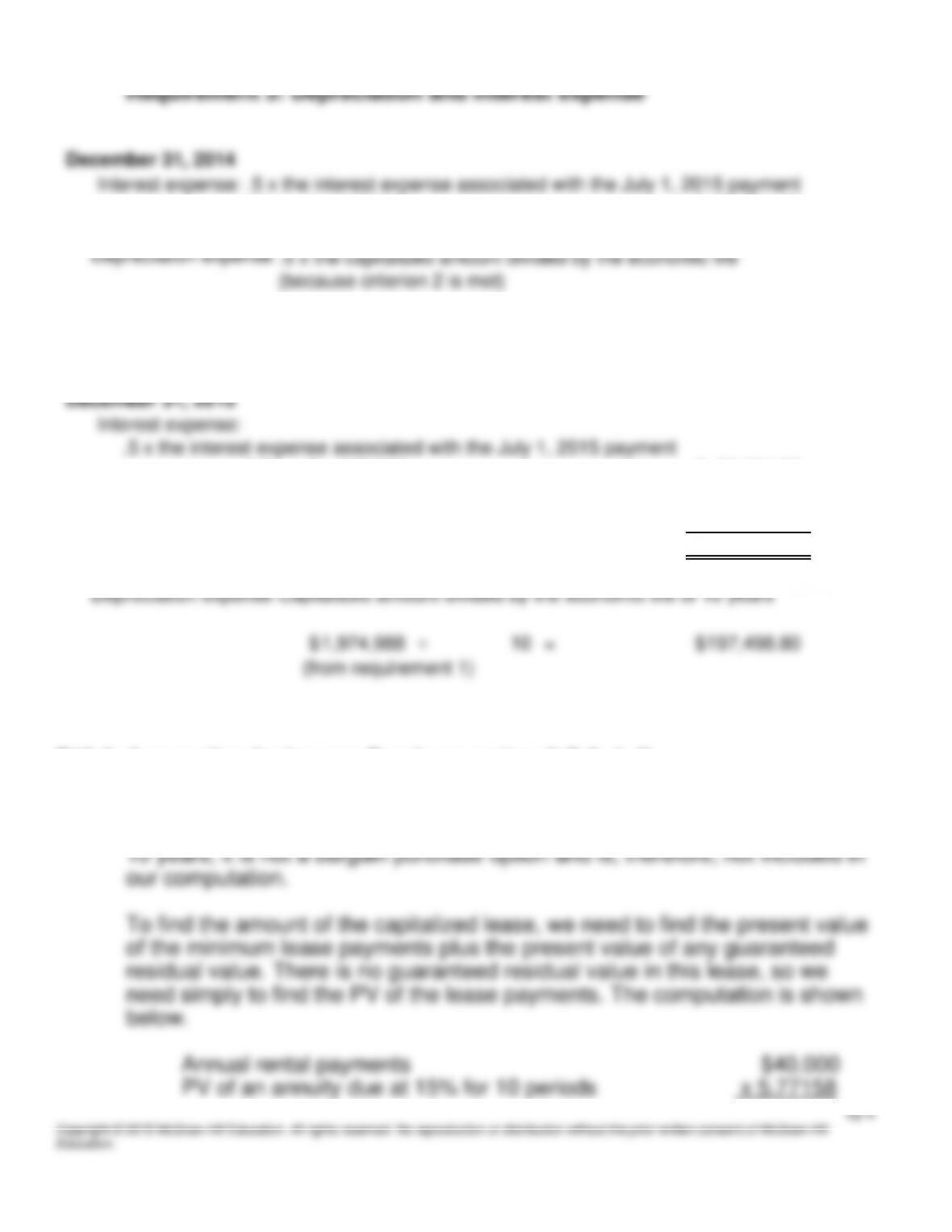
Present value of the minimum lease payments $230,863
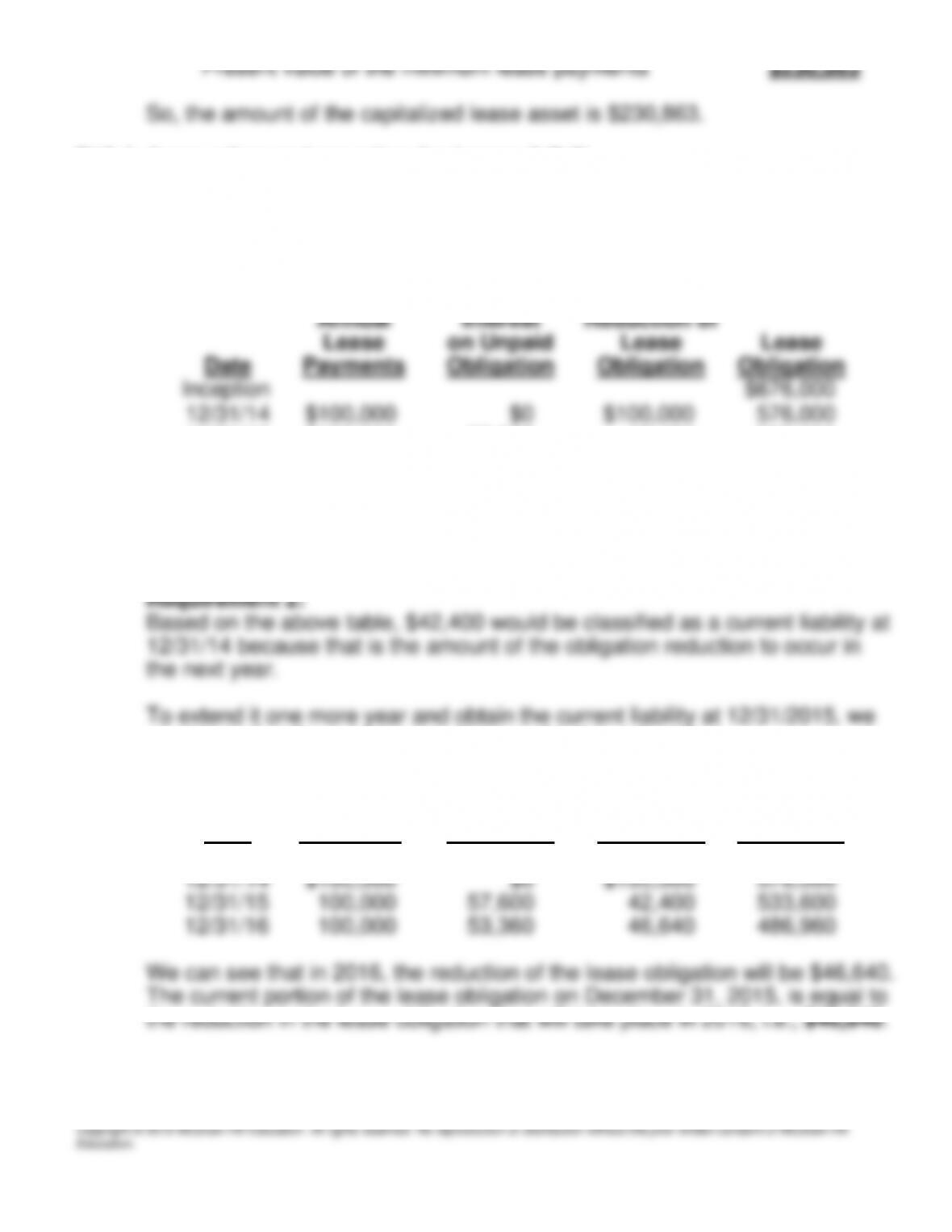
So, the amount of the capitalized lease asset is $230,863.
E12–4. Accounting and reporting for lessee (LO 5)
(AICPA adapted)
Requirement 1:
To compute the 12/31/2015 lease liability amount, we can construct an
amortization schedule.
Date
Annual
Lease
Payments
Interest
on Unpaid
Obligation
Reduction of
Lease
Obligation
Lease
Obligation
Inception
$676,000
12/31/14
$100,000
$0
$100,000
576,000
12/31/15
$100,000
57,600
42,400
533,600
We can see from the amortization table that the reduction of the lease liability
in 2014 is the entire $100,000 rental payment. In 2015, interest accrues on
only $576,000, so the interest expense for 2015 is 10% of $576,000
($57,600), and the lease obligation is reduced by $42,400 to $533,600.
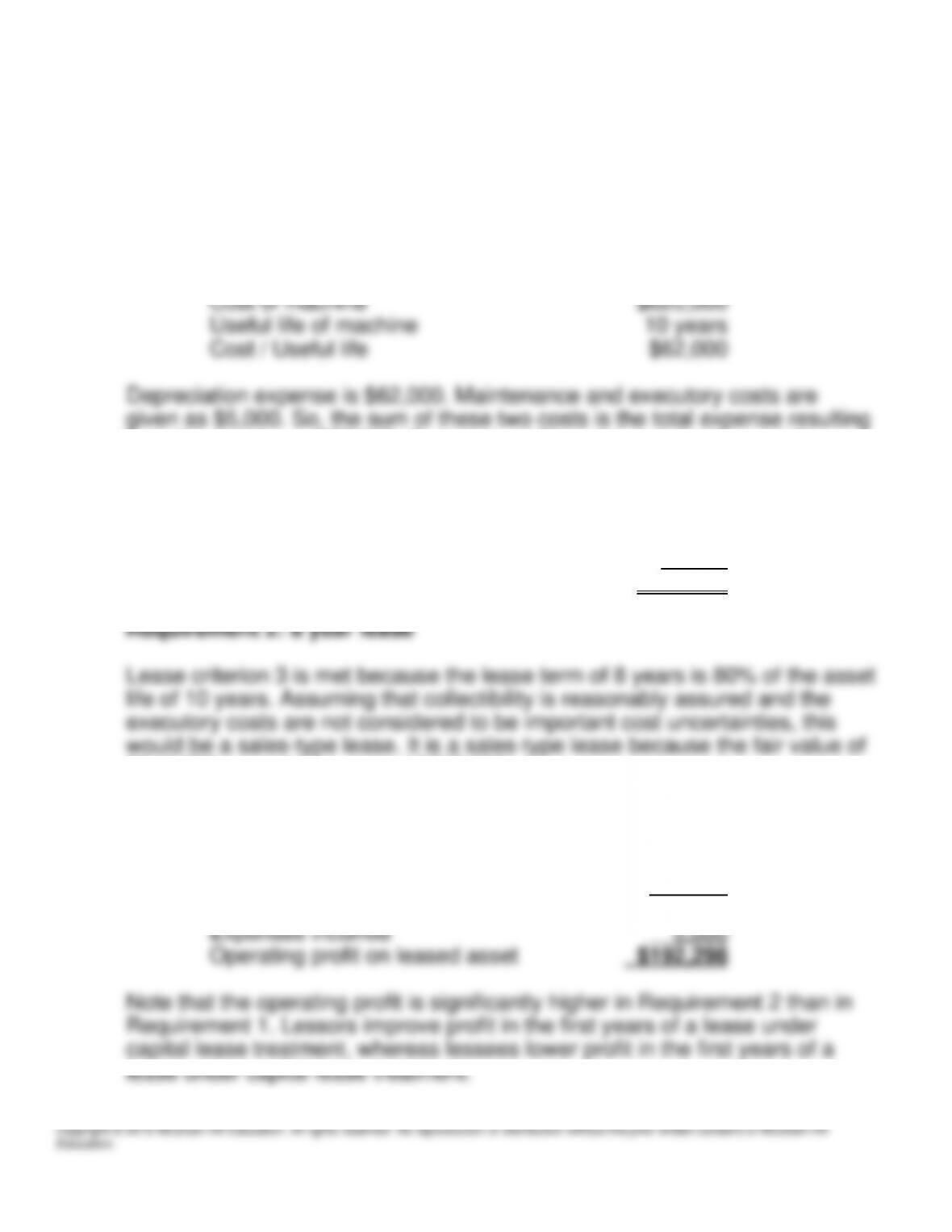
need to look at the next year on the amortization schedule.
Date
Annual
Lease
Payments
Interest on
Unpaid
Obligation
Reduction of
Lease
Obligation
Lease
Obligation
Inception
$676,000
12/31/14
$100,000
$0
$100,000
576,000
12/31/15
100,000
57,600
42,400
533,600
12/31/16
100,000
53,360
46,640
486,960
We can see that in 2016, the reduction of the lease obligation will be $46,640.
The current portion of the lease obligation on December 31, 2015, is equal to
the reduction in the lease obligation that will take place in 2016, i.e., $46,640.
12-6
E12–5. Accounting for lessor (LO 4, 6, 7, 8)
(AICPA adapted)
Requirement 1: 3 year lease
The following are expenses incurred on the machine in 2014.
Depreciation Expense:
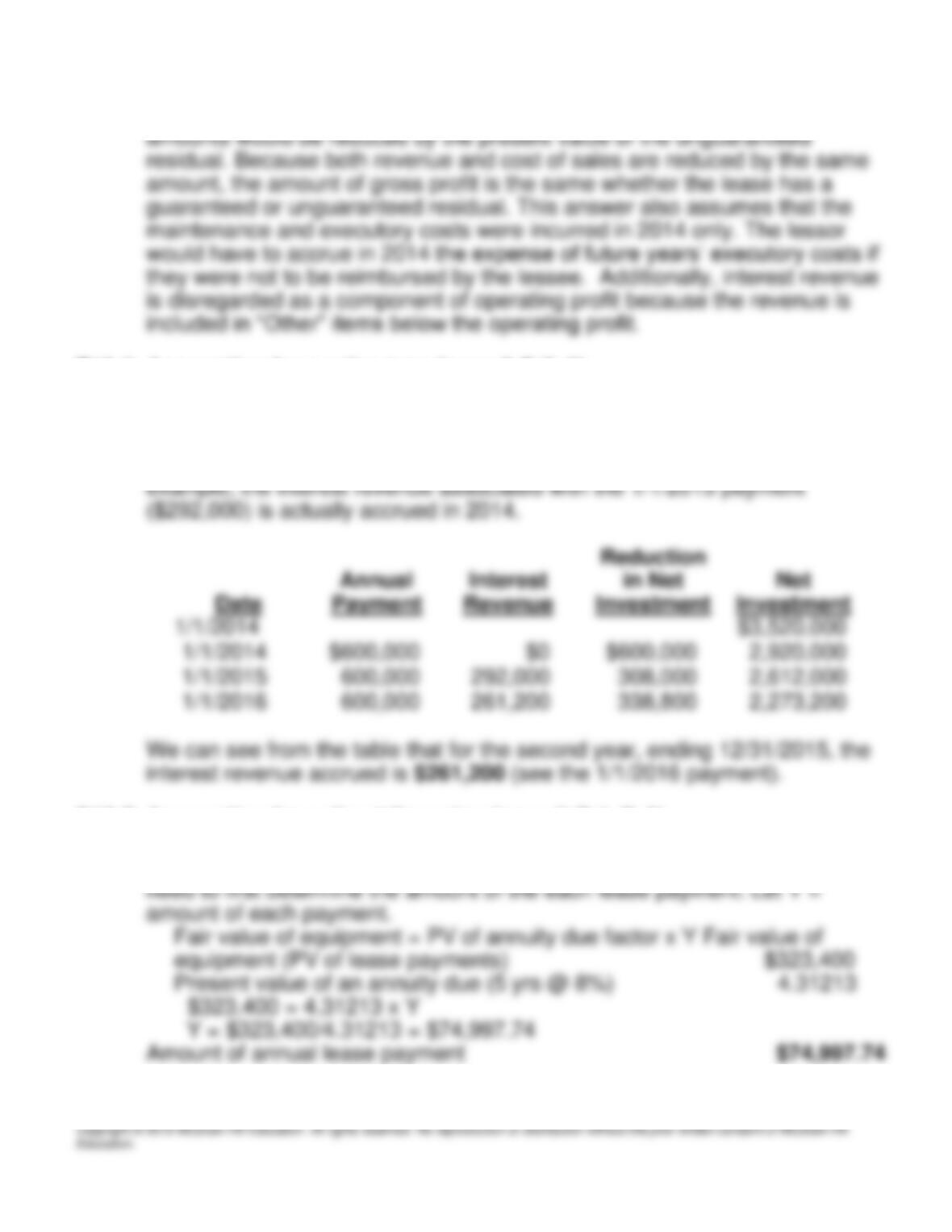
from the machine—$67,000. Operating profit on this asset is the rental
revenue less the expenses Beard incurred because this is an operating
lease:
Rental revenue $125,000
Expenses incurred __67,000
Operating profit on leased asset $58,000
$817,298 exceeds the cost of $620,000.
Operating profit would be as follows:
Revenue $817,298
Cost of sales __620,000
Gross profit $197,298
12-7
The problem does not say whether the residual is unguaranteed or
guaranteed. If it is unguaranteed then both the revenue and the cost of sales
E12–6. Accounting for a sales-type lease (LO 7, 8)
(AICPA adapted)
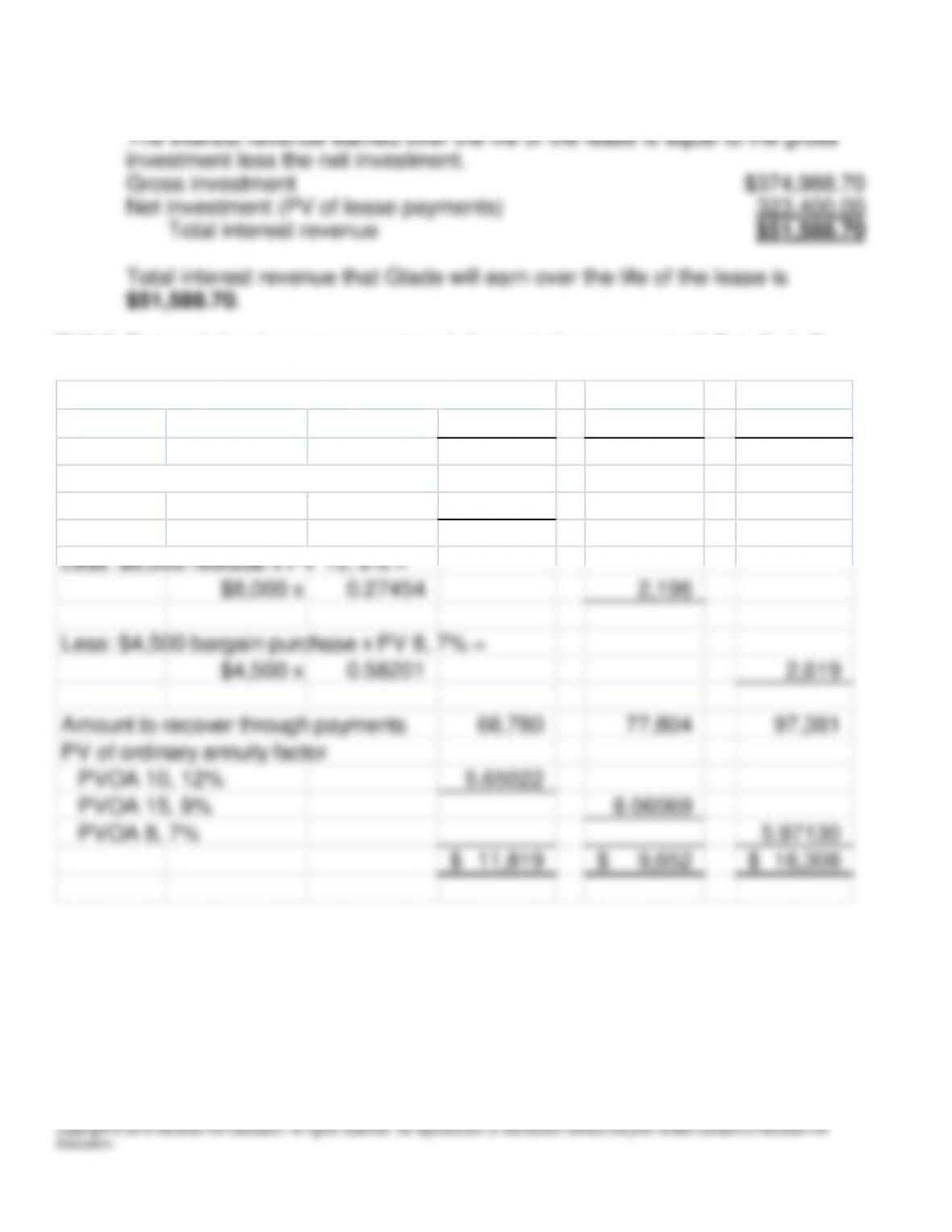
To find the amount of interest income for 2015, we need to look at the lease
amortization schedule below. Benedict accrues the interest over the year. For
E12–7. Accounting for a direct financing lease (LO 1, 7, 8)
(AICPA adapted)
To find the amount of interest revenue earned over the life of the lease, we
12-8
Next, we must find the gross investment or lease payments receivable:
$74,997.74 x 5 yrs = $374,988.70
E12–8. Determining lease payment and depreciation amounts (LO 1, 3, 4, 5)
Part 1 – Lease payment computations
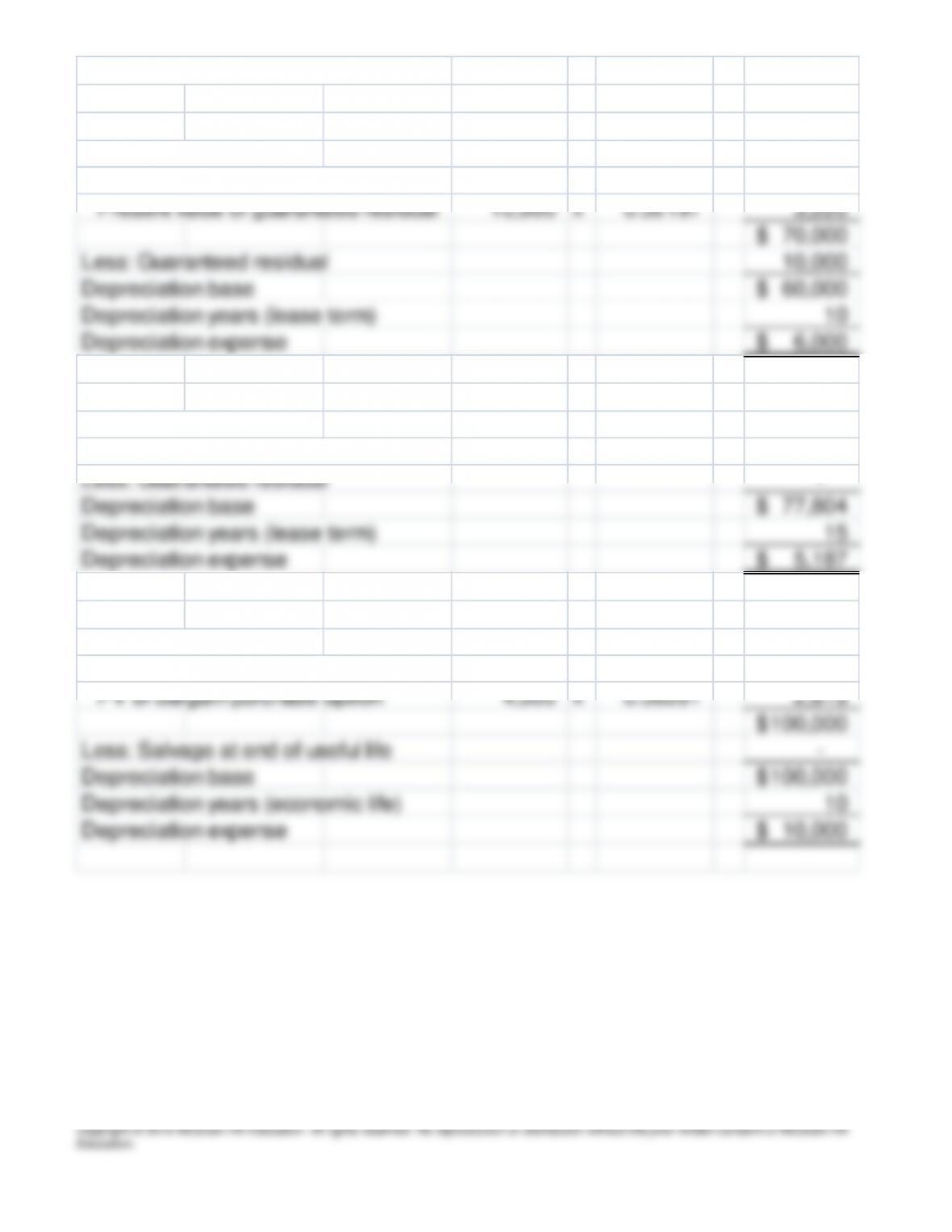
Case 1 Case 2 Case 3
Fair value 70,000 80,000 100,000
Less: $10,000 residual x PV 10, 12% =
$10,000 x 0.32197 3,220
Less: $8,000 residual x PV 15, 9% =
$8,000 x 0.27454 2,196
Less: $4,500 bargain purchase x PV 8, 7% =
$4,500 x 0.58201 2,619
Amount to recover through payments 66,780 77,804 97,381
PV of ordinary annuity factor
PVOA 10, 12% 5.65022
PVOA 15, 9% 8.06069
PVOA 8, 7% 5.97130
11,819$ 9,652$ 16,308$
12-9
Part 2 – Depreciation expense
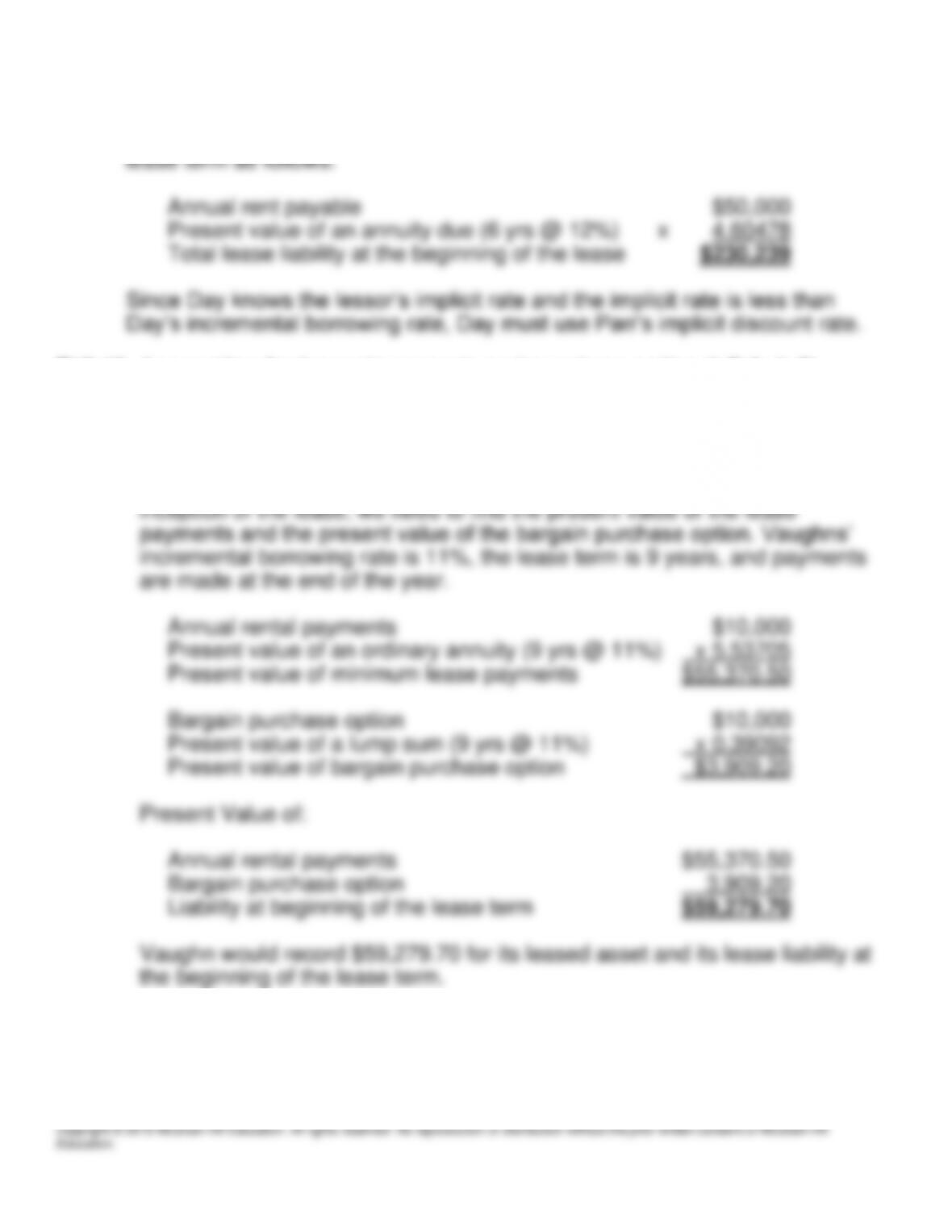
Case 1
Amount capitalized
Present value of payments 11,819$ x 5.65022 66,780$
Present value of guaranteed residual
10,000 x 0.32197 3,220
70,000$
Less: Guaranteed residual 10,000
Depreciation base 60,000$
Depreciation years (lease term) 10
Depreciation expense 6,000$
Case 2
Amount capitalized
Present value of payments 9,652$ x 8.06069 77,804$
Less: Guaranteed residual –
Depreciation base 77,804$
Depreciation years (lease term) 15
Depreciation expense 5,187$
Case 3
Amount capitalized
Present value of payments 16,308$ x 5.97130 97,381$
PV of bargain purchase option 4,500 x 0.58201 2,619
100,000$
Less: Salvage at end of useful life –
Depreciation base 100,000$
Depreciation years (economic life) 10
Depreciation expense 10,000$
12–10
E12–9. Using the appropriate discount rate (LO 3, 5)
(AICPA adapted)
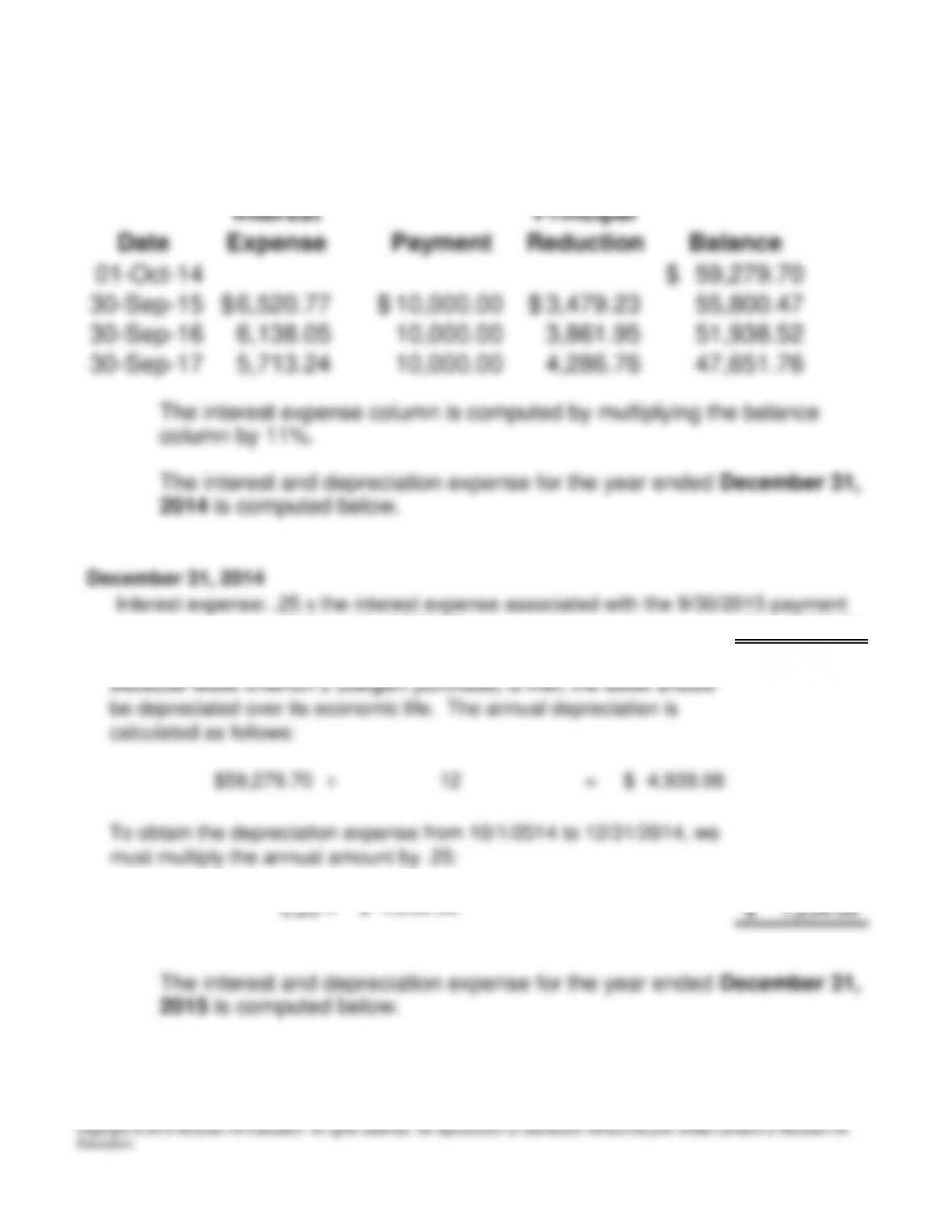
We can determine the amount of Day’s lease liability at the beginning of the
E12–10. Accounting for lessee’s accruals and purchase option (LO 3, 4, 5)
(AICPA adapted)
Requirement 1: Initial leased equipment and lease liability amount
To find the amount of leased asset that Vaughn should record at the
12–11
Requirement 2: Depreciation and interest expense
To obtain interest expense, we prepare a lease obligation amortization table
through the first two payments as follows:
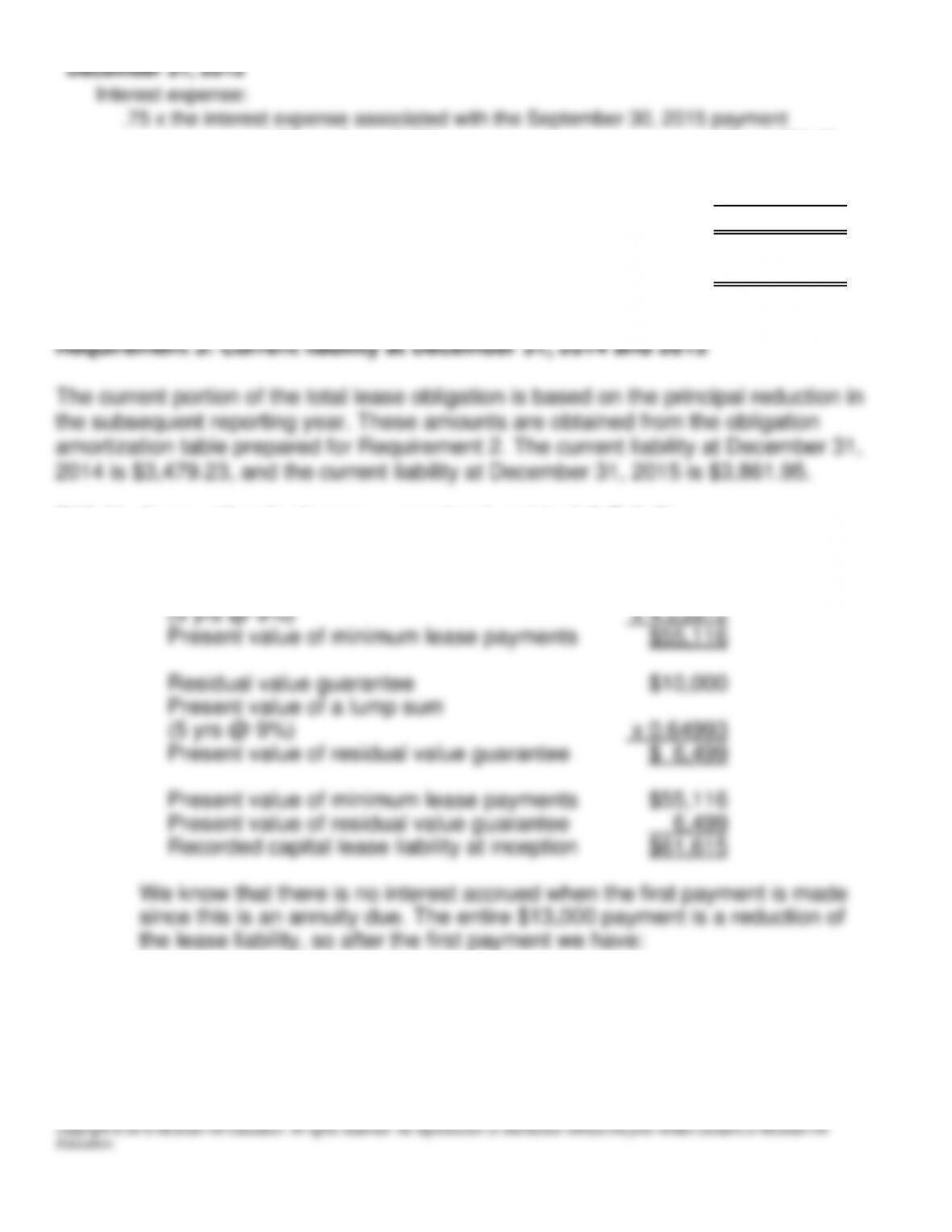
Interest Principal
Date Expense Payment Reduction Balance
01-Oct-14 59,279.70$
30-Sep-15 6,520.77$ 10,000.00$ 3,479.23$ 55,800.47
30-Sep-16 6,138.05 10,000.00 3,861.95 51,938.52
30-Sep-17 5,713.24 10,000.00 4,286.76 47,651.76
The interest expense column is computed by multiplying the balance
column by 11%.
The interest and depreciation expense for the year ended December 31,
2014 is computed below.
December 31, 2014
Interest expense: .25 x the interest expense associated with the 9/30/2015 payment
0.25 x 6,520.77$ = 1,630.19$
Depreciation expense:
59,279.70$
÷12 = 4,939.98$
0.25 x $ 4,939.98 1,234.99$
Because lease criterion 2 (bargain purchase) is met, the asset should
be depreciated over its economic life. The annual depreciation is
calculated as follows:
To obtain the depreciation expense from 10/1/2014 to 12/31/2014, we
must multiply the annual amount by .25:
The interest and depreciation expense for the year ended December 31,
2015 is computed below.
12–12
Copyright © 2015 McGraw-Hill Education. All rights reserved. No reproduction or distribution without the prior written consent of McGraw-Hill
Education.
December 31, 2015
Interest expense:
.75 x the interest expense associated with the September 30, 2015 payment
0.75 x 6,521$ = 4,890.58$
.25 x the interest expense associated with the September 30, 2016 payment
0.25 x 6,138$ = 1,534.51
6,425.09$
Annual depreciation expense (from above) $ 4,939.98
E12–11. Accounting for lessee guaranteed residual (LO 4, 5)
(AICPA adapted)
Annual lease payment $13,000
Present value of an annuity due
12–13
Date
Annual
Payment
Interest
on Unpaid
Obligation
Reduction
of Lease
Obligation
Lease
Obligation
Inception
$61,615
1/1/2014
$13,000
$0
$13,000
48,615
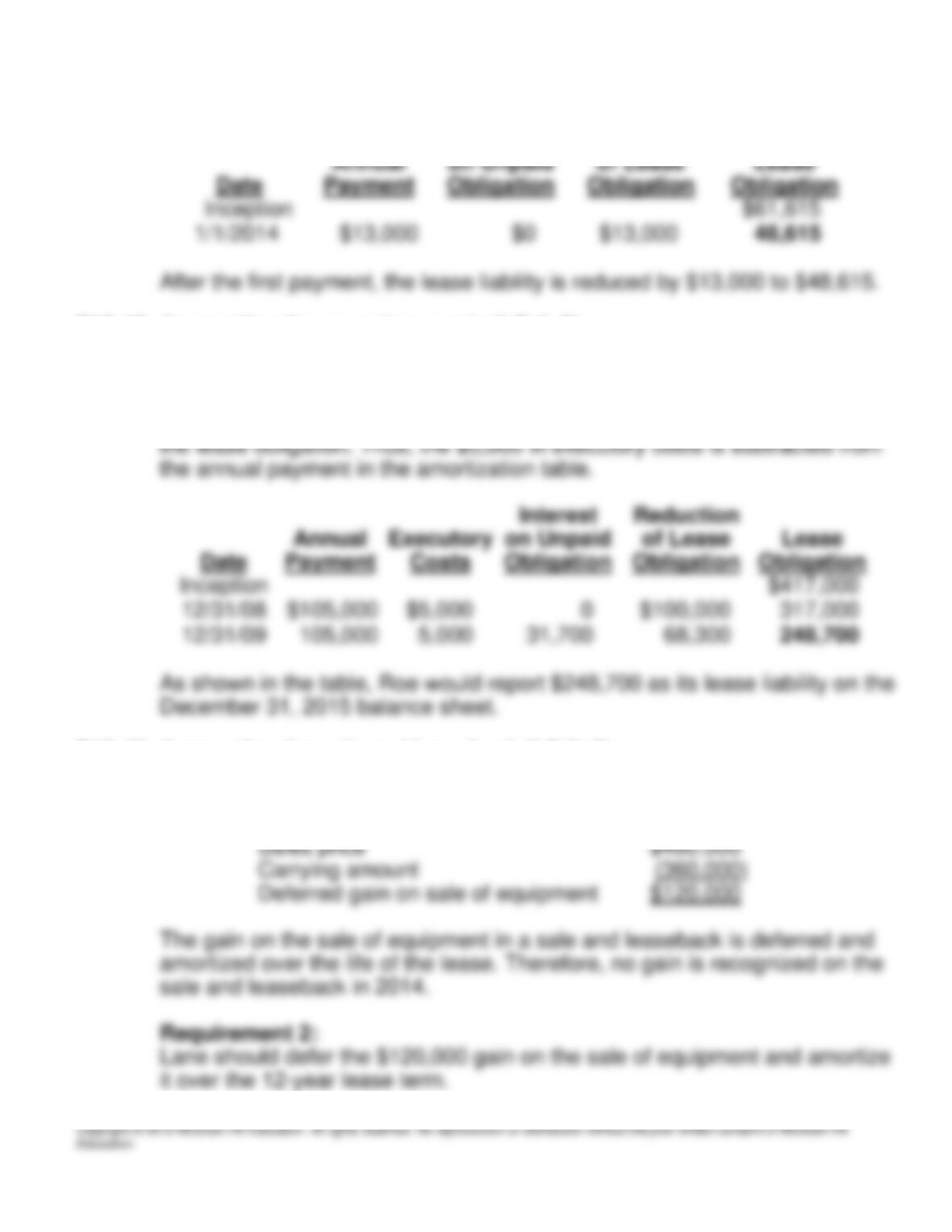
After the first payment, the lease liability is reduced by $13,000 to $48,615.
E12–12. Accounting for executory costs (LO 4, 5)
(AICPA adapted)
A partial lease amortization table for Roe Company follows. Keep in mind
that executory costs are part of the annual payment but they do not reduce
E12–13. Accounting for sale and leaseback (LO 3, 9)
(AICPA adapted)
Requirement 1:
E12–14. Determining cash flow statement effects of capital versus operating
leases (LO 5)
Requirement 1:
If the lease is an operating lease: Each year’s cash flows from operations
would decrease by $30,000 due to the lease payment, and there would be
12–15
1.0. After the leasing transaction is recorded, Nova’s current ratio will
decline since the current liabilities will increase by the amount of the current
portion of the lease liability.
Prior to the lease transaction, Nova’s debt–to-equity ratio was $2,500/
E12–16. Classifying leases under GAAP and IFRS (LO 3, 10)
Requirement 1: Classification under U.S. GAAP
The lease would be a capital lease because the lease term of 5 years is
= 77.3%].