
Financial Reporting and Analysis 6e Financial Reporting for Leases
CHAPTER 12
FINANCIAL REPORTING FOR LEASES
Chapter Overview
The treatment of leases in FASB ASC 840 represents a compromise between the
unperformed–contract and property-right approaches. FASB ASC 840 adopts a middle-of–the-
road position that neither capitalizes all leases nor prohibits capitalization. Instead, the FASB
developed criteria for determining the precise intermediate circumstances under which leases
would be capitalized.
The lease capitalization criteria rely on bright-line rules such as 75% of economic life and
90% of fair value. Because lease capitalization adversely affects lessees’ financial statements,
many lessees structure agreements to avoid lease capitalization.
The proportion of operating lease commitments to capital lease commitments can vary
greatly even between firms in the same industry. This complicates financial analysis because
keeping leases off the balance sheet improves various ratios (e.g., turnover, debt-to-equity, and
the current ratio). Consequently, analysts must constructively capitalize operating leases to make
valid comparisons between firms with different proportions of capitalized leases.
Lessors’ use of the capital lease approach accelerates income recognition in contrast to the
timing of income recognition under the operating lease approach. Lessors’ financial statements
ratios are also improved. It is perhaps not surprising, therefore, that capital leases appear
frequently on lessors’ financial statements.
The FASB and IASB have issued a jointly developed exposure draft on lease accounting.
The proposed accounting adopts a “right–of–use” approach and would require lessees to treat
most leases as capital leases. However, the exposure draft introduces a controversial second
method of accounting for real estate leases that is essentially capital lease accounting on the
balance sheet and operating lease accounting on the income statement and statement of cash
flows. Lessors would have a different model of accounting for real estate leases.
CHAPTER OUTLINE
I. EVOLUTION OF LEASE ACCOUNTING
A. A lease is a contract in which the owner of an asset (the lessor) conveys to another party
(the lessee) the right to use that asset.
1. This right is granted in exchange for a fee (the lease payment) that is usually paid
in installments.
2. Legal title to the asset typically remains with the lessor.
3. At its inception, a lease is what is usually called a mutually unperformed
contract (also called an executory contract), meaning that neither party to the
lease arrangement has yet performed all of the duties called for in the contract.
B. Currently contained under the FASB Accounting Standards Codification Topic 840,
the pre-codification SFAS No. 13 spells out the GAAP for leases.
1. Prior to the issuance of pre-codification SFAS No. 13, virtually all leases were
accounted for using the operating lease approach.
a. The accounting for operating leases conforms to the legal structure of
lease arrangements.
b. Since lease contracts typically do not convey title, the asset remains on the
books of the lessor.

Financial Reporting and Analysis 6e Financial Reporting for Leases
c. The lessee does not immediately record as a liability the stream of future
payments called for in the contract because the lessee is not legally obligated
to make the payments until the lessor performs the duties specified in the
contract.
d. Upon payment of the stipulated rental, the lessee debits rent expense
and credits cash.
e. The lessor records rent revenue as performance takes place.
2. Why Lessees Like the Operating Lease Method: The term off-balance sheet
financing means the lessee has financed the acquisition of asset services without
recognizing a liability on the financial statements.
a. GAAP requires footnote disclosure of the lessee’s future cash flows arising
from operating leases.
b. The appendix to this chapter explains how to make adjustments for off-
balance sheet leases.
3. Keeping the lease liability off the books conveys benefits to borrowers even if the
liabilities are not hidden in a real sense. These benefits are just as substantial as
the benefit from omitting lease liabilities.
4. Keeping the leased asset off the books produces a favorable impact on the
lessee’s financial statements that is as substantial as that from omitting the lease
liabilities.
5. The off-balance sheet liability reduces the likelihood that the lessee-borrower will
violate debt-to-equity loan covenants.
6. Operating leases make the leverage and turnover ratios appear to be more favorable
than the corresponding ratios for companies that own their assets.
C. The Securities and Exchange Commission’s Initiative: More recently, the SEC
issued Accounting Series Release (ASR) No. 147 to improve financial reporting for
leases. It took a property rights approach to the lease accounting. The property rights
approach views leases as conveying property rights in the asset to the lessee and the
payment stream as representing the lessee’s liability. Both asset and liability are
recorded. This is called the capital lease approach. ASR 147 emphasizes disclosure but
does not require balance sheet recognition.
II. LESEE ACCOUNTING
A. Under the FASB Accounting Standards Codification Topic 840, Lessees must
capitalize leases that meet certain specified criteria that is defined as essentially
transferring substantially all of the benefits and risks of ownership.
B. Leases that do not meet the FASB’s ASC 840 criteria cannot be capitalized, and are
accounted for as operating leases as described in the previous section.
C. If at its inception a lease satisfies any one or more of the following criteria, it must be
treated as a capital lease on the books of the lessee:
1. The lease transfers ownership of the asset to the lessee by the end of the lease term.
2. The lease contains a bargain purchase option.
3. The noncancelable lease term is 75% or more of the estimated economic life of the
leased asset.
4. The present value of minimum lease payments equals or exceeds 90% of the fair
value of the leased asset. (This is also referred to as the recovery of investment
criterion.)
D. Each criterion represents a condition under which property rights in the leased asset
have been transferred to the lessee. Current authoritative accounting literature presents

Financial Reporting and Analysis 6e Financial Reporting for Leases
a compromise between the operating lease approach and a strict property rights
approach.
E. Capital lease accounting:
1. The lessee must recognize both an asset and a liability on its books as the dollar
amount equal to the discounted present value of the minimum lease payments
specified in the lease.
a. Contingent rentals are ignored.
b. The discount rate that is used to determine the present value is the lower of
the lessee’s incremental borrowing rate or the lessor’s rate of return that is
implicit to the lease.
c. The amount recorded for both the asset and the liability is equal only at the
inception of the lease.
2. Each lease payment includes both interest (measured using the effective interest
method) and principal reduction.
3. Depreciation expense in accordance with the lessee’s depreciation schedule for
assets of this type is also recorded.
4. Executory costs (costs of using assets), including maintenance, insurance, taxes,
and other incidental costs of using the leased asset, are omitted when determining
minimum lease payments.
a. Executory costs are not included in either the capitalized asset or the liability.
b. Executory costs are treated as period costs that are charged to expense when
paid.
5. A residual value guarantee requires a lessee to pay a lessor the difference if the
actual market value of the leased asset falls below the guaranteed residual amount.
a. The lessee must include the amount specified as the residual value guarantee
in the computation of the minimum lease payment since the lessee potentially
owes the full amount of the guarantee to the lessor.
b. If the guaranteed residual at the end of the lease exceeds the market value of
the leased asset, then the lessee records a loss equivalent to the cash paid to
the lessor.
c. If the guarantee requires no payment, then the remaining asset and liability
balances are eliminated, with no resulting profit effect.
d. The residual value guarantee gives lessor protection against lessees who
abuse leased assets.
6. Payments in Advance: When lease payments are due at the start of each lease
period, the entries differ from those with payment starting later.
F. Financial Statement Effects of Treating a Lease as a Capital Lease versus
Treating it as an Operating Lease:
1. The two methods give rise to identical cumulative total lifetime charges to
expense.
a. Under the operating lease method, the total rent expense over the life of the
lease is equal to the total lease payments.
b. Under the capital lease method, the total lease expense over the life of
the lease comprises both:
i. The interest payments, and
ii. The amortization of the capitalized asset amount.
2. However, the timing of the expense charges differs between the two methods.
a. The capital lease approach leads to higher expense in the earlier years of the
lease and lower expense in the later years.
b. The operating lease approach leads to a constant lease expense each year

Financial Reporting and Analysis 6e Financial Reporting for Leases
even if the payments do not follow this pattern.
c. This accelerated recognition of lease expenses under the capital lease
approach provides another reason why many lessees prefer the
operating lease method.
Teaching Tip: Capital leases result in higher operating income (earnings before interest
and taxes) since annual straight-line depreciation expense is lower than the annual rental
expense reported under the operating lease method. For an individual lease, this difference
is never reversed and remains constant over the lease term, given constant lease payments
and use of the straight-line depreciation method.
G. The current ratio over the lease term will be lower under the capital lease approach than
it would be under the operating lease approach.
H. Cash flow statement implications also arise from lease treatment.
1. For capital leases, only the interest portion of each lease payment is reported as
an operating cash outflow, while the principal reduction portion of each lease
payment is reported as a financing cash outflow.
2. For operating leases, each lease payment is reported as an operating cash outflow.
I. Lessee’s Financial Statement Disclosures: A schedule of future minimum lease
payments (may be aggregated) must be reported both for capital leases and
operating leases. U.S. GAAP requires the disclosure of present value of minimum
lease payments only for capital leases.
III. LESSOR ACCOUNTING
A. Treating a lease as a capital lease on the lessor’s books accelerates the timing of the
recognition of leasing income. From the perspective of the lessor, the lease is treated as
a capital lease if a lease arrangement (1) transfers property rights in the leased asset to the
lessee and (2) allows reasonably accurate estimates regarding the amount and
collectibility of the eventual net cash flows to the lessor.
1. If both conditions for capital lease treatment are not simultaneously met, the lease
must be treated as an operating lease.
2. In a capital lease, the leased asset is removed from the lessor’s books.
3. There are two types of capital leases for lessors:
a. A sales-type lease exists when the lessor is a manufacturer or dealer.
b. A direct financing lease exists when the lessor is a financial institution.
B. Sales-type leases can serve as a marketing tool since leasing arrangements generate
“sales” from potential customers who are unwilling or unable to buy the assets outright
for cash.
1. The lessor earns a profit from two sources:
a. A manufacturer’s or dealer’s profit which is the difference between
the cash selling price (fair value) and its cost to the manufacturer or
dealer.
b. A financing profit which is the difference between the total (undiscounted)
minimum lease payments plus unguaranteed residual value and the fair value
of the leased asset.
2. At inception of the lease:
a. The lessor records an asset called “Gross investment in leased asset”—the sum
of the minimum lease payments plus the guaranteed residual value of the asset
at the end of the lease term. (Think of this asset account as an account
receivable.)

Financial Reporting and Analysis 6e Financial Reporting for Leases
b. The lessor credits sales revenue for the cash selling price of the leased asset.
c. The lessor credits “Unearned financing income” for the excess of the gross
investment in leased assets over its fair market value.
d. Cost of goods sold and the reduction in inventory are also recorded.
3. Financing profit is recognized over the life of the lease.
a. The total cash receipt is credited to the “Gross investment in leased assets”
account.
b. Annual financing profit is calculated using the effective interest method
and is debited to the “Unearned financing income” account.
C. Direct financing leases exist when a third-party financial institution provides lessees
with the means for financing asset acquisitions.
1. These organizations acquire assets from manufacturers by paying the fair market
value and then leasing the asset to the lessee.
2. These lessors earn their profit from a single source—the finance fee that they charge
the lessee for financing the asset acquisition.
3. At inception of the lease:
a. The lessor records an asset called “Gross investment in leased asset”—the sum
of the minimum lease payments plus the guaranteed residual value of the asset
at the end of the lease term. (Think of this asset account as an account
receivable.)
b. The lessor credits the equipment account for the fair market value of the leased
asset.
c. The lessor credits “Unearned financing income” for the excess of the
gross investment in leased assets over its fair market value.
4. Financing profit is recognized over the life of the lease.
a. The total cash receipt is credited to the “Gross investment in leased assets”
account.
b. Annual financing profit is calculated using the effective interest method
and is debited to the “Unearned financing income” account.
Teaching Tip: Most lessors net the “Unearned financing income” account against the
“Gross investment in leased asset” account. Under both the sales-type and direct financing
leases, this net amount equals the fair value of the equipment leased. This parallels, in
many ways, the accounting for sales under the installment sales method, discussed in detail
in Chapter 3, where the deferred gross profit is often deducted on the balance sheet from
gross installment accounts receivable. Note that this accounting “understates” the net
realizable value of these “net receivables” relative to the actual gross collections that are
expected.
D. Lessor’s operating leases result when the leased asset is not considered “sold.”
1. The leased asset remains on the books of the lessor.
2. Rental revenue is recognized when each lease payment is earned.
3. Depreciation expense in accordance with the lessor’s depreciation schedule for
assets of this type is also recorded each period.
E. Distinction between Capital and Operating Leases: A lease meeting at
least one of the Type I characteristics and both of the Type II characteristics
is classified as a capital lease.
1. Type I characteristics are identical to the lessee’s criteria for capital lease

Financial Reporting and Analysis 6e Financial Reporting for Leases
treatment.
a. The lease transfers ownership of the asset to the lessee by the end of the
lease term.
b. The lease contains a bargain purchase option.
c. The noncancelable lease term is 75% or more of the estimated economic life
of the leased asset.
d. The present value of minimum lease payments equals or exceeds 90% of the
fair value of the leased asset.
2. Type II characteristics establish the appropriate time for recognizing income
on the lessor’s books.
a. The collectibility of the minimum lease payments is reasonably predictable.
b. No important uncertainties surround the amount of unreimbursable costs yet
to be incurred by the lessor under the lease.
3. When at least one of the Type I characteristics and both of the Type II
characteristics are satisfied by a lease, the criteria for revenue recognition are
met and the sale, matched costs, and the profit can be recognized
immediately.
4. FASB ASC 840 tries to establish symmetry in the accounting for leases by
lessors and lessees, but this symmetry is not perfect.
F. Guaranteed versus Unguaranteed Residual Values:
1. Lease contracts do not usually require lessee to guarantee that the residual value
will exceed a certain amount.
2. Only guaranteed residual values are obligations to the lessee and are included in
the minimum lease payments.
G. Financial Statement Effects of Direct Financing versus Operating Leases:
1. Income over the life of the lease is unaffected by the accounting method used.
2. However, the timing of income does differ between the two methods.
a. The direct financing method recognizes income sooner.
b. This income timing difference widens if an accelerated depreciation
method, as opposed to the straight-line method, is used in conjunction
with the operating method.
c. This “front–ending” of income under the direct financing method may
explain why lessors—unlike lessees—have never seriously opposed the
property rights approach to lease accounting.
3. Other favorable financial statement effects under the direct financing method:
a. The lessor’s rate of return on gross asset ratio is usually improved in the early
years of a particular lease. (This effect reverses as the lease grows older.)
b. The current ratio is also improved since the principal reduction over the
next 12 months is classified as a current asset.
IV. ADDITIONAL LEASING ASPECTS:
A. A sale and leaseback condition exists when one company sells an asset to another
company and immediately leases it back.
1. This is done as a way to finance asset acquisition and/or for tax reasons.
2. The lessee can treat the entire annual rental as a deductible expense for tax
purposes.
a. For example, the sale and leaseback of a building and land results in the
deduction for tax purpose of the entire lease payment.
b. If the lessee had continued to own the property, it could deduct depreciation

Financial Reporting and Analysis 6e Financial Reporting for Leases
only for the building itself, but not for the land on which the building is
located.
c. The cash infusion may help meet cash flow needs.
3. Treatment of the difference between the sale price and the carrying value of the asset
on the lessee’s books is treated as a deferred gain and is amortized into income
using the same rate and life that is used to amortize the asset itself.
a. If the lease is an operating lease to the lessee, the gain is amortized in
proportion to the rental payment.
b. The lessee immediately recognizes any loss.
3. Sale and leaseback accounting cannot be used when the seller-lessee retains some of
the risks and rewards of ownership since it is not consistent with a “sale.”
B. Other Special Lease Accounting Rules:
1. Leveraged leases and leases involving real estate require specialized accounting
rules.
C. Financial Reporting versus Tax Accounting for Leases: The U.S. income tax
rules also distinguish between operating and capital leases.
The tax criteria for differentiating them are not the same as the GAAP criteria.
1. Lessees prefer the capital lease approach because it accelerates recognition of
expense and thereby lowers the discounted present value of their tax liability.
2. Lessors prefer the operating lease approach on the tax return because it delays
recognition of revenues and lowers the present value of the tax liability.
3. Synthetic leases allow lessees to achieve operating lease treatment for financial
purposes and capital lease treatment for tax purposes.
D. Lessor’s disclosures:
1. Capital and operating leases must be disclosed separately.
2. A minimum lease payment schedule must be provided.
3. The components of the net investment in capital leases are delineated, as are the
cost and accumulated depreciation of assets under operating leases.
E. The criteria that trigger capital lease treatment are easily evaded. Operating leases
predominate in financial reporting, but the proportion of operating lease payments to
capital lease payments can vary greatly between firms in the same industry.
V. GLOBAL VANTAGE POINT
A. Comparison of IFRS and GAAP Lease Accounting: Accounting requirements under
International Accounting Standards (IAS) 17 – Leases are similar to those under ASC
840 except for the following key differences.
1. Classification criteria for both the lessee and lessor are different from the ASC 840
criteria with the classification depending on which party has the risks and rewards
of ownership. For IFRS, whether a lease is a finance lease or an operating lease
depends on the substance of the transaction rather than the form of the contract.
a. Instead of the ASC 840’s bright-line of 75% of the economic life, IAS 17
states “major part” and instead of 90% of fair value, IAS 17 states
“substantially all”.
b. When computing for the present value of minimum lease payments, the
lessee should use the implicit interest rate if knows whereas under ASC
840, the lessee should use the lower of the implicit rate or the incremental
borrowing rate.
c. Under IAS 17, the classification criteria for the lessor and lessee are the

Financial Reporting and Analysis 6e Financial Reporting for Leases
same; the two additional lessor criteria under ASC 840 are absent.
2. A second difference relates to the ability for lessees to classify some assets held
under leases as investment property.
3. The time interval for reporting (disclosure) is different. IAS 17 lessor
disclosures are similar to ASC 840 but combine the payments for years two
through five, as is done for lessees.
B. FASB and IASB Joint Exposure Draft: to improve lease accounting. In May 2013,
the FASB and IASB issued a jointly developed leasing exposure draft. They take the
property rights approach and would require lessees to treat leases as capital leases.
a. To obtain the initial present value of the leased asset, they use an implicit rate
or the incremental borrowing rate.
b. Lease terms will include renewal options if lessee has significant incentive to
renew
c. Lessees will include variable rental payments (tied to an index) in their
present value calculations.
d. Under FASB’s proposal, firms would discount these payments and place the
present values on the balance sheet as capital leases.
e. Although initial balance sheet effect is the same for all long-term leases,
subsequent changes to the balance sheet depend on whether the asset is
equipment or property. Equipment is defined as Type A leases, and property
leases are defined as Type B leases.
f. Accounting for Type A leases is the same as accounting for capital leases.
Accounting for Type B leases yields depreciation that is equal to the
difference between the lease payment and interest expense for the period.
g. The concept of Type B leases is controversial from theoretical, complexity,
and cost-benefit viewpoints.
h. The IASB exposure draft is nearly identical to the FASB’s proposal except
differences arise because both lessees and lessors have the ability to classify
some types of assets as investment property.
VI. APPENDIX: MAKING FINANCIAL STATEMENT DATA COMPARABLE BY
ADJUSTING FOR OFF-BALANCE SHEET LEASES
A. The most straightforward method for making lessees’ balance sheet data comparable is
to treat all leases as if they were capital leases. This is called constructive
capitalization.
B. If operating leases were treated as capital leases, the liability that would appear on the
balance sheet is the discounted present value of the total net minimum operating lease
payments.
1. A discount rate must be selected.
a. The weighted average discount rate for all capital lease commitments is
appropriate if it is disclosed.
b. The weighted average rate on outstanding interest bearing long-term debt
provides a reasonable estimate of the lease discount rate.
2. Estimating Payments Beyond Five Years:
a. Assume that the minimum lease payment five years out continues for the
number of years required to account for the aggregate amount.
b. Assume that the decline in the minimum lease payments over the next five years
continues during the years that are aggregated.

Financial Reporting and Analysis 6e Financial Reporting for Leases
C. Next, an estimate of the capital lease asset is required.
1. Assume that the liability and the asset continue, beyond lease inception, to be equal.
2. However, since lease assets are generally less than lease liabilities throughout the
life of the lease, a percentage of the liability can be attributed to the asset.
a. The relationship depends on the discount rate.
b. The relationship depends on the duration of the lease term.

Financial Reporting and Analysis 6e Financial Reporting for Leases
CHAPTER QUIZ
1. For a capital lease, the amount recorded initially by the lessee as a liability should normally:
a. Exceed the total of the minimum lease payments.
b. Exceed the present value of the minimum lease payments at the beginning of the lease.
c. Equal the total of the minimum lease payments.
d. Equal the present value of the minimum lease payments at the beginning of the lease.
2. Which of the following best characterizes how a corporation’s financial reporting affects a
firm’s decision to either lease or buy an asset?
a. A company with a high debt to equity ratio will structure a lease as an operating
lease to meet a loan covenant.
b. A company will want a lease classified as operating in order to raise the return on
assets ratio.
c. Special Purpose Entities (SPEs) are used to create an off-balance sheet asset along
with the corresponding liability by transferring lease obligations to related party
entities.
d. All of the above.
3. Which of the following factors favors the structuring of leases as operating?
a. Corporate bond covenants contain specific covenants relating to financial policies that
the firm must follow.
b. Lessee ownership is closely held so that risk reduction is important.
c. Lessee has a comparative advantage in reselling the asset.
d. The asset is not specialized to the lessee.
4. Assume a noncancellable lease beginning December 31, 2015, with annual minimum lease
payments of $10,000 made at the end of each year for four years. Ten percent is assumed to
be the appropriate interest rate. If the lease is treated as a capital lease, how is the annual
rental expense allocated between interest and principal over the life of the lease?
Interest Principal
a. $0 $40,000.
b. $8,300. $31,700.
c. $9,400. $30,600.
d. $10,500 $29,500.
5. What role do the lease capitalization criteria have in determining the period over which the
leased asset is depreciated?
a. The asset is always depreciated over the lease term.
b. The asset is always depreciated over its estimated economic life.
c. The asset is depreciated over its estimated economic life when one of the transfer of
ownership criteria is met.
d. The asset is depreciated over the lease term when one of the transfer of ownership
criteria is met.

Financial Reporting and Analysis 6e Financial Reporting for Leases
6. Assuming the same facts as in #4 above, which of the following best describes the
relationship between the balance sheet asset and liability attributable to the lease?
a. The net book value of the leased asset exceeds the carrying value of the lease obligation
during the lease term.
b. The carrying value of the lease obligation exceeds the net book value of the leased asset
during the lease term.
c. The net book value of the leased asset equals the carrying value of the lease obligation
during the lease term.
d. The net book value of the leased asset exceeds the carrying value of the lease obligation
only during the first two years of the lease term.
7. Assuming the same facts as in #4 above, which of the following best describes the income
statement effects of lease classification?
a. Total rent expense recorded under the operating lease classification exceeds total
expense recorded under the capital lease classification.
b. Total rent expense recorded under the capital lease classification exceeds total
expense recorded under the operating lease classification.
c. Total rent expense recorded under the operating lease classification equals total
expense recorded under the capital lease classification in each of the four years.
d. Total rent expense recorded under the capital lease classification exceeds total
expense recorded under the operating lease classification in the last two years of
the lease term.
8. What is the difference between a direct financing and a sales-type lease?
a. The difference between the sum of all lease payments and the cost of the leased
asset to the lessor is interest income for direct financing leases, and is part interest
and part sales income for sales-type leases.
b. Lessees usually depreciate the direct financing leases over the term of the lease and
sales-type leases over the useful life of the leased asset.
c. The lease payments receivable on the books of a lessor are recorded at their present
value for sales-type leases and at their gross value for direct financing leases.
d. The lessor records the present value of the residual value of the leased asset for
direct financing leases, but records the undiscounted (gross) residual value for
sales–type leases.
9. A lessor leased a machine for a 10-year period, which approximated the useful life of the
machine. The lessor purchased the machine for $160,000 and expects to earn a 10% return
on its investment, based on an annual rental of $23,672 payable in advance each January 1.
Assuming that the lease was a direct financing lease, calculate the amount of interest income
the lessee will record at the end of the first year of the lease.
a. $7,672.
b. $13,632.
c. $16,000.
d. $23,672.
Financial Reporting and Analysis 6e Financial Reporting for Leases
10. Assuming the same facts as in #9 above, what is the dollar amount of unearned interest
revenue at the lease inception?
a. $63,088.
b. $76,720.
c. $90,352.
d. $100,392.
QUIZ ANSWERS:
1. d. FASB ASC 840 requires that the lessee record a capital lease as an asset and a liability at
the present value of the minimum lease payments during the lease term. The discount rate
is the lower of the lessor’s implicit interest rate or the lessee’s incremental borrowing rate
of interest. The present value cannot exceed the fair value of the leased asset at the
inception of the lease.
Financial Reporting and Analysis 6e Financial Reporting for Leases
Copyright © 2015 McGraw-Hill Education. All rights reserved. No reproduction or distribution without the prior written
consent of McGraw-Hill Education.
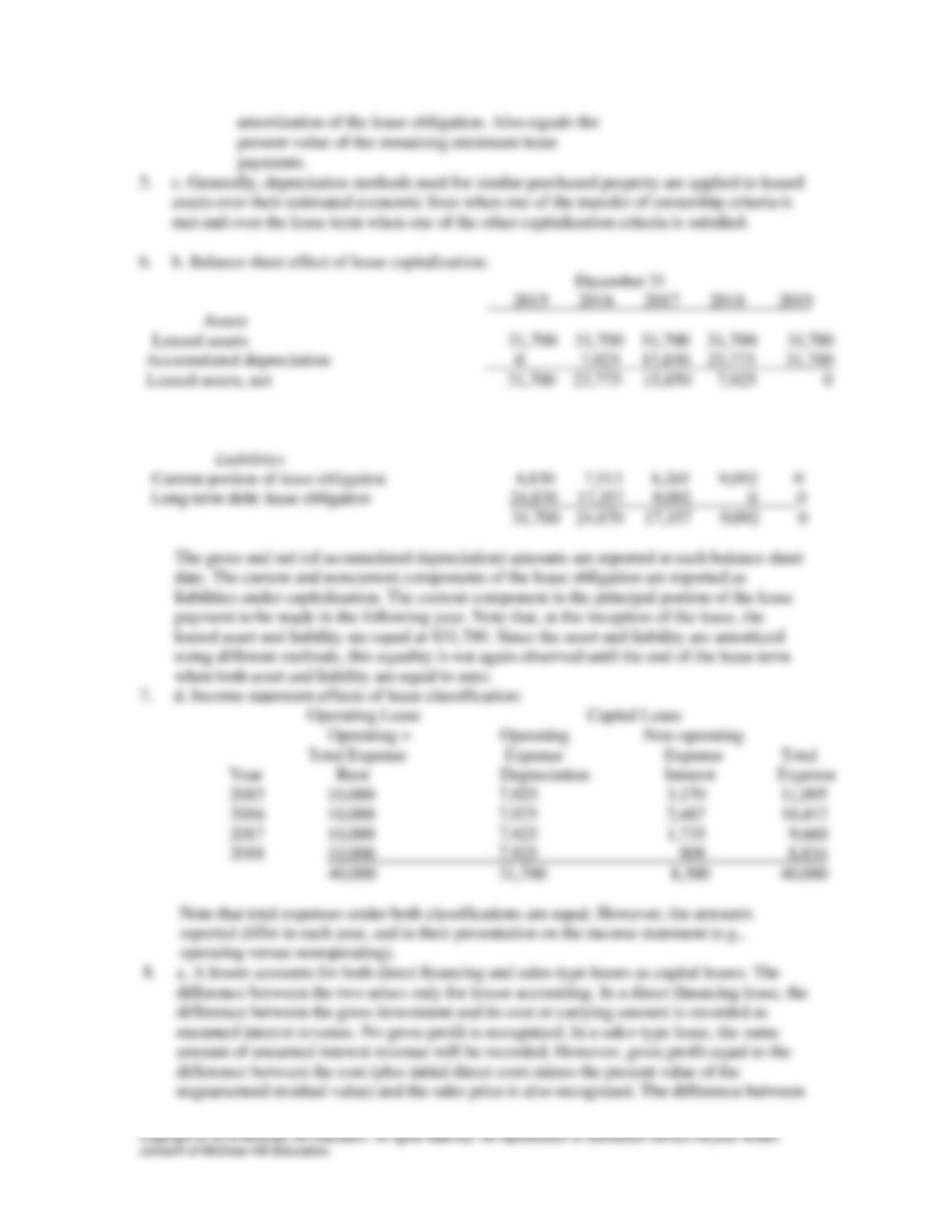
amortization of the lease obligation. Also equals the
present value of the remaining minimum lease
payments.
5. c. Generally, depreciation methods used for similar purchased property are applied to leased
assets over their estimated economic lives when one of the transfer of ownership criteria is
met and over the lease term when one of the other capitalization criteria is satisfied.
6. b. Balance sheet effect of lease capitalization: December 31
2015 2016 2017 2018 2019
Assets
Leased assets 31,700 31,700 31,700 31,700 31,700
Accumulated depreciation 0 7,925 15,850 23,775 31,700
Leased assets, net 31,700 23,775 15,850 7,925 0
Liabilities
Current portion of lease obligation 6,830 7,513 8,265 9,092 0
Long–term debt: lease obligation 24,870 17,357 9,092 0 0
31,700 24,870 17,357 9,092 0
The gross and net (of accumulated depreciation) amounts are reported at each balance sheet
date. The current and noncurrent components of the lease obligation are reported as
liabilities under capitalization. The current component is the principal portion of the lease
payment to be made in the following year. Note that, at the inception of the lease, the
leased asset and liability are equal at $31,700. Since the asset and liability are amortized
using different methods, this equality is not again observed until the end of the lease term
when both asset and liability are equal to zero.
7. d. Income statement effects of lease classification:
Operating Lease Capital Lease
Operating = Operating Non-operating
Total Expense Expense Expense Total
Year Rent Depreciation Interest Expense
2015 10,000 7,925 3,170 11,095
2016 10,000 7,925 2,487 10,412
2017 10,000 7,925 1,735 9,660
2018 10,000 7,925 909 8,834
40,000 31,700 8,300 40,000
Note that total expenses under both classifications are equal. However, the amounts
reported differ in each year, and in their presentation on the income statement (e.g.,
operating versus nonoperating).
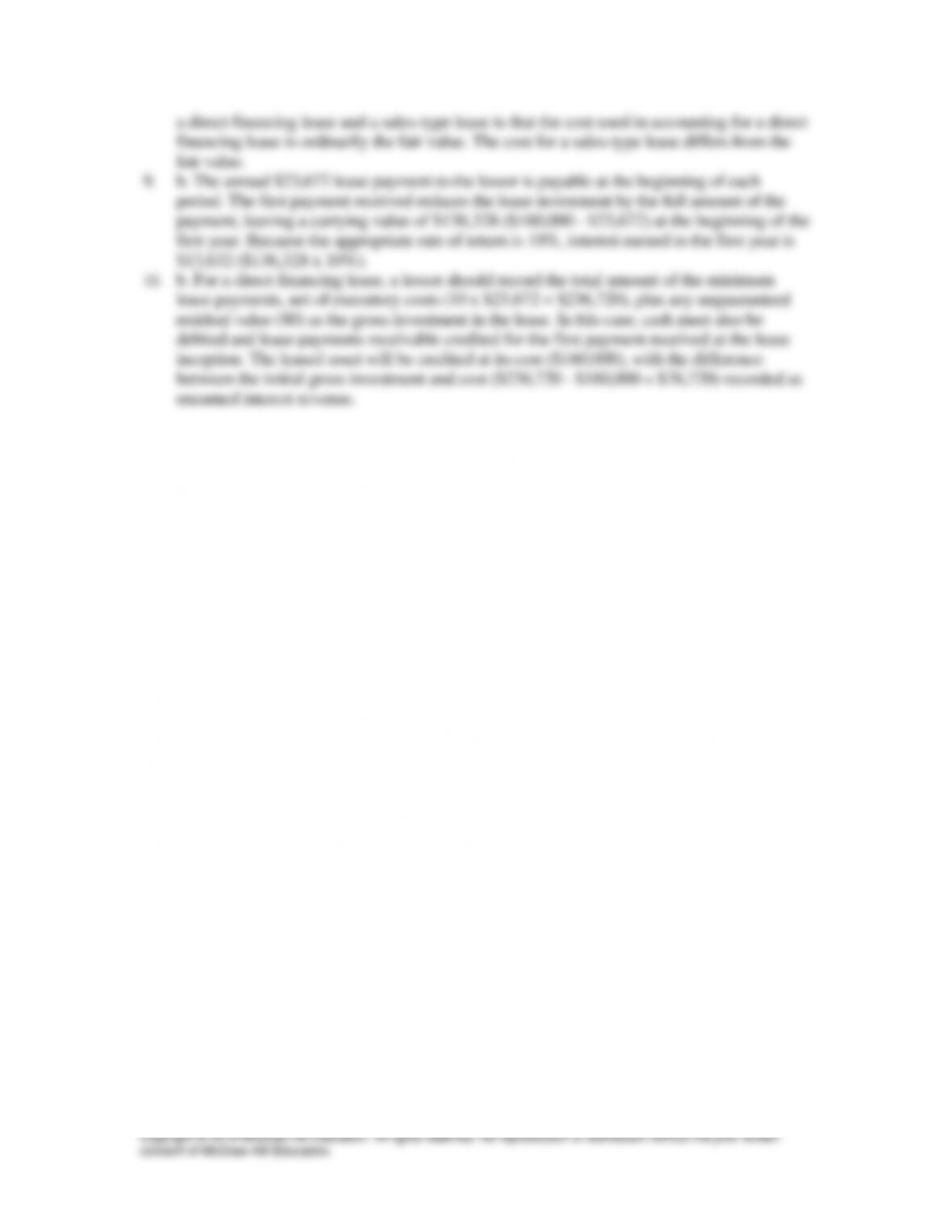
8. a. A lessee accounts for both direct financing and sales-type leases as capital leases. The
difference between the two arises only for lessor accounting. In a direct financing lease, the
difference between the gross investment and its cost or carrying amount is recorded as
unearned interest revenue. No gross profit is recognized. In a sales-type lease, the same
amount of unearned interest revenue will be recorded. However, gross profit equal to the
difference between the cost (plus initial direct costs minus the present value of the
unguaranteed residual value) and the sales price is also recognized. The difference between
Financial Reporting and Analysis 6e Financial Reporting for Leases
Copyright © 2015 McGraw-Hill Education. All rights reserved. No reproduction or distribution without the prior written
consent of McGraw-Hill Education.
a direct financing lease and a sales-type lease is that the cost used in accounting for a direct
financing lease is ordinarily the fair value. The cost for a sales-type lease differs from the
fair value.
9. b. The annual $23,672 lease payment to the lessor is payable at the beginning of each
period. The first payment received reduces the lease investment by the full amount of the
payment, leaving a carrying value of $136,328 ($160,000 – $23,672) at the beginning of the
first year. Because the appropriate rate of return is 10%, interest earned in the first year is
$13,632 ($136,328 x 10%).
10. b. For a direct financing lease, a lessor should record the total amount of the minimum
lease payments, net of executory costs (10 x $23,672 = $236,720), plus any unguaranteed
residual value ($0) as the gross investment in the lease. In this case, cash must also be
debited and lease payments receivable credited for the first payment received at the lease
inception. The leased asset will be credited at its cost ($160,000), with the difference
between the initial gross investment and cost ($236,720 – $160,000 = $76,720) recorded as
unearned interest revenue.
RECOMMENDED EXHIBITS
Figure 12.1—Differences between Operating and Capital Leases
Figure 12.2—Lessees’ Accounting for Capital Leases
Figure 12.5 – Decision Tree for Lessor’s Treatment of Leases
Figure 12.6 – Detailed Explansion of Figure 12.5 – Decision Tree for Lessor’s Treatment of Leases
Exhibit 12.4 – Comparison of Undiscounted Dollar Magnitudes of Capital and Operating Lease
Payments
SUGGESTED READINGS
1. Acito, A. A., J.J. Burks, and W. B. Johnson. 2009. Materiality Decisions and the
Correction of Accounting Errors. The Accounting Review (May) pages 659-688.
2. Bianco, A. 1998. Snapping up the runways. Business Week (April 20): 126D-126F.
3. Imhoff, E. A. Jr., R. C. Lipe, and D. W. Wright. 1991. Operating leases: Impact of
constructive capitalization. Accounting Horizons (March): 51-63.
4. Imhoff, E. A. Jr., R. C. Lipe, and D. W. Wright. 1997. Operating leases: Income effects of
constructive capitalization. Accounting Horizons (June): 12-32.
5. Monson, D. 2001. The conceptual framework and accounting for leases. Accounting
Horizons (September) Volume 15; Number 3: pages 275-287.