11–54
The issue price would by $219.231 million if the market yield is 8.125% and
$290.816 million if the market yield is 6.125%.
Requirement 8:
Century and millennium bonds share a common feature: a very large share of
C11-2 Tuesday Morning Corporation: Interpreting long-term debt disclosures
Requirement 1:
$1,402 from the balance sheet
$104) and $432 is (4 x $108).
Requirement 4:
Current portion is $2,747
$1,794 Remaining principal on note
11–55
Simple interest = $1,401 x .14 x 1/4 = $49
Requirement 6:
Journal entry for April 30:
DR Current installment on mortgage $1,794
C11-3. Groupe Casino: Determining whether it is debt or equity
Requirement 1:
International Accounting Standards (IAS) No. 32 states that “[t]he issuer of a
financial instrument shall classify the instrument, or its component parts, on
11–56
obligation to deliver cash (or another financial asset) to the note holder in the
future. In addition, the notes are not convertible into equity shares, so there
is no contractual obligation to settle the note with equity or equity-like
instruments.
where interest payments can be suspended at any time, the principal is never
repaid, and there is no equity conversion privilege? The notes seem to be
characterized by consider cash flow risk to the investor, and this risk should
translate into a price discount not a price premium. So, the red flag raised by
C11-4. Kellogg Company’s Organic Corn Hedge
11–57
organic corn. This sort of matching would normally result in a fully effective
hedge. However, the hedged item (organic corn) is not identical to the
futures contract item (non-organic corn) and consequently changes in the
price of organic corn may not be reflected fully by changes in the fair values
of the purchased futures contracts. This possibility is why the organic corn
accounting can be used in this situation because:
• The hedge item is an anticipated (forecasted) future transaction;
• The hedging instrument is a futures contract;
• The risk being hedged (described above) is cash flow risk;
• The hedge is assumed to be sufficiently effective for GAAP purposes.
DR Investment in corn futures contracts $3,200,000
CR Cash $3,200,000
To record the April 30, 2015 fair value adjustment to the futures contracts
investment account:
DR Investment in corn futures contracts $300,000
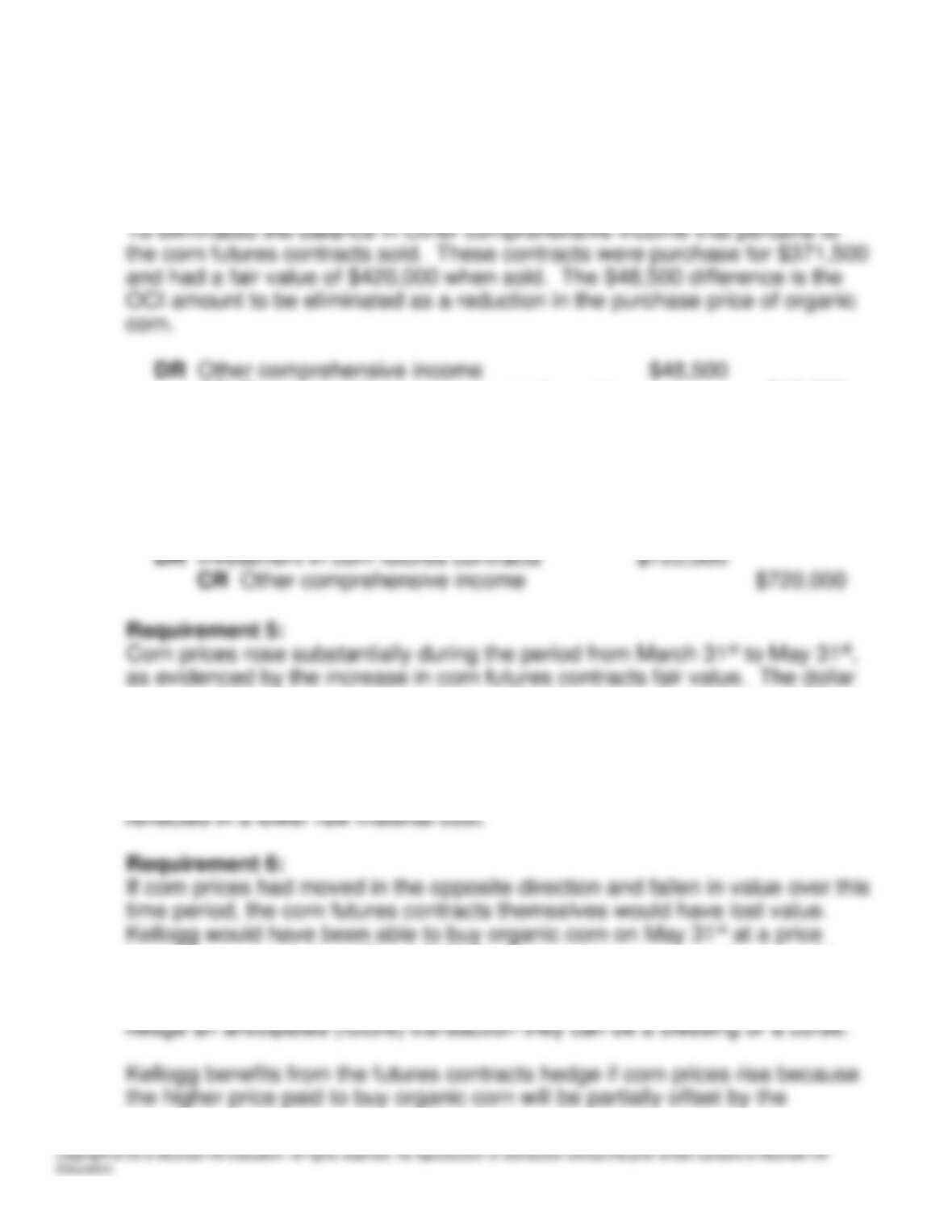
11–58
To record the May 31, 2015 sale of the “matched” corn futures contracts for
$420,000, which happens to correspond to the April 30th fair value of the
contracts sold.
DR Cash $420,000
CR Investment in corn futures contracts $420,000
CR Raw materials inventory (organic corn) $48,500
To record the May 31st fair value adjustments to the remaining corn futures
contracts. The adjustment amount is the difference between the May 31st fair
value ($3,800,000) and the investment carrying value on that date
($3,500,000 minus $420,000 contracts sold).
amount of the price increase is captured by the cumulative balance of Other
comprehensive income ($971,500 = $300,000 – $48,500 + $720,000).
Consequently, Kellogg had to pay more for the organic corn purchase May
31st than would otherwise have been the case. However, because Kellogg
hedged its organic corn purchase, saved $48,500 and this savings is
lower than expected on March 31st, the this purchase price savings would
have been offset by the loss in value on its investment in corn futures
contracts. As explained in the chapter, when futures contracts are used to
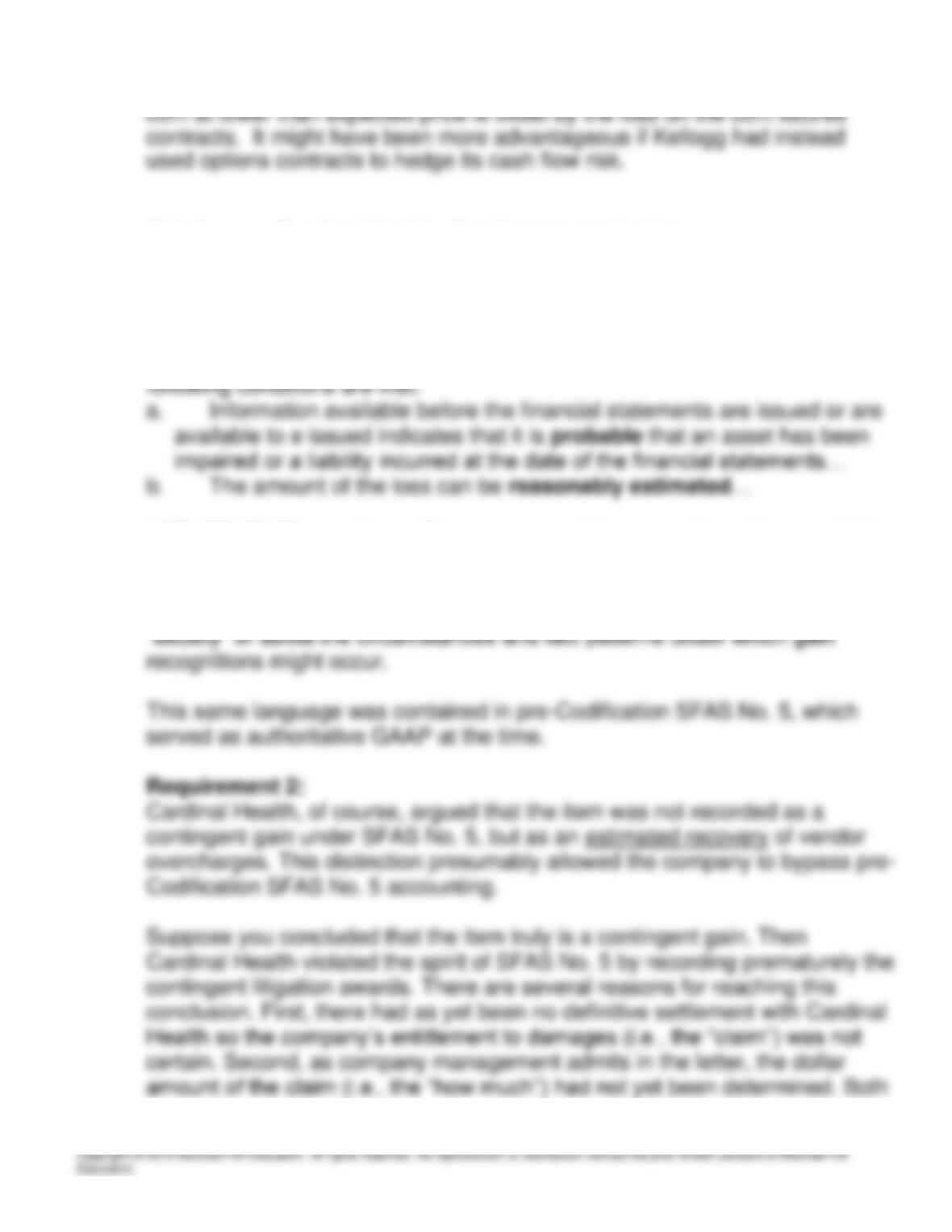
11–59
increased value of the corn futures contracts. Kellogg loses, on the other
hand, if corn prices fall. In that case, the savings obtained from buy organic
C11-5. Cardinal Health: Contingent receivables
Requirement 1:
ASC 450-20-25 on loss contingency recognition says: “An estimated loss
from a loss contingency shall be accrued by a charge to income if both of the
ASC 450-30-25 on gain contingency recognition says: “A contingency that
might result in a gain usually should not be reflected in the financial
statements because to do so might be to recognize revenue before its
realization.” The ASC do not provide guidance as to what is meant by
11–60
facts argue against realization—Cardinal did not possess a claim that was
“readily convertible into known amounts of cash.”
Requirement 3:
Here is some of what management said in its letter to shareholders:
“The reporter also directly alleges that the recording of the vitamin pricing
comprehensive guidance about our expectations based on this process,
analysts’ estimates tend to follow our expectations. Second, every quarter
has business and accounting issues that are unique to a given quarter and
impact reported results. It is an oversimplification to pick one particular item
and conclude that it was the key to the quarter—the appropriate view is of the
• Cardinal Health has had quarters with unusual expenses, for example, the
fourth quarter of FY 2002 had $28 million of inventory write-down
adjustments charged against cost of sales, but there’s been no recognition
on the reporter’s part of how that quarter could have been $0.04 better
without those charges.
timing and amounts.”
Requirement 4:
An alternative to recording the estimated recovery amounts is to disclose

11–61
to be recovered. However, it would not help Cardinal Hospital to “meet the
consensus” EPS forecasts for the quarter.