11–46
Requirements 1 and 2:
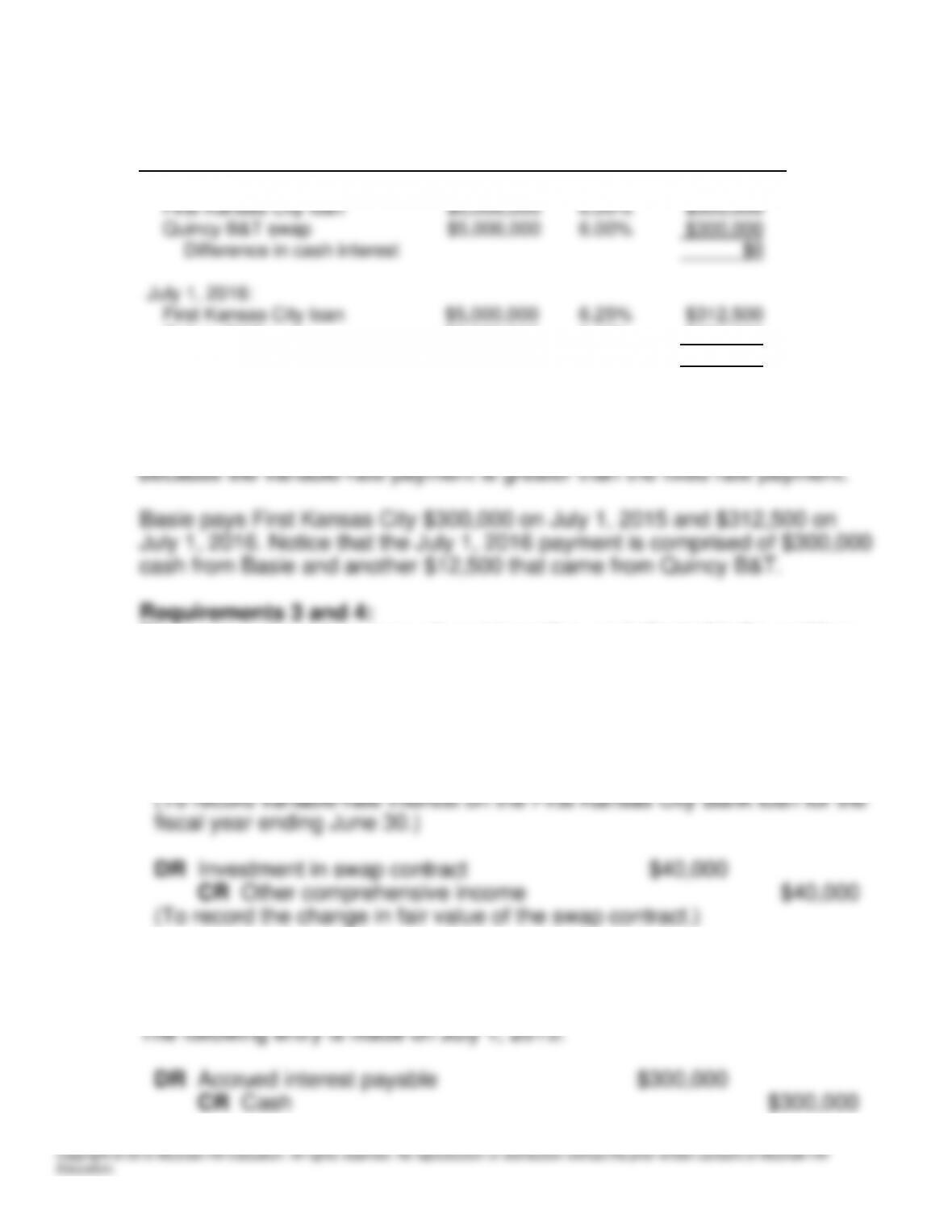
The analysis is summarized in the following table.
Notional
amount
Interest
rate
Cash
interest
July 1, 2015:
First Kansas City loan
$5,000,000
6.00%
$300,000
Quincy B&T swap
$5,000,000
6.00%
$300,000
Difference in cash interest
$0
July 1, 2016:
First Kansas City loan
$5,000,000
6.25%
$312,500
Quincy B&T swap
$5,000,000
6.00%
$300,000
Difference in cash interest
$12,500
The July 1, 2015 “net cash settlement” for Basie is zero because the fixed–
rate payment and the variable-rate payment are the same, $300,000. On
July 1, 2016 Basie will receive a $12,500 cash settlement from Quincy
The swap contract has zero value at inception, as indicated in the problem
statement, so there is no entry made when the contract is signed.
The following entries are made on June 30, 2015:
DR Interest expense $300,000
CR Accrued interest payable $300,000
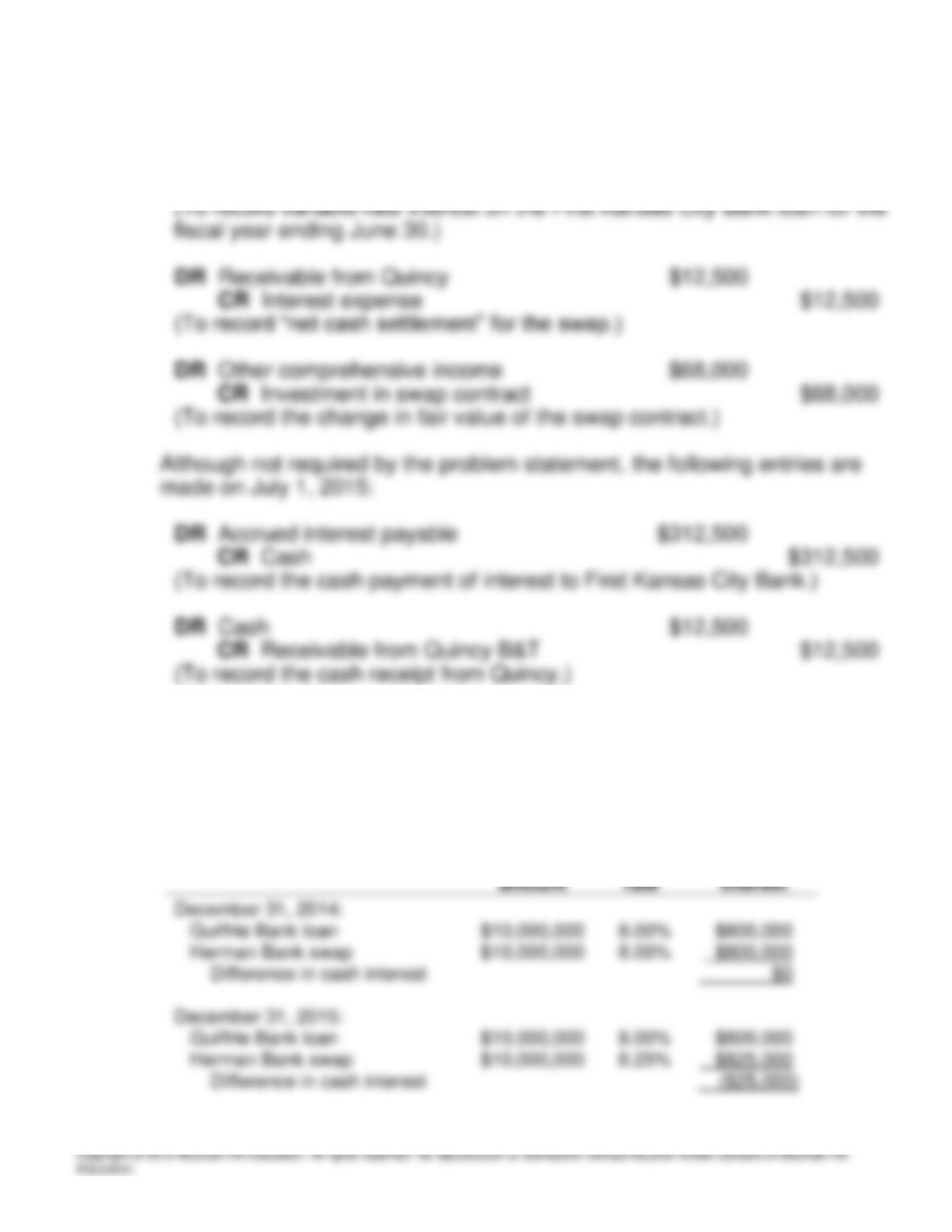
No entry is made to record “net cash settlement” for the swap because it is
zero.
11–47
(To record the cash payment of interest to First Kansas City Bank.)
The following entries are made on June 30, 2016:
DR Interest expense $312,500
CR Accrued interest payable $312,500
P11–26. Using an interest-rate swap as a fair value hedge
Requirements 1 and 2:
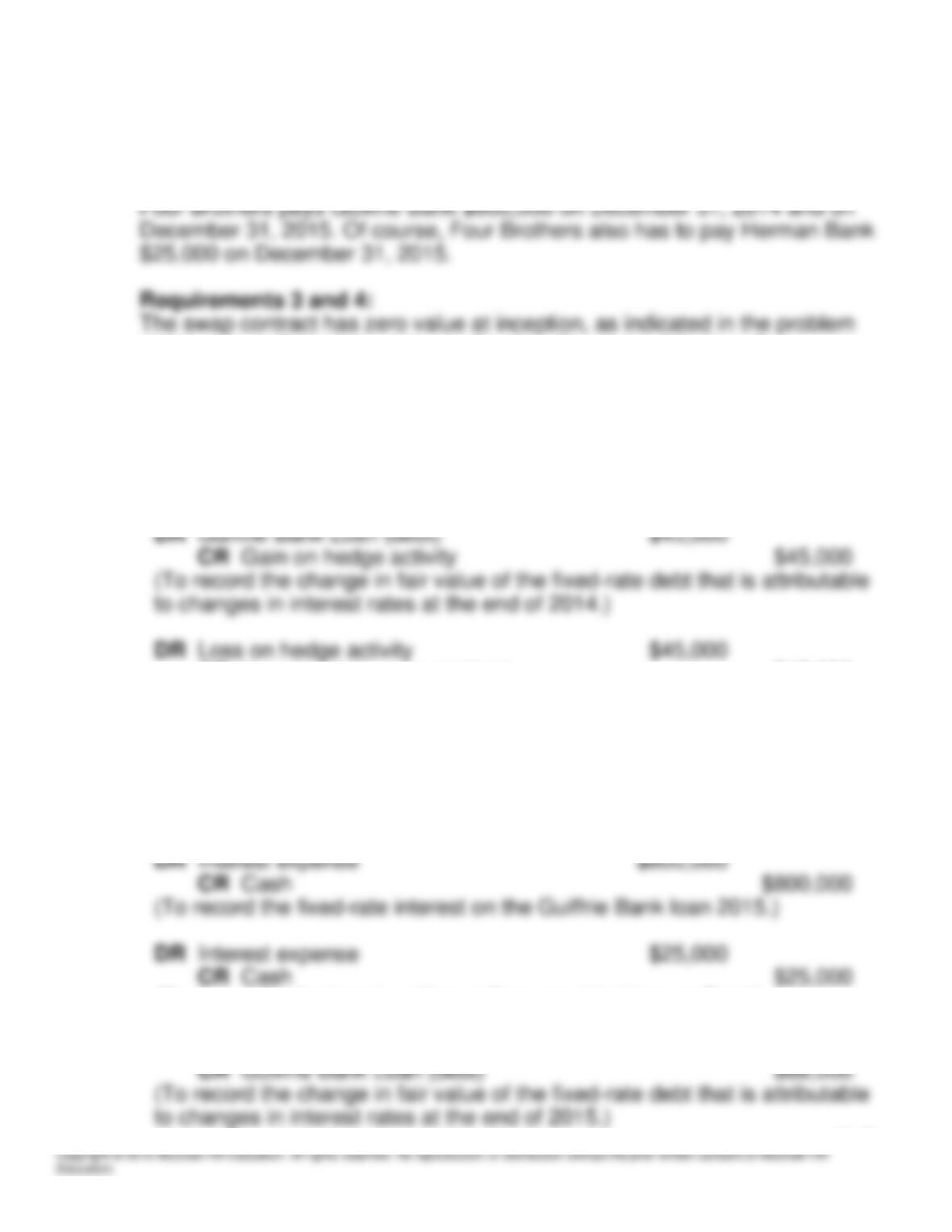
The analysis is summarized in the following table.
Notional
amount
Interest
rate
Cash
interest
December 31, 2014:
Guiffrie Bank loan
$10,000,000
8.00%
$800,000
Herman Bank swap
$10,000,000
8.00%
$800,000
Difference in cash interest
$0
December 31, 2015:
Guiffrie Bank loan
$10,000,000
8.00%
$800,000
Herman Bank swap
$10,000,000
8.25%
$825,000
Difference in cash interest
($25,000)
11–48
The December 31, 2014 “net cash settlement” for Four Brothers is zero
because the fixed-rate payment and the variable-rate payment are the same,
$800,000. On December 31, 2015 Four Brothers will pay a $25,000 cash
settlement to Herman because the variable-rate payment is greater than the
fixed rate payment.
statement, so there is no entry made when the contract is signed.
The following entries are made on December 31, 2014:
DR Interest expense $800,000
CR Cash $800,000
(To record the fixed-rate interest on the Guiffrie Bank loan 2014.)
CR Investment in swap contract $45,000
(To record the change in fair value of the swap contract.)
No entry is made to record “net cash settlement” for the swap contract
because it is zero.
The following entries are made on December 31, 2015:
(To record the “net cash settlement” payment to Herman Bank)
DR Loss on hedge activity $68,000
11–49
P11–27. Determining hedge Effectiveness
Requirement 1:
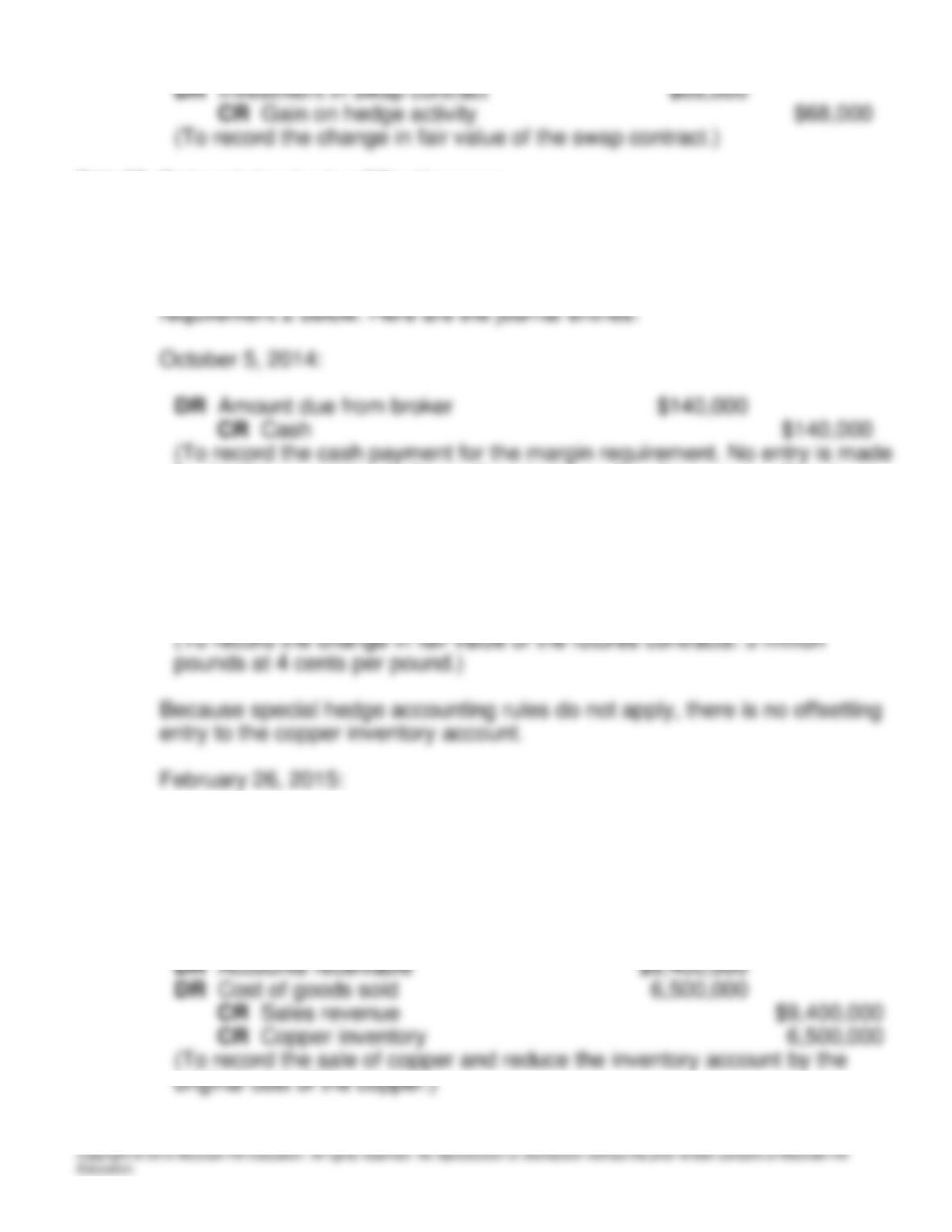
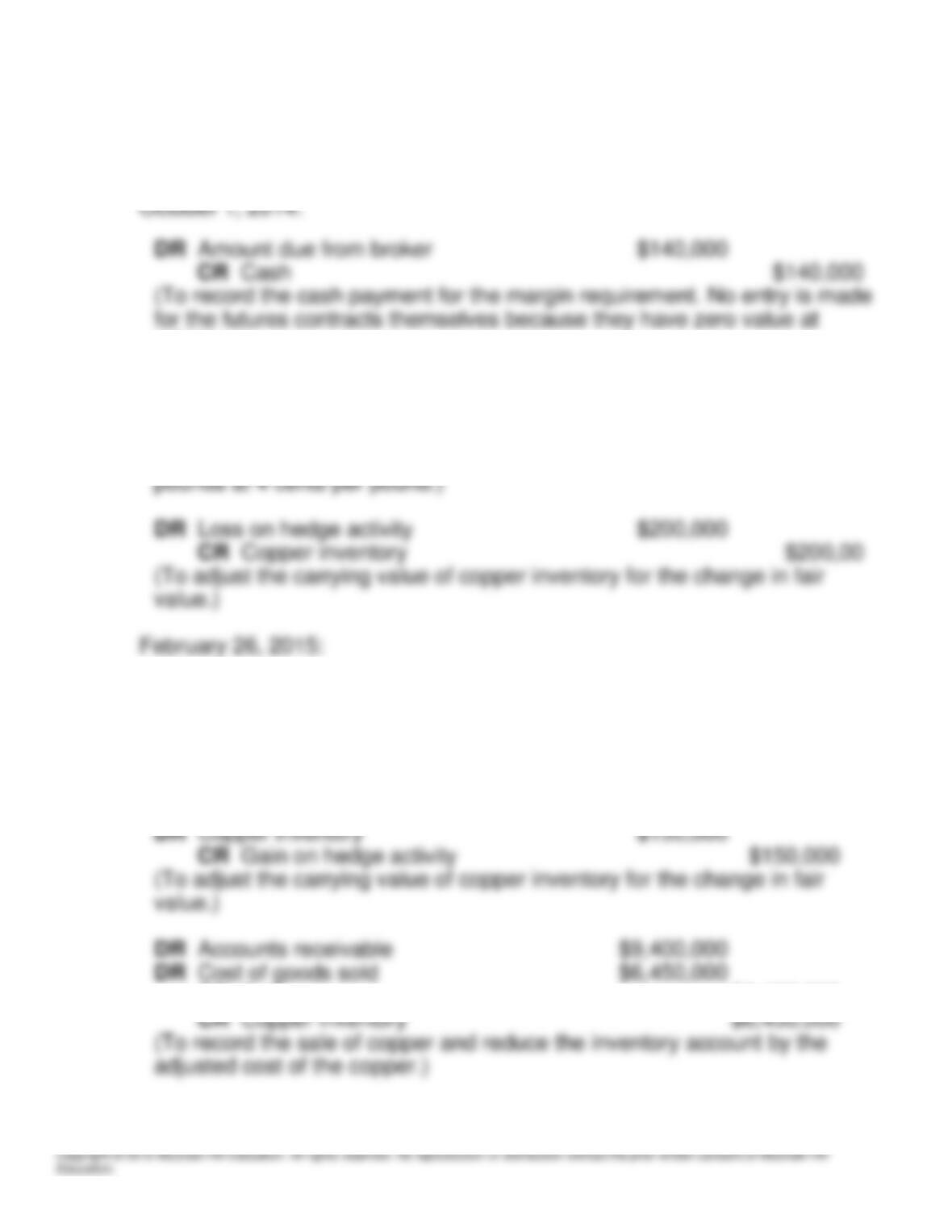
Because the futures contracts are deemed “ineffective” for GAAP purposes,
the special hedge accounting rules cannot be used. Notice how these
entries produce increased earnings volatility compared to those in
for the futures contracts themselves because they have zero value at
initiation.)
December 31, 2014:
DR Amount due from broker $200,000
CR Gain on futures contracts $200,000
DR Cash $190,000
DR Loss on futures contracts 150,000
CR Amount due from broker $340,000
(To record the change in fair value of the futures contracts—3 cents per
pound—and settlement of the contracts.)
11–50
Requirement 2:
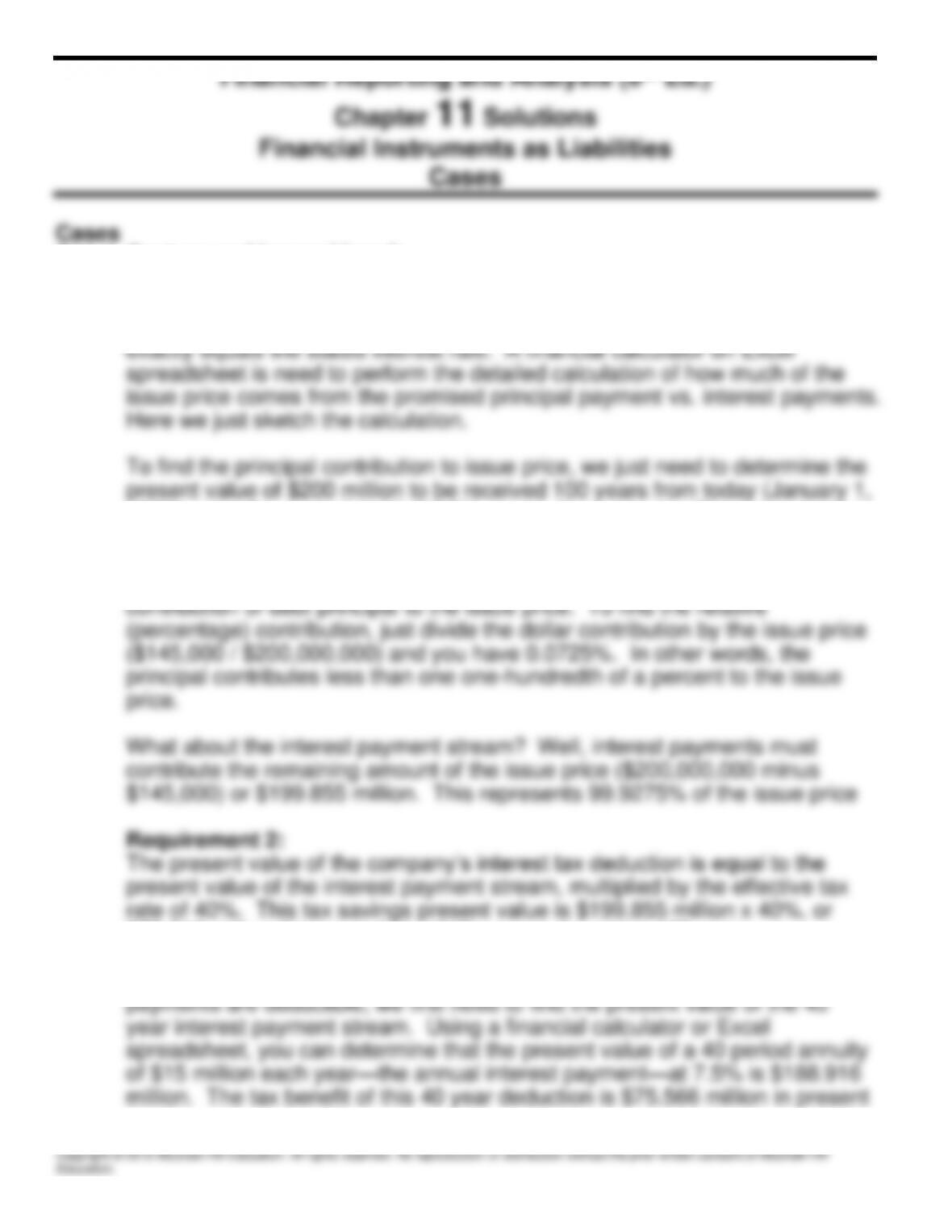
Now the futures contracts are deemed “effective” for GAAP purposes, and
the special hedge accounting rules can be used. Notice how these entries
produce less earnings volatility compared to those in requirement 1 above.
Here are the journal entries:
initiation.)
December 31, 2014:
DR Amount due from broker $200,000
CR Gain on hedge activity $200,00
(To record the change in fair value of the futures contracts: 5 million
DR Cash $190,000
DR Loss on hedge activity $150,000
CR Amount due from broker $340,000
(To record the change in fair value of the futures contracts—3 cents per
pound—and settlement of the contracts.)
CR Sales revenue $9,400,000

11–51
Requirement 3:These journal entries illustrate how the income statement
and the balance sheet are affected by the definition of the hedged item.
Notice how the first set of entries (requirement 1) gives rise to greater
11–52
Copyright © 2015 McGraw-Hill Education. All rights reserved. No reproduction or distribution without the prior written consent of McGraw-Hill
Education.
Financial Reporting and Analysis (6th Ed.)
Chapter 11 Solutions
Financial Instruments as Liabilities
Cases
Cases
C11-1. Century and beyond bonds
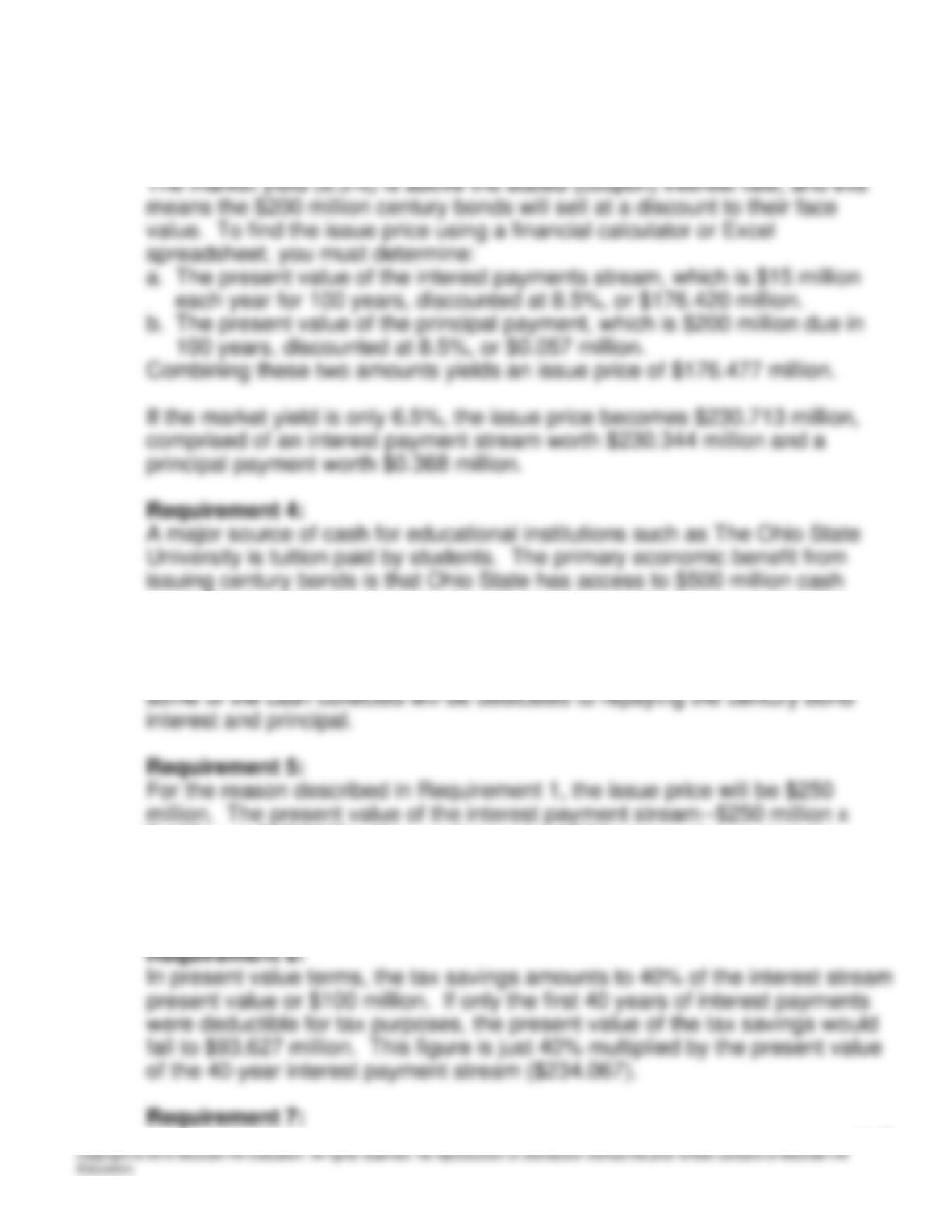
Requirement 1:The issue price of Dresser’s $200 million century bonds is
also $200 million. The follows from the fact that the market yield (7.5%)
1996) using the market yield of 7.5% as our discount rate. The present value
factor for a single payment in 100 periods at 7.5% is 0.000723. Multiplying
this factor by the amount of the payment ($200 million) yields a present value
of $145,000 (rounded to the nearest $1,000 dollars). This figure is the dollar
$79.942 million if interest deductibility spans the entire 100 years.
To find the amount of tax savings lost if only the first 40 years of interest
11–53
value terms. This means that restricting the deductibility of interest to the first
40 years will reduce the present value of the tax savings by only $4.376
million or roughly 5.5%.
Requirement 3.
immediately rather having to wait until sometime in the future when tuition
payments are actually received. In a sense, the bonds allow Ohio State to
“monetize” its anticipated future tuition payments so that the cash can be
used today. Of course, when those future tuition payments are received
7.125%, or $17.8125 million each year for 1,000 years—discounted at
7.125% is $250 million. So, the entire issue price is determined by the
interest payment stream. Investors are paying zero for the promised principal
payment. Why? Because the payment occurs so far into the future.