11–31
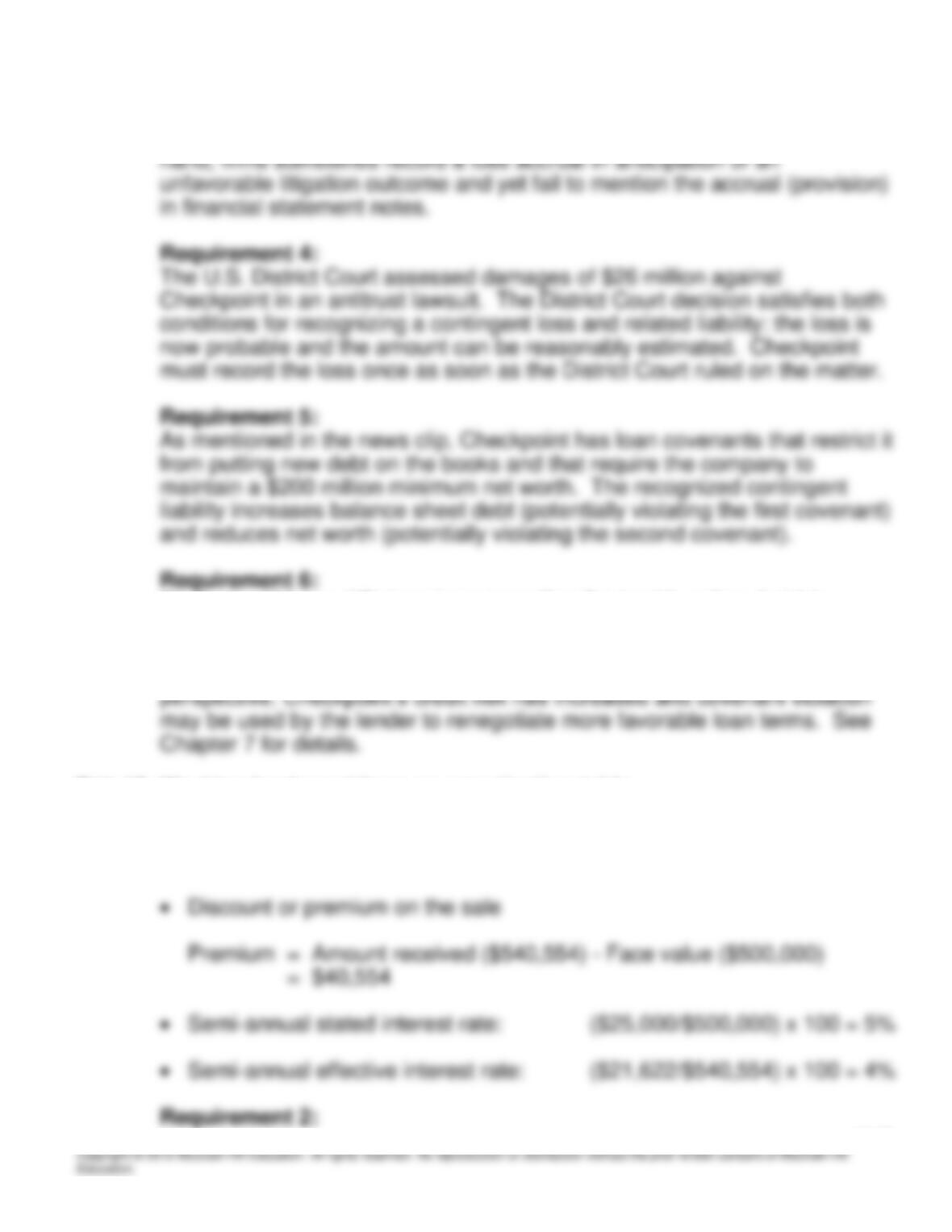
It does not appear as though Checkpoint Systems has already recognized a
loss contingency reserve related to this law suit because there is no mention
of a recorded loss accrual or provision. (By comparison, notice what Visa
has to say about its recorded litigation provision in P11-18.) On the other
Students will have differing views regarding the bank’s action, but it is
unlikely that a lender will simply waive covenant violations in such situations.
The reason is that the District Court decision reduces the future cash
available to payback Checkpoint’s existing loans. Viewed from the lender’s
P11–15. Working backward from an amortization table
Requirement 1:
Compute:
11–32
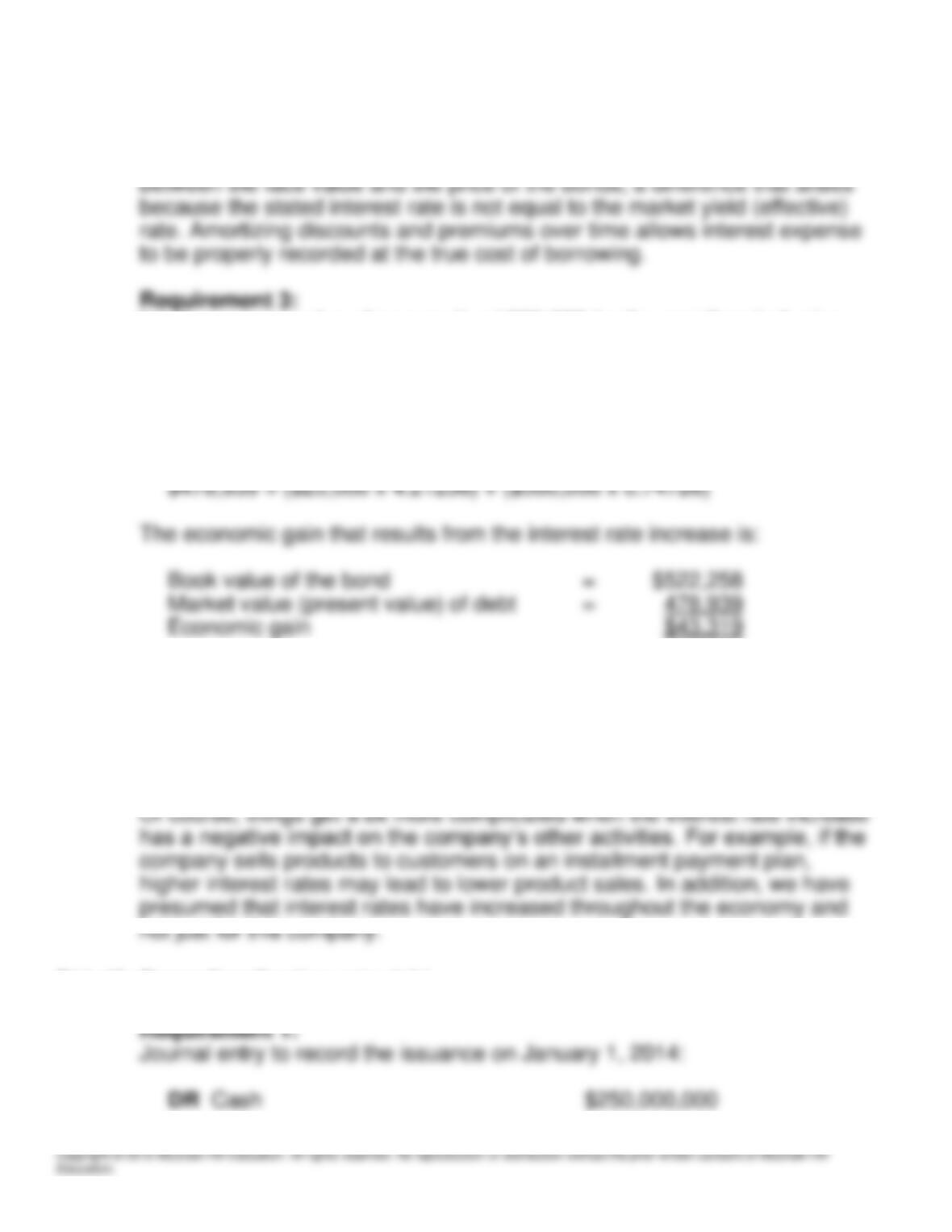
At the time of issuance, the bondholders exchanged today’s cash flow for
tomorrow’s, but with the same present value on a risk-adjusted basis.
Consequently, neither the borrower nor the lender made a profit (or loss) at
the time of the issuance of bonds. Consequently, no gain or loss should be
recorded at that time. The discount/premium merely reflects the difference
It is the present value of an annuity of $25,000 for the next 5 periods plus
the present value of $500,000 to be received at the end of 5 periods, both
discounted at the original semi-annual effective rate of 4%.
Requirement 4:
New price of the bonds on January 1, 2017, is:
Considering just the debt, the company and its shareholders are better off
because of the interest rate increase. The economic gain is the reduced
present value of debt payments (principal plus interest) at the new higher
interest rate. The cash outflow has a lower present value—indicating
bondholders will be receiving a less valuable payment stream.
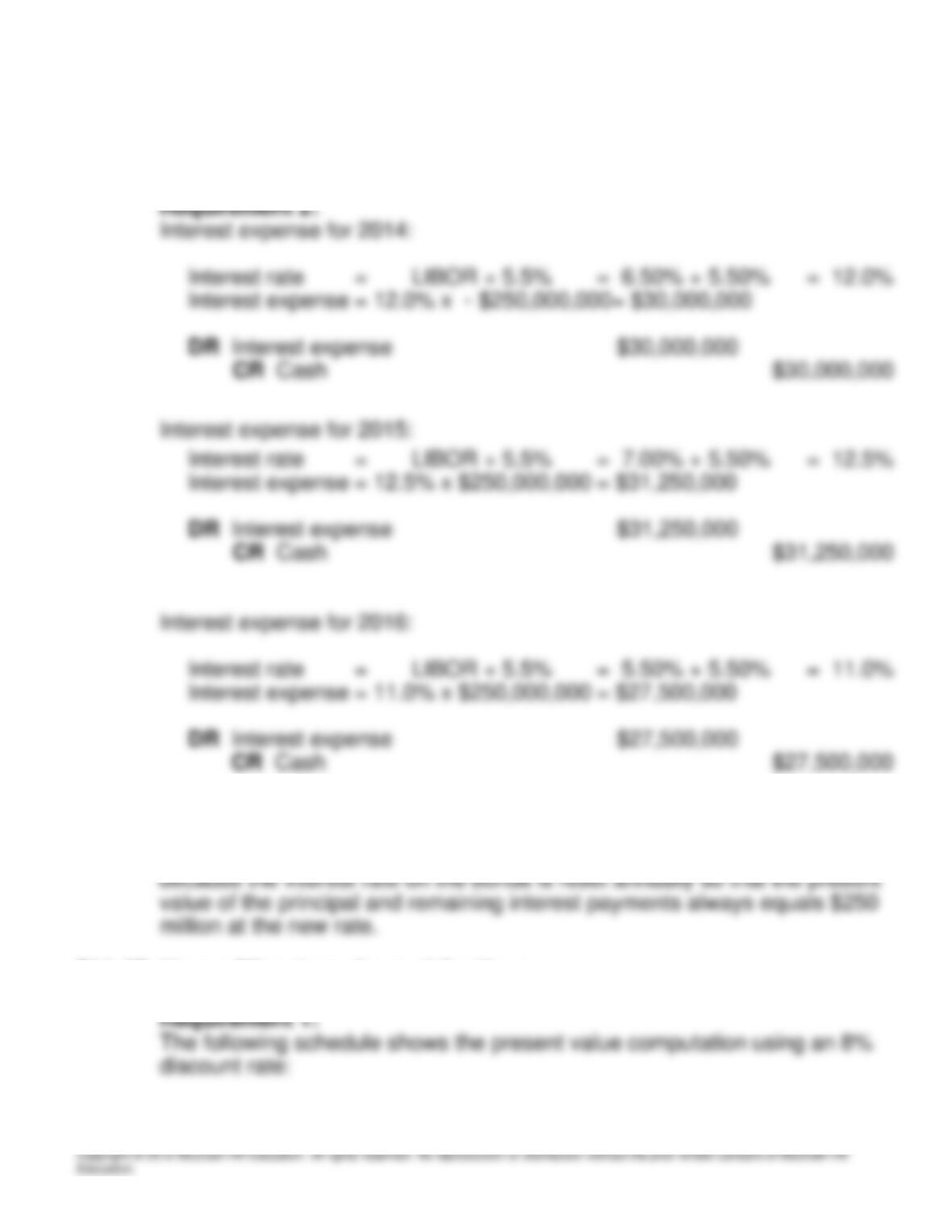
P11–16. Recording floating-rate debt
11–33
CR Bonds payable $250,000,000
If the bonds were issued at par, the effective (or market) interest rate must
have been equal to the stated rate of “LIBOR + 5.5%”, or 12%, since the
LIBOR was 6.5% at the issue date.
Requirement 3:
If the only factor influencing the market value of these bonds is the LIBOR,
the bonds will have a market value of $250 million on 12/31/2016. This is
P11–17. Unconditional purchase obligations
11–34
Year
Purchase
commitment
Present
value factor
Present value
amount
2003
$164.0
0.92593
$151.9
2004
168.0
0.85734
$144.0
2005
169.0
0.79383
$134.2
2006
157.0
0.73503
$115.4
2007
151.0
0.68058
$102.8
2008
349.8
0.63017
$220.4
2009
349.8
0.58349
$204.1
2010
349.8
0.54027
$189.0
2011
349.8
0.50025
$175.0
2012
349.8
0.46319
$162.0
$2,558.0
$1,598.7
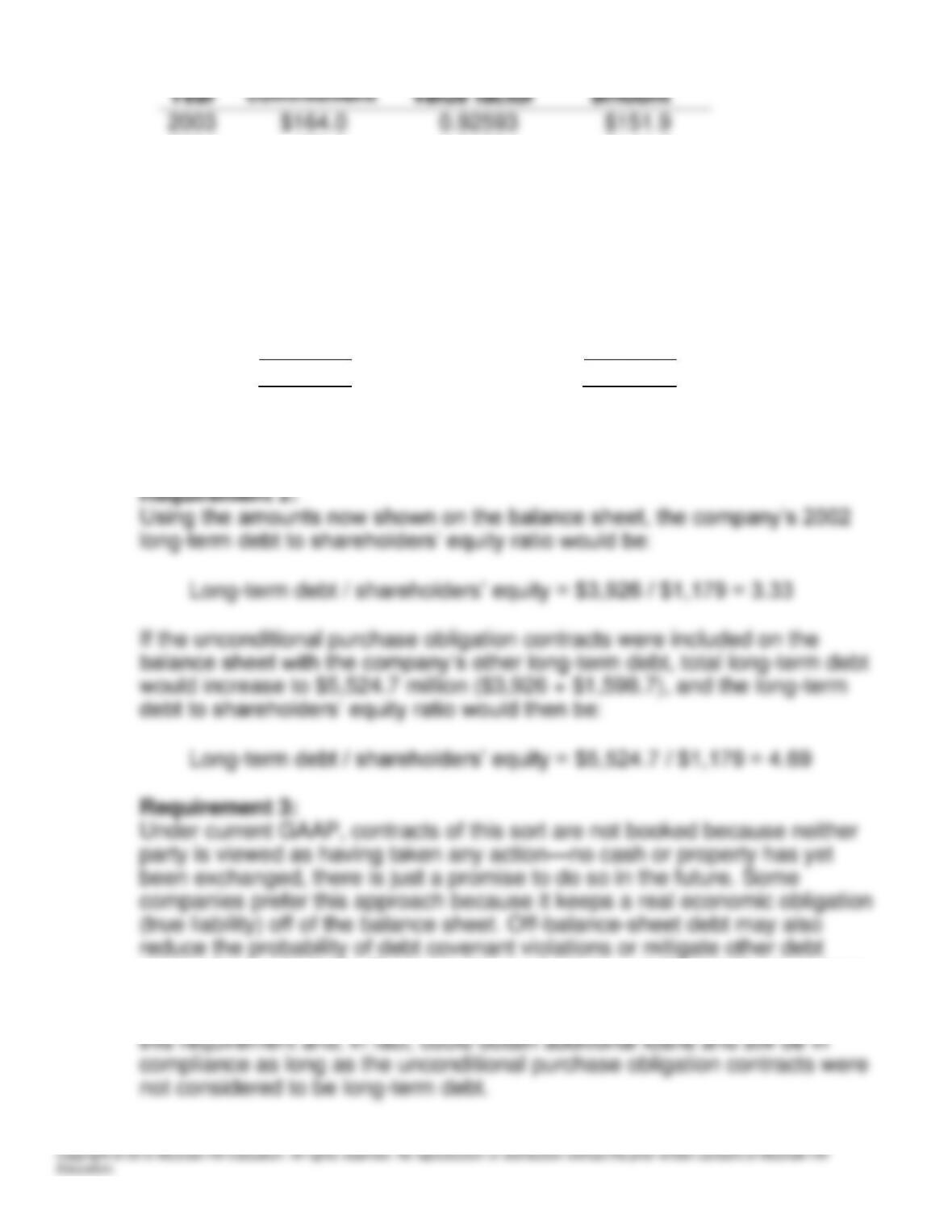
As the schedule indicates, the present value of Lyondell’s unconditional
purchase obligation contracts is $1,598.7 million.
contracting restrictions. For example, suppose Lyondell’s existing long-term
debt required the company to maintain a long-term debt to shareholders’
equity ratio of less than 4.0. The company is currently in compliance with
11–35
P11–18. Loss contingencies
Requirement 1:
A loss contingency is an event that results in the possibility of future loss. A
primary example of a loss contingency is litigation. Loss contingencies can
and (2) the amount of the loss can be reasonably estimated. Borden’s
probable loss is $26 million. Another $16 million in losses are “reasonably
possible,” but GAAP does not require reasonably possible losses to be
accrued.
Requirement 3:
11–36
company does not place a specific dollar amount on the loss. In this
situation, analysts will form their own estimate of the loss contingency.
Notice that analysts may come up with different estimates of this liability,
and, thus, different analysts may have different valuations for Exxon.
Requirement 4:
Requirement 5:
The Court’s willingness to hear the Exxon appeal will have no impact on the
company’s recorded contingent liability. If and when the appeal is
successful and a new liability amount (perhaps zero) is determined by the
Court, only then would Exxon change its balance sheet contingent liability
amount.
(discounted) value rather than full value. “Interest accretion on settled
matters” can either refer to (1) accounting interest required to bring the
recorded loss provision present value up to its full value, or (2) interest
amounts awarded to the plaintiffs (and thus to e paid by Visa) in the final
settlement or adjudication.
P11–19. Debt-for-debt swaps
Requirement 1:
11–37
DR Bonds payable (old) $5,000,000
CR Bonds payable (new) $3,200,000
CR Income tax payable (current)* 630,000
CR Gain on debt retirement** 1,170,000
payment schedule, etc.—of the instruments are “substantially” different.
Absent substantial differences in terms, no extinguishment gain or loss is
of $551.26 per $1,000 maturity value. The total cash proceeds to the
company (ignoring any investment banking fees associated with the
11–38
The present value factor for a 3% yield to maturity over twenty years is
given by:
Present value factor =
1
(1+.03)20
= 0.553676
banking fees make up the difference. A second possibility is that the “3%”
interest rate described in the company may be slightly rounded. If investors
actually paid $551.26, the actual yield to maturity on the zero coupon bonds
must have been 2.9338% because that is the interest rate that produces a
present value factor of 0.55126.
$551.26 per $1,000 principal amount at maturity. (Note: investment
banking fees—if any—are ignored in this entry.)
December 31, 2000
DR Interest expense $ 16.538 m
CR Zero coupon debentures $ 16.538 m
P11–21. Comprehensive problem on premium bond
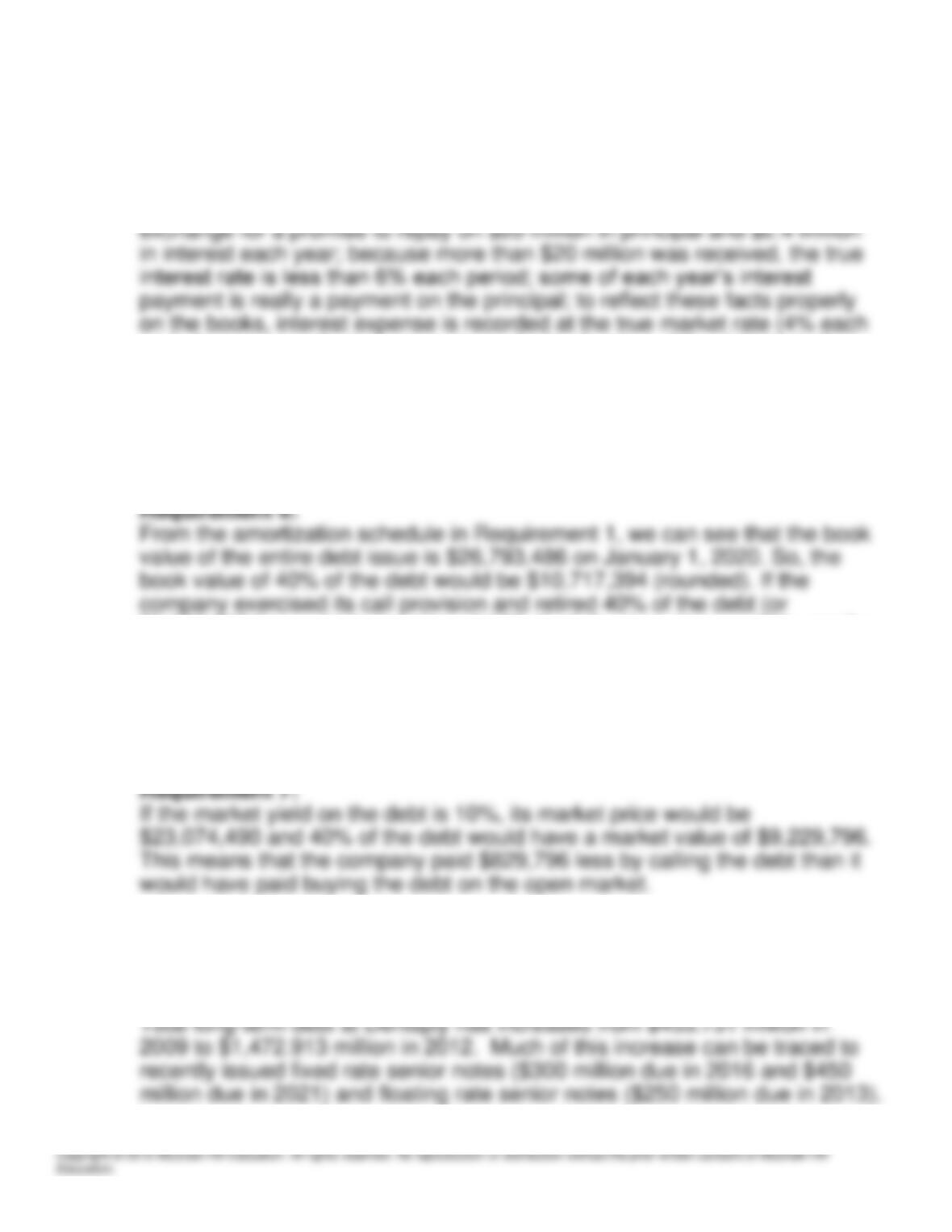
The following schedule shows the details for most parts of this question.
11–40
DR Interest expense $1,109,886
DR Premium on bonds 90,114
CR Cash $1,200,000
Requirement 4:
Points to be made include: the company received $27.9 million cash in
period) and using the true amount owed—book value of the debt including
unamortized premium.
Requirement 5:
Deere will not record the guarantee as a liability on its financial statements
but may disclose its contingent obligation in a note to the financials.
$8,000,000 face value) at a price of 105, the following entry would be made:
DR Bonds payable $8,000,000
DR Premium on bonds 2,717,394
CR Cash $8,400,000
CR Gain on extinguishment of debt 2,317,394
P11–22. Comprehensive Problem on Long-term Debt Disclosures
Requirement 1:
11–41
Dentsply continues to have loans denominated in Japanese yen and Swiss
francs.
Requirement 2:
4.1% interest rate. A similar pattern occurs for other borrowings.
These interest rate increases are inconsistent with the notion that Dentsply’s
credit risk decreased between 2009 and 2012. In competitive financial
in 2009.
Requirement 3:
According to the 2009 schedule of future debt payments, Dentsply was then
$221.865 million, respectively. In addition, the company has substantial
payment obligations in 2015 ($102.230 million) and 2016 ($448.440). The
size of these near-term cash outflow requirements is indicative of increased
credit risk when compared to the 2009 debt payment schedule.
(3.01%).
11–42
Copyright © 2015 McGraw-Hill Education. All rights reserved. No reproduction or distribution without the prior written consent of McGraw-Hill
Education.
computed as total long-term debt outstanding as of the end of 2012
($1,472.913 million) multiplied by the weighted average interest rate of
3.01%
Requirement 6:
The company is obligated to make 2013 cash payments on debt in the
11–43
P11–23. Hedging a Purchase Commitment
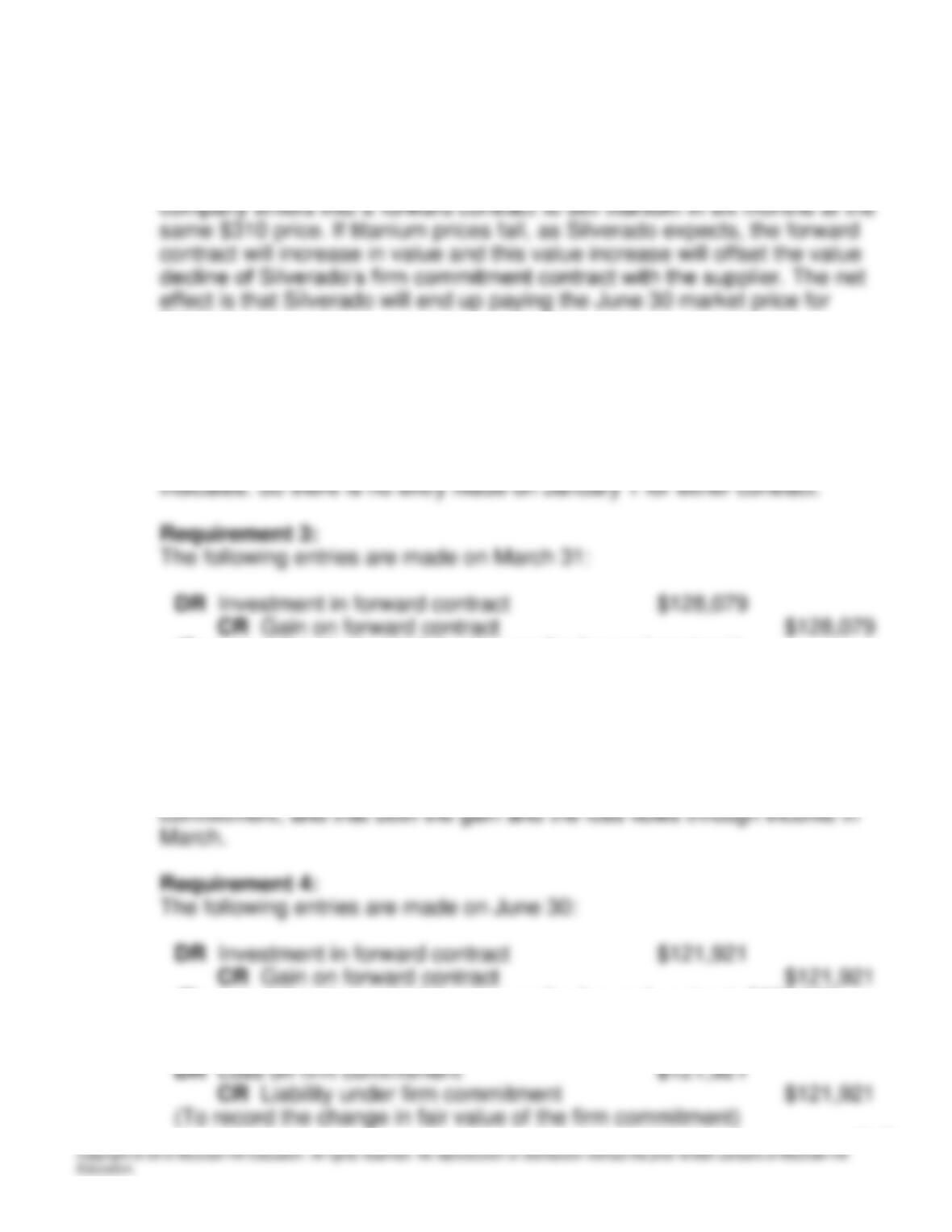
Requirement 1:
Silverado must give the supplier a six-month advance commitment for
titanium purchases at a fixed price, but the company does not want to
forego the possibility that titanium prices will decline over the period. So, the
titanium.
Was it a good idea? Yes, in this case, because titanium prices fell to $285
per pound by June 30.
Requirement 2:
Both contracts have zero value at inception, as the problem statement
(To record the change in fair value on the forward contract)
DR Loss on firm commitment $128,079
CR Liability under firm commitment $128,079
(To record the change in fair value of the firm commitment)
Notice that the gain on the forward contract is offset by the loss on the firm
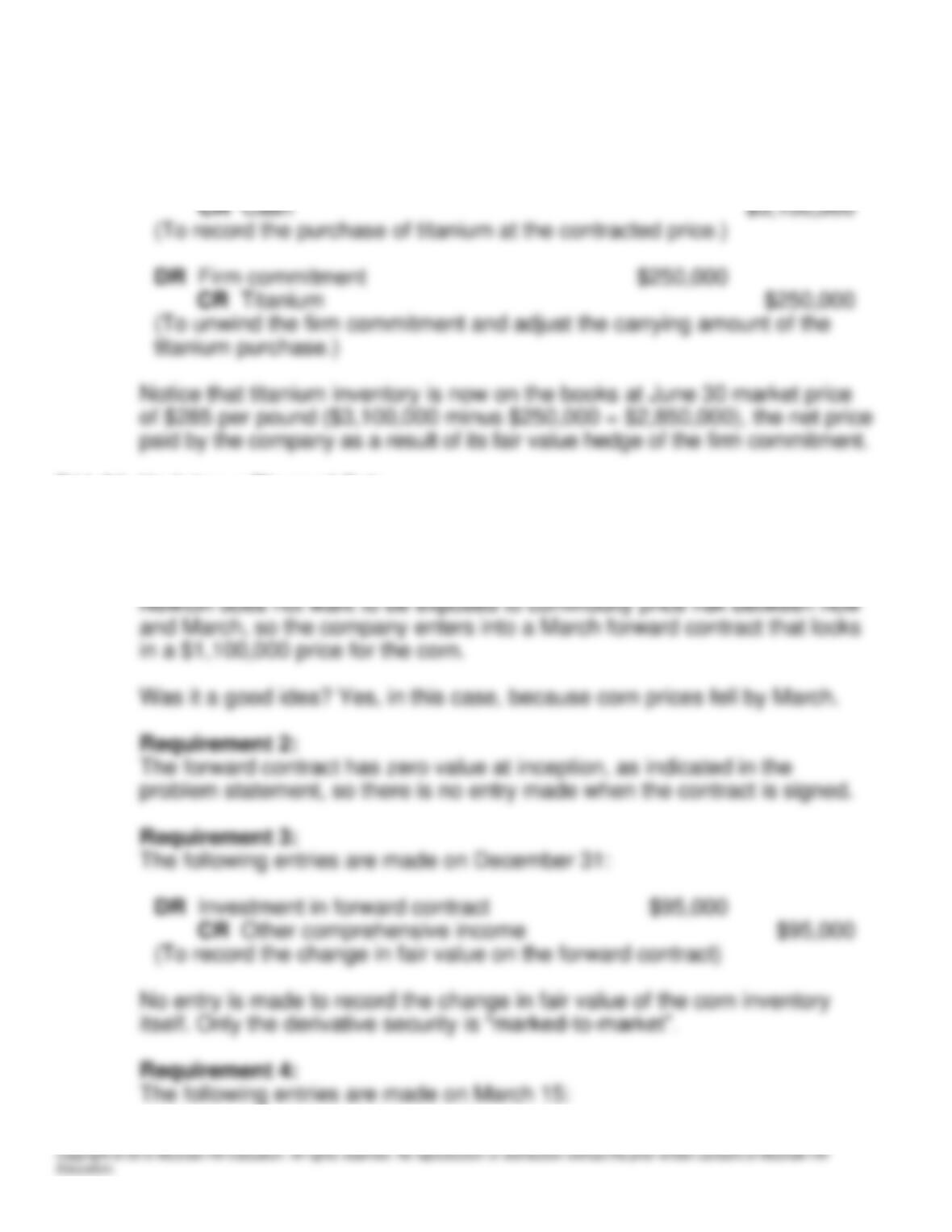
(To record the change in fair value on the forward contract: $250,000
minus $128,079)
11–44
DR Cash $250,000
CR Investment in forward contract $250,000
(To record the cash receipt upon settlement of the forward contract.)
DR Titanium $3,100,000
P11–24. Hedging a Planned Sale
Requirement 1:
Newton plans to sell some of its corn inventory next March, six months from
now (October). This sale will take place at the March market price. However,
11–45
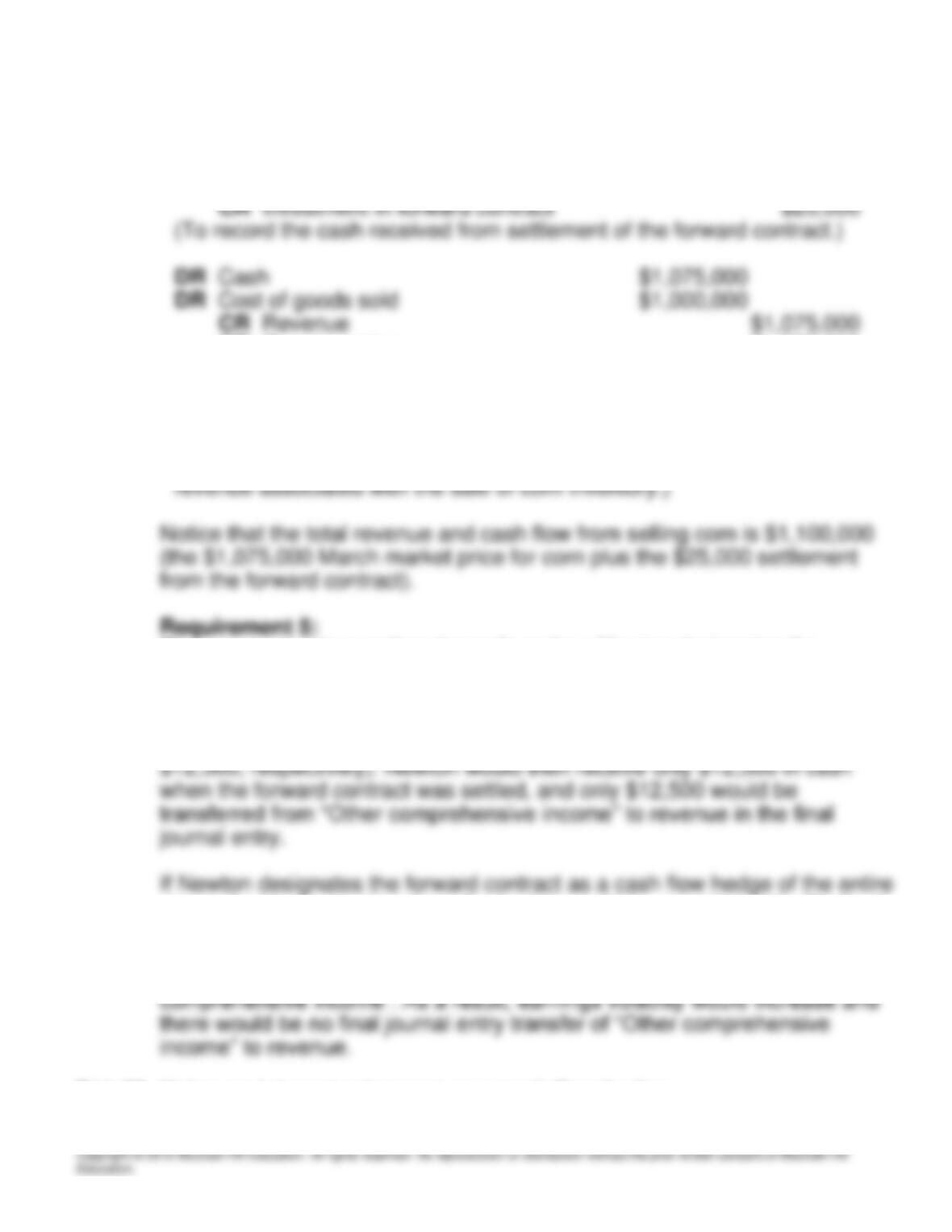
DR Other comprehensive income $70,000
CR Investment in forward contract $70,000
(To record the change in fair value on the forward contract: $95,000 minus
$25,000.)
DR Cash $25,000
CR Corn inventory $1,000,000
(To record the sale of corn inventory at the market price.)
DR Other comprehensive income $25,000
CR Revenue $25,000
(To reclassify the cumulative “Other comprehensive income” balance as
The answer to this question depends on how Newton designates the
forward contract hedge. If Newton designates the forward contract as a
cash flow hedge of 50% of planned sale of corn inventory, the hedge is “fully
effective”. In this case, the entries proceed along the lines outlined above,
except that contract fair values are scaled back by 50% (to $47,500 and
planned sale of corn inventory, the hedge would be considered “ineffective”
under GAAP and thus not qualify for special hedge accounting rules. The
derivative would still be “marked–to-market” as shown above, but the fair
value gains and losses would flow directly to income rather than to “Other
P11–25. Using an interest-rate swap as a cash flow hedge