11–16
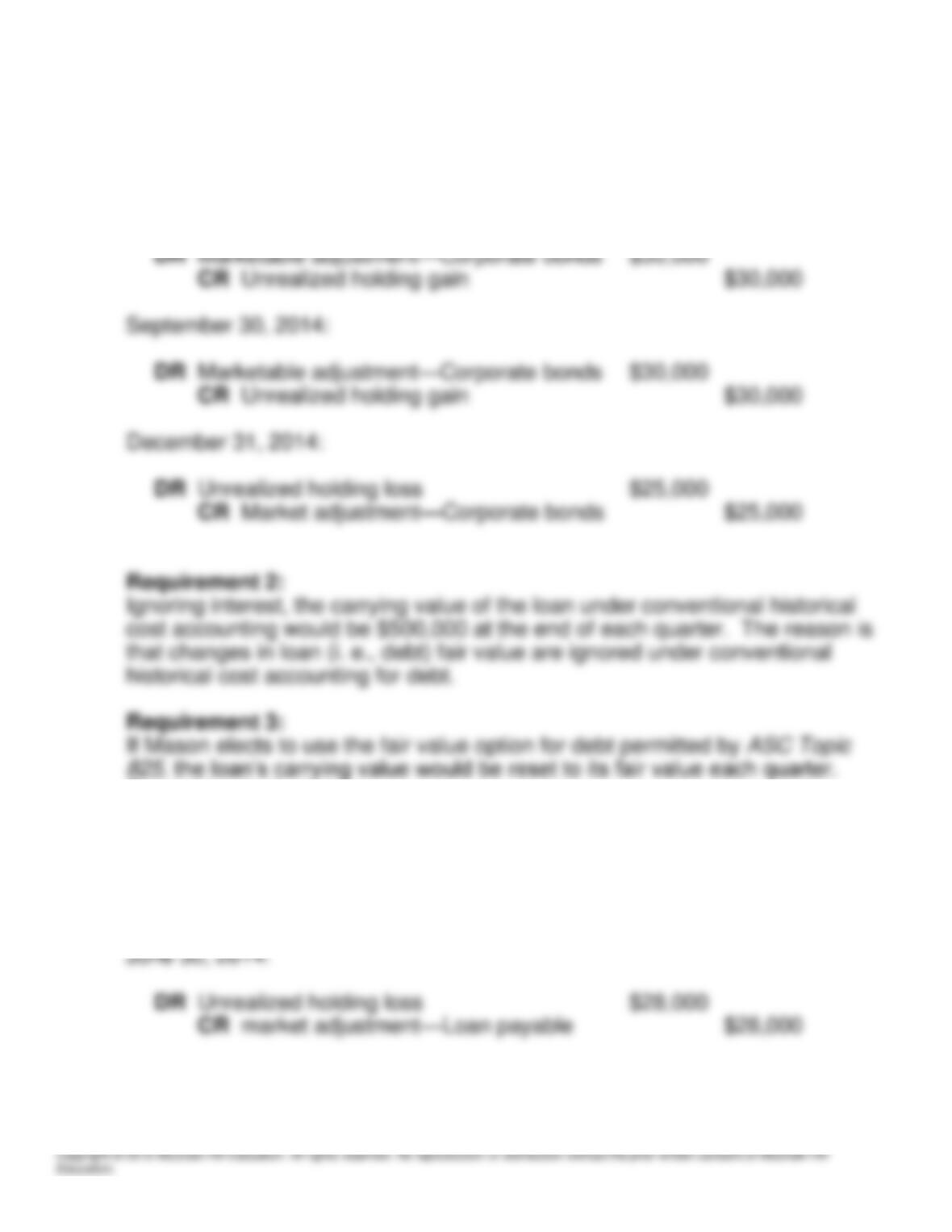
March 31, 2014:
DR Unrealized holding loss $50,000
CR Market adjustment—Corporate bonds $50,000
June 30, 2014:
The entries to do so are:
March 31, 2014:
DR Market adjustment—Loan payable $35,000
CR Unrealized holding gain $35,000
11–17
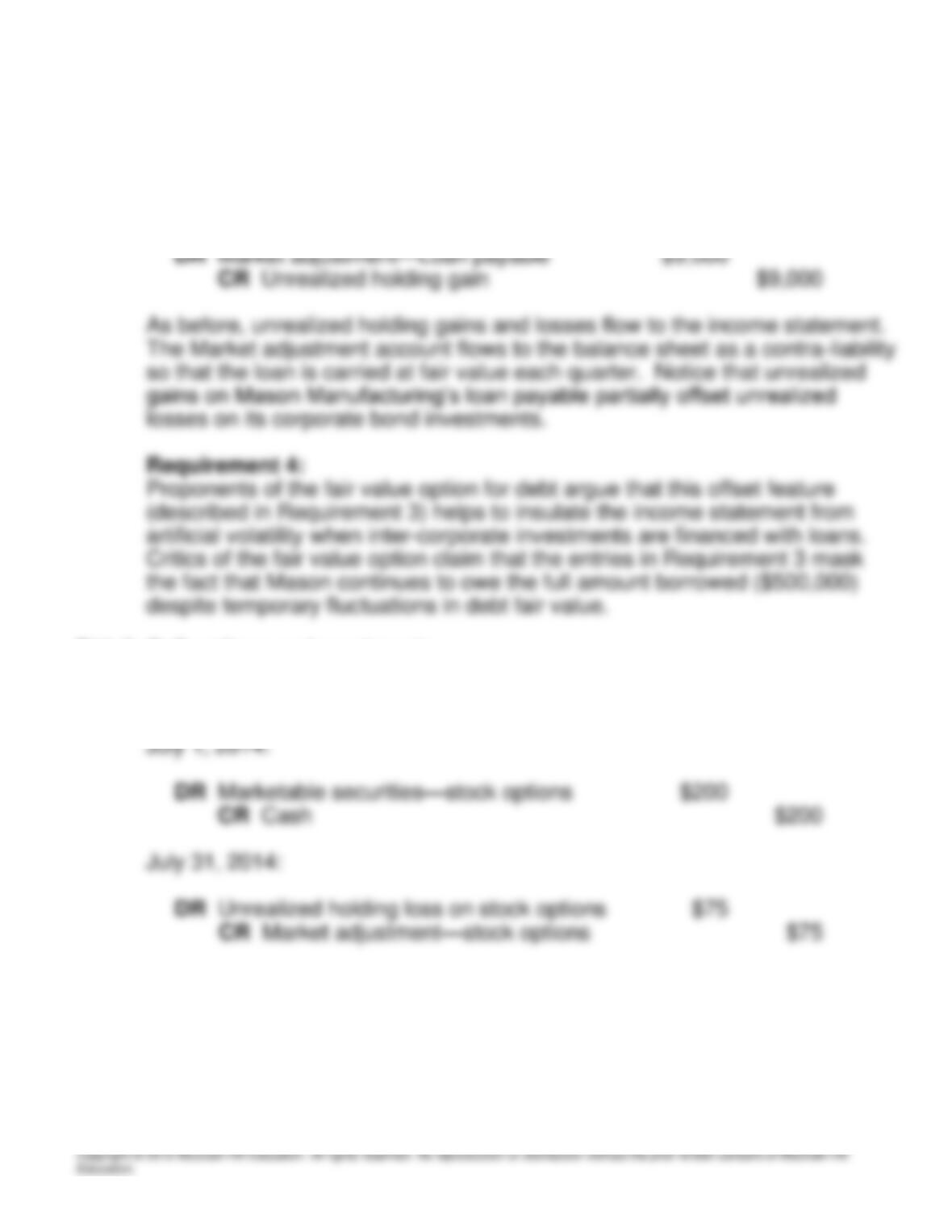
September 30, 2014:
DR Unrealized holding loss $11,000
CR Market adjustment—Loan payable $11,000
December 31, 2014:
P11–6. Call options as investments
Required entries for 1 through 3:
11–18
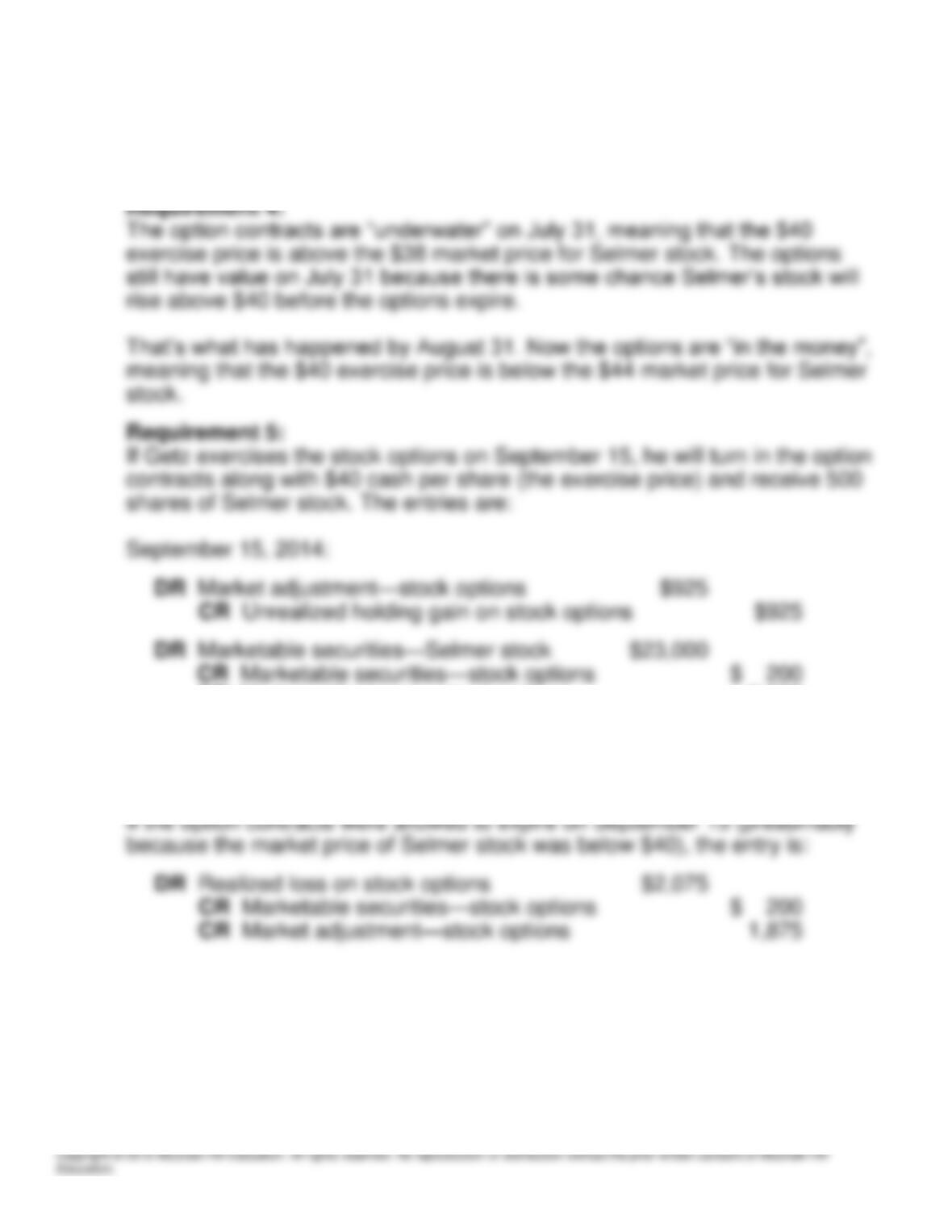
August 31, 2014:
DR Market adjustment—stock options $1,950
CR Unrealized holding gain on stock options $1,950
The unrealized holding gains and losses flow directly to income each month.
CR Market adjustment—stock options 2,800
CR Cash 20,000
Notice that the Selmer shares are worth $46 each, or $23,000.
Requirement 6:
P11–7. Retiring debt early
Requirement 1:
The issuance price of the bonds on January 1, 2014 is equal to the present
value of the principal repayment plus the present value of the semi-annual
interest payments. Since the bonds pay interest semi-annually, the present
Present value of the interest payments:
= ($75,000,000 x 0.045) x Present value of an ordinary annuity of $1
to be received for 20 periods at 5.5%
= $3,375,000 x 11.9504 = $40,332,600
Price of the bonds: = $25,702,500 + $40,332,600 = $66,035,100

11–20
11–21
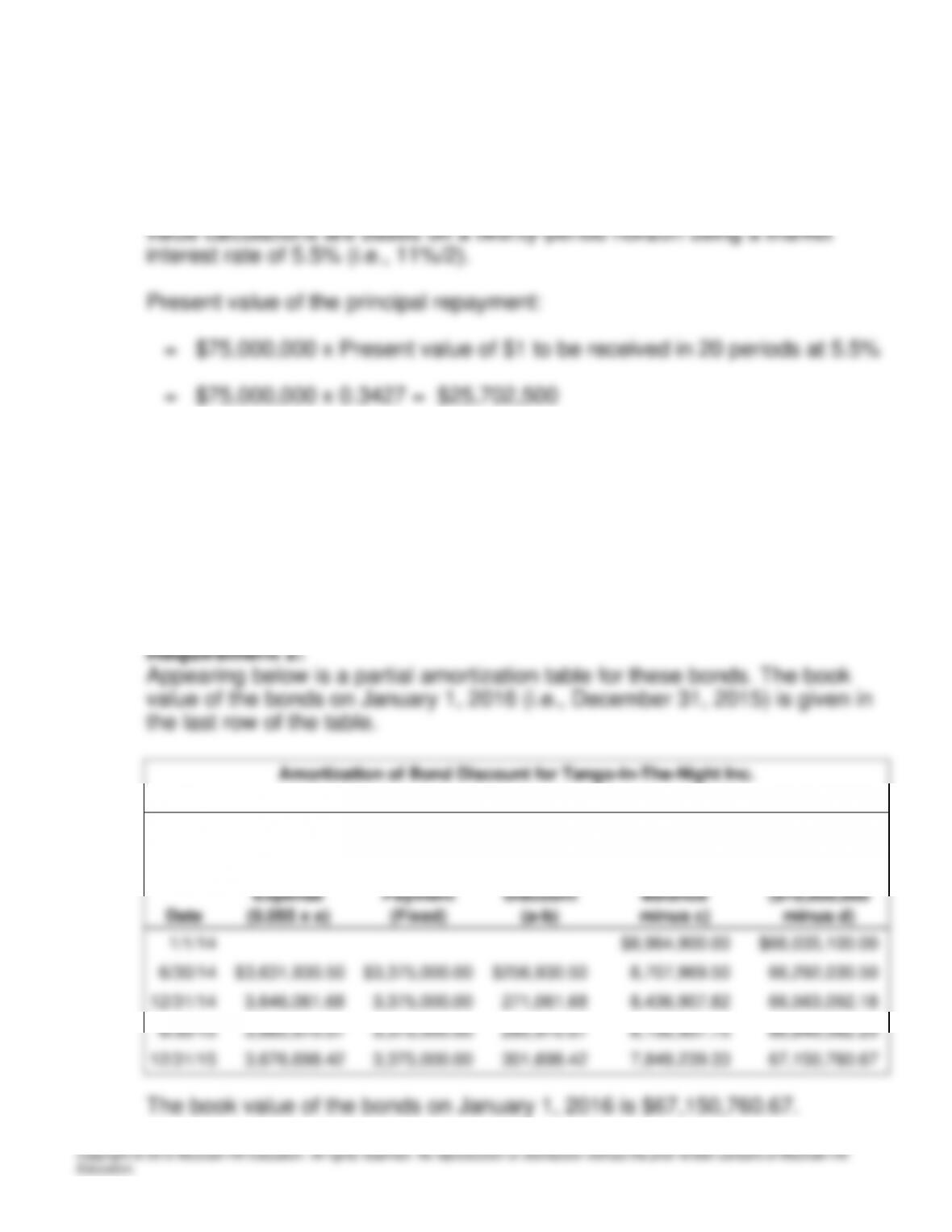
Requirement 3:
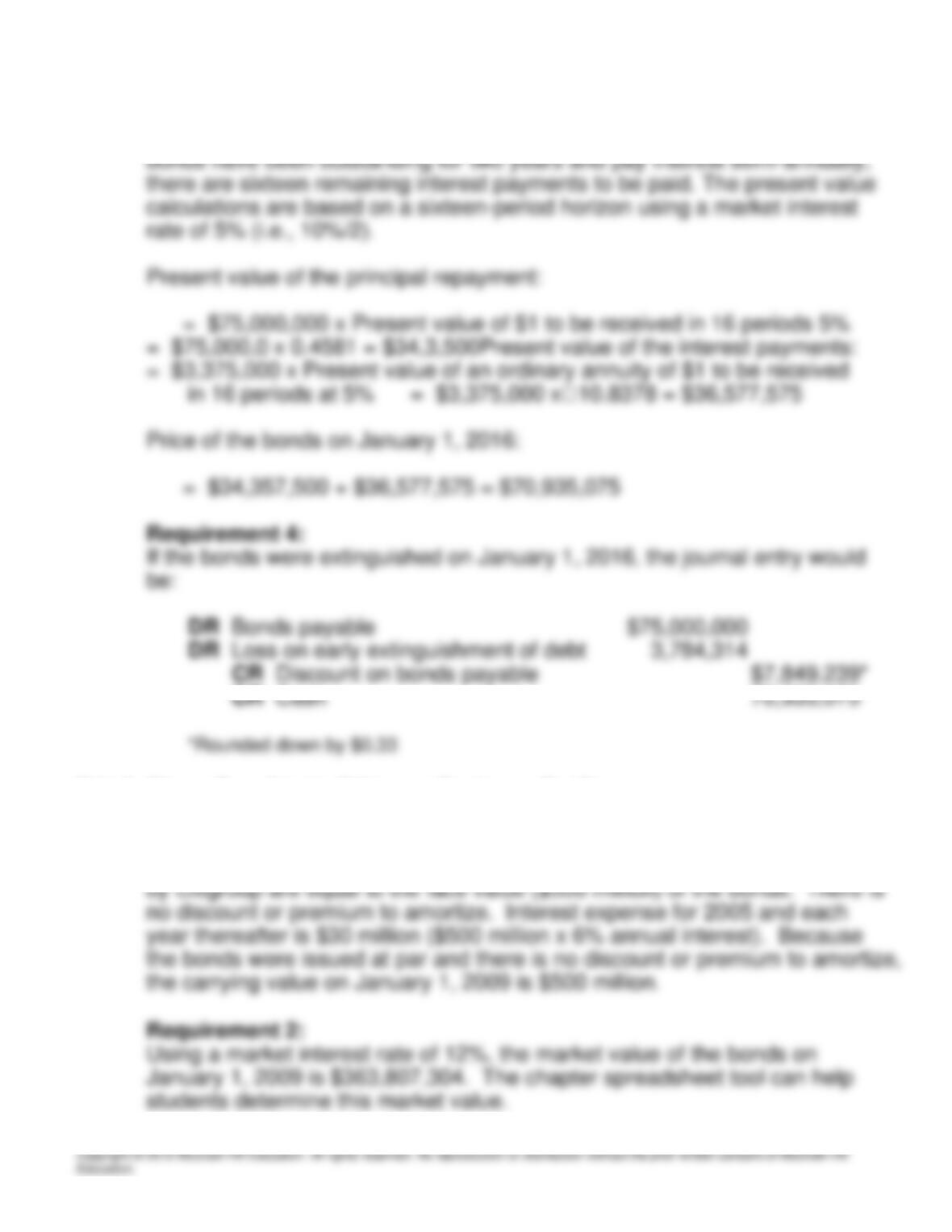
The price of the bonds on January 1, 2016 is equal to the present value of the
principal repayment to be received in eight years (i.e.,16 periods) plus the
present value of the remaining semi-annual interest payments. Since the
P11–8. Sharp Pencil Lets Citigroup Declare a Profit
Requirement 1:
The bonds were issued on January 1, 2005 at par, so the proceeds received
11–22
Requirement 3:
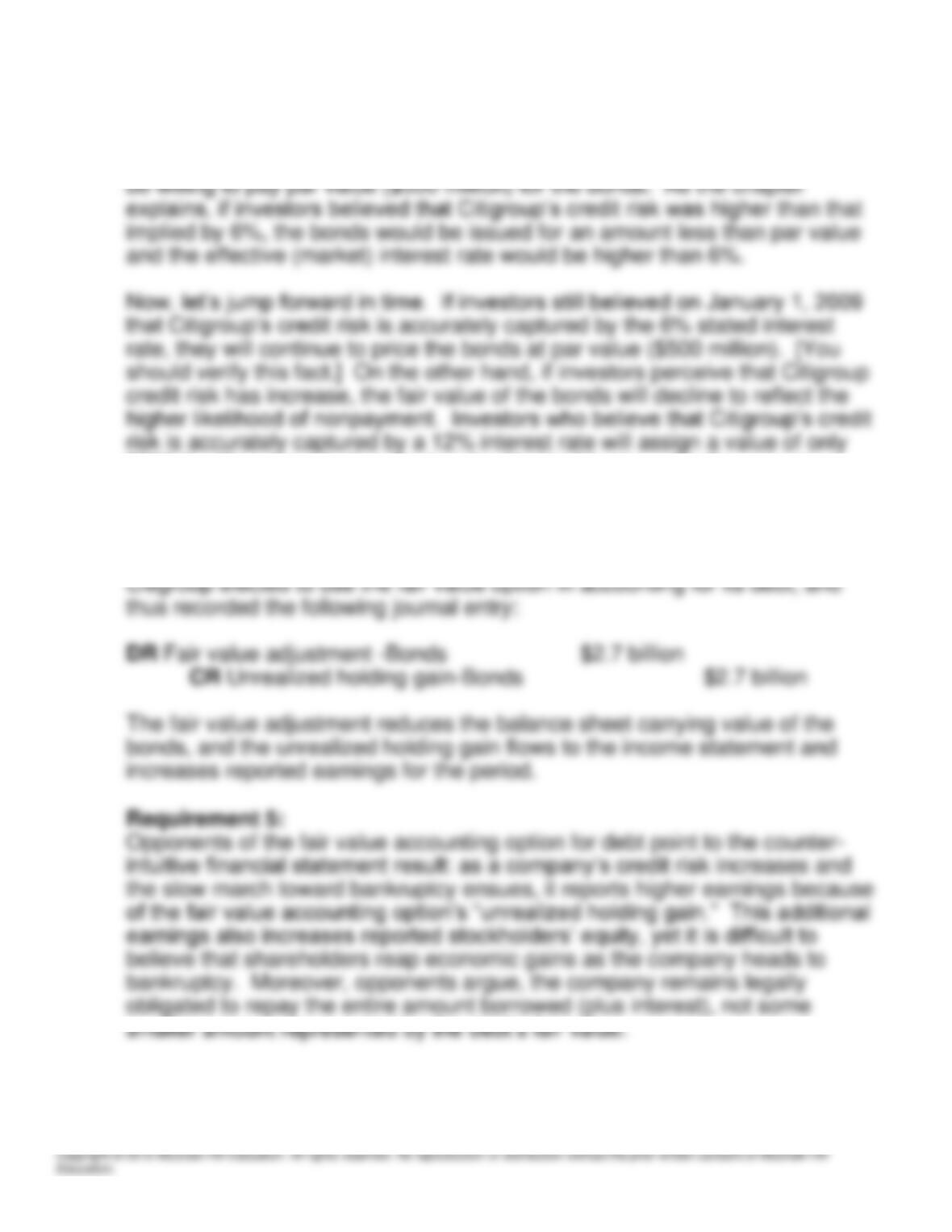
Let’s illustrate the effect of escalating credit risk using the results in
Requirements 1 and 2. Investors who believe on January 1, 2005 that
Citigroup’s credit risk is accurately captured by the 6% stated interest rate will
$363.8 million (rounded) to the bonds. Under this scenario, the value to
investors of Citigroup’s has declined in the marketplace because the
perceived risk of nonpayment by Citigroup has increased.
Requirement 4:
11–23
P11-9. Chalk Hill: Using an interest-rate swap as a speculative investment
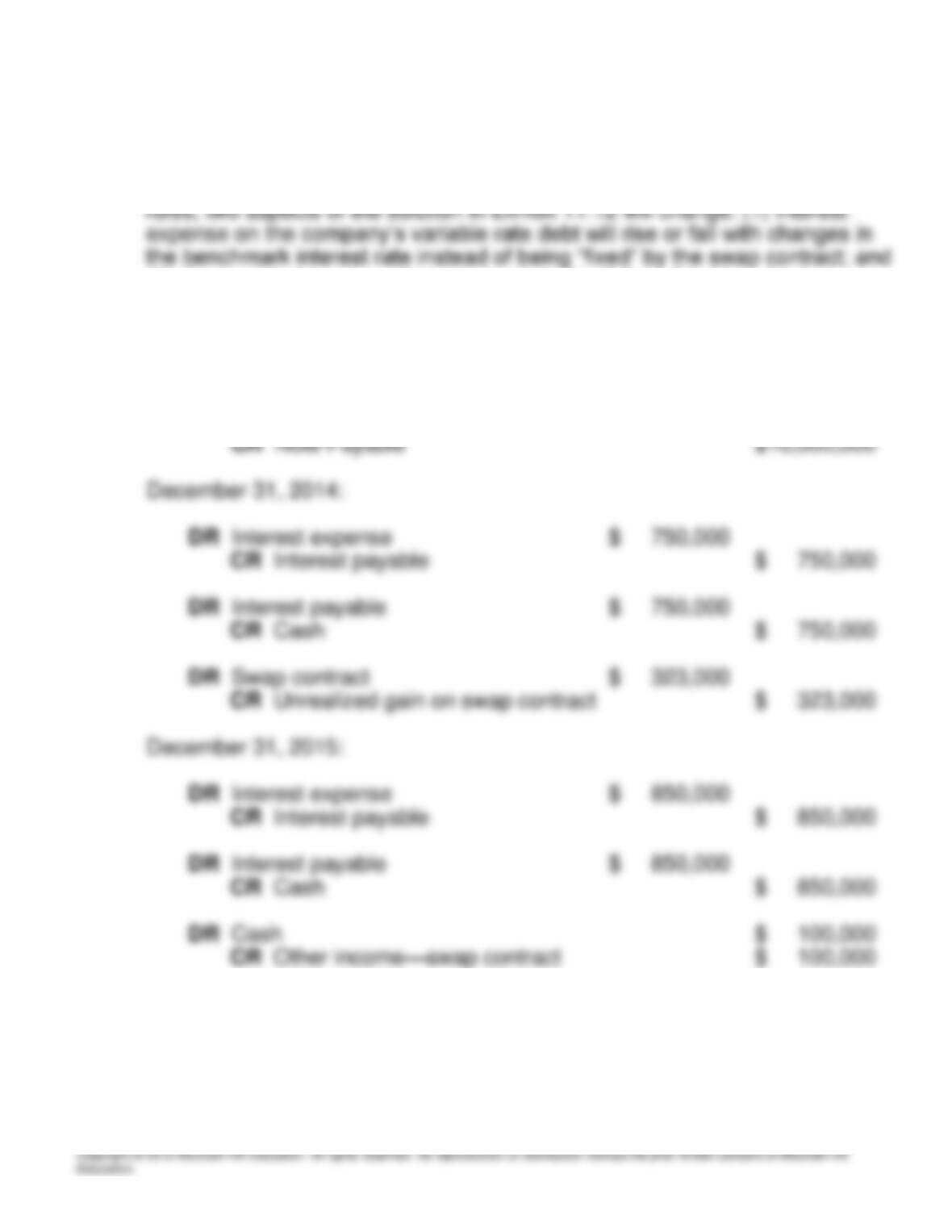
Because the swap contract does not qualify for special hedge accounting
(2) changes in the value of the swap contract will flow directly to income
rather than to “other comprehensive income”. Here are the revised journal
entries:
January 1, 2014:
DR Cash $10,000,000
11–24
DR Unrealized loss on swap contract $ 378,000
CR Swap contract $ 378,000
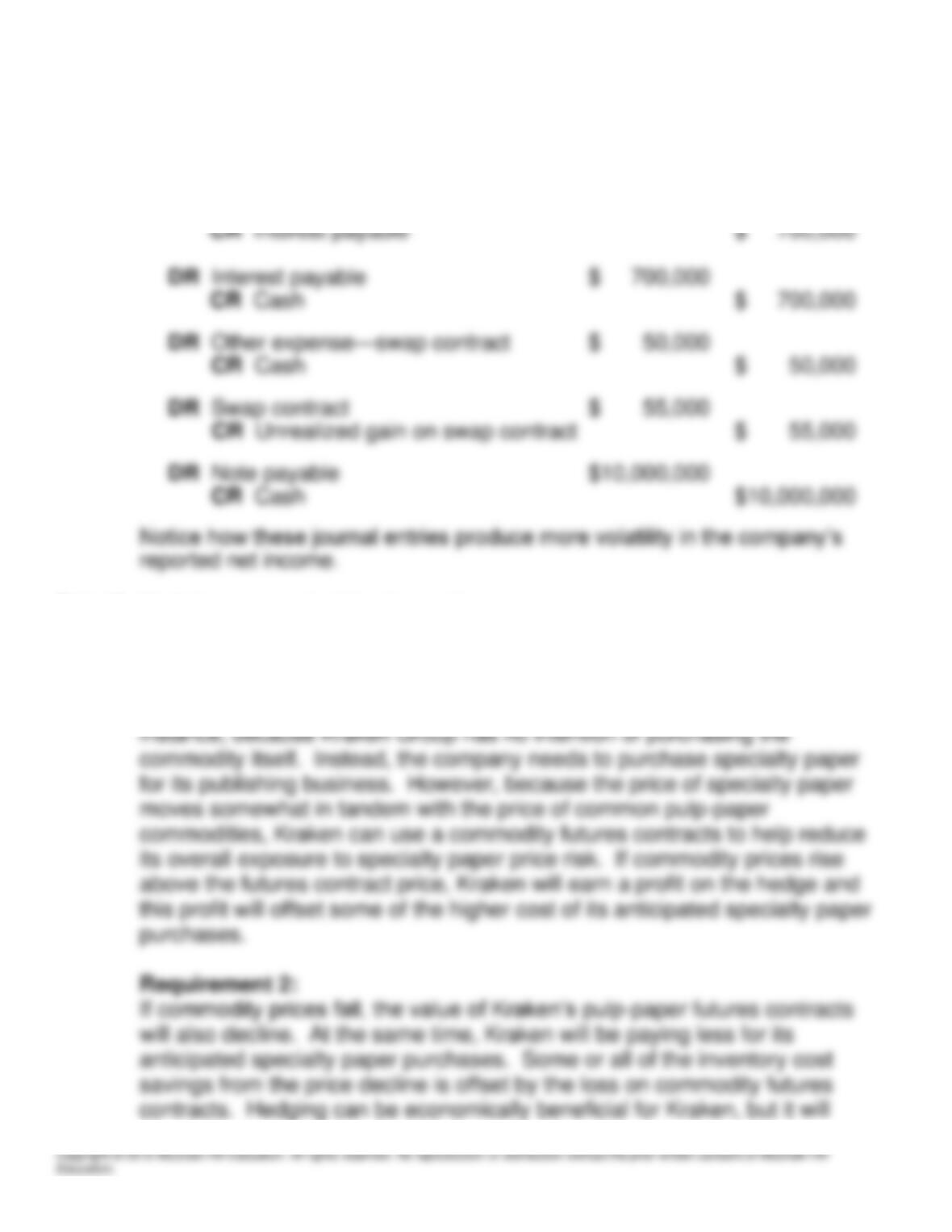
December 31, 2016:
DR Interest expense $ 700,000
P11–10. Hedging raw material price swings
Requirement 1:
Pulp–paper futures contracts can be used to “lock in” a specific price for
anticipated future inventory purchases. The details are complex in this
11–25
require a delicate balance of upside potential, downside risk, and
expectations about future inventory needs.
Requirement 3:
By executing a forward contract for ink with a supplier, Kracken can again
P11–11. Discount and premium amortization
Requirement 1:
The carrying values of both bonds in each of the two years presented is
simply equal to the present value of the principal and interest payments
11–26
pay semi-annual interest of $500,000 and have four periods until they
mature.
Present value of the principal repayment:
= $10,000,000 x Present value of $1 to be received in 4 periods at 4%
= $10,000,000 x 0.8548 = $8,548,000
= $500,000 x 1.8334 = $916,700
Carrying value of the bonds at December 31, 2011:
= $8,900,000 + $916,700 = $9,816,700
The December 31, 2010, carrying value of the 10% bonds due in 2010 is
11–27
= $10,000,000 x 0.7903 = $7,903,000
Present value of the interest payments:
= $500,000 x Present value of an ordinary annuity of $1 to be received in
6 periods at 4%
June 30 and December 31) minus the amortization of the bond premium
during 2011. This latter amount is the difference between the carrying value
of the bonds at December 31, 2010, and December 31, 2011. Based on the
calculations in part 1, this amount is:
P11–12. Sears: Reading the Financials
11–28
annual effective interest rate then interest expense for the year is found by
multiplying the beginning book value of the debt by its effective interest rate:
Interest expense = $182,700,000 x 14.6% = $26,674,200
$188.6 million minus $182.7 million). The discount amortization should
equal the change in balance sheet book values, but the two numbers differ
1. First semi-annual period
Interest expense = $182,700,000 x 7.3% = $13,337,100
2. Second semi-annual period
Interest expense = $185,537,100 x 7.3% = $13,544,208
Interest payment = $300,000,000 x 3.5 = 10,500,000
11–29
Or, since the entire expense is amortized (there’s no cash payment), it is all
added to the debt book value. Consequently, interest expense will equal the
increase in carrying value of the bonds, or:
$72.549 = $833.9 x 8.7% and $0.600 = $834.5 – $833.9
P11–13. Hedging
Requirement 1:
The company eliminated its exposure to the cash flow consequences of
changing foreign currency exchange rates between the U.S. and Canadian
11–30
Requirement 4:
The financial commodity swap allows the company to “lock in” the future
price of natural gas, an important component to the production process.
The swap effectively guarantee’s that Molson Coors will pay a known and
P11–14. Contingent liabilities and debt covenants
1. It is probable that an asset has been impaired or a liability has been
incurred at the date of the financial statements
2. The amount of loss can be reasonably estimated.
Requirement 2:
IFRS guidance on accounting for contingencies is quite similar to the U.S.