11-1
Financial Reporting and Analysis (6th Ed.)
Chapter 11 Solutions
E11–1. Finding the issue price
(AICPA adapted)
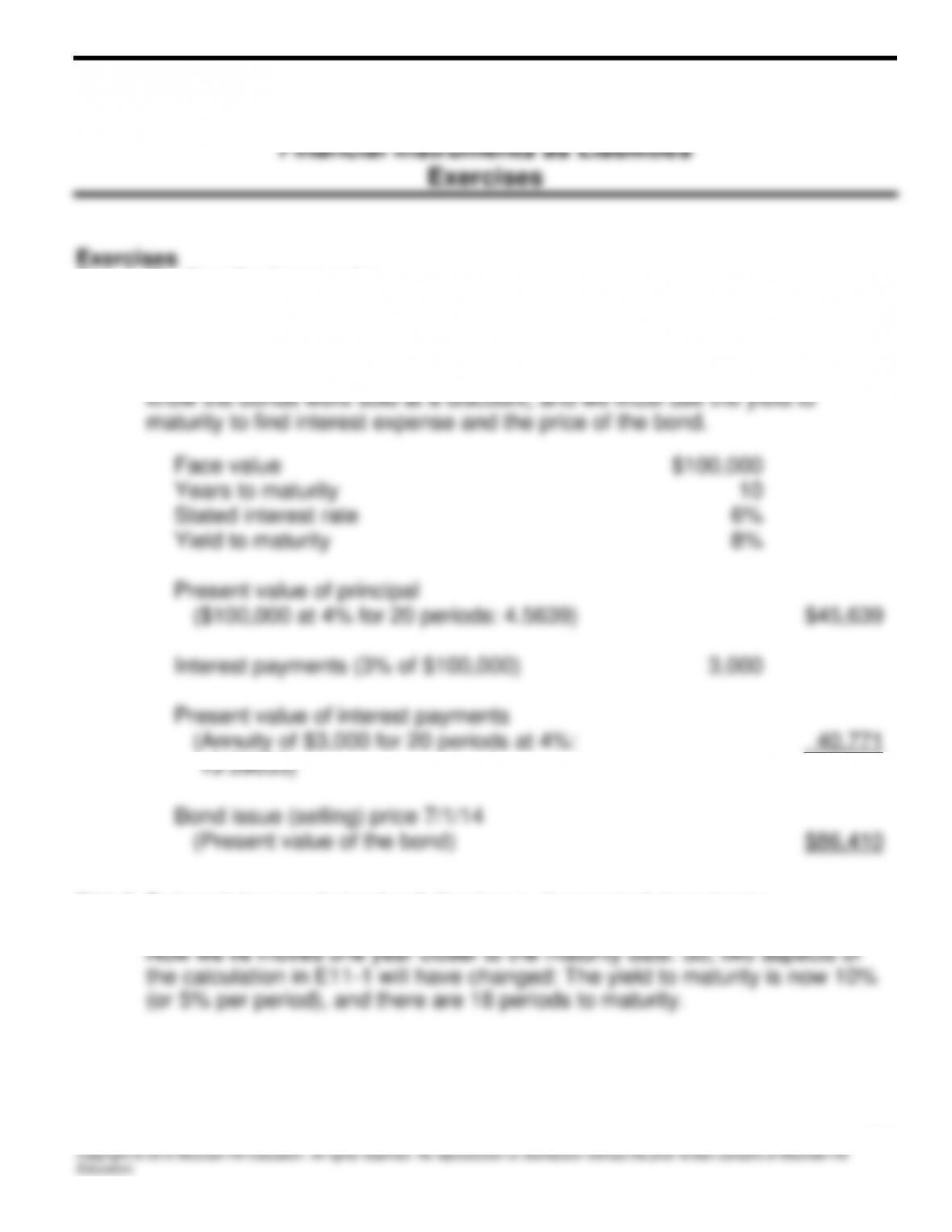
We know that the bonds were priced to yield 8% when the contract interest
rate was only 6%. Since the yield is higher than the contract interest rate, we
E11–2. Determining market price following a change in interest rate
11-2
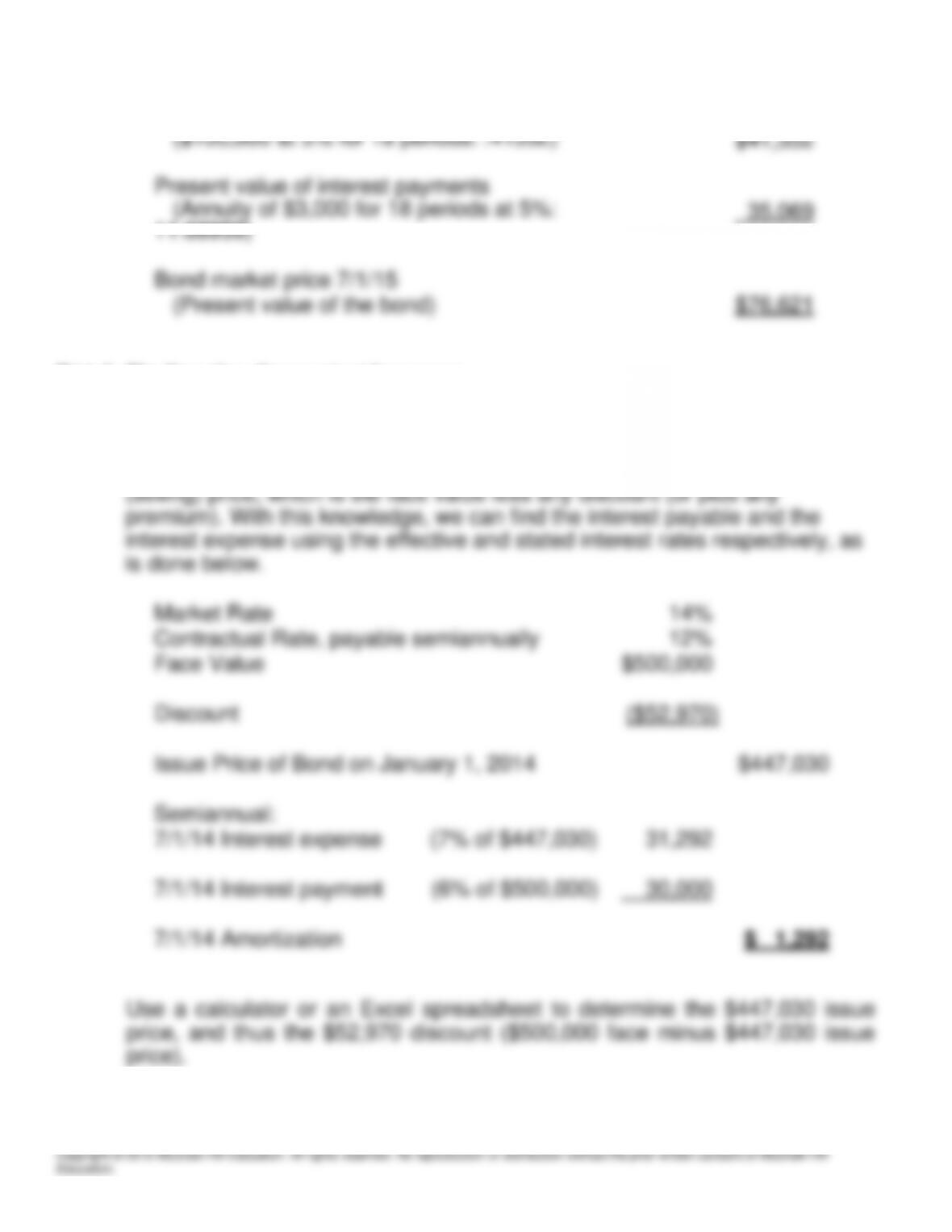
Present value of principal
($100,000 at 5% for 18 periods: .41552)
$41,552
Present value of interest payments
(Annuity of $3,000 for 18 periods at 5%:
11.68959)
_35,069
Bond market price 7/1/15
(Present value of the bond)
$76,621
E11–3. Finding the discount at Issuance
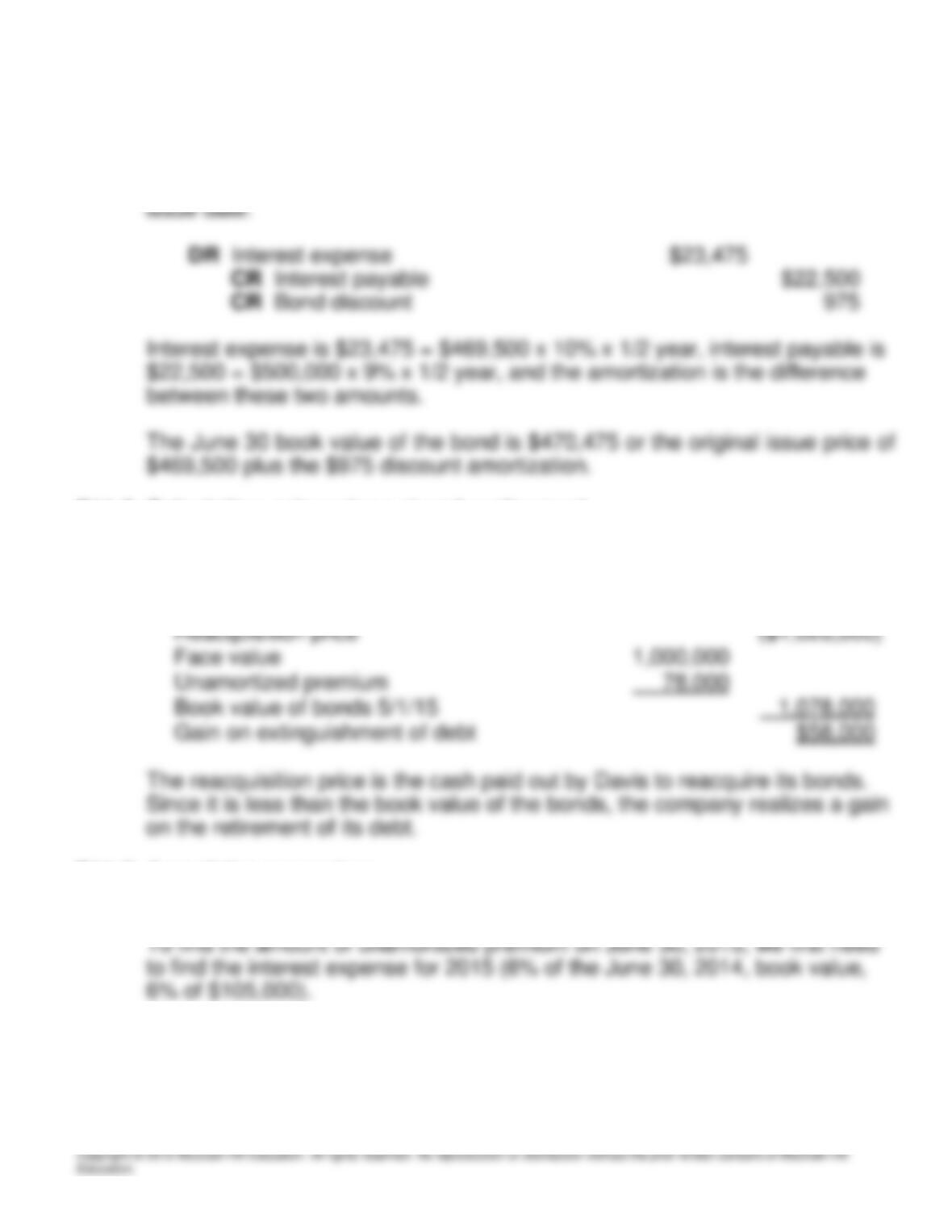
To find the amount of amortization on July 1, 2014 we first need to know the
book value of the bond on that date. Since this is the first interest payment
date, the beginning-of-period book value is the same as the original issue
Contractual Rate, payable semiannually
Issue Price of Bond on January 1, 2014
11-3
E11–4. Determining a bond’s balance sheet value
(AICPA adapted)
Even though the bonds pay interest only annually on December 31, the
June 30 balance sheet would still need to reflect interest accrued since the
E11–5. Calculating gain or loss at early retirement
(AICPA adapted)
The gain (or loss) on bond extinguishment can be computed as follows:
Reacquisition price
($1,020,000)
Face value
1,000,000
Unamortized premium
78,000
Book value of bonds 5/1/15
1,078,000
Gain on extinguishment of debt
$58,000
The reacquisition price is the cash paid out by Davis to reacquire its bonds.
Since it is less than the book value of the bonds, the company realizes a gain
on the retirement of its debt.
E11–6. Amortizing a premium
(AICPA adapted)
11-4
Date
Interest
Payment
Interest
Expense
Premium
Amortization
Book Value
6/30/14
105,000
6/30/15
7,000
6,300
700
104,300
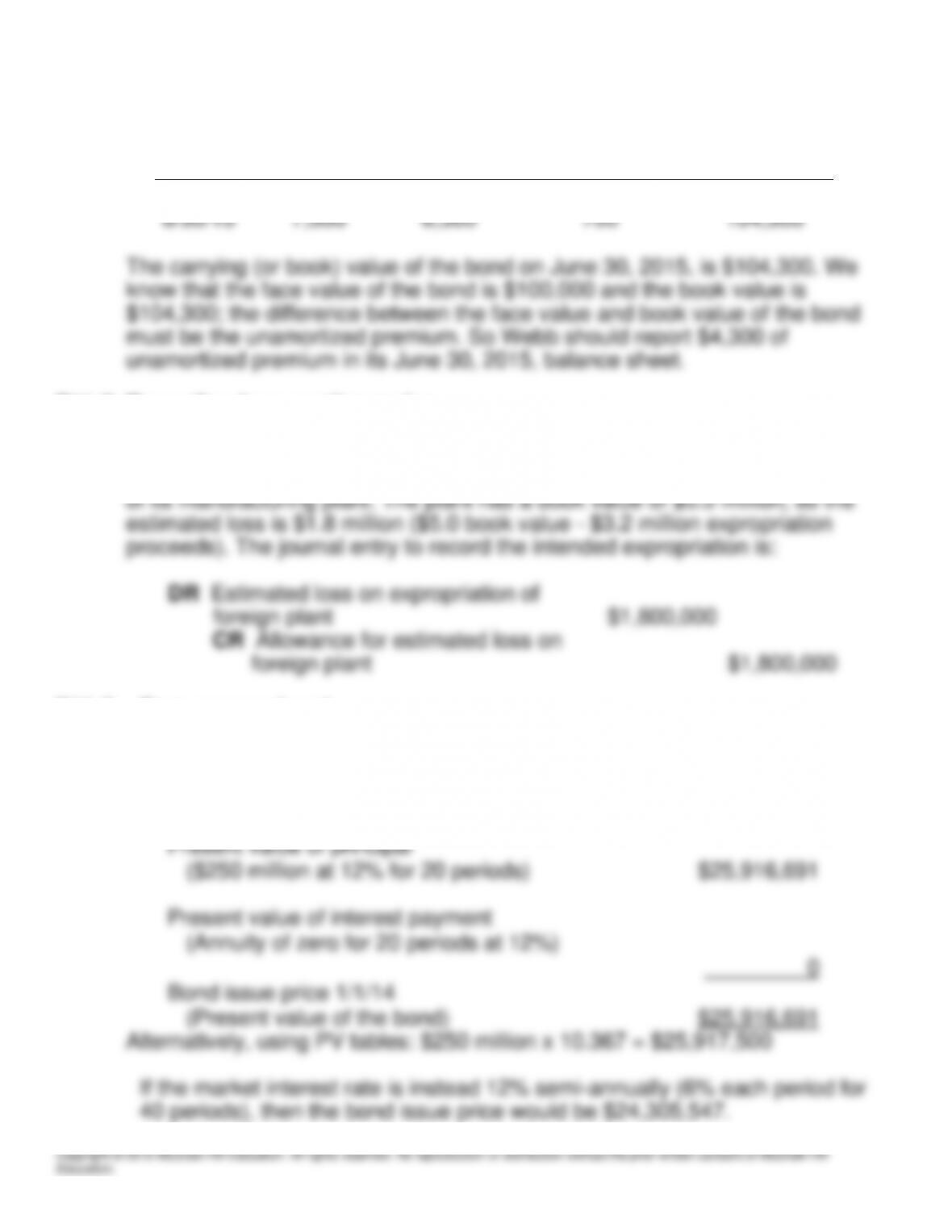
The carrying (or book) value of the bond on June 30, 2015, is $104,300. We
know that the face value of the bond is $100,000 and the book value is
$104,300; the difference between the face value and book value of the bond
must be the unamortized premium. So Webb should report $4,300 of
unamortized premium in its June 30, 2015, balance sheet.
E11–7. Recording loss contingencies
(AICPA adapted)
Brower expects to receive $3.2 million as compensation for the expropriation
E11–8. Zero coupon bond
Requirement 1:
These bonds have a face value of $250 million, a zero coupon rate, a
market yield rate of 12%, and mature in 20 years. The issue price is:
Present value of principal
($250 million at 12% for 20 periods)
$25,916,691
Present value of interest payment
(Annuity of zero for 20 periods at 12%)
0
Bond issue price 1/1/14
(Present value of the bond)
$25,916,691
Alternatively, using PV tables: $250 million x 10.367 = $25,917,500
If the market interest rate is instead 12% semi-annually (6% each period for
40 periods), then the bond issue price would be $24,305,547.
11-5
Alternatively, using PV tables: $250 million x .09722 = $24,305,000
Requirement 2:
How much interest expense would the company record on the bonds in
E11–9. Floating-rate debt
Requirement 1:
The floating interest rate for 2014, set on January 1 of that year, was 12% or
the LIBOR rate of 6% plus 6% additional interest. The 2014 interest
E11–10. Identifying incentives for early debt retirement
Requirement 1:
We must first determine the book value of the bonds on December 31,
11-6
$5,000,000 = $125 million x 4%
The total book value (including Interest) of the debt on December 31, 2014,
is $130 million, the $125 million borrowed plus the $5 million of interest
owed for July 1 through December 31.
Requirement 2:
There are several reasons a company might want to retire debt early: take
advantage of lower interest rates; postpone scheduled principal repayments;
eliminate a conversion feature attached to the debt; improve the company’s
E11–11. Off-balance sheet debt
11-7
is not required (see Chapter 16 for the details and special consolidation
rules). The $200 million will show up on the books of the joint venture, but
E11–12. Noninterest-bearing loan
Requirement 1:
The present value of this payment stream, discounted at 9%, is:
Present value of $100,000 at delivery $100,000
E11–13. Understanding GAAP hedges
Requirement 1:
1. Manufacturer’s work–in-process inventory is an existing asset.
2. Credit card receivables are an existing asset at JC Penney.
3. Corn inventory is an existing asset at the cooperative.
4. Salaries payable are an existing liability at Ford Motor Company.
5. The three-year note is an existing liability at GM.
11-8
6. The three-year note is an existing liability at Chrysler.
Requirement 2:
The qualifying hedge instrument is most often a derivative security, although
not all derivatives meet the GAAP rules and some qualifying hedges do not
(c) American Express’s risk that members won’t pay their bills is an eligible
11-9
Financial Reporting and Analysis (6th Ed.)
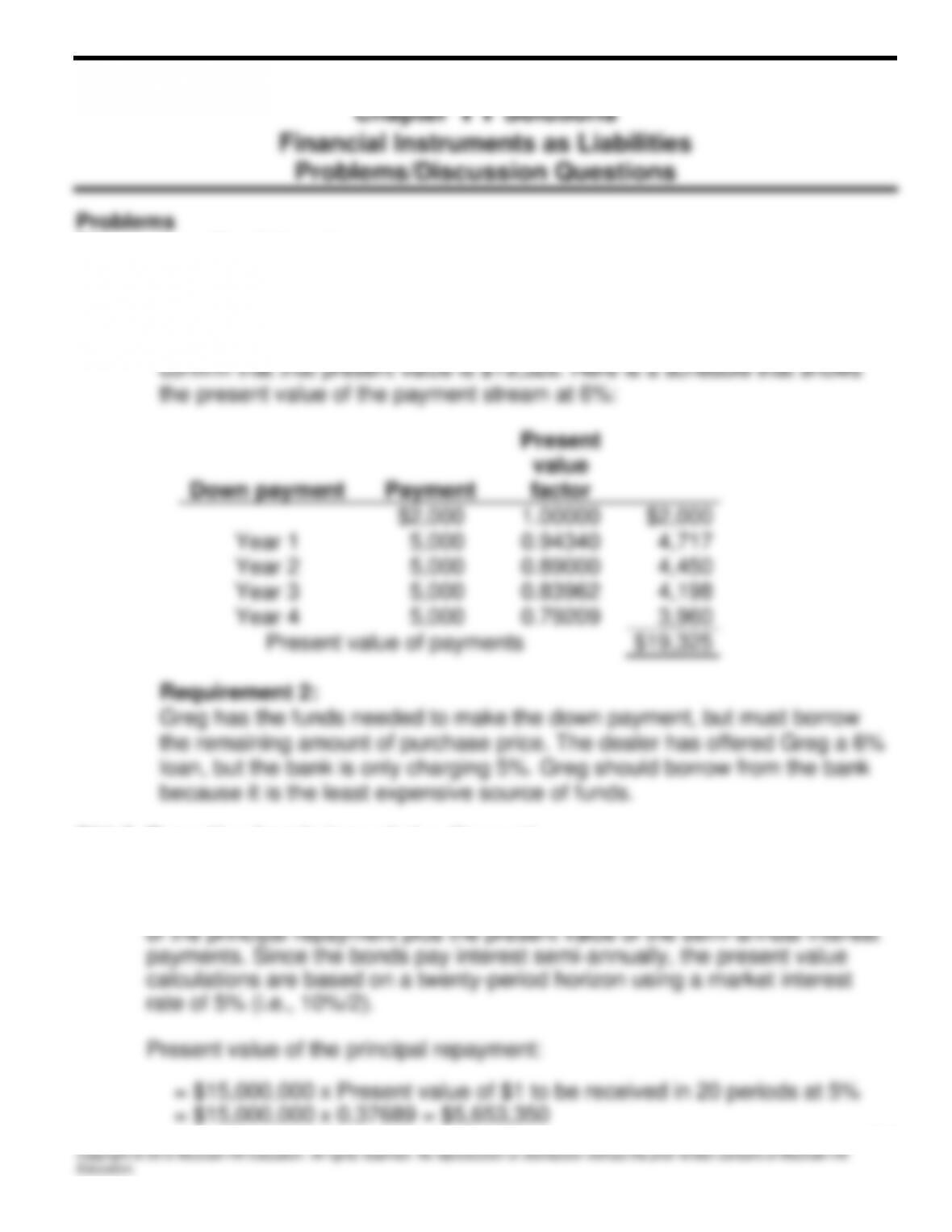
P11–1. Imputing interest
Requirement 1:
To verify that the imputed interest rate on the dealer’s loan is 6%, compute
the present value of the payment stream using a 6% discount rate and
P11–2. Reporting bonds issued at a discount
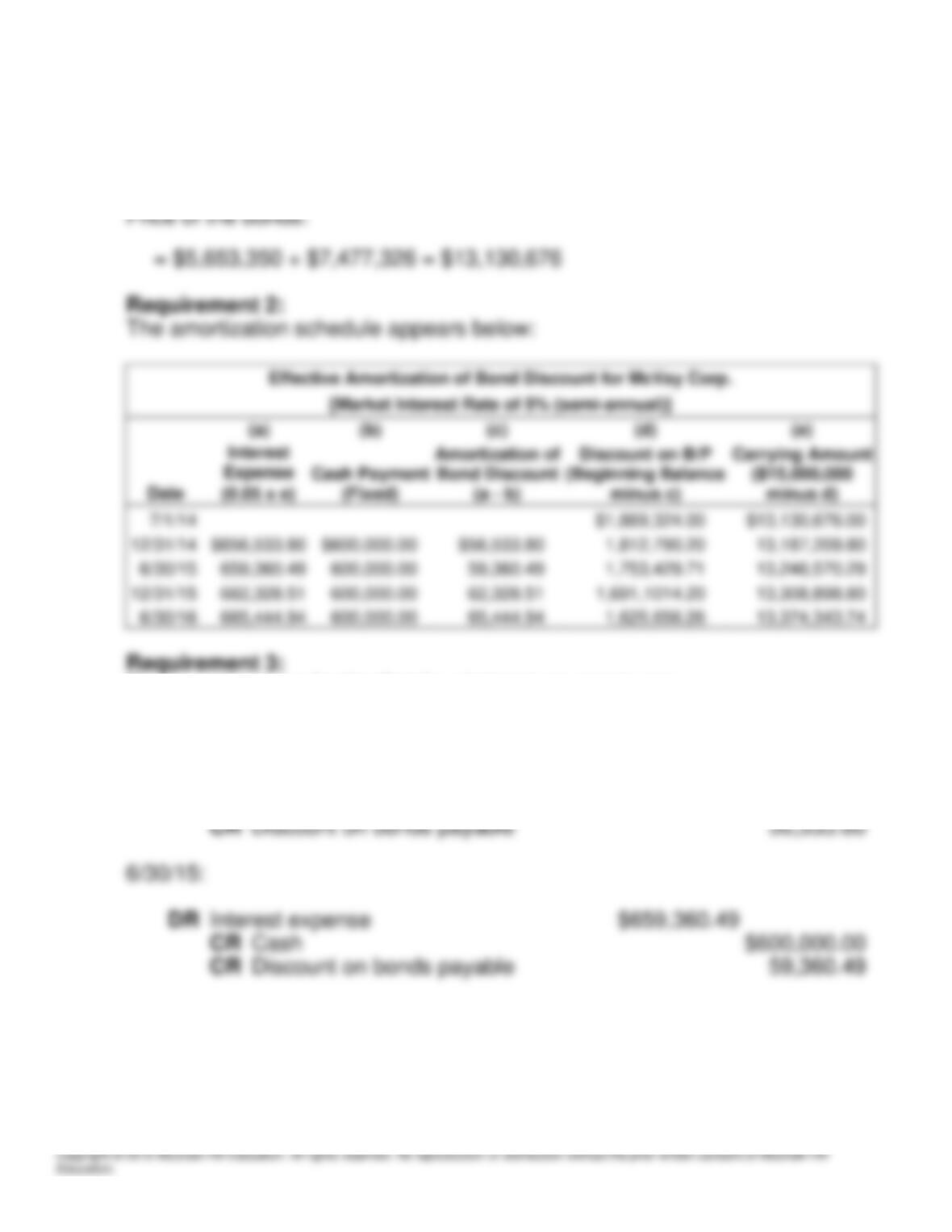
Requirement 1:
The issuance price of the bonds on July 1, 2014 is equal to the present value
11–10
Present value of the interest payments:
= ($15,000,000 x 0.04) x Present value of an ordinary annuity of $1 to be
received for 20 periods at 5%
= $600,000 x 12.46221 = $7,477,326
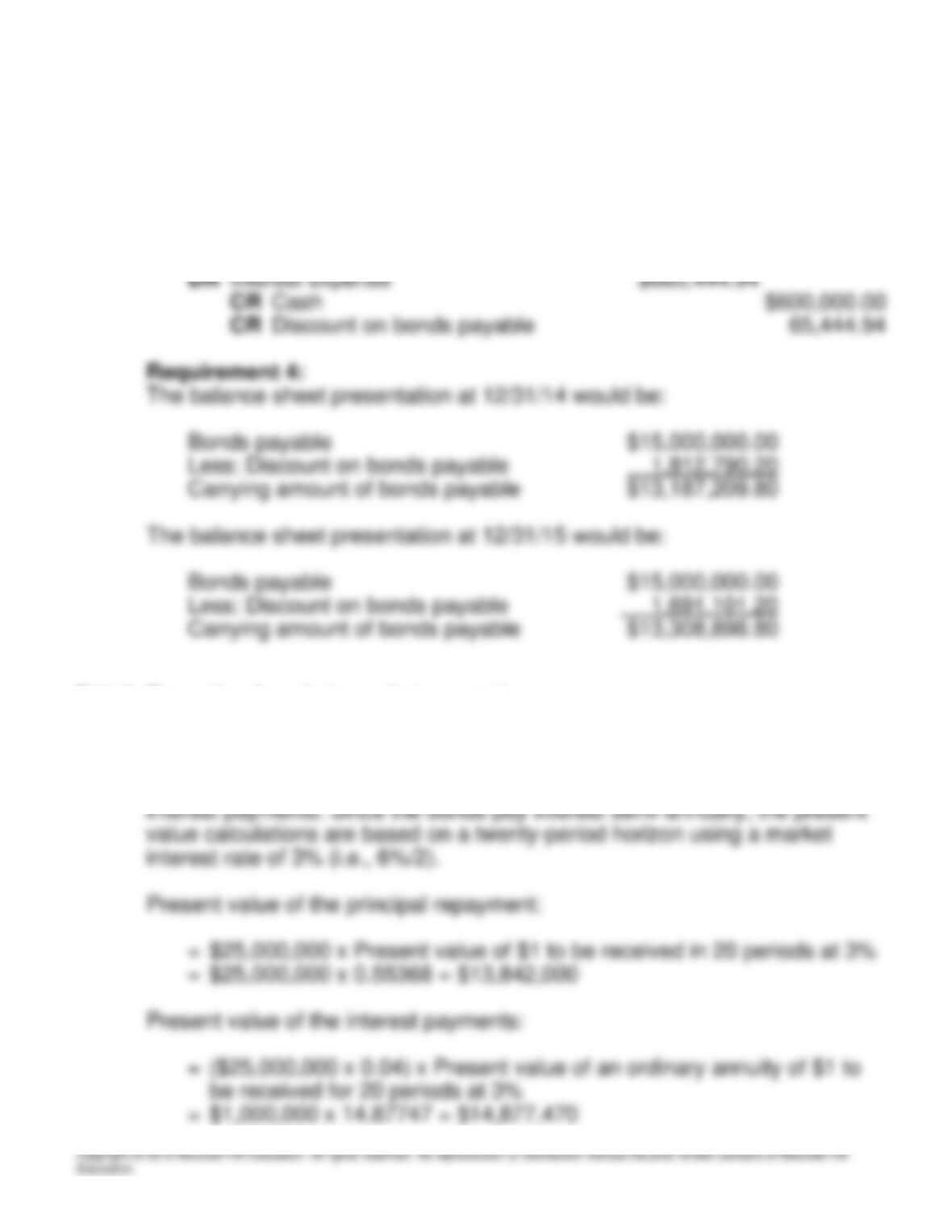
The journal entries for the first four interest payments are:
12/31/14:
DR Interest expense $656,533.80
CR Cash $600,000.00
11–11
12/31/15:
DR Interest expense $662,328.51
CR Cash $600,000.00
CR Discount on bonds payable 62,328.51
6/30/16:
P11–3. Reporting bonds issued at a premium
Requirement 1:
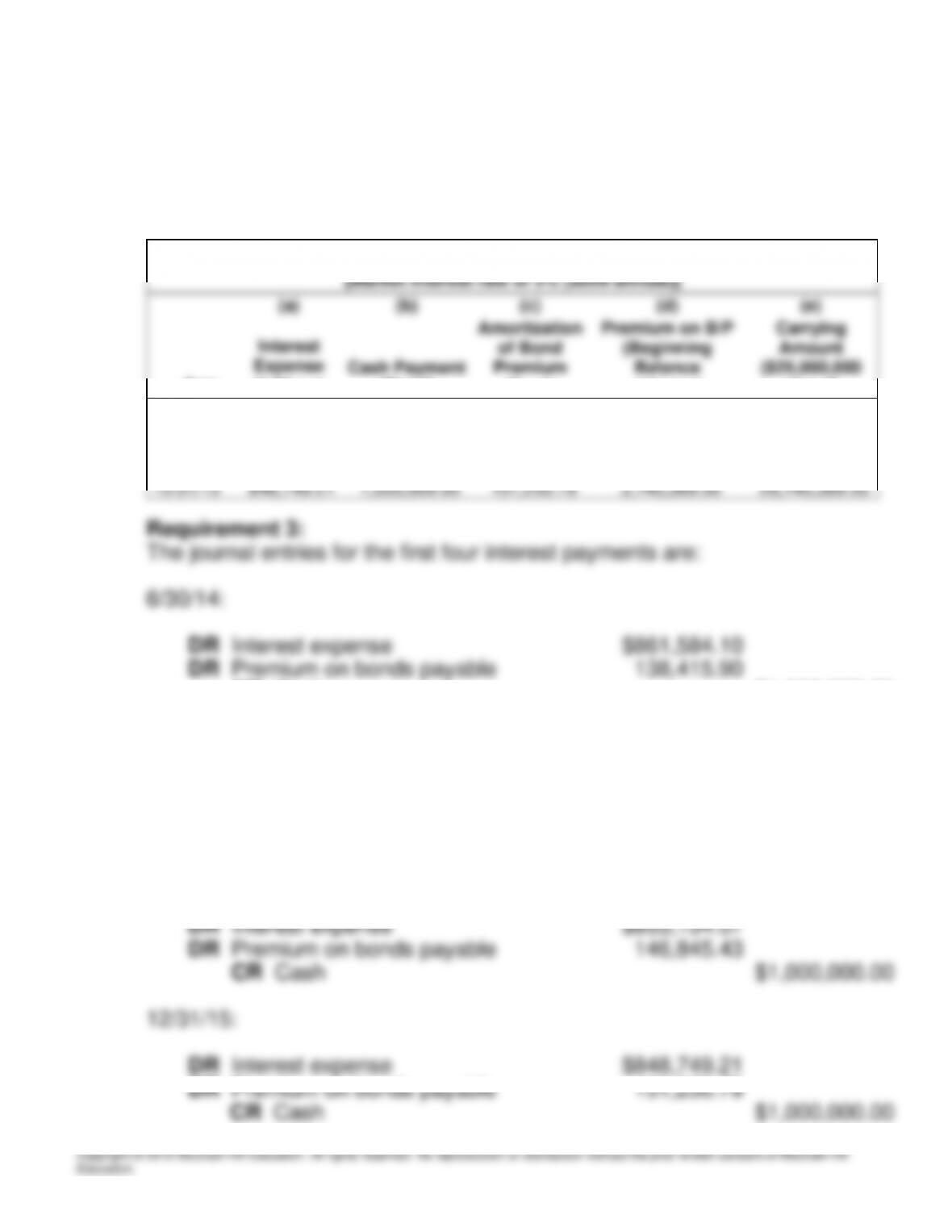
The issuance price of the bonds on January 1, 2014, is equal to the present
value of the principal repayment plus the present value of the semi-annual

11–12
11–13
Issue price of the bonds:
= $13,842,000 + $14,877,470 = $28,719,470
Requirement 2:
The amortization schedule appears below:
Effective Amortization of Bond Premium for Fleetwood Inc.
[Market interest rate of 3% (semi-annual)]
(a)
(b)
(c)
(d)
(e)
Date
Interest
Expense
(0.03 x e)
Cash Payment
(Fixed)
Amortization
of Bond
Premium
(b – a)
Premium on B/P
(Beginning
Balance
minus c)
Carrying
Amount
($25,000,000
plus d)
1/1/14
$3,719,470.00
$28,719,470.00
6/30/14
$861,584.10
$1,000,000.00
$138,415.90
3,581,054.10
28,581,054.10
12/31/14
857,431.62
1,000,000.00
142,568.38
3,438,485.72
28,438,485.72
6/30/15
853,154.57
1,000,000.00
146,845.43
3,291,640.29
28,291,640.29
12/31/15
848,749.21
1,000,000.00
151,250.79
3,140,389.50
28,140,389.50
CR Cash $1,000,000.00
12/31/14:
DR Interest expense $857,431.62
DR Premium on bonds payable 142,568.38
CR Cash $1,000,000.00
6/30/15:
11–14
Requirement 4:
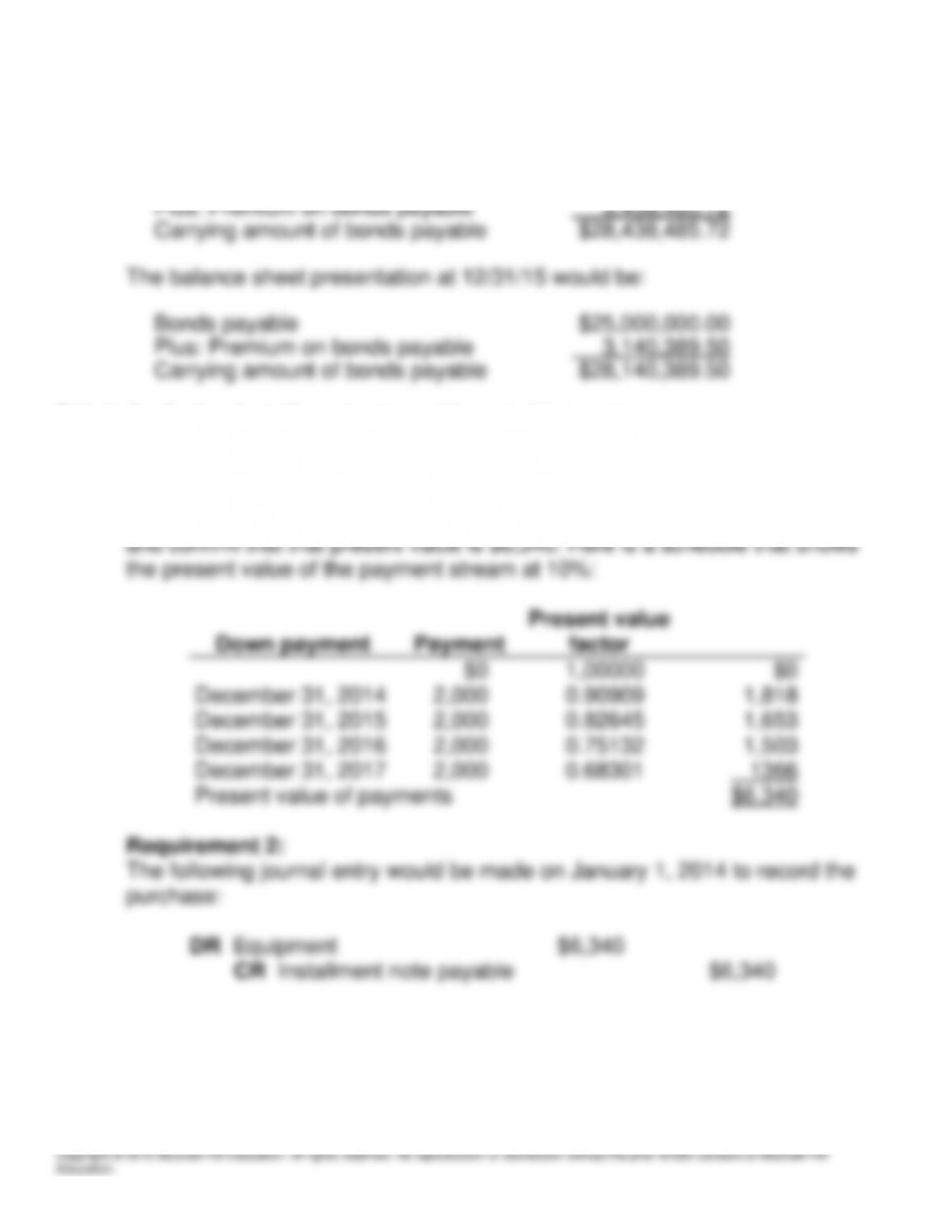
The balance sheet presentation at 12/31/14 would be:
Bonds payable $25,000,000.00
P11-4. Analyzing installment note and imputed interest
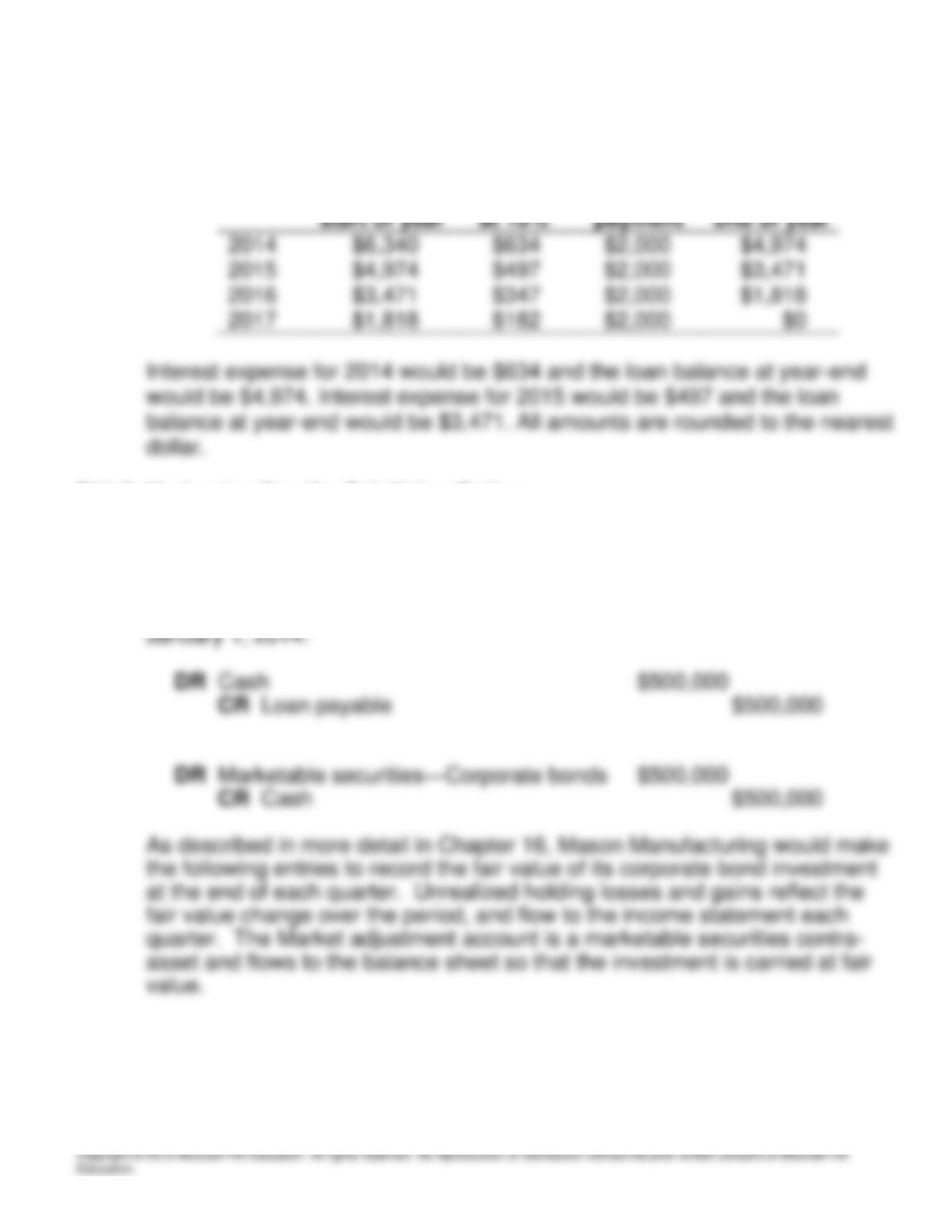
Requirement 1:
To verify that the imputed interest rate on the installment note is 10%, we
compute the present value of the payment stream using a 10% discount rate
11–15
Requirements 3 and 4:
The following schedule shows interest expense and the loan balance for each
year:
Balance at
start of year
Interest
at 10%
Loan
payment
Balance at
end of year
2014
$6,340
$634
$2,000
$4,974
2015
$4,974
$497
$2,000
$3,471
2016
$3,471
$347
$2,000
$1,818
2017
$1,818
$182
$2,000
$0
Interest expense for 2014 would be $634 and the loan balance at year-end
would be $4,974. Interest expense for 2015 would be $497 and the loan
balance at year-end would be $3,471. All amounts are rounded to the nearest
dollar.
P11–5. Understanding the Fair Value Option
Requirement 1:
Mason would make the following entry to record the borrowing and initial
purchase of its corporate bond investment: