10–31
Requirement 2:
ROA for Lantana Co. (000s omitted):
Jan. 1
Dec. 31
Dec. 31
Dec. 31
Dec. 31
Dec. 31
2014
2014
2015
2016
2017
2018
Asset net book value
$20,000
$20,080*
$20,234
$20,455
$20,736
$21,071
Net operating cash
flow, increasing
2%/year
$5,000
$5,100
$5,202
$5,306
$5,412
Depreciation exp.
4,000
4,008
4,024
4,049
4,082
Pretax profit
$1,000
$1,092
$1,178
$1,257
$1,330
ROA on beginning
5%
5.4%
5.8%
6.1%
6.4%
of year assets
Average age of
assets
5 years
5 years
5 years
5 years
5 years
10–32
2014
2015
2016
2017
2018
Beginning of the
year gross assets1
$40,000
$40,080
$40,242
$40,487
$40,817
Less: retired
($4,000)
($4,000)
($4,000)
($4,000)
($4,000)
Add: new assets
4,080
4,162
4,245
4,330
4,417
End of year gross
$40,080
$40,242
$40,487
$40,817
$41,234
assets
Depreciation expense
$4,000
$4,008
$4,024
$4,049
$4,082
(Beginning of year
x 10%)
1 Assets are, on average, 5 years old, with a 10-year life = ½ depreciated. Therefore,
$20,000,000 net asset base x 2 = $40,000,000 gross asset base.
*Computed as: Beginning net book value ($20,000,000) + capital expenditures ($4,080,000) –
depreciation expense ($4,000,000). All other years computed similarly.
Requirement 3:
Gardenia’s rapidly increasing ROA gives the appearance of significant year–
to-year improvement. But this is illusory because the ROA increase is caused
primarily by the increasing average age of its asset base. This factor would
alone cause ROA to increase even in the absence of inflation. But the upward
P10–17. Accounting for asset retirement obligations
Requirement 1:
GAAP requires companies to recognize an asset retirement obligation (ARO)
when a reasonable estimate of its fair value can be made. These legal
obligations arise when a company builds or buys an asset that requires
Payment $15,000,000
x PV factor, 5 periods, at 10% .62092
= Present value of the ARO $ 9,313,800
Journal entry:
01/01/Year 1
10–34
The entry to record the interest (for example, in year 1) is:
DR Accretion expense $931,380
P10-18. Accounting for assets held for sale
Requirement 1:
Carrying value at 12/31/11:
Historical cost $12,000,000
10–35
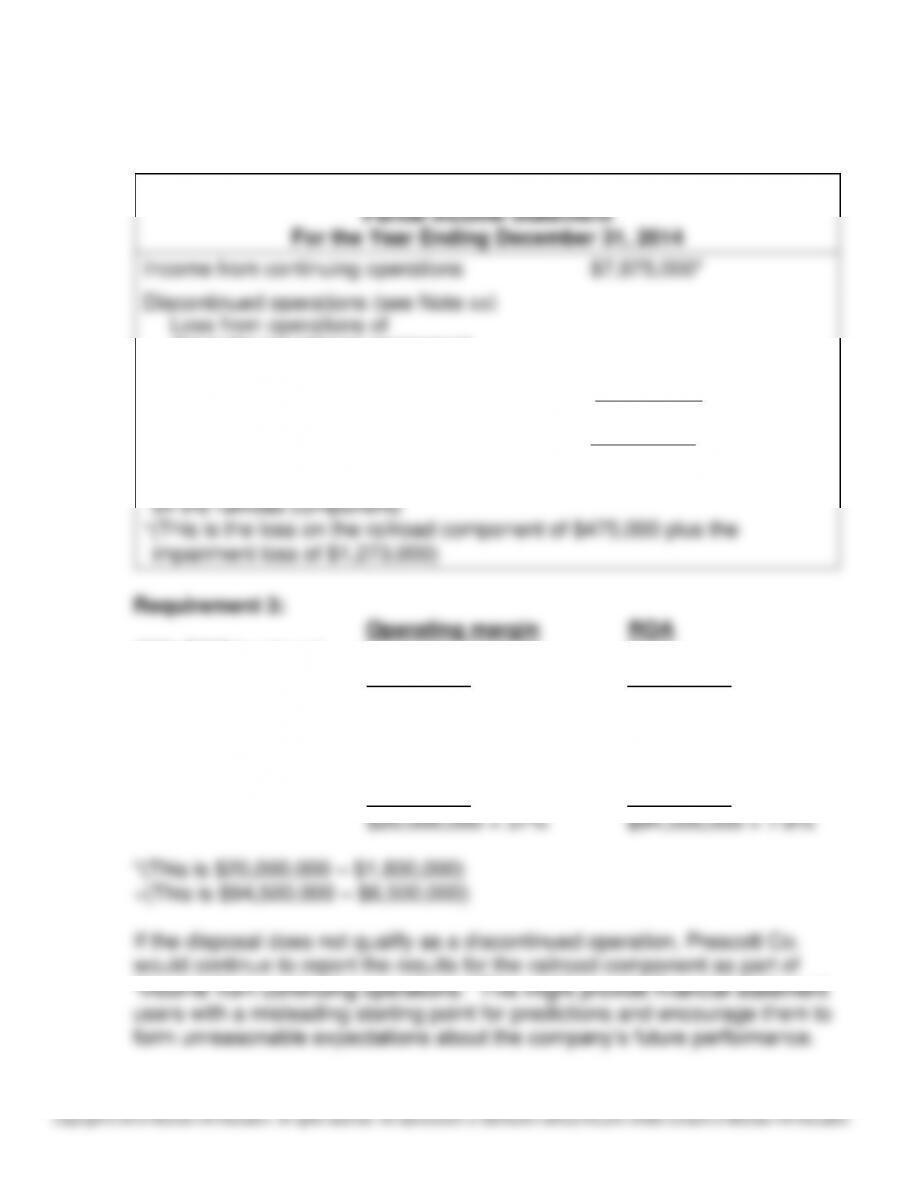
Prescott’s income statement for the year ended December 31, 2014 should
report discontinued operations for the railroad component after income from
continuing operations and before extraordinary items.
Prescott Co.
Partial Income Statement
For the Year Ending December 31, 2014
Income from continuing operations
$7,875,000*
Discontinued operations (see Note xx)
Loss from operations of
discontinued railroad component
(Including $1,273,000 impairment
loss)
(1,748,000)+
Net income
$6,127,000
*(This is net income of $7,400,000 plus the loss of $475,000 added back
on the railroad component)
+(This is the loss on the railroad component of $475,000 plus the
impairment loss of $1,273,000)
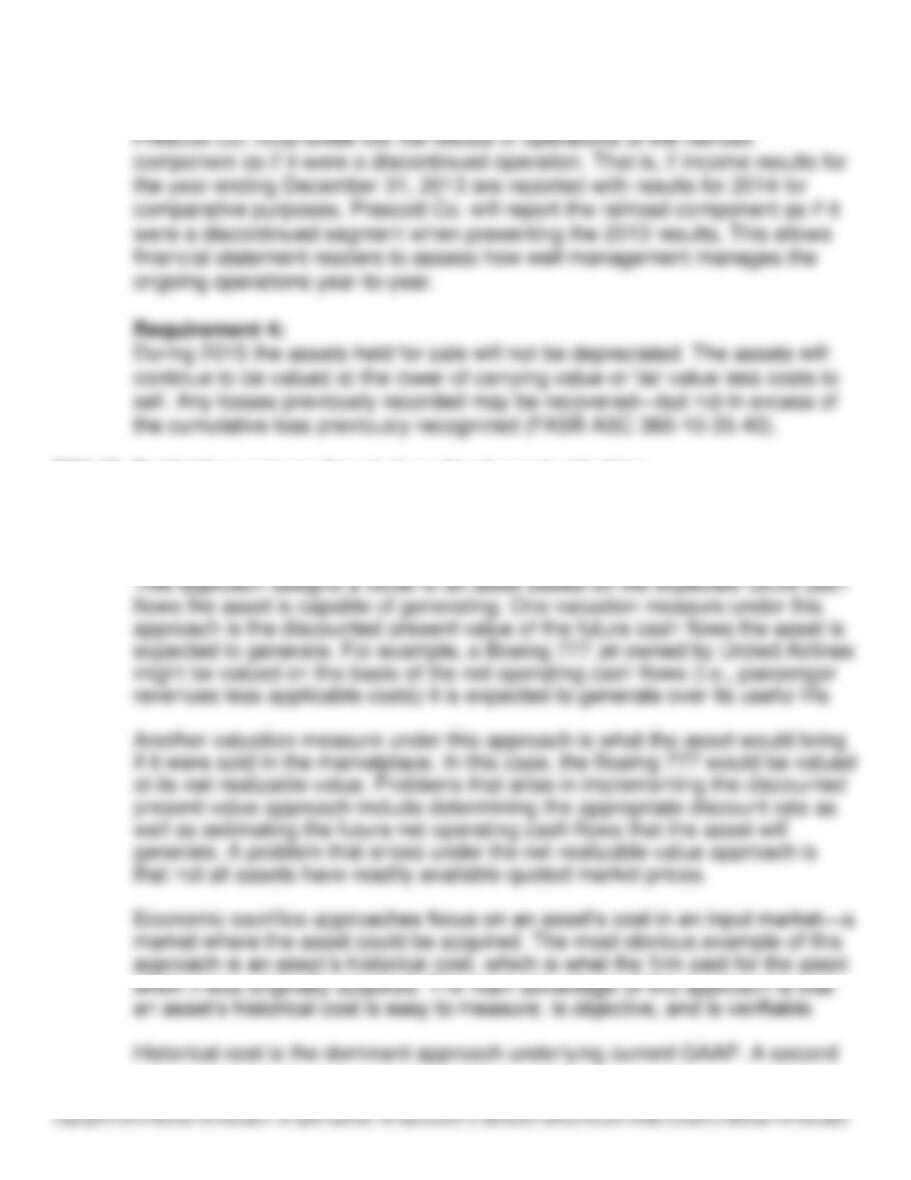
Requirement 3:
Operating margin ROA
With DCO treatment
$7,875,000 $7,875,000
$18,200,000* = 43.3% $88,000,000+ = 8.9%
Without DCO treatment
$7,400,000 $7,400,000
10–36
Separate reporting of discontinued operations helps financial statement
readers make meaningful comparisons of year-to-year results for income from
continuing operations. For all prior years presented for comparative purposes,
P10–19. Evaluating approaches to long-lived asset valuation
Requirement 1:
Expected benefit approaches focus on the estimated value of long-term
assets in an output market, that is, a market where the assets could be sold.
10–37
example of an economic sacrifice approach is current replacement cost. This
is the amount that would be required to purchase/replace the asset today with
an “identical” or “similar” asset. A problem that arises under this approach is
estimates about the future conditions of the firm and appropriate discount
rates. Many managers believe that the necessity of these estimates will
P10–20. Weakness of the Straight-line Depreciation Method
Requirement 1:
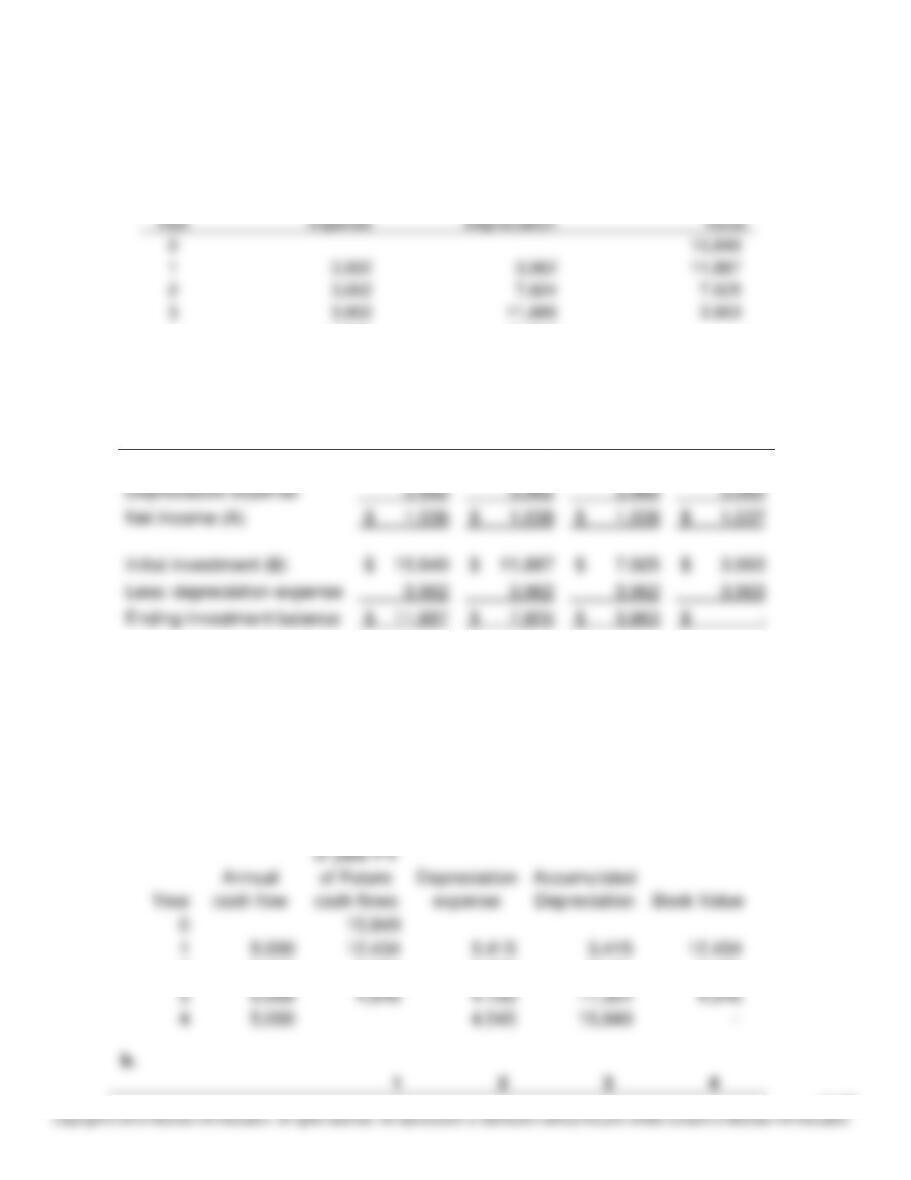
a. Annual depreciation expense = (Cost – salvage) ÷ life
$3,962 = ($15,849 − $0) ÷ 4
End of
Depreciation
Accumulated
Book
Year
Expense
Depreciation
Value
0
15,849
1
3,962
3,962
11,887
2
3,962
7,924
7,925
3
3,962
11,886
3,963
4
3,963
15,849
–
b. If the company were to record straight–line depreciation, its four years’ income statements
would appear as follows:
1
2
3
4
Revenue
$ 5,000
$ 5,000
$ 5,000
$ 5,000
Depreciation expense
3,962
3,962
3,962
3,963
Net income (A)
$ 1,038
$ 1,038
$ 1,038
$ 1,037
Initial investment (B)
$ 15,849
$ 11,887
$ 7,925
$ 3,963
Less: depreciation expense
3,962
3,962
3,962
3,963
Ending investment balance
$ 11,887
$ 7,925
$ 3,963
$ –
c.
Return on investment (A ÷ B) 6.5% 8.7% 13.1% 26.2%
Requirement 2:
a.
Under the present value method of depreciation, annual depreciation expense is the
difference between the present value of future cash flows at the beginning of year and end of
year.
Beginning
of year PV
Annual
of Future
Depreciation
Accumulated
Year
cash flow
cash flows
expense
Depreciation
Book Value
0
15,849
1
5,000
12,434
3,415
3,415
12,434
2
5,000
8,678
3,756
7,171
8,678
3
5,000
4,545
4,133
11,304
4,545
4
5,000
4,545
15,849
–
10–39
Revenue
$ 5,000
$ 5,000
$ 5,000
$ 5,000
Depreciation expense
3,415
3,756
4,133
4,545
Net income (A)
$ 1,585
$ 1,244
$ 867
$ 455
Initial investment (B)
$ 15,849
$ 12,434
$ 8,678
$ 4,545
Less: depreciation expense
3,415
3,756
4,133
4,545
Ending investment balance
$ 12,434
$ 8,678
$ 4,545
$ 0
created by the use of an arbitrary method of depreciation. In this example, with
straight-line depreciation, a constant numerator (Net income) is divided by a
declining denominator (Initial investment) to produce a rising annual return on
investment, which is a counter-intuitive result. Why should the annual return on
investment be rising when the actual cash inflow each year was precisely as
investment would be correspondingly higher or lower. The use of this method
enables a reader of the income statement to determine whether, and to what
extent, the company achieved its required 10% return on investment. Another
way of looking at the “present value method” is that the depreciation expense
each year represents the implicit depreciation when one calculates the present
10–40
Copyright © 2015 McGraw-Hill Education. All rights reserved. No reproduction or distribution without the prior written consent of McGraw-Hill Education.
Requirement 4:
The “present value method” is not an acceptable method in U.S. financial