Financial Reporting and Analysis (6th Ed.)
Chapter 10 Solutions
Long-Lived Assets and Depreciation
Exercises
Exercises
E10–1. Capitalizing costs
Requirement 1:
Phoenix may capitalize the following costs to the Machine account:
Finder’s fee $ 2,000
E10-2. Determining depreciation expense—multiple methods
Requirement 1:
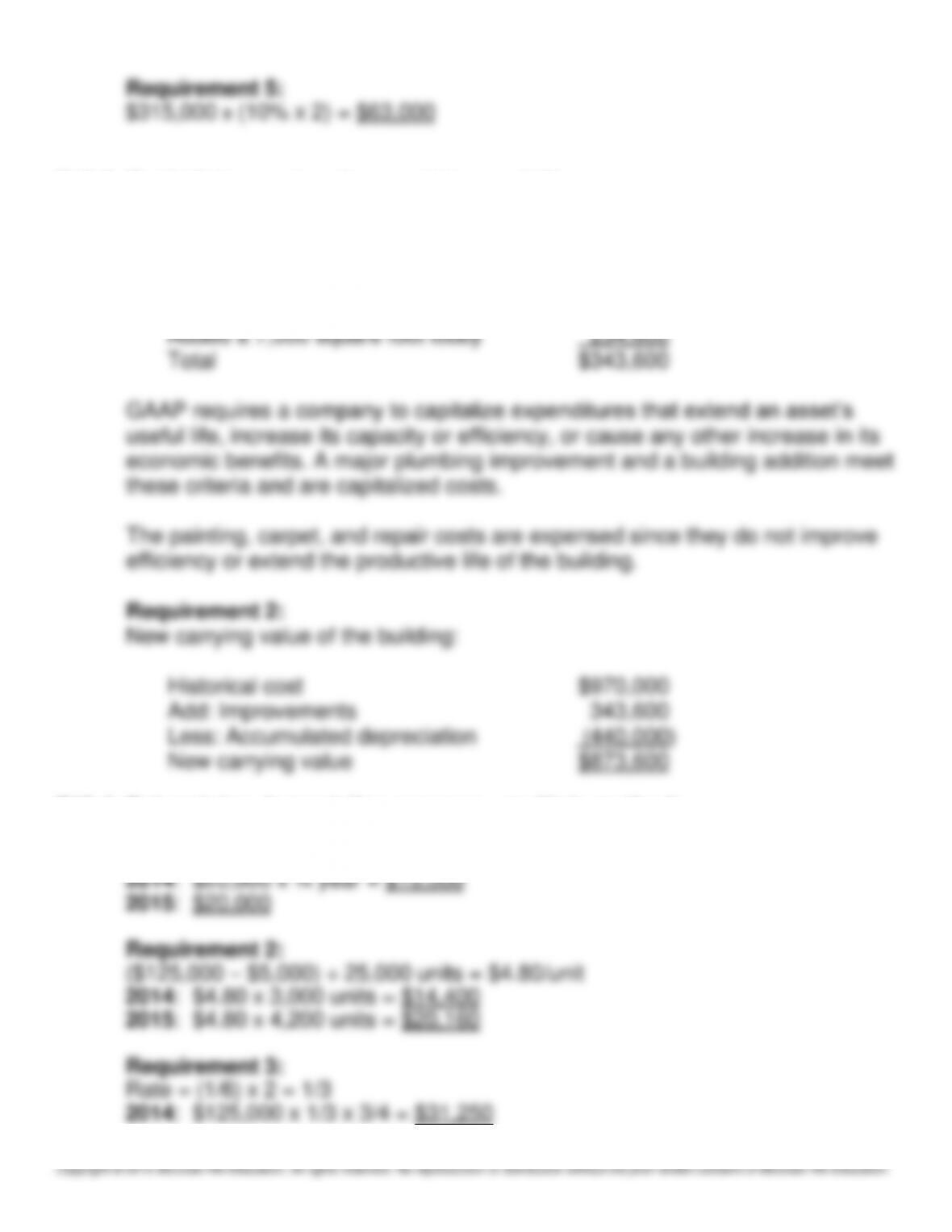
($315,000 − $15,000) ÷ 10 years = $30,000
10-2
Copyright © 2015 McGraw-Hill Education. All rights reserved. No reproduction or distribution without the prior written consent of McGraw-Hill Education.
Requirement 5:
$315,000 x (10% x 2) = $63,000
E10–3. Capitalizing costs subsequent to acquisition
Requirement 1:
The following costs are capitalized to the building:
Major improvement to the plumbing $109,000
E10–4. Determining depreciation expense – multiple methods
Requirement 1:
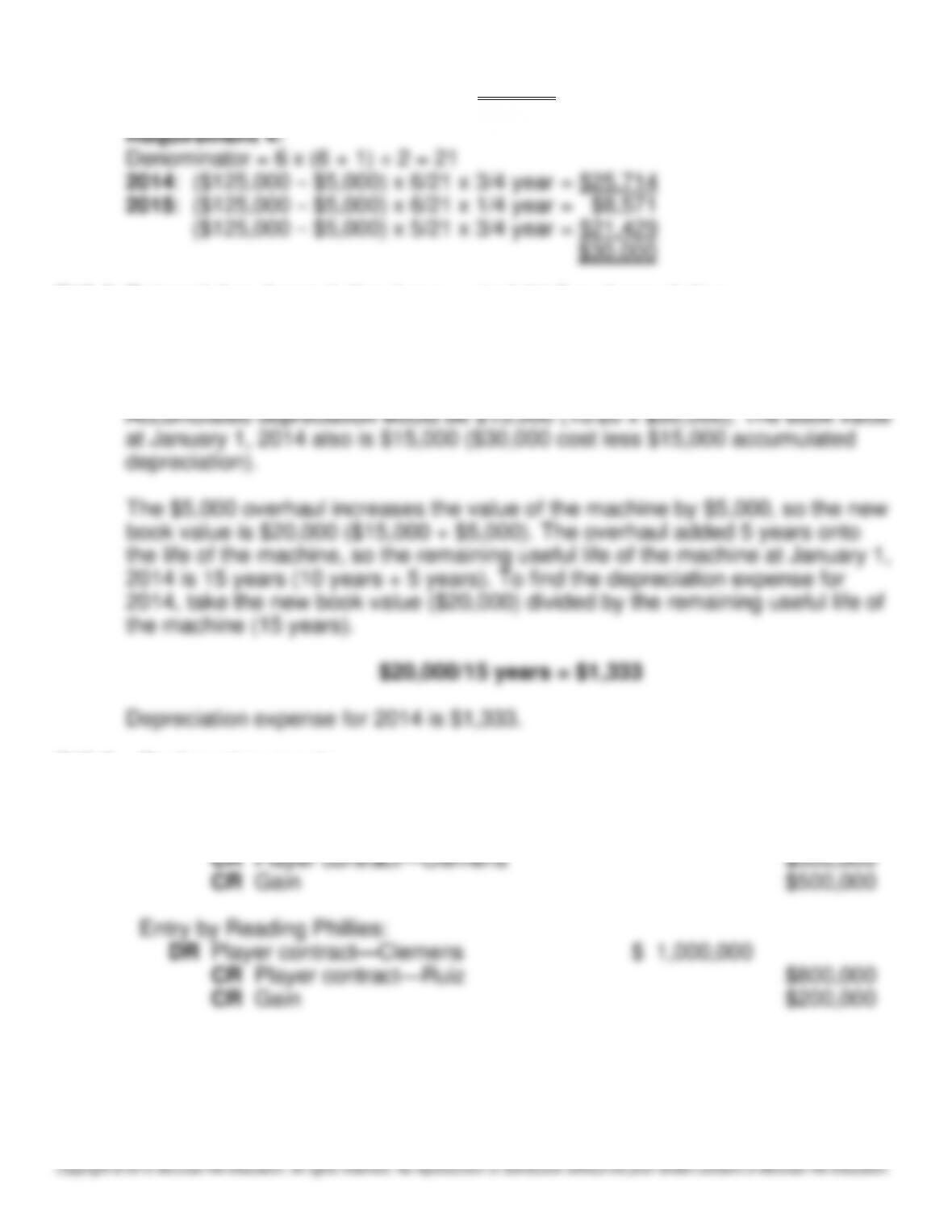
($125,000 − $5,000) ÷ 6 years = $20,000
10-3
2015: ($125,000 − $31,250) x 1/3 = $31,250
E10–5. Determining depreciation base – straight-line depreciation
(AICPA adapted)
First determine the book value of the machine at the beginning of 2014. Given
that the machine has been used for 10 years and has a 20 year life,
E10–6. Exchanging assets
Entry by Williamsport Crosscutters:
DR
Player contract—Ruiz
$ 1,000,000
CR Player contract—Clemens
$500,000
CR Gain
$500,000
Entry by Reading Phillies:
DR
Player contract—Clemens
$ 1,000,000
CR Player contract—Ruiz
$800,000
CR Gain
$200,000
10-4
E10–7. Determining asset cost and depreciation expense – straight-line
(AICPA adapted)
First, we must find the total cost of the machine.
Purchase price $65,000
2014. The machine has been depreciated for two years, so:
Depreciation base, January 1, 2012 $62,800
2012 depreciation (3,140)
E10–8. Buying assets with a note
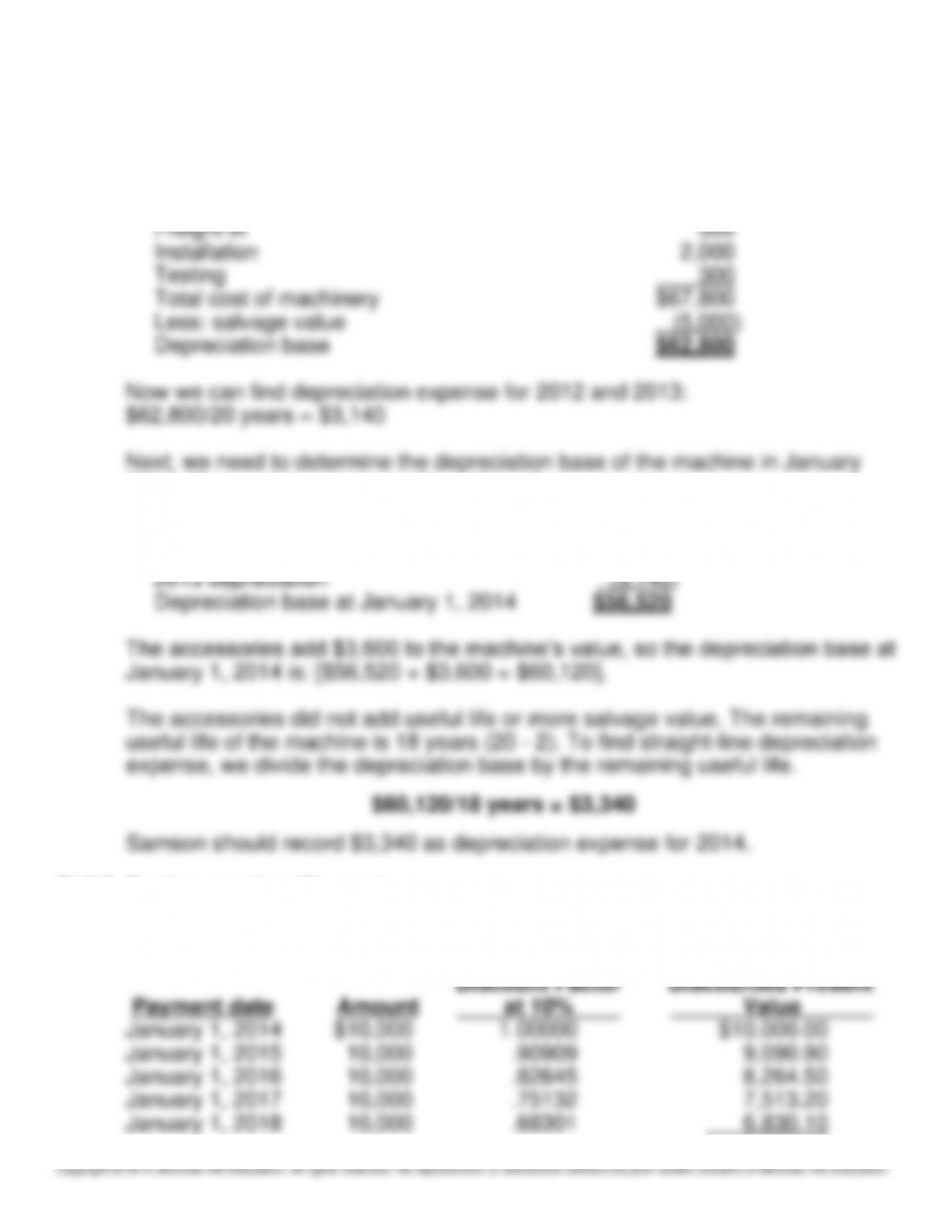
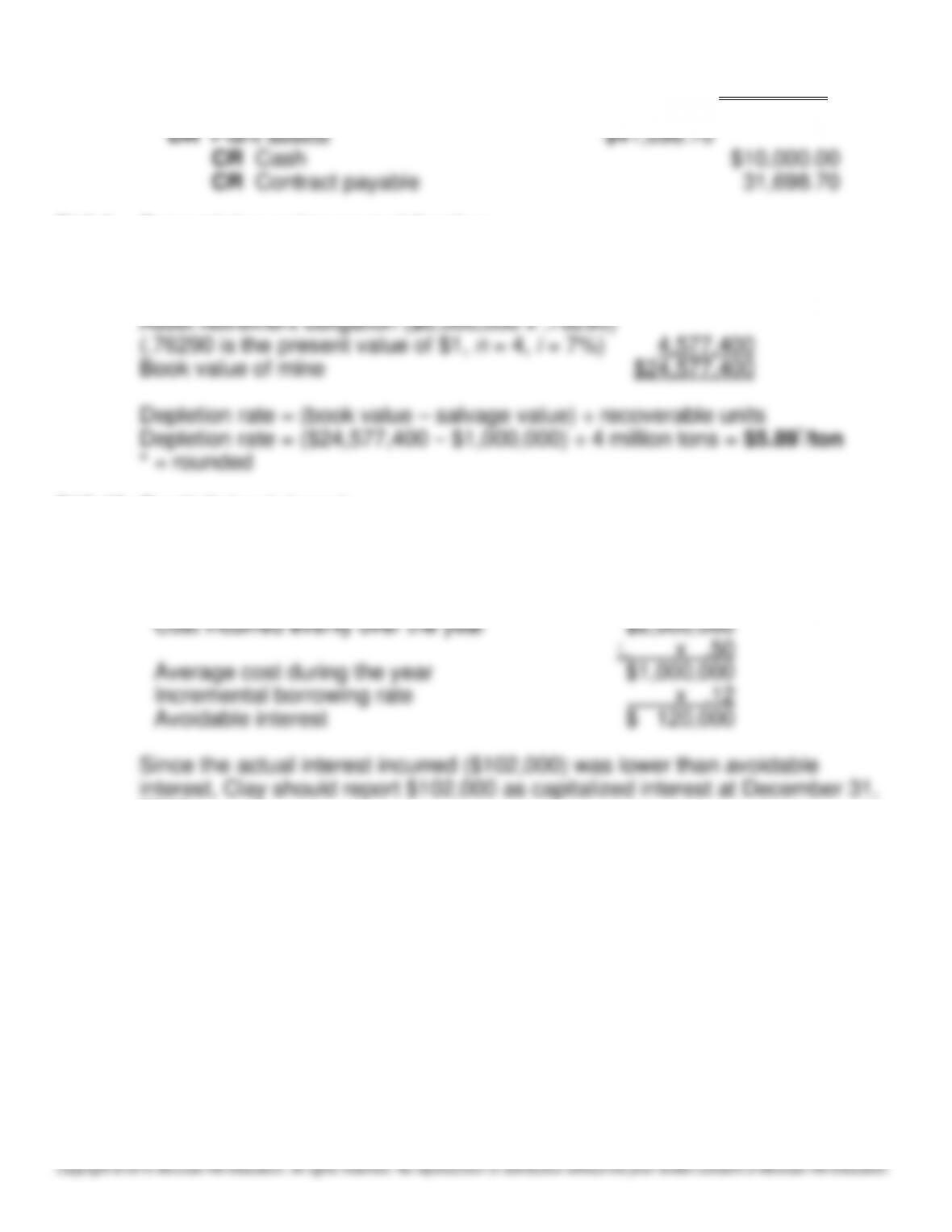
The plant assets should be recorded at the discounted present value of the
payments:
10-5
Total $41,698.70
E10–9. Determining retirement obligation
(AICPA adapted)
Purchase price of land
$20,000,000
Asset retirement obligation ($6,000,000 x .76290)
(.76290 is the present value of $1, n = 4, i = 7%)
4,577,400
Book value of mine
$24,577,400
E10–10. Capitalizing interest
(AICPA adapted)
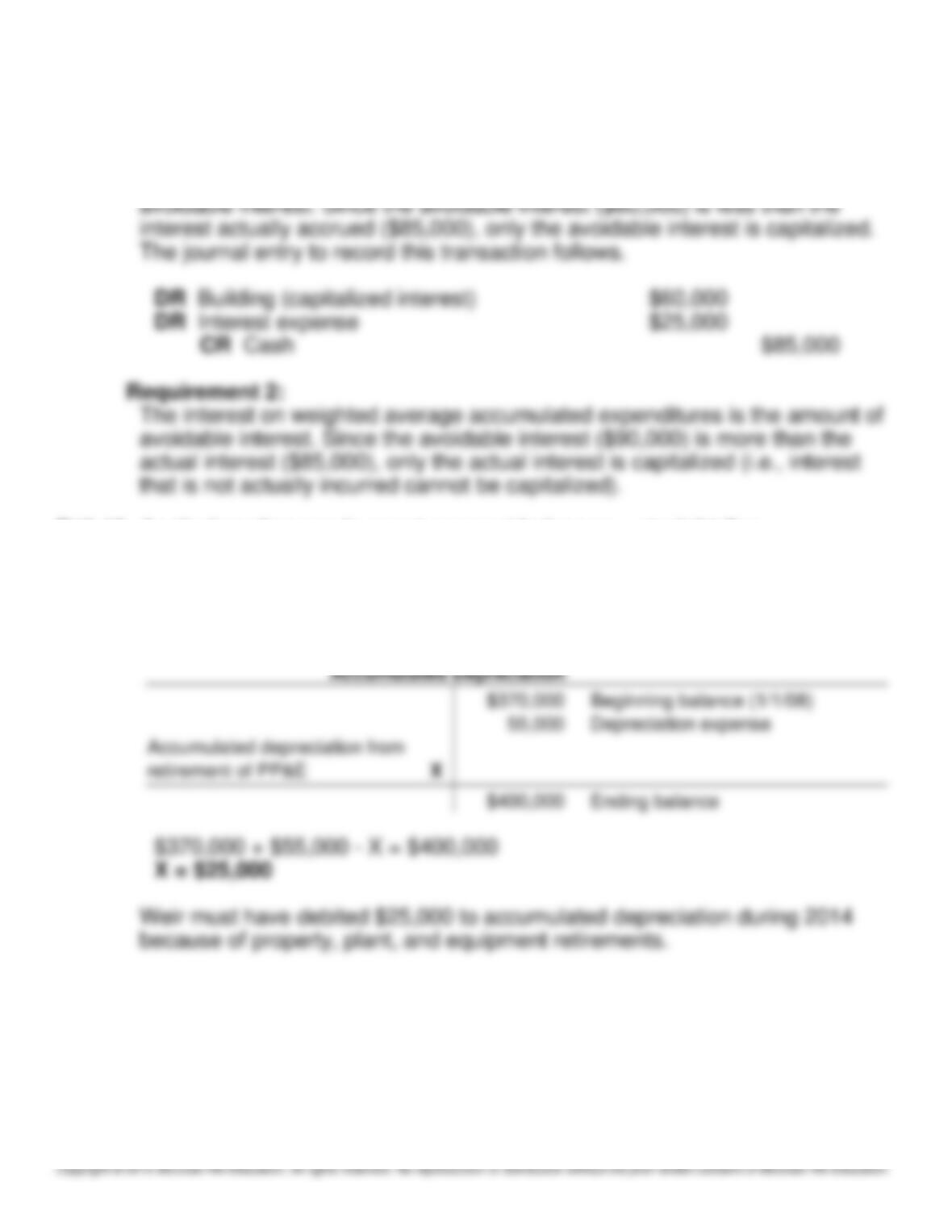
The avoidable interest during 2013 is:
2013.
10-6
E10–11. Capitalizing interest
(AICPA adapted)
Requirement 1:
The interest on weighted average accumulated expenditures is the amount of
E10–12. Analyzing changes in asset account balances – straight-line
(AICPA adapted)
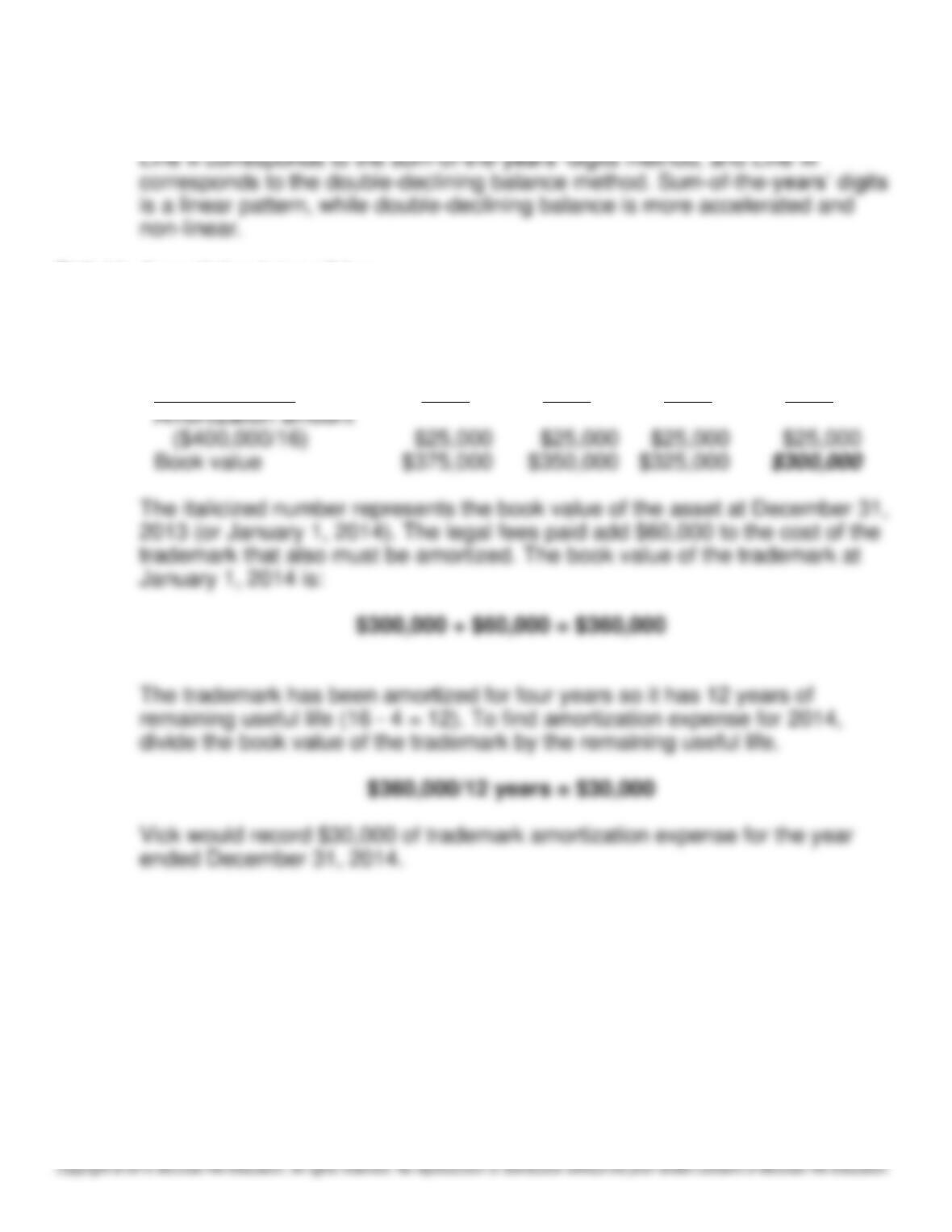
To determine the amount debited in 2014, we reconstruct the accumulated
depreciation T-account:
10-7
E10–13. Identifying depreciation expense patterns – SL, DDB, and SYD
(AICPA adapted)
E10–14. Amortizing intangibles
(AICPA adapted)
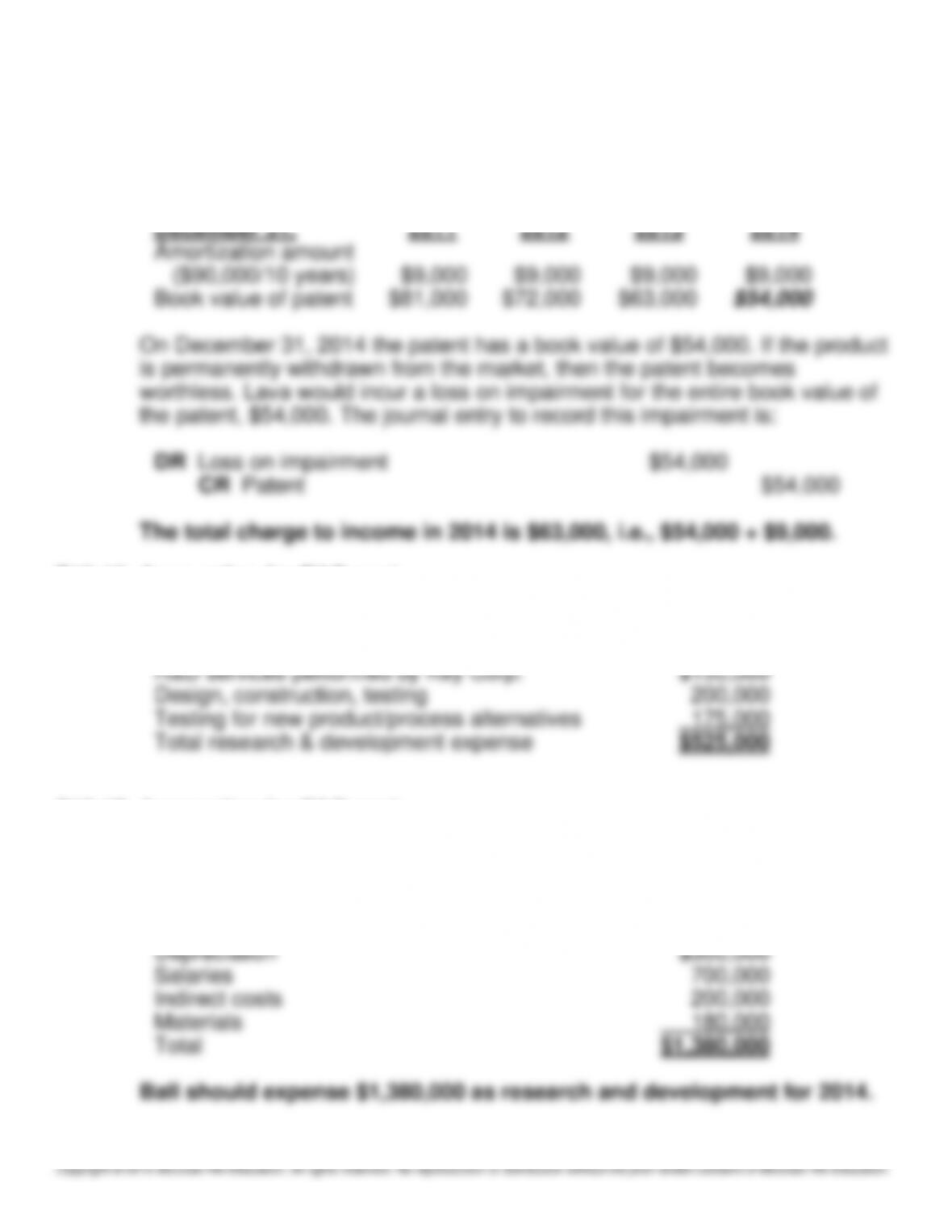
First, determine the book value of the trademark at 1/1/14:
December 31,
2010
2011
2012
2013
Amortization amount
($400,000/16)
$25,000
$25,000
$25,000
$25,000
Book value
$375,000
$350,000
$325,000
$300,000
The italicized number represents the book value of the asset at December 31,
2013 (or January 1, 2014). The legal fees paid add $60,000 to the cost of the
trademark that also must be amortized. The book value of the trademark at
January 1, 2014 is:
$300,000 + $60,000 = $360,000
The trademark has been amortized for four years so it has 12 years of
remaining useful life (16 – 4 = 12). To find amortization expense for 2014,
divide the book value of the trademark by the remaining useful life.
$360,000/12 years = $30,000
Vick would record $30,000 of trademark amortization expense for the year
ended December 31, 2014.
10-8
E10–15. Determining amount of intangibles expensed
Find the book value of the patent at 12/31/14. The patent is amortized over its
useful life (10 yrs.) instead of its valid legal life (15 yrs.) because the useful life
is shorter.
December 31,
2011
2012
2013
2014
Amortization amount
($90,000/10 years)
$9,000
$9,000
$9,000
$9,000
Book value of patent
$81,000
$72,000
$63,000
$54,000
On December 31, 2014 the patent has a book value of $54,000. If the product
is permanently withdrawn from the market, then the patent becomes
worthless. Lava would incur a loss on impairment for the entire book value of
the patent, $54,000. The journal entry to record this impairment is:
DR Loss on impairment $54,000
CR Patent $54,000
The total charge to income in 2014 is $63,000, i.e., $54,000 + $9,000.
E10–16. Accounting for R&D cost
All of the costs should be expensed as research and development for 2014.
E10–17. Accounting for R&D cost
Costs incurred in Ball Labs that will not be reimbursed by the governmental
unit should be expensed as research and development. The computation
follows:
10-9
E10–18. Accounting for software development costs
Requirement 1:
All costs incurred during 2013 are expensed as part of research and
development (R&D) expense in 2013. Until technological feasibility is
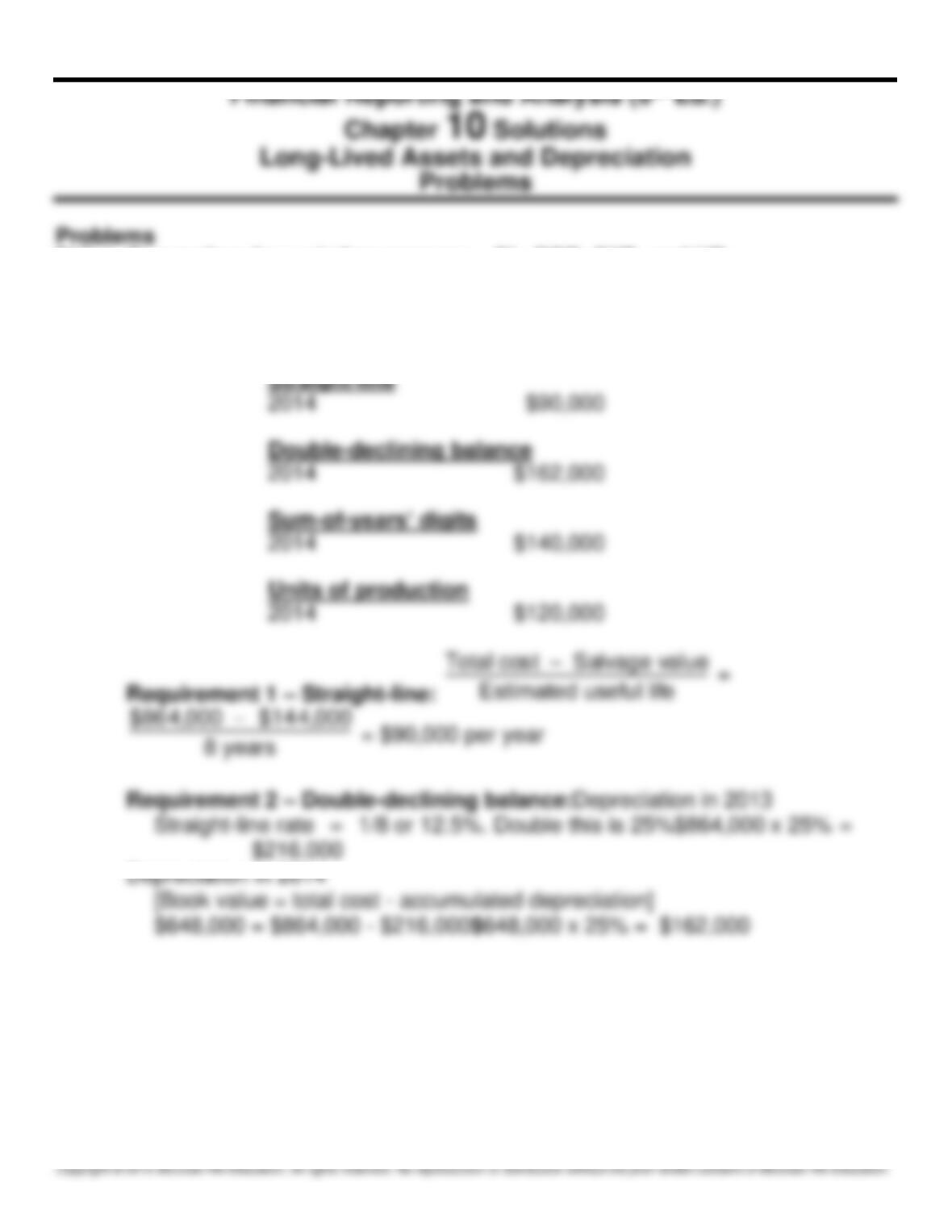
E10–20. Determining depletion expense with asset retirement obligation – units-
of-production
(AICPA adapted)
To determine the depletion base, we need to add together the costs
10–10
Copyright © 2015 McGraw-Hill Education. All rights reserved. No reproduction or distribution without the prior written consent of McGraw-Hill Education.
Financial Reporting and Analysis (6th Ed.)
Chapter 10 Solutions
Long-Lived Assets and Depreciation
Problems
Problems
P10–1. Computing depreciation expense – SL, DDB, SYD, and UP
(AICPA adapted)
The table below shows the amount of depreciation expense in 2014 under each
method. Computations are shown below the schedule.
Straight-line
2014
$90,000
Double-declining balance
2014
$162,000
Sum-of–years’ digits
2014
$140,000
Units of production
2014
$120,000
Requirement 1 – Straight-line:
Total cost − Salvage value
Estimated useful life
=
$864,000 − $144,000
8 years
= $90,000 per year
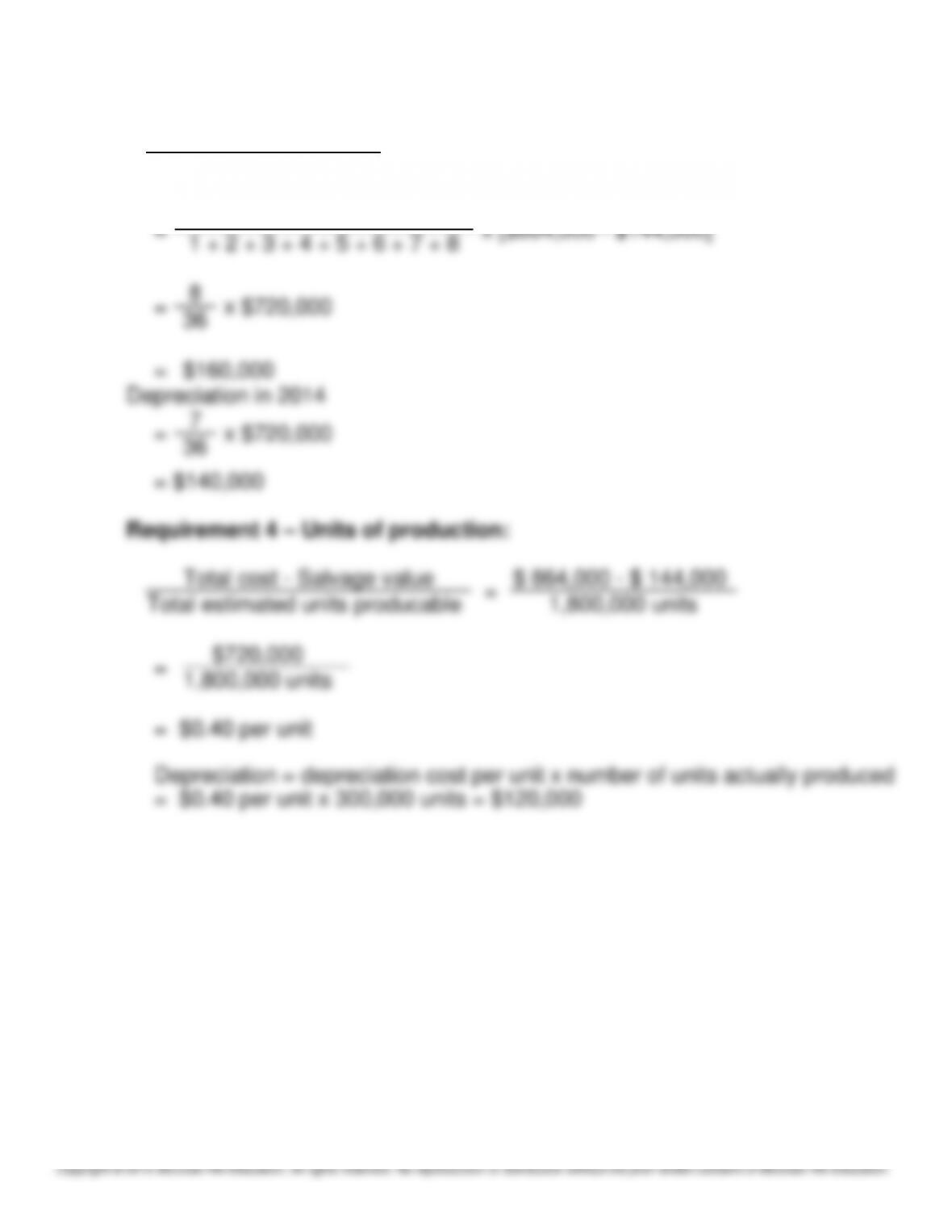
Requirement 2 – Double-declining balance:Depreciation in 2013
Straight-line rate = 1/8 or 12.5%. Double this is 25%$864,000 x 25% =
$216,000
Depreciation in 2014
[Book value = total cost – accumulated depreciation]
$648,000 = $864,000 – $216,000$648,000 x 25% = $162,000
10–11
Requirement 3 – Sum-of–years’ digits: Depreciation in 2013
Year
x
[Total cost – Salvage value]
Sum – of – years’ digits
=
8
x [$864,000 – $144,000]
1 + 2 + 3 + 4 + 5 + 6 + 7 + 8
=
8
x $720,000
36
=
$160,000
Depreciation in 2014
=
7
x $720,000
36
= $140,000
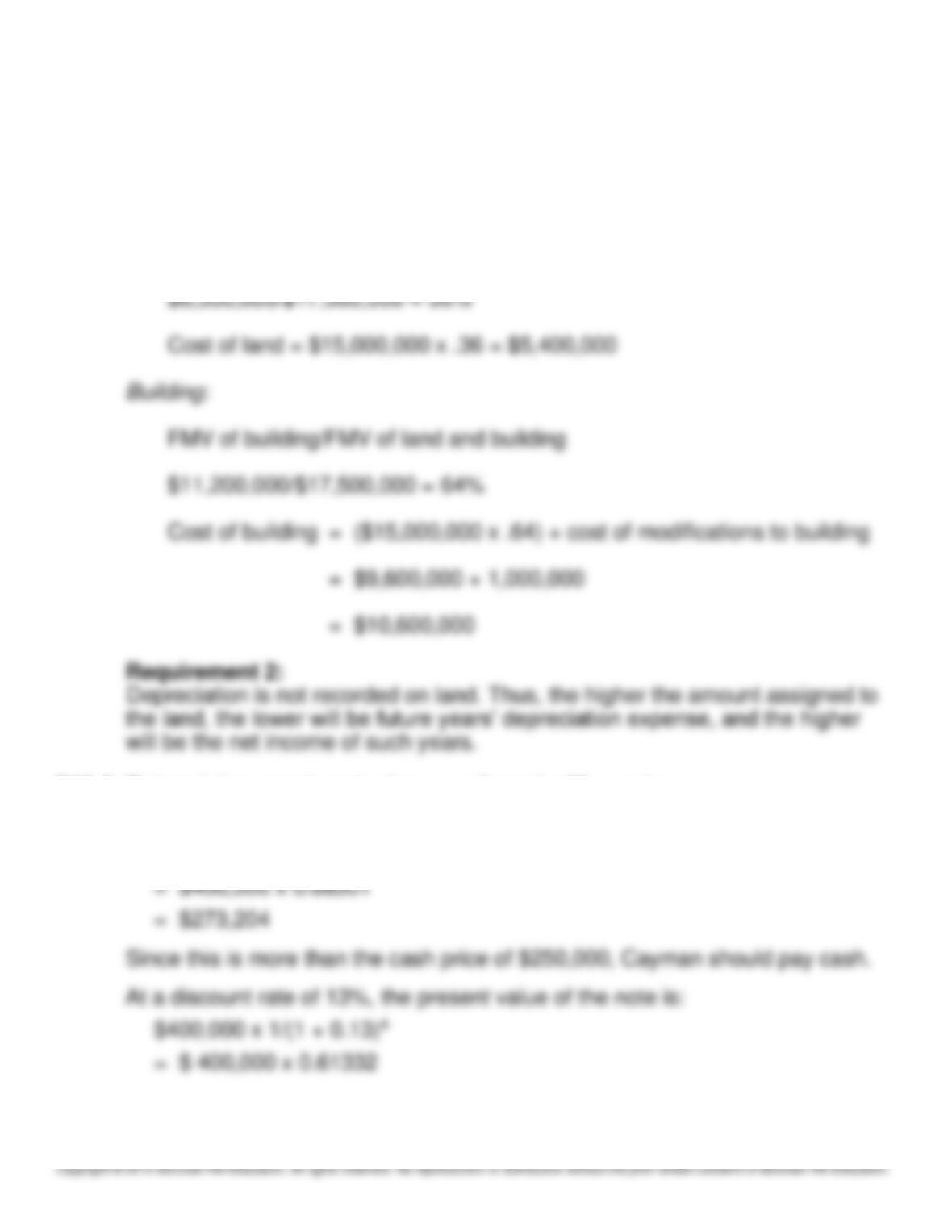
Requirement 4 – Units of production:
Total cost – Salvage value
=
$ 864,000 – $ 144,000
Total estimated units producable
1,800,000 units
=
$720,000
1,800,000 units
= $0.40 per unit
Depreciation = depreciation cost per unit x number of units actually produced
= $0.40 per unit x 300,000 units = $120,000
10–12
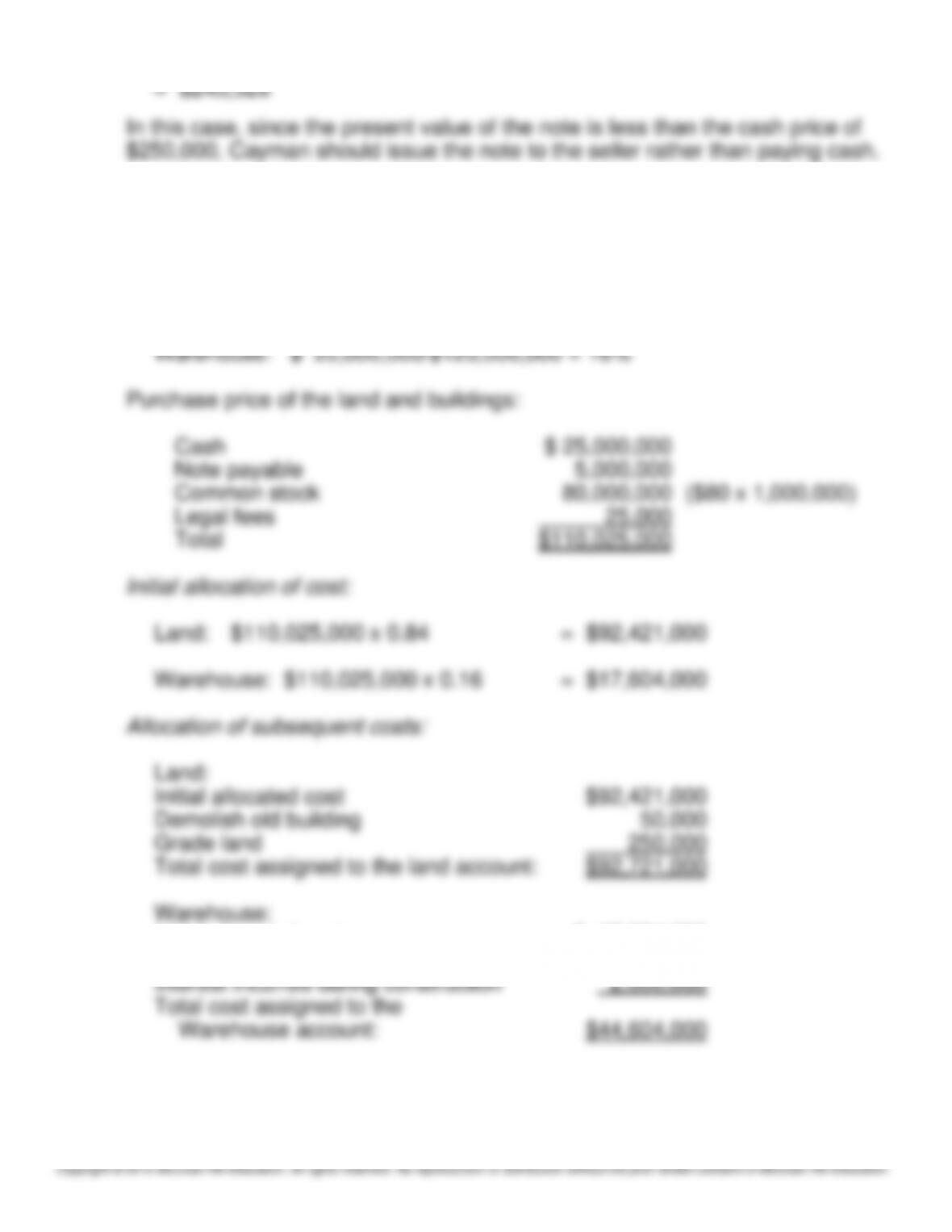
P10–2. Recording lump-sum purchases
Requirement 1:
Cost of land and building:
Land:
FMV of land/FMV of land and building
P10–3. Determining asset cost when purchased with a note
At a discount rate of 10%, the present value of the note is:
$400,000 x 1/(1 + 0.10)4
10–13
Copyright © 2015 McGraw-Hill Education. All rights reserved. No reproduction or distribution without the prior written consent of McGraw-Hill Education.
= $245,328
In this case, since the present value of the note is less than the cash price of
$250,000, Cayman should issue the note to the seller rather than paying cash.
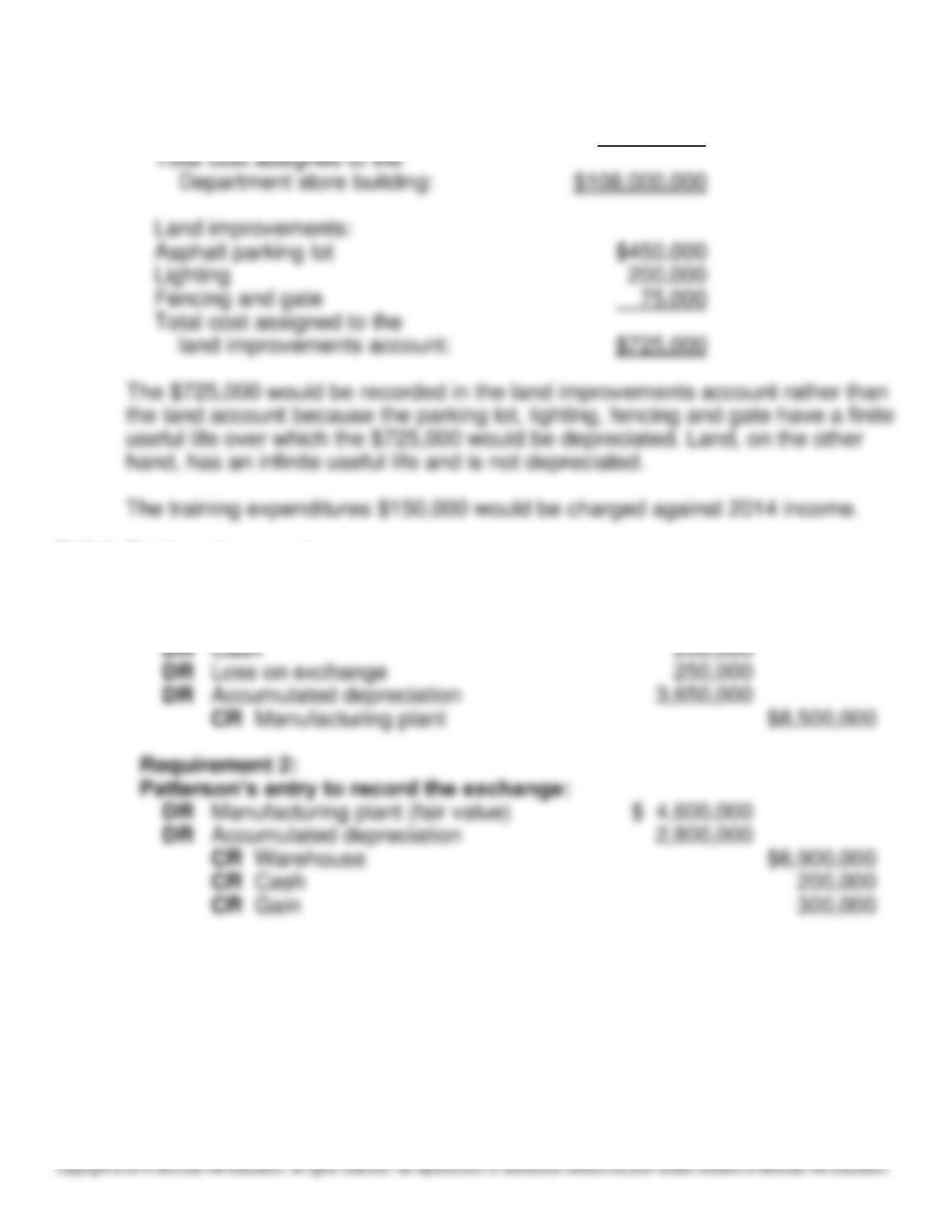
P10–4. Allocating acquisition costs among asset accounts and interest
capitalization
Relative assessed values of the land and building at the time of purchase:
Land: $105,000,000/$125,000,000 = 84%
Initial allocated cost $ 17,604,000
Renovate old building 25,000,000
10–14
Department store:
Cost of new building 100,000,000
Interest incurred during construction 8,000,000
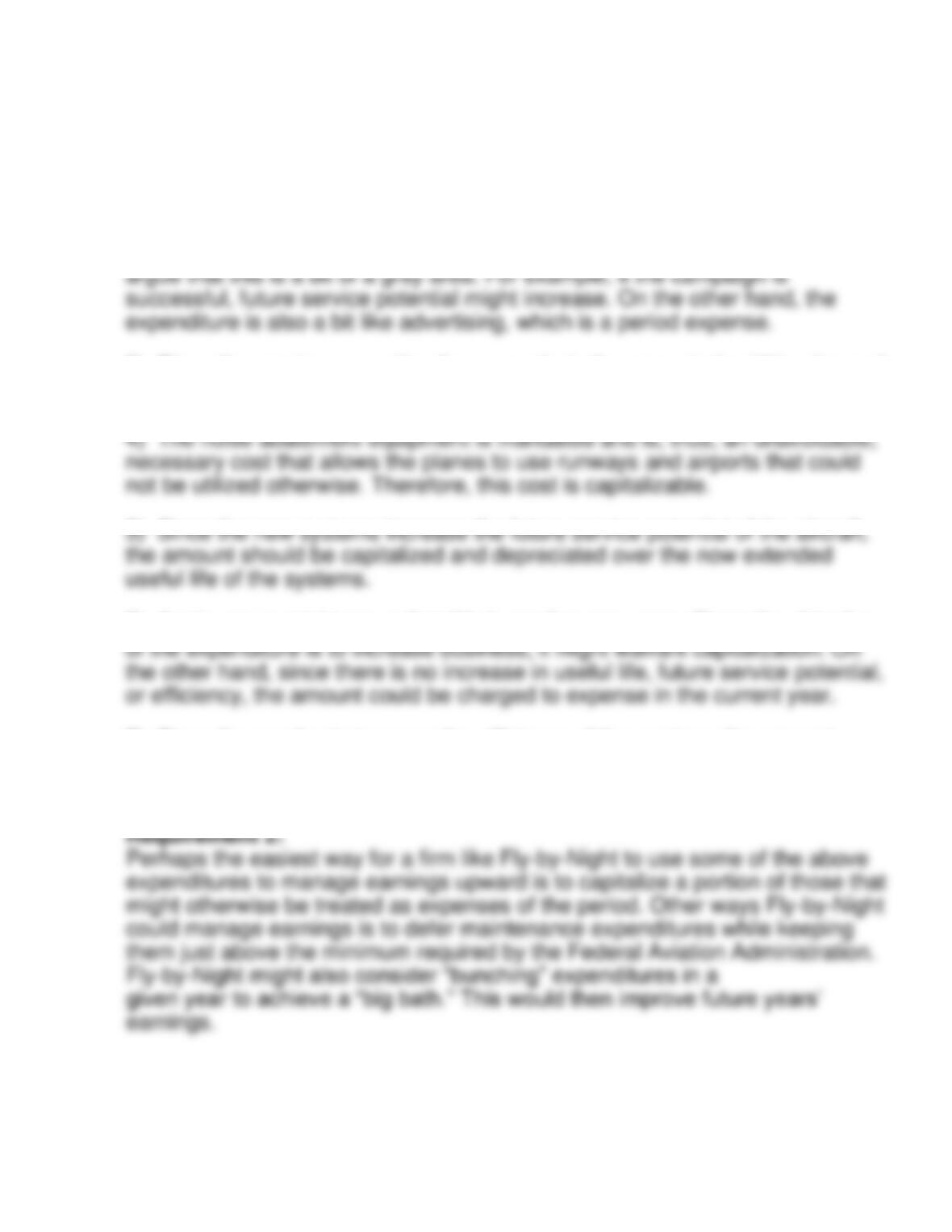
P10-5. Exchanging assets
Requirement 1:
Hoyle’s entry to record the exchange:
DR
Warehouse (fair value)
$ 4,400,000
DR
Cash
200,000
DR
Loss on exchange
250,000
DR
Accumulated depreciation
3,650,000
CR Manufacturing plant
$8,500,000
DR
Manufacturing plant (fair value)
$ 4,600,000
DR
Accumulated depreciation
2,800,000
CR Warehouse
$6,900,000
CR Cash
200,000
CR Gain
300,000
10–15
Copyright © 2015 McGraw-Hill Education. All rights reserved. No reproduction or distribution without the prior written consent of McGraw-Hill Education.
P10–6. Capitalizing or expensing various costs
Requirement 1:
1) Since the new engines increase the future service potential of the aircraft,
the amount should be capitalized and depreciated over the engines’ useful life.
2) Since there is no increase in useful life, future service potential, or efficiency,
the amount should be charged to expense in the current year. Some might
3) Since the repairs are routine (i.e., recurring), the amount should be charged
to expense in the current year.
6) Again, some might argue that this is another gray area. Since the objective
7) Since the overhauls increase the efficiency of the engines, the amount
should be capitalized and depreciated over the expected useful life of the
improvements.