Exercise 4B-2 (15 minutes)
Service
Departments
Operating
Departments
Admini-
stration
Janitorial
Groceries
Gifts
Total
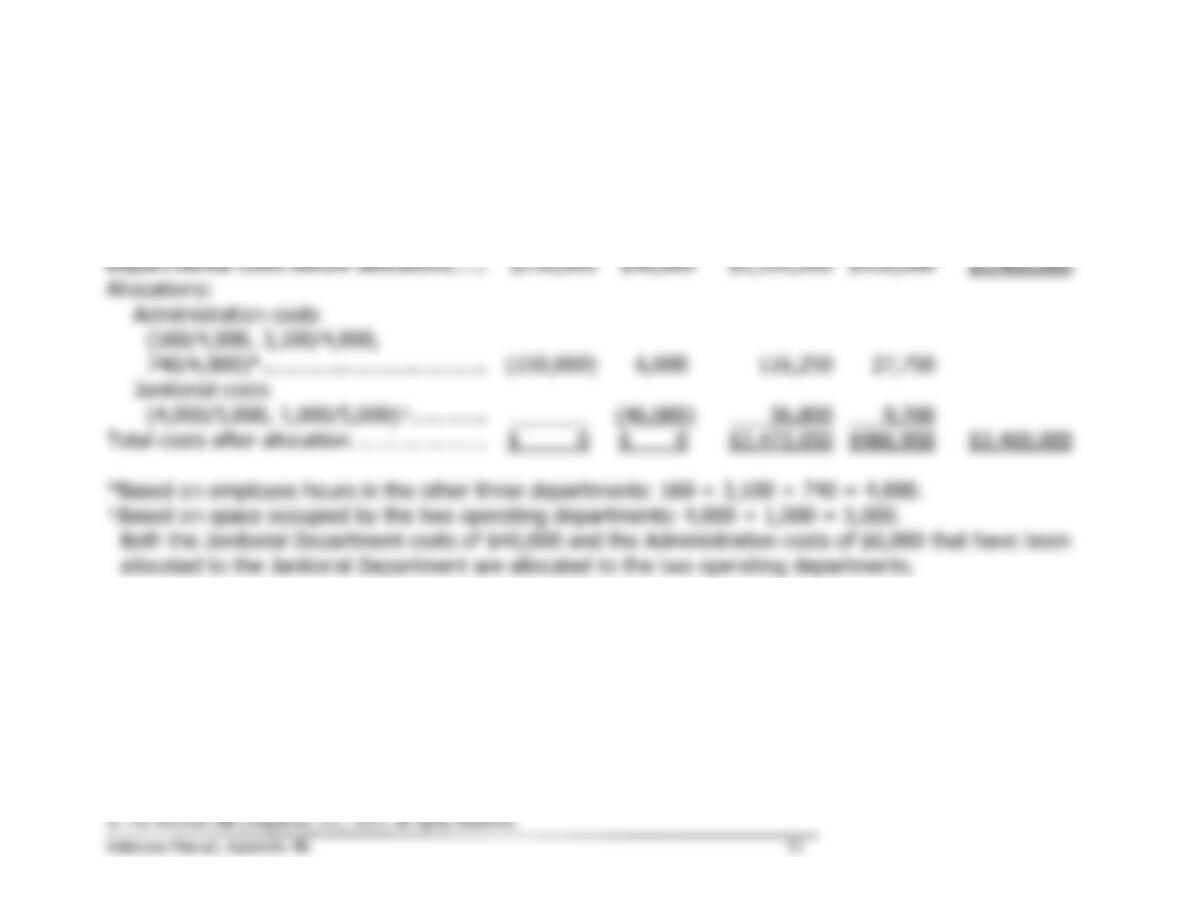
Departmental costs before allocations …..
$150,000
$40,000
$2,320,000
$950,000
$3,460,000
Allocations:
Administration costs
(160/4,000, 3,100/4,000,
740/4,000)* ………………………………
(150,000)
6,000
116,250
27,750
Janitorial costs
(4,000/5,000, 1,000/5,000)† …………
(46,000)
36,800
9,200
Total costs after allocation ………………….
$ 0
$ 0
$2,473,050
$986,950
$3,460,000
*Based on employee hours in the other three departments: 160 + 3,100 + 740 = 4,000.
†Based on space occupied by the two operating departments: 4,000 + 1,000 = 5,000.
Both the Janitorial Department costs of $40,000 and the Administration costs of $6,000 that have been
allocated to the Janitorial Department are allocated to the two operating departments.
Exercise 4B-3 (20 minutes)
Service
Departments
Operating
Departments
Admini-
stration
Janitorial
Mainte-
nance
Binding
Printing
Total
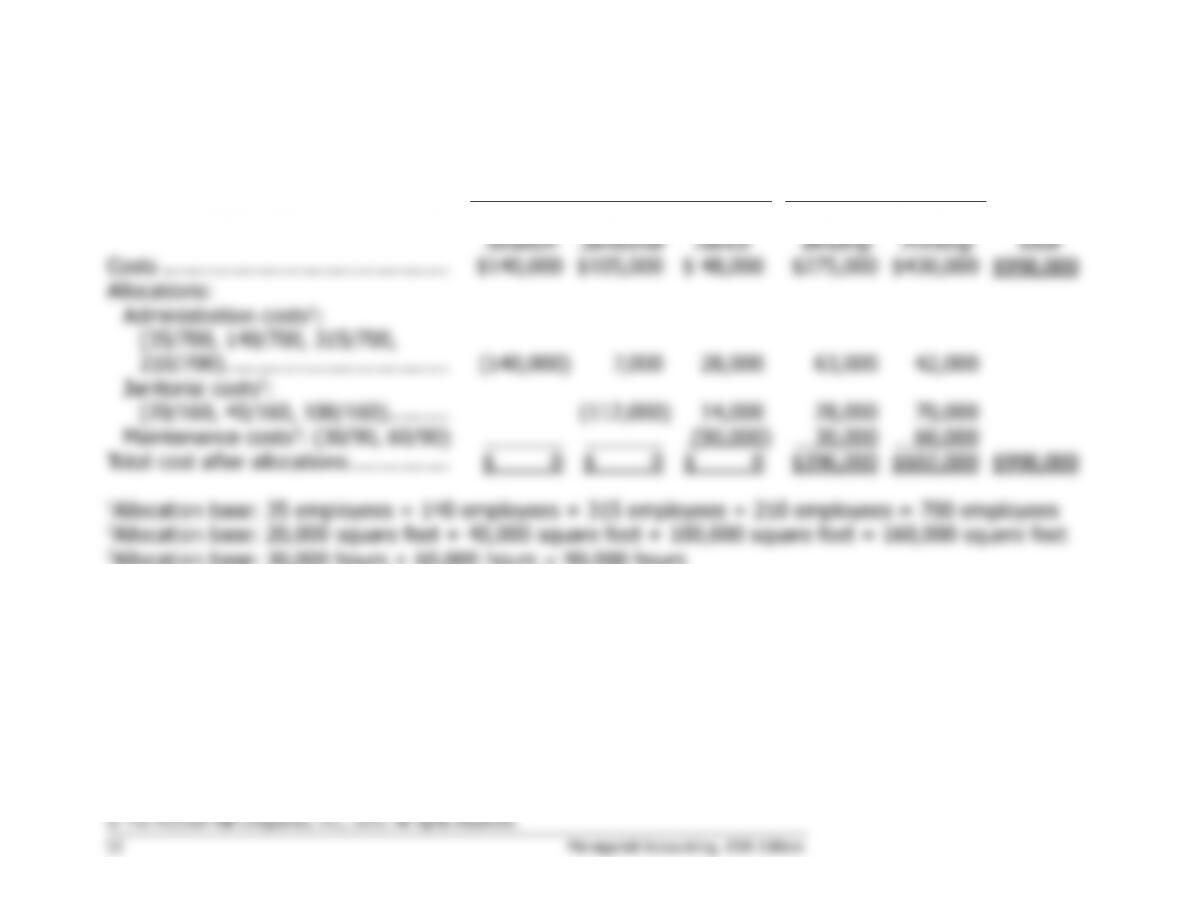
Costs ……………………………………….
$140,000
$105,000
$ 48,000
$275,000
$430,000
$998,000
Allocations:
Administration costs1:
(35/700, 140/700, 315/700,
210/700) ………………………………
(140,000)
7,000
28,000
63,000
42,000
Janitorial costs2:
(20/160, 40/160, 100/160) ……….
(112,000)
14,000
28,000
70,000
Maintenance costs3: (30/90, 60/90)
(90,000)
30,000
60,000
Total cost after allocations …………….
$ 0
$ 0
$ 0
$396,000
$602,000
$998,000
1Allocation base: 35 employees + 140 employees + 315 employees + 210 employees = 700 employees
2Allocation base: 20,000 square feet + 40,000 square feet + 100,000 square feet = 160,000 square feet
3Allocation base: 30,000 hours + 60,000 hours = 90,000 hours
Exercise 4B-4 (20 minutes)
Service
Departments
Operating
Departments
Admini-
stration
Janitorial
Mainte-
nance
Binding
Printing
Total
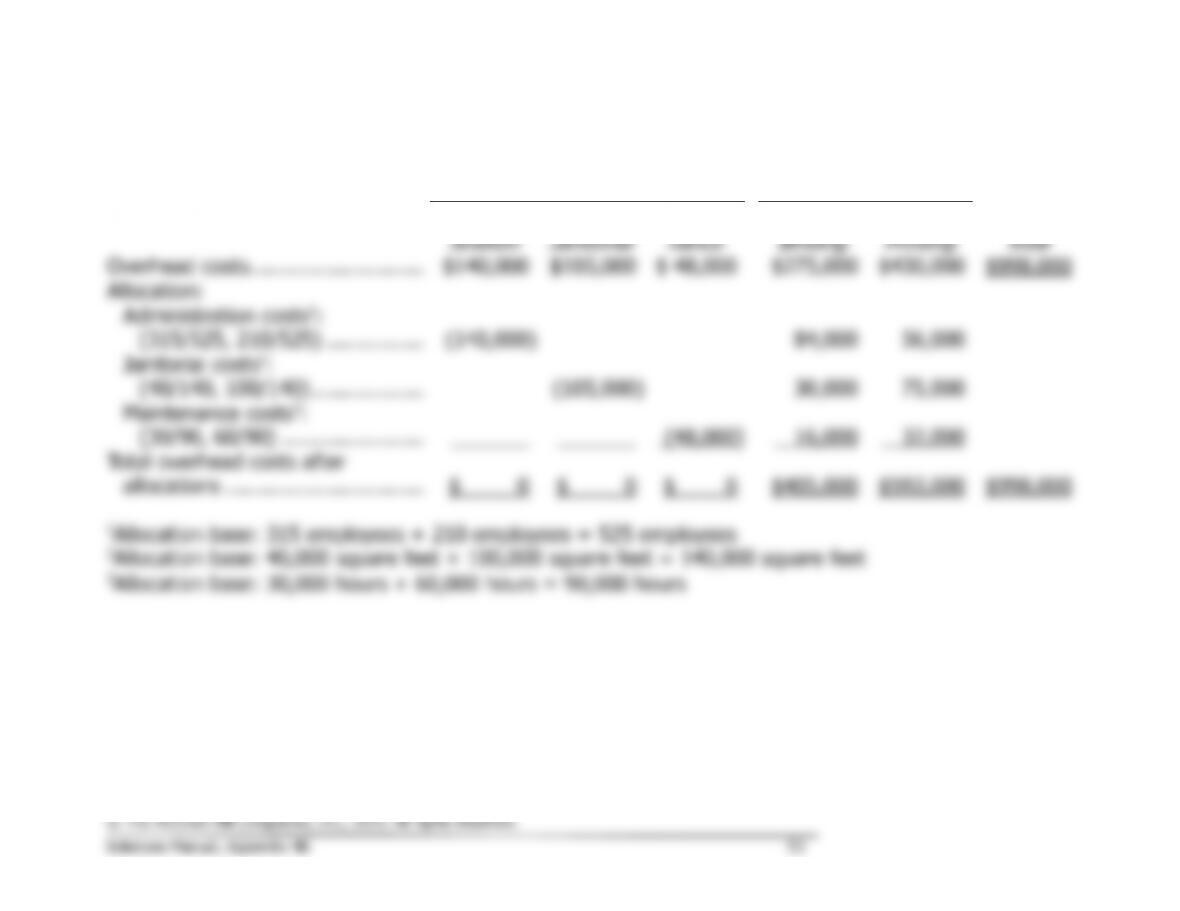
Overhead costs ……………………….
$140,000
$105,000
$ 48,000
$275,000
$430,000
$998,000
Allocation:
Administration costs1:
(315/525, 210/525) …………….
(140,000)
84,000
56,000
Janitorial costs2:
(40/140, 100/140) ………………
(105,000)
30,000
75,000
Maintenance costs3:
(30/90, 60/90) …………………..
(48,000)
16,000
32,000
Total overhead costs after
allocations …………………………..
$ 0
$ 0
$ 0
$405,000
$593,000
$998,000
1Allocation base: 315 employees + 210 employees = 525 employees
2Allocation base: 40,000 square feet + 100,000 square feet = 140,000 square feet
3Allocation base: 30,000 hours + 60,000 hours = 90,000 hours
Problem 4B-5 (45 minutes)
House-
keeping
Services
Food
Services
Admini-
strative
Services
Laboratory
Radiology
General
Hospital
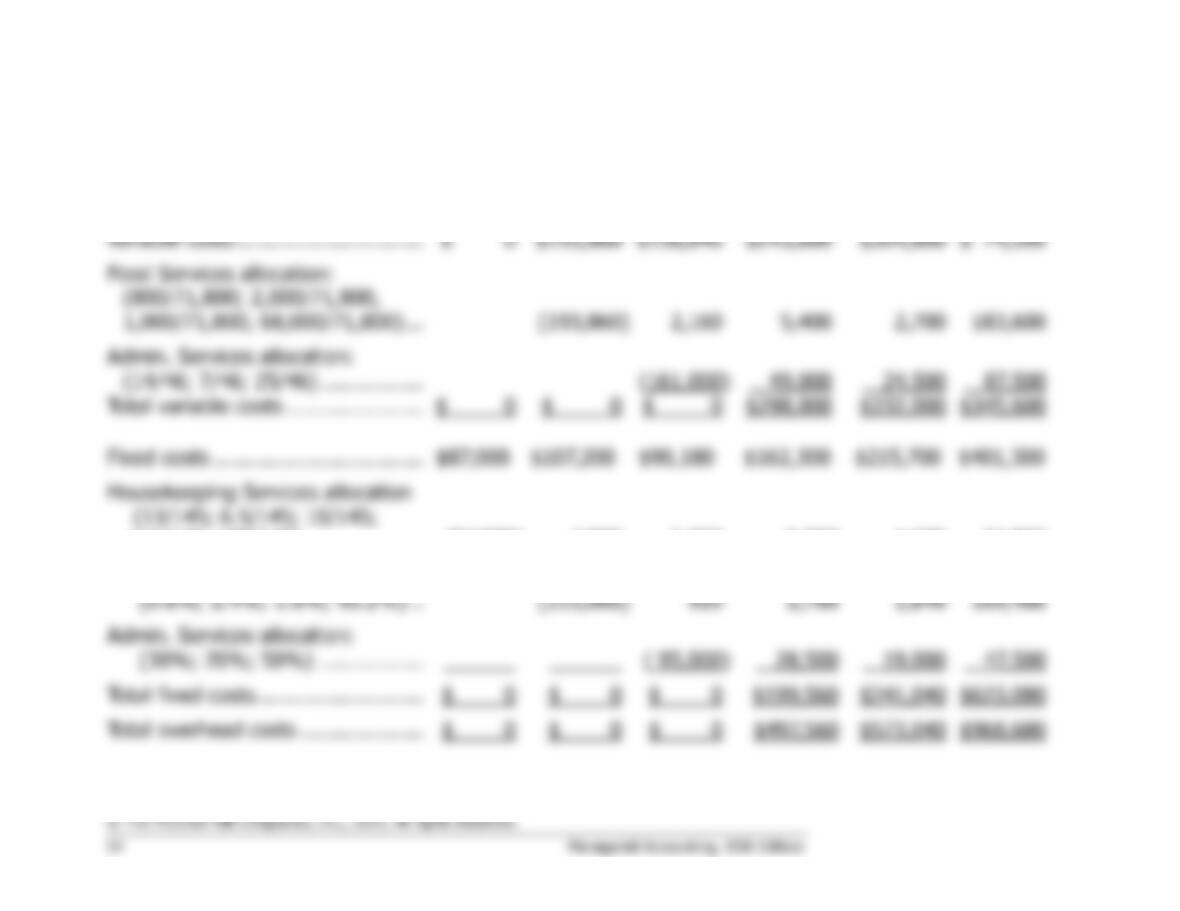
Variable costs …………………………
$ 0
$193,860
$158,840
$243,600
$304,800
$ 74,500
Food Services allocation:
(800/71,800; 2,000/71,800,
1,000/71,800; 68,000/71,800) …
(193,860)
2,160
5,400
2,700
183,600
Admin. Services allocation:
(14/46; 7/46; 25/46) ……………..
(161,000)
49,000
24,500
87,500
Total variable costs ………………….
$ 0
$ 0
$ 0
$298,000
$332,000
$345,600
Fixed costs …………………………….
$87,000
$107,200
$90,180
$162,300
$215,700
$401,300
Housekeeping Services allocation
(13/145; 6.5/145; 10/145;
7.5/145; 108/145) ……………….
(87,000)
7,800
3,900
6,000
4,500
64,800
Food Services allocation:
(0.8%; 2.4%; 1.6%; 95.2%) ..
(115,000)
920
2,760
1,840
109,480
Admin. Services allocation:
(30%; 20%; 50%) ……………..
( 95,000)
28,500
19,000
47,500
Total fixed costs ………………………
$ 0
$ 0
$ 0
$199,560
$241,040
$623,080
Total overhead costs ………………..
$ 0
$ 0
$ 0
$497,560
$573,040
$968,680
Problem 4B-6 (60 minutes)
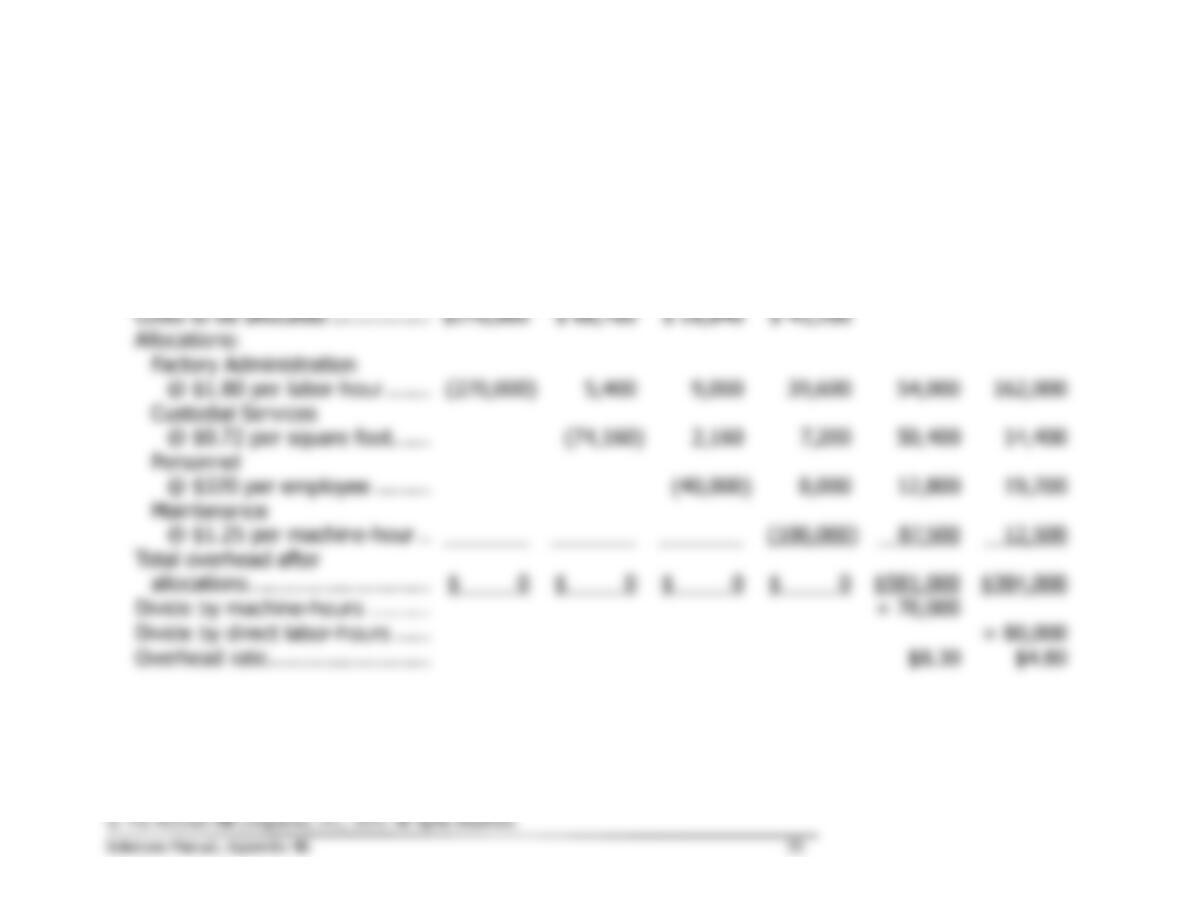
1.
Factory
Admini-
stration
Custodial
Services
Personnel
Mainte-
nance
Machining
Assembly
Step-down method
Operating department costs ……
$376,300
$175,900
Costs to be allocated …………….
$270,000
$ 68,760
$ 28,840
$ 45,200
Allocations:
Factory Administration
@ $1.80 per labor-hour …….
(270,000)
5,400
9,000
39,600
54,000
162,000
Custodial Services
@ $0.72 per square foot. …..
(74,160)
2,160
7,200
50,400
14,400
Personnel
@ $320 per employee ………
(40,000)
8,000
12,800
19,200
Maintenance
@ $1.25 per machine-hour ..
(100,000)
87,500
12,500
Total overhead after
allocations ………………………..
$ 0
$ 0
$ 0
$ 0
$581,000
$384,000
Divide by machine-hours ……….
÷ 70,000
Divide by direct labor-hours ……
÷ 80,000
Overhead rate ……………………..
$8.30
$4.80
Problem 4B-6 (continued)
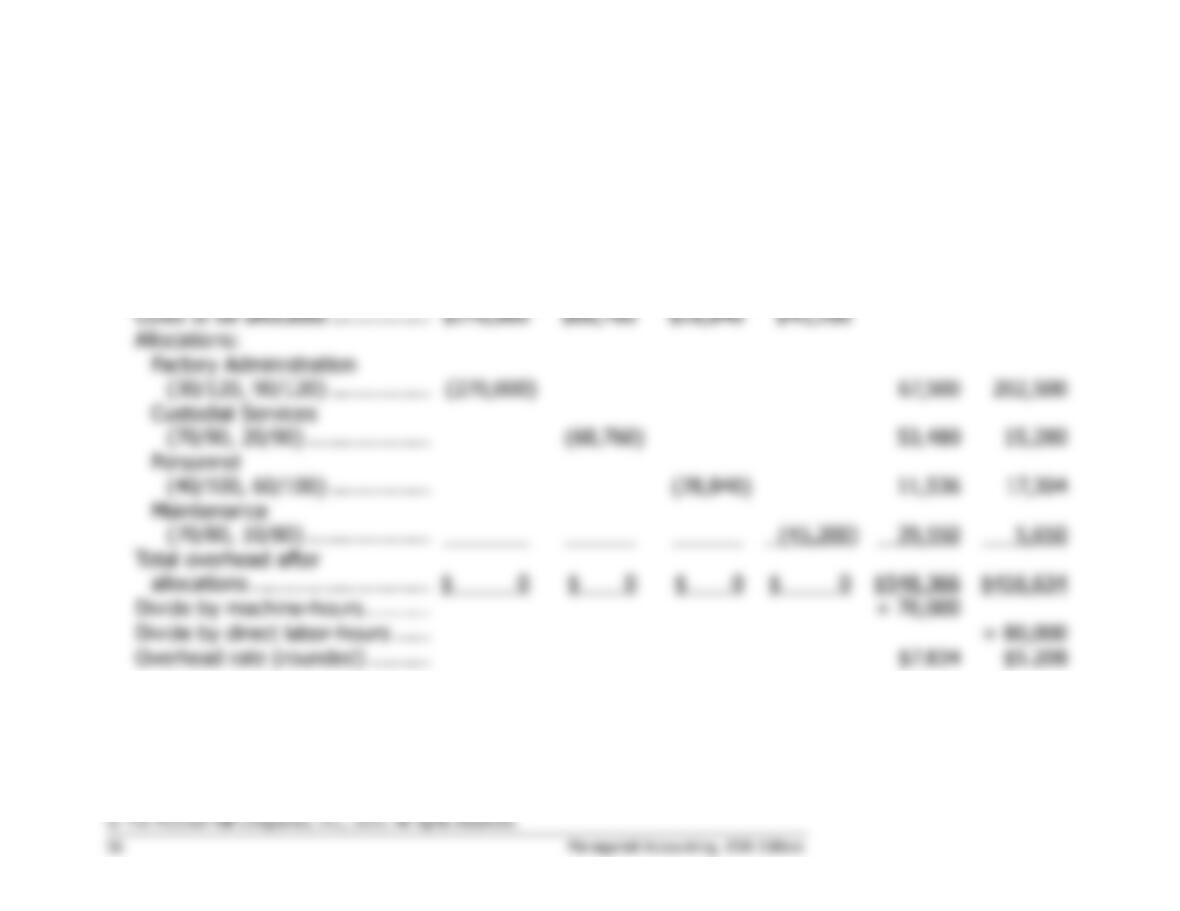
2.
Factory
Admini-
stration
Custodial
Services
Personnel
Mainte-
nance
Machining
Assembly
Direct method
Operating department costs ……
$376,300
$175,900
Costs to be allocated …………….
$270,000
$68,760
$28,840
$45,200
Allocations:
Factory Administration
(30/120, 90/120) …………….
(270,000)
67,500
202,500
Custodial Services
(70/90, 20/90) ………………..
(68,760)
53,480
15,280
Personnel
(40/100, 60/100) …………….
(28,840)
11,536
17,304
Maintenance
(70/80, 10/80) ………………..
(45,200)
39,550
5,650
Total overhead after
allocations ………………………..
$ 0
$ 0
$ 0
$ 0
$548,366
$416,634
Divide by machine-hours………..
÷ 70,000
Divide by direct labor-hours ……
÷ 80,000
Overhead rate (rounded) ……….
$7.834
$5.208
Problem 4B-6 (continued)
3.
Plantwide rate
Total overhead cost
Overhead rate= Total direct labor-hours
$965,000
= = $9.65 per DLH
100,000 DLHs
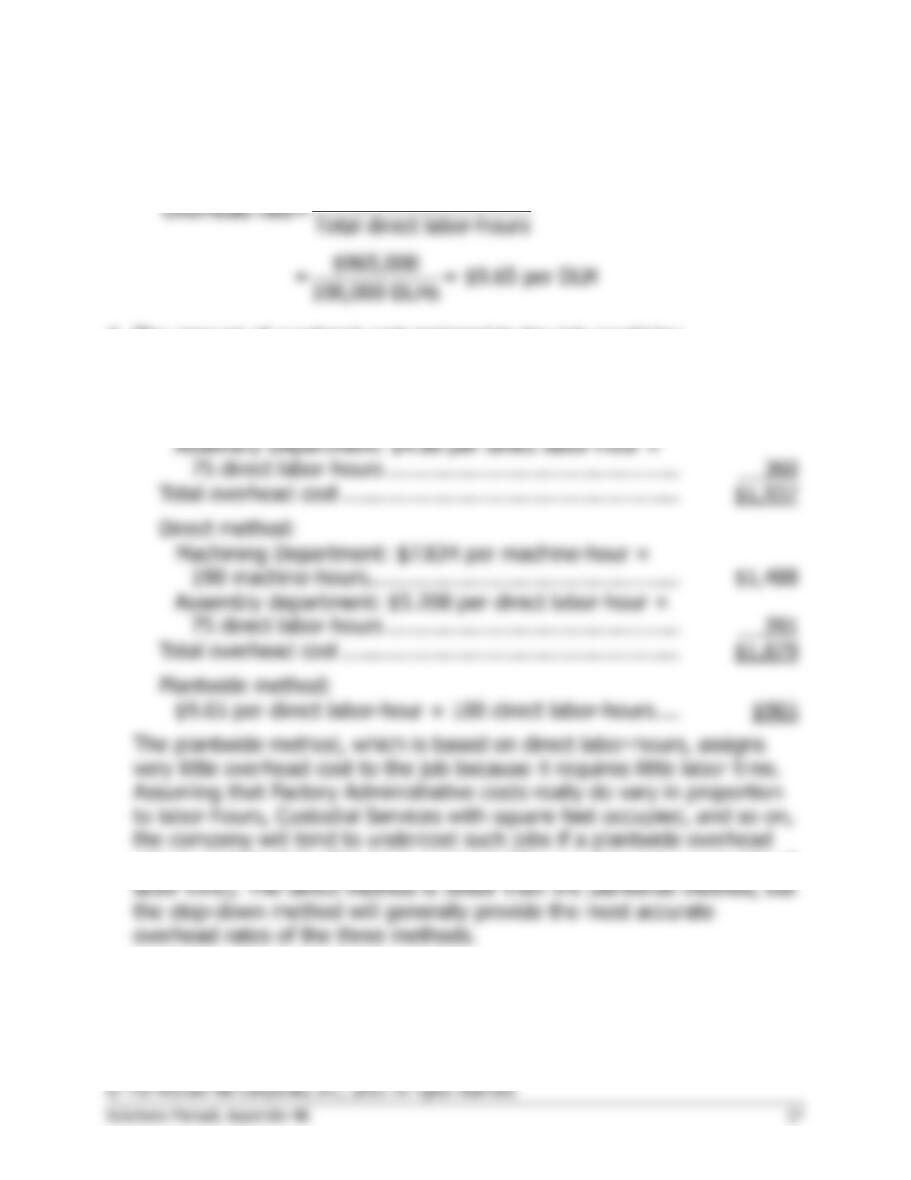
4. The amount of overhead cost assigned to the job would be:
Step-down method:
Machining Department: $8.30 per machine-hour ×
190 machine-hours …………………………………………..
$1,577
Assembly Department: $4.80 per direct labor-hour ×
75 direct labor-hours ………………………………………..
360
Total overhead cost ………………………………………………
$1,937
Direct method:
Machining Department: $7.834 per machine-hour ×
190 machine-hours …………………………………………..
$1,488
Assembly department: $5.208 per direct labor-hour ×
75 direct labor-hours ………………………………………..
391
Total overhead cost ………………………………………………
$1,879
Plantwide method:
$9.65 per direct labor-hour × 100 direct labor-hours ….
$965
The plantwide method, which is based on direct labor-hours, assigns
very little overhead cost to the job because it requires little labor time.
Assuming that Factory Administrative costs really do vary in proportion
to labor-hours, Custodial Services with square feet occupied, and so on,
the company will tend to undercost such jobs if a plantwide overhead
rate is used (and it will tend to overcost jobs requiring large amounts of
Case 4B-7 (60 minutes)
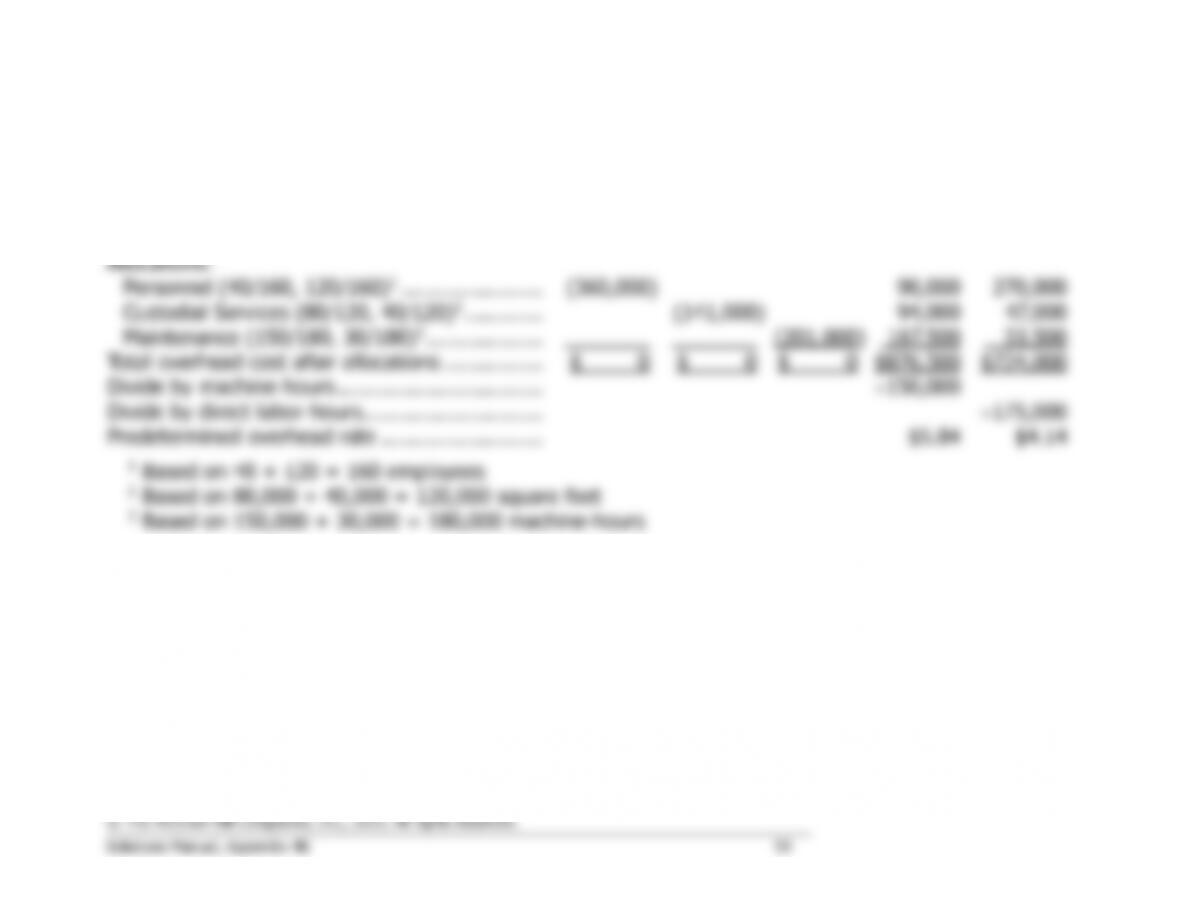
1. Step-down method:
Personnel
Custodial
Services
Mainte-
nance
Printing
Binding
Total cost before allocations ……………………….
$360,000
$141,000
$201,000
$525,000
$373,500
Allocations:
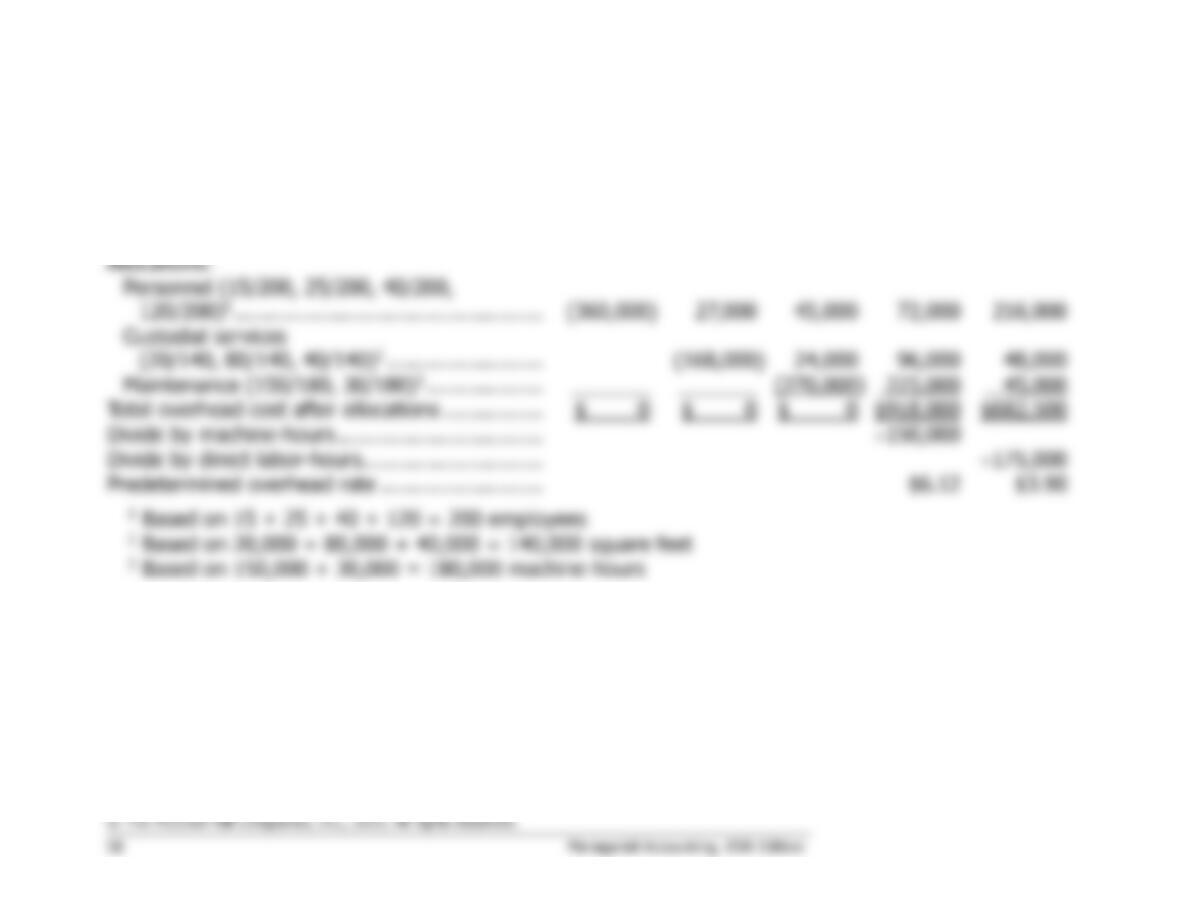
Personnel (15/200, 25/200, 40/200,
120/200)1…………………………………………..
(360,000)
27,000
45,000
72,000
216,000
Custodial services
(20/140, 80/140, 40/140)2 …………………….
(168,000)
24,000
96,000
48,000
Maintenance (150/180, 30/180)3 ……………….
(270,000)
225,000
45,000
Total overhead cost after allocations …………….
$ 0
$ 0
$ 0
$918,000
$682,500
Divide by machine-hours …………………………...
150,000
Divide by direct labor-hours ………………………..
175,000
Predetermined overhead rate ……………………..
$6.12
$3.90
1
Based on 15 + 25 + 40 + 120 = 200 employees
2
Based on 20,000 + 80,000 + 40,000 = 140,000 square feet
3
Based on 150,000 + 30,000 = 180,000 machine-hours
Case 4B-7 (continued)
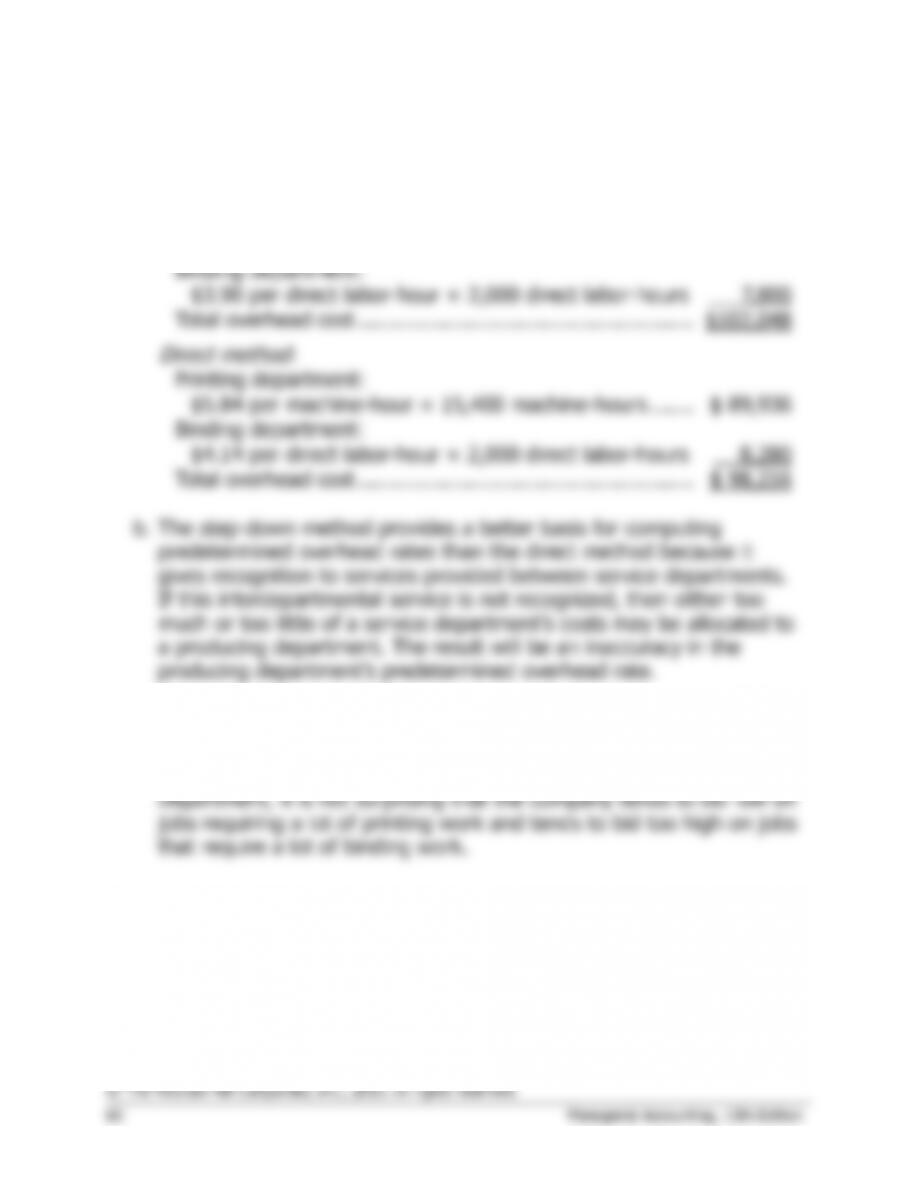
2. Direct method:
Personnel
Custodial
Services
Mainte-
nance
Printing
Binding
Total costs before allocations ………………………
$360,000
$141,000
$201,000
$525,000
$373,500
Allocations:
Personnel (40/160, 120/160)1 …………………..
(360,000)
90,000
270,000
Custodial Services (80/120, 40/120)2 ………….
(141,000)
94,000
47,000
Maintenance (150/180, 30/180)3 ……………….
(201,000)
167,500
33,500
Total overhead cost after allocations …………….
$ 0
$ 0
$ 0
$876,500
$724,000
Divide by machine-hours …………………………...
150,000
Divide by direct labor-hours ………………………..
175,000
Predetermined overhead rate ……………………..
$5.84
$4.14
1
Based on 40 + 120 = 160 employees
2
Based on 80,000 + 40,000 = 120,000 square feet
3
Based on 150,000 + 30,000 = 180,000 machine-hours
Case 4B-7 (continued)
3. a. The amount of overhead cost assigned to the job would be:
Step-down method
:
Printing department:
$6.12 per machine-hour × 15,400 machine-hours …….
$ 94,248
Binding department:
$3.90 per direct labor-hour × 2,000 direct labor-hours
7,800
Total overhead cost …………………………..………………….
$102,048
Direct method
:
Printing department:
$5.84 per machine-hour × 15,400 machine-hours …….
$ 89,936
Binding department:
$4.14 per direct labor-hour × 2,000 direct labor-hours
8,280
Total overhead cost …………………………..………………….
$ 98,216
b. The step-down method provides a better basis for computing
predetermined overhead rates than the direct method because it
gives recognition to services provided between service departments.
If this interdepartmental service is not recognized, then either too
much or too little of a service department’s costs may be allocated to
a producing department. The result will be an inaccuracy in the
producing department’s predetermined overhead rate.
Inaccuracies in the predetermined overhead rate can cause
corresponding inaccuracies in bids for jobs. Because the direct
method in this case understates the overhead rate in the Printing
Department and overstates the overhead rate in the Binding