Problem 4-2A (Concluded)
Aug. 15 Cash ………………………………………………………….. 4,508
Sales Discounts* ……………………………………….. 92
Accounts Receivable—Laird ……………….. 4,600
Collected receivable within 2% discount period.
*[($5,200 – $600) x 2%]
18 Accounts Payable—Waters ………………………… 4,840
Merchandise Inventory * ……………………… 47
Cash …………………………………………………… 4,793
Financial & Managerial Accounting, 5th Edition
262
Problem 4-3A (60 minutes)
Part 1
Adjustment (a)
Jan 31 Store Supplies Expense …………………………..… 4,050
Store Supplies …………………………………….. 4,050
To record store supplies expense
($5,800 – $1,750).
Adjustment (b)
Problem 4-3A (Continued)
Part 2 Multiple-step income statement
NELSON COMPANY
Income Statement
For Year Ended January 31, 2013
Sales ………………………………………………………………. $111,950
Less: Sales discounts …………………………………….. $ 2,000
Sales returns and allowances ………………… 2,200 4,200
Net sales …………………………………………………………. 107,750
Cost of goods sold* ………………………………………… 40,000
Gross profit …………………………………………………….. 67,750
Financial & Managerial Accounting, 5th Edition
264
Problem 4-3A (Concluded)
Part 3 Single–step income statement
NELSON COMPANY
Income Statement
For Year Ended January 31, 2013
Net sales ………………………………………………………. $107,750
Expenses
Cost of goods sold …………………………………… $40,000
Part 4
Current assets
Cash …………………………………………………………………..
$ 1,000
Merchandise inventory ………………………………………..
10,900
Store supplies …………………………………………………….
1,750
Prepaid insurance ……………………………………………….
1,000*
Total current assets …………………………………………….
$ 14,650
Current liabilities …………………………………………………...
$ 10,000
Current ratio ($14,650 / $10,000) ………………………………….
1.47
*$2,400 – $1,400 = $1,000
Quick assets (Cash) ……………………………………………….
$ 1,000
Current liabilities …………………………………………………...
$ 10,000
Acid-test ratio ($1,000 / $10,000) ………………………………...
0.10
Net Sales ……………………………………………………………….
$107,750
Cost of Goods Sold ………………………………………………..
40,000
Gross margin ………………………………………………………...
$ 67,750
Gross margin ratio ($67,750 / $107,750) ……………………….
0.63
Problem 4-4A (40 minutes)
1. Net sales
Sales …………………………..………………………………………...
$225,600
Less: Sales discounts…………………………………………..
(2,250)
Sales returns and allowances ……………………..
(12,000)
Net sales ……………………………………………………………….
$211,350
2. Cost of Merchandise purchased
Invoice cost of merchandise purchased ………………...
$ 92,000
Purchase discounts received ………………………………...
(2,000)
Purchase returns and allowances …………………………..
(4,500)
Costs of transportation–in ……………………………………...
4,600
Total cost of merchandise purchased …………………….
$ 90,100
Financial & Managerial Accounting, 5th Edition
266
Problem 4-4A (Continued)
3. Multiple-step income statement
VALLEY COMPANY
Income Statement
For Year Ended August 31, 2013
Sales ………………………………………………………….. $225,600
Less: Sales discounts ………………………………… $ 2,250
Sales returns and allowances …………… 12,000 14,250
Net sales ……………………………………………………. 211,350
Cost of goods sold * …………………………………… 74,500
Gross profit ……………………………………………….. 136,850
Expenses
Selling expenses
*Cost of goods sold (alternative computation):
Problem 4-4A (Concluded)
4. Single-step income statement
VALLEY COMPANY
Income Statement
For Year Ended August 31, 2013
Net sales ………………………………………………………… $211,350
Expenses
Cost of goods sold ……………………………………….. $74,500
Financial & Managerial Accounting, 5th Edition
268
Problem 4-5A (30 minutes)
Part 1
Closing entries
Aug. 31 Sales ……………………………………………………. 225,600
Income Summary ……………………………. 225,600
To close temporary accounts with
credit balances.
Aug. 31 Income Summary ………………………………….. 175,750
Sales Discounts …………………………….. 2,250
Sales Returns and Allowances ……….. 12,000
Cost of Goods Sold ………………………… 74,500
Sales Salaries Expense …………………… 32,000
Problem 4-5A (Concluded)
Part 2
The first step is to determine the amount of purchases that are subject to a
discount during the year:
Invoice cost of merchandise purchases ………..
$92,000
Purchase returns and allowances ………………….
(4,500)
Total cost of merchandise payable ………………..
$87,500
This amount is used to determine the maximum discount, which is then
compared to the actual discount:
Maximum discount available (3% x $87,500) ….
$ 2,625
Purchase discounts received ………………………..
(2,000)
Purchase discounts missed ………………………….
$ 625
As a percent of available discounts ($625/$2,625) …………….. 23.8%
This analysis suggests that nearly 24% of available discounts have been
missed. As a result, it would appear that cash is not being well managed.
Management should try to identify a better system for ensuring that all
favorable discounts are taken. It is possible that the 24% of discounts not
taken are actually at rates not favorable to the company (meaning that
management is worse off expending resources on those discounts)—
further information is required to assess this possibility.
Part 3
The first step is to compute this year’s sales returns and allowances rate:
Sales …………………………………………………………….
$225,600
Sales returns and allowances ……………………….
$ 12,000
Percent of returns and allowances to sales ……
5.3%
This calculation shows that the company’s customers are returning or
requiring allowances on items at a higher rate than the 4% rate observed in
prior years. It appears that management should investigate the situation to
see why there are more dissatisfied customers this year than in prior years.
Problem 4-6AB (50 minutes)
NELSON COMPANY
Work Sheet
For Year Ended January 31, 2013
Unadjusted
Trial Balance
Adjustments
Adjusted
Trial Balance
Income
Statement
Balance Sheet
Account Title
Dr.
Cr.
Dr.
Cr.
Dr.
Cr.
Dr.
Cr.
Dr.
Cr.
Cash ………………………………………………………
1,000
1,000
1,000
Merchandise inventory ……………….……
12,500
(d)
1,600
10,900
10,900
Store supplies …………………………..…………
5,800
(a)
4,050
1,750
1,750
Prepaid insurance ………………………..…
2,400
(b)
1,400
1,000
1,000
Store equipment …………………………………
42,900
42,900
42,900
Accum. depreciation—Store eq ………….
15,250
(c)
1,525
16,775
16,775
Accounts payable ………………………..…
10,000
10,000
10,000
Common stock ……………………………..……
5,000
5,000
5,000
Retained earnings ………………………..…
27,000
27,000
27,000
Dividends………………………………………..……
2,200
2,200
2,200
Sales …………………………..…………………………
111,950
111,950
111,950
Sales discounts …………………………....……
2,000
2,000
2,000
Sales returns and allowances …………
2,200
2,200
2,200
Cost of goods sold ……………………….….
38,400
(d)
1,600
40,000
40,000
Depreciation expense—Store eq ……….
0
(c)
1,525
1,525
1,525
Salaries expense …………………………..
35,000
35,000
35,000
Insurance expense ……………………….….
0
(b)
1,400
1,400
1,400
Rent expense …………………………..…….……
15,000
15,000
15,000
Store supplies expense ……………………
0
(a)
4,050
4,050
4,050
Advertising expense …………………………
9,800
______
____
____
9,800
______
9,800
______
______
______
Totals ……………………………………………….……
169,200
169,200
8,575
8,575
170,725
170,725
110,975
111,950
59,750
58,775
Net income …………………………..………………
975
______
______
975
Totals ……………………………………………….……
111,950
111,950
59,750
59,750
PROBLEM SET B
Problem 4-1B (40 minutes)
May 2 Merchandise Inventory ………………………………. 10,000
Accounts Payable—Havel ……………………. 10,000
Purchased goods on credit, terms 1/15, n/30.
4 Accounts Receivable—Heather ………………….. 11,000
Sales …………………………………………………… 11,000
Sold goods on credit, terms 2/10, n/60.
4 Cost of Goods Sold ……………………………………. 5,600
Financial & Managerial Accounting, 5th Edition
272
Problem 4-1B (Concluded)
May 17 Accounts Payable—Havel …………………………. 10,000
Merchandise Inventory * ……………………… 100
Cash …………………………………………………… 9,900
Paid payable in discount period (*10,000 x 1%).
20 Accounts Receivable—Tameron ……………….. 2,800
Sales …………………………………………………… 2,800
Sold goods on credit, terms 2/15, n/60.
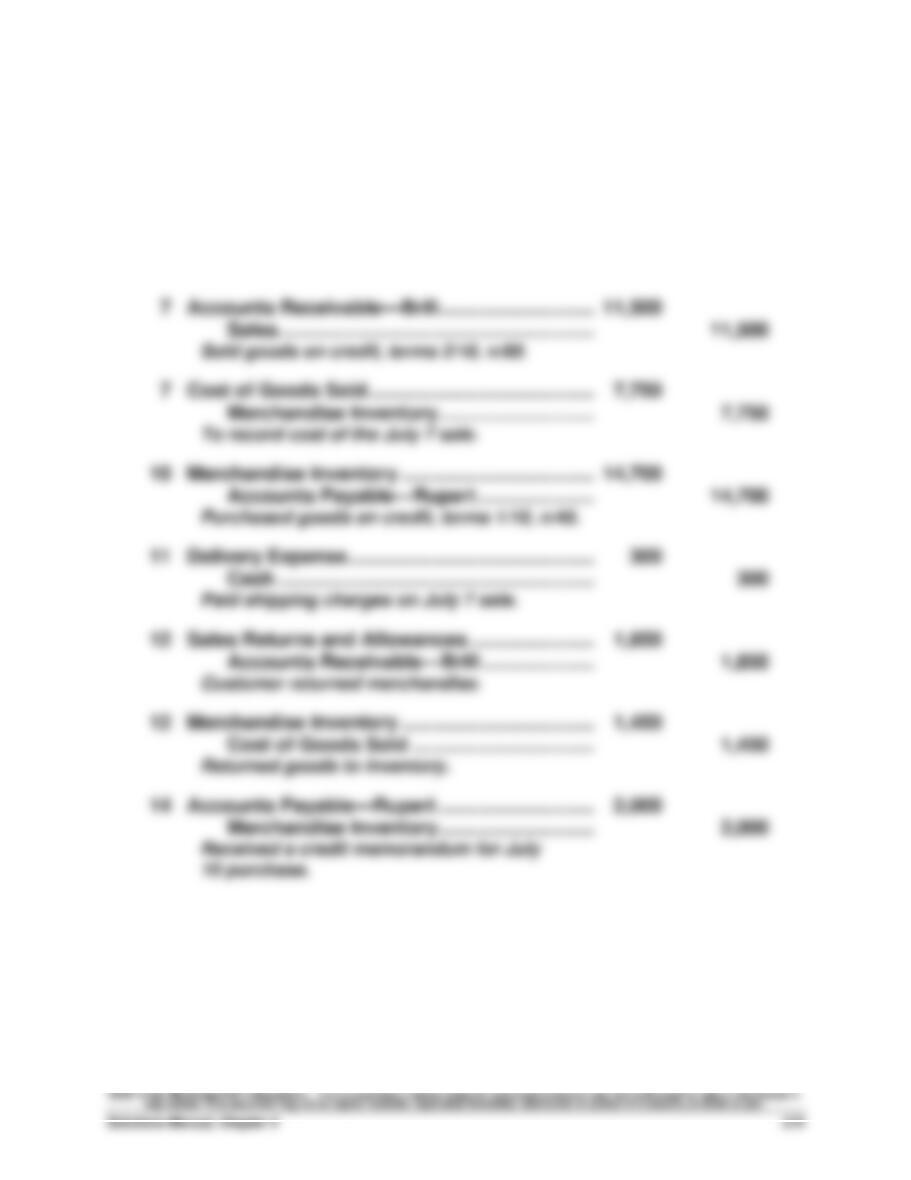
Problem 4-2B (40 minutes)
July 3 Merchandise Inventory ……………………………… 15,000
Accounts Payable—OLB …………………….. 15,000
Purchased goods on credit, terms 1/10, n/30.
4 Accounts Payable—OLB …………………………... 150
Cash ………………………………………………….. 150
Paid freight for OLB Corp.
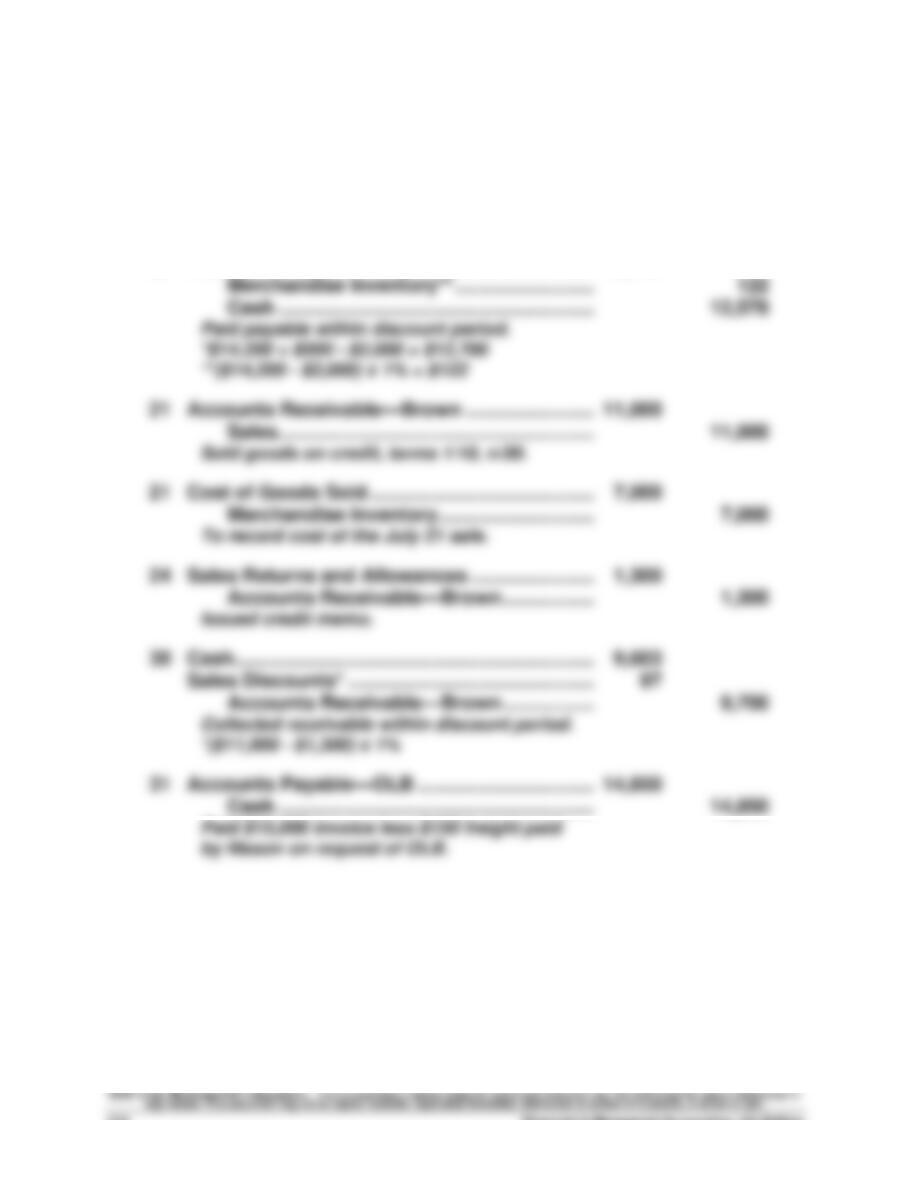
Financial & Managerial Accounting, 5th Edition
274
Problem 4-2B (Concluded)
July 17 Cash …………………………………………………………. 9,457
Sales Discounts* ………………………………………. 193
Accounts Receivable—Brill ………………… 9,650
Collected receivable within discount period.
*($11,500 – $1,850) x 2%
20 Accounts Payable—Rupert* ………………………. 12,700
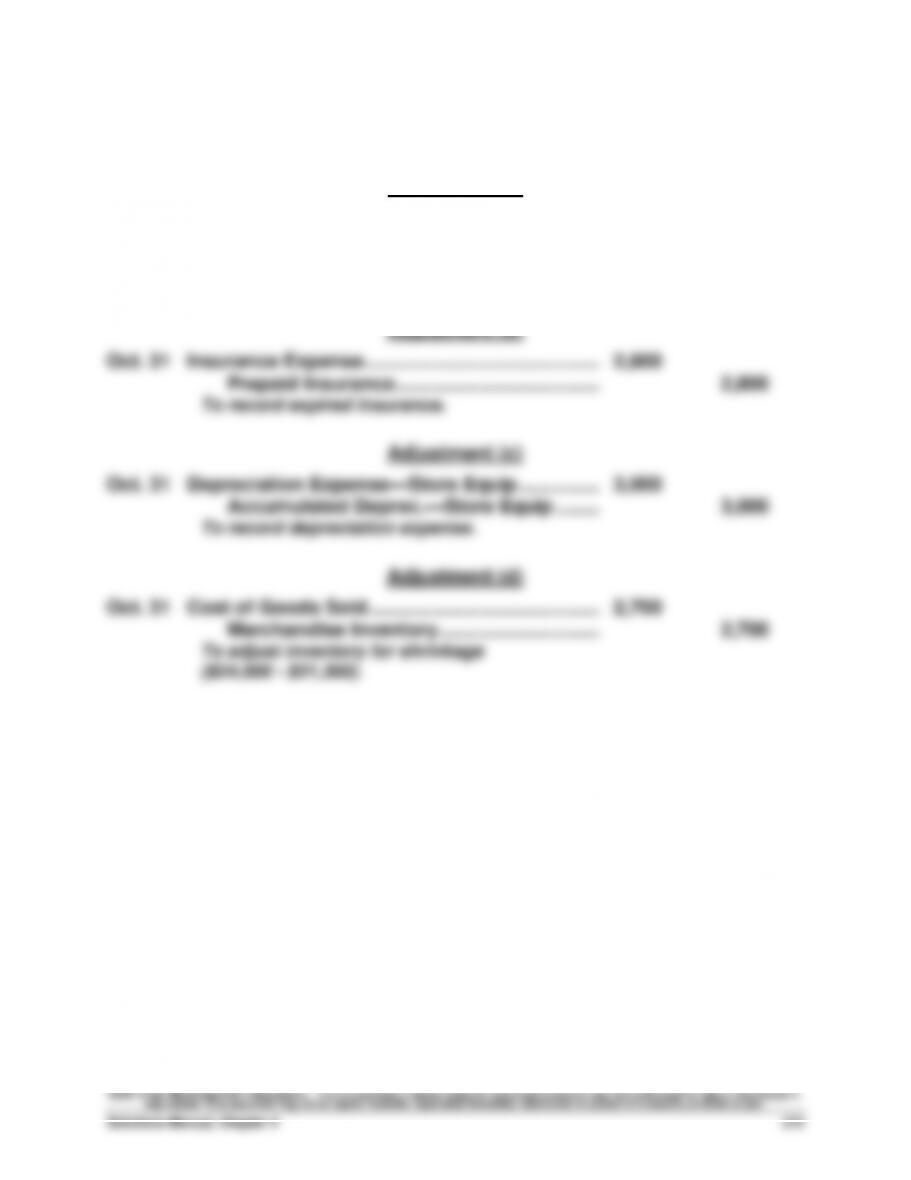
Problem 4-3B (60 Minutes)
Part 1
Adjustment (a)
Oct. 31 Store Supplies Expense …………………………….. 6,000
Store Supplies …………………………………….. 6,000
To record store supplies expense
($9,700 – $3,700).
Adjustment (b)