17–1
CHAPTER 17
ANALYSIS OF FINANCIAL STATEMENTS
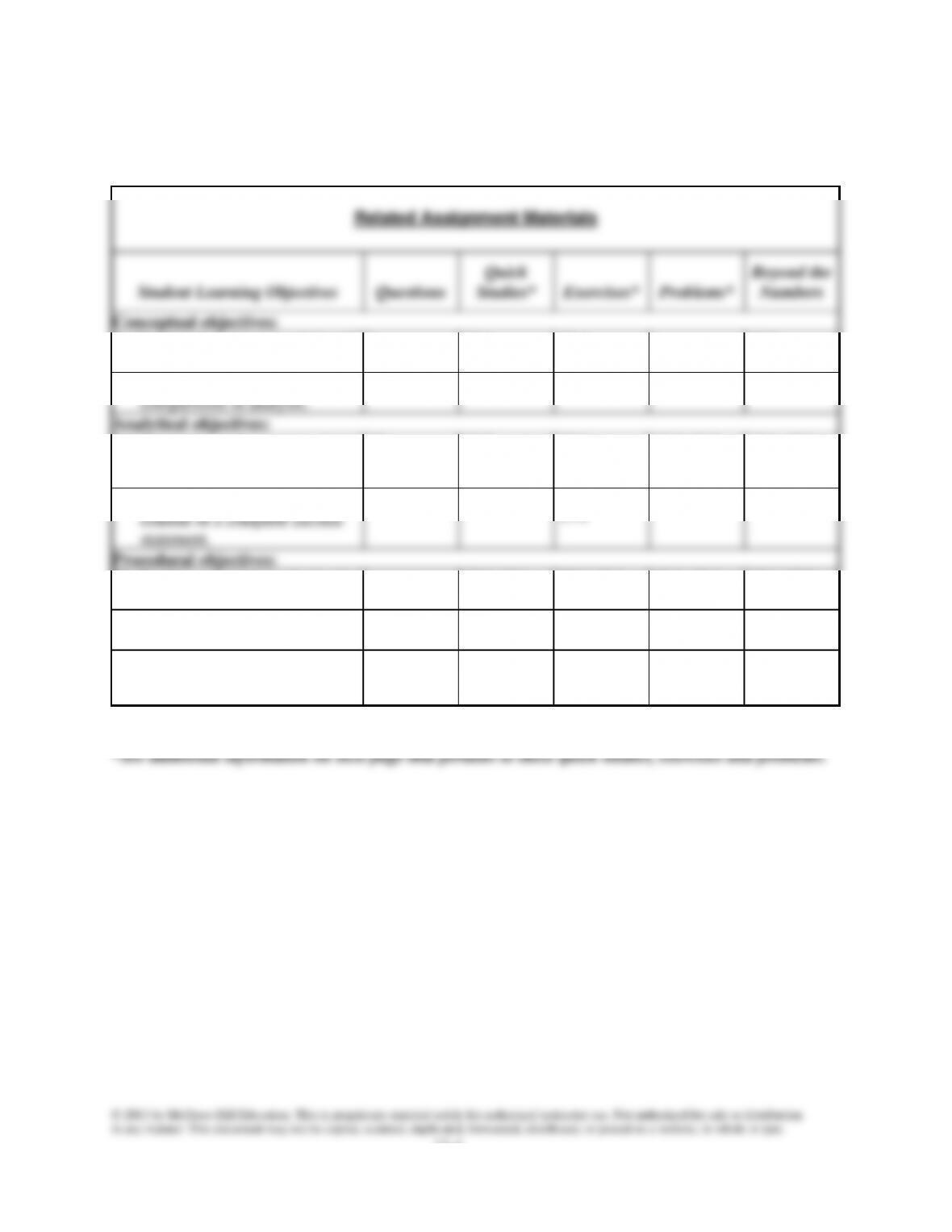
Related Assignment Materials
Student Learning Objectives
Questions
Quick
Studies*
Exercises*
Problems*
Beyond the
Numbers
Conceptual objectives:
C1. Explain the purpose and identify
the building blocks of analysis.
1
17-1
17-1
17-8
C2. Describe standards for
comparisons in analysis.
2, 3
17-5, 17-9
17-2
17-2
Analytical objectives:
A1 Summarize and report results of
analysis.
17
17-7
17-6
17-2, 17-5
17-1, 17-3,
17-4, 17–7,
17-9
A2A Explain the form and assess the
content of a complete income
statement.
13
17-8
17-1, 17-3,
17-4
17-6
Procedural objectives:
P1. Explain and apply methods of
horizontal analysis.
17-2, 17-4
17-3, 17-4
17-1, 17-2
17-1, 17–6,
17-7
P2. Describe and apply methods of
vertical analysis.
17-3
17-4, 17-5,
17-7, 17-8
17-1
17-1, 17–2,
17-6, 17-7
P3. Define and apply ratio analysis.
4, 5, 6, 7, 8, 9,
10, 11, 12,,
14,15, 16, 17
17-6
17– 9, 17-10,
17-11, 17–12,
17–15
17-1, 17-3,
17-4, 17-5
17-4, 17-5,
17-6, 17–7,
17-8
17–3
Chapter Outline
Notes
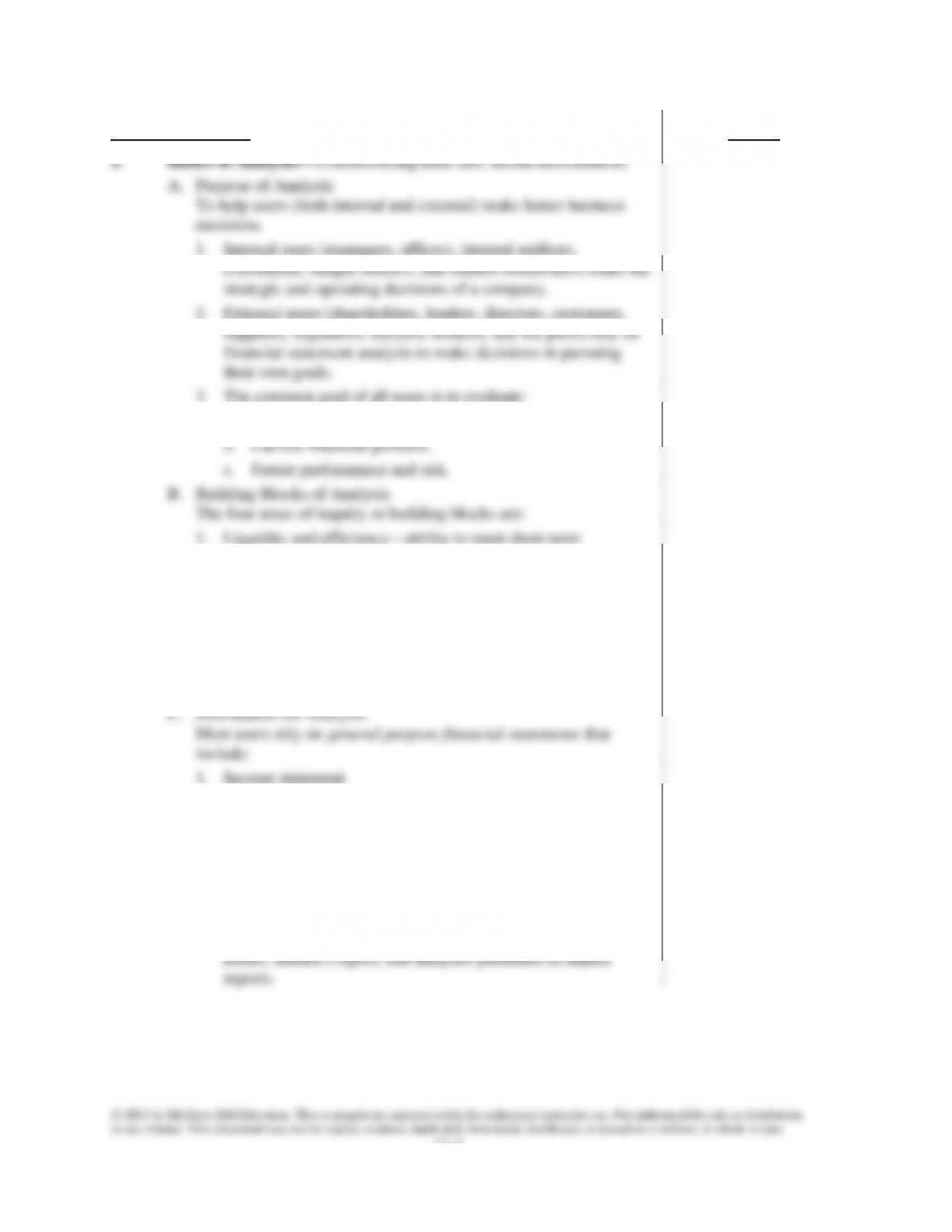
I. Basics of Analysis—Transforming data into useful information.
A. Purpose of Analysis
To help users (both internal and external) make better business
decisions.
1. Internal users (managers, officers, internal auditors,
consultants, budget officers, and market researchers) make the
strategic and operating decisions of a company.
2. External users (shareholders, lenders, directors, customers,
suppliers, regulators, lawyers, brokers, and the press) rely on
financial statement analysis to make decisions in pursuing
their own goals.
3. The common goal of all users is to evaluate:
a. Past and current performance.
b. Current financial position.
c. Future performance and risk.
B. Building Blocks of Analysis
The four areas of inquiry or building blocks are:
1. Liquidity and efficiency—ability to meet short-term
obligations and to efficiently generate revenues.
2. Solvency—ability to generate future revenues and meet long-
term obligations.
3. Profitability—ability to provide financial rewards sufficient to
attract and retain financing.
4. Market prospects—ability to generate positive market
expectations.
C. Information for Analysis
Most users rely on general purpose financial statements that
include:
1. Income statement
2. Balance sheet
3. Statement of stockholders’ equity (or statement of retained
earnings)
4. Statement of cash flows
5. Notes related to the statements
6. Other useful financial data—10K/other SEC filings, news
releases, shareholders’ meetings, forecasts, management
letters, auditor’s report, and analyses published in annual
reports.
Chapter Outline
Notes
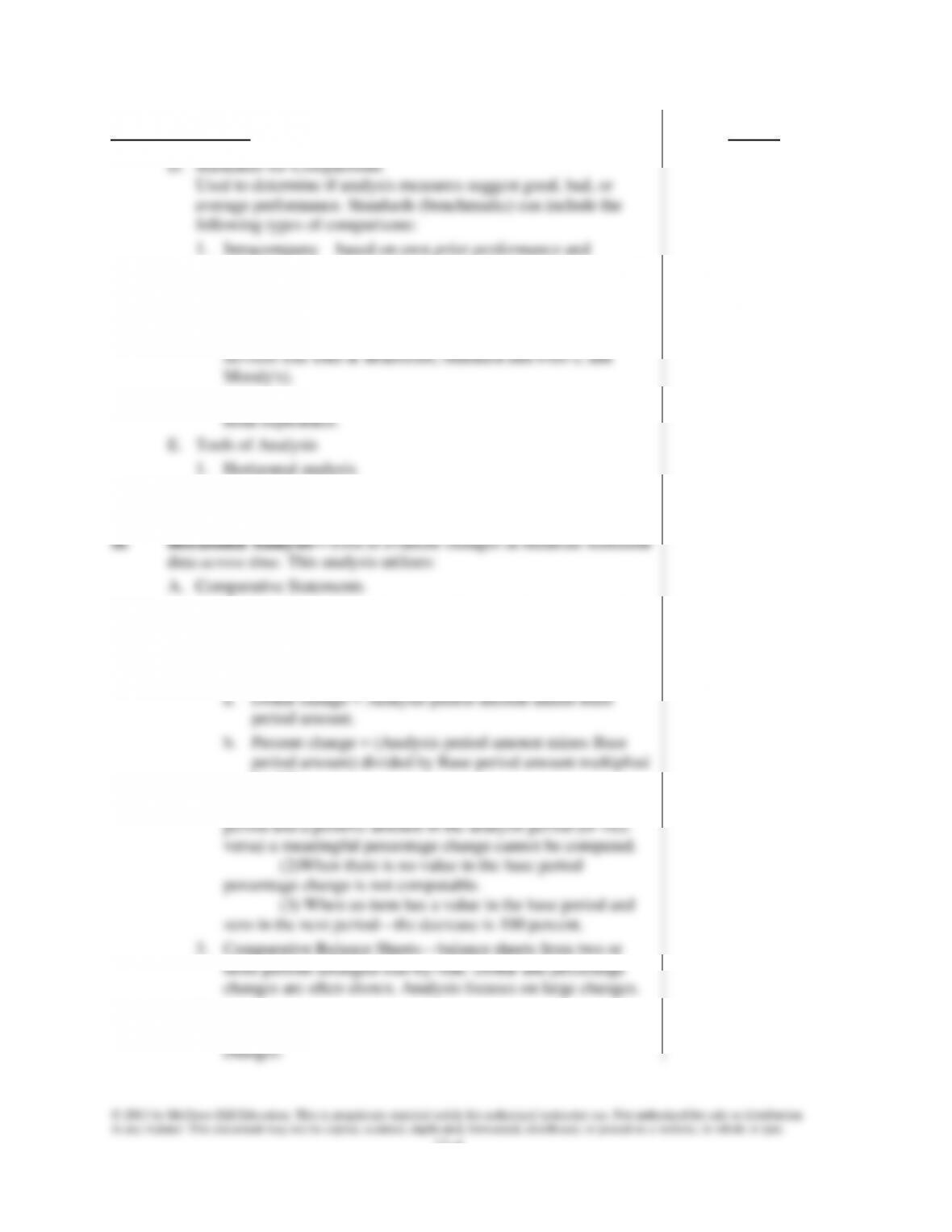
D. Standards for Comparisons
Used to determine if analysis measures suggest good, bad, or
average performance. Standards (benchmarks) can include the
following types of comparisons:
1. Intracompany—based on own prior performance and
relationships between its financial items.
2. Competitor—compared to one or more direct competitors.
(often best)
3. Industry—published industry statistics (available from
services like Dun & Bradstreet, Standard and Poor’s, and
Moody’s).
4. Guidelines (rules-of-thumb)—general standards developed
from experience.
E. Tools of Analysis
1. Horizontal analysis
2. Vertical analysis
3. Ratio analysis
II. Horizontal Analysis—Tool to evaluate changes in financial statement
data across time. This analysis utilizes:
A. Comparative Statements
1. Reports where financial amounts for more than one period are
placed side by side in columns on a single statement.
2. Dollar changes and percentage changes—usually shown in
line items.
a. Dollar change = Analysis period amount minus Base
period amount.
b. Percent change = (Analysis period amount minus Base
period amount) divided by Base period amount multiplied
by 100.
Note: (1) When a negative amount appears in the base
period and a positive amount in the analysis period (or vice
versa) a meaningful percentage change cannot be computed.
(2)When there is no value in the base period—
percentage change is not computable.
(3) When an item has a value in the base period and
zero in the next period—the decrease is 100 percent.
3. Comparative Balance Sheets—balance sheets from two or
more periods arranged side-by-side. Dollar and percentage
changes are often shown. Analysis focuses on large changes.
4. Comparative Income Statements—also compares two or more
periods presented side-by side with dollar and percentage
changes.
Chapter Outline
Notes
B. Trend analysis (also called trend percent analysis or index
number trend analysis)
1. A form of horizontal analysis used to reveal patterns in data
across successive periods.
2. Involves computing trend percents (or index number) as
follows: Analysis period amount divided by base period
amount) multiplied by 100.
3. Often aided by graphical depiction.
III. Vertical Analysis—(also called common-size analysis) Comparing
financial condition and performance to a base amount. The analysis
tools include:
A. Common-Size Statements—reveal changes in the relative
importance of each financial statement item by redefining each in
terms of common-size percents.
1. Base amount is commonly defined as 100%. Usually a key
aggregate figure is the base (Examples: revenue—income
statement base, total assets—balance sheet base).
2. Sum of individual items is 100%.
3. Common-size percentage equals (Analysis amount divided by
Base amounts) multiplied by 100.
B. Common-Size Graphics
Graphical analysis (Ex. pie charts and bar charts) of common-size
statements that visually highlight comparison information.
IV. Ratio Analysis—widely used analysis tool that express key
relationships among financial statement items. Ratios are organized
into the four (A to D below) building blocks of analysis:
A. Liquidity and Efficiency
1. Liquidity refers to the availability of resources to meet short-
term cash requirements.
2. Efficiency refers to how productive a company is in using its
assets. Efficiency is usually measured relative to how much
revenue is generated for a certain level of assets.
3. Ratios in this block:
a. Working capital—the excess of current assets less current
liabilities.
b. Current ratio—current assets divided by current liabilities;
describes a company’s ability to pay its short-term
obligations.
c. Acid-test ratio—similar to current ratio but focuses on
quick assets (i.e., cash, short-term investments, accounts
receivable, and notes receivable) rather than current
assets. Calculated as quick assets divided by current
liabilities.
Chapter Outline
Notes
d. Accounts receivable turnover—net sales or credit sales
divided by average accounts receivable; a measure of how
long it takes a company to collect its accounts.
e. Inventory turnover—cost of goods sold divided by
average inventory; the number of times a company’s
average inventory is sold during an accounting period.
f. Days’ sales uncollected—(accounts receivable divided by net
credit sales) multiplied by 365 days; measures how
frequently a company collects its accounts receivable.
g. Days’ sales in inventory—(ending inventory divided by
cost of goods sold) multiplied by 365; measures how
many days it will take to convert the inventory on hand at
the end of the period into accounts receivable or cash.
h. Total asset turnover—net sales divided by average total
assets; describes the ability to use assets to generate sales.
B. Solvency
1. Solvency refers to a company’s long-run financial viability and
its ability to cover long-term obligations. Capital structure is
one of the most important components of solvency analysis.
2. Capital structure refers to a company’s sources of financing.
3. Ratios in this block:
a. Debt ratio—total liabilities divided by total assets.
b. Equity ratio—total stockholders’ equity divided by total
assets; compliment of debt ratio.
c. Debt-to-equity ratio—total liabilities divided by total
equity.
Note: A company is considered less risky if its capital
structure (equity and long-term debt) is composed more of
equity. Financial leveraging, the inclusion of debt, can
increase return to stockholders.
d. Times interest earned—income before interest expense
and income taxes divided by interest expense; reflects the
risk of repayments with interest to creditors.
C. Profitability
1. Profitability refers to a company’s ability to generate an
adequate return on invested capital.
2. Return is judged by assessing earnings relative to the level
and sources of financing.
Chapter Outline
Notes
3. Ratios in this block:
a. Profit margin—net income divided by net sales;
describes the ability to earn a net income from sales.
b. Return on total assets—net income divided by average
total assets; a summary measure of operating
efficiency, comprises profit margin and total asset
turnover.
c. Return on common stockholders’ equity—net income
less preferred dividends divided by average common
stockholders’ equity; measures the success of a
company in earning net income for its owners.
D. Market Prospects
1. Market measures are useful for analyzing corporations with
publicly traded stock.
2. Market measures use stock price in their computation.
3. Ratios in this block:
a. Price-earnings ratio—market price per share of common
stock divided by earnings per share; used to evaluate the
profitability of alternative common stock investments.
b. Dividend yield—annual cash dividends paid per share of
stock divided by market price per share; used to compare
the dividend paying performance of different investment
alternatives.
E. Summary of Ratios
Exhibit 17.16 on p. 699 of text sets forth the names of each of the
common ratios by category, and includes the formula and a
description of what is measured by each ratio.
Chapter Outline
Notes
V. Global View—Compares U.S.GAAP to IFRS
A. Horizontal and vertical analyses help eliminate many differences
between U.S.GAAP and IFRS when analyzing and interpreting
financial statements. Percentages are consistently applied across
and within periods. However, where reporting rules differ, users
should exercise caution in drawing conclusions.
B. Ratio analysis has many of the advantages and disadvantages of
horizontal and vertical analysis as mentioned above.
VI. Decision Analysis—Analysis Reporting
Goal of financial statement analysis report is to reduce uncertainty
through rigorous and sound evaluation. A good analysis report usually
consists of six sections:
1. Executive summary
2. Analysis overview
3. Evidential matter
4. Assumptions
5. Key factors
6. Inferences
VII. Sustainable Income—Appendix 17A—When a revenue and expense
transactions are from normal, continuing operations, a simple income
statement is adequate. When activities include events that are not
normal, it must disclose this information by separating the income
statement into different sections as follows (A-D):
A. Continuing Operations
Reports the revenues, expenses, and income generated by the
company’s continuing operations.
B. Discontinued Segments
1. A business segment is a part of a company’s operations that
serves a particular line of business or class of customers.
2. Section reports:
a. Income (loss) from operating each discontinued business
segment for the current period prior to disposal (net of
taxes).
b. Gain or loss on disposal of each segment (net of related
income tax effects).
17–9
Chapter Outline
Notes
C. Extraordinary Items—reports extraordinary gains and losses that
are both unusual and infrequent.
1. An unusual gain or loss is abnormal or otherwise unrelated to
the company’s regular activities and environment.
2. An infrequent gain or loss is not expected to recur given the
company’s operating environment.
3. Items that are unusual or infrequent, but not both, are reported
in the income statement as part of continuing operations but
below the normal revenues and expenses.
D. Earnings per Share
1. Final section of income statement
2. Reports EPS for three subcategories of income (continuing
operations, discontinued segments, and extraordinary
items).EPS discussed in chapter 13
E. Changes in Accounting Principles
1. The consistency principle directs a company to apply the same
accounting principle across periods. Changes from one
accounting principles to another (Example: LIFO to FIFO) are
acceptable if justified as improvements in financial reporting.
2. A footnote would describe change and why it is an
improvement.
3. Requires retrospective application (application of new
accounting principle to prior periods as if that principle had
always been used).

17–10
Alternate Demonstration Problem
Chapter Seventeen
Following are data from the statements of two companies selling similar
products:
Current Year-End Balance Sheets
Sled
Company
Zip
Company
Cash ………………………………………………………………
$ 11,900
$ 20,000
Notes receivable—short-term …………………………
7,700
3,200
Accounts receivable, net ………………………………..
42,000
64,000
Inventory ……………………………………………………….
58,800
87,680
Prepaid expenses …………………………………………..
1,680
3,520
Plant and equipment, net ………………………………..
232,120
274,400
Total assets ……………………………………………………
$354,200
$452,800
Current liabilities ……………………………………………
$ 56,000
$ 80,000
Mortgage payable …………………………………………..
70,000
80,000
Common stock, $10 par value …………………………
140,000
160,000
Retained earnings ………………………………………….
88,200
132,800
Total liabilities and stockholders’ equity …………
$354,200
$452,800
Data from the Current Year’s Income Statement
Sales ……………………………………………………………..
$672,000
$880,000
Cost of goods sold …………………………………………
528,080
699,840
Interest expense …………………………………………….
4,200
5,600
Net income …………………………………………………….
23,373
28,896
Beginning–of-Year Data
Inventory ……………………………………………………….
$ 53,200
$ 85,120
Total assets ……………………………………………………
345,800
443,200
Stockholders’ equity ………………………………………
217,000
285,120
Required:
1. Calculate current ratios, acid-test ratios, inventory turnovers, and days’ sales
uncollected for the two companies. Then state which company you think is
the better short-term credit risk and why.
2. Calculate return on total assets employed and return on stockholders’
equity. Then, under the assumption that each company’s stock can be
purchased at book value, state which company’s stock you think is the
better investment and why.
17–11
Solution: Alternate Demonstration Problem
Chapter Seventeen
Part 1
Sled Company
Zip Company
Current ratio:
$122,080
$ 56,000
= 2.18 to 1
$178,400
$ 80,000
= 2.23 to 1
Acid-test ratio:
$ 61,600
$ 56,000
= 1.10 to 1
$ 87,200
$ 80,000
= 1.09 to 1
Inventory
turnover:
$528,080
$ 56,000
= 9.4 times
$669,840
$ 86,400
= 7.8 times
Days’ sales
uncollected:
$ 42,000
$672,000
x 365 = 22.8
$ 64,000
$880,000
x 365 = 26.5
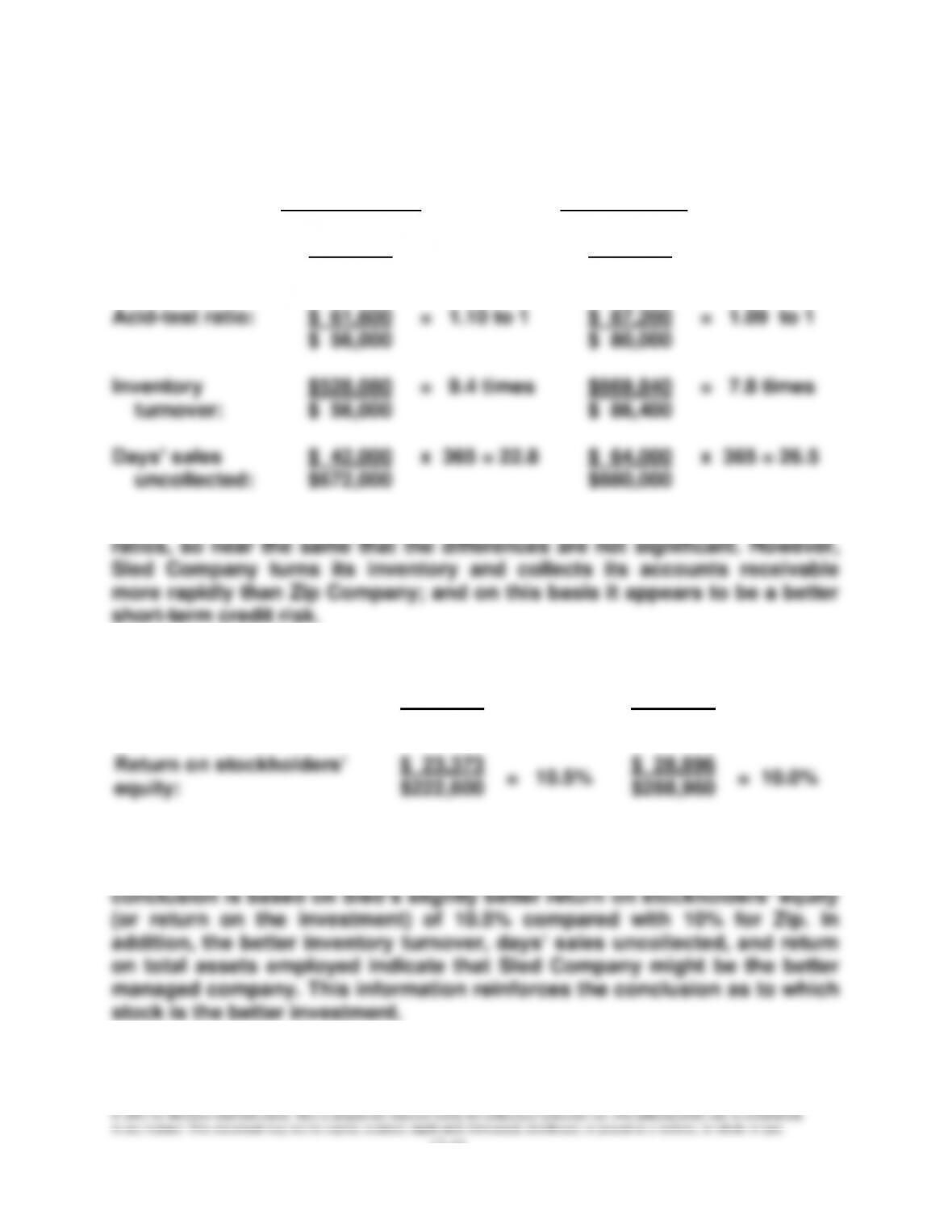
Sled Company and Zip Company have almost equal current and acid-test
Part 2
Return on total assets:
$ 23,373
$350,000
= 6.68%
$ 28,896
$448,000
= 6.45%
Return on stockholders’
equity:
$ 23,373
$222,600
= 10.5%
$ 28,896
$288,960
= 10.0%
Assuming that the stock of each company could be purchased at book
value, Sled Company’s stock seems to be the better investment. This