Chapter 09 – Reporting and Interpreting Liabilities
9-12
LO 8 – Apply present value concepts to liabilities.
E. Accounting Applications of Present Value
1. Computing the amount of a liability with a single
payment
Related present value
computations and journal
entries are illustrated in text
2. Computing the amount of a liability with an annuity
3. Computing the amount of a lease liability
VI. Chapter Supplement A: Present Value Computations using
Excel
Steps illustrated in text
A. Present Value of a Single Payment
1. Use Excel to compute the present value
2. Enter the present value formula: =Payment/(1+i)^n
B. Present Value of an Annuity
1. Select the function button (fx)
2. In drop down menu, under the Select Category heading,
pick “Financial,” scroll down under Select Function, and
click on “PV”
3. In new drop down box, enter specific information for
problem and click “OK”
VII. Chapter Supplement B: Deferred Taxes
A. Deferred Taxes – Reported as a long-term liability
1. Deferred tax items – exist because of timing differences
caused by reporting revenues and expenses according to
GAAP on a company’s income statement and according
to the Internal Revenue Code on the tax return
2. Temporary differences – timing differences that cause
deferred income taxes and will reverse, or turn around, in
the future
3. Deferred tax amounts always reverse themselves
B. Example
1. In 2014, Starbucks owned a building that originally cost
$10 million; book value on the balance sheet is $8.5
million; for tax purposes, book value is $6.5 million
a. The $2 million difference is caused by using straight-
line depreciation for financial reporting and
accelerated depreciation for tax purposes
b. The company has delayed (or deferred) paying federal
income taxes by reporting more depreciation on its tax
return than it did on its income statement
c. The amount of deferred tax liability is computed by
multiplying the timing difference by the corporate tax
rate (34%):
Deferred Tax Liability = $2 million × 34% = $680,000
d. If there were no other deferred tax items, a deferred
tax liability of $680,000 is reported on balance sheet

Chapter 09 – Reporting and Interpreting Liabilities
9-13
2. At the end of the following year, 2015, the company
would compare the tax book value and the GAAP book
value of the building
a. The tax book value of the building was $6 million and
the GAAP book value was $8.2 million
Computation of deferred
taxes is discussed in
advanced accounting
courses; stress that students
need to understand only that
deferred tax assets and
liabilities are caused by
temporary differences
between the income statement
and tax return
b. The timing difference is $2.2 million, resulting in a
deferred tax liability of $748,000 ($2.2 million × 34%)
c. The income tax expense reported under GAAP =
income tax payment +/ – change in deferred taxes
dr Income Tax Expense
(+E, –SE)
618,000
cr Deferred Taxes (+L)
68,000
cr Income Taxes Payable (+L)
550,000
Assets = Liabilities + Stockholders’ Equity
0 = Deferred Taxes (L) + 68,000 + Income Taxes
Payable (L) + 550,000 + Income Tax Expense (E)
– 618,000
VIII. Chapter Supplement C: Future Value Concepts
A. Future Value – the sum to which an amount will increase as
the result of compound interest
B. Future Value of a Single Payment
1. In future value of a single amount problems, you are
asked to calculate how much money you will have in the
future as the result of investing a certain amount in the
present
2. On 1/1/14, you deposit $1,000 in a savings account at
10% annual interest, compounded annually. What will the
account balance be at the end of 3 years?
Use Supplemental
Enrichment Activity #4
a. Future value factor – For i = 10%, n = 3, present value
of $1 is 1.3310
b. Future value = $1,000 × 1.3310 = $1,331
C. Future Value of an Annuity
1. Annuity – a series of periodic cash receipts or payments
that are equal in amount each interest period
2. At the end of each year for three years, you deposit
$1,000 cash in a savings account at 10% interest per year.
You make the first $1,000 deposit on 12/31/14, the
second one on 12/31/15, and the third one on 12/31/16.
What will the account balance be at the end of 3 years?
Use Supplemental
Enrichment Activity #4
a. Future value factor – For i = 10%, n = 3, present value
of annuity of $1 is 3.3100
b. Future value = $1,000 × 3.3100 = $3,3100

Chapter 09 – Reporting and Interpreting Liabilities
9-14
Supplemental Enrichment Activities
Note: These activities would be suitable for individual or group activities.
1. Handout 9-1
Use Handout 9-1 for an in-class activity to review entries relating to payroll. The solution follows the
handout master.
2. Handout 9-2
Use Handout 9-2 for an in-class activity to review the issuance of a note payable. The solution
follows the handout master.
3. Handout 9-3
Use Handout 9-3 for an in-class activity to review the accounting for deferred revenues. The solution
follows the handout master.
4. Handout 9-4
Use Handout 9-4 for an in-class activity to review present and future value concepts. The solution
follows the handout master.

Chapter 09 – Reporting and Interpreting Liabilities
9-15
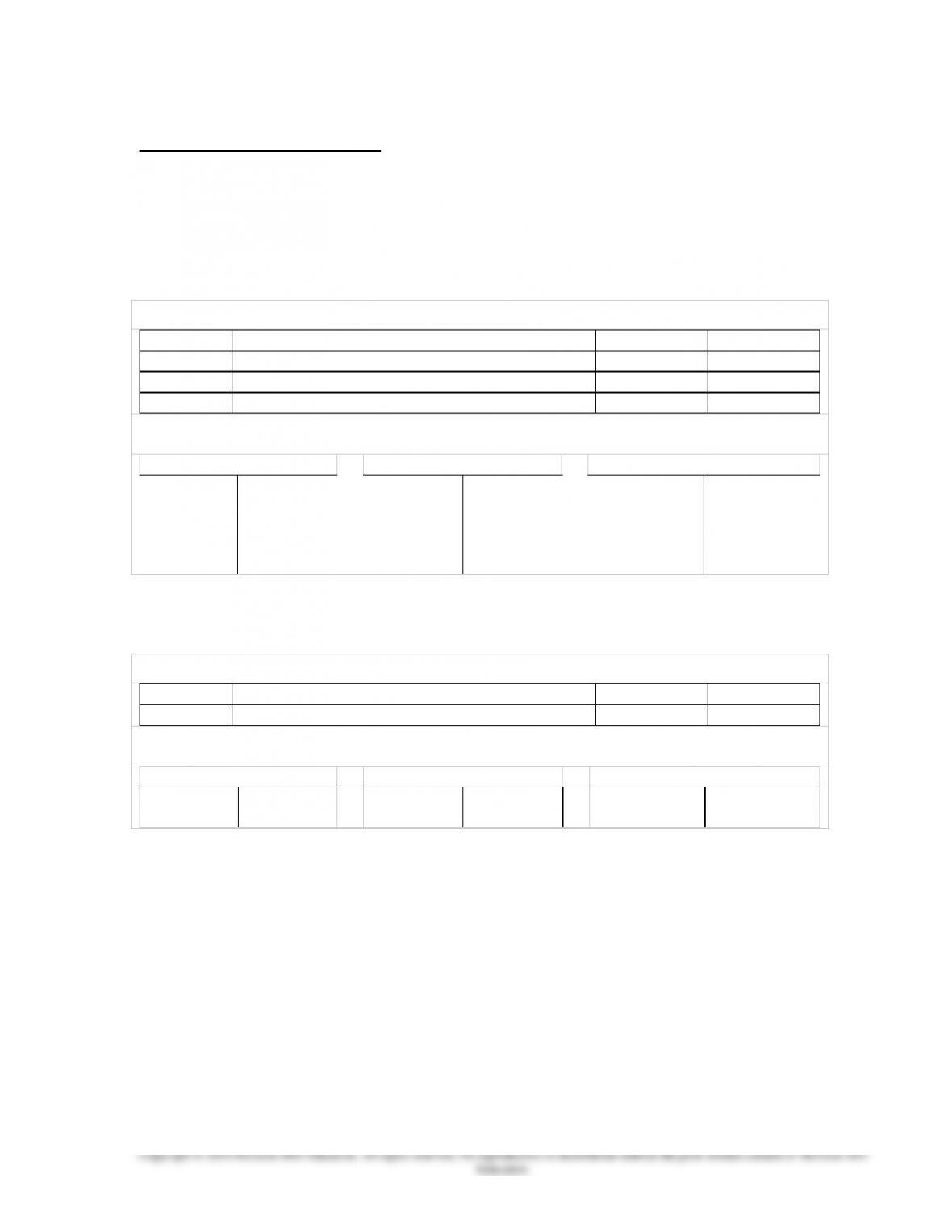
HANDOUT 9 – 1
PAYROLL ENTRIES
J&W Buffet Co. employees earned $350,000 in the week ended December 17, 2014. Of this, $26,775
was deducted from employees’ pay for FICA and $62,000 was deducted for income taxes.
Prepare the journal entry to record the employees’ portion of payroll for December 17, 2014.
Debit and credit the accounts affected
Ensure the equation still balances and debits = credits
Assets
=
Liabilities
+
Stockholders’ Equity
Prepare the journal entry to record the employer’s share of FICA payroll taxes for December 17, 2014.
Debit and credit the accounts affected
Ensure the equation still balances and debits = credits
Assets
=
Liabilities
+
Stockholders’ Equity
Chapter 09 – Reporting and Interpreting Liabilities
9-16
HANDOUT 9 – 1 SOLUTION
PAYROLL ENTRIES
J&W Buffet Co. employees earned $350,000 in the week ended December 17, 2014. Of this, $26,775 was
deducted from employees’ pay for FICA and $62,000 was deducted for income taxes.
Prepare the journal entry to record the employees’ portion of payroll for December 17, 2014.
Debit and credit the accounts affected
Dec. 17
Compensation Expense (+E, –SE)
350,000
2014
Liability for Income Taxes Withheld (+L)
62,000
FICA Payable (+L)
26,775
Cash (–A)
261,225
Ensure the equation still balances and debits = credits
Assets
=
Liabilities
+
Stockholders’ Equity
Cash
–261,225
Liability
for Income
Taxes W/H
+62,000
Compensation
Expense
–350,000
FICA
Payable
+26,775
Prepare the journal entry to record the employer’s share of FICA payroll taxes for December 17, 2014.
Debit and credit the accounts affected
Dec. 17
Compensation Expense (+E, –SE)
26,775
2014
FICA Payable (+L)
26,775
Ensure the equation still balances and debits = credits
Assets
=
Liabilities
+
Stockholders’ Equity
FICA
Payable
+26,775
Compensation
Expense
–26,775

Chapter 09 – Reporting and Interpreting Liabilities
9-17
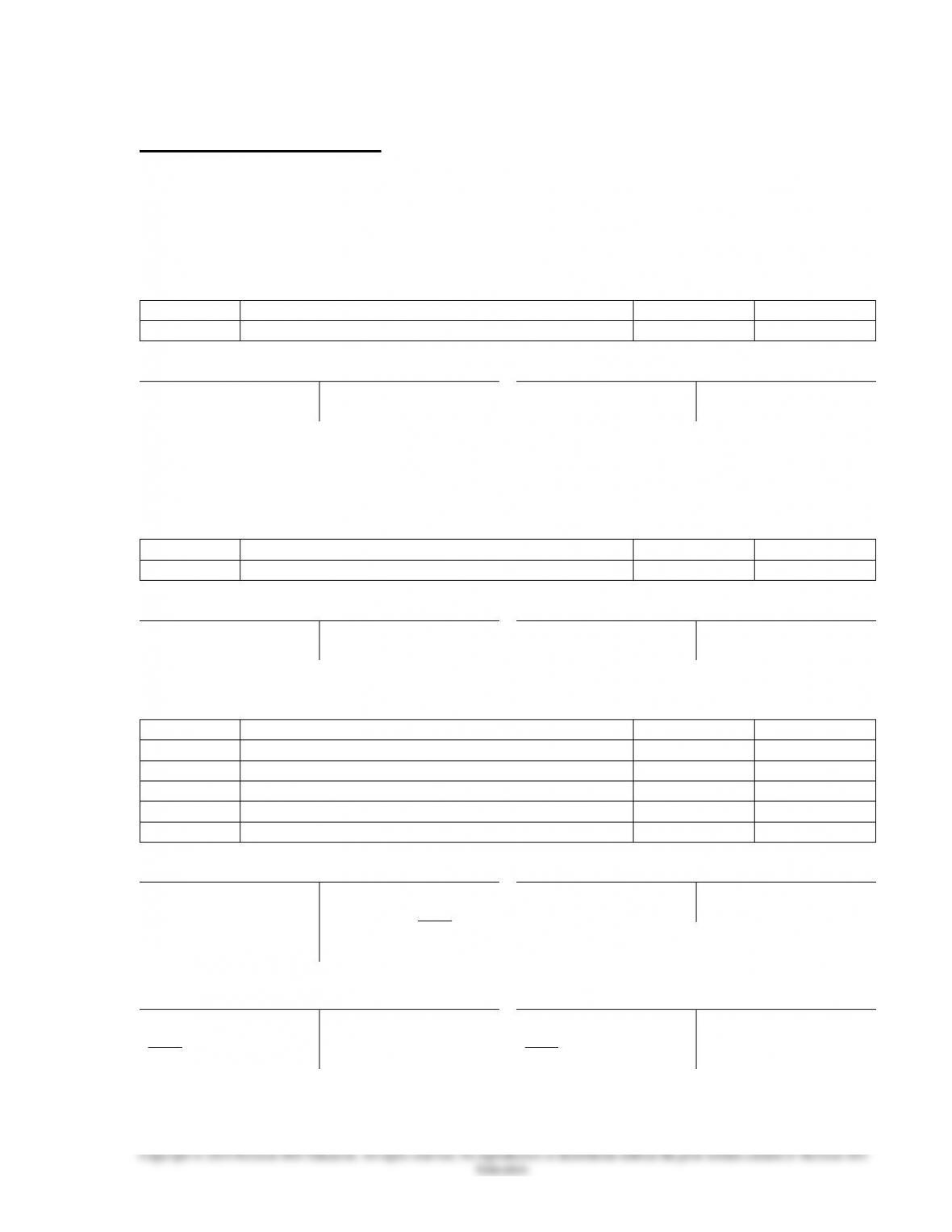
HANDOUT 9 – 2
NOTES PAYABLE
Mumford Co. borrowed a $100,000 note payable on June 1, 2014, with 6% interest. The note is due on
May 31, 2015.
Prepare the journal entry to record the issuance of the note and receipt of cash on June 1, 2014.
Debit and credit the accounts affected
Ensure the equation still balances and debits = credits
Assets
=
Liabilities
+
Stockholders’ Equity
Prepare the adjusting journal entry to record the interest owed at the end of the accounting period on
December 31, 2014.
Debit and credit the accounts affected
Ensure the equation still balances and debits = credits
Assets
=
Liabilities
+
Stockholders’ Equity
Prepare the journal entries to record the interest and principal payments to the lender on May 31, 2015.
Debit and credit the accounts affected
Ensure the equation still balances and debits = credits
Assets
=
Liabilities
+
Stockholders’ Equity
Chapter 09 – Reporting and Interpreting Liabilities
9-18
HANDOUT 9 – 2 SOLUTION
NOTES PAYBLE
Mumford Co. borrowed a $100,000 note payable on June 1, 2014, with 6% interest. The note is due on
May 31, 2015.
Prepare the journal entry to record the issuance of the note and receipt of cash on June 1, 2014.
June 1
Cash (+A)
100,000
2014
Note Payable (+L)
100,000
+ Cash (A) –
June 1
100,000
– Note Payable (L) +
100,000
June 1
Prepare the adjusting journal entry to record the interest owed at the end of the accounting period on
December 31, 2008.
Principal x Rate x Time Period = $100,000 x 6% x 7/12 = $3,500
Dec. 31
Interest Expense (+E, –SE)
3,500
2014
Interest Payable (+L)
3,500
– Interest Payable (L) +
3,500
Dec. 31
+ Interest Expense (E) –
Dec. 31
3,500
Prepare the journal entries to record the interest and principal payments to the lender on May 31, 2015.
May. 31
Interest Expense (+E, –SE) ($100,000 x 6% x 5/12)
2,500
2015
Interest Payable (–L)
3,500
Cash (–A) ($100,000 x 6% x 12/12)
6,000
May 31
Note Payable (–L)
100,000
2015
Cash (–A)
100,000
+ Cash (A) –
June 1
100,000
2015
6,000
May 31
100,000
May 31
+ Interest Expense (E) –
May 31
2,500
– Interest Payable (L) +
3,500
Dec. 31
2015
May 31
3,500
– Note Payable (L) +
100,000
June 1
2015
May 31
100,000

Chapter 09 – Reporting and Interpreting Liabilities
9-19
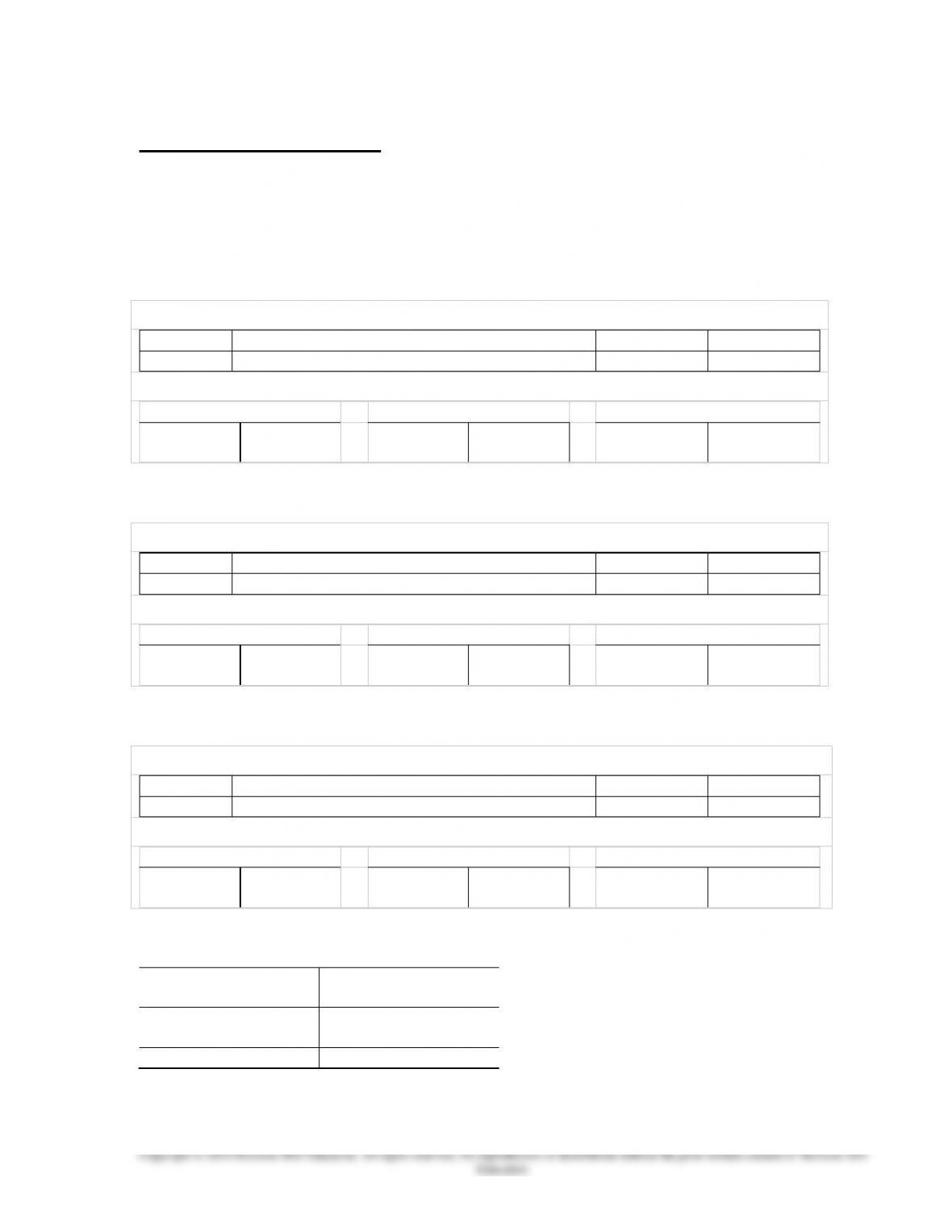
HANDOUT 9 – 3
DEFERRED REVENUE
On January 1, 2013, Charlie Rangel paid $2,000 for a two–year membership to the Beam Gym.
Prepare the journal entry to record the receipt of cash on January 1, 2009.
Debit and credit the accounts affected
Ensure the equation still balances and debits = credits
Assets
=
Liabilities
+
Stockholders’ Equity
By December 31, 2013, one half of Rangel’s membership expired. Prepare the adjusting journal entry.
Debit and credit the accounts affected
Ensure the equation still balances and debits = credits
Assets
=
Liabilities
+
Stockholders’ Equity
By December 31, 2014, the remainder of the membership expired. Prepare the adjusting journal entry.
Debit and credit the accounts affected
Ensure the equation still balances and debits = credits
Assets
=
Liabilities
+
Stockholders’ Equity
Post the entries above to the Deferred Revenue account:
– Deferred Revenue (L) +
End Bal
End Bal
Chapter 09 – Reporting and Interpreting Liabilities
9-20
HANDOUT 9 – 3 SOLUTION
DEFERRED REVENUE
On January 1, 2013, Charlie Rangel paid $2,000 for a two–year membership to the Beam Gym.
Prepare the journal entry to record the receipt of cash on January 1, 2009.
Debit and credit the accounts affected
Jan. 1
Cash (+A)
2,000
2013
Deferred Revenue (+L)
2,000
Ensure the equation still balances and debits = credits
Assets
=
Liabilities
+
Stockholders’ Equity
Cash
+2,000
Deferred
Revenue
+2,000
By December 31, 2013, one half of Rangel’s membership expired. Prepare the adjusting journal entry.
Debit and credit the accounts affected
Dec. 31
Deferred Revenue (–L)
1,000
2013
Revenue (+R, +SE)
1,000
Ensure the equation still balances and debits = credits
Assets
=
Liabilities
+
Stockholders’ Equity
Unearned
Revenue
–1,000
Revenue
+1,000
By December 31, 2014, the remainder of the membership expired. Prepare the adjusting journal entry.
Debit and credit the accounts affected
Dec. 31
Deferred Revenue (–L)
1,000
2014
Revenue (+R, +SE)
1,000
Ensure the equation still balances and debits = credits
Assets
=
Liabilities
+
Stockholders’ Equity
Unearned
Revenue
–1,000
Revenue
+1,000
Post the entries above to the Unearned Revenue account:
– Deferred Revenue (L) +
2,000
Jan. 1 ‘13
Dec. 31 ‘13
1,000
1,000
End Bal
Dec. 31 ‘14
1,000
0
End Bal

Chapter 09 – Reporting and Interpreting Liabilities
9-21
HANDOUT 9 – 4
PRESENT AND FUTURE VALUES
1. What is the present value of $3,000 received 5 years from now, assuming 20% interest?
2. What is the present value of an annuity of $50,000 received over 20 years, assuming 9% interest?
3. What is the future value of $12,000, invested now at 10%, at maturity in 3 years?
4. What is the future value of an annuity of $7,500, invested at 12%, at maturity in 5 years?

Chapter 09 – Reporting and Interpreting Liabilities
9-22
HANDOUT 9 – 4 SOLUTION
PRESENT AND FUTURE VALUES
1. What is the present value of $3,000 received 5 years from now, assuming 20% interest?
n =5; i = 20%; Single payment = $3,000
Present value factor of $1 from Table C.2 = 0.4019
0.4019 x $3,000 = $1,206
2. What is the present value of an annuity of $50,000 received over 20 years, assuming 9% interest?
n =20; i = 9%; Payments = $50,000 each
Present value factor of annuity of $1 from Table C.4 = 9.1285
9.1285 x $50,000 = $456,425
3. What is the future value of $12,000, invested now at 10%, at maturity in 3 years?
n =3; i = 10%; Single payment = $12,000
Future value of annuity of $1 factor from Table C.3 = 1.3310
15.1929 x $12,000 = $15,972
4. What is the future value of an annuity of $7,500, invested at 12%, at maturity in 5 years?
n =5; i = 12%; Payments = $7,500 each
Future value factor of annuity of $1 from Table C.3 = 6.3528
6.3528 x $7,500 = $47,646