Chapter 08 – Reporting and Interpreting Property, Plant, and Equipment; Intangibles; and Natural Resources
P8–10.
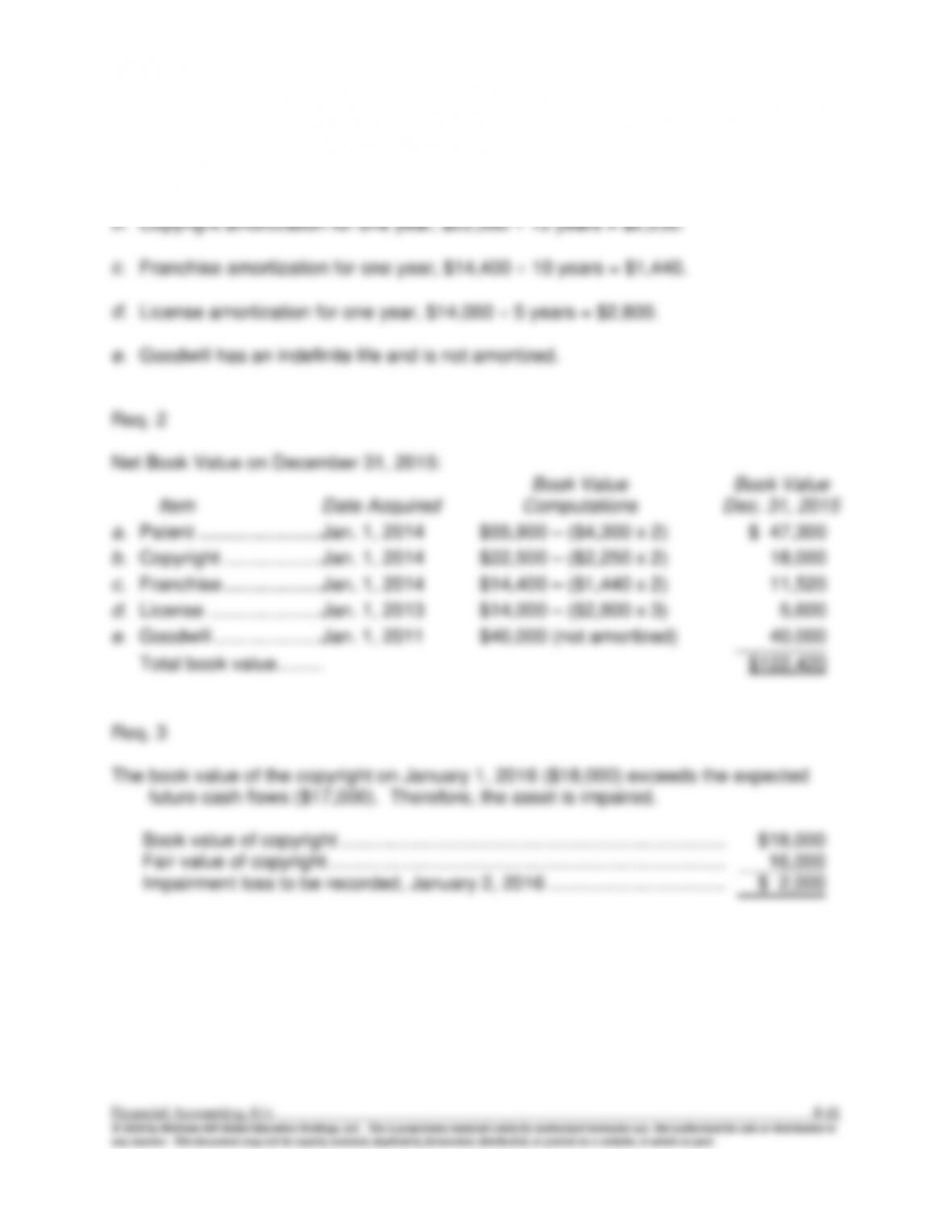
Req. 1
a.
Patent amortization for one year, $55,900 13 years = $4,300.
b.
Copyright amortization for one year, $22,500 10 years = $2,250.
c.
Franchise amortization for one year, $14,400 10 years = $1,440.
d.
License amortization for one year, $14,000 5 years = $2,800.
e.
Goodwill has an indefinite life and is not amortized.
Chapter 08 – Reporting and Interpreting Property, Plant, and Equipment; Intangibles; and Natural Resources
ALTERNATE PROBLEMS
AP8–1.
Req. 1
Long-lived assets are tangible and intangible resources owned by a business and used
in its operations over several years. Tangible assets (such as property, plant, and
equipment or natural resources) are assets that have physical substance. Intangible
Chapter 08 – Reporting and Interpreting Property, Plant, and Equipment; Intangibles; and Natural Resources
AP8–2.
Req. 1
Building
Accum.
Deprec.
Deprec.
Expense
Repairs
Expense
Cash
Balance 1/1/2015
$330,000
$82,500
Depreciation
for 2015
16,500
(1)$16,500
NE
Balance prior to
expenditures
330,000
99,000
16,500
a.
NE
NE
NE
+$6,000
−$6,000
b.
+ 17,000
NE
NE
NE
−17,000
c.
+ 70,000
NE
NE
NE
−70,000
Balance 12/31/2015
$417,000
$99,000
$16,500
$6,000
(1) $330,000 cost 20 years = $16,500 per year
Req. 2
Book Value of Building on Dec. 31, 2015:
Building ($330,000 + $17,000 + $70,000) ………………………..
$417,000
Less: Accumulated depreciation ($82,500 + $16,500) ……….
99,000
Net book (carrying) value ……………………………………………
$318,000
Req. 3
Depreciation is a noncash expense. Unlike most expenses, no cash payment is made
when the expense is recognized. The cash outflow occurred when the related asset
was acquired. For companies selecting the indirect method of preparing a statement of
cash flows (reconciling net income on the accrual basis to cash from operations),
depreciation expense is added back to net income because the expense reduces net
Chapter 08 – Reporting and Interpreting Property, Plant, and Equipment; Intangibles; and Natural Resources
AP8–4.
Req. 1
Depreciation expense of $634 million recorded in the current year is inferred from the
activities affecting the Accumulated Depreciation account:
Accumulated Depreciation (in millions)
Impairments 0
5,010 Beg. bal.
Asset sales 384
634 Deprec. Exp.
5,260 End. bal.
opposite effects.
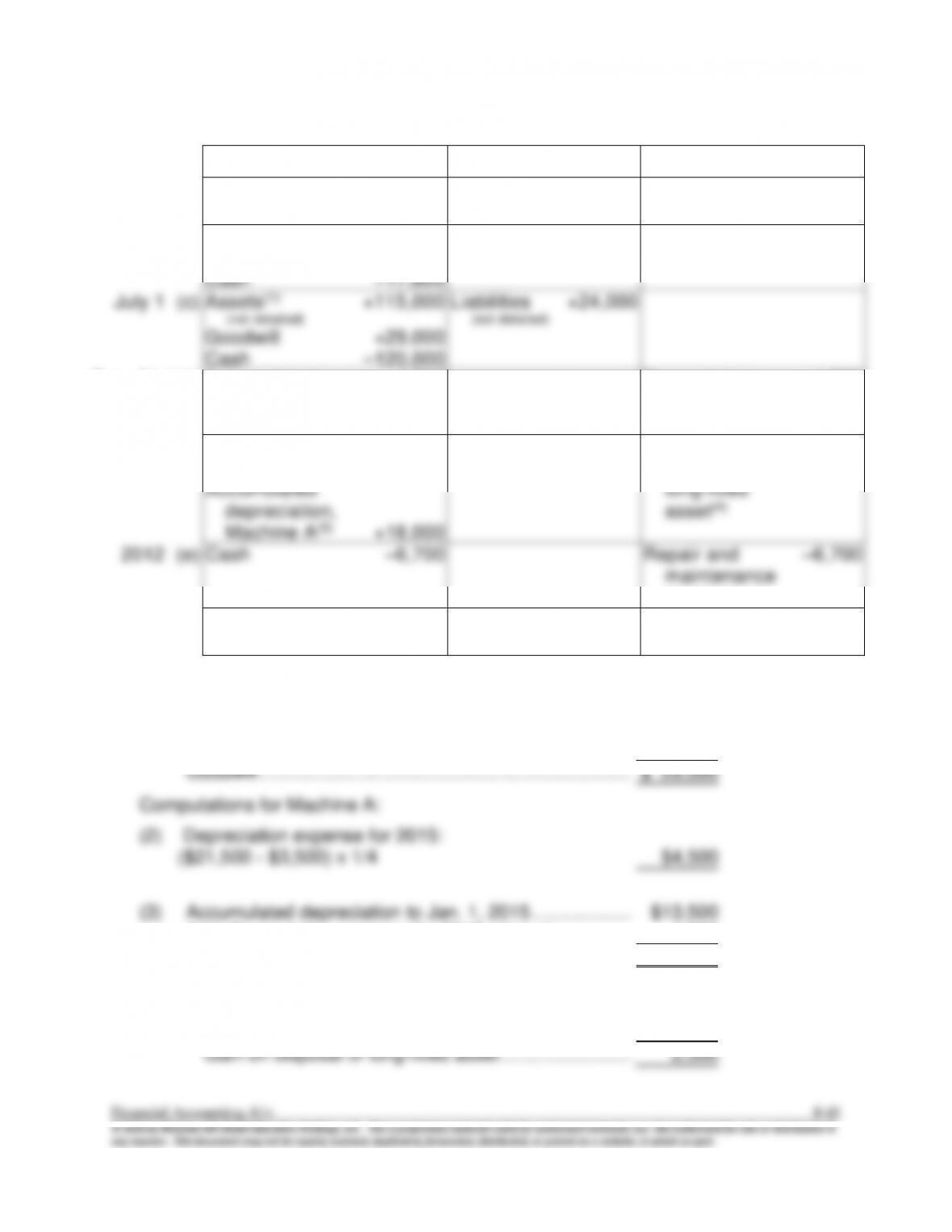
Assets
Liabilities
Stockholders’
Equity
Revenues
Expenses
Net Income
Overstated
NE
Overstated
NE
Understated
Overstated
Ratio
Computation
Effect on Ratio of Failing to
Record Depreciation Expense
Earnings per
share
Net income
Number of shares of stock
outstanding
Net income will be overstated
with no change in the
denominator → Overstated
Fixed asset
turnover
Sales
Average net fixed asset balance
Numerator does not change;
however, the denominator is
overstated → Understated
Current
ratio
Current assets
Current liabilities
Neither the numerator nor the
denominator are affected by
depreciation expense, since
accumulated depreciation affects
only long-lived assets on the
balance sheet → No effect
Return on
assets
Net income
Average total assets
Net income is overstated and so
is average total assets, although
at a lower amount due to
averaging → Overstated
Chapter 08 – Reporting and Interpreting Property, Plant, and Equipment; Intangibles; and Natural Resources
AP8–6.
Req. 1
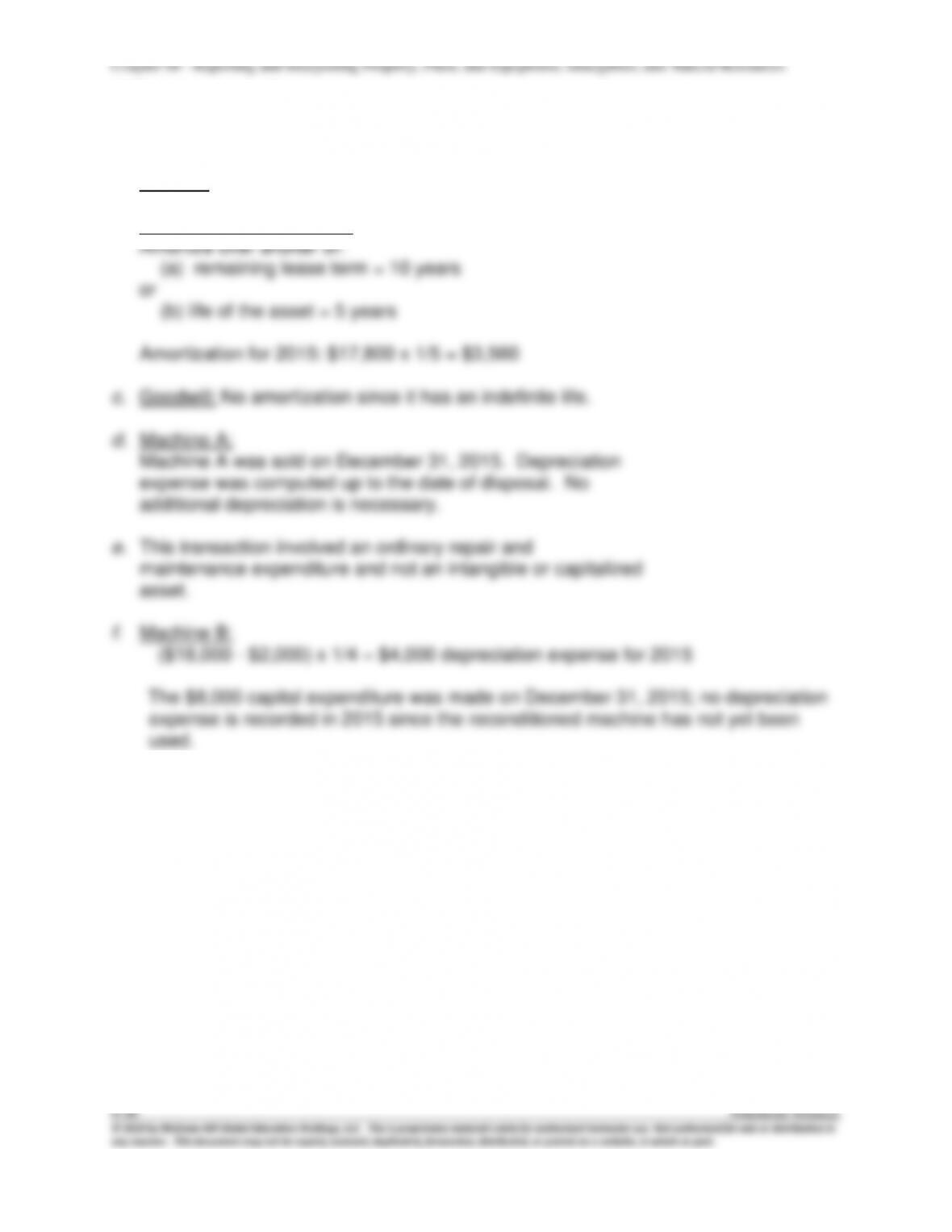
Assets
Liabilities
Stockholders’ Equity
Jan. 1 (a)
License
Cash
+7,200
–7,200
Jan. 1 (b)
Leasehold
improvements
Cash
+17,800
–17,800
July 1 (c)
Assets(1)
(not detailed)
Goodwill
Cash
+115,000
+29,000
–120,000
Liabilities
(not detailed)
+24,000
Dec. 31 (d1)
Accumulated
depreciation,
Machine A(2)
–4,500
Depreciation
expense
–4,500
Dec. 31 (d2)
Cash
Equipment
Accumulated
depreciation,
Machine A(3)
+6,000
–21,500
+18,000
Gain on
disposal of
long–lived
asset(4)
+2,500
2012 (e)
Cash
–6,700
Repair and
maintenance
expense
–6,700
Dec. 31 (f)
Cash
Equipment
–8,000
+8,000
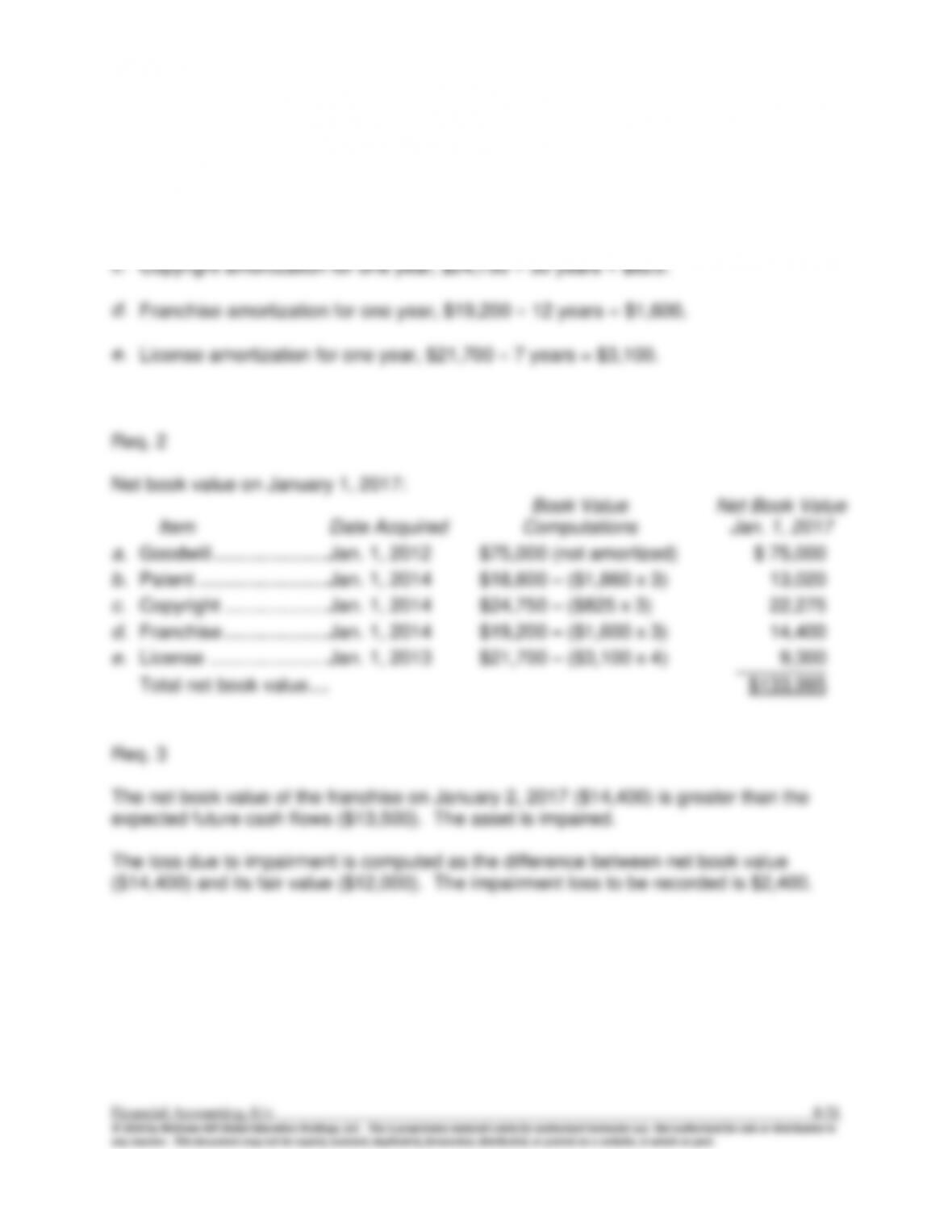
Computations for Acquisition:
(1)
Purchase price …………………………………………………….
$120,000
Less: Market value of net assets ($115,000 – $24,000)
91,000
Goodwill ……………………………………………………………..
$ 29,000
Computations for Machine A:
(2)
Depreciation expense for 2015:
($21,500 – $3,500) x 1/4
$4,500
(3)
Accumulated depreciation to Jan. 1, 2015 ……………….
$13,500
Add: Depreciation expense for 2015 (above) ……………
4,500
Total accumulated depreciation ………………………….
$18,000
(4)
Cash proceeds from disposition ……………………………..
$6,000
Net book value of Machine A ($21,500 – $18,000) …….
3,500
Gain on disposal of long-lived asset …………………….
2,500
Chapter 08 – Reporting and Interpreting Property, Plant, and Equipment; Intangibles; and Natural Resources
AP8–7.
Req. 1
a.
Goodwill is not amortized since it has an indefinite life.
b.
Patent amortization for one year, $18,600 10 years = $1,860.
c.
Copyright amortization for one year, $24,750 30 years = $825.
d.
Franchise amortization for one year, $19,200 12 years = $1,600.
e.
License amortization for one year, $21,700 7 years = $3,100.
Chapter 08 – Reporting and Interpreting Property, Plant, and Equipment; Intangibles; and Natural Resources
COMPREHENSIVE PROBLEM (Chapters 6, 7, and 8)
COMP8-1.
Case A
Accounts
Receivable
–
Allowance for
Uncollectible Accounts
Net
= Realizable
Value
Beg. 541
5 Beg.
536
Sales 5,903
5,850 Collections
4 Bad debt
6 Write-offs
Write-offs 6
expense
End. 588
3 End.
585
1 Beg. allowance $5 + Bad debt expense $4 – Write-offs ? = End. Allowance $3
Write-offs = $6
2 Beg. accounts receivable $541 + Sales $5,903 – Write-offs $6 – Collections ? =
End. accounts receivable $588
Collections = $5,850
Req. 3
Net Income
÷
Net Sales
= Net Profit Margin
2011
$606
$5,903
.1027 or 10.27%
2010
528
5,636
.0937 or 9.37%
2009
555
5,531
.1003 or 10.03%
The company’s net profit margin fell in 2010, but increased in 2011, while sales
increased each year. This suggests that, although Dr Pepper Snapple’s
management has generated increasing sales revenue over time, it was less effective
at controlling costs and expenses in 2010, but was more effective in 2011.
Chapter 08 – Reporting and Interpreting Property, Plant, and Equipment; Intangibles; and Natural Resources
Financial Accounting, 8/e 8-53
COMP8-1. (continued)
Case B
Req. 1
The company should record bad debt expense of $13,900 for 2014.
Req. 2
Accounts Receivable
–
Allowance for Uncollectible
Accounts
Net
= Realizable Value
1,500
Unadj. bal.
Bad debt
13,900 expense
End. 620,000
12,400 End.
607,600
Unadj. allowance bal. $(1,500) + Bad debt expense ? = End. bal. $12,400
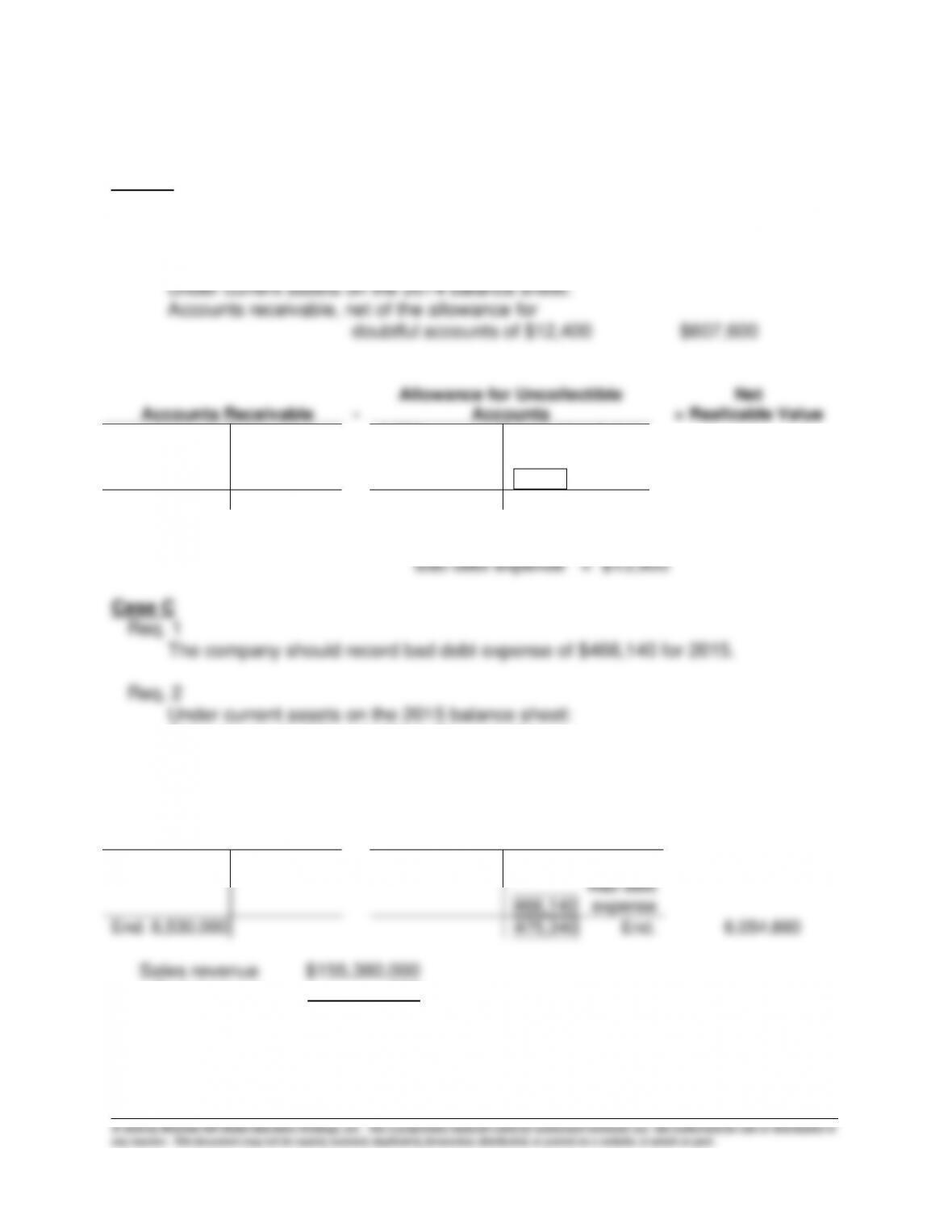
Accounts receivable, net of the allowance for
doubtful accounts of $475,340 $6,054,660
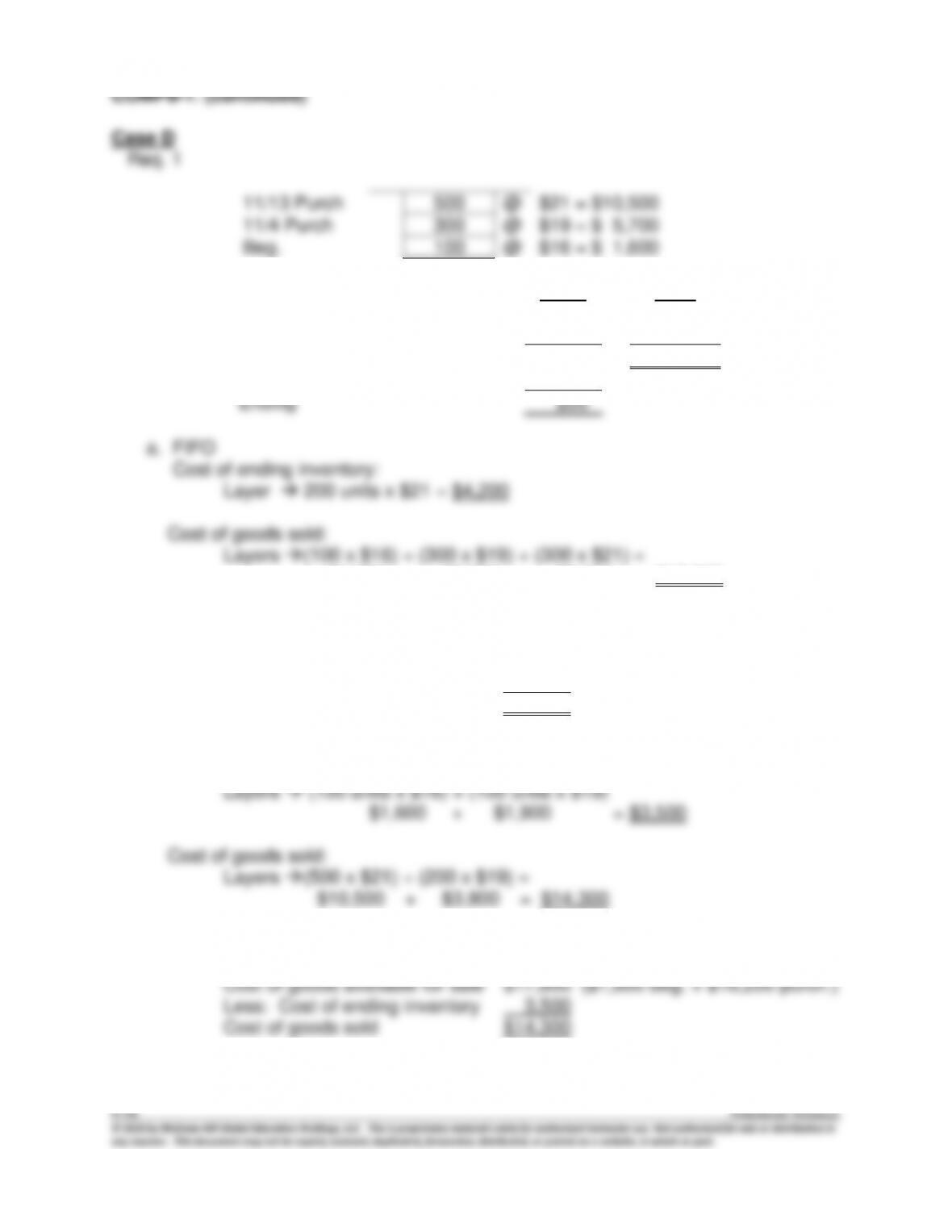
Accounts Receivable
–
Allowance for Uncollectible
Accounts
Net
= Realizable Value
9,200 Unadj. bal.
Bad debt
466,140 expense
End. 6,530,000
475,340 End.
6,054,660
Sales revenue $155,380,000
x Bad debt rate x .003
Bad debt expense $ 466,140
Unadj. allowance bal. $9,200 + Bad debt expense $466,140 = End. bal. $475,340
Chapter 08 – Reporting and Interpreting Property, Plant, and Equipment; Intangibles; and Natural Resources
8-54 Solutions Manual
© 2014 by McGraw-Hill Global Education Holdings, LLC. This is proprietary material solely for authorized instructor use. Not authorized for sale or distribution in
any manner. This document may not be copied, scanned, duplicated, forwarded, distributed, or posted on a website, in whole or part.
COMP8-1. (continued)
Case D
Req. 1
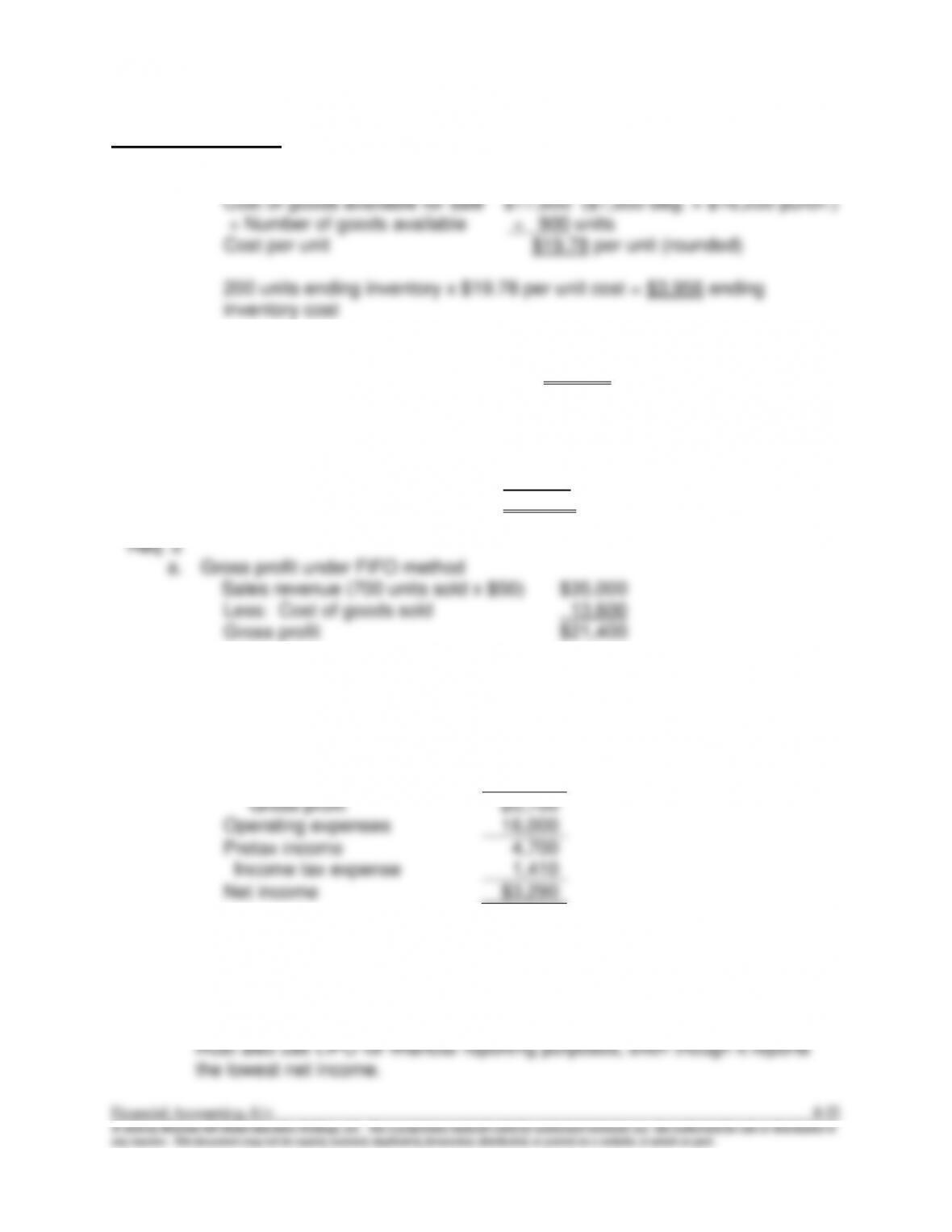
11/13 Purch
500
@
$21 = $10,500
11/4 Purch
300
@
$19 = $ 5,700
Beg.
100
@
$16 = $ 1,600
Units
Cost
Beginning
100
$ 1,600
Purchases
800
16,200
Available for sale
900
$17,800
Less: Sales
(700)
Ending
200
$1,600 + $5,700 + $6,300 = $13,600
OR
Cost of goods available for sale $17,800 ($1,600 beg. + $16,200 purch.)
Less: Cost of ending inventory 4,200
Cost of goods sold $13,600
b. LIFO
Cost of ending inventory:
OR
Chapter 08 – Reporting and Interpreting Property, Plant, and Equipment; Intangibles; and Natural Resources
COMP8-1. (continued)
Case D (continued)
c. Weighted average
Cost of ending inventory:
Cost of goods sold:
700 units sold x $19.78 per unit cost = $13,846 cost of goods sold
OR
Cost of goods available for sale $17,800 ($1,600 beg. + $16,200 purch.)
Less: Cost of ending inventory 3,956
Cost of goods sold $13,844 (difference due to rounding)
Gross profit percentage:
$21,400 gross profit / $35,000 sales revenue = .6114 or 61.14%
b. Net income under LIFO method
Sales revenue
$35,000
Less: Cost of goods sold
14,300
Gross profit
20,700
Operating expenses
16,000
Pretax income
4,700
Income tax expense
1,410
Net income
$3,290
c. The LIFO method should be recommended to Stewart for tax and financial
reporting purposes. Prices of inventory are rising. When prices rise, LIFO
yields the highest cost of goods sold, lowest net income, and, for tax
purposes, the lowest tax amount. When a company chooses LIFO to save
taxes (reduce cash outflows), the LIFO Conformity Rule indicates a company