Chapter 08 – Reporting and Interpreting Property, Plant, and Equipment; Intangibles; and Natural Resources
Chapter 8
Reporting and Interpreting
Property, Plant, and Equipment;
Intangibles; and Natural Resources
ANSWERS TO QUESTIONS
1. Long-lived assets are noncurrent assets, which a business retains beyond one
year, not for sale, but for use in the course of normal operations. Long-lived assets
2. The fixed asset turnover ratio =
Net sales
3. Long-lived assets are classified as follows:
(1) Tangible long-lived assets—assets that are tangible (i.e., have physical
substance) and long-lived (i.e., beyond one year); they are acquired for use in
Chapter 08 – Reporting and Interpreting Property, Plant, and Equipment; Intangibles; and Natural Resources
8. To compute depreciation, the three values that must be known or estimated are:
Cost—the actual total expenditures incurred in acquiring the asset in conformity
with the cost principle.
9. The estimated useful life and estimated residual value of a long-lived asset when
used for depreciation purposes relate to the current owner-user and not to all
10. a. The straight-line method of depreciation causes an equal amount of
depreciation expense to be apportioned to, or matched with, the revenues of
each period. It is especially appropriate for tangible long-lived assets that are
used at an approximately uniform level from period to period.
Chapter 08 – Reporting and Interpreting Property, Plant, and Equipment; Intangibles; and Natural Resources
Financial Accounting, 8/e 8-5
ANSWERS TO MULTIPLE CHOICE
10. e
Chapter 08 – Reporting and Interpreting Property, Plant, and Equipment; Intangibles; and Natural Resources
Authors’ Recommended Solution Time
(Time in minutes)
Mini-exercises
Exercises
Problems
Alternate
Problems
Comprehensive
Problem
Cases and
Projects
No.
Time
No.
Time
No.
Time
No.
Time
No.
Time
No.
Time
1
5
1
10
1
20
1
20
1
60
1
20
2
5
2
15
2
30
2
30
2
20
3
3
3
15
3
25
3
25
3
20
4
4
4
20
4
20
4
20
4
15
5
5
5
15
5
25
5
20
5
10
6
4
6
15
6
20
6
30
6
15
7
4
7
20
7
20
7
25
7
15
8
5
8
20
8
30
8
15
9
5
9
10
9
15
9
15
10
5
10
10
10
25
10
*
11
20
11
20
12
20
13
15
Continuing Case
14
15
1
25
15
10
16
15
17
20
18
20
19
15
20
15
21
15
22
20
23
15
* Due to the nature of this project, it is very difficult to estimate the amount of time
students will need to complete the assignment. As with any open-ended project, it is
possible for students to devote a large amount of time to these assignments. While
students often benefit from the extra effort, we find that some become frustrated by the
perceived difficulty of the task. You can reduce student frustration and anxiety by
Chapter 08 – Reporting and Interpreting Property, Plant, and Equipment; Intangibles; and Natural Resources
Financial Accounting, 8/e 8-7
MINI-EXERCISES
M8–1.
Asset
Nature
Cost
Allocation Concept
(1)
Tractors
E
DR
(2)
Land in use
L
NO
(3)
Timber tract
NR
DP
(4)
Warehouse
B
DR
(5)
New engine for old machine
E
DR
(6)
Operating license
I
A
(7)
Production plant
B
DR
(8)
Trademark
I
A
(9)
Silver mine
NR
DP
(10)
Land held for sale
O (investment)
NO
M8–2.
Young’s fixed asset turnover ratio is
= Net sales
M8–3.
(1) C
(2) E
(3) N
(4) C
(5) N
(6) E
(7) E
(8) C
(9) C
Chapter 08 – Reporting and Interpreting Property, Plant, and Equipment; Intangibles; and Natural Resources
M8–4.
Machinery (original cost) $31,000
Accumulated depreciation at end of third year
M8–5.
Machinery (original cost) $55,000
Accumulated depreciation at end of first year:
Depreciation expense = ($55,000 – $0 acc. depr.) x 2 / 5 = $22,000 22,000
Net book value at end of first year $33,000
M8–6.
Machinery (original cost) $26,000
Accumulated depreciation at end of third year
Depreciation expense per machine hour
Chapter 08 – Reporting and Interpreting Property, Plant, and Equipment; Intangibles; and Natural Resources
M8–7.
Impairment
Loss
Cost – Fair Value
a. Machine
Y
$6,000
$15,500 -$ 9,500
b. Copyright
N
—
Estimated cash flows
exceed book value
c. Factory building
Y
$31,000
$58,000 – $27,000
d. Building
N
—
Estimated cash flows
equal book value
M8–8.
Store fixtures (original cost) $6,500
Accumulated depreciation at end of tenth year
Depreciation expense =
M8–9.
Elizabeth Pie Company’s management may choose to accept the offer of $5,000,000 as
this amount is more than the $4,800,000 market value of separately identifiable assets
and liabilities ($4,500,000 market value of recorded assets and liabilities and $300,000
Chapter 08 – Reporting and Interpreting Property, Plant, and Equipment; Intangibles; and Natural Resources
EXERCISES
E8–1.
Hasbro, Inc.
Excerpts from Balance Sheet
(in millions)
ASSETS
Current Assets
Cash and cash equivalents
$ 642
Accounts receivable (net of allowance for doubtful accounts, $24)
1,035
Inventories
334
Prepaid expenses and other current assets
243
Total current assets
2,254
Property, Plant, and Equipment
Machinery and equipment
462
Buildings and improvements
202
Land and improvements
7
Property, plant, and equipment (at cost)
671
Less: Accumulated depreciation
453
Total property, plant, and equipment (net)
218
Other Assets
Goodwill
475
Other intangibles (net of accumulated amortization, $622)
467
Other noncurrent assets
717
Total other assets
1,659
Total Assets
$4,131
Chapter 08 – Reporting and Interpreting Property, Plant, and Equipment; Intangibles; and Natural Resources
E8–3
Req. 1
Building (+A) ……………………………………………………….
106,000
Land (+A) …………………………………………………………………..
113,000
Cash (−A) ……………………………………………………….
219,000
Building
Land
Cash paid
$82,000
$107,000
+ renovations to prepare for use
3,000
+ share of transfer costs
21,000
6,000
$106,000
$113,000
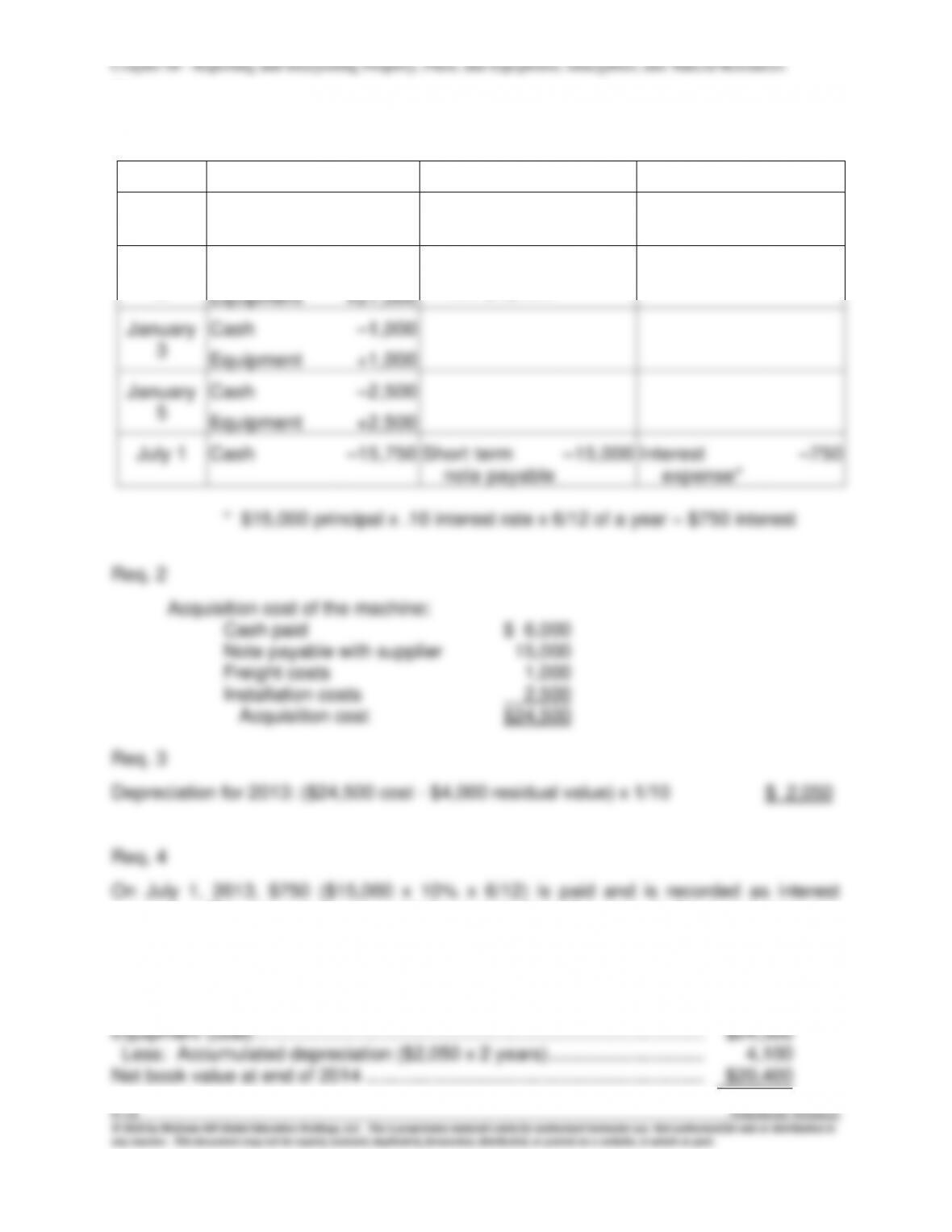
Req. 2
Straight-line depreciation computation:
($106,000 cost – $15,000 residual value) x 1/10 = $9,100 depreciation expense per year
Note: Land is not depreciated.
Req. 3
Computation of the book value of the property at the end of year 2:
Building
$106,000
Less: Accumulated depreciation ($9,100 x 2 years)
(18,200)
$ 87,800
Land
113,000
Net book value
$200,800
Chapter 08 – Reporting and Interpreting Property, Plant, and Equipment; Intangibles; and Natural Resources
E8–5.
Req. 1
Adjusting entry for 2013:
Depreciation expense (+E, −SE) …………………………………
7,200
Accumulated depreciation, equipment (+XA, −A) ……..
7,200
($120,000 – $12,000) x 1/15 = $7,200
Req. 2 ( beginning of 2014)
Estimated life 15 years
Less: Used life –
$57,600 accumulated depreciation $7,200 annual expense = 8 years
Remaining life 7 years
1,000
1,000
(Ordinary repairs incurred.)
Equipment (+A) …………………………..…………………………...
Cash (−A)……………………………………………………………
Improvements incurred and capitalized.
Chapter 08 – Reporting and Interpreting Property, Plant, and Equipment; Intangibles; and Natural Resources
E8–8.
Req. 1
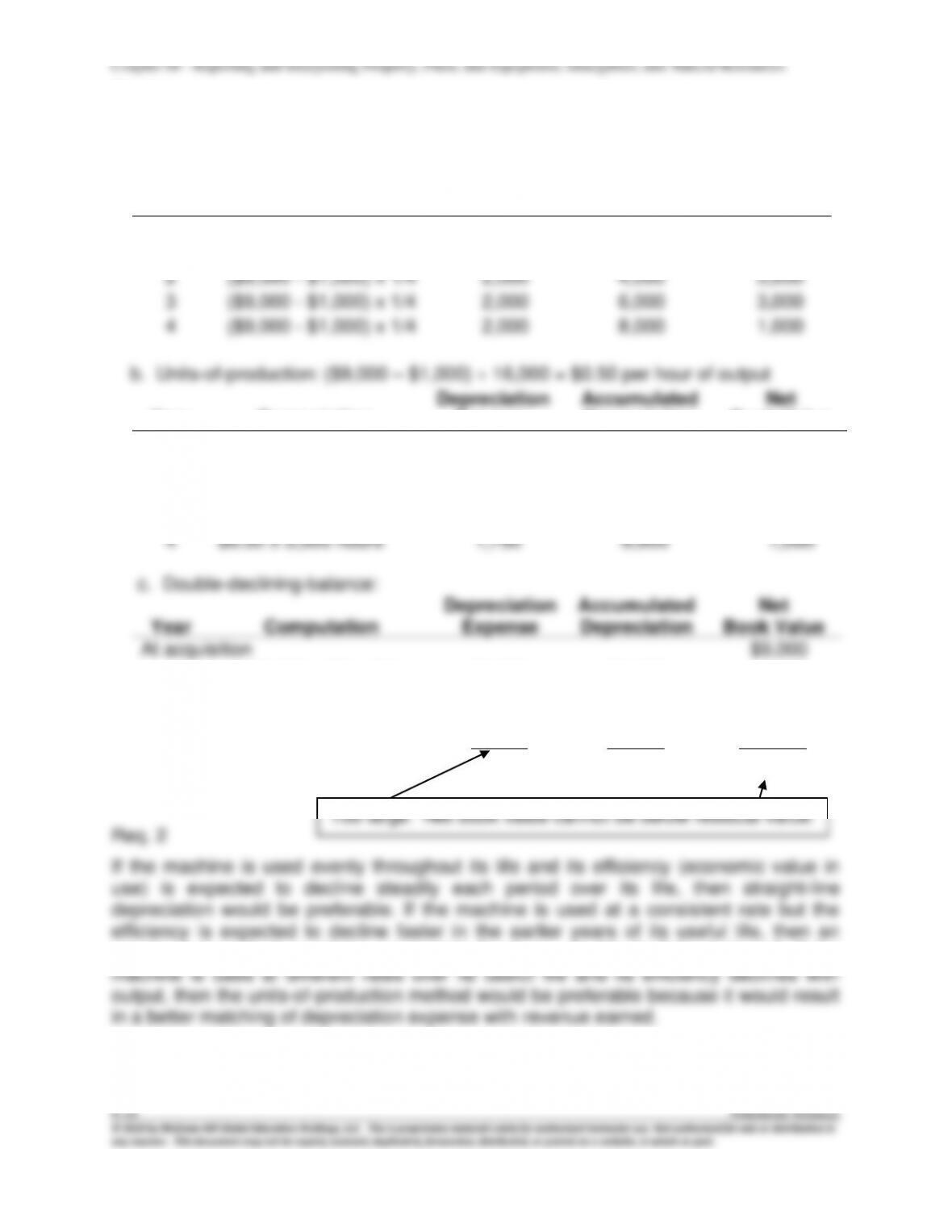
a. Straight-line:
Year
Computation
Depreciation
Expense
Accumulated
Depreciation
Net
Book Value
At acquisition
$950,000
1
($950,000 – $50,000) x 1/5
$180,000
$180,000
770,000
2
($950,000 – $50,000) x 1/5
180,000
360,000
590,000
3
($950,000 – $50,000) x 1/5
180,000
540,000
410,000
4
($950,000 – $50,000) x 1/5
180,000
720,000
230,000
5
($950,000 – $50,000) x 1/5
180,000
900,000
50,000
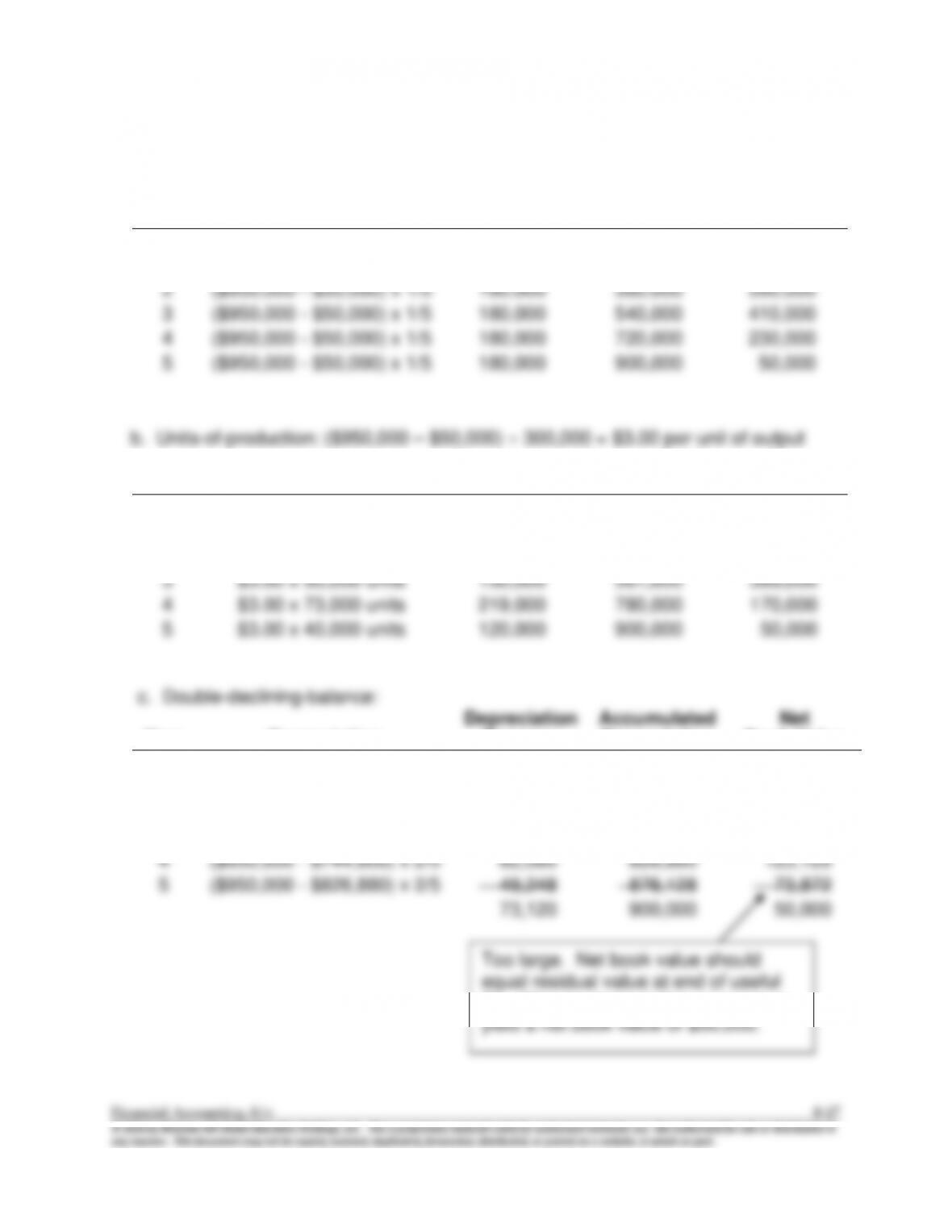
b. Units-of-production: ($950,000 – $50,000) 300,000 = $3.00 per unit of output
Year
Computation
Depreciation
Expense
Accumulated
Depreciation
Net
Book Value
At acquisition
$950,000
1
$3.00 x 70,000 units
$210,000
$210,000
740,000
2
$3.00 x 67,000 units
201,000
411,000
539,000
3
$3.00 x 50,000 units
150,000
561,000
389,000
4
$3.00 x 73,000 units
219,000
780,000
170,000
5
$3.00 x 40,000 units
120,000
900,000
50,000
c. Double-declining-balance:
Year
Computation
Depreciation
Expense
Accumulated
Depreciation
Net
Book Value
At acquisition
$950,000
1
($950,000 – 0) x 2/5
$380,000
$380,000
570,000
2
($950,000 – $380,000) x 2/5
228,000
608,000
342,000
3
($950,000 – $608,000) x 2/5
136,800
744,800
205,200
4
($950,000 – $744,800) x 2/5
82,080
826,880
123,120
5
($950,000 – $826,880) x 2/5
49,248
876,128
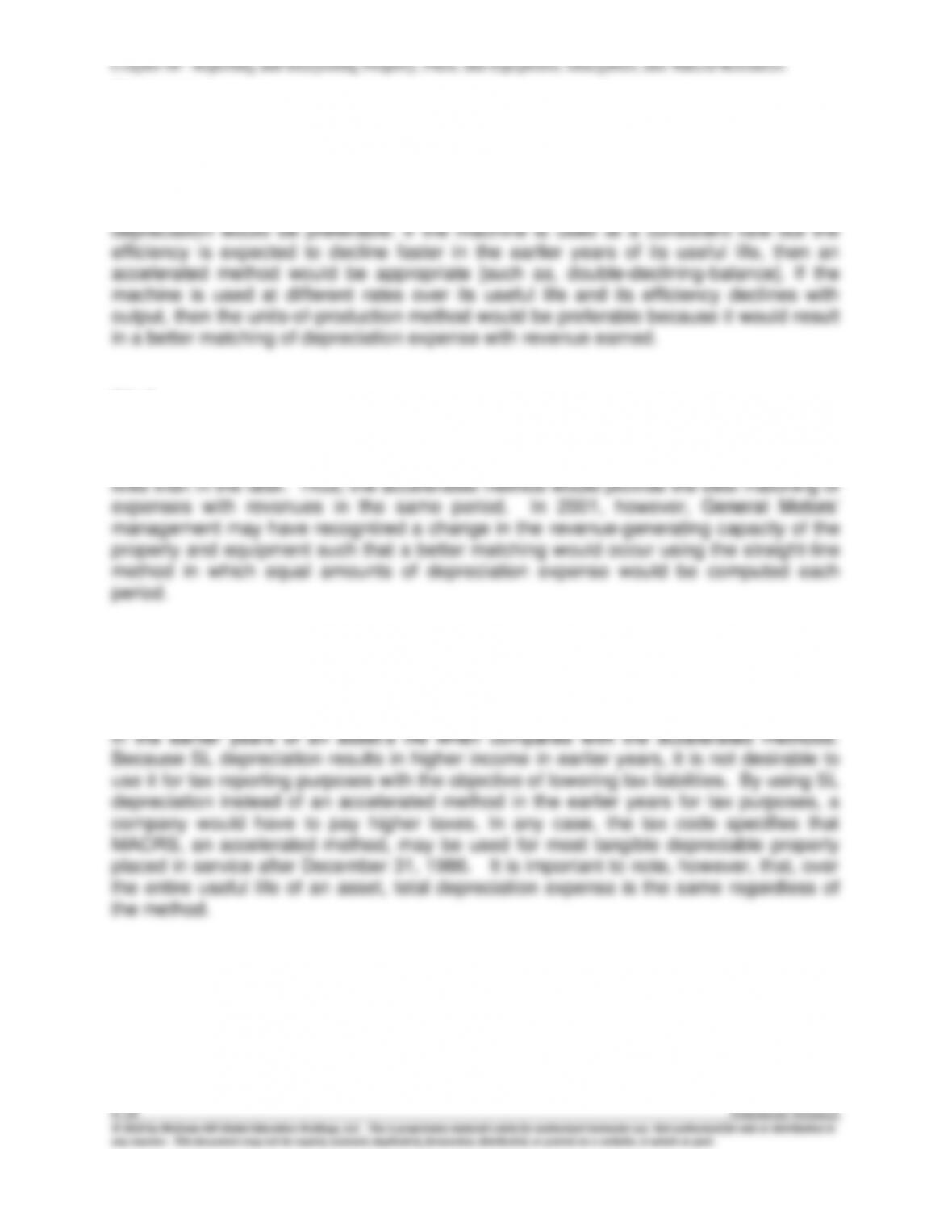
73,872
73,120
900,000
50,000
Too large. Net book value should
equal residual value at end of useful
life. Change depreciation expense to
yield a net book value of $50,000.
Chapter 08 – Reporting and Interpreting Property, Plant, and Equipment; Intangibles; and Natural Resources
E8–11.
Req. 1
Depreciation Expense
Book Value at End of
Method of Depreciation
Year 1
Year 2
Year 1
Year 2
Straight-line ……………………..
$22,500
$22,500
$73,500
$51,000
Units-of-production ……………
32,250
33,750
63,750
30,000
Double-declining-balance …..
48,000
24,000
48,000
24,000
Year 1:
43,000 x $.75
=
$32,250
Year 2:
45,000 x $.75
=
$33,750
Double-declining-balance (Rate: 2 x the straight line rate of 25% (2/4) = 50%):
Year 1:
$96,000 x 50% = $48,000
Year 2:
($96,000 – $48,000) x 50% = $24,000
Req. 2
The double-declining-balance method would result in the lowest EPS for Year 1
recognized. Ignoring income tax implications, all methods have the same impact on
cash flows in year 1. Assuming a method is applied for tax determination, the straight-
line method will result in the lowest expense, highest net income, highest tax liability,
and therefore the highest amount of cash outflows in year 1. Companies will select
methods for tax purposes that reduce tax obligations.
Req. 4