Chapter 08 – Reporting and Interpreting Property, Plant, and Equipment; Intangibles; and Natural Resources
8-1
CHAPTER 8
REPORTING AND INTERPRETING PROPERTY, PLANT, AND
EQUIPMENT; INTANGIBLES; AND NATURAL RESOURCES
Learning Objectives and Related Assignment Materials
Learning Objectives
Mini-
Exercises
Exercises
Problems
Alternate
Problems
Cases and
Projects
1. Define, classify, and explain the nature
of long-lived productive assets and
interpret the fixed asset turnover ratio.
1, 2
1, 2, 20
1, 4, 5
1, 4
1, 2, 3, 5,
6, 8, 9,
10
2. Apply the cost principle to measure
the acquisition and maintenance of
property, plant, and equipment.
3
3, 4, 5, 6,
20, 22
1, 2, 3, 8
1, 2, 3, 6
1, 2, 7, 8,
9, 10
3. Apply various cost allocation methods
as assets are held and used over time.
1, 4, 5, 6
3, 4, 5, 6,
7, 8, 9,
10, 11,
15, 20,
21, 22,
23
2, 3, 4, 5,
6, 8, 9,
10, 11
2, 3, 4, 5,
6, 7
3, 4, 10
4. Explain the effect of asset impairment
on the financial statements.
7
12, 20
10
7
1, 10
5. Analyze the disposal of property,
plant, and equipment.
8
12, 13,
14, 15,
20
6, 7
5
6
6. Apply measurement and reporting
concepts for intangible assets and
natural resources.
1, 9
16, 17,
18, 19,
20
8, 9, 10
6, 7
1, 2, 5,
10
7. Explain how the acquisition, use, and
disposal or long-lived assets impact
cash flows.
10
11, 20,
23
7
5, 6, 9,
10
Chapter Supplement A: Changes in
depreciation estimates
21, 23
11
Synopsis of Chapter Revisions
Focus Company: Southwest Airlines
▪ Focus and contrast company data updated.
▪ New GUIDED HELP feature provides free access to step-by-step video instruction on the three cost
allocation methods—straight-line method, units-of-production method, and double-declining balance
method.
▪ New International Perspective box on component allocation, replacing the International Perspective
box on measurement basis for property, plant, and equipment in the previous edition.
▪ Coverage of intangible assets moved to precede the discussion of natural resources.
Chapter 08 – Reporting and Interpreting Property, Plant, and Equipment; Intangibles; and Natural Resources
Synopsis of Chapter Revisions, continued
▪ New International Perspective box on the differences in accounting for tangible and intangible assets,
replacing the International Perspective box on standards in process in the previous edition.
▪ New CONTINUING CASE added to the end-of-chapter problems. Students are asked to record the
acquisition, depreciation, and disposal of equipment for Pool Corporation, a public company.
▪ Two demonstration cases: One on accounting for and reporting of property, plant, equipment, and
intangible assets; and one on accounting for natural resources.
▪ New and updated real companies, as well as modified accounts, names, and amounts for fictional
companies in end-of-chapter exercises, problems, and cases.
PowerPoint Slides
Learning Objectives
PowerPoint® Slides
1. Define, classify, and explain the nature of long-lived productive assets and
interpret the fixed asset turnover ratio.
8-1 through 8-4
2. Apply the cost principle to measure the acquisition and maintenance of
property, plant, and equipment.
8-5 through 8-12
3. Apply various cost allocation methods as assets are held and used over
time.
8-13 through 8-26
4. Explain the effect of asset impairment on the financial statements.
8-27
5. Analyze the disposal of property, plant, and equipment.
8-28 through 8-34
6. Apply measurement and reporting concepts for intangible assets and natural
resources.
8-35 through 8-45
7. Explain how the acquisition, use, and disposal or long-lived assets impact
cash flows.
8-46
Chapter Supplement A: Changes in depreciation estimates
8-47 through 8-48
Related Video Program

Chapter 08 – Reporting and Interpreting Property, Plant, and Equipment; Intangibles; and Natural Resources
8-3
Chapter Take-Aways
1. Define, classify, and explain the nature of long-lived productive assets and interpret the fixed
asset turnover ratio.
a. Productive assets are those that a business retains for long periods of time for use in the course of
normal operations rather than for sale. They may be divided into tangible assets (land, buildings,
equipment, natural resources) and intangible assets (including goodwill, patents, and franchises).
b. The cost allocation method utilized affects the amount of net property, plant, and equipment that is
used in the computation of the fixed asset turnover ratio. Accelerated methods reduce book value
and increase the turnover ratio.
2. Apply the cost principle to measure the acquisition and maintenance of property, plant, and
equipment.
The acquisition cost of property, plant, and equipment is the cash-equivalent purchase price plus all
reasonable and necessary expenditures made to acquire and prepare the asset for its intended use.
These assets may be acquired using cash, debt, stock, or through self-construction. Expenditures
made after the asset is in use are either additions and improvements or ordinary repairs:
a. Ordinary repairs and maintenance provide benefits during the current accounting period only.
Amounts are debited to appropriate current expense accounts when the expenses are incurred.
b. Improvements provide benefits for one or more accounting periods beyond the current period.
Amounts are debited to the appropriate asset accounts (they are capitalized) and depreciated,
depleted, or amortized over their useful lives.
3. Apply various cost allocation methods as assets are held and used over time.
Cost allocation methods: In conformity with the expense matching principle, cost (less any
estimated residual value) is allocated to periodic expense over the periods benefited. Because of
depreciation, the net book value of an asset declines over time and net income is reduced by the
amount of the expense. Common depreciation methods include straight-line (a constant amount over
time), units-of-production (a variable amount over time), and double-declining-balance (a decreasing
amount over time).
a. Depreciation—buildings and equipment.
b. Depletion—natural resources.
c. Amortization— intangibles.
4. Explain the effect of asset impairment on the financial statements.
When events or changes in circumstances reduce the estimated future cash flows of long-lived assets
below their book value, the book values should be written down (by recording a loss) to the fair value
of the assets.
5. Analyze the disposal of property, plant, and equipment.
When assets are disposed of through sale or abandonment,
a. Record additional depreciation since the last adjustment was made.
b. Remove the cost of the old asset and its related accumulated depreciation, depletion, or
amortization.
c. Recognize the cash proceeds.
d. Recognize any gains or losses when the asset’s net book value is not equal to the cash received.

Chapter 08 – Reporting and Interpreting Property, Plant, and Equipment; Intangibles; and Natural Resources
8-4
6. Apply measurement and reporting concepts for intangible assets and natural resources.
The cost principle should be applied in recording the acquisition of intangible assets and natural
resources. Intangibles with definite useful lives are amortized using the straight-line method.
Intangibles with indefinite useful lives, including goodwill, are not amortized, but are reviewed at
least annually for impairment. Report intangibles at net book value on the balance sheet. Natural
resources should be depleted (usually by the units-of-production method) usually with the amount of
the depletion expense capitalized to an inventory account.
7. Explain how the acquisition, use, and disposal or long-lived assets impact cash flows.
Depreciation expense is a noncash expense that has no effect on cash. It is added back to net income
on the statement of cash flows to determine cash from operations. Acquiring and disposing of long-
lived assets are investing activities.
Key Ratio
The fixed asset turnover ratio measures how efficiently a company utilizes its investment in property,
plant, and equipment over time. Its ratio can be compared to competitors’ ratios. The fixed asset turnover
ratio is computed as follows:
Fixed Asset Turnover = Net Sales (or Operating Revenues) Average Net Fixed Assets
Finding Financial Information
Balance Sheet
Under Noncurrent Assets
Property, plant, and equipment (net of
accumulated depreciation)
Natural resources (net of accumulated
depletion)
Intangibles (net of accumulated
amortization, if any)
Income Statement
Under Operating Expenses
Depreciation, depletion, and amortization
expense or included in
Selling, general, and administrative
expenses and
Cost of goods sold (with amount of
depreciation expense disclosed in a
note)
Statement of Cash Flows
Under Operating Activities (indirect method)
Net income
+ Depreciation and amortization expense
− Gains on sales of assets
+ Losses on sales of assets
Under Investing Activities
+ Sales of assets for cash
− Purchases of assets for cash
Notes
Under Summary of Significant Accounting
Policies
Description of management’s choice for
depreciation and amortization methods,
including useful lives, and the amount of
annual depreciation expense, if not listed
on the income statement.
Under a Separate Footnote
If not specified on the balance sheet, a listing
of the major classifications of long-lived
assets at cost and the balance in
accumulated depreciation, depletion, and
amortization.
Chapter 08 – Reporting and Interpreting Property, Plant, and Equipment; Intangibles; and Natural Resources
8-5
Chapter Outline
Teaching Notes
LO 1 – Define, classify, and explain the nature of long-lived productive assets and interpret the fixed
asset turnover ratio.
I. Acquisition and Maintenance of Plant and Equipment
Show Video Program #10
A. Classifying Long-Lived Assets
Illustrated in Exhibit 8.1
1. Long-lived assets – Tangible and intangible resources
owned by a business and used in its operations over
several years
2. Tangible assets – Long-lived assets with physical
substance
a. Land used in operations
b. Buildings, fixtures, and equipment used in operations
c. Natural resources used in operations
3. Intangible assets – long-lived assets without physical
substance that confer specific rights on their owner
B. Key Ratio Analysis: Fixed Asset Turnover Ratio
1. Fixed Asset Turnover Ratio = Net Sales (or Operating
Revenues) ÷ Average Net Fixed Assets
2. Average Net Fixed Assets = [Beginning + Ending Fixed
Asset balance (net of accumulated depreciation) ÷ 2
3. Ratio measures the sales dollars generated by each dollar
of fixed assets used
4. A high rate normally suggests effective management; an
increasing rate signals more efficient fixed asset use
5. A lower or declining fixed asset turnover rate may
indicate that a company is expanding (by acquiring
additional productive assets) in anticipation of higher
future sales.
6. An increasing ratio could also signal that a firm has cut
back on capital expenditures due to a downturn in
business.
LO 2 – Apply the cost principle to measure the acquisition and maintenance of property, plant, and
equipment.
C. Measuring and Recording Acquisition Cost
1. Cost principle requires that all reasonable and necessary
expenditures made in acquiring and preparing an asset for
use should be recorded as the cost of the asset
a. Expenditures are capitalized when they are recorded
as part of the cost of an asset instead of as expenses in
the current period
i. Any sales taxes, legal fees, transportation costs,
and installation costs are then added to the
purchase price of the asset
ii. Special discounts are subtracted
iii. Any interest charges associated with purchase are
expensed as incurred

Chapter 08 – Reporting and Interpreting Property, Plant, and Equipment; Intangibles; and Natural Resources
8-6
iv. All of the incidental costs of the purchase of land
(e.g., title fees, sales commissions, legal fees, title
insurance, delinquent taxes, and surveying fees) are
included in its cost
v. Renovation and repair costs incurred by the
company prior to asset’s use are included in cost
b. When purchasing land, building, and equipment as a
group, the total cost is allocated to each asset in
proportion to the asset’s market value relative to the
total market value of the assets as a whole
2. For Cash
Assume that Southwest paid $75 million cash for an
aircraft with a net cash invoice price of $74 million and
$1 million of related transportation and preparation costs
dr Flight Equipment (+A)
75 mill
cr Cash (–A)
75 mill
Assets = Liabilities + Stockholders’ Equity
Flight Equipment (A) + 75 mill + Cash (A) – 75 mill = 0
3. For Debt
Assume instead that Southwest signed a note payable in
the amount of $74 million and paid cash for the $1
million of transportation and preparation costs
dr Flight Equipment (+A)
75 mill
cr Cash (–A)
1 mill
cr Note Payable (+L)
74 mill
Assets = Liabilities + Stockholders’ Equity
Flight Equipment (A) + 75 mill + Cash (A) – 1 mill =
Note Payable (L) + 74 mill
4. For Equity (or Other Noncash Considerations)
a. Cash equivalent cost = fair value of the asset given or
received
b. Assume that Southwest gave Boeing 1 million shares
of its $1 par value common stock with a market value
of $50 per share and paid $ 25 million in cash for
flight equipment
dr Flight Equipment (+A)
75 mill
cr Common Stock (+SE)
(1 mill shares x $1 par
value)
1 mill
cr Additional Paid-in Capital
(+SE) (1 mill shares x $49
excess)
49 mill
cr Cash (–A)
25 mill
Assets = Liabilities + Stockholders’ Equity
Flight Equipment (A) + 76 mill + Cash (A) – 25 mill
= Common Stock (SE) + 1 mill + Additional Paid-in
Capital (SE) + 49 mill

Chapter 08 – Reporting and Interpreting Property, Plant, and Equipment; Intangibles; and Natural Resources
8-7
5. By Construction
a. Cost includes all the necessary costs associated with
construction, such as labor, materials, and in most
situations, capitalized interest
i. Capitalized interest – a portion of the interest
incurred during the construction period
ii. Amount of interest expense capitalized is recorded
by debiting the asset and crediting cash when the
interest is paid
Computation of amount of
interest is covered in other
accounting courses.
b. Southwest constructed a new hangar, paying $600,000
in labor costs and $1,300,000 in supplies and
materials; Southwest also paid $100,000 in interest
expense during the year related to the construction
project
dr Building (+A)
2 mill
cr Cash (–A)
2 mill
Assets = Liabilities + Stockholders’ Equity
Flight Equipment (A) + 2 mill + Cash (A) – 2 mill = 0
Refer students to Pause for
Feedback – Self-Study Quiz
D. Repairs, Maintenance, and Additions
1. Most assets require substantial expenditures during their
lives to maintain or enhance their productive capacity
a. Ordinary repairs and maintenance – Expenditures that
maintain the productive capacity of the asset during
the current accounting period only
i. Recurring in nature, involve relatively small
amounts at each occurrence, and do not directly
lengthen the useful life of the asset
ii. Recorded as expenses in the period in which
incurred
b. Improvements – Increase the productive life, operating
efficiency, or capacity of the asset.
i. Capital expenditures – added to appropriate asset
accounts
ii. Occur infrequently, involve large amounts of
money, and increase an asset’s economic
usefulness in the future through either increased
efficiency or longer life
See Financial Analysis
feature “WorldCom: Hiding
Billions in Expenses
through Capitalization”
2. To avoid spending too much time classifying these
expenditures, companies develop policies to govern the
accounting (e.g., individual items that cost less than a set
dollar amount are expensed)
Refer students to Pause for
Feedback – Self-Study Quiz

Chapter 08 – Reporting and Interpreting Property, Plant, and Equipment; Intangibles; and Natural Resources
8-8
LO 3 – Apply various cost allocation methods as assets are held and used over time.
II. Use, Impairment, and Disposal of Plant and Equipment
A. Depreciation Concepts
1. Expense matching principle requires that a portion of an
asset’s cost be allocated as an expense in the same period
that revenues are generated by its use
2. Depreciation – Process of allocating the cost of buildings
and equipment over their productive lives using a
systematic and rational method
a. Depreciation is a process of cost allocation, not a
process of determining an asset’s current market value
b. An adjusting journal entry is needed at the end of each
period to reflect the use of buildings and equipment
for the period
dr Depreciation Expense (+E, –SE)
Debit
cr Accumulated Depreciation
(+XA, –A)
Credit
Assets = Liabilities + Stockholders’ Equity
Accumulated Depreciation (XA) = Depreciation
Expense (E)
2. Reporting:
a. The amount of depreciation recorded during each
period is reported on the income statement as
Depreciation Expense
b. The amount of depreciation expense accumulated
since the acquisition date is reported on the balance
sheet as a contra-account, Accumulated Depreciation,
and deducted from the related asset’s cost
Illustrated in Exhibit 8.1
i. Net amount on the balance sheet is called net book
value or carrying value
See Financial Analysis
feature “Book Value as an
Approximation
of Remaining Life”
ii. Net book value of a long-lived asset – Its
acquisition cost less the accumulated depreciation
from the acquisition date to the balance sheet date
c. To calculate depreciation expense, three amounts are
required for each asset:
i. Acquisition cost
See Financial Analysis
feature “Differences in
Estimated Lives
within a Single Industry”
ii. Estimated useful life – Expected service life of an
asset to the present owner
iii. Estimated residual (or salvage) value – Estimate of
the amount to be recovered upon disposal of the
asset at the end of its estimated useful life
d. Asset’s useful life and residual value are estimates;
therefore, depreciation expense is an estimate

Chapter 08 – Reporting and Interpreting Property, Plant, and Equipment; Intangibles; and Natural Resources
8-9
B. Alternative Depreciation Methods
1. Managers may choose:
a. From several acceptable depreciation methods that
match depreciation expense with the revenues
generated in a period
b. Different methods for specific assets or groups of
assets
2. Once selected, the method should be applied consistently
over time to enhance comparability of financial
information
3. Most common depreciation methods:
a. Straight-line (used by 98% of companies surveyed)
All three methods illustrated
b. Units of production.
in Exhibit 8.3
c. Declining balance
2. Straight-Line Method
a. Allocates the cost of an asset in equal periodic
amounts over its useful life
b. Straight-Line Formula:
Depreciation Expense = (Cost − Residual Value) × (1
÷ Useful Life)
c. Depreciable cost = Cost – Residual Value; it is the
amount to be depreciated
d. Straight-line rate = 1 ÷ Useful Life
e. Note that:
i. Depreciation expense is a constant amount each
year
ii. Accumulated depreciation increases by an equal
amount each year
iii. Net book value decreases by the same amount each
year until it equals the estimated residual value
3. Units-of-Production Method
a. Allocates the cost of an asset over its useful life based
on the relation of its periodic output to its total
estimated output
b. Units-of-Production Formula:
Depreciation Expense = [(Cost − Residual Value) ÷
Estimated Total Production] × Actual Production
c. Depreciation rate per unit of production = Depreciable
Cost ÷ estimated Total Production
e. If the total estimated productive output differs from
actual total output, the final adjusting entry to
depreciation expense should be for the amount needed
to bring the asset’s net book value equal to the asset’s
estimated residual value
f. Note that, from period to period, depreciation expense,
accumulated depreciation, and book value vary
directly with the units produced.

Chapter 08 – Reporting and Interpreting Property, Plant, and Equipment; Intangibles; and Natural Resources
8-10
4. Declining-Balance Method
a. Allocates the net book value of an asset over its useful
life based on a multiple of the straight-line rate (often
two times)
b. If the asset is more efficient or productive when it is
newer, matches higher depreciation expense with
higher revenues in the early years of an asset’s life and
lower depreciation expense with lower revenues in the
later years
c. Based on applying a rate exceeding the straight-line
rate to the asset’s net book value over time
d. Rate is often double (two times) the straight-line rate;
termed the double-declining-balance rate
Use Supplemental
Enrichment Activity #1
Use Supplemental
Enrichment Activity #2
e. Double-Declining-Balance Formula:
Depreciation Expense = (Cost − Accumulated
Depreciation) × (2 ÷ Useful Life)
f. Unique to this method:
i. Accumulated depreciation, not residual value, is
included in the formula
• Since accumulated depreciation increases
each year, net book value (Cost minus
Accumulated Depreciation) decreases
• The double-declining rate is applied to a
lower net book value each year, resulting in a
decline in depreciation expense over time
ii. An asset’s book value cannot be depreciated below
residual value
• If the annual computation reduces net book
value below residual value, a lower amount of
depreciation expense must be recorded so that
net book value equals residual value
• No additional depreciation expense is
computed in subsequent years
Refer students to Pause for
Feedback – Self-Study Quiz
g. Companies in industries that expect fairly rapid
obsolescence of their equipment use the declining-
balance method
See Financial Analysis
feature “Increased
Profitability Due to an
C. How Managers Choose
Accounting Adjustment?
Reading the Notes”
See International Perspective
feature “Component
Allocation”
1. Financial Reporting
a. Managers must determine which depreciation method
provides the best matching of revenues and expenses
for any given asset
i. If the asset is expected to provide benefits evenly
over time, the straight-line method is preferred
• Managers find it easy to use and explain
• During the early years of an asset’s life, the
straight-line method reports higher income
than the accelerated methods do
See Financial Analysis
feature “Impact of
Alternative Depreciation
Methods”

Chapter 08 – Reporting and Interpreting Property, Plant, and Equipment; Intangibles; and Natural Resources
8-11
ii. Alternatively, certain assets produce more revenue
in their early lives because they are more efficient
than in later years; managers then select an
accelerated method
2. Tax Reporting
a. Least and the latest rule
i. Applied when managers have a choice among
acceptable tax accounting methods
ii. All taxpayers want to pay the lowest amount of tax
that is legally permitted at the latest possible date
b. It is both legal and ethical to maintain separate records
for tax and financial reporting purposes; however,
these records must effect the same transactions.
See A Question of Ethics
feature “Two Sets of Books”
c. Most corporations use the IRS-approved Modified
Accelerated Cost Recovery System (MACRS) to
calculate depreciation expense for their tax returns
i. MACRS is similar to the declining-balance method
and is applied over relatively short asset lives to
yield high depreciation expense in the early years.
ii. The high depreciation expense reported under
MACRS reduces a corporation’s taxable income
and therefore the amount it must pay in taxes
iii. MACRS is not acceptable for financial reporting
purposes
LO 4 – Explain the effect of asset impairment on the financial statements.
D. Measuring Asset Impairment
1. Impairment – Occurs when events or changed
circumstances cause the estimated future cash flows
(future benefits) of these assets to fall below their book
value
2. Corporations must review long-lived tangible and
intangible assets for possible impairment
3. Two steps are necessary:
a. Step 1: Test for Impairment – If net book value >
estimated future cash flows, then asset is impaired
b. Step 2: Compute Impairment Loss – If impaired, asset
is written down to fair value and a loss is recognized:
Impairment Loss = Net Book Value – Fair Value
4. Southwest has an aircraft with a net book value of
$10,000,000 and a fair value was $7,500,000; the
impairment loss = $2,500,000 ($10,000,000 net book
value –$7,500,000 fair value)
dr Asset Impairment Loss
(+Loss, –SE)
2,500,000
cr Flight Equipment (–A)
2,500,000
Assets = Liabilities + Stockholders’ Equity
Flight Equipment (A) – 2,500,000 = Asset Impairment
Loss (Loss) – 2,500,000
Chapter 08 – Reporting and Interpreting Property, Plant, and Equipment; Intangibles; and Natural Resources
8-12
LO 5 – Analyze the disposal of property, plant, and equipment.
E. Disposal of Property, Plant and Equipment
1. Disposals (whether voluntary or involuntary) seldom
occur on last day or accounting period
2. As a result, the disposal of a depreciable asset usually
requires two journal entries:
a. An adjusting entry to update the depreciation expense
and accumulated depreciation accounts
b. An entry to record the disposal
i. The cost of the asset and any accumulated
depreciation at the date of disposal must be
removed from the accounts
ii. The difference between any resources received on
disposal of an asset and its book value at the date
of disposal is treated as a gain or loss on the
disposal of the asset
iii. This gain (or loss) is reported on the income
statement
• Not an operating revenue (or expense)
because it arises from peripheral or incidental
activities rather than from central operations
• Usually shown as a separate item on the
income statement.
3. At the end of year 17, Southwest sold an aircraft for $11
million cash; cost of $30 million was depreciated using
the straight-line method over 25 years with no residual
value ($1.2 million depreciation expense per year)
a. The last accounting for depreciation was at the end of
year 16; record depreciation expense for year 17:
dr Depreciation Expense
(+E, –SE)
1.2 mill
cr Accumulated Depreciation
(+XA, –A)
1.2 mill
Assets = Liabilities + Stockholders’ Equity
Accumulated Depreciation (XA) – 1.2 mill =
Depreciation Expense (E) – 1.2 mill
b. Computation of gain/loss on sale:
Cash received
$11,000,000
Original cost
$30,000,000
Less accumulated
depreciation
20,400,000
Book value at
date of sale
9,600,000
Gain on sale
$ 1,400,000

Chapter 08 – Reporting and Interpreting Property, Plant, and Equipment; Intangibles; and Natural Resources
8-13
c. Record sale:
dr Cash (+A)
11,000,000
dr Accum. Depreciation
(–XA, +A)
20,400,000
cr Flight Equipment (–A)
30,000,000
Cr Gain on Sale of
Assets (+Gain, +SE)
1,400,000
Assets = Liabilities + Stockholders’ Equity
Cash (A) + 11,000,000 + Accumulated Depreciation
(XA) + 20,400,000 – Flight Equipment (A)
30,000,000 = Gain on Sale of Assets (Gain) +
1,400,000
Refer students to Pause for
Feedback – Self-Study Quiz
LO 6 – Apply measurement and reporting concepts for intangible assets and natural resources.
III. Intangible Assets and Natural Resources
A. Acquisition and Amortization of Intangible Assets
1. Acquisition
a. Intangible assets are recorded at historical cost only if
they have been purchased
b. If developed internally by the company, they are
expensed when incurred
2. Amortization – upon acquisition, managers determine
whether the separate intangibles have definite or
indefinite lives:
a. Definite Life
i. Cost of an intangible asset with a definite life is
allocated on a straight-line basis each period over
its useful life in a process called amortization
(similar to depreciation)
ii. Most companies do not estimate a residual value
for their intangible assets
iii. Amortization expense is included on the income
statement each period
iv. Intangible assets are reported at cost less
accumulated amortization on the balance sheet
v. A company purchases a patent for $800,000 and
intends to use it for 20 years; adjusting entry to
record $40,000 in patent amortization expense
($800,000 ÷ 20 years):
dr Patents Amortization
Expense (+E, –SE)
40,000
cr Patents (–A) [or
Accumulated Amortization
(+XA, –A)]
40,000
Assets = Liabilities + Stockholders’ Equity
Patents (A) [or Accumulated Amortization (XA)]
– 40,000 = Patents Amortization Expense (E)
– 40,000
Chapter 08 – Reporting and Interpreting Property, Plant, and Equipment; Intangibles; and Natural Resources
b. Indefinite Life
i. Intangible assets with indefinite lives are not
amortized
ii. Instead, the asset is tested at least annually for
possible impairment; the asset’s book value is
written down (decreased) to its fair value if
impaired
3. Types of Intangible Assets:
a. Goodwill (cost in excess of net assets acquired)
i. Excess of the purchase price of a business over the
fair market value of the business’s assets and
liabilities
ii. Arises from factors such as customer confidence,
reputation for good service or quality goods,
location, outstanding management team, and
financial standing
iii. Reported as an asset only if another business is
purchased
iv. Considered to have an indefinite life; must be
tested for possible impairment
b. Trademark
i. An exclusive legal right to use a special name,
image, or slogan
ii. Rarely seen on balance sheets; intangible assets are
not recorded unless they are purchased
c. Copyright
i. The exclusive right to publish, use, and sell a
literary, musical, or artistic work
ii. In general, the limit is 70 years beyond the death of
an author; for anonymous authors, the limit is 95
years from the first publication date
d. Technology – includes costs for computer software
and Web development
e. Patent
i. An exclusive right granted by the federal
government for a period of 20 years, typically
granted to a person who invents a new product or
discovers a new process
ii. Recorded at purchase price or, if developed
internally, at only their registration and legal costs
because GAAP requires the immediate expensing
of research and development costs

Chapter 08 – Reporting and Interpreting Property, Plant, and Equipment; Intangibles; and Natural Resources
8-15
f. Franchises
i. A contractual right to sell certain products or
services, use certain trademarks, or perform
activities in a geographical region
ii. Usually require an investment by the franchisee;
therefore, should be accounted for as intangible
assets
iii. The life of the franchise agreement depends on the
contract
g. Licenses and Operating Rights
i. Obtained through agreements with governmental
units or agencies, permit owners to use public
property in performing their service
ii. Can be bought and sold; therefore, should be
accounted for as intangible assets
h. Research and Development Expense
i. Not an intangible asset under U.S. GAAP
See International Perspective
feature “Difference in
Accounting for Tangible and
Intangible Assets”
ii. If an intangible asset is developed internally, the
cost of development normally is recorded as
research and development expense
B. Acquisition and Depletion of Natural Resources
1. Natural resources – Assets that occur in nature, such as
mineral deposits, timber tracts, oil, and gas; often called
wasting assets because they are depleted (i.e., physically
used up)
a. When acquired or developed, they are recorded in
conformity with the cost principle
b. As used up, its acquisition cost must be apportioned
among the periods in which revenues are earned in
conformity with the expense matching principle
c. Depletion – The systematic and rational allocation of
the cost of a natural resource over the period of its
exploitation
i. When depleted, the company obtains inventory
ii. Since depleting the natural resource is necessary to
obtain the inventory, the depletion computed
during a period is not expensed immediately, but is
capitalized as part of the cost of the inventory
iii. Only when the inventory is sold does the company
record an expense (Cost of Goods Sold)
2. A timber tract costing $530,000 is depleted over its
estimated cutting period based on a “cutting” rate of
approximately 20% per year
dr Inventory (+A)
106,000
cr Timber Tract (–A) [or
Accumulated Depletion (+XA,
–A)]
106,000
Assets = Liabilities + Stockholders’ Equity
Inventory (A) + 106,000 + Timber Tract (A) [or
Accumulated Depletion (XA)] – 106,000 = 0
Chapter 08 – Reporting and Interpreting Property, Plant, and Equipment; Intangibles; and Natural Resources
8-16
LO 7 – Explain how the acquisition, use, and disposal or long-lived assets impact cash flows.
C. Focus on Cash Flows – Productive Assets and Depreciation
1. Operating Activities
a. Since depreciation expense (a noncash expense) is
subtracted in calculating net income on the income
statement, it must be added back to net income to
eliminate its effect
See Financial Analysis
feature “A
Misinterpretation”
b. Any gain (or loss) on the sale of long-lived assets (an
investing activity) is added (or subtracted) to
determine net income, it must be subtracted from (or
added to) net income to eliminate its effect
2. Investing Activities
a. Cash outflow (–) arises from purchase of long-lived
assets
b. Cash inflow (+) equals proceeds from sales of long-
lived assets
IV. Chapter Supplement A: Changes in Depreciation Estimates
A. Depreciation is based on two estimates: useful life and
residual value
1. Estimates are made at the time a depreciable asset is
acquired
2. As experience with the asset accumulates, one or both of
these initial estimates may need to be revised
B. Prospective change in estimate
1. When either estimate is revised, the undepreciated asset
balance (less any residual value at that date) should be
apportioned over the remaining estimated life from the
current year into the future
2. To compute new depreciation expense, substitute the net
book value for the original acquisition cost, the new
residual value for the original amount, and the estimated
remaining life in place of the original estimated life
3. Straight-line formula:
Revised Depreciation Expense = (Net Book Value − New
Residual Value) × (1 ÷ Remaining Life)
Refer students to Pause for
Feedback – Self-Study Quiz
4. A change in depreciation method requires significantly
more disclosure
a. Change violates the consistency principle, which
requires that accounting information reported in the
financial statements should be comparable across
accounting periods
b. Under GAAP, changes in accounting estimates and
depreciation methods should be made only when a
new estimate or accounting method “better measures”
the periodic income of the business

Chapter 08 – Reporting and Interpreting Property, Plant, and Equipment; Intangibles; and Natural Resources
8-17
Supplemental Enrichment Activities
Note: These activities would be suitable for individual or group activities and class discussion.
1. Handout 8-1
Use Handout 8-1 for an in-class to review acquisition cost, depreciation computations using all four
methods, and the calculation of a gain/loss on sale. The solution follows the handout master.
2. Handout 8-2
If you used Handout 8-1, use Handout 8-2 for an in-class discussion of the results of the calculations
performed in Handout 8-1.

Chapter 08 – Reporting and Interpreting Property, Plant, and Equipment; Intangibles; and Natural Resources
8-18
HANDOUT 8 – 1
DEPRECIATION METHODS AND GAIN/LOSS ON SALE
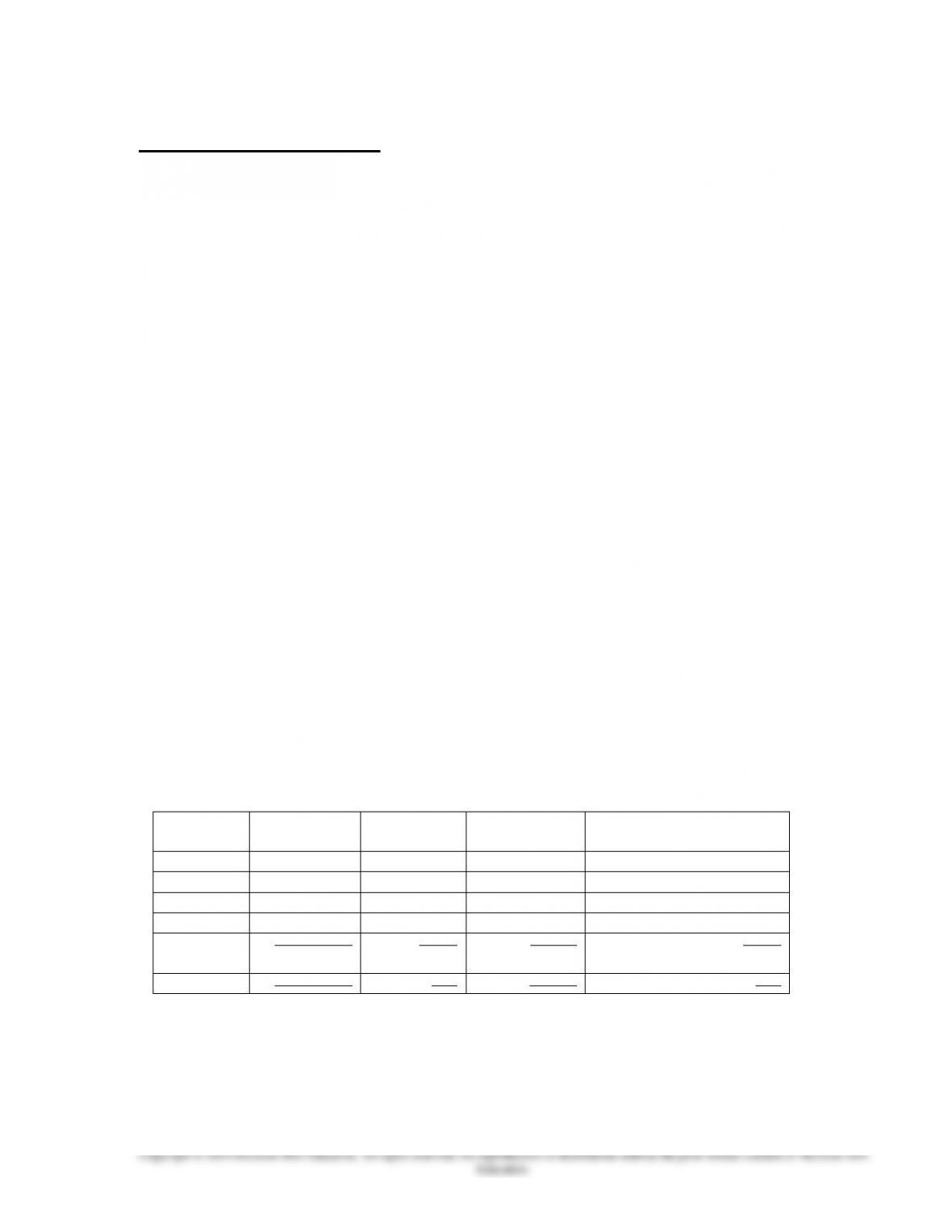
Joel Harvey Florists acquired a truck on January 1, 2012. The company paid $11,000 for the truck, $500
for destination charges, and $250 to paint the company name on the side of the truck. The company’s
accounting manager estimates the truck to have a five-year useful life and a residual value of $1,750. The
truck is expected to be driven 100,000 miles in five years. It is actually driven 15,000 miles in 2012,
25,000 miles in 2013, 30,000 miles in 2014, 25,000 miles in 2015, and 5,000 miles in 2016.
Part 1
On January 1, 2012, how much should Joel Harvey Florist capitalize for the cost of the truck?
Part 2
How much depreciation expenses that would be recorded for the years 2012 through 2016 using each of
the following methods?
a. Straight-line
b. Unit-of-production
c. Declining-balance
Part 3
On December 31, 2016, Joel Harvey sold the truck for $3,000 cash. Compute the gain or loss on sale.
Chapter 08 – Reporting and Interpreting Property, Plant, and Equipment; Intangibles; and Natural Resources
8-19
HANDOUT 8 – 1 SOLUTION
DEPRECIATION METHODS AND GAIN/LOSS ON SALE
Joel Harvey Florists acquired a truck on January 1, 2012. The company paid $11,000 for the truck, $500
for destination charges, and $250 to paint the company name on the side of the truck. The company’s
accounting manager estimates the truck to have a five-year useful life and a residual value of $1,750. The
truck is expected to be driven 100,000 miles in five years. It is actually driven 15,000 miles in 2012,
25,000 miles in 2013, 30,000 miles in 2014, 25,000 miles in 2015, and 5,000 miles in 2016.
Part 1
On January 1, 2012, how much should Joel Harvey Florist capitalize for the cost of the truck?
$11,000 + $500 + $250 = $11,750.
Part 2
How much depreciation expenses that would be recorded for the years 2012 through 2016 using each of
the following methods?
a. Straight-line
($11,750 – $1,750) ÷ 5 = $2,000 per year
b. Unit-of-production
($11,750 – $1,750) ÷ 100,000 = 10 cents/mile (or $0.10 per mile)
2005: 15,000 x $0.10 = $1,500
2006: 25,000 x $0.10 = $2,500
2012: 30,000 x $0.10 = $3,000
2013: 25,000 x $0.10 = $2,500
2014: 5,000 x $0.10 = $500
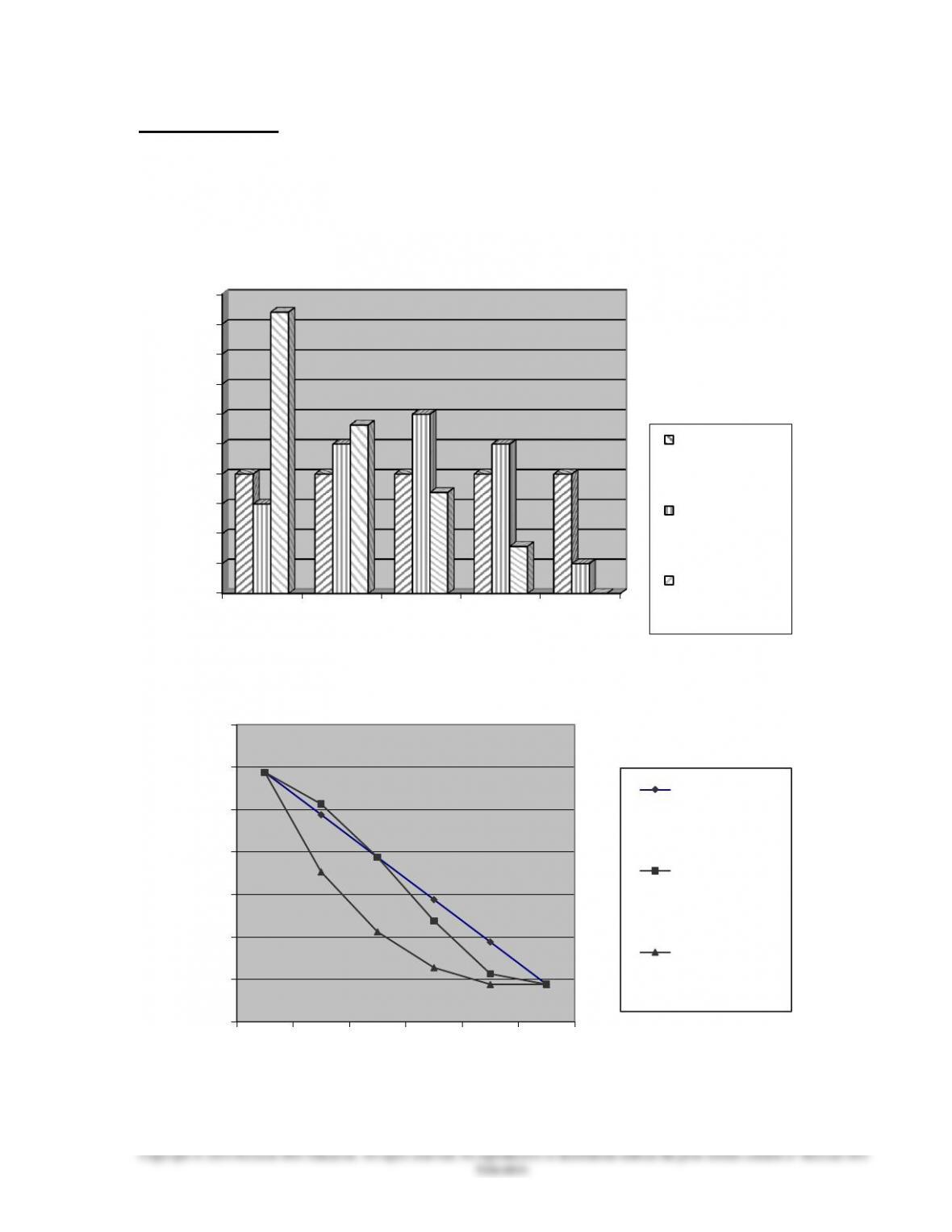
c. Declining-balance
Year
Computation
Depreciation
Expense
Accumulated
Depreciation
Net Book Value
Acquisition
$11,750
2012
$11,750 x 2/5
$4,700
$4,700
7,050
2013
7,050 x 2/5
2,820
7,520
4,230
2014
4,230 x 2/5
1,692
9,212
2,538
2015
2,538 x 2/5
2,538 – 1,750
788 1,015
10,000 10,227
1,750 1,448
2016
1,448 x 2/5
0 579
0 10,806
1,750 944
Part 3
On December 31, 2016, Joel Harvey sold the truck for $3,000 cash. Compute the gain or loss on sale.
$3,000 – $1,750 = $1,250 gain
Chapter 08 – Reporting and Interpreting Property, Plant, and Equipment; Intangibles; and Natural Resources
8-20
HANDOUT 8 – 2
COMPARISON OF DEPRECIATION EXPENSE AND NET BOOK VALUE
$0
$500
$1,000
$1,500
$2,000
$2,500
$3,000
$3,500
$4,000
$4,500
$5,000
2012 2013 2014 2015 2016
$2,000 $2,000 $2,000 $2,000 $2,000
$1,500
$2,500
$3,000
$2,500
$500
$4,700
$2,820
$1,692
$788
$0
Depreciation Expense
Straight-line
Units-of-
production
Double-
declining
balance
$11,750
$9,750
$7,750
$5,750
$3,750
$1,750
$11,750
$10,250
$7,750
$4,750
$2,250 $1,750
$11,750
$7,050
$4,230
$2,538
$1,750 $1,750
$0
$2,000
$4,000
$6,000
$8,000
$10,000
$12,000
$14,000
Pre-
2012 2012 2013 2014 2015 2016
Net Book Value
Straight-line
Units-of-
production
Double-
declining
balance