Chapter 05 – Communicating and Interpreting Accounting Information
Financial Accounting, 8/e 5-33
CP5-2.
1. The company presents the subtotals “gross profit,” “income from operations,” and
“income before income taxes”.
5. Buildings are depreciated over useful lives of 39 years. This is disclosed in note 2.
6. Buildings are $118,050,000, which is 9% of the total balance of gross property and
equipment. This is disclosed in note 5.
7.
2012
2011
Gross Profit
=
Gross Profit
$860,536
=
0.348
$936,620
=
0.412
Percentage
Net Sales
2,473,801
2,274,102
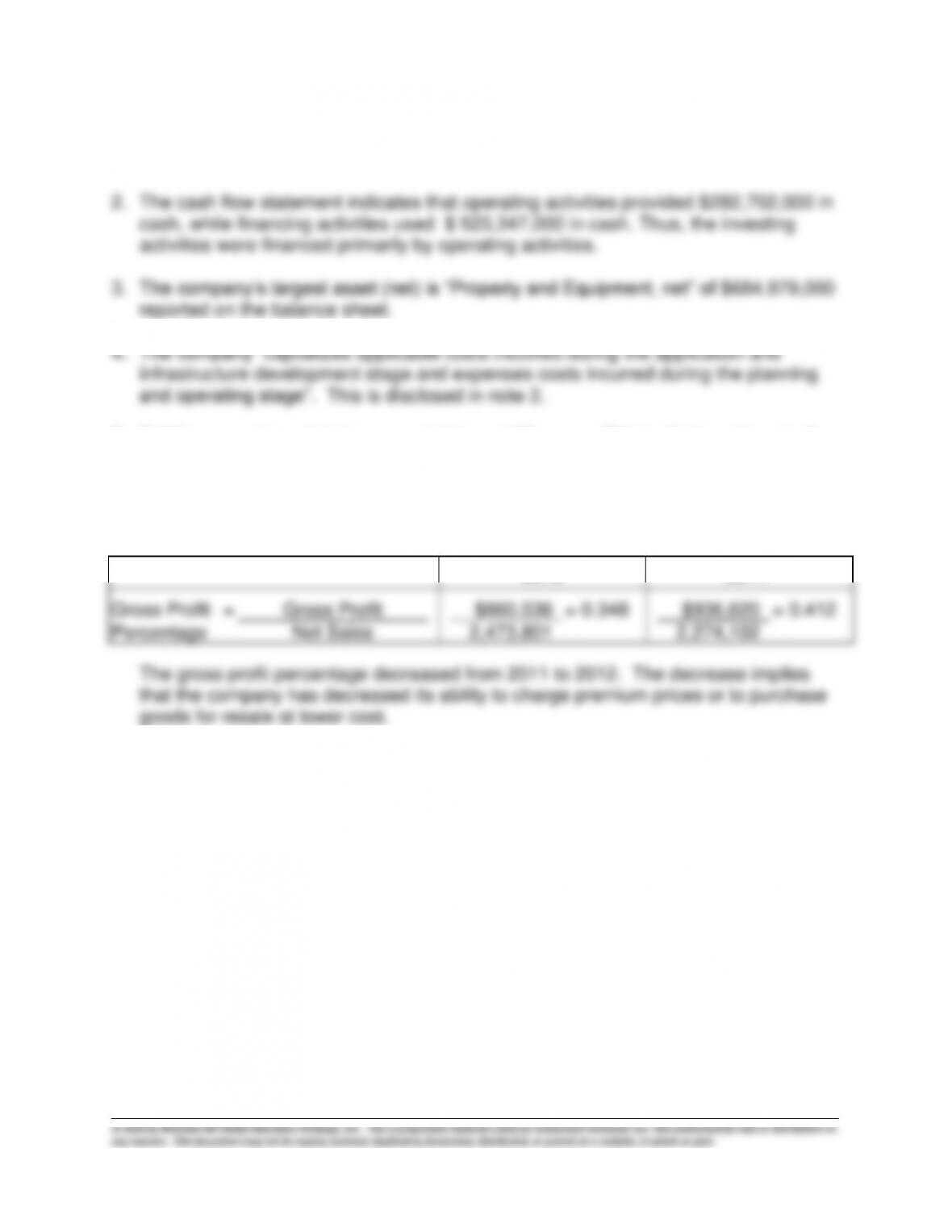
The gross profit percentage decreased from 2011 to 2012. The decrease implies
that the company has decreased its ability to charge premium prices or to purchase
goods for resale at lower cost.
Chapter 05 – Communicating and Interpreting Accounting Information
CP5-3. (continued)
Req. 3.
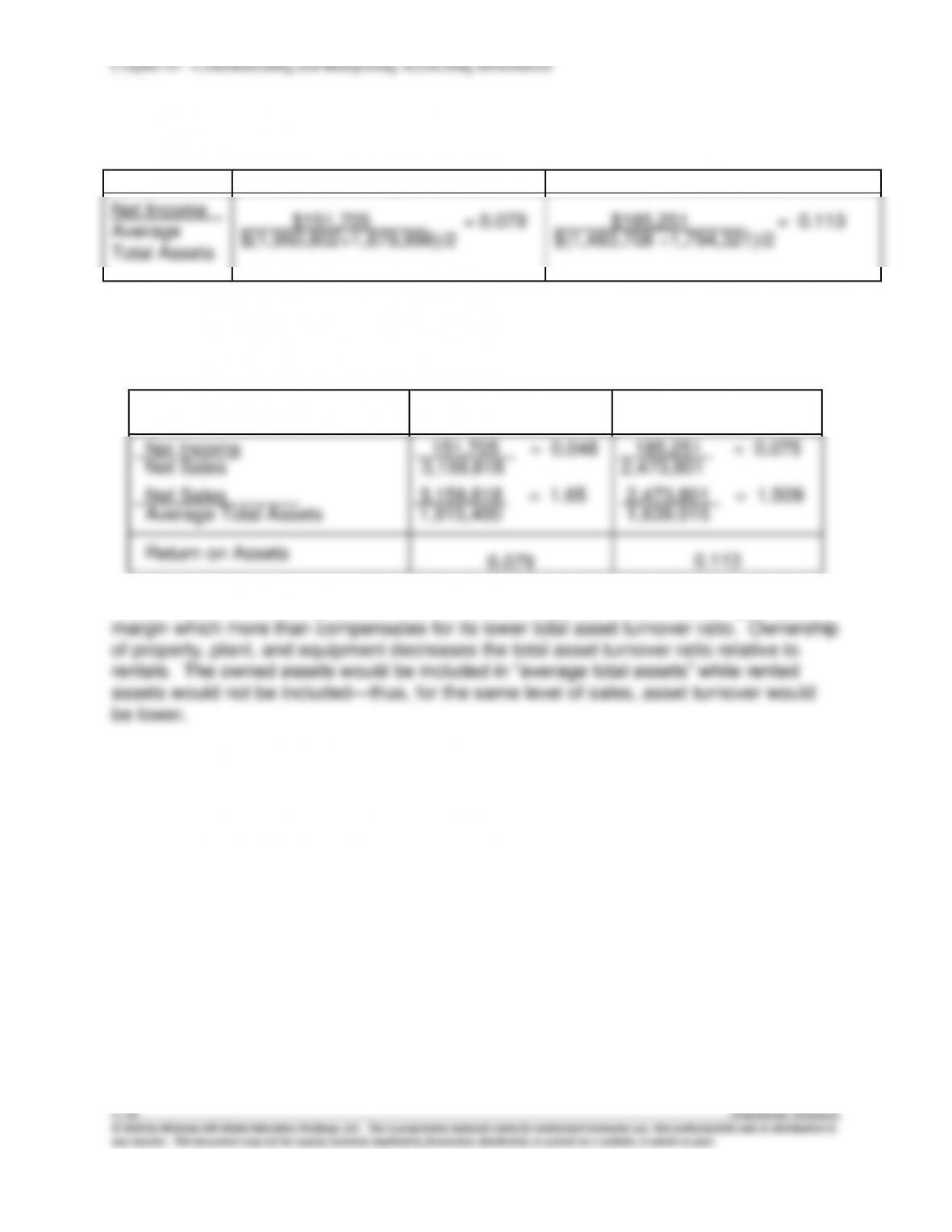
Industry Return on Assets (ROA) profit driver analysis:
ROA = Net Profit Margin Total Asset Turnover
ROA Analysis
Industry
Average
American Eagle
Outfitters
Urban Outfitters
Net Profit Margin
.054
.048
.075
Total Asset Turnover
1.75
1.65
1.51
Return on Assets
.091
0.079
0.113
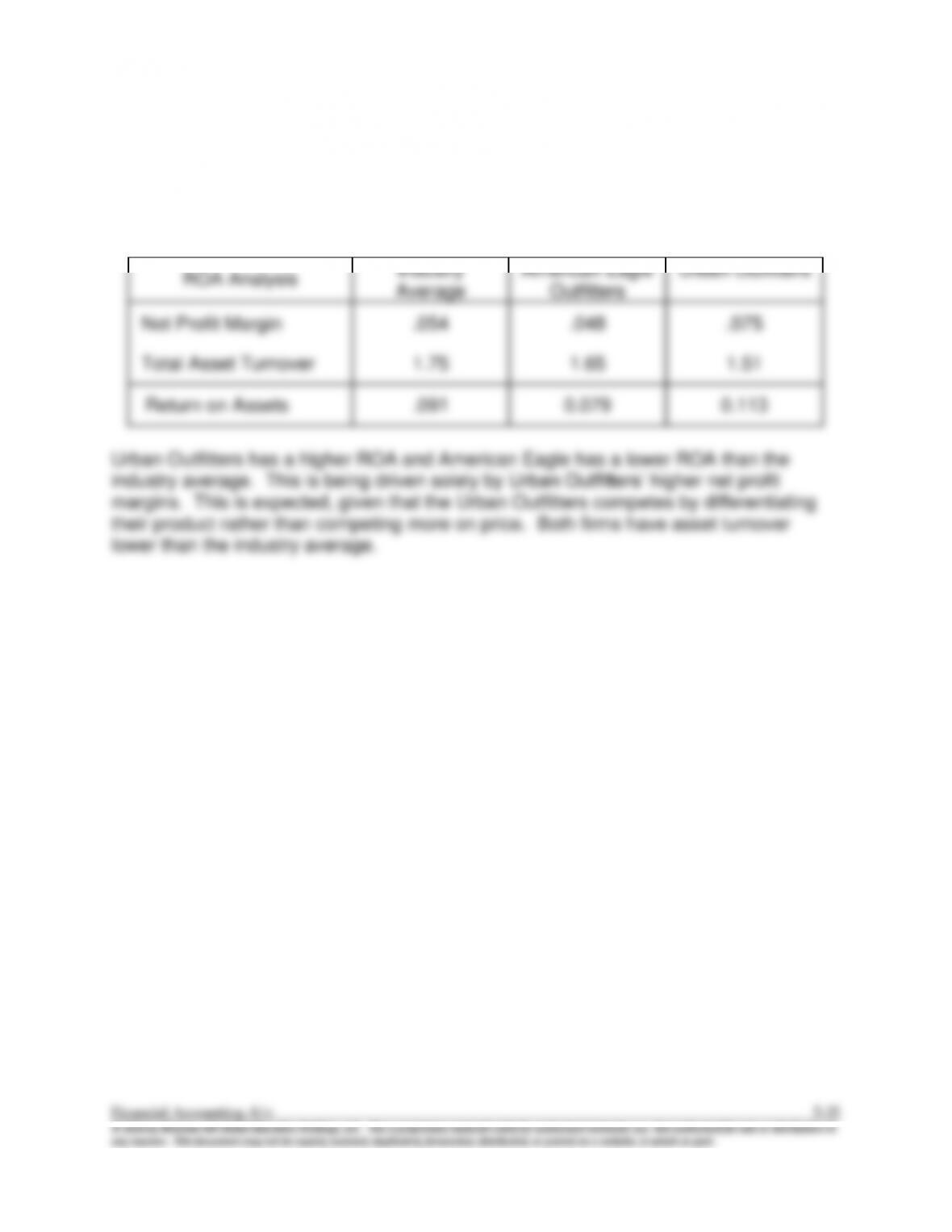
Urban Outfitters has a higher ROA and American Eagle has a lower ROA than the
industry average. This is being driven solely by Urban Outfitters’ higher net profit
margins. This is expected, given that the Urban Outfitters competes by differentiating
their product rather than competing more on price. Both firms have asset turnover
lower than the industry average.
Chapter 05 – Communicating and Interpreting Accounting Information
FINANCIAL REPORTING AND ANALYSIS CASES
CP5-4.
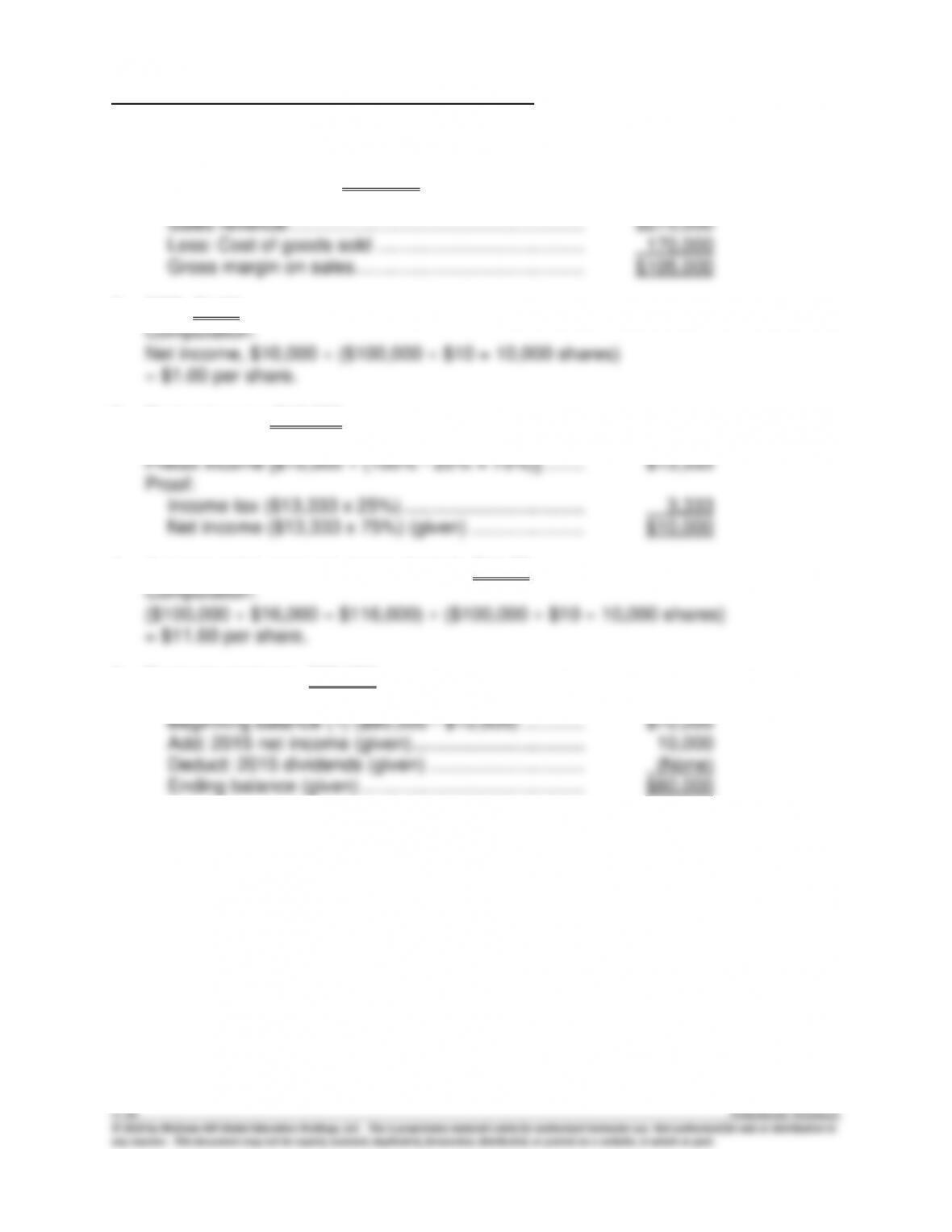
1. Gross margin on sales, $105,000.
Computation:
2. EPS, $1.00.
3. Pretax income, $13,333.
Computation (and proof):
4. Average sales price per share of stock, $11.60.
5. Beginning balance, $70,000.
Computation: (work backwards)
Chapter 05 – Communicating and Interpreting Accounting Information
CRITICAL THINKING CASES
CP5-5.
Strategy
Change
Current
Period
ROA
Future
Periods’
ROA
Explanation
a.
+
–
The decrease in R&D investments would lead to lower expense in
the current year, increasing current period’s income and ROA.
However, when fewer products are brought to market in future
periods, income and ROA will decrease.
b.
–
+
The advertising expense would decrease income and ROA in the
current year. Assuming that the movie earns a greater income in
future periods because of the advertising, net income will
increase, increasing ROA in future periods.
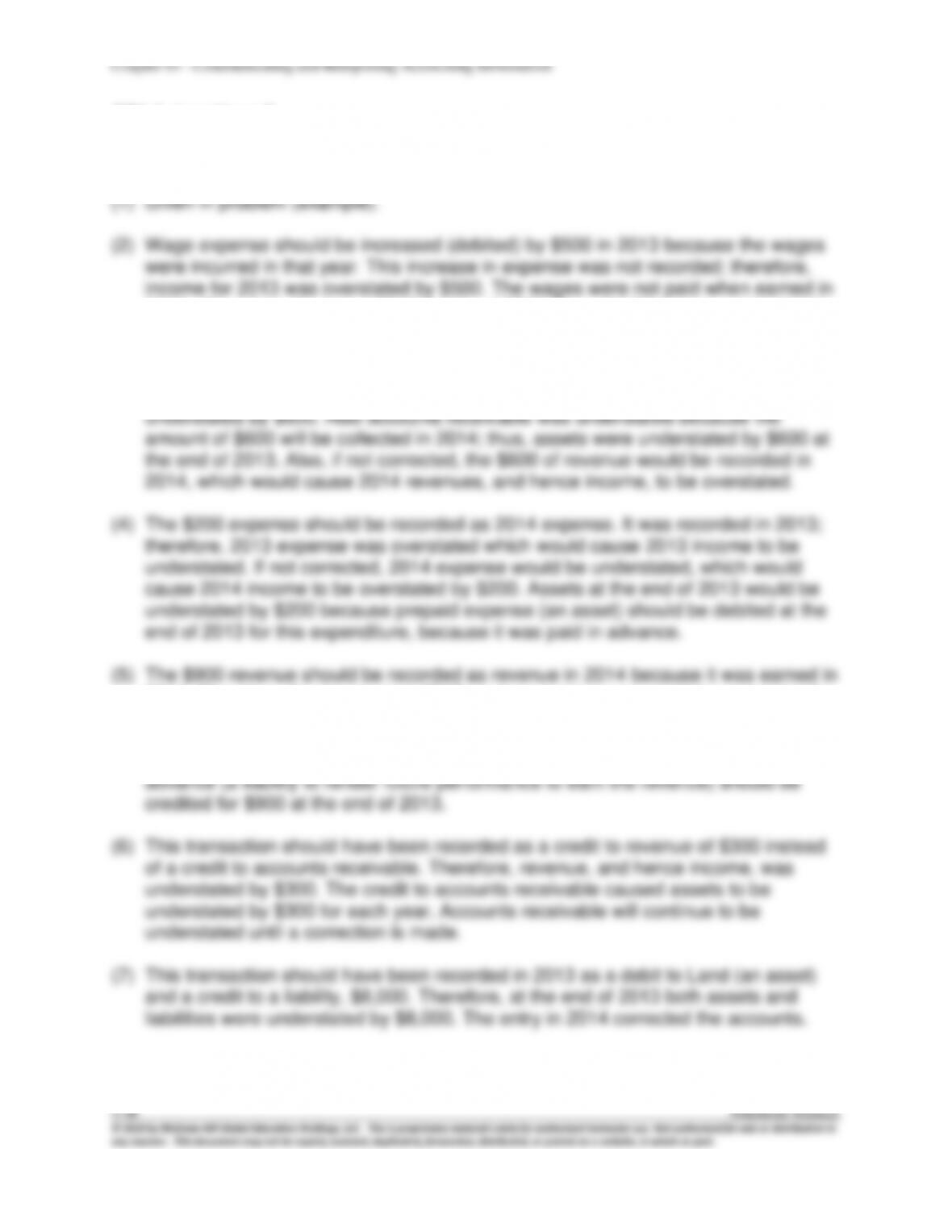
CP5-6.
Net Income
Assets
Liabilities
Error
2013
2014
2013
2014
2013
2014
(1)
O
NE
O
O
NE
NE
$950
$950
$950
(2)
O
U
NE
NE
U
NE
500
$500
$500
(3)
U
O
U
NE
NE
NE
600
600
600
(4)
U
O
U
NE
NE
NE
200
200
200
(5)
O
U
NE
NE
U
NE
900
900
900
(6)
U
NE
U
U
NE
NE
300
300
300
(7)
NE
NE
U
NE
U
NE
8,000
8,000
5-38 Solutions Manual
© 2014 by McGraw-Hill Global Education Holdings, LLC. This is proprietary material solely for authorized instructor use. Not authorized for sale or distribution in
any manner. This document may not be copied, scanned, duplicated, forwarded, distributed, or posted on a website, in whole or part.
CP5-6. (continued)
Explanation of analysis if not corrected:
2013. Therefore, there is a 2013 liability of $500; thus, liabilities were understated
at the end of 2013. In 2014 when the wages are recorded, wage expense will be
overstated and income will be understated.
(3) Revenues were understated by $600 in 2013, which caused 2013 income to be
2014. Therefore, if not corrected, 2013 revenue and income would be overstated by
$900. Also, 2014 revenue and income would be understated by $900 because that
is the year that the $900 revenue was earned but was not recorded. At the end of
2013 liabilities would be understated by $900 because revenue collected in
Chapter 05 – Communicating and Interpreting Accounting Information
CP5-7.
1. At the time this solution was prepared, three former top managers had pleaded
guilty to fraud charges and the chief marketing officer pleaded not guilty and was
2. In October 2004, the SEC chose not to impose a monetary fine on the company
because of its extensive cooperation with the investigation. The company promptly
3. Bonuses tied to performance measures such as accounting earnings tend to align
the managers’ interests with those of the shareholders. However, when companies
CP5-8.
The solutions to this case will depend on the company and/or accounting period
selected for analysis.
Chapter 05 – Communicating and Interpreting Accounting Information
CONTINUING CASE
CC5–1.
a.
Retained earnings (−SE) …………………………………………….
10,000
Cash (−A) ……………………………………………………………..
10,000
b.
Cash (+A) …………………………………………………………………
2,000
Deferred revenue (+L) …………………………………………….
2,000
c.
Rent expense (+E, −SE) …………………………..…………………
500
Cash (−A) ……………………………………………………………..
500
d.
Equipment (+A) …………………………………………………………
14,000
Note payable (+L) ………………………………………………….
14,000
e.
Depreciation expense (+E, −SE) ………………………………….
600
Accumulated depreciation (+XA, −A) …………………………
600
f.
Interest expense (+E, −SE) …………………………………………
400
Interest payable (+L) ……………………………………………….
400
Req. 1
Transaction
Gross Profit
Operating
Income (Loss)
Current
Assets
a.
NE
NE
−10,000
b..
NE
NE
+2,000
c.
NE
−500
–500
d.
NE
NE
NE
e.
NE
−600
NE
f.
NE
NE
NE
Req. 2
Transaction
Net Profit
Margin
Total Asset
Turnover
Return on
Assets
a.
NE
+
+
b.
NE
−
−
c.
−
+
−
d.
NE
−
−
e.
−
+
−
f.
−
NE
−
Chapter 05 – Communicating and Interpreting Accounting Information
CC5–2.
Req. 1
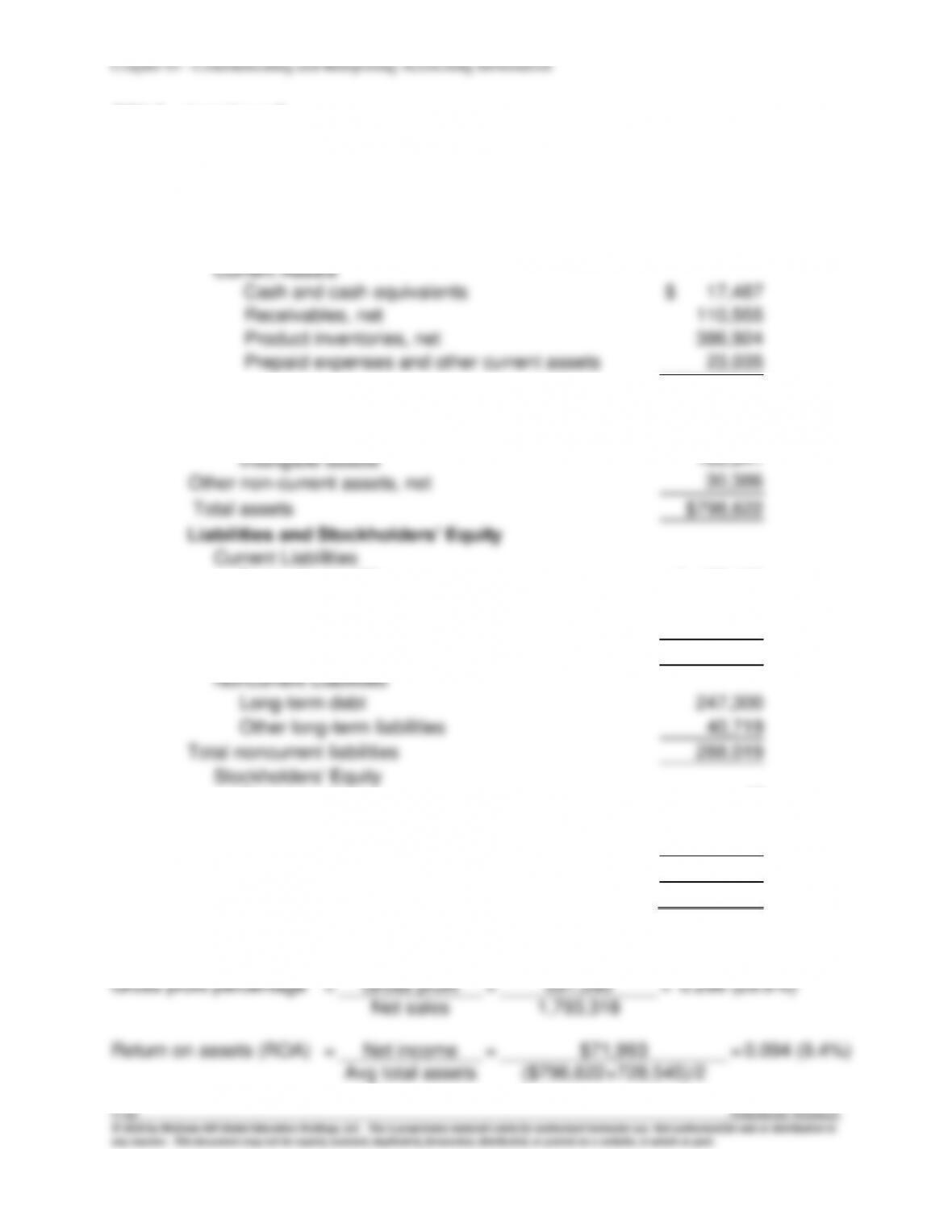
Pool Corporation
Consolidated Statement of Income
For Year Ended December 31, Current Year
(In Thousands Except Per Share Amounts)
Net sales
$1,793,318
Cost of goods sold
1,261,728
Gross profit
531,590
Selling and administrative expenses
406,523
Operating income
125,067
Interest expense
7,755
Income before income taxes
117,312
Provision for income taxes
45,319
Net income
$71,993
Earnings per share:
Basic earnings per share
$1.49
Weighted average shares outstanding
48,158
5-42 Solutions Manual
© 2014 by McGraw-Hill Global Education Holdings, LLC. This is proprietary material solely for authorized instructor use. Not authorized for sale or distribution in
any manner. This document may not be copied, scanned, duplicated, forwarded, distributed, or posted on a website, in whole or part.
CC5-2. (continued)
Pool Corporation
Consolidated Balance Sheet
December 31, Current Year
(in Thousands)
Assets
Current Assets
Cash and cash equivalents
$ 17,487
Receivables, net
110,555
Product inventories, net
386,924
Prepaid expenses and other current assets
23,035
Total current assets
$538,001
Noncurrent Assets
Property and equipment, net
41,394
Intangible assets
188,841
Other non-current assets, net
30,386
Total assets
$798,622
Liabilities and Stockholders’ Equity
Current Liabilities
Accounts payable
$ 177,437
Accrued expenses and other current liabilities
53,398
Current portion of long-term debt
22
Total current liabilities
230,857
Noncurrent Liabilities
Long-term debt
247,300
Other long-term liabilities
40,719
Total noncurrent liabilities
288,019
Stockholders’ Equity
Common stock
47
Additional paid-in capital
173,180
Retained earnings
106,519
Total stockholders’ equity
279,746
Total liabilities and stockholders’ equity
$798,622
Req. 2
Gross profit percentage
=
Gross profit
=
531,590
=
0.296 (29.6%)
Net sales
1,793,318
Return on assets (ROA)
=
Net income
=
$71,993
=
0.094 (9.4%)
Avg total assets
($798,622+728,545)/2

Chapter 05 – Communicating and Interpreting Accounting Information
Financial Accounting, 8/e 5-43