Chapter 05 – Communicating and Interpreting Accounting Information
Chapter 5
Communicating and Interpreting
Accounting Information
ANSWERS TO QUESTIONS
1. The primary responsibility for the accuracy of the financial records and conformance
with Generally Accepted Accounting Principles (GAAP) of the information in the
financial statements rests with management, normally the CEO and CFO.
2. Financial analysts, who normally work for brokerage and investment banking
houses, mutual funds, and investment advisory services, gather extensive financial
3. Information services provide a wide variety of financial and nonfinancial information
4. Material amounts are amounts that are large enough to influence a user’s decision.
6. Private companies normally issue quarterly and annual reports, both of which are
Chapter 05 – Communicating and Interpreting Accounting Information
7. Public companies issue quarterly press releases, quarterly reports, and annual
reports to shareholders and Forms 10-Q (quarterly reports), 10-K (annual reports),
and 8-K (special events) reports to the SEC. Press releases include a summary of
the quarterly report information and are the first announcement of quarterly financial
8. The four major subtotals or totals on the income statement are: (a) gross profit, (b)
income from operations, (c) income before income taxes, and (d) net income.
9. The six major classifications on the balance sheet are: (a) current assets, (b)
10. Property, plant, and equipment are reported on the balance sheet. Property, plant,
and equipment are those assets held by the business not for resale but for use in
operating the business, such as a delivery truck. (a) Property, plant, and equipment
are reported at their acquisition cost which represents the amount of resources
11. The major classifications of stockholders’ equity are: (1) contributed capital, which
Financial Accounting, 8/e 5-3
© 2014 by McGraw-Hill Global Education Holdings, LLC. This is proprietary material solely for authorized instructor use. Not authorized for sale or distribution in
any manner. This document may not be copied, scanned, duplicated, forwarded, distributed, or posted on a website, in whole or part.
Contributed capital is often split between the account common stock (which consists
of a nominal legal amount called par value) and additional paid-in capital.
12. The three major classifications on the Statement of Cash Flows are (a) cash from
operating activities, (b) cash from investing activities, and (c) cash from financing
activities.
13. The three major categories of notes to the financial statements are: (1) descriptions
of accounting rules applied to the company’s statements, often called significant
14. Return on assets (ROA) is a ratio measure defined as net income divided by
average total assets. It measures how much the firm earned for each dollar of
ANSWERS TO MULTIPLE CHOICE
1. b)
2. b)
3. c)
4. a)
5. b)
6. d)
7. b)
8. c)
9. c)
10. a)
Chapter 05 – Communicating and Interpreting Accounting Information
Authors’ Recommended Solution Time
(Time in minutes)
Mini-exercises
Exercises
Problems
Alternate
Problems
Cases and
Projects
No.
Time
No.
Time
No.
Time
No.
Time
No.
Time
1
5
1
10
1
30
1
40
1
30
2
5
2
10
2
20
2
20
2
30
3
5
3
15
3
40
3
40
3
40
4
10
4
10
4
20
4
35
4
30
5
10
5
20
5
20
5
30
6
10
6
30
6
40
6
30
7
10
7
15
7
35
7
40
8
20
8
40
8
*
9
25
9
20
10
25
11
25
Continuing Cases
12
12
1
45
13
15
2
45
14
15
15
15
16
20
17
25
18
20
19
20
* Due to the nature of these cases and projects, it is very difficult to estimate the amount
of time students will need to complete the assignment. As with any open–ended project,
Chapter 05 – Communicating and Interpreting Accounting Information
MINI-EXERCISES
M5-1.
Players
Definitions
____D____ (1) Independent auditor
____C____ (2) CEO and CFO
____B____ (3) Users
____A____ (4) Financial analyst
A. Adviser who analyzes financial and other economic
information to form forecasts and stock recommendations.
B. Institutional and private investors and creditors (among
others).
C. Chief executive officer and chief financial officer who have
primary responsibility for the information presented in financial
statements.
D. Independent CPA who examines financial statements and
attests to their fairness.
M5-2.
No.
Title
____3_____
Form 10-K
____1_____
Earnings press release
____2_____
Annual report
M5–3.
Elements of
Financial Statements Financial Statements
A (1) Expenses A. Income statement
C (2) Cash from operating activities B. Balance sheet
5-6 Solutions Manual
© 2014 by McGraw-Hill Global Education Holdings, LLC. This is proprietary material solely for authorized instructor use. Not authorized for sale or distribution in
any manner. This document may not be copied, scanned, duplicated, forwarded, distributed, or posted on a website, in whole or part.
M5–4.
Transaction
Current
Assets
Gross Profit
Current
Liabilities
a.
+
+
NE
b.
NE
NE
+
M5–5.
Assets
Liabilities
Stockholders’ Equity
a.) Accounts Receivable +1,800
Inventory -1,200
Sales Revenue +1,800
Cost of Goods Sold -1,200
b.) Cash +60,000
*Common stock +5,000
**Additional paid-in
capital +55,000
*$1 par value 5,000 shares
**$60,000 cash – $5,000 common stock
Chapter 05 – Communicating and Interpreting Accounting Information
M5–6.
a. Accounts receivable (+A) ……………………………………………….. 1,800
Sales revenue (+R, +SE) ……………………………………… 1,800
M5–7.
Return on assets (ROA)
=
Net income
=
$100
=
$100
=
0.111 (11.1%)
Avg total assets
($1,000+$800)/2
$900
Chapter 05 – Communicating and Interpreting Accounting Information
EXERCISES
E5-1.
Players Definitions
F (1) Financial
analyst
A (2) Creditor
H (3) Independent
auditor
G (4) Private
investor
D (5) SEC
E (6) Information
service
C (7) Institutional
investor
B (8) CEO and
CFO
A. Financial institution or supplier that lends money to the
company.
B. Chief Executive Officer and Chief Financial Officer who
have primary responsibility for the information
presented in financial statements.
C. Manager of pension, mutual, and endowment funds
that invest on the behalf of others.
D. Securities and Exchange Commission which regulates
financial disclosure requirements.
E. A company that gathers, combines, and transmits
(paper and electronic) financial and related information
from various sources.
F. Adviser who analyzes financial and other economic
information to form forecasts and stock
recommendations.
G. Individual who purchases shares in companies.
H. Independent CPA who examines financial statements
and attests to their fairness.
E5–2.
Information Release Definitions
C (1) Form 10-Q
B (2) Quarterly report
D (3) Press release
F (4) Annual report
E (5) Form 10-K
A (6) Form 8-K
A. Report of special events (e.g., auditor changes,
mergers) filed by public companies with the
SEC.
B. Brief unaudited report for quarter normally
containing summary income statement and
balance sheet.
C. Quarterly report filed by public companies with
the SEC that contains additional unaudited
financial information.
Chapter 05 – Communicating and Interpreting Accounting Information
E5–3.
Information Item Report
B,F (1) Summarized financial data for 5-year period.
B,F (2) Notes to financial statements.
B,F (3) The four basic financial statements for the year.
E (4) Summarized income statement information for the
quarter.
F (5) Detailed discussion of the company’s competition.
D (6) Initial announcement of hiring of new vice president
for sales.
D (7) Initial announcement of quarterly earnings.
B,F (8) A description of those responsible for the financial
statements.
A (9) Complete quarterly income statement, balance sheet
and cash flow statement.
C (10) Announcement of a change in auditors.
A. Form 10-Q
B. Annual report
C. Form 8-K
D. Press release
E. Quarterly report
F. Form 10-K
G. None of the above
E5–4.
No. Title
7 Long-term liabilities
6 Current liabilities
Chapter 05 – Communicating and Interpreting Accounting Information
E5–6.
Req. 1.
Snyder’s-Lance
Consolidated Balance Sheet
December 31, Current Year
(in millions)
Assets
Current Assets
Cash and cash equivalents
$ 20,841
Accounts receivable, net
143,238
Inventories
106,261
Prepaid expenses and other
20,705
Other current assets
96,983
Total current assets
388,028
Property, plant and equipment, net
313,043
Goodwill
367,853
Other intangible assets, net
376,062
Other assets
21,804
Total assets
$1,466,790
Liabilities and Stockholders’ Equity
Current Liabilities
Accounts payable
$ 52,930
Accrued compensation
29,248
Other payables and accrued liabilities
68,712
Short-term debt
4,256
Total current liabilities
155,146
Long-term debt
253,939
Other long-term liabilities
219,114
Total liabilities
628,199
Stockholders’ Equity
Common stock, 67,820,798 shares outstanding
56,515
Additional paid-in capital
730,338
Retained earnings
51,738
Total stockholders’ equity
838,591
Total liabilities and stockholders’ equity
$1,466,790
Chapter 05 – Communicating and Interpreting Accounting Information
E5-8.
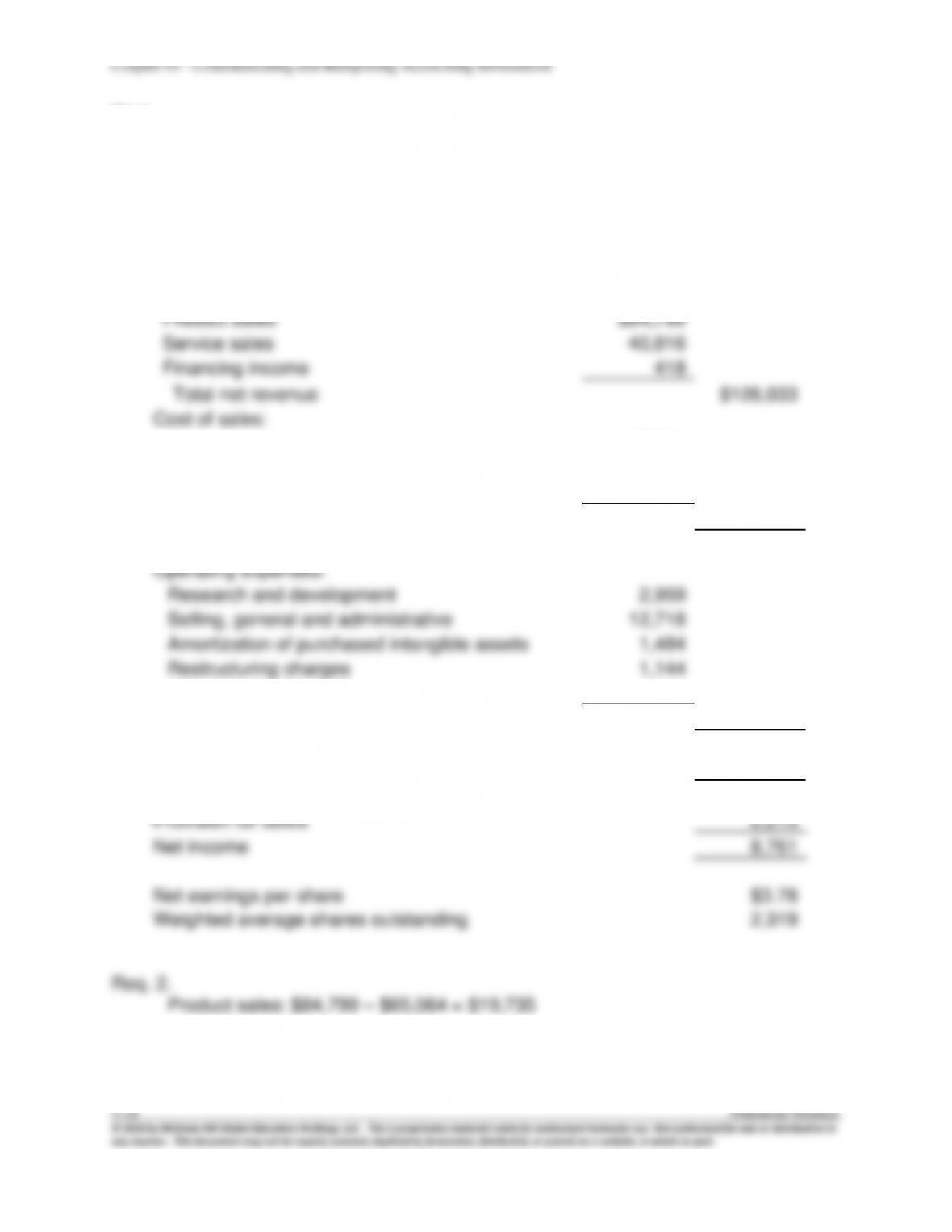
TOWNSHIP CORPORATION
Income Statement
For the Year Ended December 31, 2015
Computations in Order
5-14 Solutions Manual
© 2014 by McGraw-Hill Global Education Holdings, LLC. This is proprietary material solely for authorized instructor use. Not authorized for sale or distribution in
any manner. This document may not be copied, scanned, duplicated, forwarded, distributed, or posted on a website, in whole or part.
E5-9.
Req. 1.
Hewlett Packard Company
Consolidated Statement of Income
For Year Ended October, Current Year
(In millions)
Net sales
Product sales
$84,799
Service sales
40,816
Financing income
418
Total net revenue
$126,033
Cost of sales:
Cost of products
65,064
Cost of services
30,590
Cost of financing
302
Total cost of sales
95,956
Gross profit
30,077
Operating expenses:
Research and development
2,959
Selling, general and administrative
12,718
Amortization of purchased intangible assets
1,484
Restructuring charges
1,144
Acquisition-related charges
293
Total operating expenses
18,598
Operating income
11,479
Interest expense
505
Income before income taxes
10,974
Provision for taxes
2,213
Net income
8,761
Net earnings per share
$3.78
Weighted average shares outstanding
2,319
Req. 2.
Product sales: $84,799 – $65,064 = $19,735
Chapter 05 – Communicating and Interpreting Accounting Information
E5–10.
Case A Case B Case C Case D Case E
Sales revenue $800 $600 $500 $1,170* $760*
Cost of goods sold 425* 150 280* 500 320
E5–11.
Case A Case B Case C Case D Case E
Sales revenue $770 $1,200* $400* $600 $1,050
Cost of goods sold 300* 320 125 250 420*
E5–12.
Common Stock
Additional
Paid-in
Retained
Total
Stockholders’
Shares
Amount
Capital
Earnings
Equity
Shares issued for
employee stock option
plan
12,100
121
343,879
344,000
5-16 Solutions Manual
© 2014 by McGraw-Hill Global Education Holdings, LLC. This is proprietary material solely for authorized instructor use. Not authorized for sale or distribution in
any manner. This document may not be copied, scanned, duplicated, forwarded, distributed, or posted on a website, in whole or part.
E5–13.
Req. 1.
Beginning RE + Net income – Dividends = Ending RE
Dividends = Beginning RE + Net income – Ending RE
E5-14.
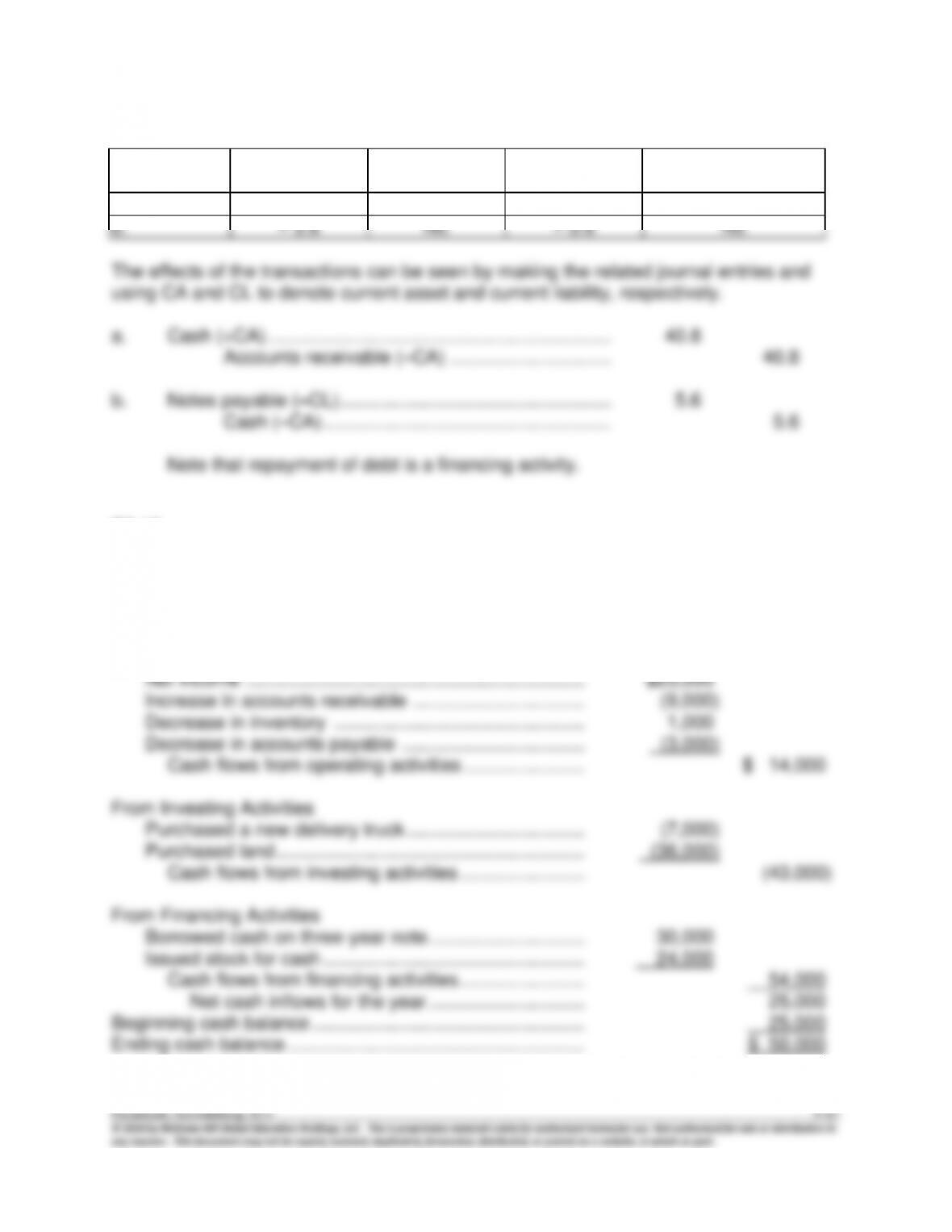
Transaction
Current
Assets
Gross Profit
Current
Liabilities
a.
+$2,449.3
+$2,449.3
NE
b.
+$500.0
NE
+$500.0
c.
–$197.6
NE
NE
Chapter 05 – Communicating and Interpreting Accounting Information
E5-15.
Transaction
Current
Assets
Gross Profit
Current
Liabilities
Cash Flow from
Operating Activities
a.
NE
NE
NE
+ 40.8
b.
– 5.6
NE
– 5.6
NE
The effects of the transactions can be seen by making the related journal entries and
using CA and CL to denote current asset and current liability, respectively.
a. Cash (+CA) ………………………………………………………… 40.8
Accounts receivable (–CA) …………………………. 40.8
b. Notes payable (–CL) ……………………………………………. 5.6
Cash (–CA) ………………………………………………. 5.6
Note that repayment of debt is a financing activity.
E5-16.
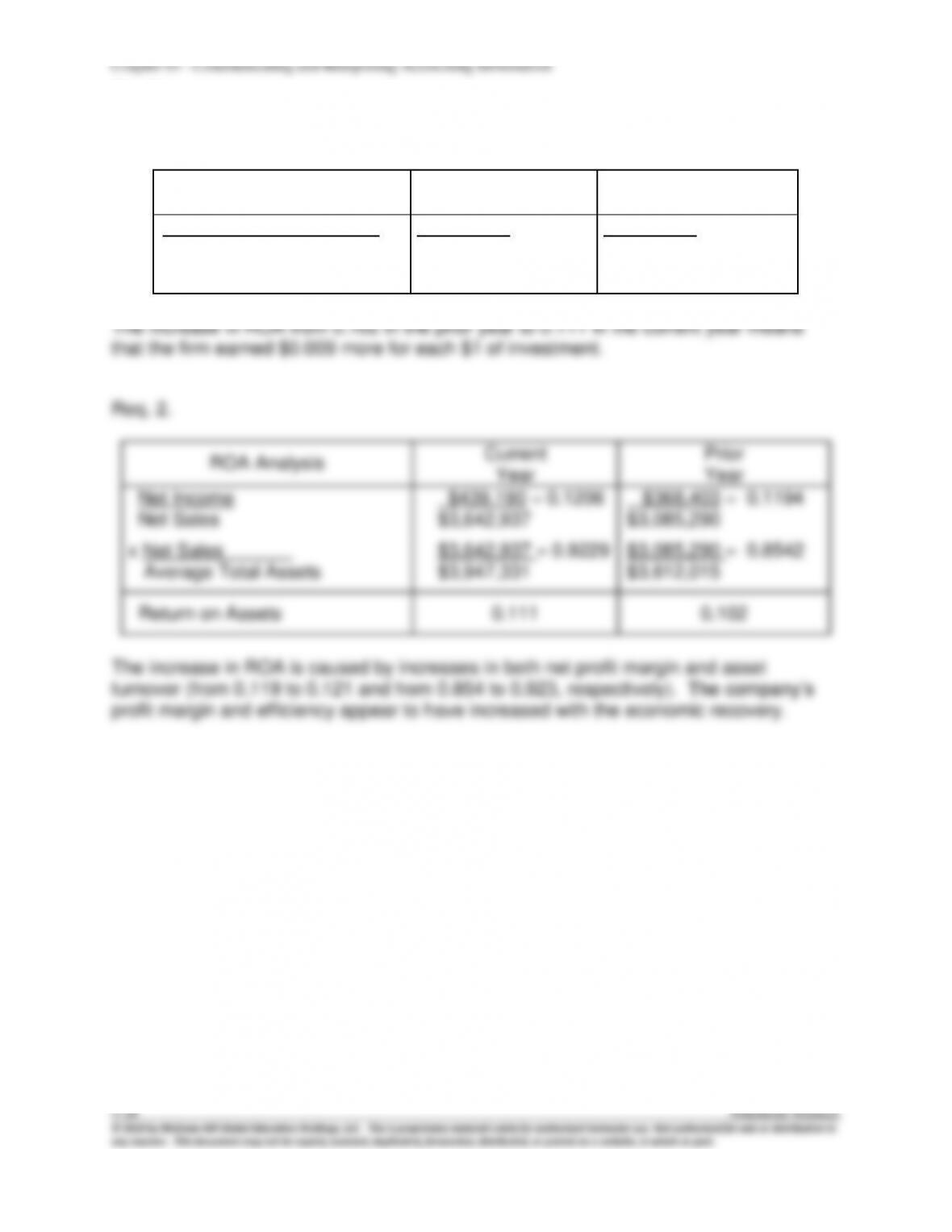
AVALOS CORPORATION
Statement of Cash Flows
For the Year Ended December 31, 2014
From Operating Activities
Chapter 05 – Communicating and Interpreting Accounting Information
E5-18.
Req. 1.
Current
Year
Prior
Year
Net Income (given)
Average Total Assets
(given)
$59,387 = 0.147
$403,162
$55,425 = 0.141
$394,143
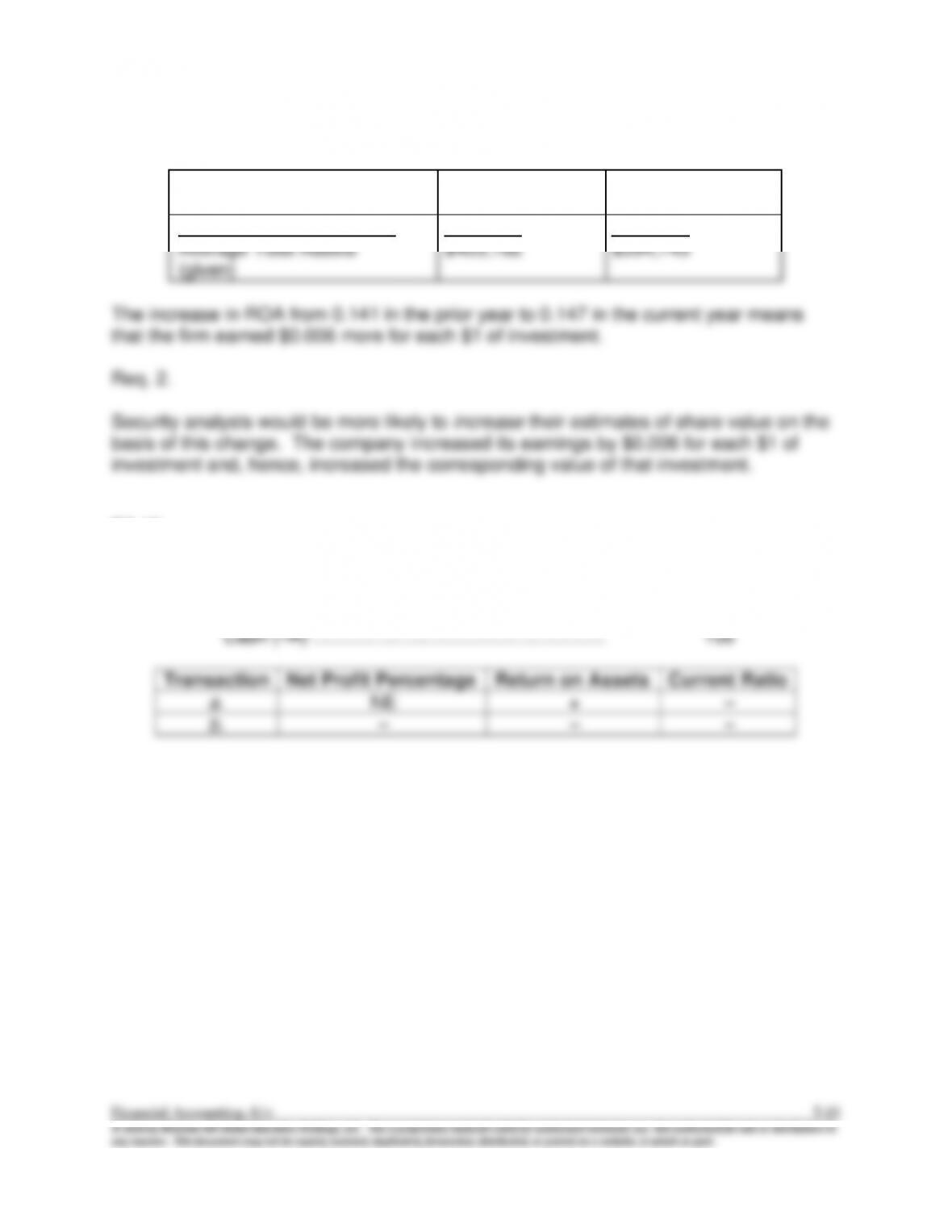
The increase in ROA from 0.141 in the prior year to 0.147 in the current year means
that the firm earned $0.006 more for each $1 of investment.
Req. 2.
Security analysts would be more likely to increase their estimates of share value on the
basis of this change. The company increased its earnings by $0.006 for each $1 of
investment and, hence, increased the corresponding value of that investment.
E5–19
a. Notes payable (long-term) (–L) ……………………………. 2,000
Cash (–A) ……………………………………………….. 2,000
b. Rent expense (+E, –SE) …………………………………….. 100
5-20 Solutions Manual
© 2014 by McGraw-Hill Global Education Holdings, LLC. This is proprietary material solely for authorized instructor use. Not authorized for sale or distribution in
any manner. This document may not be copied, scanned, duplicated, forwarded, distributed, or posted on a website, in whole or part.
P5–1.
(1) E; (2) L; (3) D; (4) I; (5) M; (6) W; (7) B; (8) Q; (9) A; (10) H; (11) U; (12) J; (13) C;
(14) G; (15) V; (16) R; (17) K; (18) N; (19) T; (20) S; (21) O; (22) P; (23) F.
P5–2.
P (1) Capital in excess of par B (11) Current liabilities
E (2) Assets C (12) Long-term liabilities
M (3) Retained earnings N (13) Fixed assets