Chapter 03 – Operating Decisions and the Accounting System
CP3-2. (continued)
4. Dollars in thousands:
Fiscal year
ended
Net
Income
÷
Net Sales (or
Operating) Revenues
=
Net Profit Margin
Ratio
2012
$185,251
$2,473,801
0.075 or 7.5%
2011
272,958
2,274,102
0.120 or 12.0%
2010
219,893
1,937,815
0.113 or 11.3%
The net profit margin ratio measures the profit for every sales dollar earned. In fiscal
year ended 2012, Urban Outfitters had $0.075 per dollar of sales. Between 2010 and
2011, the ratio increased slightly. However, between fiscal years ended 2011 and
2012, Urban Outfitters’ net profit margin ratio decreased, suggesting that
management was less effective at generating sales and/or controlling expenses.
Although sales increased by 8.8% between fiscal years ended 2011 and 2012,
expenses increased by 14.4%. Most of the increase in expenses was due to higher
cost of sales, which increased 20.6%.
Chapter 03 – Operating Decisions and the Accounting System
Financial Accounting, 8/e 3-55
CP3–4.
Req. 1
American Eagle Outfitters (dollars in thousands)
Fiscal year
ended
Income from
Continuing
Operations
÷
Net Sales (or
Operating)
Revenues
=
Net Profit Margin
Ratio
2012
$151,705
$3,159,818
0.048 or 4.8%
2011
181,934
2,967,559
0.061 or 6.1%
2010
213,398
2,940,269
0.073 or 7.3%
2009
229,984
2,948,679
0.078 or 7.8%
2008
433,507
3,041,158
0.143 or 14.3%
Req. 2
Current ratio reported in American Eagle Outfitters’ 10-K report (Item 6) for fiscal year
ended:
2012
3.18
2011
3.03
2010
2.85
2009
2.30
2008
2.71
Chapter 03 – Operating Decisions and the Accounting System
CP3–5.
Req. 1
Accrual accounting is defined in the article as follows:
“By accruing, or allotting, revenues to specific periods, they (accountants) aim to
companies make to come up with revenues and expenses on an accrual basis.
Companies are given wide discretion in determining estimates to use to compute net
income under current accounting rules, and users of the financial statements need to
read statements carefully to understand the impact of management judgments and
accounting rules. Even then, the author suggests that financial statements are often
Chapter 03 – Operating Decisions and the Accounting System
CRITICAL THINKING CASES
CP3–6.
Req. 1
Estela used the cash basis of accounting. We can infer this from his references to
income collected rather than earned, expenses paid rather than incurred, and supplies
purchased rather than used. Accrual accounting should be used because it correctly
assigns revenues and expenses to the accounting period in which they are earned or
incurred.
Req. 2
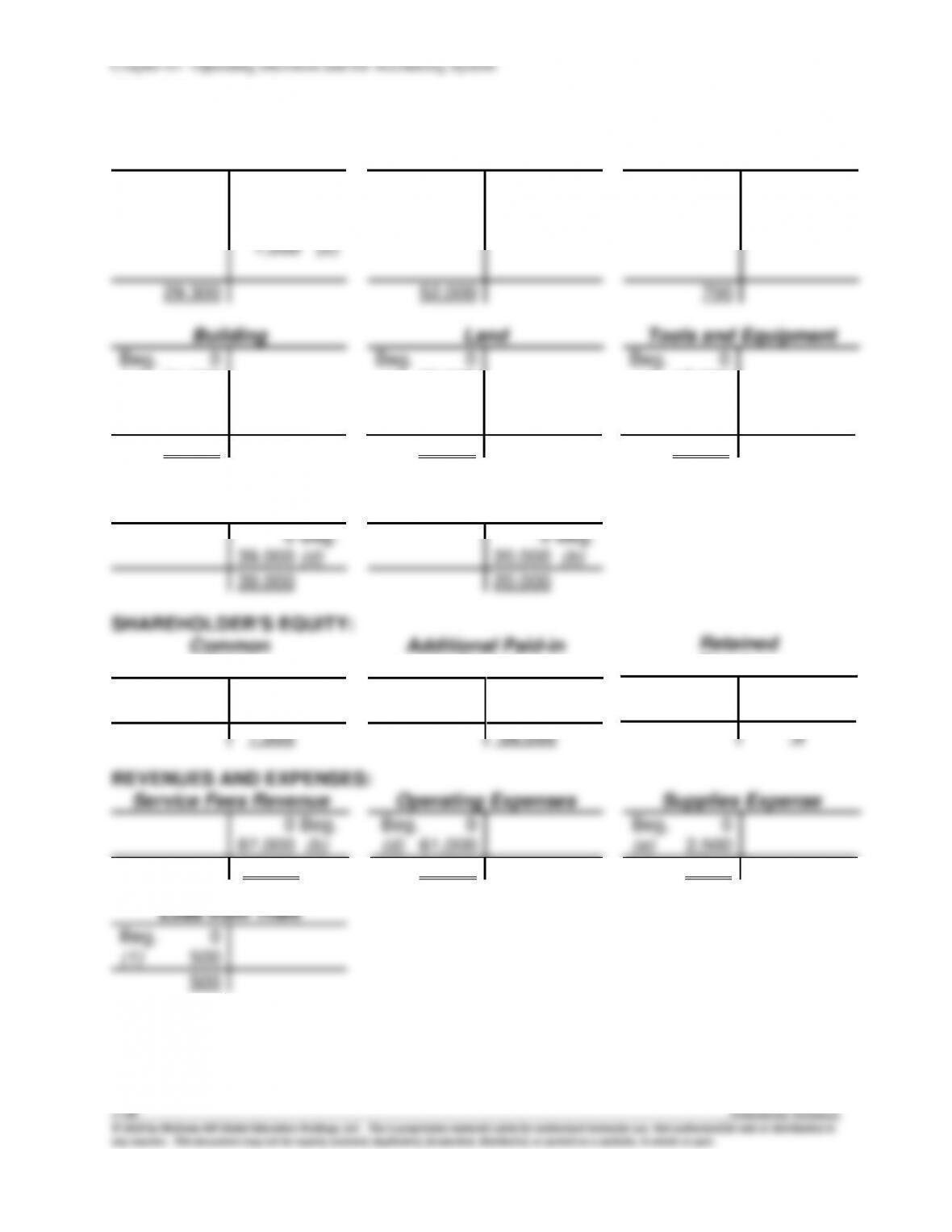
(a)
Building (+A) ………………………………………………………………
21,000
Tools and equipment (+A) ……………………………………………
17,000
Land (+A) ………………………………………………………………….
20,000
Cash (+A) ………………………………………………………………….
1,000
Common stock (+SE) ………………………………………..
Additional paid-in capital (+SE) …………………………..
1,000
58,000
(b)
Cash (+A) …………………………………………………………………..
55,000
Accounts receivable (+A) ……………………………………………..
52,000
Unearned revenue (+L) ………………………………………
20,000
Service fees revenue (+R, +SE) …………………………..
87,000
(c)
No entry
(d)
Operating expenses (+E, −SE) ……………………………………..
61,000
Accounts payable (+L) ………………………………………..
39,000
Cash (−A) …………………………………………………………
22,000
(e)
Supplies expense (+E, −SE)* ……………………………………….
2,500
Supplies (+A) ……………………………………………………………..
700
Cash (−A) …………………………………………………………
3,200
Other
(1)
Loss from theft (+E, −SE) …………………………………………….
500
Cash (−A) …………………………………………………………
500
(2)
Tools and equipment (+A) ……………………………………………
1,000
Cash (−A) …………………………………………………………
1,000
* Supplies purchased, $3,200 − Supplies on hand at end of 2015, $700 = $2,500
Chapter 03 – Operating Decisions and the Accounting System
Financial Accounting, 8/e 3-59
CP3–6. (continued)
Req. 3
ESTELA COMPANY
(a)
Income Statement
(b)
For the Year Ended December 31, 2015
(c)
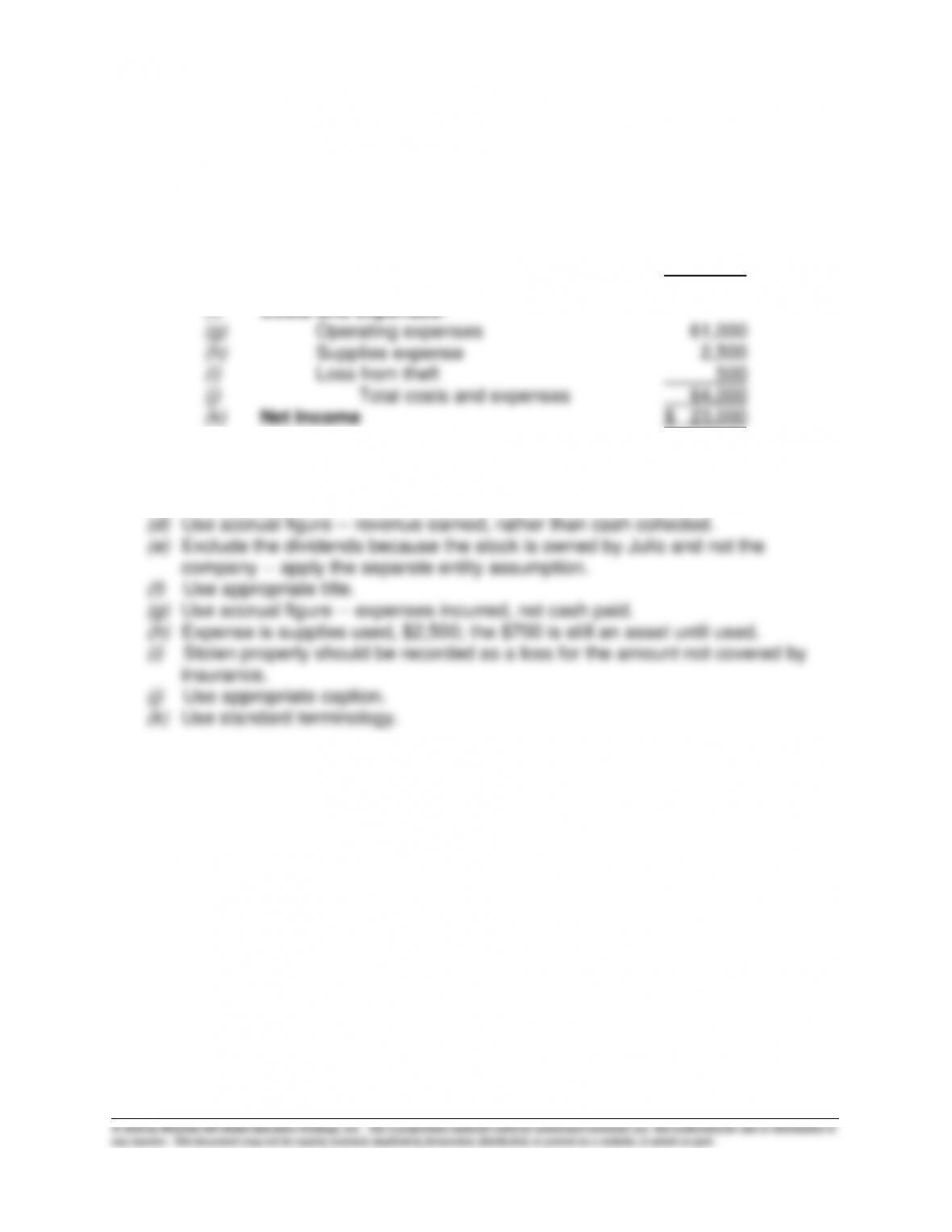
Revenues:
(d)
Service fees revenue
$ 87,000
(e)
[see note]
(f)
Costs and expenses:
(g)
Operating expenses
61,000
(h)
Supplies expense
2,500
(i)
Loss from theft
500
(j)
Total costs and expenses
64,000
(k)
Net Income
$ 23,000
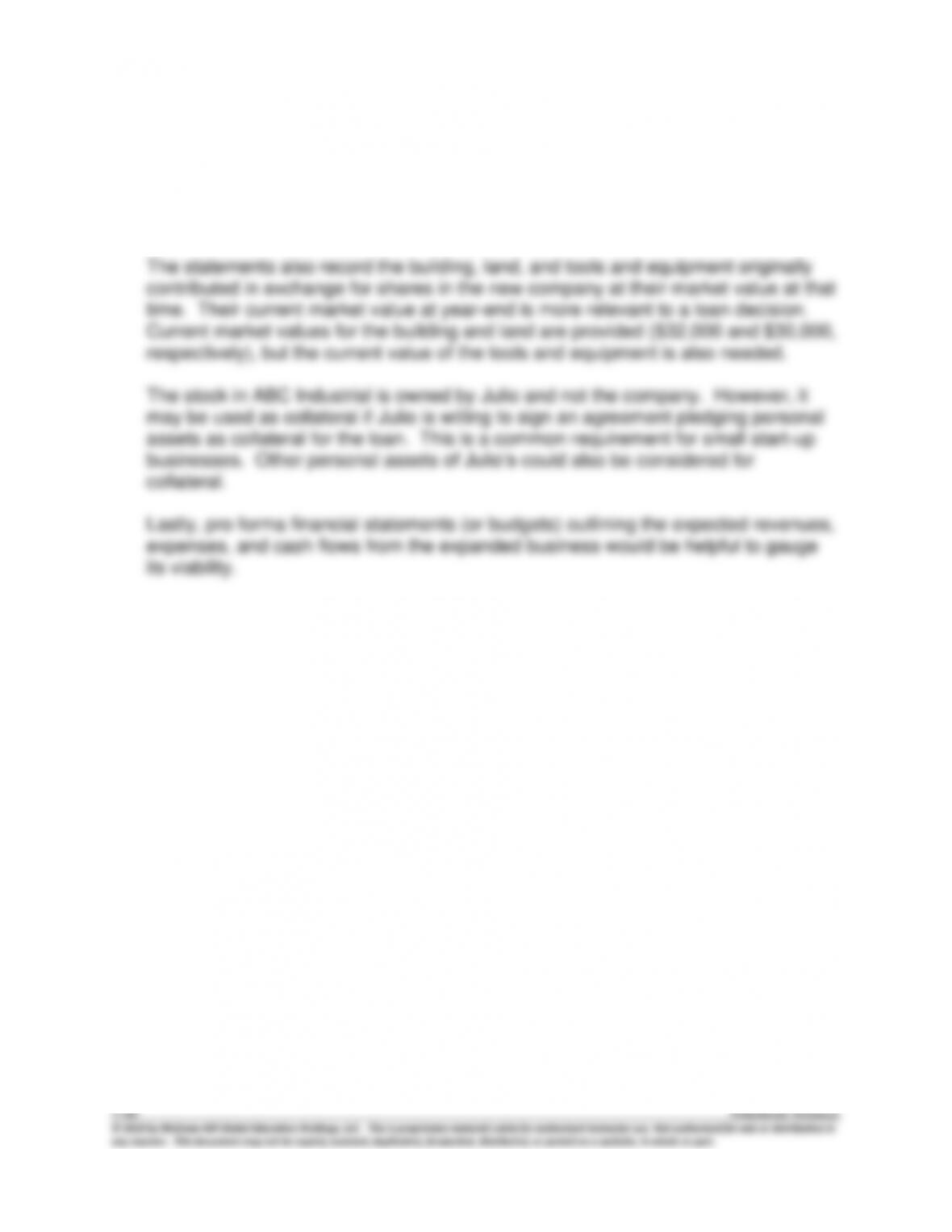
(a) Use the standard title.
(b) Date to indicate time period covered.
(c) Use appropriate title.
Chapter 03 – Operating Decisions and the Accounting System
CP3–6. (continued)
Req. 4
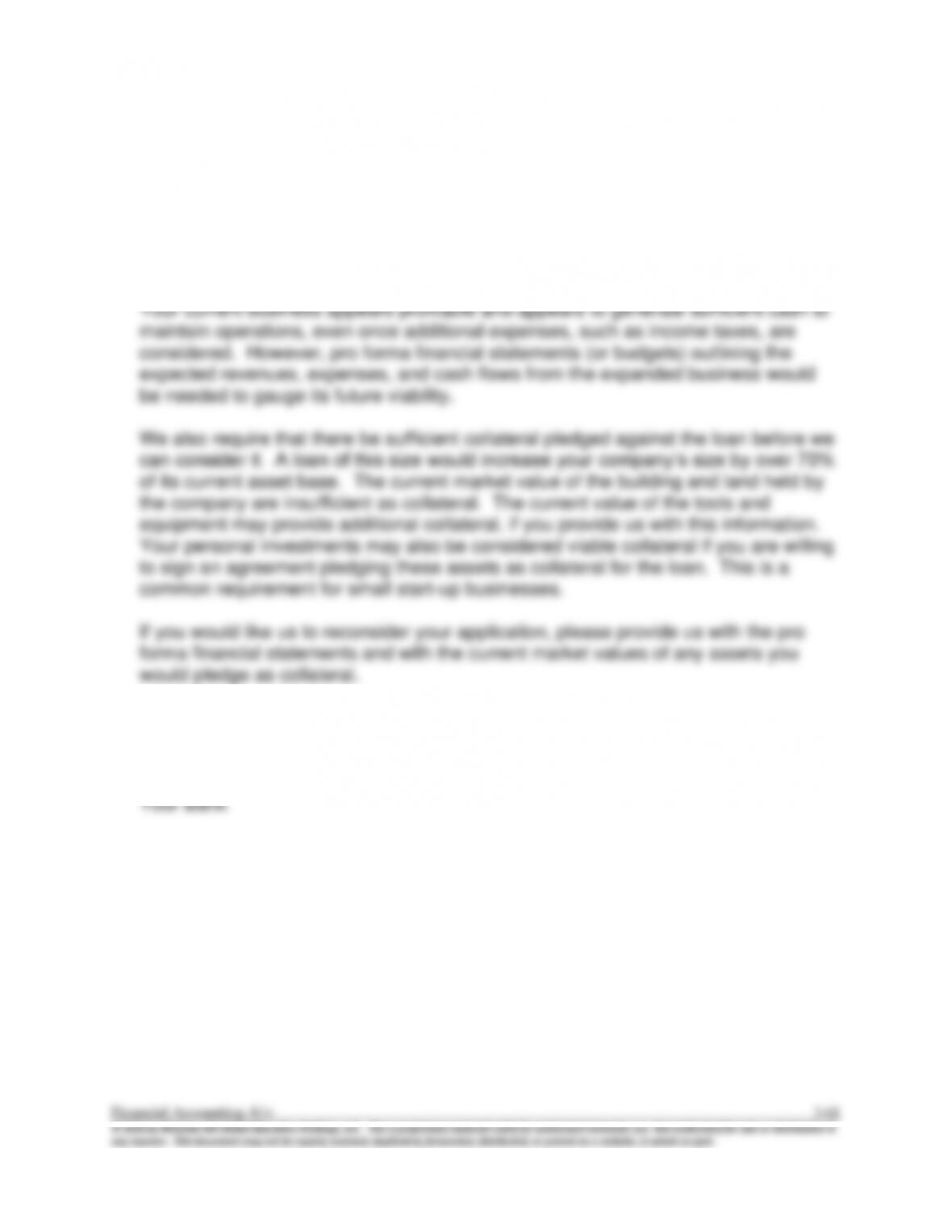
The above statements do not yet take into account most year-end adjustments,
including depreciation and income taxes. The adjusting entry for income taxes is
especially important because of the implication for future cash flows.
Chapter 03 – Operating Decisions and the Accounting System
CP3–6. (continued)
Req. 5
(today’s date)
Dear Mr. Estela:
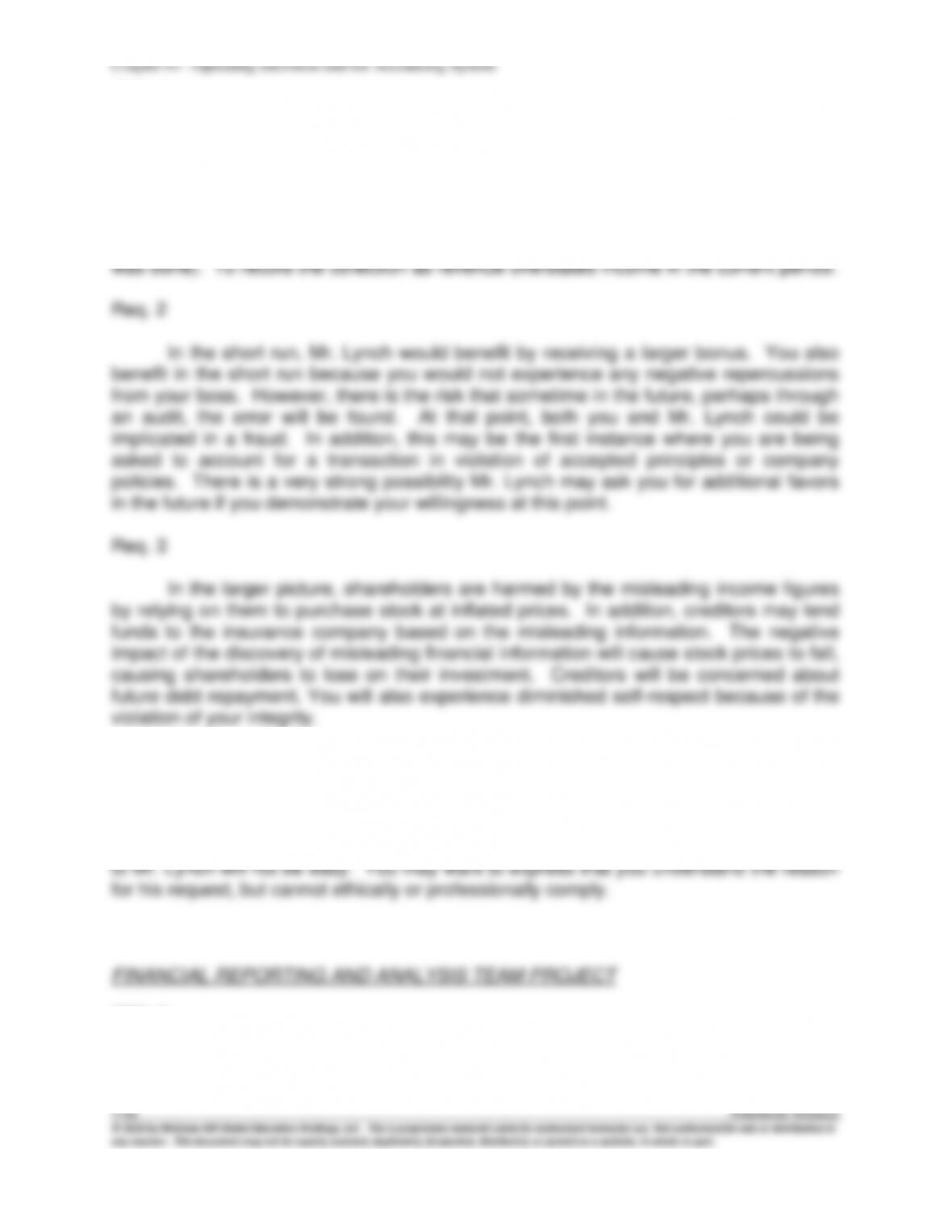
We regret to inform you that your request for a $100,000 loan has been denied.
Regards,
(your name)
Loan Application Department,
Chapter 03 – Operating Decisions and the Accounting System
CONTINUING CASE
CC3–1.
Req. 1
(a)
Advertising expense (+E, −SE) ……………………………………..
2,600
Cash (−A) ………………………………………………………..
2,600
(b)
Cash (+A) …………………………………………………………………..
16,000
Accounts receivable (+A) ……………………………………………..
3,200
Pool cleaning revenue (+R, +SE) …………………………
19,200
(c)
Accounts payable (−L) …………………………………………………
10,600
Cash (−A) ………………………………………………………..
10,600
(d)
Cash (+A) ………………………………………………………………….
10,000
Unearned pool cleaning revenue (+L) …………………..
10,000
(e)
Wages payable (−L) ……………………………………………………
1,500
Wages expense (+E, −SE ) ………………………………………….
3,000
Cash (−A) …………………………………………………………
4,500
(f)
Repairs expense (+E, −SE) ………………………………………….
310
Cash (−A) …………………………………………………………
310
(g)
Utilities expense (+E, −SE) …………………………………………..
220
Cash (−A) …………………………………………………………
220
(h)
Cash (+A) ………………………………………………………………….
75
Investment revenue (+R, +SE) …………………………...
75
(i)
Property tax expense (+E, −SE) ……………………………………
600
Property taxes payable (+L) ……………………………….
600
(j)
Prepaid expenses (+A) ………………………………………………..
2,400
Cash (−A) ………………………………………………………..
2,400