Chapter 03 – Operating Decisions and the Accounting System
P3–7. (continued)
Req. 2
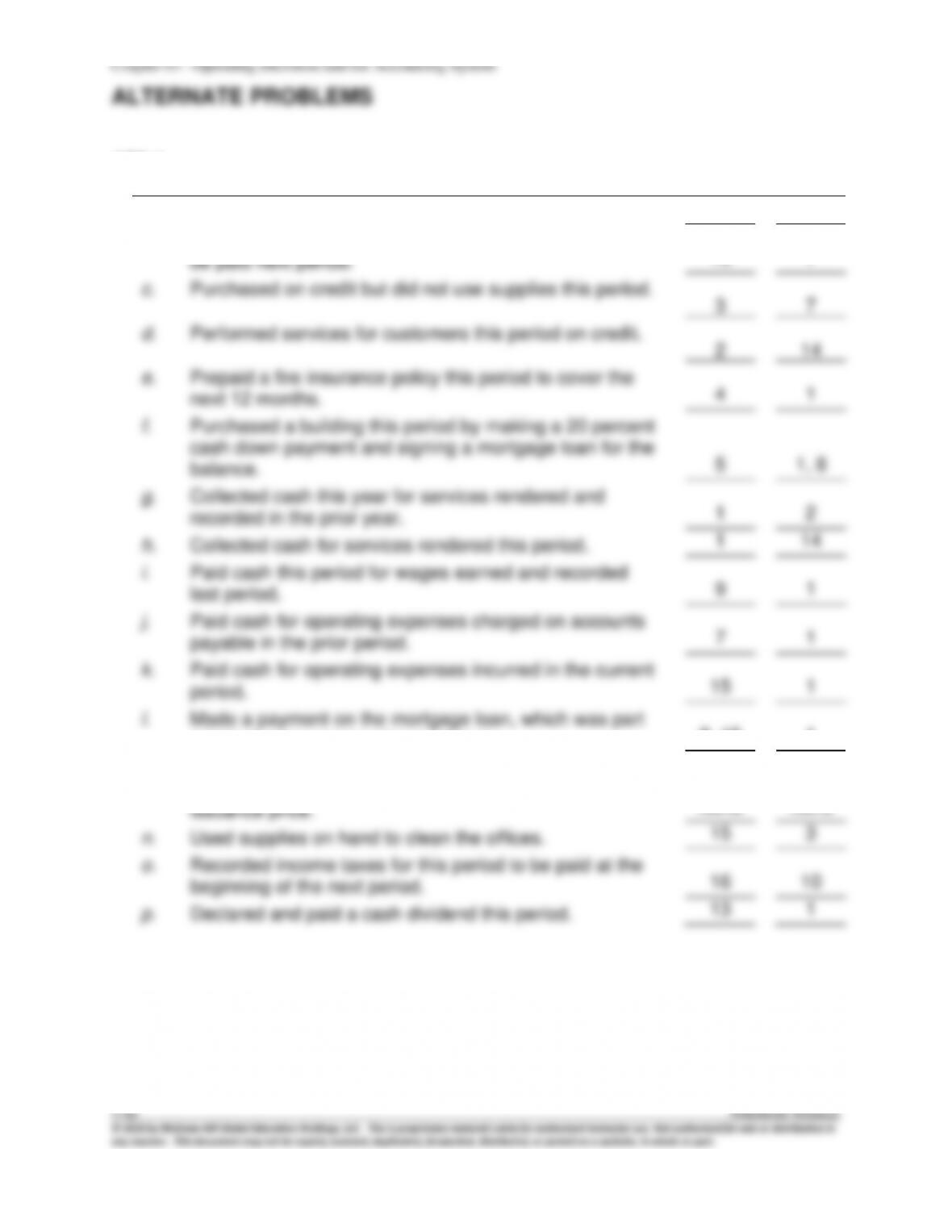
Transaction
Operating, Investing, or
Financing Cash Flows
Direction and Amount
of the Effect (in thousands)
(a)
O
+596,042
(b)
O
–401,630
(c)
F
–47,100
(d)
O
+365,693
(e)
I
–90,190
(f)
O
+81,855
(g)
O
–153,326
(h)
O
–119,431
(i)
O
–134,044
(j)
O
–11,600
3-42 Solutions Manual
© 2014 by McGraw-Hill Global Education Holdings, LLC. This is proprietary material solely for authorized instructor use. Not authorized for sale or distribution in
any manner. This document may not be copied, scanned, duplicated, forwarded, distributed, or posted on a website, in whole or part.
AP3-1.
Transactions
Debit
Credit
a.
Example: Issued stock to new investors.
1
11, 12
b.
Incurred and recorded operating expenses on credit to
be paid next period.
15
7
c.
Purchased on credit but did not use supplies this period.
3
7
d.
Performed services for customers this period on credit.
2
14
e.
Prepaid a fire insurance policy this period to cover the
next 12 months.
4
1
f.
Purchased a building this period by making a 20 percent
cash down payment and signing a mortgage loan for the
balance.
5
1, 8
g.
Collected cash this year for services rendered and
recorded in the prior year.
1
2
h.
Collected cash for services rendered this period.
1
14
i.
Paid cash this period for wages earned and recorded
last period.
9
1
j.
Paid cash for operating expenses charged on accounts
payable in the prior period.
7
1
k.
Paid cash for operating expenses incurred in the current
period.
15
1
l.
Made a payment on the mortgage loan, which was part
principal repayment and part interest.
8, 15
1
m.
This period a shareholder sold some shares of her stock
to another person for an amount above the original
issuance price.
None
None
n.
Used supplies on hand to clean the offices.
15
3
o.
Recorded income taxes for this period to be paid at the
beginning of the next period.
16
10
p.
Declared and paid a cash dividend this period.
13
1
Chapter 03 – Operating Decisions and the Accounting System
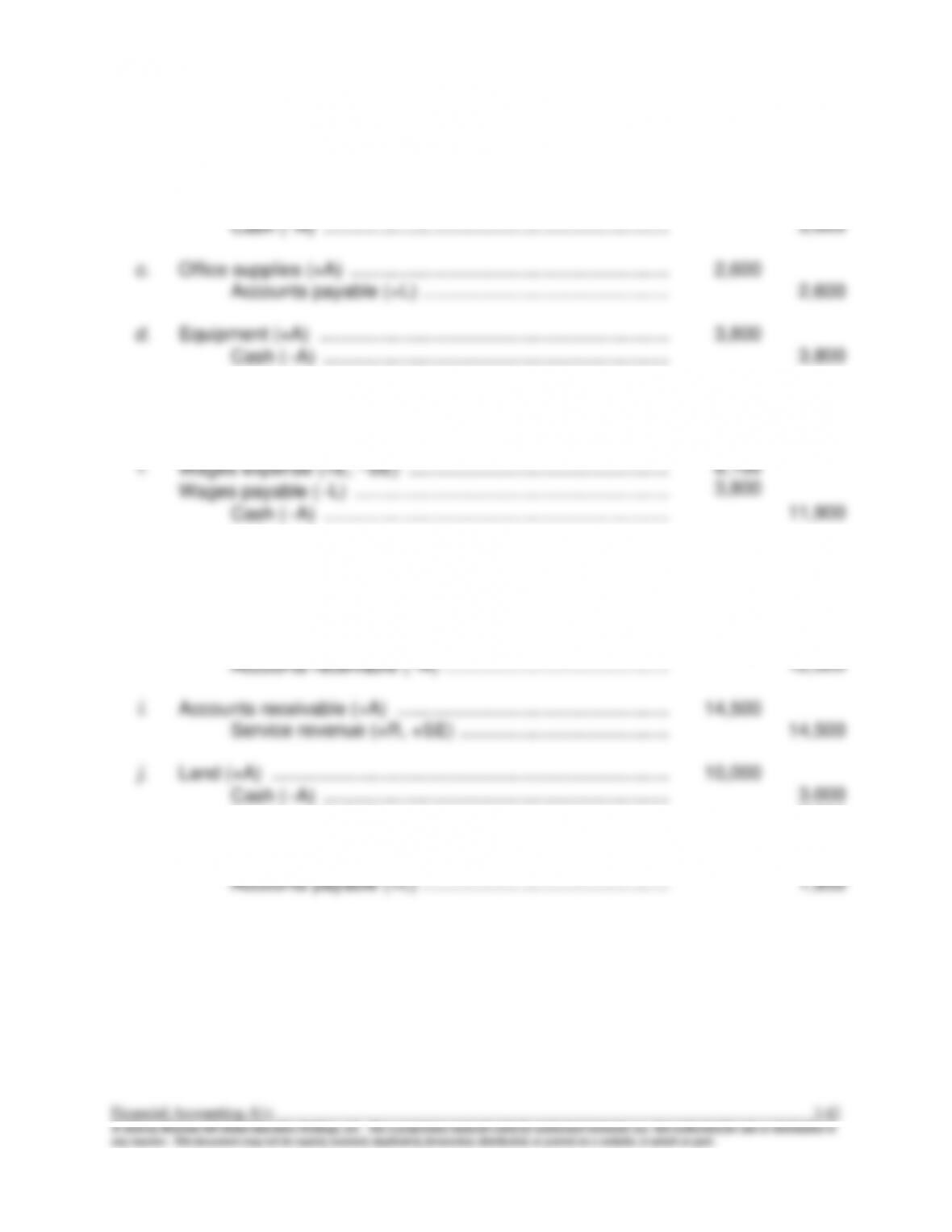
AP3–2.
a.
Accounts receivable (+A) …………………………………………….
23,500
Service revenue (+R, +SE) ………………………………….
23,500
b.
Accounts payable (−L) …………………………………………………
3,005
Cash (−A) …………………………………………………………
3,005
c.
Office supplies (+A) …………………………………………………….
2,600
Accounts payable (+L) ………………………………………..
2,600
d.
Equipment (+A) ………………………………………………………….
3,800
Cash (−A) …………………………………………………………
3,800
e.
Advertising expense (+E, −SE) ……………………………………..
1,400
Cash (−A) …………………………………………………………
1,400
f.
Wages expense (+E, −SE) …………………………………………..
Wages payable (−L) ……………………………………………………
8,100
3,800
Cash (−A) …………………………………………………………
11,900
g.
Cash (+A) ………………………………………………………………….
135,000
Common stock (+SE) …………………………………………
Additional paid-in capital (+SE) …………………………...
1,500
133,500
h.
Cash (+A) ………………………………………………………………….
12,500
Accounts receivable (−A) …………………………………….
12,500
i.
Accounts receivable (+A) …………………………………………….
14,500
Service revenue (+R, +SE) ………………………………….
14,500
j.
Land (+A) ………………………………………………………………….
10,000
Cash (−A) …………………………………………………………
Note payable (+L) ………………………………………………
3,000
7,000
k.
Utilities expense (+E, −SE) …………………………………………..
1,950
Accounts payable (+L) ………………………………………..
1,950
Chapter 03 – Operating Decisions and the Accounting System
AP3–4.
Req. 1 and 2
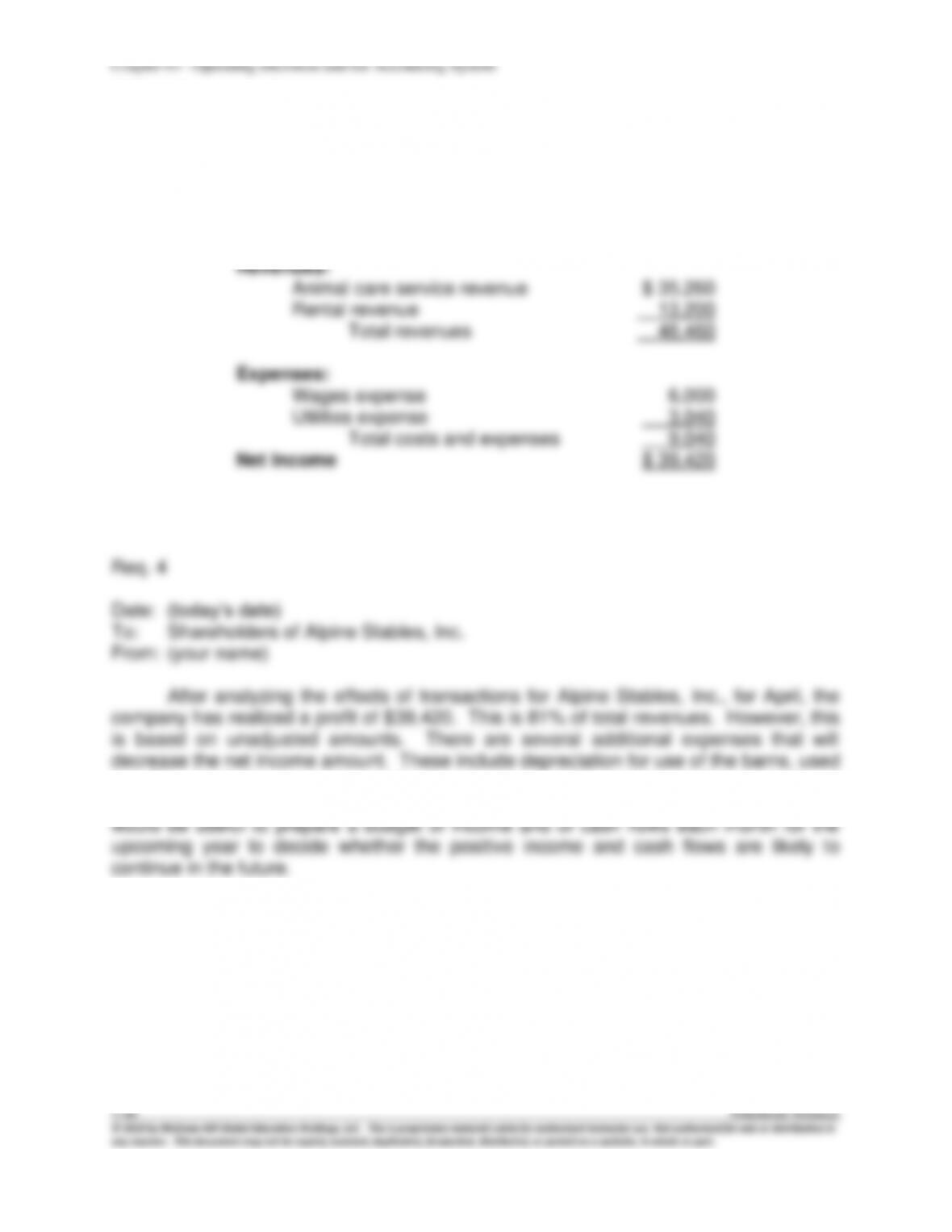
Cash
Accounts Receivable
Supplies
Beg. 0
(a) 60,000
(d) 13,200
(e) 2,400
(i) 10,000
31,000 (b)
1,240 (g)
2,700 (h)
6,000 (j)
3,600 (k)
500 (m)
Beg. 0
(c) 35,260
10,000 (i)
Beg. 0
(a) 12,000
(f) 3,810
40,560
25,260
15,810
Land
(k) 3,600
0 Beg.
3,810 (f)
1,800 (l)
0 Beg.
2,910
31,000
150 (a)
0 Beg.
150
Revenue
35,260 (c)
35,260
13,200
Chapter 03 – Operating Decisions and the Accounting System
AP3–4. (continued)
Req. 5
Net
Income
÷
Net Sales (or
Operating) Revenue
=
Net Profit Margin
Ratio
2016
$50,000
$450,000
0.1111 or 11.11%
2015
30,000
400,000
0.0750 or 7.5%
2014
(10,000)
360,000
(0.0278) or (2.78%)
Under your management, the net profit margin ratio appears to be increasing over time.
This suggests that management is more effective over time at generating revenues
and/or controlling expenses. In addition, with the new facilities, revenues should
increase in the future. However, expenses should also increase. As long as the
increase in expenses is proportional to the increase in revenues, the net profit margin
ratio should remain around 11%. Based on this rationale, you should be promoted.
AP3–5.
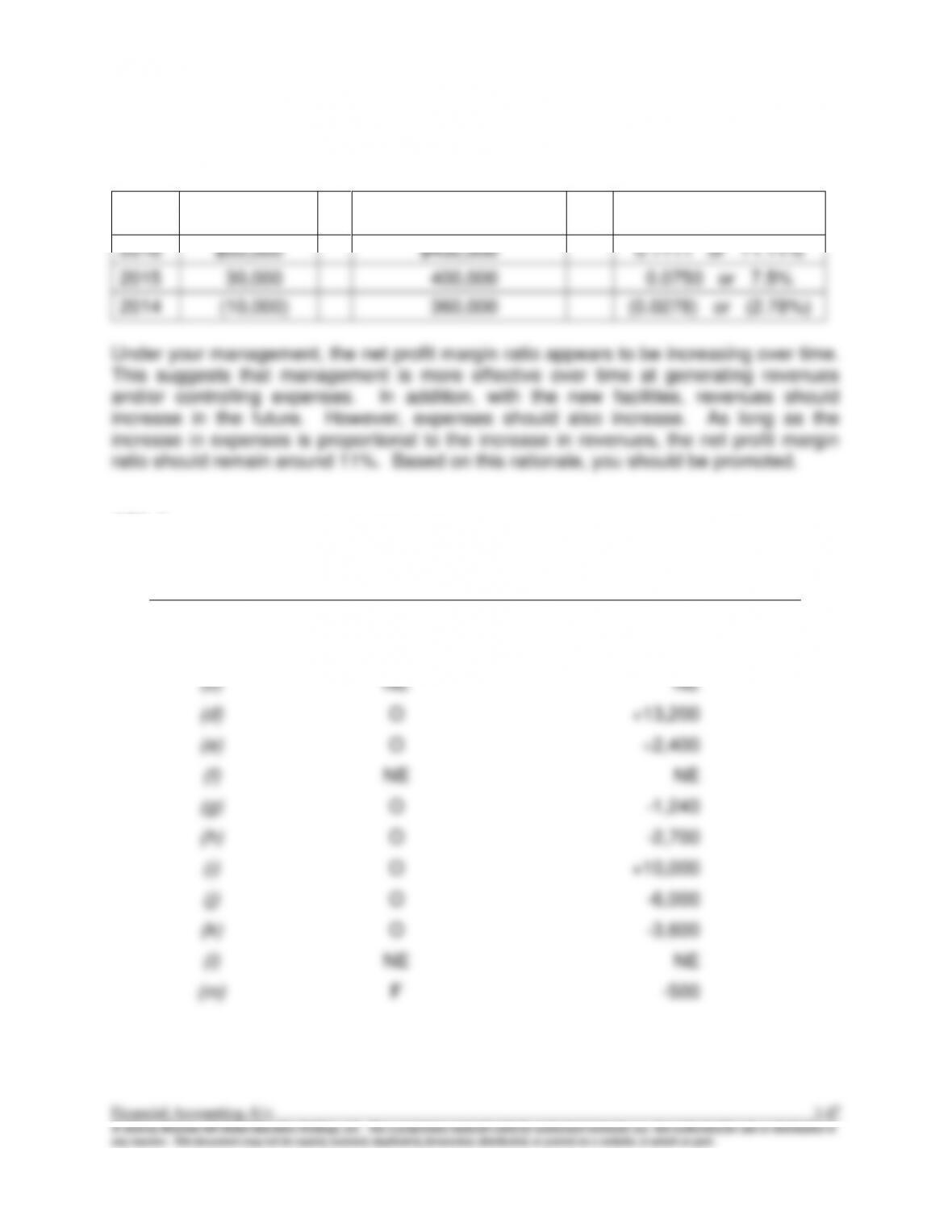
Transaction
Operating, Investing, or
Financing Cash Flows
Direction and Amount
of the Effect (in thousands)
(a)
F
+60,000
(b)
I
-31,000
(c)
NE
NE
(d)
O
+13,200
(e)
O
+2,400
(f)
NE
NE
(g)
O
-1,240
(h)
O
-2,700
(i)
O
+10,000
(j)
O
-6,000
(k)
O
-3,600
(l)
NE
NE
(m)
F
–500
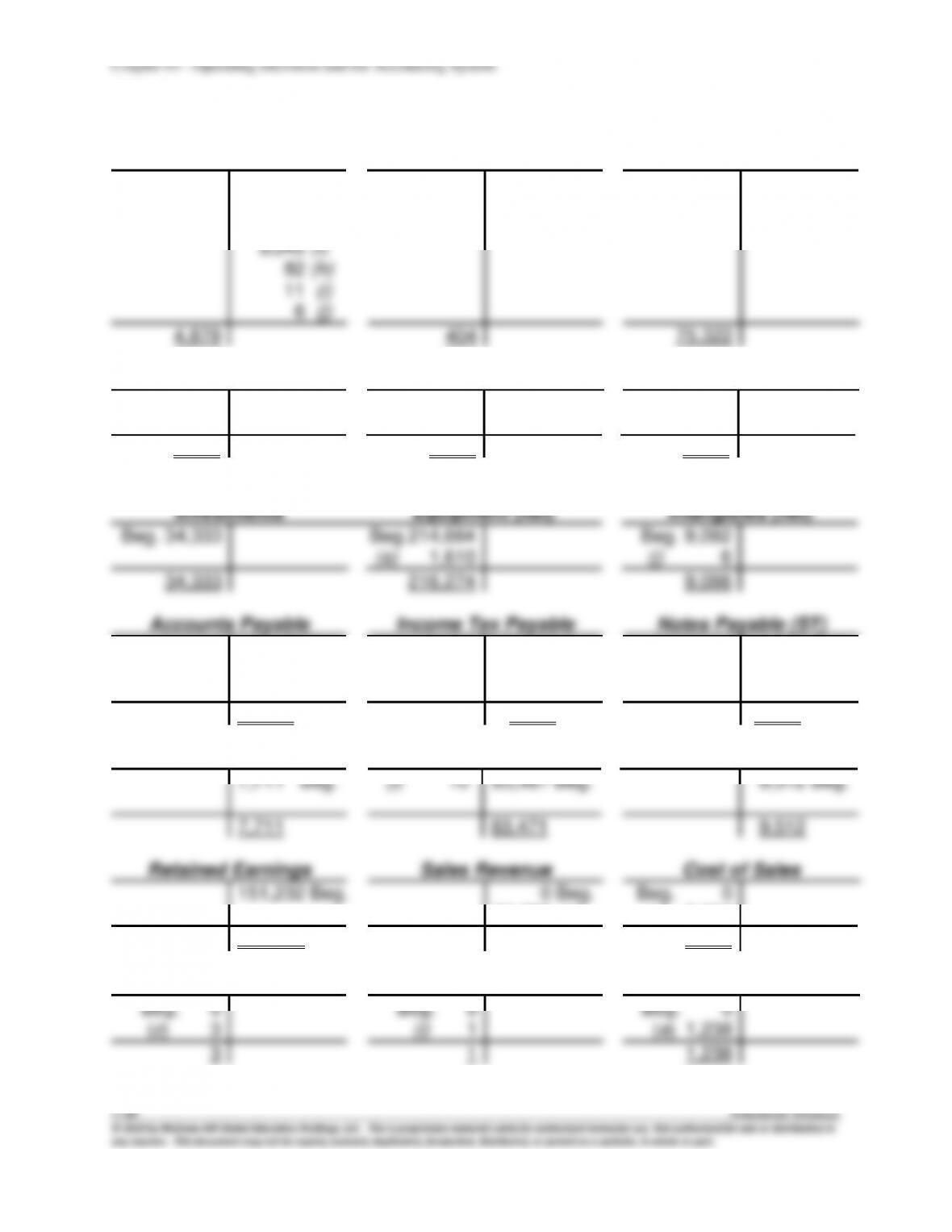
Chapter 03 – Operating Decisions and the Accounting System
AP3–6. (continued)
Req. 3
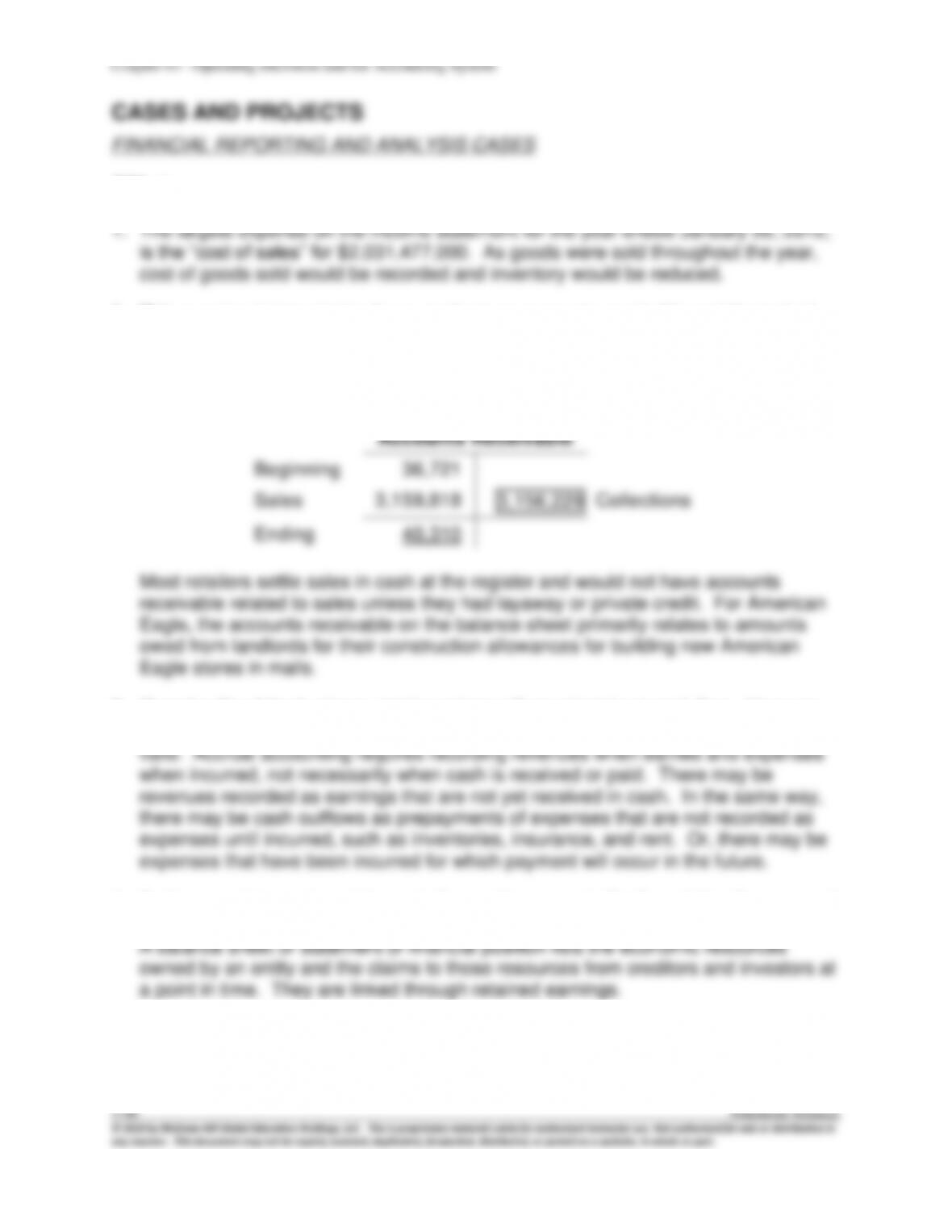
Exxon Mobil Corporation
Income Statement (unadjusted)
For the Month Ended January 31, 2014
for each $1 of sales revenue. This is high, primarily because the accounts are
unadjusted. Many additional expenses have yet to be recorded, such as the using of
property, plant, and equipment. The actual net profit margin for ExxonMobil based on
information reported in its recent annual report was 8.5%, not nearly 82% as determined
above.
3-50 Solutions Manual
© 2014 by McGraw-Hill Global Education Holdings, LLC. This is proprietary material solely for authorized instructor use. Not authorized for sale or distribution in
any manner. This document may not be copied, scanned, duplicated, forwarded, distributed, or posted on a website, in whole or part.
CP3–1.
2. This question is intended to focus students on accounts receivable and the typical
activities that increase and decrease the account.
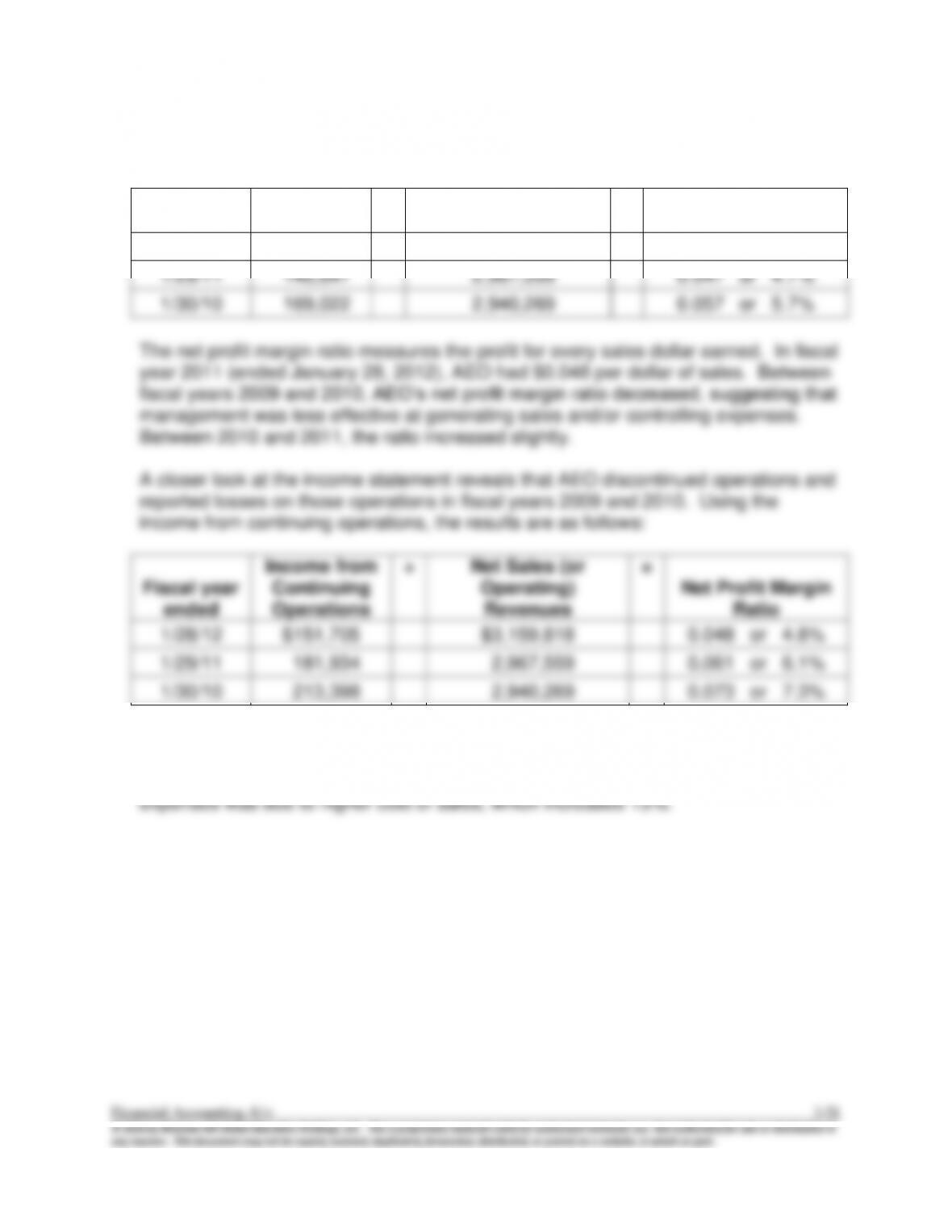
Assuming all net sales are on credit, American Eagle Outfitters collected
$3,156,229,000 from customers. T-account numbers are in thousands.
Accounts Receivable
Beginning
36,721
Sales
3,159,818
3,156,229
Collections
Ending
40,310
Most retailers settle sales in cash at the register and would not have accounts
receivable related to sales unless they had layaway or private credit. For American
Eagle, the accounts receivable on the balance sheet primarily relates to amounts
owed from landlords for their construction allowances for building new American
Eagle stores in malls.
3. Over the life of the business, total earnings will equal total net cash flow. However,
for any given year, the assumption that net earnings is equal to cash inflows is not
4. An income statement or statement of operations reports the financial performance of
a company over a period of time in terms of revenues, gains, expenses, and losses.
Chapter 03 – Operating Decisions and the Accounting System
CP3–1. (continued)
5. Dollars in thousands:
Fiscal year
ended
Net
Income
÷
Net Sales (or
Operating) Revenues
=
Net Profit Margin
Ratio
1/28/12
$151,705
$3,159,818
0.048 or 4.8%
1/29/11
140,647
2,967,559
0.047 or 4.7%
1/30/10
169,022
2,940,269
0.057 or 5.7%
The net profit margin ratio measures the profit for every sales dollar earned. In fiscal
year 2011 (ended January 28, 2012), AEO had $0.048 per dollar of sales. Between
fiscal years 2009 and 2010, AEO’s net profit margin ratio decreased, suggesting that
management was less effective at generating sales and/or controlling expenses.
Between 2010 and 2011, the ratio increased slightly.
A closer look at the income statement reveals that AEO discontinued operations and
reported losses on those operations in fiscal years 2009 and 2010. Using the
income from continuing operations, the results are as follows:
Fiscal year
ended
Income from
Continuing
Operations
÷
Net Sales (or
Operating)
Revenues
=
Net Profit Margin
Ratio
1/28/12
$151,705
$3,159,818
0.048 or 4.8%
1/29/11
181,934
2,967,559
0.061 or 6.1%
1/30/10
213,398
2,940,269
0.073 or 7.3%
From these results, it appears AEO became less effective at generating sales and/or
controlling expenses each year. Although sales increased by 6.5% between fiscal
years 2010 and 2011, expenses increased by 8.0%. Most of the increase in