Chapter 03 – Operating Decisions and the Accounting System
E3–10. (continued)
Req. 3
Net income using the accrual basis of accounting:
Revenues
$19,850
($19,000 + $850)
– Expenses
16,900
($16,500 + $400)
Net Income
(accrual basis)
$ 2,950
Assets
=
Liabilities
+
Stockholders’ Equity
$12,090
$ 7,700
$ 1,700
24,800
4,440
7,820
2,460
48,500
9,360
10,420
2,950 net income
7,400
25,300
$82,470
$60,640
$21,830
Req. 4
Net income using the cash basis of accounting:
Cash receipts
$27,650
(transactions a through d)
– Cash disbursements
19,760
(transactions g, i, and k)
Net Income
(cash basis)
$ 7,890
Cash basis net income ($7,890) is higher than accrual basis net income ($2,950)
because of the differences in the timing of recording revenues versus receipts and
expenses versus disbursements between the two methods. The $7,800 higher amount
in cash receipts over revenues includes cash received prior to being earned (from (b),
$600) and cash received after being earned (in (d), $7,200). The $2,860 higher amount
Chapter 03 – Operating Decisions and the Accounting System
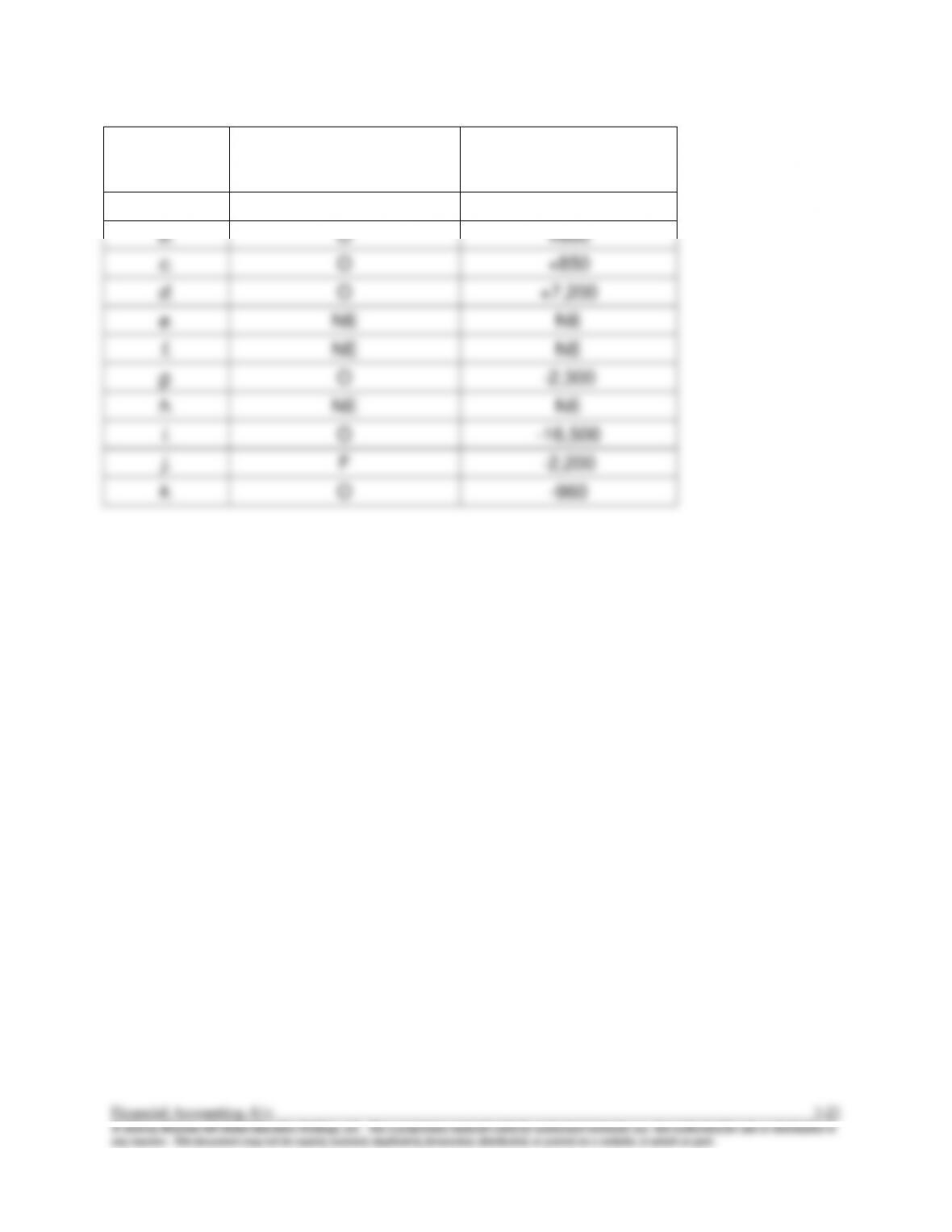
E3–12.
Transaction
O, I, or F Activity (or No
Effect) on Statement of
Cash Flows
Direction and Amount
of Effect
a.
O
+19,000
b.
O
+600
c.
O
+850
d.
O
+7,200
e.
NE
NE
f.
NE
NE
g.
O
-2,300
h.
NE
NE
i.
O
-16,500
j.
F
-2,200
k.
O
–960
Chapter 03 – Operating Decisions and the Accounting System
E3–14.
Req. 1
TRAVELING GOURMET, INC.
Income Statement (unadjusted)
For the Month Ended March 31, 2014
Revenues:
Food sales revenue
Catering sales revenue
Total revenues
Expenses:
Supplies expense
Utilities expense
Wages expense
Fuel expense
Total costs and expenses
$ 11,900
4,200
16,100
10,830
420
6,280
363
17,893
Net Loss
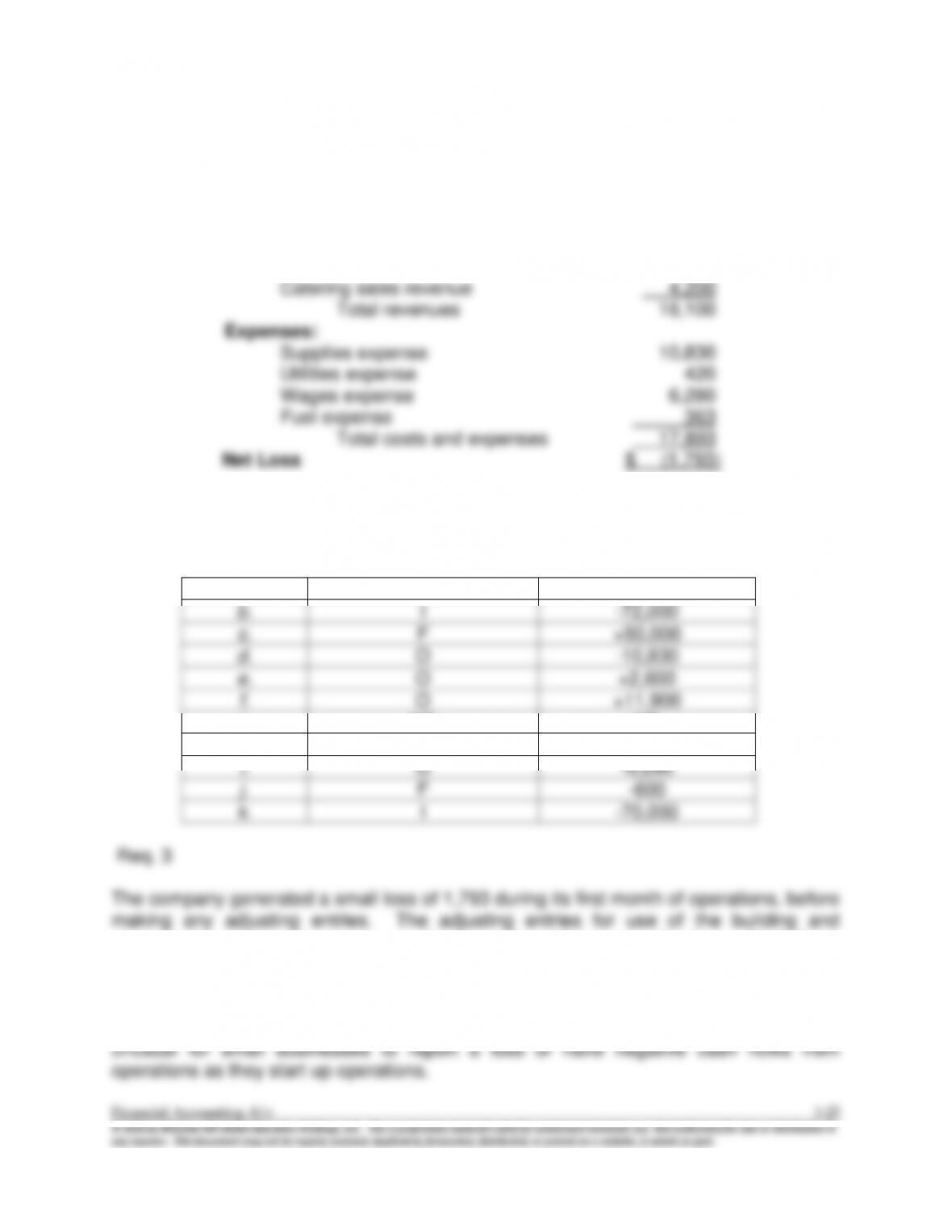
$ (1,793)
Req. 2
Transaction
O, I, or F Activity (or No
Effect) on Statement of
Cash Flows
Direction and Amount
of Effect
a.
F
+160,000
b.
I
-72,000
c.
F
+50,000
d.
O
-10,830
e.
O
+2,600
f.
O
+11,900
g.
NE
NE
h.
O
–363
i.
O
-6,280
j.
F
–600
k.
I
-70,000
Req. 3
The company generated a small loss of 1,793 during its first month of operations, before
making any adjusting entries. The adjusting entries for use of the building and
equipment and interest expense on the borrowing will increase the loss. Cash flows
from operating activities were also negative at $2,973 (= + 11,900 + 2,600 – 10,830 –
363 – 6,280) . So far the company does not appear to be successful, but it is only in its
first month of operating a retail store. If sales can be increased without inflating fixed
costs (particularly salaries expense), the company may soon turn a profit. It is not
Chapter 03 – Operating Decisions and the Accounting System
E3–15. (continued)
Kate’s Kite Company
Balance Sheet
At April 30, 2014
Assets
Liabilities and Shareholders’ Equity
Current Assets:
Current Liabilities:
Cash
$70,400
Accounts payable
$20,080
Accounts receivable
4,180
Unearned revenue
2,510
Inventory
17,800
Total current liabilities
22,590
Prepaid expenses
1,860
Shareholders’ Equity:
Total current assets
94,240
Common stock
10,000
Store fixtures
15,400
Additional paid-in capital
72,000
Retained earnings
5,050
Total shareholders’ equity
87,050
Total Assets
$109,640
Total Liabilities &
Shareholders’ Equity
$109,640
E3–16.
Req. 1
Assets
=
Liabilities
+
Stockholders’ Equity
$ 3,200
$ 2,400
$ 800
8,000
5,600
4,000
6,400
1,600
3,200
$17,600
$9,600
$ 8,000
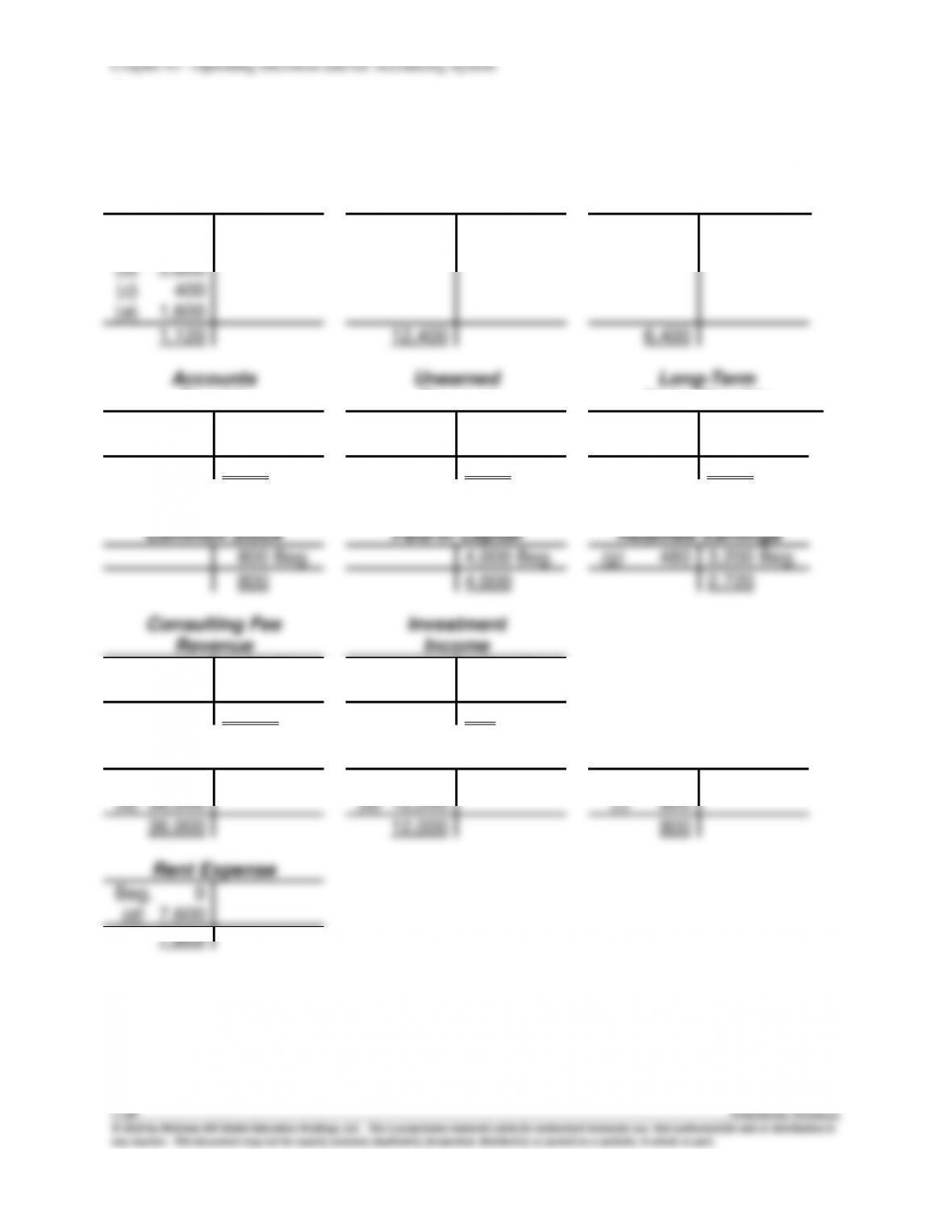
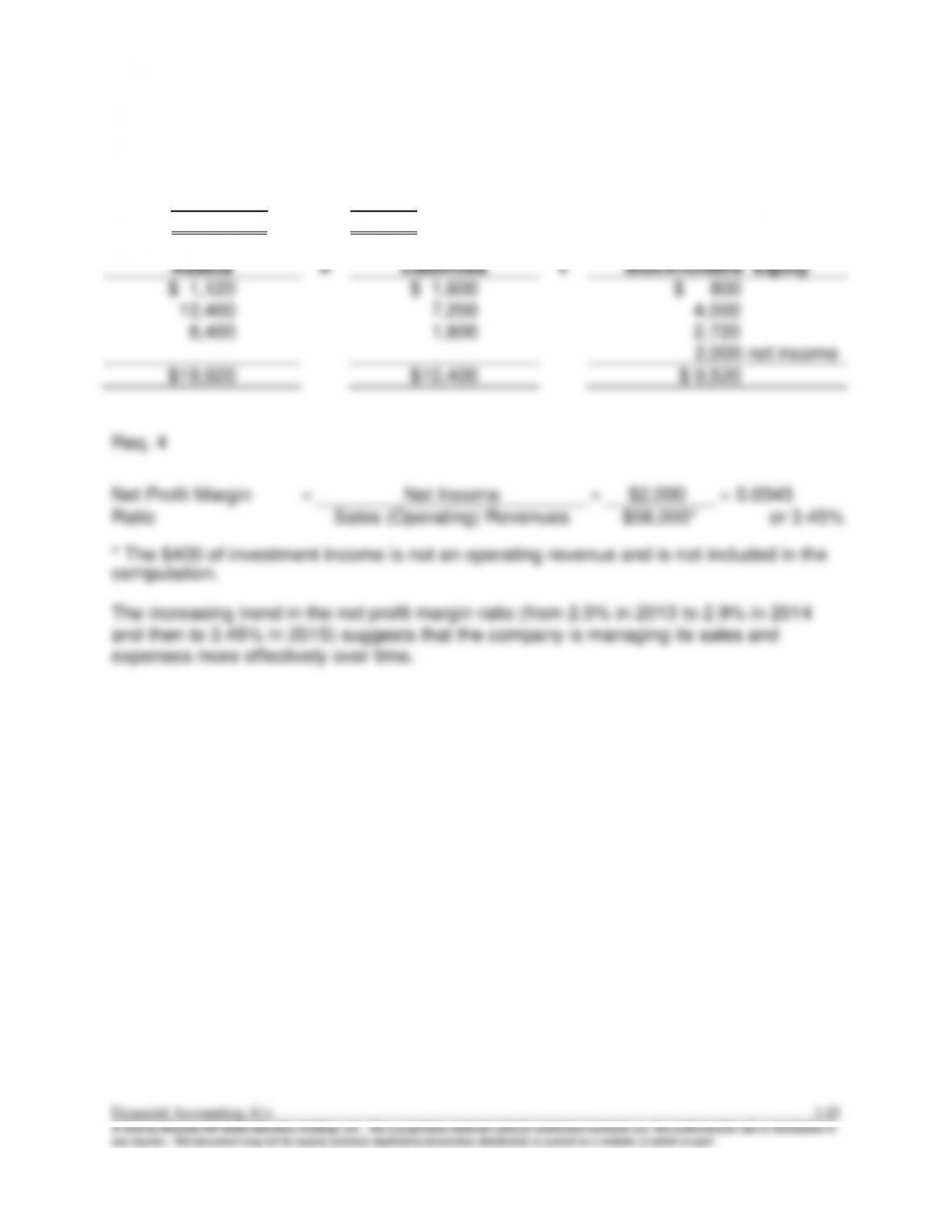
Chapter 03 – Operating Decisions and the Accounting System
E3–16. (continued)
Req. 3
Revenues
$58,400
($58,000 from sales + $400 on investments)
– Expenses
56,400
($36,000 + $12,000 + $800 + $7,600)
Net Income
$ 2,000
Assets
=
Liabilities
+
Stockholders’ Equity
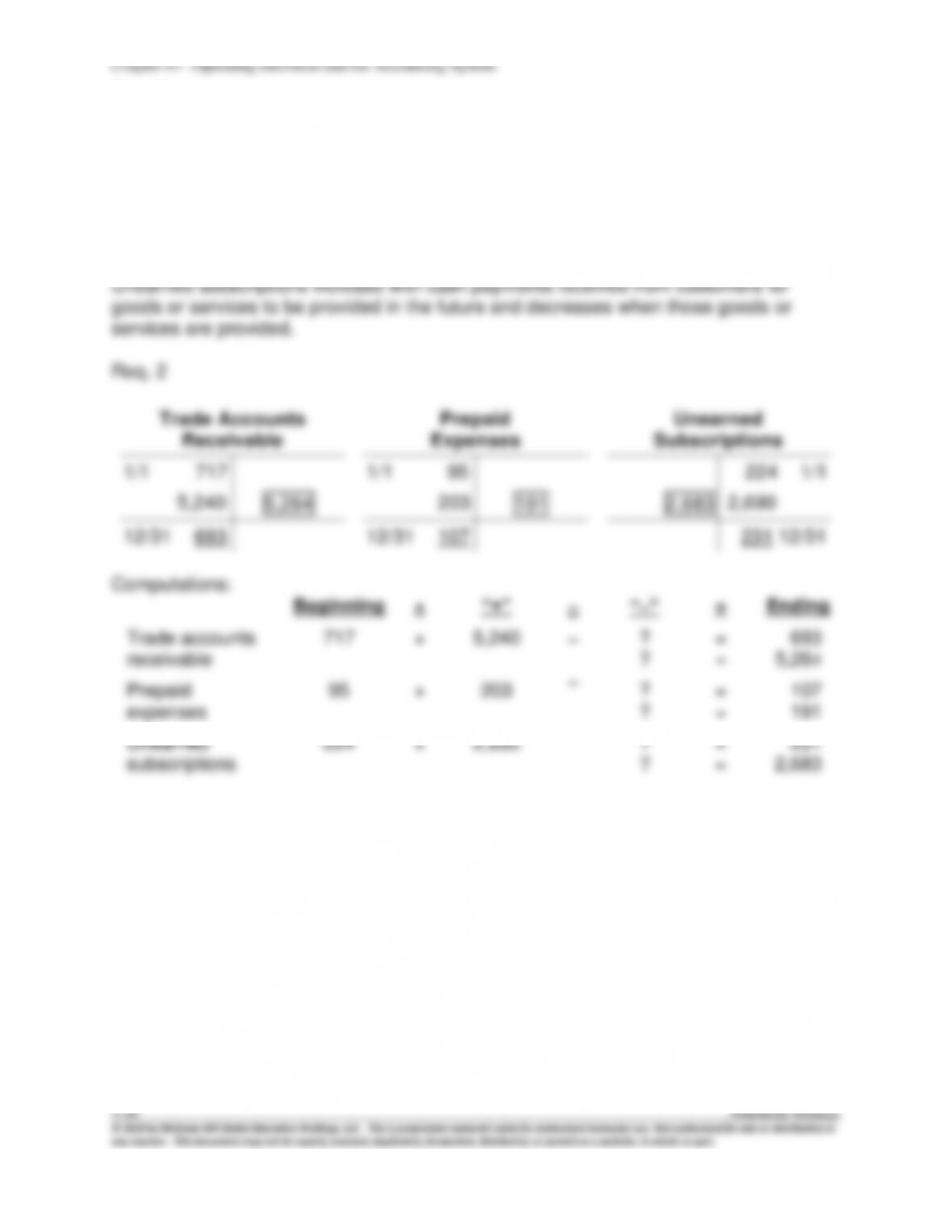
$ 1,120
$ 1,600
$ 800
12,400
7,200
4,000
6,400
1,600
2,720
2,000 net income
$19,920
$10,400
$ 9,520
Req. 4
Net Profit Margin
=
Net Income
=
$2,000
=
0.0345
Ratio
Sales (Operating) Revenues
$58,000*
or 3.45%
* The $400 of investment income is not an operating revenue and is not included in the
computation.
The increasing trend in the net profit margin ratio (from 2.5% in 2013 to 2.9% in 2014
and then to 3.45% in 2015) suggests that the company is managing its sales and
expenses more effectively over time.
Chapter 03 – Operating Decisions and the Accounting System
Financial Accounting, 8/e 3-31
E3–18.
ITEM
LOCATION
1. Description of a company’s
primary business(es).
Letter to shareholders;
Management’s Discussion and Analysis;
Summary of significant accounting policies
note
2. Income taxes paid.
Notes; Statement of cash flows
3. Accounts receivable.
Balance sheet
4. Cash flow from operating
activities.
Statement of cash flows
5. Description of a company’s
revenue recognition policy.
Summary of significant accounting policies
note
6. The inventory sold during the
year.
Income statement (Cost of Goods Sold)
7. The data needed to compute the
net profit margin ratio.
Income statement
Chapter 03 – Operating Decisions and the Accounting System
PROBLEMS
P3-1.
Transactions
Debit
Credit
a.
Example: Purchased equipment for use in the business;
paid one-third cash and signed a note payable for the balance.
5
1, 8
b.
Paid cash for salaries and wages earned by employees this
period.
15
1
c.
Paid cash on accounts payable for expenses
incurred last period.
7
1
d.
Purchased supplies to be used later; paid cash.
3
1
e.
Performed services this period on credit.
2
14
f.
Collected cash on accounts receivable for services
performed last period.
1
2
g.
Issued stock to new investors.
1
11, 12
h.
Paid operating expenses incurred this period.
15
1
i.
Incurred operating expenses this period to be paid
next period.
15
7
j.
Purchased a patent (an intangible asset); paid cash.
6
1
k.
Collected cash for services performed this period.
1
14
l.
Used some of the supplies on hand for operations.
15
3
m.
Paid three-fourths of the income tax expense for the year;
the balance will be paid next year.
16
1, 10
n.
Made a payment on the equipment note in (a); the payment
was part principal and part interest expense.
8, 17
1
o.
On the last day of the current period, paid cash for an
insurance policy covering the next two years.
4
1
Chapter 03 – Operating Decisions and the Accounting System
Financial Accounting, 8/e 3-33
P3–2.
a.
Cash (+A) ………………………………………………………………….
40,000
Common stock (+SE) ……………………………………………..
20
Additional paid-in capital (+SE) ……………………………….
39,980
b.
Cash (+A) ………………………………………………………………….
60,000
Note payable (long-term) (+L) ………………………………….
60,000
c.
Rent expense (+E, −SE) ………………………………………………
1,500
Prepaid rent (+A) ………………………………………………………..
1,500
Cash (−A) ……………………………………………………………..
3,000
d.
Prepaid insurance (+A) ………………………………………………..
2,400
Cash (−A) …………………………………………………………….
2,400
e.
Furniture and fixtures (or Equipment) (+A) ……………………..
15,000
Accounts payable (+L) …………………………………………..
12,000
Cash (−A) …………………………………………………………….
3,000
f.
Inventory (+A) …………………………………………………………….
2,800
Cash (−A) …………………………………………………………….
2,800
g.
Advertising expense (+E, −SE)……………………………………..
350
Cash (−A) …………………………………………………………….
350
h.
Cash (+A) ………………………………………………………………….
850
Accounts receivable (+A) …………………………………………….
850
Sales revenue (+R, +SE) ……………………………………….
1,700
Cost of goods sold (+E, −SE) ……………………………………….
900
Inventory (−A) ………………………………………………………
900
i.
Accounts payable (−L) …………………………………………………
12,000
Cash (−A) …………………………………………………………….
12,000
j.
Cash (+A) ………………………………………………………………….
210
Accounts receivable (−A) ……………………………………….
210
Chapter 03 – Operating Decisions and the Accounting System
P3–4.
Req. 1 and 2
Cash
Accounts Receivable
Supplies
Beg. 0
(a) 30,200
(e) 11,000
(h) 2,675
(k) 600
(m) 1,200
5,250 (b)
1,560 (d)
11,000 (f)
400 (g)
550 (i)
1,300 (j)
400 (l)
Beg. 0
(h) 825
600 (k)
Beg. 0
(d) 1,560
25,215
225
1,560
Inventory
Prepaid Expenses
Equipment
Beg. 0
(c) 6,000
1,600 (h)
600 (m)
Beg. 0
(b) 5,250
Beg. 0
(f) 2,750
3,800
5,250
2,750
Accounts Payable
6,000 (c)
8,250
5,450
40 (a)
40
1,200 (m)
Beg. 0
(h) 1,600
Beg. 0
2,200
400
1,300
Chapter 03 – Operating Decisions and the Accounting System
P3–5.
Transaction
O, I, or F Activity (or No
Effect) on Statement of
Cash Flows
Direction and Amount
of Effect
a.
F
+30,200
b.
O
-5,250
c.
NE
NE
d.
O
-1,560
e.
F
+11,000
f.
I
-11,000
g.
O
–400
h.
O
+2,675
i.
O
–550
j.
O
-1,300
k.
O
+600
l.
O
–400
m.
O
+1,200
Chapter 03 – Operating Decisions and the Accounting System
P3–6. (continued)
Req. 3
FedEx
Income Statement (unadjusted)
For the Year Ended May 31, 2015
(in millions)
Revenues:
Delivery service revenue
Expenses:
Rental expense
Wage expense
Fuel expense
Repair expense
Total expenses
$ 39,304
10,136
15,276
8,564
3,864
37,840
Net Income
$ 1,464
Req. 4
Net Profit Margin Ratio
=
Net Income
=
$1,464
=
0.037 or 3.7%
Net Sales (or Operating)
Revenues
$39,304
The net profit margin ratio suggests that the company obtained nearly $0.04 in net
income for every $1 in sales revenue. To analyze this result, we would need to
calculate the ratio for the company over time to observe the trend in how effectively
management is at generating sales and/or controlling expenses. We would also need
the industry ratio for the current period to determine how the company is doing in