Chapter 11 – Reporting and Interpreting Owners’ Equity
E11–20.
July 15
Retained earnings (-SE) ………………………………………………..
119,900,000
Cash (-A) …………………………………………………………………
119,900,000
Declaration and payment of preferred dividends.
Retained earnings (-SE) ………………………………………………..
691,688,600
Cash (-A) …………………………………………………………………
691,688,600
Declaration and payment of common dividends.
Shares issued ………………….
387,514,300
Treasury stock ………………….
41,670,000
Shares outstanding …………..
345,844,300
Dividends paid:
345,844,300 x $2 = $691,688,600
E11–21.
Req. 1
Stockholders’ Equity
Before Stock
Dividend
After Stock
Dividend
Contributed capital:
Common stock, authorized 65,000 shares
Outstanding: 30,000 shares, par $12 ………….
$360,000
Outstanding: 48,000 shares, par $12 ………….
$576,000
Capital in excess of par value ……………………….
120,000
120,000
Retained earnings …………….
580,000
364,000
Total stockholders’ equity………………………….
$1,060,000
$1,060,000
Req. 2
Item
Effects of Stock Dividend
Assets
No change because no assets were disbursed.
Liabilities
No change because no liability was created (no assets were to be
disbursed).
Stockholders’
equity
–Total stockholders’ equity not changed.
–Retained earnings was reduced by the amount of the dividend.
–The common stock account was increased by the same amount.
Chapter 11 – Reporting and Interpreting Owners’ Equity
E11–24.
Comparative results:
Items
Before Dividend
and Split
After Stock
Dividend
After Stock
Split
Common stock account
$640,000
$896,000
$640,000
Par per share
$8
$8
$ 4.80
Shares outstanding
80,000
112,000
133,333
Capital in excess of par
$ 280,000
$ 280,000
$ 280,000
Retained earnings
$ 2,100,000
$ 1,844,000
$ 2,100,000
Total stockholders’ equity
$3,020,000
$3,020,000
$3,020,000
Comments: Neither the stock dividend nor stock split changed total stockholders’ equity
because neither involved the disbursement of assets. The stock dividend reduced
retained earnings and increased the common stock account by the same amount; it
increased shares outstanding but did not change par value per share. The stock split
did not change any account balances; its only effects were to (1) increase shares
outstanding and (2) decrease par value per share.
E11–25.
Req. 1
A corporation does not need to earn net income in a given year in order to declare and
pay dividends. There are two requirements 1) the balance of retained earnings should
be sufficient to pay dividends, and 2) there must be sufficient cash on hand.
Req. 2
11–24 Solutions Manual
© 2014 by McGraw-Hill Global Education Holdings, LLC. This is proprietary material solely for authorized instructor use. Not authorized for sale or distribution in
any manner. This document may not be copied, scanned, duplicated, forwarded, distributed, or posted on a website, in whole or part.
P11–1.
1.
Shares authorized (given) ……………………………………………………………….
200,000
Shares issued ($2,125,000 $17) ……………………………………………………
125,000
Shares outstanding (125,000 – 3,000) ………………………………………………
122,000
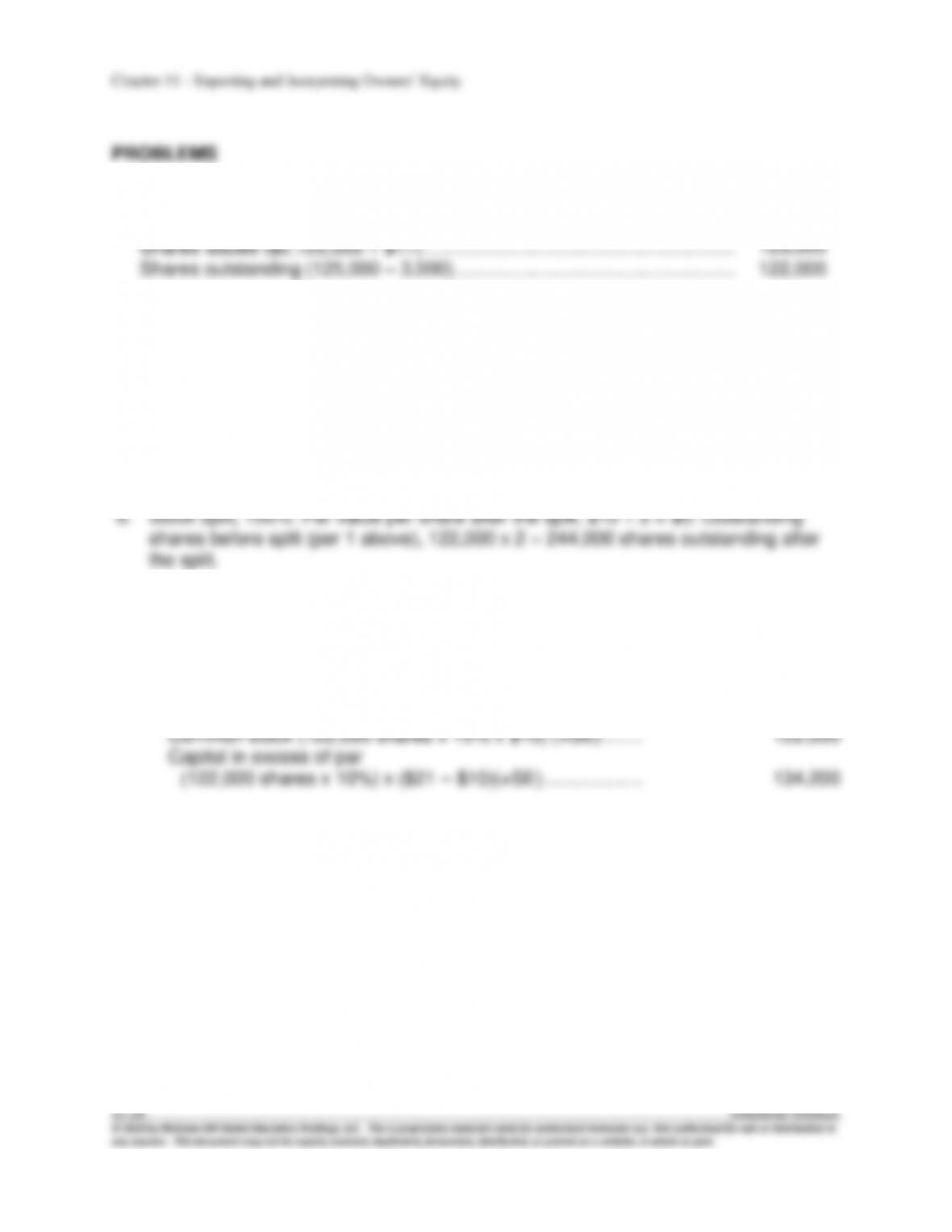
2. Capital in excess of par: $2,125,000 – (125,000 shares issued x $10 par) =
$875,000.
3. Earnings per share: $240,340 122,000 shares = $1.97
4. Dividend per share: $123,220 122,000 shares = $1.01.
5. Treasury stock: Stockholders’ equity, as a deduction in the amount of 3,000 shares
x $20 cost = $60,000.
7. Entry for the stock split—None, because the total par value amount before and
after the split is the same; retained earnings are not capitalized in a stock split.
8. Entry for stock dividend (capitalize retained earnings for market value of $21 per
share):
Retained earnings (122,000 shares x 10% x $21) (-SE) …….
256,200
Common stock (122,000 shares x 10% x $10) (+SE) ……..
122,000
Capital in excess of par
(122,000 shares x 10%) x ($21 – $10)(+SE) ……………….
134,200
Chapter 11 – Reporting and Interpreting Owners’ Equity
P11–2.
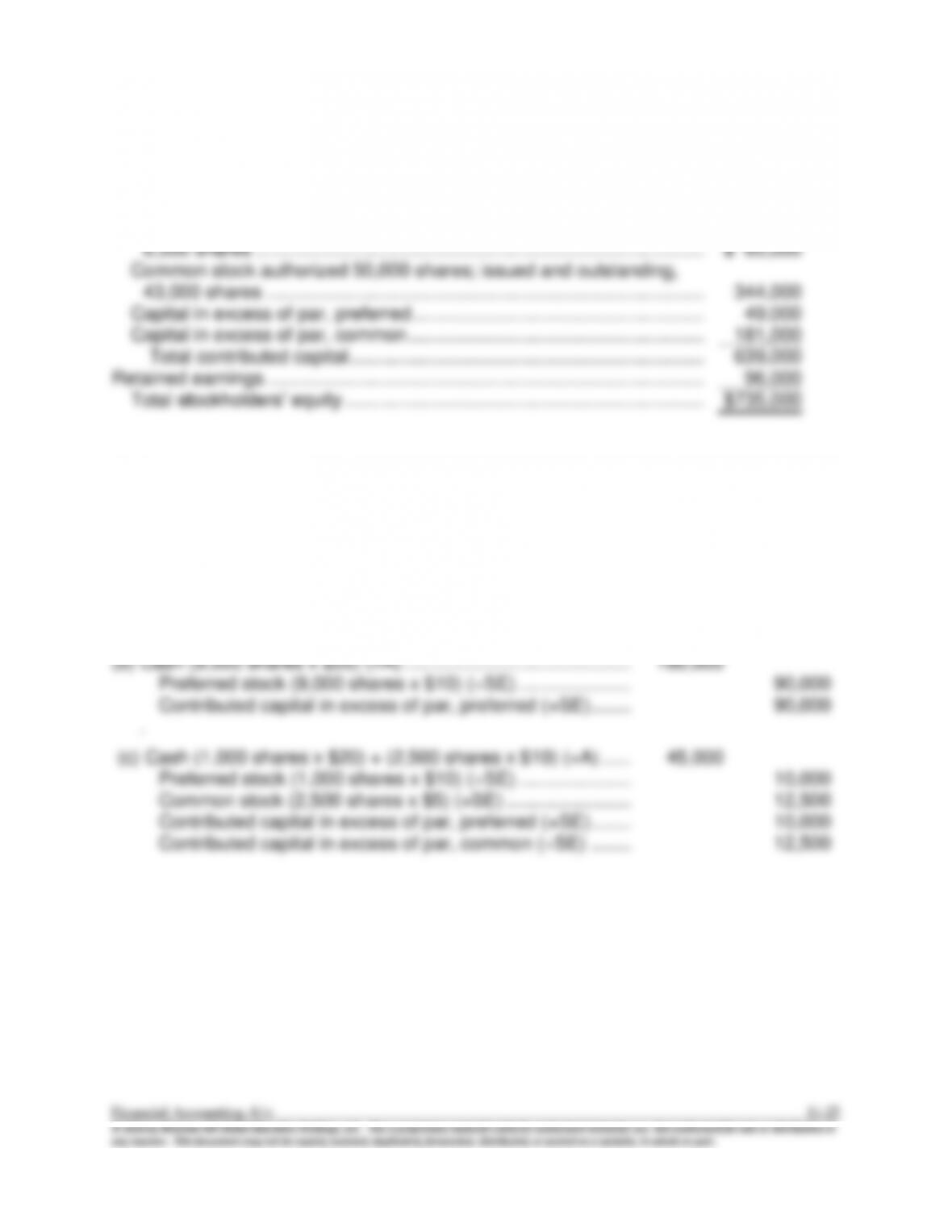
Stockholders’ Equity
Contributed capital:
Preferred stock authorized 21,000 shares; issued and outstanding,
6,500 shares …………………………………………………………………………..
$ 65,000
Common stock authorized 50,000 shares; issued and outstanding,
43,000 shares …………………………………………………………………………
344,000
Capital in excess of par, preferred ………………………………………………..
49,000
Capital in excess of par, common …………………………………………………
181,000
Total contributed capital …………………………………………………………..
639,000
Retained earnings …………………………………………………………………………
96,000
Total stockholders’ equity ……………………………………………………………
$735,000
P11–3.
(a)
Cash (66,000 shares x $9)(+A) ………………………………………
594,000
Common stock (66,000 shares x $5) (+SE) …………………
330,000
Contributed capital in excess of par, common (66,000 x
$4) (+SE) ………………………………………………………………
264,000
.
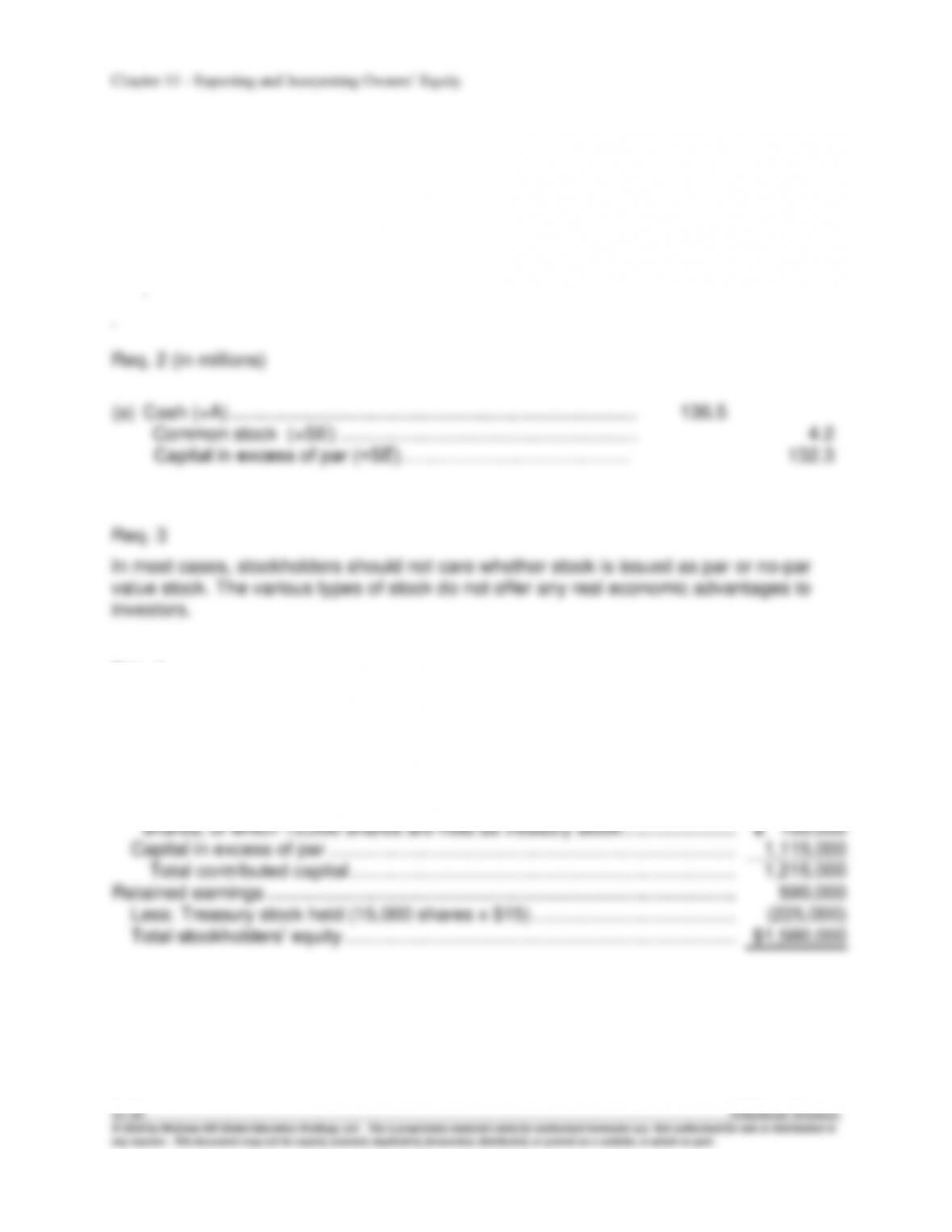
(b)
Cash (9,000 shares x $20) (+A) ……………………………………..
180,000
Preferred stock (9,000 shares x $10) (+SE) ………………….
90,000
Contributed capital in excess of par, preferred (+SE) ……..
90,000
.
(c)
Cash (1,000 shares x $20) + (2,500 shares x $10) (+A) ……
45,000
Preferred stock (1,000 shares x $10) (+SE) ………………….
10,000
Common stock (2,500 shares x $5) (+SE) ……………………
12,500
Contributed capital in excess of par, preferred (+SE) ……..
10,000
Contributed capital in excess of par, common (+SE) ……..
12,500
11–26 Solutions Manual
© 2014 by McGraw-Hill Global Education Holdings, LLC. This is proprietary material solely for authorized instructor use. Not authorized for sale or distribution in
any manner. This document may not be copied, scanned, duplicated, forwarded, distributed, or posted on a website, in whole or part.
P11–4.
Req. 1 (in millions)
(a)
Cash (+A) ……………………………………………………………………
136.5
Common stock (+SE) ……………………………………………….
136.5
.
(a)
Cash (+A) …………………………..……………………………………….
136.5
Common stock (+SE) …………………………………………………
4.2
Capital in excess of par (+SE)……………………………….
132.3
P11–5.
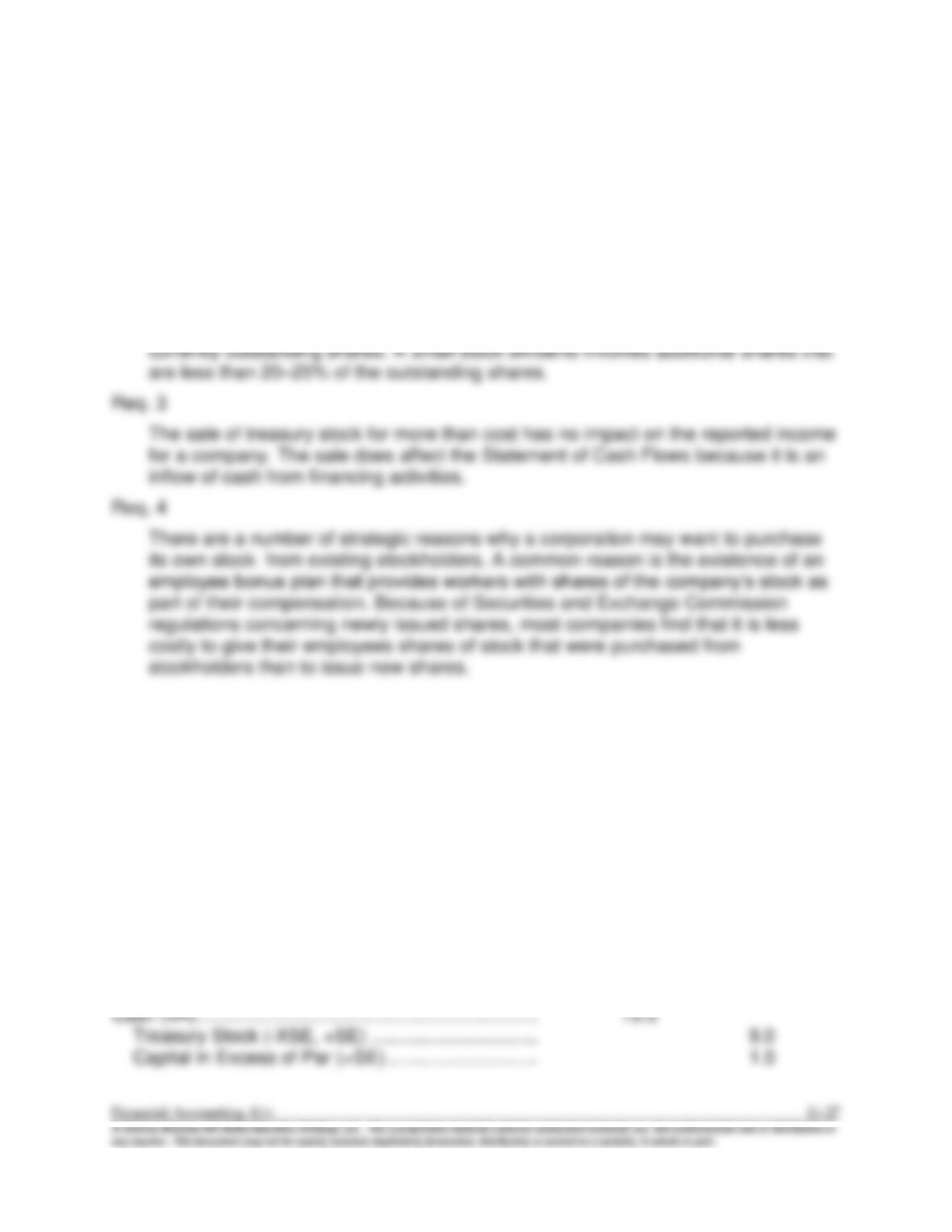
Stockholders’ Equity
Contributed capital:
Common stock, par $1, authorized 200,000 shares; issued 100,000
shares, of which 15,000 shares are held as treasury stock ………………….
$ 100,000
Capital in excess of par ……………………………………………………………………
1,115,000
Total contributed capital ………………………………………………………………..
1,215,000
Retained earnings ………………………………………………………………………………
590,000
Less: Treasury stock held (15,000 shares x $15) …………………………………
(225,000)
Total stockholders’ equity …………………………………………………………………
$1,580,000
Chapter 11 – Reporting and Interpreting Owners’ Equity
P11–6.
Req. 1
A stock dividend is a dividend paid in additional stock of the issuing company while
a cash dividend is paid in cash.
Req. 2
Stock dividends are classified as either large or small. A large stock dividend
involves the distribution of additional shares that are more than 20–25% of the
P11–7.
Req. 1
Treasury Stock (+XSE, –SE) ………………………………………….
113.3
Cash (-A) ……………………………………………………….
113.3
Req. 2
Cash (+A) ……………………………………………………….…………..
10.0
Treasury Stock (-XSE, +SE) …………………………..
9.0
Capital in Excess of Par (+SE) …………………………..
1.0
11–28 Solutions Manual
© 2014 by McGraw-Hill Global Education Holdings, LLC. This is proprietary material solely for authorized instructor use. Not authorized for sale or distribution in
any manner. This document may not be copied, scanned, duplicated, forwarded, distributed, or posted on a website, in whole or part.
P11–8.
Req. 1
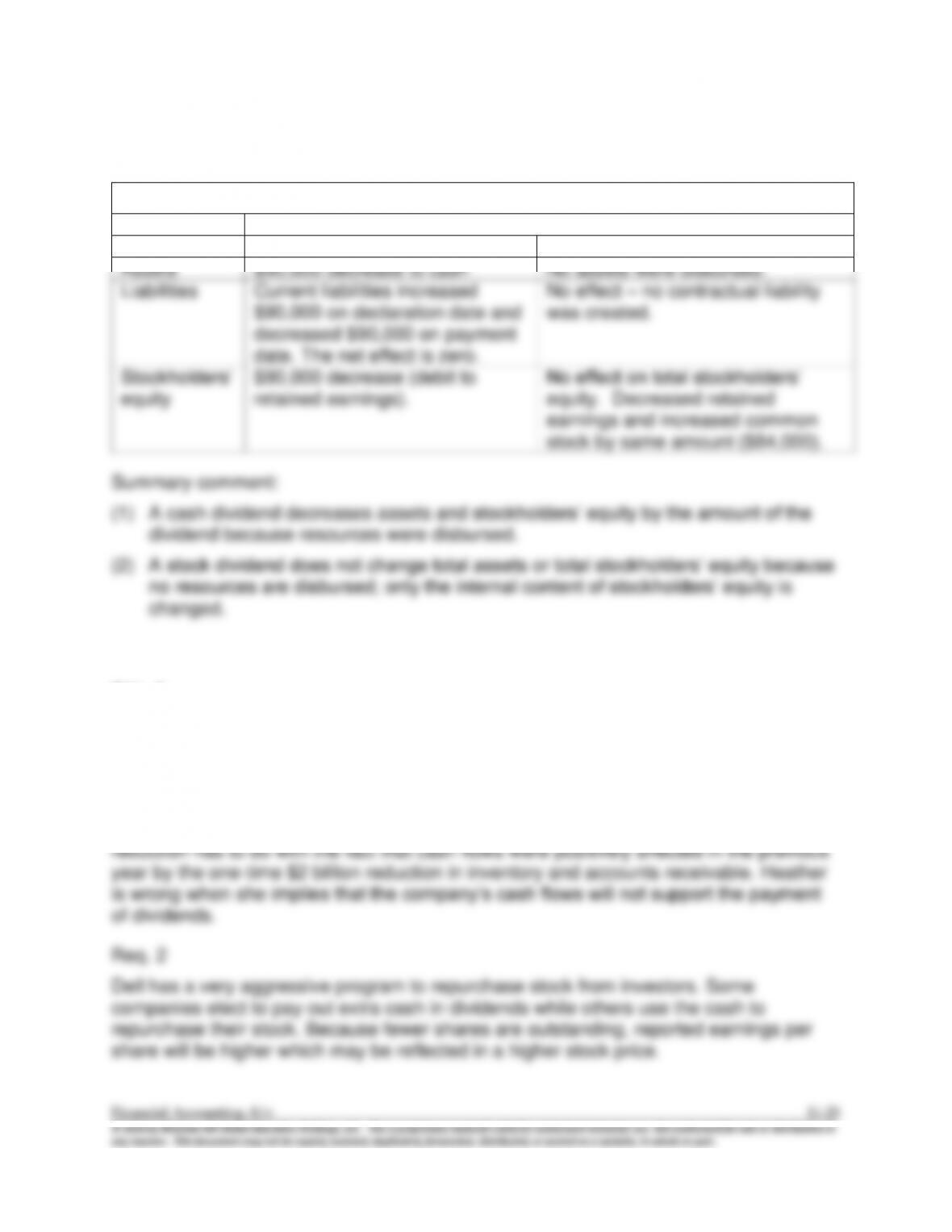
Case A—Preferred is noncumulative (total amount to distribute, $31,000):
Preferred
(8,000
shares)
Common
(35,000
shares)
Total
Preferred ($120,000 x 10%) …………………………………..
$ 12,000
$ 12,000
Balance to common ($31,000 – $12,000) ………………..
$19,000
19,000
$ 12,000
$19,000
$31,000
Per share ……………………………………………………………
$1.50
$0.54
Case B—Preferred is cumulative (total amount to distribute, $35,000):
Preferred:
Arrears ($120,000 x 10% x 2 years) …………………….
$ 24,000
$ 24,000
Current year ($120,000 x 10%) …………………………..
11,000
–0–
11,000
$35,000
–0–
$35,000
Per share ……………………………………………………………
$4.375
$ –0–
Case C—Preferred is cumulative (total amount to distribute, $90,000):
Preferred:
Arrears ($120,000 x 10% x 2 years) …………………….
$ 24,000
$ 24,000
Current year ($120,000 x 10%) …………………………..
12,000
12,000
Balance to common ($90,000 – $36,000)
$54,000
54,000
$36,000
$54,000
$90,000
Per share ……………………………………………………………
$4.50
$1.54
Chapter 11 – Reporting and Interpreting Owners’ Equity
P11–8. (continued)
Req. 2
Schedule of Comparative Differences (with comments)
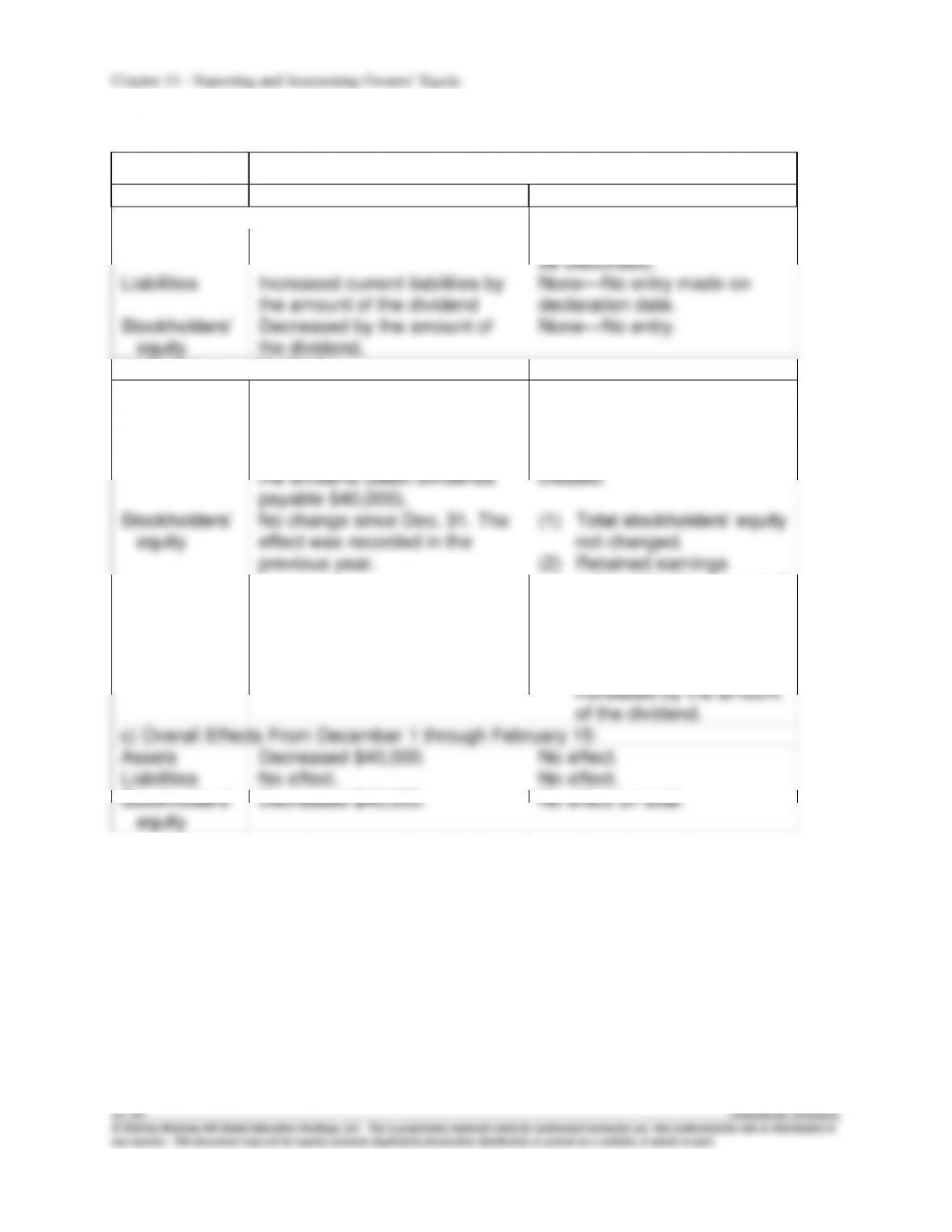
Item
Amount of Dollar Increase (Decrease)
Cash Dividend – Case C
Stock Dividend
Assets
$90,000 decrease to cash
No assets were disbursed.
Liabilities
Current liabilities increased
$90,000 on declaration date and
decreased $90,000 on payment
date. The net effect is zero.
No effect – no contractual liability
was created.
Stockholders’
equity
$90,000 decrease (debit to
retained earnings).
No effect on total stockholders’
equity. Decreased retained
earnings and increased common
stock by same amount ($84,000).
Summary comment:
(1) A cash dividend decreases assets and stockholders’ equity by the amount of the
dividend because resources were disbursed.
(2) A stock dividend does not change total assets or total stockholders’ equity because
no resources are disbursed; only the internal content of stockholders’ equity is
changed.
P11–9.
Req. 1
Heather feels some concern about whether Scott is looking in the right place on the
Statement of Cash Flows (SCF) for dividends. She shouldn’t be concerned; dividends
paid are reported in the financing activities section of the SCF.
While cash flows from operating activities have declined for the current year, the
Chapter 11 – Reporting and Interpreting Owners’ Equity
P11–11.
Req. 1
March 9
No journal entry is required for the declaration of a stock dividend.
May 21
No journal entry is required.
June 18 (millions)
Retained earnings* (-SE) …………………………………………..
12,500
Common stock (+SE) ……………………………………………..
250
Capital in excess of par (+SE) …………………………………
12,250
* 2,500 million shares x 10% x $50 = $12,500 million.
Req. 2
This simple question can give the instructor an excellent opportunity to discuss the
relevancy of dividend policy. There is a strong theoretical argument to be made that
dividend policy is irrelevant. There are several real world factors that make the question
more difficult to answer (e.g., the impact of taxes, information content of dividends, and
the clientele effect). The level of the discussion of this issue will depend on the amount
of finance that has been introduced during the instructor’s lectures.
Req. 3
The board must consider the impact of the stock dividend and the increase in cash
dividends on the price of the stock. They made the decision with the expectation that it
would have a favorable impact on the long-term value of the stock.