
Chapter 11 – Reporting and Interpreting Owners’ Equity
11–14
Supplemental Enrichment Activities
Note: These activities would be suitable for individual or group activities.
1. Use the following for an in-class discussion of the concepts of authorized, issued, and outstanding.
Ask your students if they have ever attended an evening reception at which drink tickets were sold.
Typically, the host will have a roll of authorized tickets and will issue individual tickets as people buy
them. These drink tickets will be held by the people until they are exchanged with the bartender for
drinks. The returned drink ticket will then be either destroyed by the bartender or given back to the
host to reissue. At any time during the evening, there are likely to be some tickets on the roll available
for future sale, some still outstanding in people’s pockets, and some already returned to the host for
possible reuse. Ask your students to match the tickets in this story to the terms (1) authorized, (2)
issued, and (3) treasury.
Solution:
Just like the host with the initial roll of drink tickets, a corporation is authorized to issue a specific
number of shares. Shares will be “issued” to stockholders and will remain outstanding until they are
returned to the company’s treasury. This “treasury stock” will either be destroyed or reissued just like
the used drink tickets.
2. Handout 11-1
Use Handout 11-1 for an in-class activity designed to review the preparation of journal entries for
various stock transactions. The solution follows the handout master.
3. Handout 11-2
Use Handout 11-2 for an in-class activity designed to review the recording of cash dividends. The
solution follows the handout master.
4. Handout 11-3
Use Handout 11-3 for an in-class activity designed to review the recording of stock dividends. The
solution follows the handout master.
5. Use the following for an in-class discussion of the concepts of stock dividends and stock splits:
A company’s board of directors must choose between a large 100 percent stock dividend and a 2-for-
1 stock split. What should be considered in making this decision?
Solution:
The decision may be closely related to how stock dividends and splits are accounted for.
a. A stock dividend causes a reduction in Retained earnings, whereas a stock split doesn’t.
b. A company that anticipates future financial difficulties will want to use a 2-for-1 stock split
because it doesn’t reduce Retained earnings or its ability to declare cash dividends in the future.
c. On the other hand, if the company is expecting financial success, it won’t care that Retained
earnings is reduced by a stock dividend because future earnings will build up Retained earnings
enough to allow cash dividends to be declared. In fact, it may want to use a stock dividend just to
show confidence that the company is expecting to do well in the near future.

Chapter 11 – Reporting and Interpreting Owners’ Equity
11–15
Supplemental Enrichment Activities, continued
6. Handout 11-4
Use Handout 11-4 for an in-class activity designed to review concepts relating to dividends on
preferred stock. The solution follows the handout master.
Chapter 11 – Reporting and Interpreting Owners’ Equity
11–16
HANDOUT 11 – 1
STOCK TRANSACTIONS
Prepare the journal entries required to record the following transactions and then post them to the related
T-accounts:
Strait Corp. sold 10,000 shares of $1 par value stock for $25 per share on May 1, 2014.
On December 1, 2014, Strait Corp. repurchased 1,000 shares of its stock on the market when it was
trading for $16 per share.
Chapter 11 – Reporting and Interpreting Owners’ Equity
11–17
HANDOUT 11 – 1, CONTINUED
On December 15, 2014, Strait Corp. sold 500 of the treasury shares for $30 each.
On December 30, 2014, Strait Corp. sold 500 of the treasury shares for $15 each.
Chapter 11 – Reporting and Interpreting Owners’ Equity
11–18
HANDOUT 11 – 1 SOLUTION
STOCK TRANSACTIONS
Prepare the journal entries required to record the following transactions and then post them to the related
T-accounts:
Strait Corp. sold 10,000 shares of $1 par value stock for $25 per share on May 1, 2014.
May 1
Cash (+A) (10,000 x $25)
250,000
2014
Common Stock (+SE) (10,000 x $1)
10,000
Capital in Excess of Par (+SE)
($250,000 – $10,000)
240,000
+ Cash (A) –
May 1
250,000
– Common Stock (SE) +
10,000
May 1
– Capital in Excess of Par (SE) +
240,000
May 1
On December 1, 2014, Strait Corp. repurchased 1,000 shares of its stock on the market when it was
trading for $16 per share.
Dec. 1
Treasury Stock (+xSE, –SE) (1,000 x $16)
16,000
2014
Cash (–A)
16,000
+ Cash (A) –
May 1
250,000
16,000
Dec. 1
+ Treasury Stock (xSE) –
Dec. 1
16,000
On December 15, 2014, Strait Corp. sold 500 of the treasury shares for $30 each.
Dec. 15
Cash (+A) (500 x $30)
15,000
2014
Treasury Stock (–xSE, +SE)
(500 x $16)
8,000
Capital in Excess of Par (+SE)
(500 x [$30 – $16])
7,000
+ Cash (A) –
May 1
250,000
16,000
Dec. 1
Dec. 15
15,000
+ Treasury Stock (xSE) –
Dec. 1
16,000
8,000
Dec. 15
– Capital in Excess of Par (SE) +
240,000
May 1
7,000
Dec. 15
Chapter 11 – Reporting and Interpreting Owners’ Equity
11–19
HANDOUT 11 – 1 SOLUTION, CONTINUED
On December 30, 2014, Strait Corp. sold 500 of the treasury shares for $15 each.
Dec. 30
Cash (+A) (500 x $15)
7,500
2014
Capital in Excess of Par (–SE)
(500 x [$16 – $15])
500
Treasury Stock (–xSE, +SE)
(500 x $16)
8,000
+ Cash (A) –
May 1
250,000
16,000
Dec. 1
Dec. 15
15,000
Dec. 30
7,500
+ Treasury Stock (xSE) –
Dec. 1
16,000
8,000
Dec. 15
8,000
Dec. 30
– Capital in Excess of Par (SE) +
240,000
May 1
7,000
Dec. 15
Dec. 30
500
Chapter 11 – Reporting and Interpreting Owners’ Equity
11–20
HANDOUT 11 – 2
CASH DIVIDENDS
Jones Corp. has 200,000 shares of stock authorized, 120,000 shares issued, and 100,000 shares
outstanding. On August 1, 2014, Jones’ Board of Directors declared a cash dividend of $0.50 per share,
with a date of record of September 1, 2014. The dividend will be paid on October 1, 2014.
Prepare the journal entries required to record the transactions described above, as needed, and then post
them to the related T-accounts:

Chapter 11 – Reporting and Interpreting Owners’ Equity
11–21
HANDOUT 11 – 2 SOLUTION
CASH DIVIDENDS
Jones Corp. has 200,000 shares of stock authorized, 120,000 shares issued, and 100,000 shares
outstanding. On August 1, 2014, Jones’ Board of Directors declared a cash dividend of $0.50 per share,
with a date of record of September 1, 2014. The dividend will be paid on October 1, 2014.
Prepare the journal entries required to record the transactions described above, as needed, and then post
them to the related T-accounts:
Aug. 1
Dividends Declared (+D, –SE)
(100,000 x $0.50)
50,000
2014
Dividends Payable (+L)
50,000
+ Dividends Declared (D) –
Aug 1
50,000
– Dividends Payable (L) +
50,000
May 1
Sept. 1
No Entry
2014
Oct. 1
Dividends Payable (–L)
50,000
2014
Cash (–A)
50,000
+ Cash (A) –
50,000
Oct. 1
– Dividends Payable (L) +
50,000
May 1
Oct. 1
50,000
Chapter 11 – Reporting and Interpreting Owners’ Equity
11–22
HANDOUT 11 – 3
STOCK DIVIDENDS AND STOCK SPLITS
Jennings Corp. has 1,000,000 shares of $1 par value stock authorized, 200,000 shares issued, and 150,000
shares outstanding. On June 1, 2014, Jennings’ Board of Directors declared a 10% stock dividend at a
time that the stock carried a market value of $30.
Prepare the journal entry required to record the transaction described above and then post it to the related
T-accounts:
Compute the number of shares outstanding after the June 1, 2014 stock dividend.
Jennings Corp. announced a 100% stock dividend on June 1, 2015.
Prepare the journal entry required to record the transaction described above and then post it to the related
T-accounts:

Chapter 11 – Reporting and Interpreting Owners’ Equity
11–23
HANDOUT 11 – 3, continued
Compute the number of shares outstanding after the June 1, 2015 stock dividend.
Jennings Corp. announced a 2 for 1 stock split on June 1, 2016.
Prepare the journal entry required to record the transaction described above and then post it to the related
T-accounts:
Chapter 11 – Reporting and Interpreting Owners’ Equity
11–24
HANDOUT 11 – 3 SOLUTION
STOCK DIVIDENDS AND STOCK SPLITS
Jennings Corp. has 1,000,000 shares of $1 par value stock authorized, 200,000 shares issued, and 150,000
shares outstanding. On June 1, 2014, Jennings’ Board of Directors declared a 10% stock dividend at a
time that the stock carried a market value of $30.
Prepare the journal entry required to record the transaction described above and then post it to the related
T-accounts:
June. 1
Retained Earnings (–SE)
(150,000 x 10% x $30)
450,000
2014
Common Stock (+SE)
(150,000 x 10% x $1)
15,000
Capital in Excess of Par (+SE)
435,000
– Retained Earnings (SE) +
June 1, 2014
450,000
– Common Stock (SE) +
15,000
June 1, 2014
– Capital in Excess of Par (SE) +
435,000
June 1, 2014
Compute the number of shares outstanding after the June 1, 2014 stock dividend.
150,000 + (150,000 x 10%) = 165,000 shares
Jennings Corp. announced a 100% stock dividend on June 1, 2015.
Prepare the journal entry required to record the transaction described above and then post it to the related
T-accounts:
June 1
Retained Earnings (–SE)
(165,000 x $1)
165,000
2015
Common Stock (+SE)
165,000
– Retained Earnings (SE) +
June 1, 2014
450,000
June 1, 2015
165,000
– Common Stock (SE) +
15,000
June 1, 2014
165,000
June 1, 2014
Compute the number of shares outstanding after the June 1, 2015 stock dividend.
165,000 old shares + 165,000 new shares = 330,000 shares
Jennings Corp. announced a 2 for 1 stock split on June 1, 2016.
June 1
2016
Memorandum entry: The 2-for-1 stock split caused the
number of shares outstanding to increase from
330,000 shares to 660,000 shares and the par value to
decrease from $1.00 per share to $0.50 per share.
Chapter 11 – Reporting and Interpreting Owners’ Equity
11–25
HANDOUT 11 – 4
PREFERRED DIVIDENDS
On January 1, 2014, Garden State issued 10,000 shares of $10 par preferred stock for $19 per share.
Prepare the journal entry required to record this transaction and post it to the appropriate T-accounts:
January 1
2014
The stock pays a cumulative annual dividend of 7% of par value. What is the total amount of the annual
dividends that would be paid, if declared, to preferred stockholders?
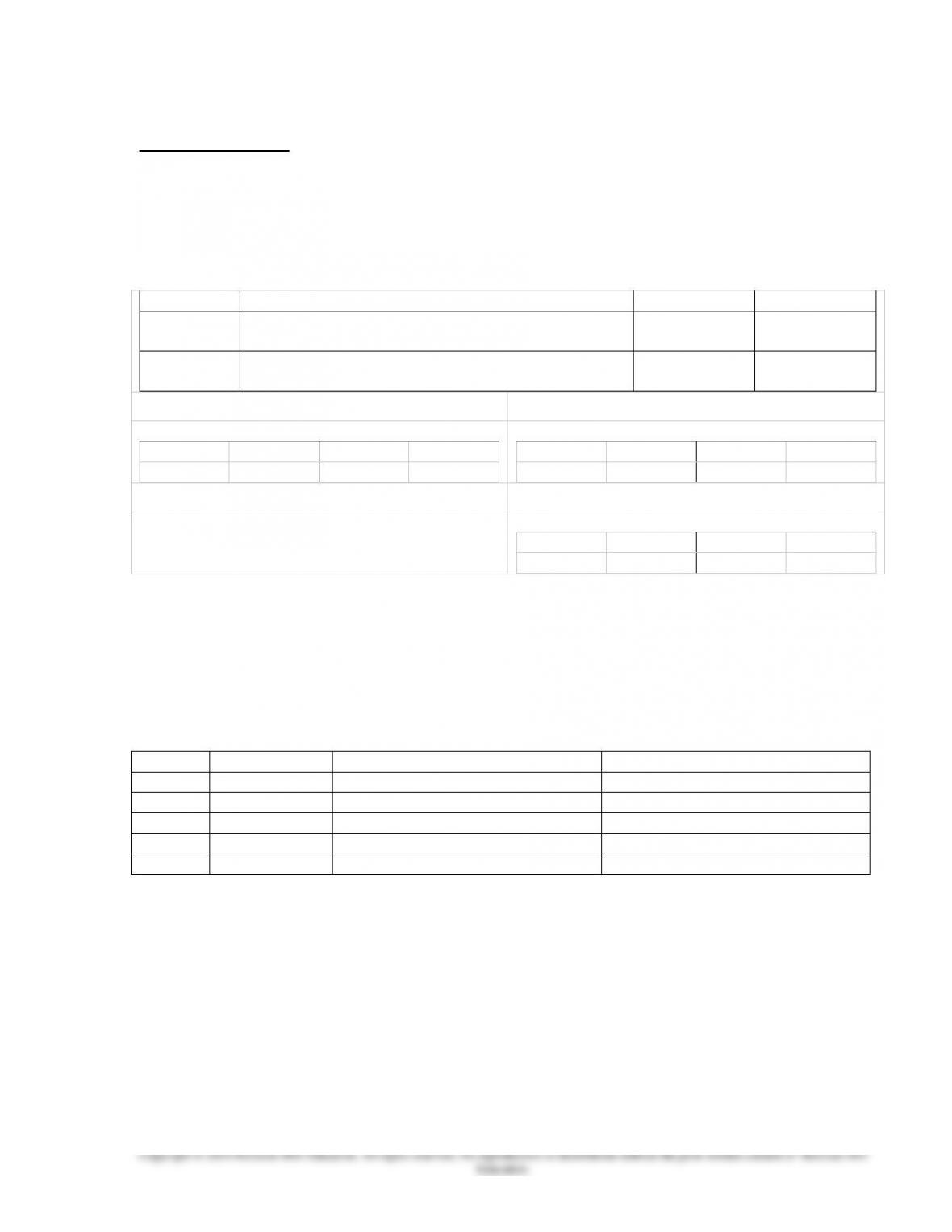
Complete the following table to explain how dividends would be allocated between preferred and
common stockholders:
Year
Total Dividend
To Preferred Stockholders
To Common Stockholders
2014
$100,000
2015
5,000
2016
10,000
2017
None
2018
20,000
Chapter 11 – Reporting and Interpreting Owners’ Equity
11–26
HANDOUT 11 – 4
PREFERRED DIVIDENDS
On January 1, 2014, Garden State issued 10,000 shares of $10 par preferred stock for $19 per share.
Prepare the journal entry required to record this transaction and post it to the appropriate T-accounts:
January 1
Cash (+A) (10,000 x $19)
190,000
2014
Preferred Stock (+SE)
(10,000 x $10)
100,000
Capital in Excess of Par (+SE)
(10,000 x [$19 – $10])
90,000
+ Cash (A) –
June 1
190,000
– Preferred Stock (SE) +
100,000
June 1
– Capital in Excess of Par (SE) +
90,000
June 1
The stock pays a cumulative annual dividend of 7% of par value. What is the total amount of the annual
dividends that would be paid, if declared, to preferred stockholders?
100,000 x 7% = $7,000 to preferred
Complete the following table to explain how dividends would be allocated between preferred and
common stockholders.
Year
Total Dividend
To Preferred Stockholders
To Common Stockholders
2014
$100,000
$7,000
$93,000
2015
5,000
5,000
0
2016
10,000
9,000 (2,000 in arrears + 7,000)
1,000
2017
None
0
0
2018
20,000
14,000
6,000