Chapter 10
Reporting and Interpreting Bonds
ANSWERS TO QUESTIONS
1. A bond is a liability that may or may not be secured by a mortgage on specified
assets. Bonds usually are in denominations of $1,000 or $10,000, are transferable
2. A bond indenture is an agreement drawn up by a company planning to sell a bond
issue. The indenture specifies the legal provisions of the bond issue such as
3. Secured bonds are supported by a mortgage or pledge of specific assets as a
guarantee of payment. Secured bonds are designated on the basis of the type of
4. Callable bonds—bonds that may be called for early retirement at the option of the
issuer.
Convertible bonds—bonds that may be converted to other securities of the issuer
5. Several important advantages of bonds compared with capital stock benefit the
issuer. The issuance of bonds establishes a fixed amount of liability and a fixed rate
6. The higher the tax rate is, the lower the net cost of borrowing money because the
interest paid on borrowed money is deductible on the income tax return of the
8. When a bond is issued (sold) at its face amount, it is issued at par. In contrast,
when a bond is sold at an amount lower than the par amount, it is issued at a
discount, and conversely, when it is sold at a price above par, it is issued at a
9. The stated rate of interest is the rate specified on a bond, whereas the effective
rate of interest is the market rate at which the bonds are selling currently.
10. When a bond is sold at par, the stated interest rate and the effective or market
interest rate are identical. When a bond is sold at a discount, the stated rate of
11. A bond issued at par will have a book or carrying value, or net liability, equal to the
par or principal of the bond. This amount should be reported as the carrying value
on each balance sheet date. When a bond is sold at a premium or discount, the
Authors’ Recommended Solution Time
(Time in minutes)
Mini-exercises
Exercises
Problems
Alternate
Problems
Cases and
Projects
No.
Time
No.
Time
No.
Time
No.
Time
No.
Time
1
5
1
10
1
40
1
20
1
25
2
5
2
10
2
30
2
30
2
20
3
5
3
15
3
30
3
35
3
20
4
5
4
15
4
40
4
40
4
30
5
5
5
15
5
50
5
40
5
30
6
5
6
10
6
45
6
35
6
25
7
5
7
20
7
45
7
*
8
5
8
20
8
50
9
10
11
12
5
5
5
5
9
10
11
12
13
14
15
16
17
20
15
15
20
30
20
20
20
25
9
10
11
12
13
14
35
40
40
25
35
20
18
19
20
21
22
30
25
10
10
10
* Due to the nature of this project, it is very difficult to estimate the amount of time
students will need to complete the assignment. As with any open-ended project, it is
MINI-EXERCISES
M10–1. 1. Balance Sheet
2. Income Statement
M10–2.
Principal
$600,000 0.4564
=
$273,840
Interest
$ 24,000 13.5903
=
326,167
Issue Price
=
$600,007*
*Issue price should be exactly $600,000. The $7 difference is the result of
rounding the present value factors at four digits.
M10–3.
Principal
$900,000 0.4350
=
$391,500
Interest
$ 27,000 13.2944
=
358,949
Issue Price
=
$750,449
M10–4.
January 1, 2014:
Cash (+A) ……………………………………………………………………
940,000
Discount on Bonds Payable (+XL, -L) ……………………………..
60,000
Bonds Payable (+L) ………………………………………………….
1,000,000
10-6 Solutions Manual
© 2014 by McGraw-Hill Global Education Holdings, LLC. This is proprietary material solely for authorized instructor use. Not authorized for sale or distribution in
any manner. This document may not be copied, scanned, duplicated, forwarded, distributed, or posted on a website, in whole or part.
M10–5.
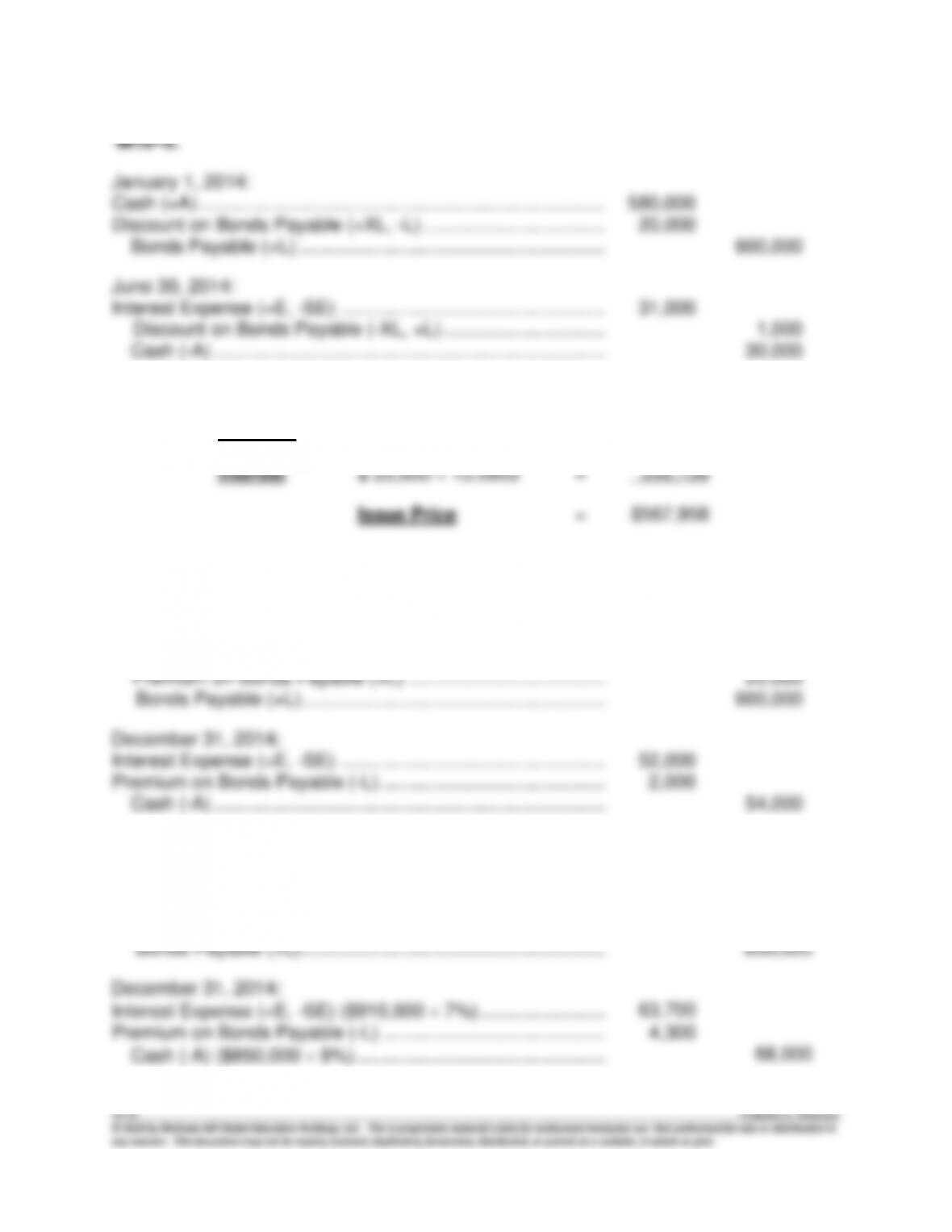
January 1, 2014:
Cash (+A) ……………………………………………………………………
580,000
Discount on Bonds Payable (+XL, -L) ……………………………..
20,000
Bonds Payable (+L) …………………………………………………..
600,000
June 30, 2014:
Interest Expense (+E, –SE) ……………………………………………
31,000
Discount on Bonds Payable (-XL, +L) ………………………….
1,000
Cash (-A) …………………………………………………………………
30,000
M10–6.
Principal
$500,000 0.4564
=
$228,200
Interest
$ 25,000 13.5903
=
339,758
Issue Price
=
$567,958
M10–7.
January 1, 2014:
Cash (+A) ……………………………………………………………………
620,000
Premium on Bonds Payable (+L) ………………………………..
20,000
Bonds Payable (+L) ………………………………………………….
600,000
Interest Expense (+E, –SE) ……………………………………………
52,000
Premium on Bonds Payable (-L) …………………………..………..
2,000
Cash (-A) …………………………………………………………………
54,000
M10–8
January 1, 2014:
Cash (+A) ……………………………………………………………………
910,000
Premium on Bonds Payable (+L) ………………………………..
60,000
Bonds Payable (+L) ………………………………………………….
850,000
December 31, 2014:
Interest Expense (+E, –SE) ($910,000 7%) ……………………
63,700
Premium on Bonds Payable (-L) …………………………..………..
4,300
Cash (-A) ($850,000 8%) …………………………………………
68,000
M10–9.
The debt-to-equity ratio and times interest earned ratio are both measures of the
risk associated with using debt in the capital structure of a company. A company
M10–10.
If the interest rates fall after the issuance of a bond, the bond’s price will
M10–11.
When a company issues a bond at a discount, the interest expense each period
M10–12.
Cash paid to retire a bond would be reported in the financing activities section of
10-8 Solutions Manual
© 2014 by McGraw-Hill Global Education Holdings, LLC. This is proprietary material solely for authorized instructor use. Not authorized for sale or distribution in
any manner. This document may not be copied, scanned, duplicated, forwarded, distributed, or posted on a website, in whole or part.
EXERCISES
E10–1.
1. Bond principal, par value, or face value
2. Par value or face value
3. Face value or par value
4. Stated rate, coupon rate, or contract rate
5. Debenture
6. Callable bonds
7. Convertible bonds
E10–2.
The AT&T bonds have a coupon interest rate of 6.5%. If bonds with a $10,000 face
E10–3.
CASE A:
$100,000 x 0.5835 ………………………………………………..
$ 58,350
$8,000 x 5.2064 ……………………………………………………
41,651
Issue price (market and stated rate same) ……………….
$100,001
(at par; $1
rounding error)
CASE B:
$100,000 x 0.6651 ………………………………………………..
$ 66,510
$8,000 x 5.5824 ……………………………………………………
44,659
Issue price (market rate less than stated rate) …………..
$111,169
(at a premium)
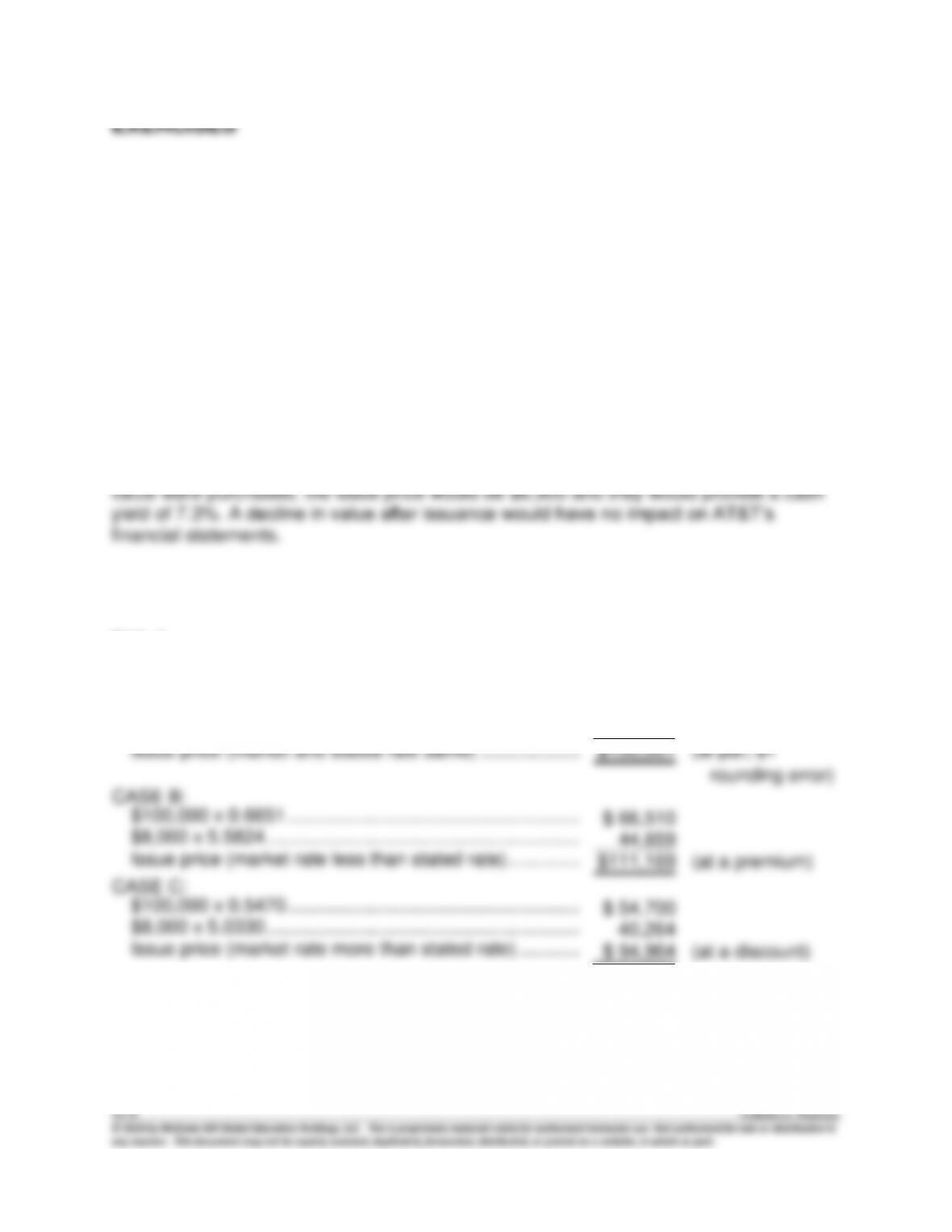
CASE C:
$100,000 x 0.5470 ………………………………………………..
$ 54,700
$8,000 x 5.0330 ……………………………………………………
40,264
Issue price (market rate more than stated rate) …………
$ 94,964
(at a discount)
E10–4.
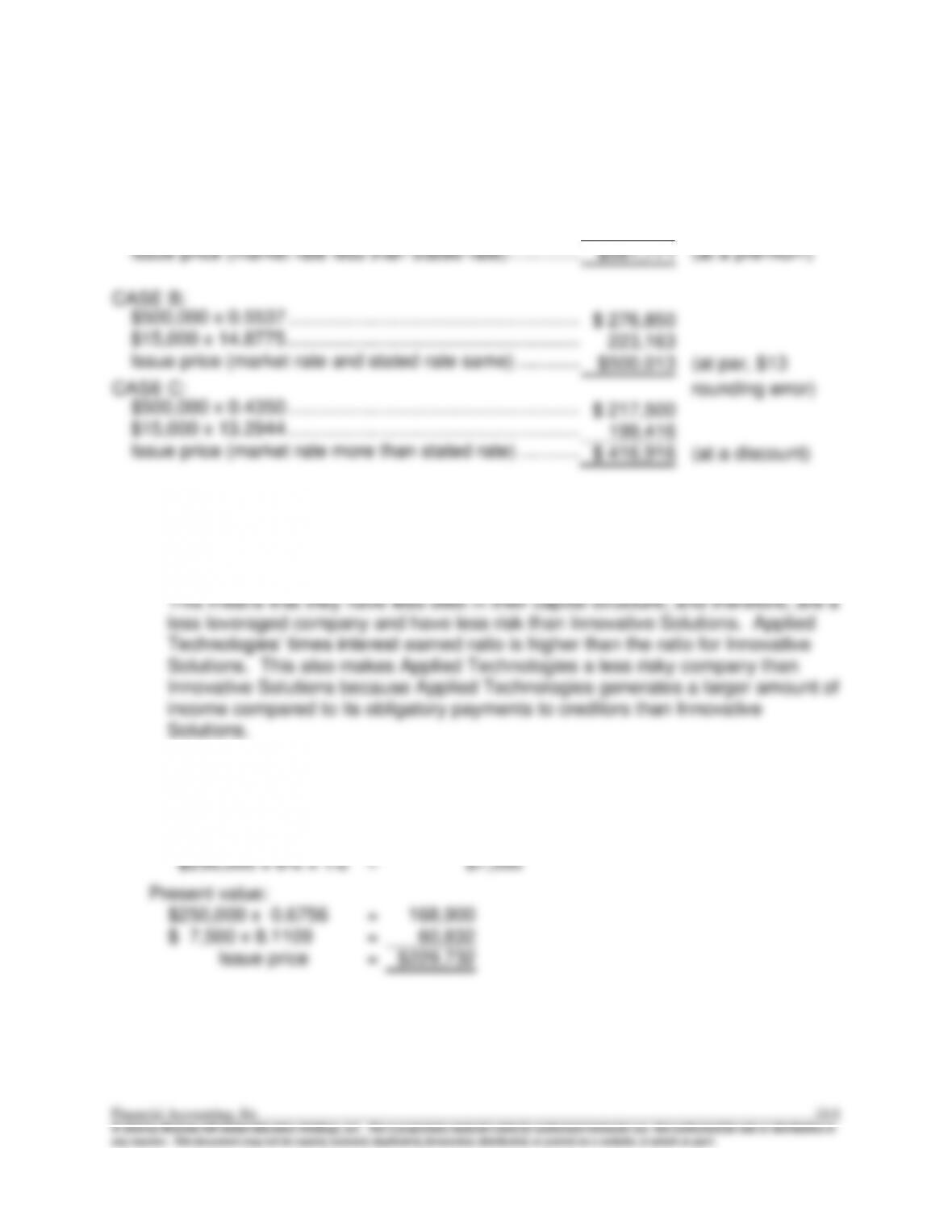
CASE A:
$500,000 x 0.6730 ………………………………………………..
$ 336,500
$15,000 x 16.3514 ………………………………………………..
245,271
Issue price (market rate less than stated rate) …………..
$581,771
(at a premium)
CASE B:
$500,000 x 0.5537 ………………………………………………..
$ 276,850
$15,000 x 14.8775 ………………………………………………..
223,163
Issue price (market rate and stated rate same) …………
$500,013
(at par, $13
CASE C:
rounding error)
$500,000 x 0.4350 ………………………………………………..
$ 217,500
$15,000 x 13.2944 ………………………………………………..
199,416
Issue price (market rate more than stated rate) …………
$ 416,916
(at a discount)
E10–5.
Applied Technologies’ ratios look better than Innovative Solutions’ ratios.
Applied Technologies has a lower debt-to-equity ratio than Innovative Solutions.
E10–6.
Computations:
Interest:
$250,000 x 6% x 1/2
=
$7,500
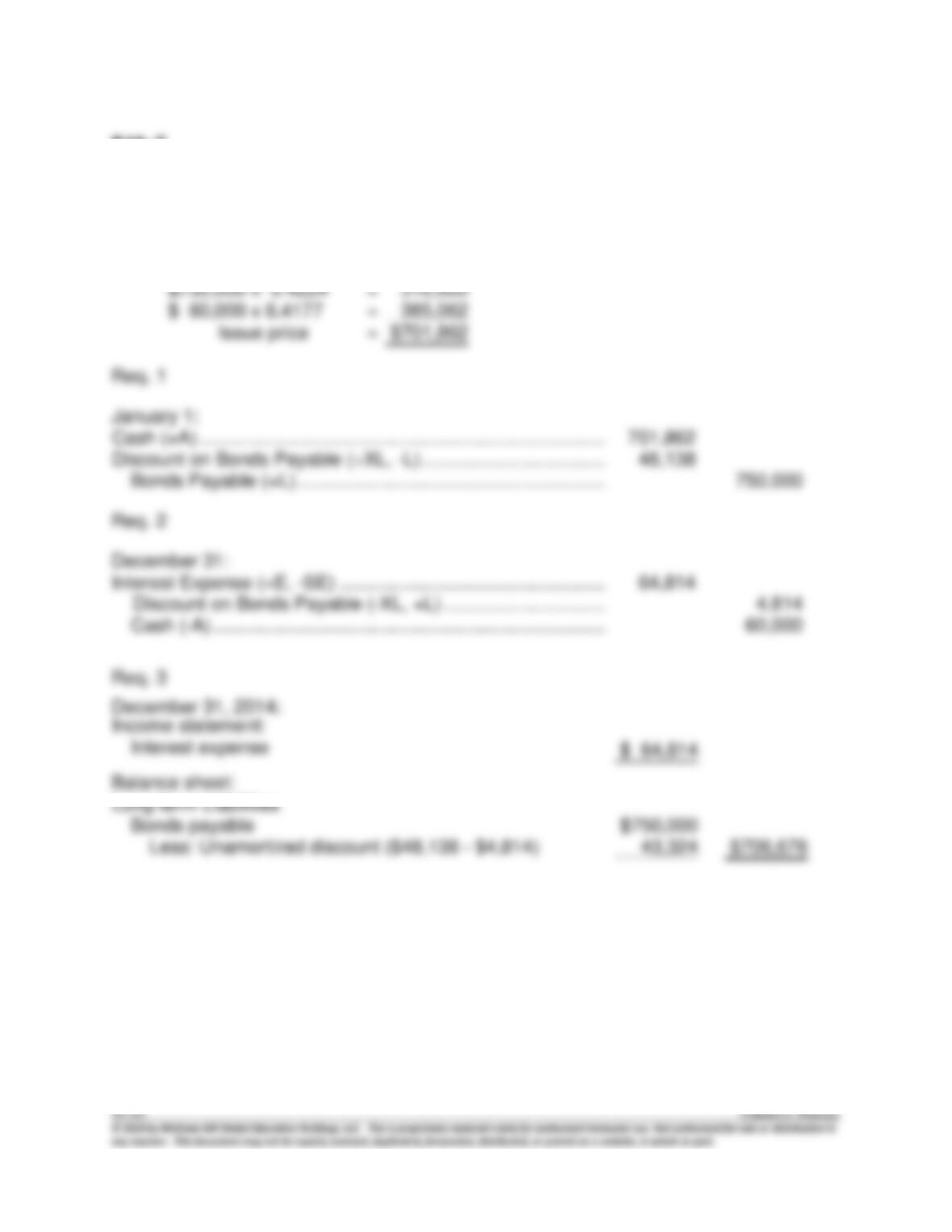
Present value:
$250,000 x 0.6756
=
168,900
$ 7,500 x 8.1109
=
60,832
Issue price
=
$229,732
E10–7.
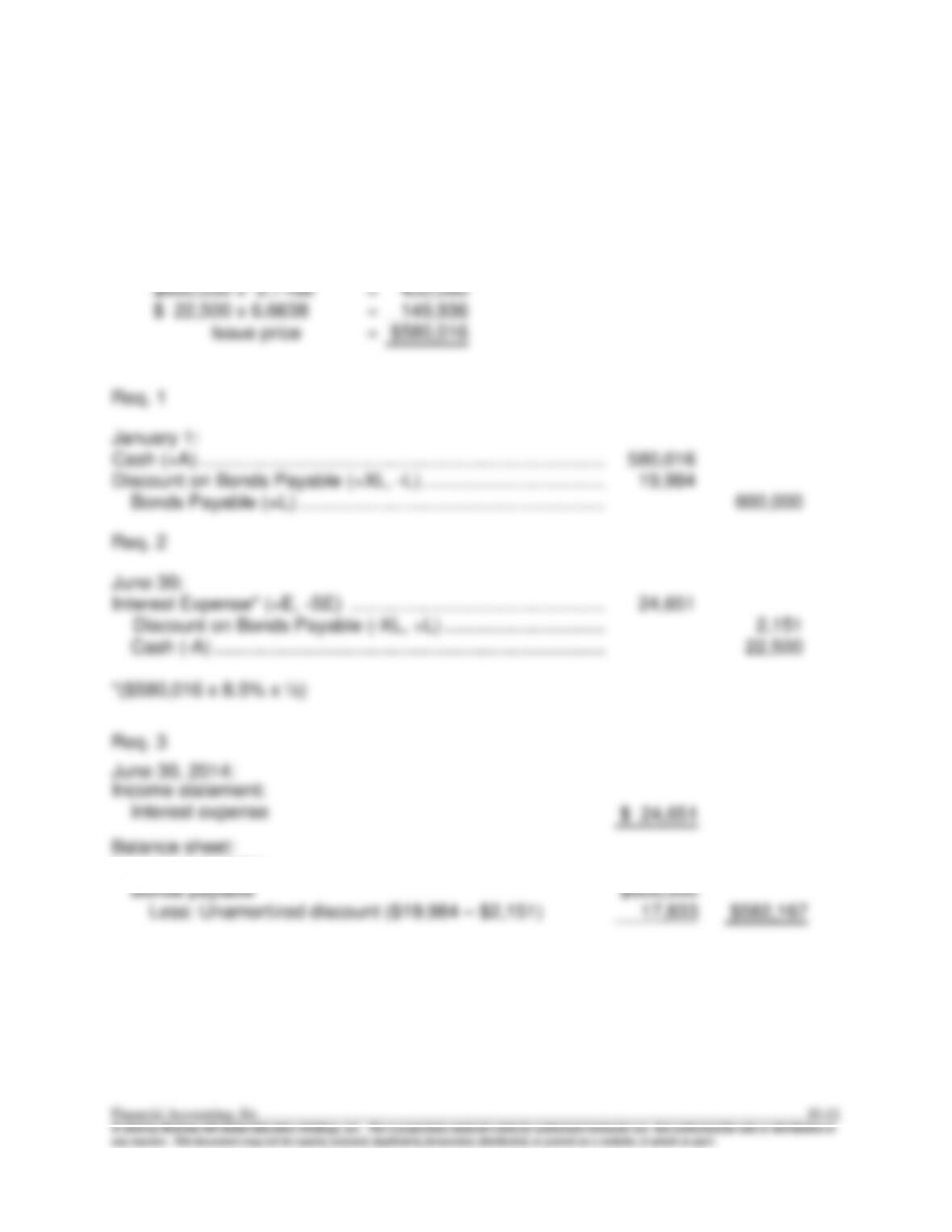
Computations:
Interest:
$750,000 x 8%
=
$ 60,000
Present value:
$750,000 x 0.4224
=
316,800
$ 60,000 x 6.4177
=
385,062
Issue price
=
$701,862
Cash (+A) ……………………………………………………………………
Discount on Bonds Payable (+XL, -L) ……………………………..
Bonds Payable (+L) …………………………………………………..
Interest Expense (+E, –SE) ……………………………………………
$ 64,814
Long-term Liabilities
Bonds payable
$750,000
Less: Unamortized discount ($48,138 – $4,814)
E10–8.
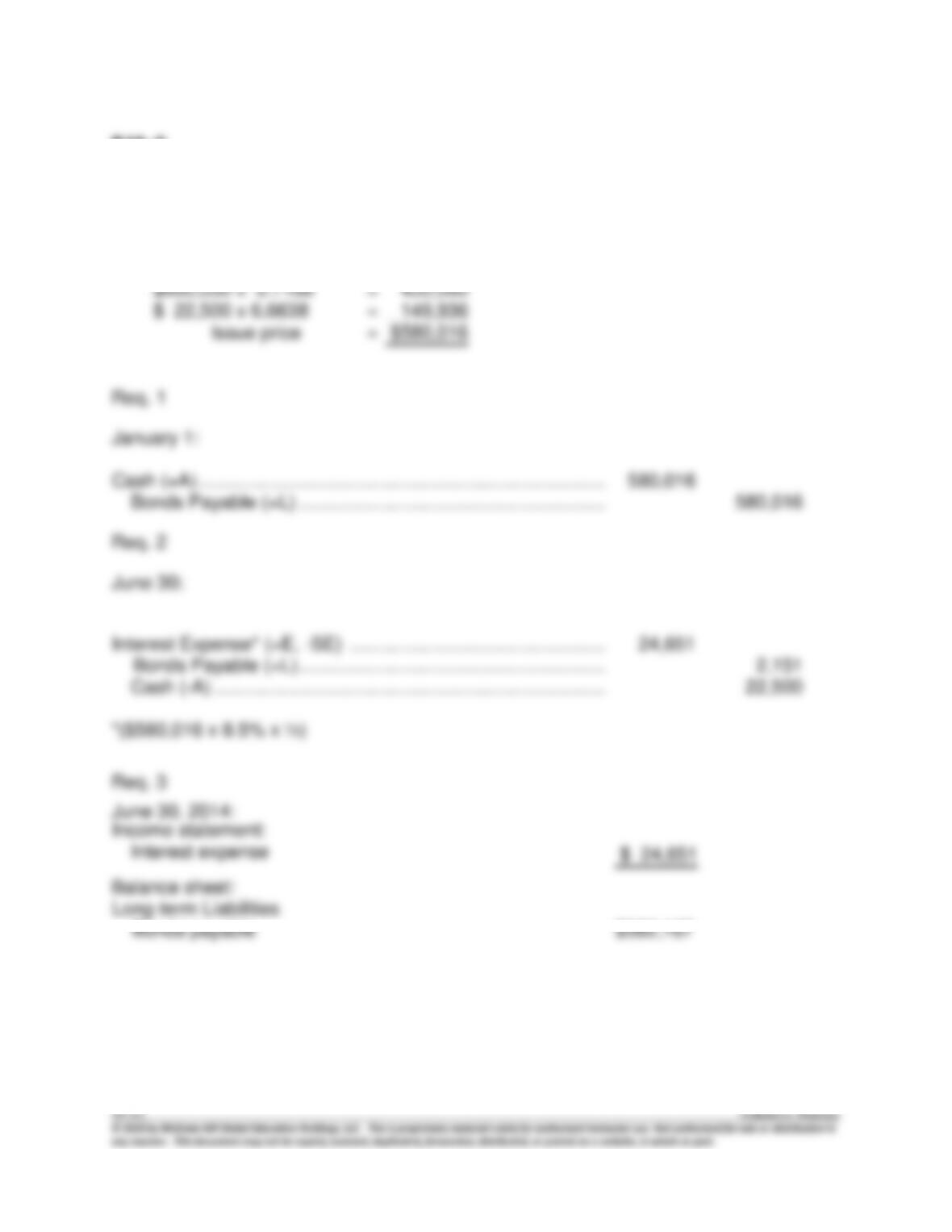
Computations:
Interest:
$600,000 x 7.5% x 1/2
=
$ 22,500
Present value:
$600,000 x 0.7168
=
430,080
$ 22,500 x 6.6638
=
149,936
Issue price
=
$580,016
Cash (+A) ……………………………………………………………………
580,016
Discount on Bonds Payable (+XL, -L) ……………………………..
19,984
Bonds Payable (+L) …………………………………………………..
600,000
Req. 2
June 30:
Interest Expense* (+E, -SE) ………………………………………….
24,651
Discount on Bonds Payable (-XL, +L) ………………………….
2,151
Cash (-A) …………………………………………………………………
22,500
*($580,016 x 8.5% x ½)
Req. 3
June 30, 2014:
Income statement:
Interest expense
$ 24,651
Long-term Liabilities
Bonds payable
$600,000
Less: Unamortized discount ($19,984 – $2,151)
17,833
$582,167
10–12 Solutions Manual
© 2014 by McGraw-Hill Global Education Holdings, LLC. This is proprietary material solely for authorized instructor use. Not authorized for sale or distribution in
any manner. This document may not be copied, scanned, duplicated, forwarded, distributed, or posted on a website, in whole or part.
E10–9.
Computations:
Interest:
$600,000 x 7.5% x 1/2
=
$ 22,500
Present value:
$600,000 x 0.7168
=
430,080
$ 22,500 x 6.6638
=
149,936
Issue price
=
$580,016
Cash (+A) ……………………………………………………………………
580,016
Bonds Payable (+L) …………………………………………………..
580,016
Req. 2
June 30:
Interest Expense* (+E, -SE) ………………………………………….
24,651
Bonds Payable (+L) …………………………………………………..
2,151
Cash (-A) …………………………………………………………………
22,500
*($580,016 x 8.5% x ½)
Req. 3
June 30, 2014:
Income statement:
Interest expense
$ 24,651
Long-term Liabilities
Bonds payable $582,167
Financial Accounting, 8/e 10–13
E10–10.
Req. 1
Issue price:
1. Par, $500,000 – Carrying value at end of 1 year, $481,100 = $18,900 (unamortized
discount for 9 remaining years).
2. $18,900 9 years = $2,100 discount amortization per year (straight line).
3. $481,100 – $2,100 = $479,000 issue price (discount $21,000).
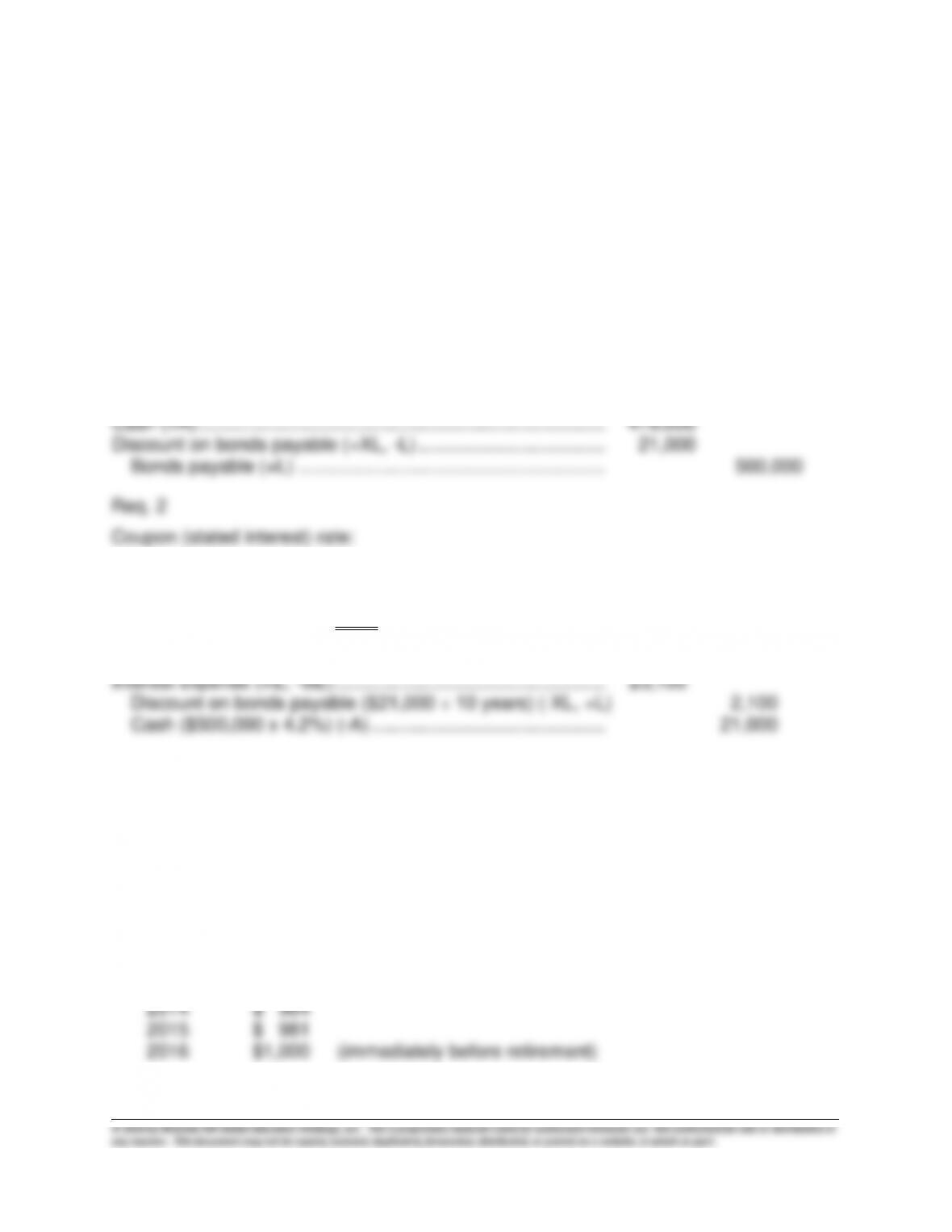
Issuance entry:
Cash (+A) ……………………………………………………………………
479,000
Discount on bonds payable (+XL, -L) ………………………………
21,000
Bonds payable (+L) …………………………………………………..
500,000
Req. 2
Coupon (stated interest) rate:
1. Reported interest expense, $23,100 – Discount amortized, $2,100 = $21,000 (cash
interest).
2. $21,000 ÷ $500,000 = 4.2% coupon (stated interest) rate.
Interest expense:
Interest expense (+E, –SE) …………………………..………………..
23,100
Discount on bonds payable ($21,000 ÷ 10 years) (-XL, +L)
2,100
Cash ($500,000 x 4.2%) (-A) ………………………………………
21,000
E10–11.
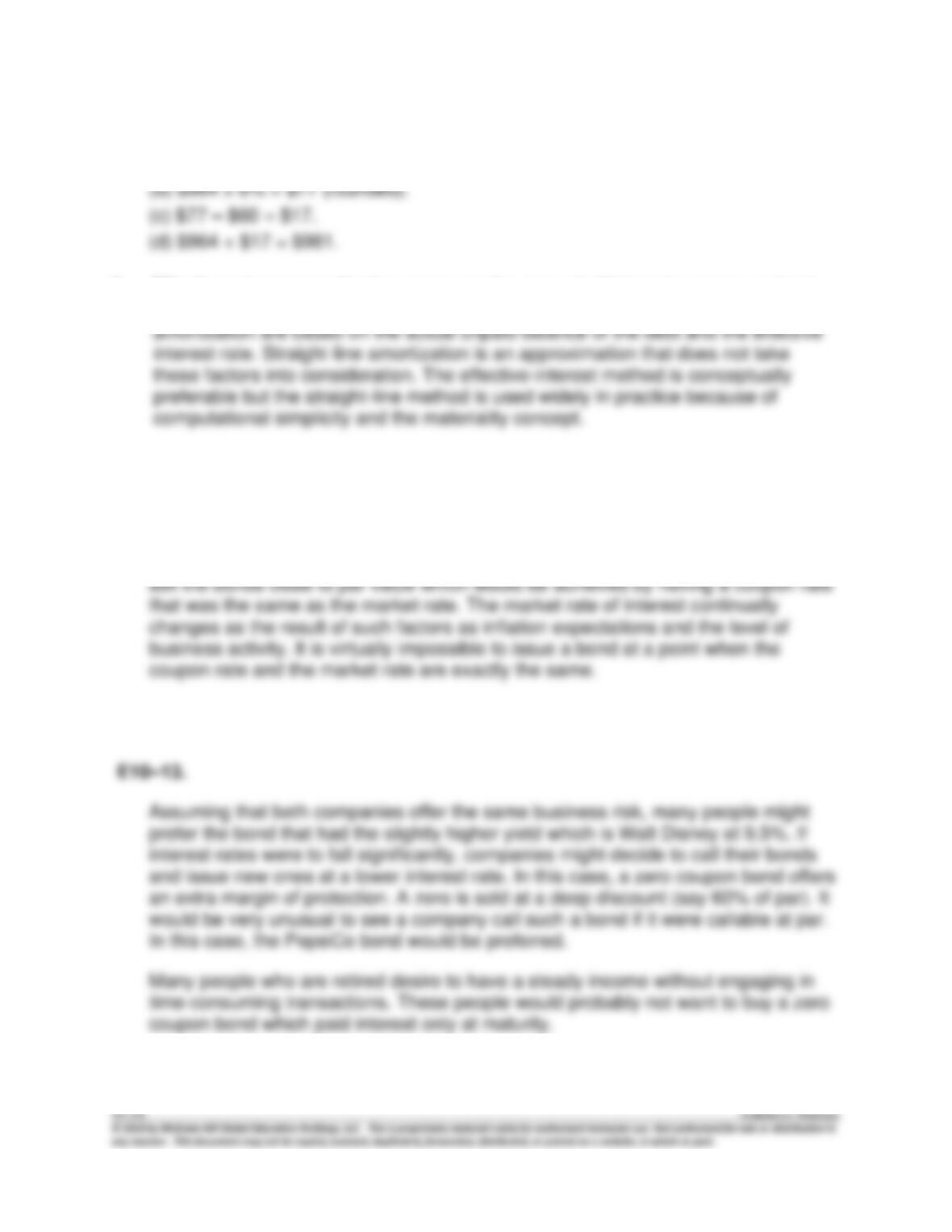
1. Issue price: $948. Stated rate, 6%; effective or yield rate, 8% (both were given).
2. Discount: $1,000 – $948 = $52.
3. $1,000 x 6% = $60.
4. 2014, $76; 2015, $77; 2016, $79.
5. Balance sheet:
2014
$ 964
2015
$ 981
2016
$1,000
(immediately before retirement)
6. Effective-interest amortization was used.
E10–11. (continued)
7. (a) $1,000 x 6% = $60.
8. Effective-interest amortization measures the amount of interest expense and net
liability for each period on a present value basis. The interest expense and related
E10–12.
The effective interest rate for a bond is determined by market forces and not the
company. American was able to specify the coupon rate for the bonds which
determines the periodic interest payments. It appears that American intended to
E10–14.
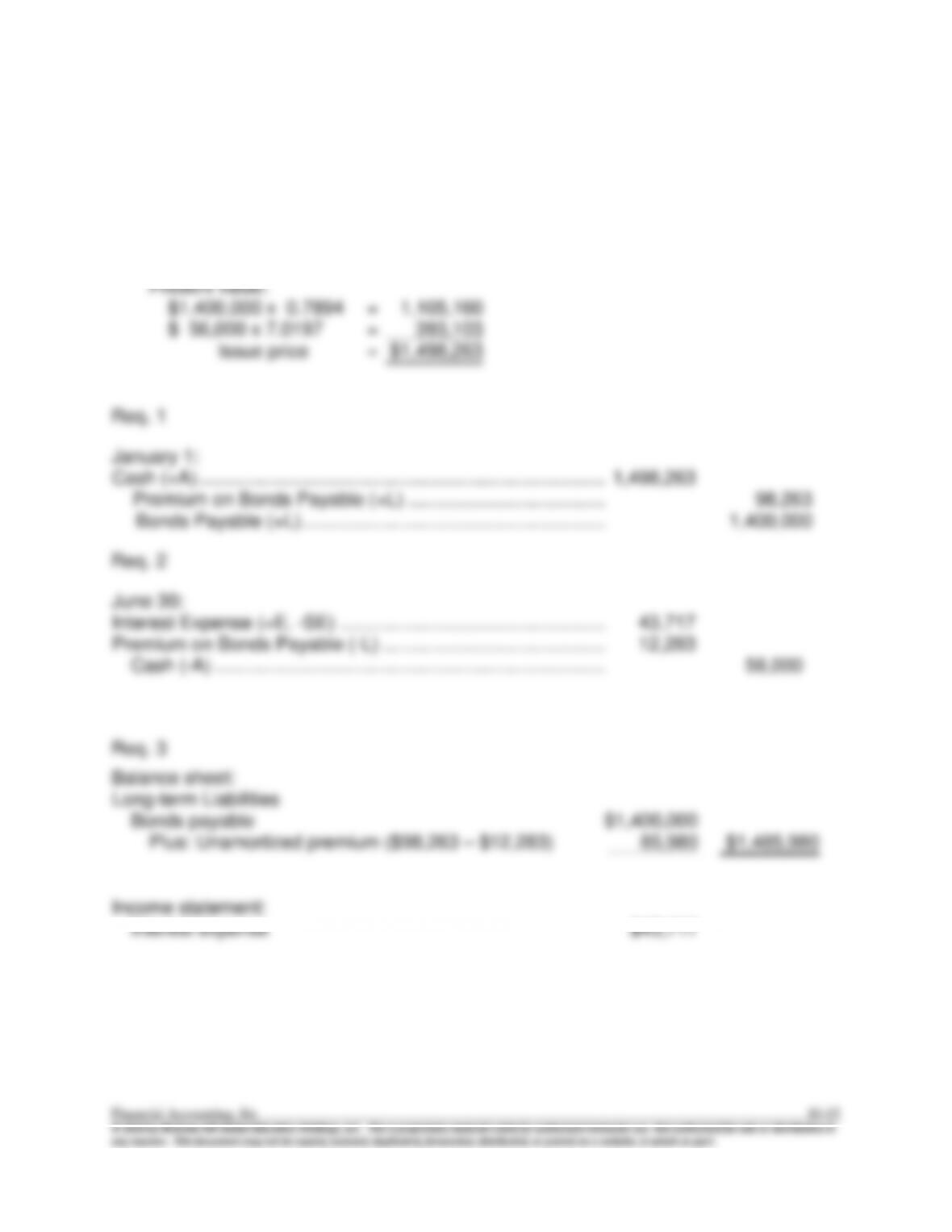
Computations:
Interest:
$1,400,000 x 8% x 1/2
=
$ 56,000
=
=
=
$1,400,000
E10–15.
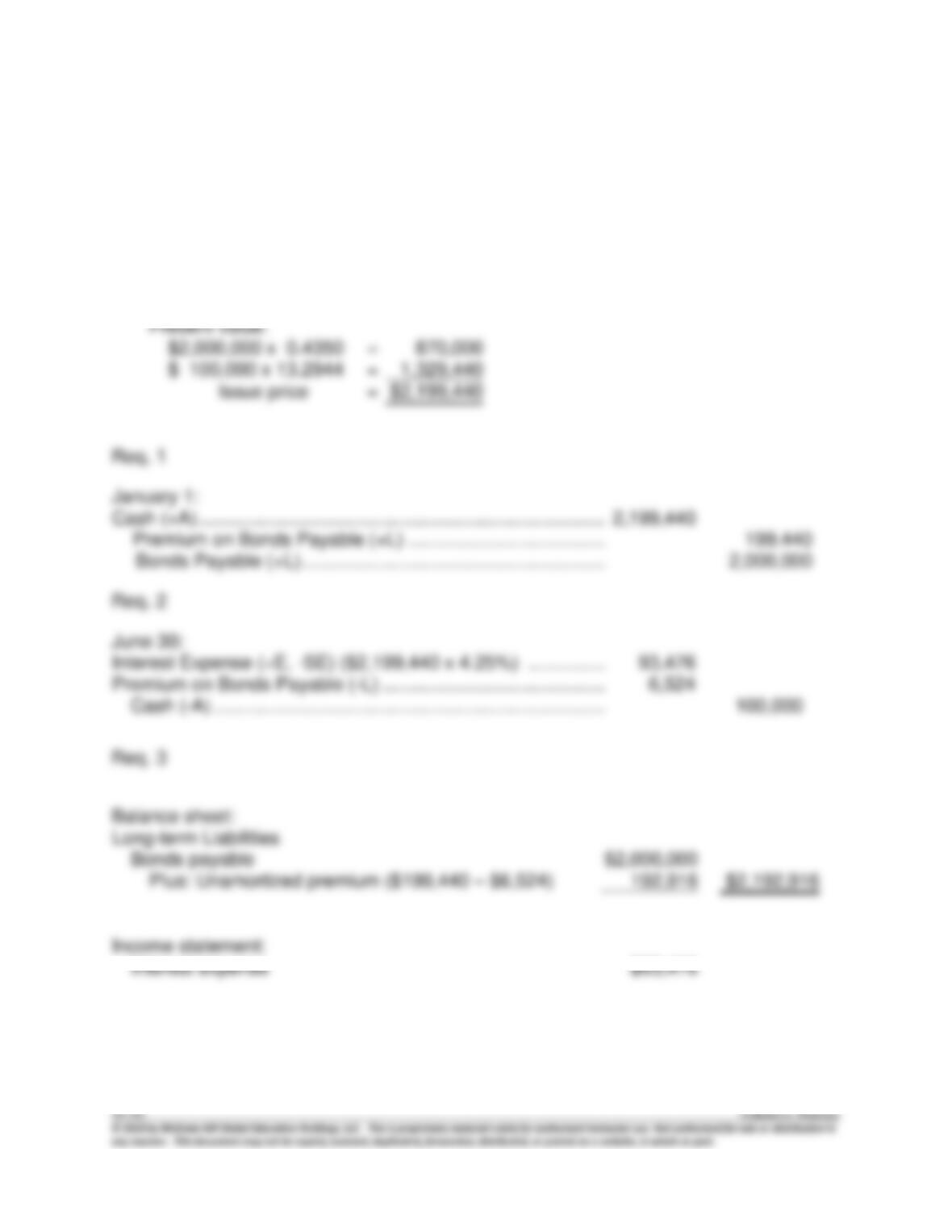
Computations:
Interest:
$2,000,000 x 5%
=
$ 100,000
=
=
=
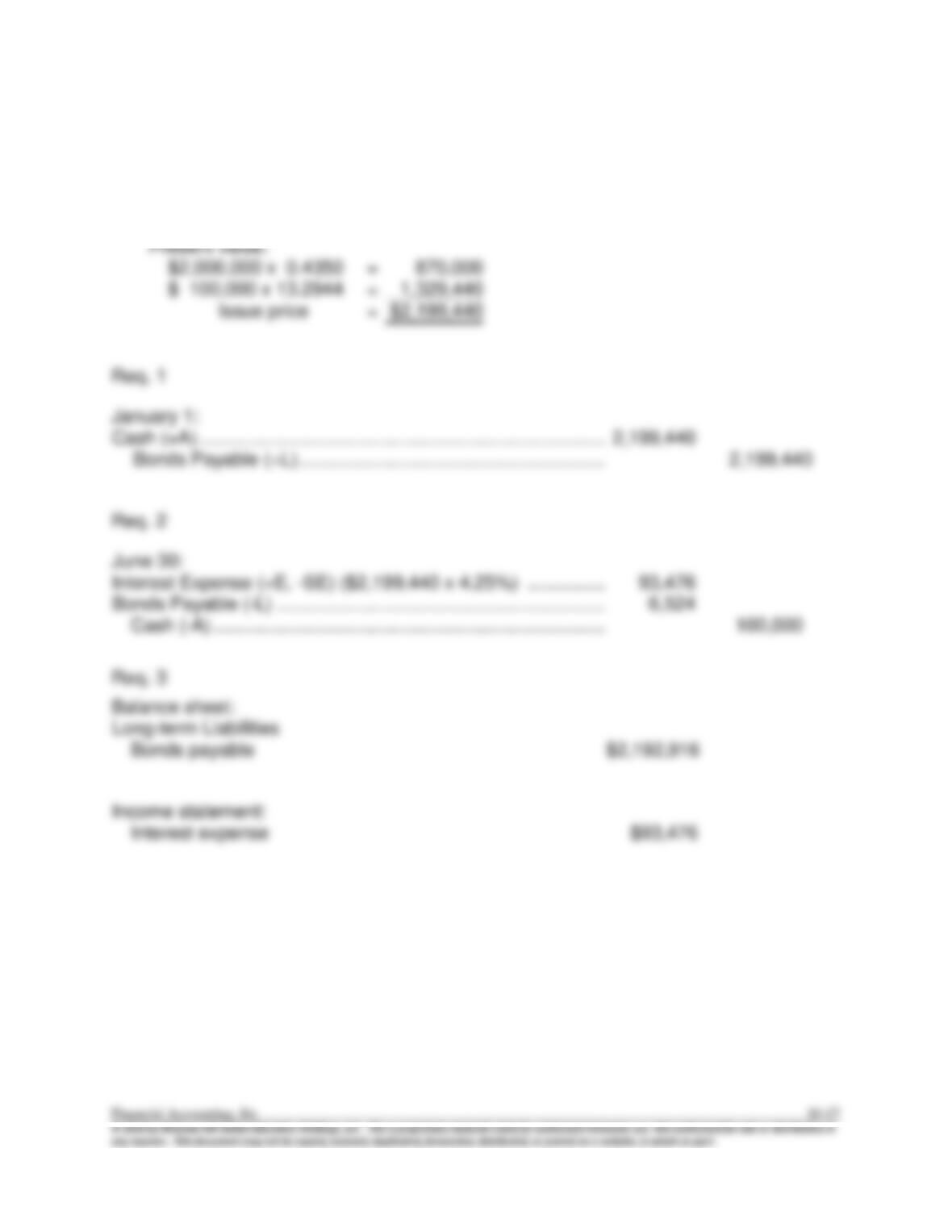
E10–16.
Computations:
Interest:
$2,000,000 x 5%
=
$ 100,000
=
=
=
E10–17.
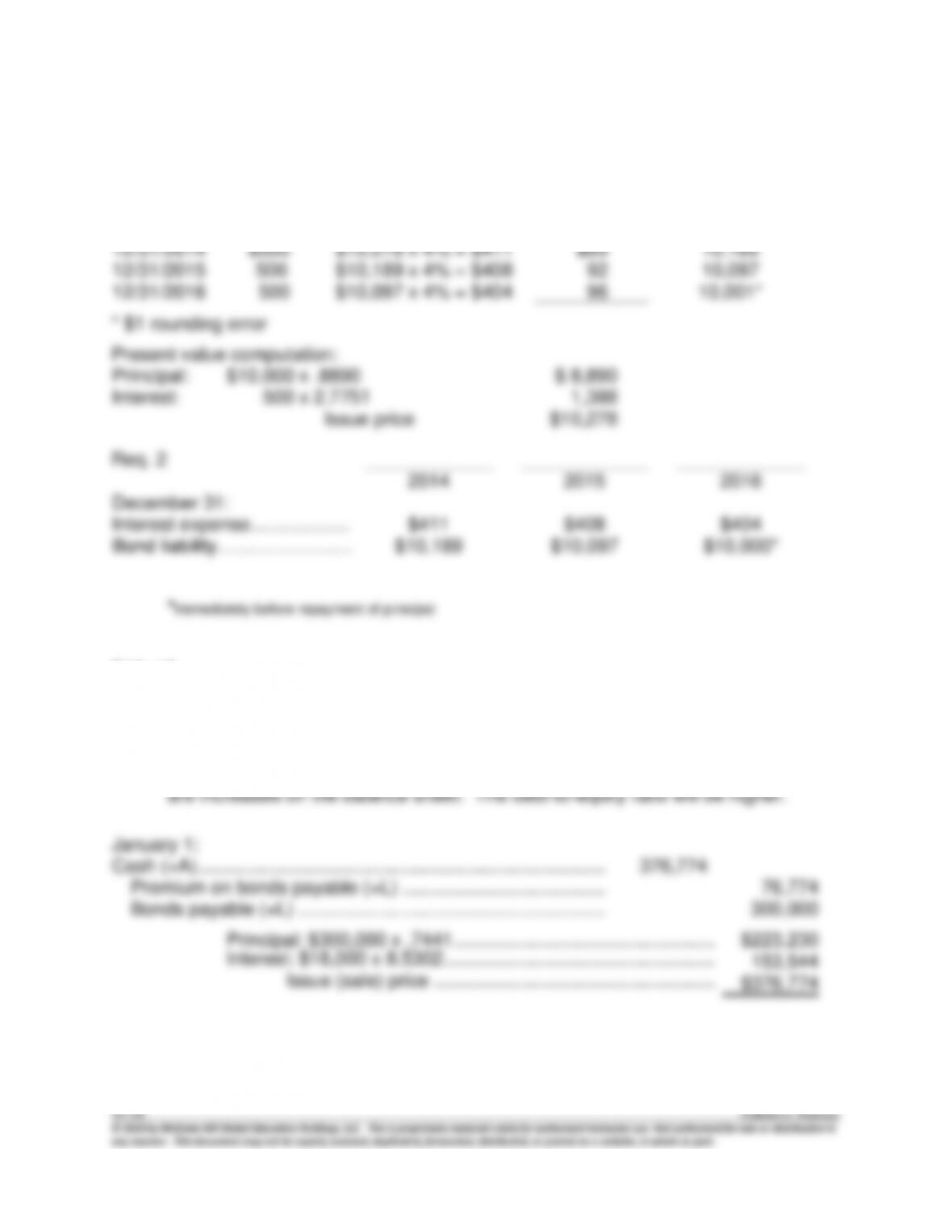
Req. 1
Date
Cash
Interest
Interest Expense
Premium
Amortization
Net Liability
Balance
1/1/2014
$10,278
12/31/2014
$500
$10,278 x 4% = $411
$89
10,189
12/31/2015
500
$10,189 x 4% = $408
92
10,097
12/31/2016
500
$10,097 x 4% = $404
96
10,001*
* $1 rounding error
Present value computation:
Principal:
$10,000 x .8890
$ 8,890
Interest:
500 x 2.7751
1,388
Issue price
$10,278
Req. 2
2014
2015
2016
December 31:
Interest expense ……………….
$411
$408
$404
Bond liability………………….
$10,189
$10,097
$10,000*
E10–18.
Req. 1
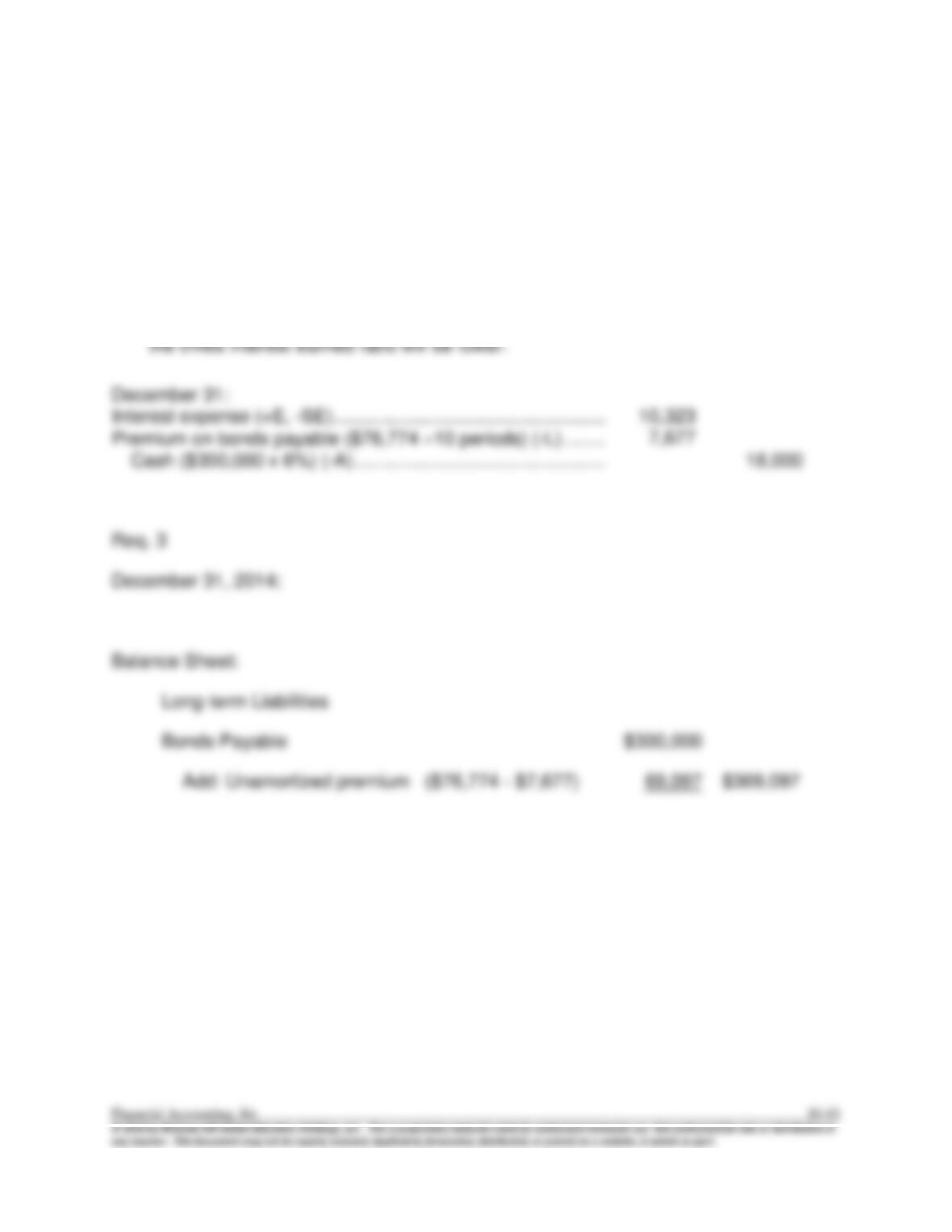
Cash is increased on the balance sheet. The statement of cash flows shows an
inflow from financing activities. Bonds payable and premium on bonds payable
Cash (+A) ……………………………………………………………………
376,774
Premium on bonds payable (+L) …………………………………
76,774
Bonds payable (+L) …………………………………………………..
300,000
Principal: $300,000 x .7441 …………………………………………..
$223,230
Interest: $18,000 x 8.5302 …………………………………………….
153,544
Issue (sale) price ………………………………………………
$376,774
E10–18. (continued)
Req. 2
The interest expense will be increased on the income statement and the cash will
be decreased on the balance sheet. The premium on bonds payable will be
decreased on the balance sheet. The debt–to-equity ratio will be decreased and
E10–19.
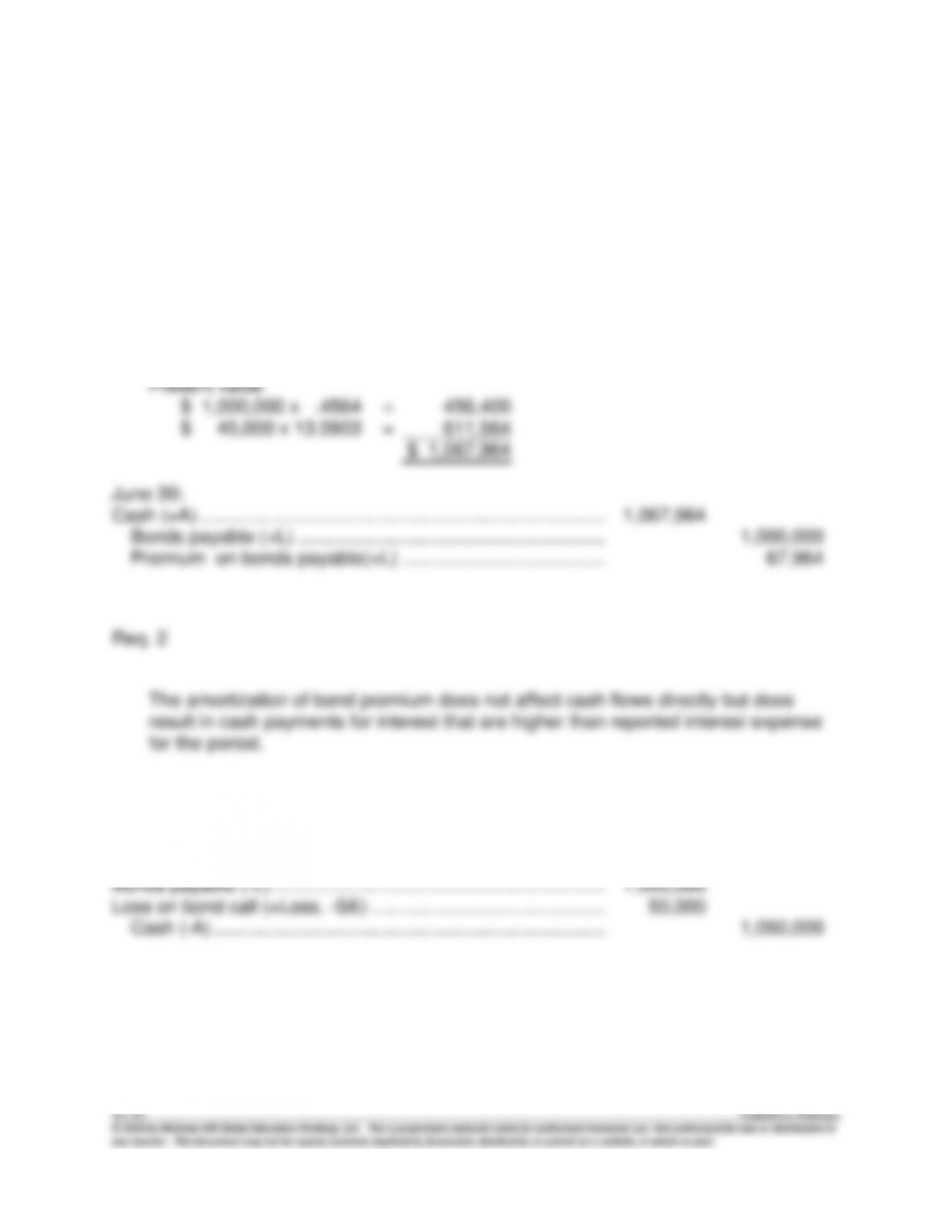
Req. 1
Computations:
Interest:
$1,000,000 x 9%
=
$90,000 ÷ 2 = $45,000
=
=
Cash (+A) ……………………………………………………………………
Bonds payable (+L) …………………………………………………..
Premium on bonds payable(+L) …………………………………
Bonds payable (-L) ……………………………………………………….
Loss on bond call (+Loss, –SE) ………………………………………
Cash (-A) …………………………………………………………………