PE–4.
Req. 1
The fair value method must be used for both the D common stock and F bonds. The
fair value method must be used for D common stock because only 14.74% of it is
owned. If less than 20% of the outstanding stock is owned, it is assumed there can be
no exercise of significant influence or control; therefore, the fair value method must be
PE–4. (continued)
2014
2015
d.
Fair value effects:
Net unrealized gains (losses) (–OCI, –SE)
39,000
Investment in AFS securities (–A)……
39,000
Investment in AFS securities (+A)………
31,000
Net unrealized gains (losses) (+OCI, +SE)
31,000
Computations:
Year
Corporation
Fair Value
−
Book Value
before
Adjustment
=
Amount for
Adjusting
Entry
2014
D
$140,000
−
$154,000
=
−$14,000
F
375,000
−
400,000
=
−25,000
515,000
−39,000
2015
D
161,000
−
140,000
=
+21,000
F
385,000
−
375,000
=
+10,000
546,000
+31,000
Req. 3
a.
Balance Sheet:
2014
2015
Long-term Investments:
Investments in AFS securities (at fair value)………………….
$515,000
$546,000
b.
Stockholders’ Equity:
Net unrealized gains (losses) (in OCI) ………………………….
(39,000
)
(8,000
)
c.
Income Statement:
Dividend revenue ………………………………………………………
7,000
9,800
Interest revenue ………………………………………………………..
28,000
28,000
Financial Accounting, 8/e Appendix E-23
PE–5.
Req. 1
Aug. 4, 2015
Investments in TS (+A)………………………………………………….
180,000
Cash (–A) ……………………………………………………….
180,000
Dec. 31, 2015
Net unrealized gains (losses) (+Loss, –SE) ……………………..
10,000
Investments in TS (–A) ………………………………………………
10,000
June 1, 2016
Cash (+A) ……………………………………………………….
7,000
Dividend revenue (+R, +SE) …………………………..
7,000
Dec. 31, 2016
Investments in TS (+A)………………………………………………….
12,000
Net unrealized gains (losses) (+Gain, +SE) ………………….
12,000
June 1, 2017
Cash (+A) ……………………………………………………….
7,000
Dividend revenue (+R, +SE) …………………………..
7,000
Dec. 31, 2017
Investments in TS (+A)………………………………………………….
6,000
Net unrealized gains (losses) (+Gain, +SE) ………………….
6,000
Computations for Year-End Adjustments to Market:
Year
Fair Value
−
Book Value before
Adjustment
=
Amount for
Adjusting
Entry
2015
$170,000
($85 x 2,000 shares)
−
$180,000
=
−$10,000
2016
182,000
($91 x 2,000 shares)
−
170,000
(from prior fair value)
=
+12,000
2017
188,000
($94 x 2,000 shares)
−
182,000
(from prior fair value)
=
+6,000
PE–5. (continued)
Req. 2
Aug. 4, 2015
Investments in AFS securities (+A) …………………………..
180,000
Cash (–A) ……………………………………………………….
180,000
Dec. 31, 2015
Net unrealized gains (losses) (–OCI, –SE) ………………………
10,000
Investments in AFS securities (–A) …………………………..
10,000
June 1, 2016
Cash (+A) ……………………………………………………….
7,000
Dividend revenue (+R, +SE) …………………………..
7,000
Dec. 31, 2016
Investments in AFS securities (+A) …………………………..
12,000
Net unrealized gains (losses) (+OCI, +SE) ………………….
12,000
June 1, 2017
Cash (+A) ……………………………………………………….
7,000
Dividend revenue (+R, +SE) …………………………..
7,000
Dec. 31, 2017
Investments in AFS securities (+A) …………………………..
6,000
Net unrealized gains (losses) (+OCI, +SE) ………………….
6,000
($85 x 2,000 shares)
($91 x 2,000 shares)
($94 x 2,000 shares)
PE–5. (continued)
Req. 3
Aug. 4, 2015
Investments in affiliates (+A) …………………………..
180,000
Cash (–A) ……………………………………………………….
180,000
Dec. 31, 2015
Investments in affiliates (+A) …………………………..
9,000
Equity in affiliate earnings (+R, +SE) ………………………….
9,000
(30% x $30,000)
June 1, 2016
Cash (+A) ……………………………………………………….
7,000
Investments in affiliates (–A) …………………………..
7,000
Dec. 31, 2016
Investments in affiliates (+A) …………………………..
9,000
Equity in affiliate earnings (+R, +SE) ………………………….
9,000
(30% x $30,000)
June 1, 2017
Cash (+A) ……………………………………………………….
7,000
Investments in affiliates (–A) …………………………..
7,000
Dec. 31, 2017
Investments in affiliates (+A) …………………………..
9,000
Equity in affiliate earnings (+R, +SE) ………………………….
9,000
(30% x $30,000)
PE–6.
Req. 1
CASE A
The fair value method must be used by Company P because it owns 12%
(3,000 ÷ 25,000) of the total outstanding common shares of Company T. The
fair value method must be used when less than 20% of the outstanding shares
are owned because the investor (Company P) cannot exercise significant
influence or control.
CASE B
The equity method must be used by Company P because it owns 35% (8,750 ÷
25,000) of the outstanding common shares of Company T. The equity method
must be used if the level of ownership is at least 20% but not more than 50%
because the investor (Company P) can exercise significant influence, but not
control, over the operating and financing policies of Company T.
Req. 2
Case A-12%
Case B-35%
a.
January 1, 2014 purchase:
Investments in AFS securities (+A) …
75,000
Cash (–A) ………………………………..
75,000
(3,000 shares x $25)
Investments in affiliates (+A) ………….
218,750
Cash (–A) ………………………………..
218,750
(8,750 shares x $25)
b.
Income reported by Company T:
None
Investments in affiliates (+A) ………….
15,750
Equity in affiliate earnings (+R, +SE)
15,750
($45,000 x 35%)
c.
Dividends declared and paid by Co. T:
Cash (+A) …………………………………..
1,980
Dividend revenue (+R, +SE) ……..
1,980
•
($16,500 x 12%)
•
Cash (+A) ……………………………………
5,775
Investments in affiliates (–A) …….
5,775
($16,500 x 35%)
d.
Net unrealized gains (losses) (–OCI, –SE)
9,000
None
Investments in AFS securities (–A)
9,000
3,000 shares x ($22 fair value – $25 cost) = −$9,000.
PE–6. (continued)
Req. 3
Case A-12%
Case B-35%
Balance Sheet:
Investments:
Investments in AFS securities (1) ……..
$66,000
Investments in affiliates (2) ……………….
$228,725
Stockholders’ Equity:
Other comprehensive income:
Net unrealized losses/gains …………
(9,000
)
None
Income Statement:
Dividend revenue ……………………………..
Equity in earnings of affiliate ………………
1,980
15,750
(1) Cost $75,000 – Year-end adjustment to fair value $9,000 = $66,000 fair value
(reported on balance sheet)
(2) Cost $218,750 + % Affiliate’s net income $15,750 – % Affiliate’s dividends
declared $5,775 = $228,725 book value (reported on balance sheet)
Req. 4
Assets (investments), stockholders’ equity (retained earnings), and revenues (from
investments) are different because (1) different methods of recognizing revenue are
required and (2) adjustments for changes in fair value are recorded only under the fair
value method.
PE–7.
Req. 1
CASE
A
The fair value method must be used by the company because it owns 12.5%
(15,000 ÷ 120,000) of the total shares of the outstanding common stock of Surge
Corporation. The fair value method must be used when less than 20% of the
outstanding stock is owned because the investor cannot exercise either significant
influence or control.
CASE
B
The equity method must be used by the company because it owns 40% (48,000 ÷
120,000) of the total shares of the outstanding common stock of Surge Corporation.
The equity method must be used when at least 20% but not more than 50% of the
outstanding stock is owned, because the investor can exercise significant influence,
but not control, over the operating and financing policies of the other company.
Req. 2
Case A-12.5%
Case B-40%
a.
Jan. 10, 2014 purchase:
Investments in AFS securities (+A) ……..
375,000
Cash (–A) ………………………………….
375,000
(15,000 shares x $25)
Investments in affiliates (+A) ………………
1,200,000
Cash (–A) ………………………………….
1,200,000
(48,000 shares x $25)
b.
Net income of Surge Co.:
None1
Investments in affiliates (+A) ………………
70,000
Equity in affiliate earnings (+R, +SE)
($175,000 x 40%)
70,000
c.
Dividends paid by Surge Corporation:
Cash (+A) ……………………………………
15,000
Dividend revenue (+R, +SE) ……….
15,000
(15,000 shares x $1)
Cash (+A) ……………………………………
48,000
Investments in affiliates (–A) ………
48,000
(48,000 shares x $1)
d.
Year-end valuation:
Net unrealized gains (losses) (–OCI, –SE)
30,000
None2
Investments in AFS securities (–A)
30,000
[15,000 x ($23 fair value – $25 cost) = −$30,000]
1 Not recorded under fair value method. 2 Not recorded under the equity method.
PE–7. (continued)
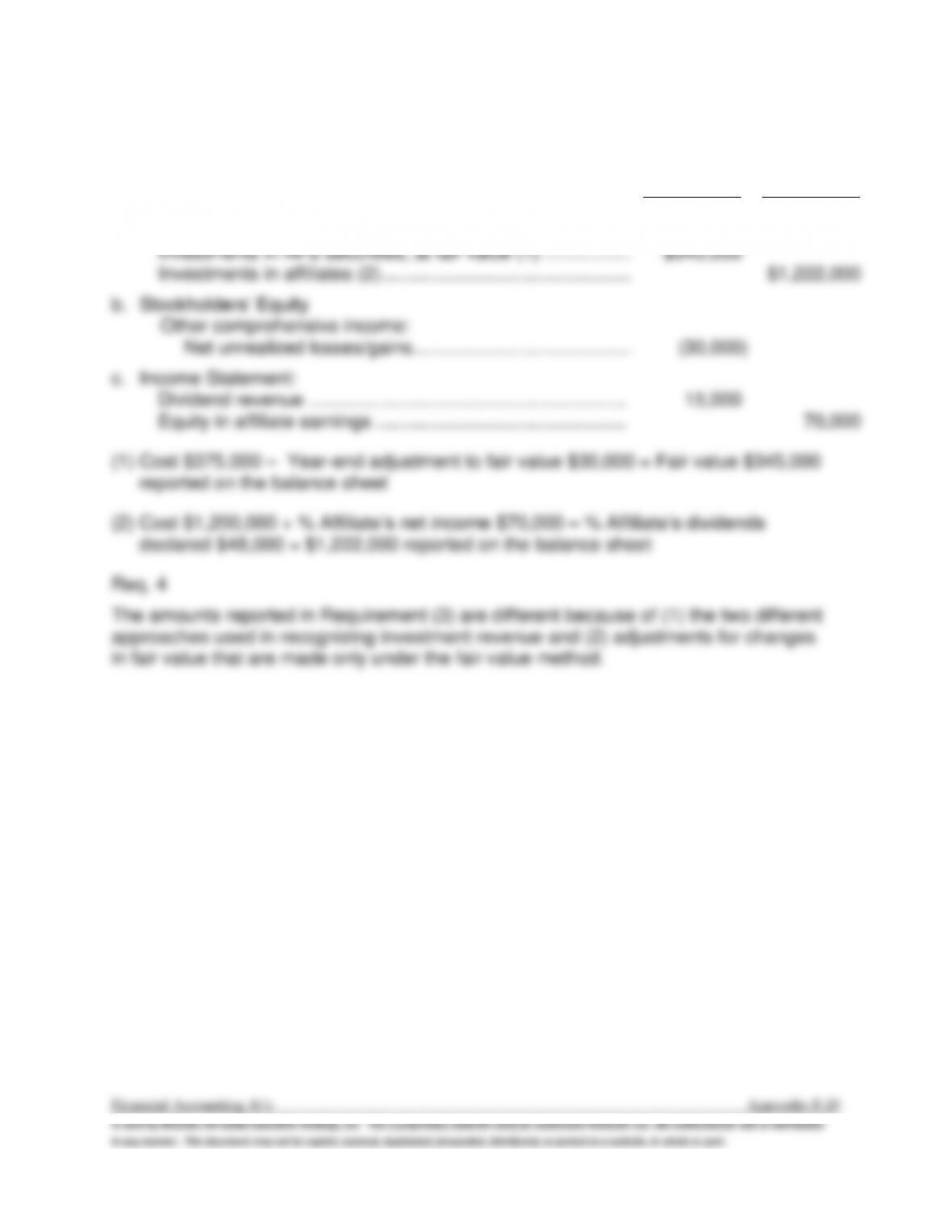
Req. 3
Case A
Case B
a.
Balance Sheet:
Long-term Investments:
Investments in AFS securities, at fair value (1) ……………..
$345,000
Investments in affiliates (2) …………………………………………
$1,222,000
b.
Stockholders’ Equity
Other comprehensive income:
Net unrealized losses/gains ……………………………………
(30,000
)
c.
Income Statement:
Dividend revenue …………………………………………………….
Equity in affiliate earnings …………………………………………
15,000
70,000
(1) Cost $375,000 – Year-end adjustment to fair value $30,000 = Fair value $345,000
reported on the balance sheet
(2) Cost $1,200,000 + % Affiliate’s net income $70,000 – % Affiliate’s dividends
declared $48,000 = $1,222,000 reported on the balance sheet
Req. 4
The amounts reported in Requirement (3) are different because of (1) the two different
approaches used in recognizing investment revenue and (2) adjustments for changes
in fair value that are made only under the fair value method.
PE–8.
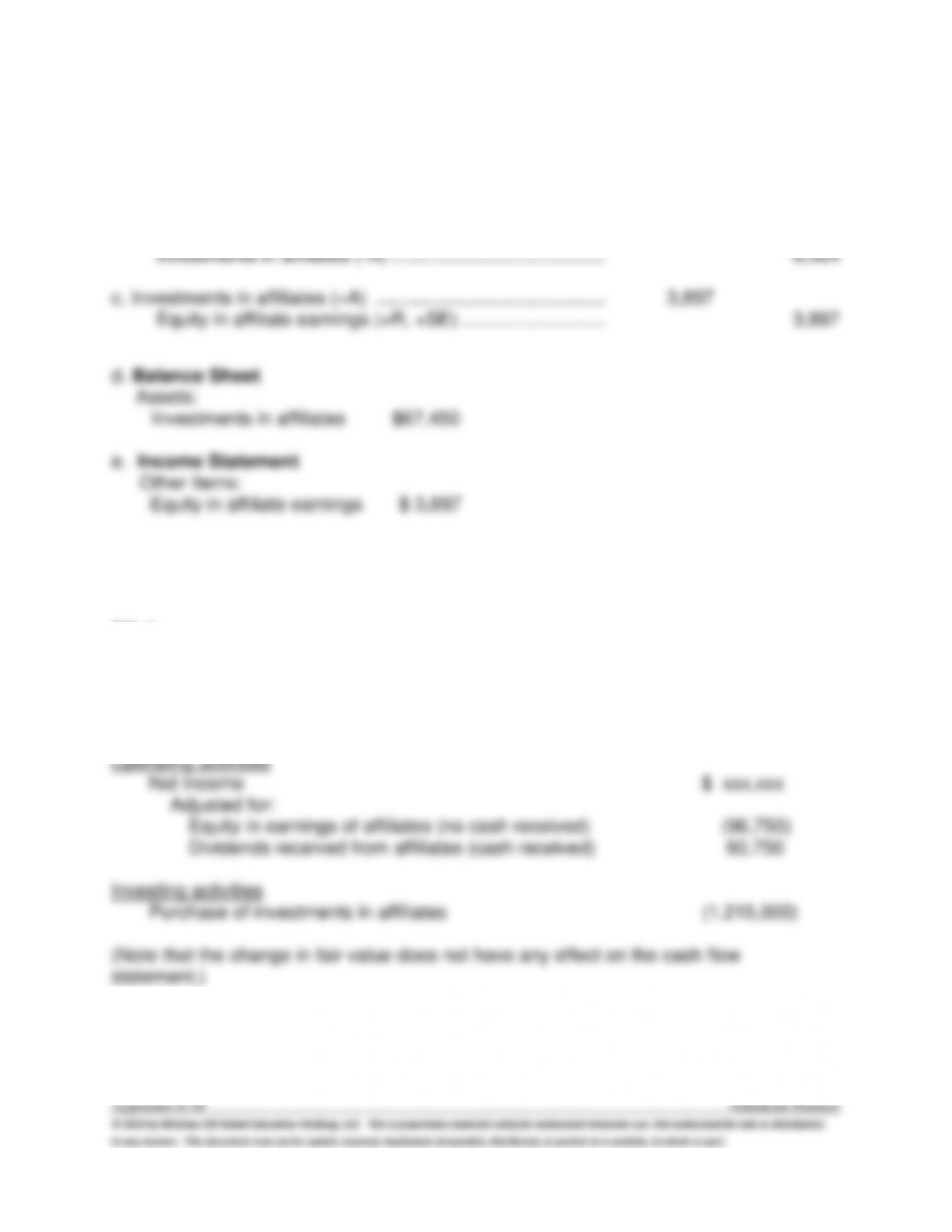
a. Investments in affiliates (+A) ……………………………………..
15,685
Cash (–A) ……………………………………………………………
15,685
b. Cash (+A) ……………………………………………………………….
8,564
Investments in affiliates (-A) …………………………………..
8,564
c. Investments in affiliates (+A) ……………………………………..
3,897
Equity in affiliate earnings (+R, +SE) ……………………….
3,897
d. Balance Sheet
Assets:
Investments in affiliates $67,450
e. Income Statement
Other Items:
Equity in affiliate earnings $ 3,897
PE–9.
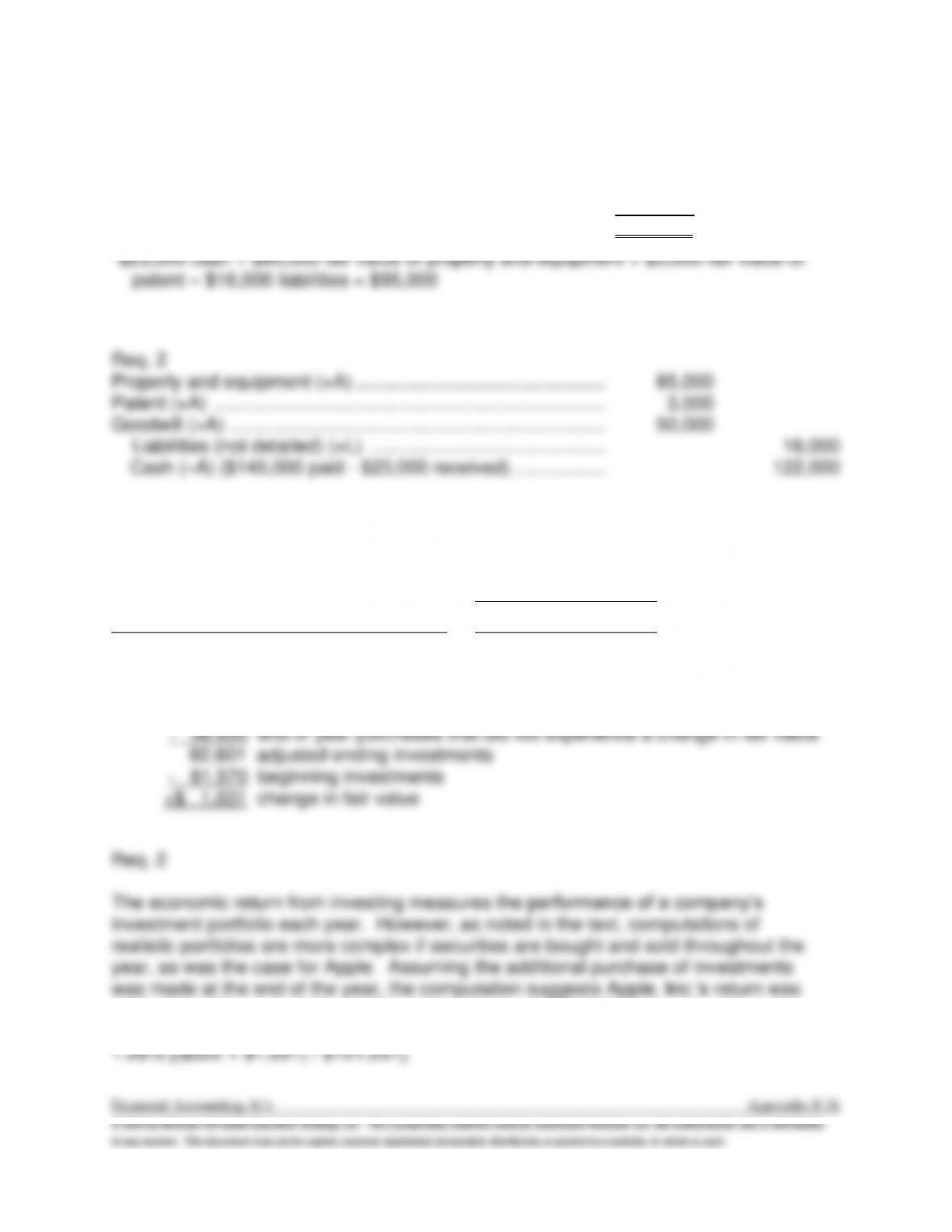
Since Bradford Company acquired 45% (40,500/90,000) of Hall’s outstanding
common stock, this investment is accounted for using the equity method.
Statement of Cash Flows:
PE–10.
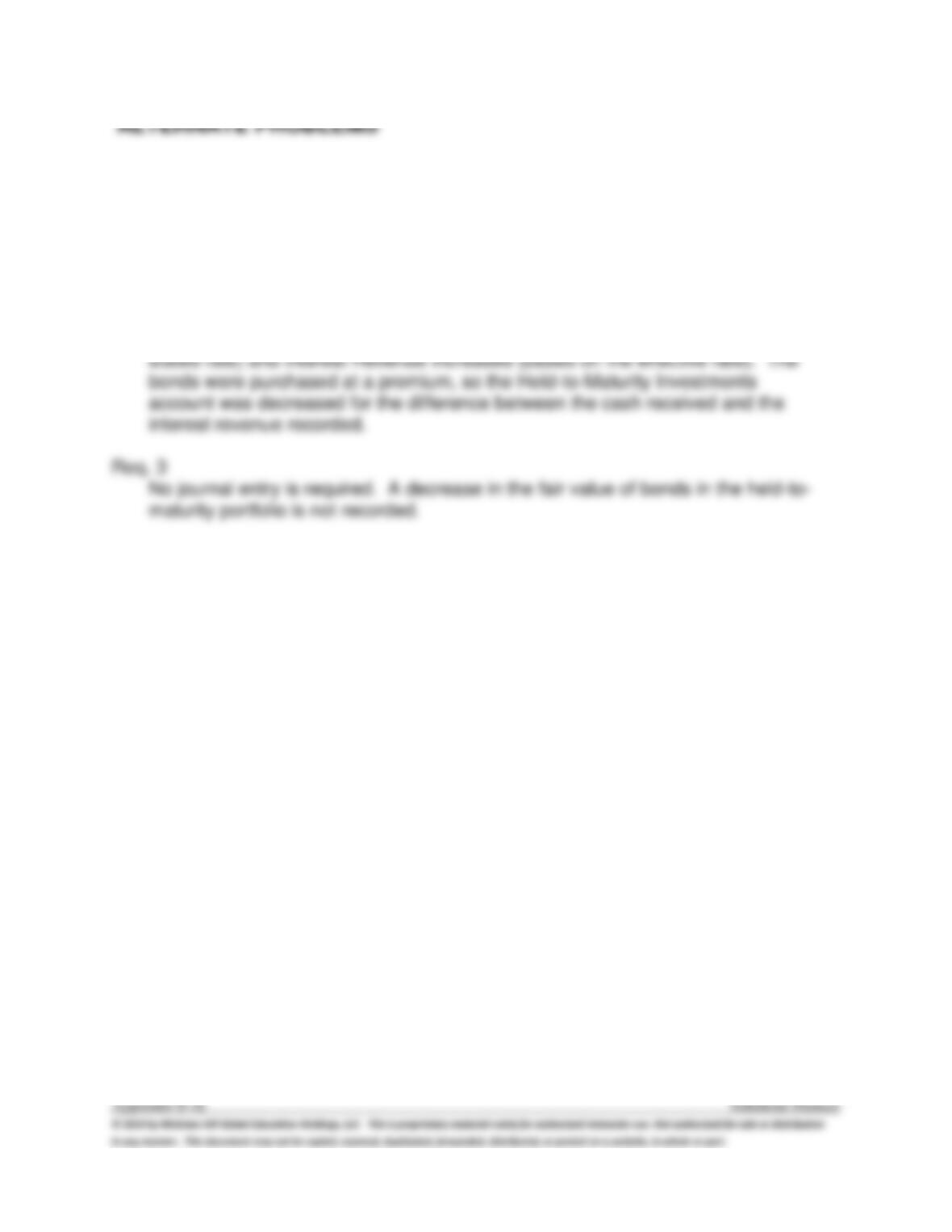
Req. 1
Purchase price for the net assets $145,000
Fair value of net assets acquired* – 95,000
Goodwill purchased $ 50,000
Appendix E-32 Solutions Manual
© 2014 by McGraw-Hill Global Education Holdings, LLC. This is proprietary material solely for authorized instructor use. Not authorized for sale or distribution
in any manner. This document may not be copied, scanned, duplicated, forwarded, distributed, or posted on a website, in whole or part.
ALTERNATE PROBLEMS
APE–1.
Req. 1
When the bonds were purchased, the company increased Held-to-Maturity
Investments and decreased Cash.
Req. 2
When interest was received on the investments, Cash increased (based on the